


The Once Great Salt Lake

“Apocalypse now. To my hometown, my city of origins. We are in great danger,” says artist Tom Judd about the falling water levels of the Great Salt Lake. His 2023 work, Standing in the Lake, uses a historic photograph of idle bathers leisurely enjoying the lake. He paints on top of the image and installs a physical drain over the water.
The level of the Great Salt Lake is at a historic low. Scientific reports suggest that without significant intervention, it could disappear entirely in as little as five years, which could lead to both ecological and economic disaster.

Tom Judd, Standing in the Lake, 2023, mixed media with faucet, 36 x 26 in., courtesy of the artist
This is not just a Utah problem, or the problem of one place. The lake itself, said wetlands ecologist Heidi Hoven, “is a bellwether for the fragile future of water in the arid West.” Or as Bonnie Baxter of the Great Salt Lake Institute says, it is a “canary in the coal mine.”
The scientific warnings came first, but, increasingly, artists are also speaking up. “I feel like the Great Salt Lake is showing us her essence. . . and it is so stark and so bare, it's haunting,” poet Terry Tempest Williams wrote in 2023. Photography by Fazal Sheikh, whose practice has long focused on the environmental damage in the Southwest, made Williams’s words visible. Images of the drying lake paired with powerful writing gave the science a voice.
Artists in Utah are sounding the alarm. From museum exhibitions to community installations, they’re using their work to focus attention on the crisis of the Great Salt Lake—and on potential solutions.

Alfred Lambourne, Autumn Sunset, West Shore, Gunnison Island, 1924, gouache/tempera, Gift from Marie Fowler Bozievick, Bethesda, Maryland, Springfield Museum of Art

A sailboat on the Great Salt Lake.
The Inland Sea
The Great Salt Lake was not always viewed through the lens of fragility and decline. In the 19th century, artist Alfred Lambourne described it not as a shrinking remnant, but as an “Inland Sea.” Lambourne lived alone on an island in the lake and focused his practice nearly entirely on the subject, painting large-scale panoramic views. Capturing a sense of wonder, he wrote:
There is another phenomenon to be seen at infrequent periods on the Inland Sea, one that is unpaintable, and also, I believe, entirely local. It is to be witnessed during the calm summer twilights, when the pale, fairy-like tints on the water are breathed upon by opposite currents of languid wind.
Alfred Lambourne
Hoping to draw tourists to Lambourne’s idyllic sea, architect Richard Kletting designed Saltair in 1893. In its heyday, the waterfront resort featured a roller coaster, posturing itself as the “Coney Island of the West.” It ultimately faded into decline, for a variety of reasons, including the lake’s fluctuating water levels.

A photograph by Charles R. Savage of bathers swimming at Saltair in the Great Salt Lake, ca. 1893-1900, silver gelatin print, L. Tom Perry Special Collections, Harold B. Lee Library, Brigham Young University


Artists Respond

Installation view, As the Lake Fades, Utah Museum of Contemporary Art (UMOCA), January 26–June 1, 2024. Photo: Zachary Norman, © UMOCA.
As awareness of the ecological crisis has grown, Utah artists and arts organizations are using their work as a rallying point. In 2024 we presented the exhibition As the Lake Fades at the Utah Museum of Contemporary Art. It started with a series of questions that sought solutions to what is ultimately a man-made problem: water diverted upstream.
- In what ways can residents change their behaviors to save the lake from disappearing? Is it possible to expand conservation practices to large-scale farms that consume up to 75% of the water in the State?
- What does Utah look like without the lake?
- What effect will it have on the population, and how will people survive the circumstances of its disappearance?
Organized by curator Jared Steffensen, the exhibition emphasized the importance of research, data, and community engagement. Through public programming, lectures, and panels, we brought scientists, hydrologists, and artists together in conversation. The show illustrated how residents must work together to understand and mitigate human-caused environmental disasters, focusing on sustainable, equitable, and creative solutions.
Alisha Anderson’s 2016 work, Lacustrine, takes its title from the term for a dried lake plain. This is an eerie geological marker of absence, of a place where water once existed but has since receded. Anderson is anticipating the potential fate of the Great Salt Lake; her work is both a warning and a meditation on loss. She describes her practice as one that “flows from the confluence of identity and earth and attempts to question (and reposition) how humans fit in this world.” Lacustrine suggests that, to understand ecological collapse, we must also grapple with human identity, memory, and responsibility. Anderson’s work pushes us to confront how intimately environmental futures and human survival are intertwined.
Mary Toscano’s 2022 drawings—In Form, In Phase, In Condition, and In Suspense—turn the lake’s shrinking shoreline into an archeological excavation of the present. Through meticulously rendered, hand-drawn images, Toscano documents the objects that emerge as the lake recedes. Her drawings evoke sites of ancient discovery. But in fact they are prophecies, revealing a future in which the Great Salt Lake has become a ruin. The remnants of human presence—fragments left, dropped, or discarded—are transformed into relics of loss. Treating them as sacred artifacts, Toscano asks us to consider what will remain of our time once the water is gone.

Mary Toscano, In Form (2022, pencil on paper, courtesy of the artist); In Phase (2022, pencil on paper, courtesy of the artist); In Condition (2022, pencil on paper, courtesy of State of Utah Alice Merrill Horne Art Collection, Utah Division of Arts & Museums); In Suspense (2022, pencil on paper, courtesy of Michelle Macfarlane). Installation view, As the Lake Fades, Utah Museum of Contemporary Art (UMOCA), January 26–June 1, 2024. Photo: Zachary Norman, © UMOCA.

Mary Toscano, In Form, 2022, pencil on paper, courtesy of the artist
A Wake Up Call
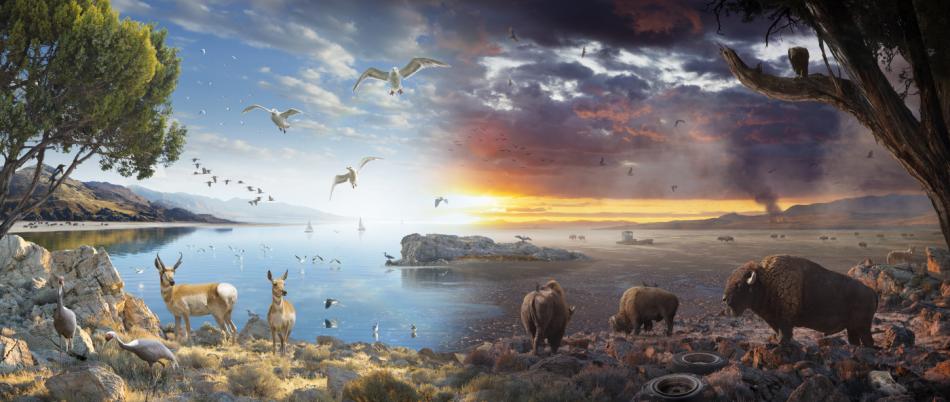
Wake the Great Salt Lake, a temporary public art project in 2024 and 2025, aimed to educate and inspire residents and visitors about preventing the decline of the lake. The meaning of the title is layered: it references the wave boats cause on a body of water, a funeral gathering, and a wake-up call to action.
Organized by the Salt Lake Arts Council in connection with the Salt Lake Mayor’s Office and Bloomberg Philanthropies, the project included 12 interventions throughout the city with multiple artists and community partners.




The Possibility of Survival
Art can not only bring awareness to the crisis of the Great Salt Lake but also help cultivate conversation and change. The artists and communities responding to the crisis of the Great Salt Lake are one part of a larger solution. As Larisa Bowen of The Nature Conservancy notes, it won’t “be easy or fast. It took a long time for the Lake to decline, and it will take a long time to recover, but the Lake’s importance demands our patience and enduring devotion.”

To stand at the lake’s edge today is to feel both the grief of loss and the urgency of saving the beauty that remains. Terry Tempest Williams captures this duality: “It’s still so beautiful. . . It’s brilliant. There’s a clarity of light that is breathtaking. It’s never not been beautiful.” Even in decline, the Great Salt Lake resists being defined only by crisis; it remains a site of wonder.
To savor what remains, then, is also to believe in what could return. The role of art is not only to mourn what is disappearing but also to imagine futures in which the Inland Sea—the Once Great Salt Lake—endures. It is fragile yet luminous, diminished but not gone. In this imagining lies the possibility of survival, and perhaps even repair.

West to East
Discover how artists across America have been inspired by their communities and the places they call home.
Across the Nation
This article was written as part of our Across the Nation partnership with the Utah Museum of Contemporary Art. Learn more about the national program to send art across America.
You may also like

Article: The Japanese-American Artist Who Shaped Flowing Water
The multidisciplinary artist George Tsutakawa found inspiration in the Pacific Northwest’s natural environment and dedicated his life to art. His family follows in his footsteps.

Article: There Will Be Light
Not constrained by any one medium, style, or artistic tradition, Barbara Earl Thomas is eager to step into the unknown as she continues telling her story.