Article

Your Tour of Women Artists at the National Gallery

6 min read
Shown from the shins up, two elegantly dressed women and two young boys, all with light skin, sit together on a bench in front of a stone balustrade with a forest landscape beyond in this horizontal portrait painting. The people are brightly lit from our left but the darkened sky suggests dusk. The boys lean onto the woman at the center of the composition, and the second woman sits to her right, our left. All of the people have pale skin, rosy cheeks, delicate noses, and their pink lips all turn up in slight smiles. The woman on our left sits with her body angled toward her friend but she turns her face to look at us with brown eyes under curving brows. Her wavy, flint-gray hair is loosely bound up so it frames the sides of her face and curls over her shoulders. Her swirling, white head covering is edged in gold and tied in a bow over her left ear, on our right. Her long-sleeved dress has a tight-fitting bodice and a low, scooped neckline lined with pleated white fabric. Her dress shimmers from sapphire blue to dusky pink, suggesting it is iridescent taffeta. Large pearls hang off the end of round, gold, hoop earrings, and a glimmering gold sash is tied around her waist. She sits with her left hand resting on her friend’s right shoulder, closer to her, and she gestures toward one of the young boys leaning on the friend’s lap with her other hand. The second woman sits with her body facing us, and she looks off to our left with gray-blue eyes. Her silvery gray, upswept hair is covered with a long piece of white fabric with pink stripes, twisted loosely into a turban-like head covering. She wears dangling gold earrings, and her dress is striped with parchment white and rust red. Her right hand, on our left, rests on her friend’s knee, and her other arm is wrapped around the older boy. He kneels on the bench and leans forward, wrapping the arm we can see around her torso. His face near hers, he looks up at her from under his lashes. A dimple marks the flushed cheek we can see. His chestnut-brown hair falls around his shoulders, and he wears a gingerbread-brown suit. The smaller and younger of the two boys rests his head on his crossed hands on her thigh, and looks out at us. He wears a white garment with a lilac-purple sash tied in a bow around his waist. There is a pale pink rosebush in the lower right corner of the painting, near the kneeling boy’s foot. The landscape beyond the balustrade is filled with dark green trees against a slate-blue sky. The painting is created with blended brushstrokes, giving it a soft look.
Élisabeth Louise Vigée Le Brun, The Marquise de Pezay, and the Marquise de Rougé with Her Sons Alexis and Adrien, 1787, oil on canvas, Purchased as the Gift of the Bay Foundation in memory of Josephine Bay Paul and Ambassador Charles Ulrick Bay, 1964.11.1

On this page:

  1. West Building
  2. East Building
  3. Sculpture Garden

Use our guide to explore works by women artists on view in our galleries.

They are all pioneers who paved new paths in art. We’ve also included related works you can find nearby, in case you have more time. 

Take this guide with you through the galleries. You will need a map. Pick one up at any information desk.

Estimated time for the tour: 1 hour

West Building

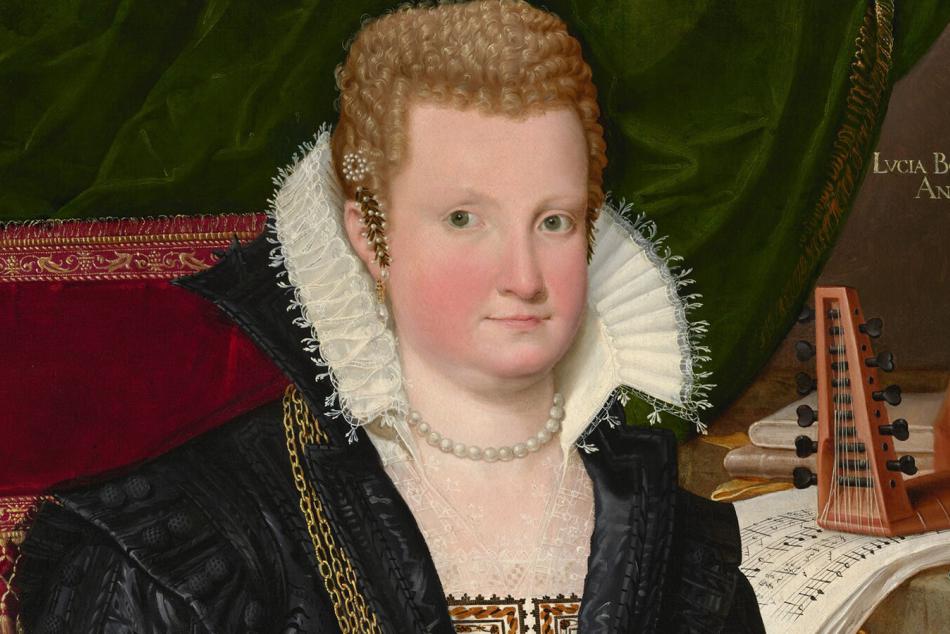
1. Lavinia Fontana, Lucia Bonasoni Garzoni
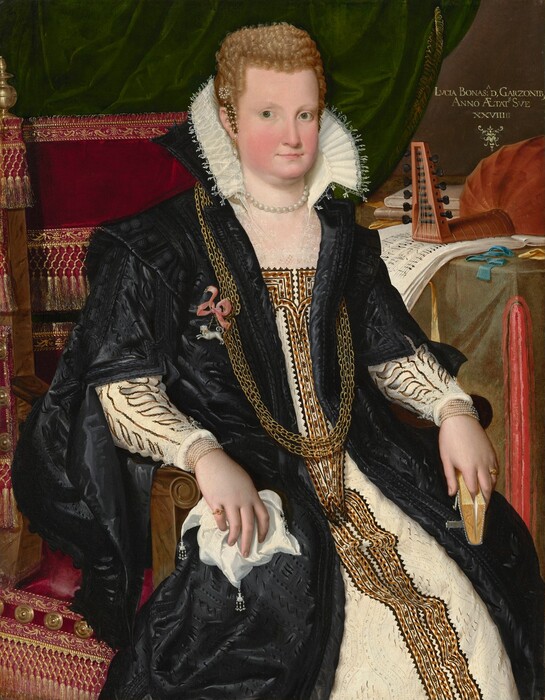
This painting is a portrait of a seated woman, her body turned slightly to the right and her head looking towards us. She has a fair complexion, with round, rosy cheeks, pale eyebrows, large green eyes, and thin pink lips in a neutral expression. Her light blonde hair is styled in short curls close to her head and adorned with pearls and a clip or barrette in the shape of small leaves. She is dressed in a cream-colored dress with intricate embroidery in shades of brown, gold, and black. On top of the dress is a long black garment that flows over her shoulders and upper arms and has a high collar, decorative buttons, and more embroidery.  Her gown is paired with a ruffled white collar and lace at her neckline and wrists. Long gold chains drape across her chest, and she wears a pearl necklace around her neck and two small golden rings on her fingers. In her left hand, our right, she holds a small book, while a lace handkerchief is in her right hand, our left. She wears pearl earrings, strands of pearl bracelets, and a decorative brooch in the shape of a white dog with a pink bow. The seat she sits on is wooden with dark red cushions decorated with golden tassels and embroidery, behind her on the left is a draped green cloth, and on the right, a table is covered with music sheets, a stringed instrument, books, and small blue and yellow ribbons. The wall behind the table is brown, and there is some gold lettering in the top right corner.
Lavinia Fontana, Lucia Bonasoni Garzoni, c. 1590, oil on canvas, Gift of Funds from Anonymous in memory of Montana Walker Strauss, and Patrons' Permanent Fund, 2022.38.1

This work celebrates the talents and connected stories of two creative women: its painter Lavinia Fontana and her subject, lute player and singer Lucia Bonasoni Garzoni. Fontana and Garzoni were successful artists in Bologna, Italy, during the second half of the 1500s. They were popular in spite of the constraints of a male-dominated society.

Fontana was one of the most productive women artists of the period. She became famous for portraits of noblewomen like this one. But she also painted church altarpieces, portraits of scholars, and mythological nudes—a subject that was unheard of for women artists at the time. Thanks to her success, she was able to support her family, including 11 children, with profits from her painting.

Main Floor, Gallery 33

More artists nearby: Clara Peeters, Judith Leyster, Gesina ter Borch
 

2. Luisa Roldán, Virgin and Child
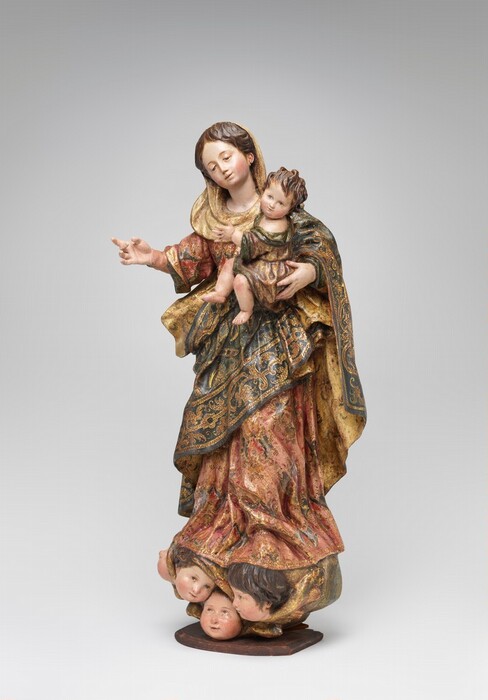
Luisa Roldán, Virgin and Child, c. 1680/1686, painted wood, Pepita Milmore Memorial Fund, Patrons' Permanent Fund and William and Buffy Cafritz Family Sculpture Fund, 2022.39.1

Roldán's father was one of the most accomplished sculptors in Seville. She established her own workshop and style and went on to be the official court sculptor to not one but two Spanish kings in the 17th century.

Roldán created elaborately painted wood and clay sculptures of individual figures and interacting groups. Her expressive compositions are remarkably carved and modeled. A professional painter (probably her brother-in-law) applied the elaborate decoration. Take a close look at the overlapping layers and prints of fabric.

Main Floor, Gallery 34
 

3. Élisabeth Louise Vigée Le Brun, The Marquise de Pezay, and the Marquise de Rougé with Her Sons Alexis and Adrien
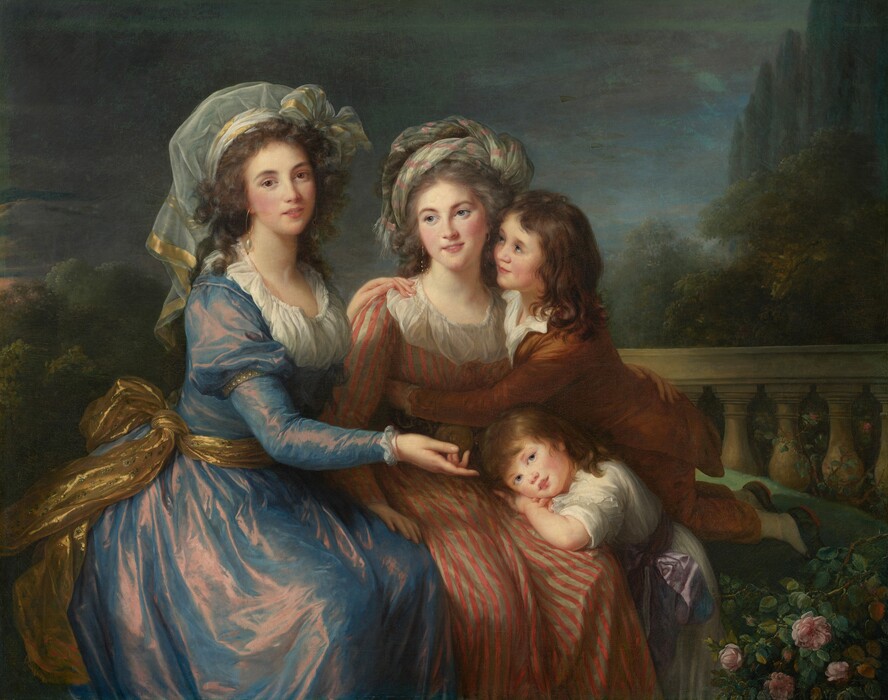
Shown from the shins up, two elegantly dressed women and two young boys, all with light skin, sit together on a bench in front of a stone balustrade with a forest landscape beyond in this horizontal portrait painting. The people are brightly lit from our left but the darkened sky suggests dusk. The boys lean onto the woman at the center of the composition, and the second woman sits to her right, our left. All of the people have pale skin, rosy cheeks, delicate noses, and their pink lips all turn up in slight smiles. The woman on our left sits with her body angled toward her friend but she turns her face to look at us with brown eyes under curving brows. Her wavy, flint-gray hair is loosely bound up so it frames the sides of her face and curls over her shoulders. Her swirling, white head covering is edged in gold and tied in a bow over her left ear, on our right. Her long-sleeved dress has a tight-fitting bodice and a low, scooped neckline lined with pleated white fabric. Her dress shimmers from sapphire blue to dusky pink, suggesting it is iridescent taffeta. Large pearls hang off the end of round, gold, hoop earrings, and a glimmering gold sash is tied around her waist. She sits with her left hand resting on her friend’s right shoulder, closer to her, and she gestures toward one of the young boys leaning on the friend’s lap with her other hand. The second woman sits with her body facing us, and she looks off to our left with gray-blue eyes. Her silvery gray, upswept hair is covered with a long piece of white fabric with pink stripes, twisted loosely into a turban-like head covering. She wears dangling gold earrings, and her dress is striped with parchment white and rust red. Her right hand, on our left, rests on her friend’s knee, and her other arm is wrapped around the older boy. He kneels on the bench and leans forward, wrapping the arm we can see around her torso. His face near hers, he looks up at her from under his lashes. A dimple marks the flushed cheek we can see. His chestnut-brown hair falls around his shoulders, and he wears a gingerbread-brown suit. The smaller and younger of the two boys rests his head on his crossed hands on her thigh, and looks out at us. He wears a white garment with a lilac-purple sash tied in a bow around his waist. There is a pale pink rosebush in the lower right corner of the painting, near the kneeling boy’s foot. The landscape beyond the balustrade is filled with dark green trees against a slate-blue sky. The painting is created with blended brushstrokes, giving it a soft look.
Élisabeth Louise Vigée Le Brun, The Marquise de Pezay, and the Marquise de Rougé with Her Sons Alexis and Adrien, 1787, oil on canvas, Purchased as the Gift of the Bay Foundation in memory of Josephine Bay Paul and Ambassador Charles Ulrick Bay, 1964.11.1

Vigée Le Brun was a prodigy and established a painting career in her teens. She became a successful portraitist during the reign of French kings Louis XV and Louis XVI. Queen Marie Antoinette took note of her talents and became one of her primary patrons. Vigée Le Brun painted some 30 portraits of Marie Antoinette. The queen helped Vigée Le Brun enter France’s prestigious royal art academy, then a rare feat for a woman.

More than two–thirds of Vigée Le Brun's surviving paintings are portraits. Most, like this one, are of women and children who are idealized —flattered—into a kind of family resemblance. These unrelated young women, for example, could easily be mistaken for sisters. Their garments, airy silks and iridescent taffetas, are almost more individual than their faces, although both women were friends of the artist. The picture was hailed as a tribute to friendship and maternal love when it was shown at the Salon of 1787.

Main Floor, Gallery 56
 

4. Lilly Martin Spencer, Raspberries
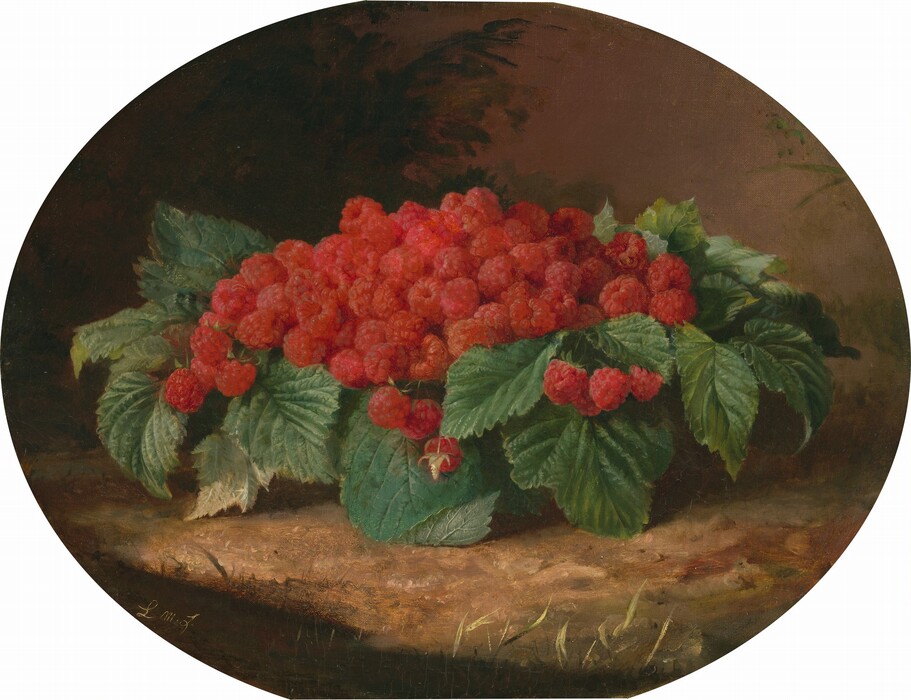
In this oval painting, a cluster of ripe red raspberries is surrounded by green leaves.  The raspberries are in the center of the painting, surrounded by the leaves that extend towards the edges. Some berries hang from thin green stems over the leaves, towards the light brown ground. The background includes some shadowed green plants and a brown sky.
Lilly Martin Spencer, Raspberries, c. 1859, oil on canvas, Gift of William and Abigail Gerdts, 2005.161.1

This still life showcases Spencer’s technical skills: each raspberry’s form is carefully painted. Recent research suggests that a member of abolitionist Reverence Henry Ward Beecher’s clergy may have requested this painting after seeing a similar one in Beecher’s personal collection.

Spencer had started with portraits and literary subjects. But she became one of the most famous American painters of family life in the mid-19th century. She drew on her experience as a wife and mother of seven to create domestic paintings. These lively and highly detailed scenes of ordinary people and everyday life appealed to Victorian sensibilities. Spencer was her family’s primary breadwinner, a savvy businesswoman who reproduced her paintings as lithographs.

Main Floor, Gallery 69A

More artists nearby: Gretchen W. Rogers and Cecilia Beaux
 

East Building

1. Ursula von Rydingsvard, Five Cones
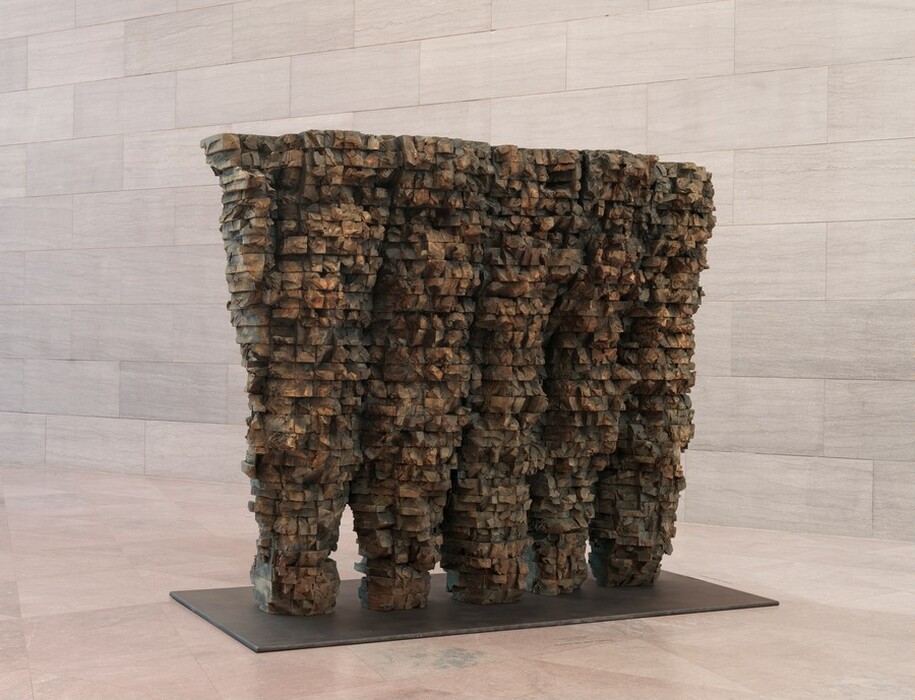
This is a sculpture with five vertical segments that are wider at the top and slightly thinner at the bottom, stacked together in a staggered arrangement. The brown material used gives the appearance of aged, weathered wood. The material appears to have been divided into many small, irregular blocks that were then all stacked together to make the four segments, giving it an organic and rugged appearance. It stands on a flat gray rectangular base against a light-colored tiled wall.
Ursula von Rydingsvard, Five Cones, 1990-1992, cedar and graphite, Gift of Sherry and Joel Mallin, 2011.154.1

Ursula von Rydingsvard transforms stacks of 4 × 4 cedar beams into monumental abstract sculptures. When she turned to wood in the 1970s, the prominent sculptors of the time (mostly men) were working with metal. Von Rydingsvard was frustrated with the limitations of steel, but inspired by the possibilities of carving wood into forms “that felt like the earth, or felt fleshy.”

Since then, Von Rydingsvard has been using cedar to create organic forms like Five Cones. The sculptures often defy gravity to breathe new life into the material. They can feel fluid or alive.

Mezzanine, Landing
 

2. Betye Saar, Twilight Awakening
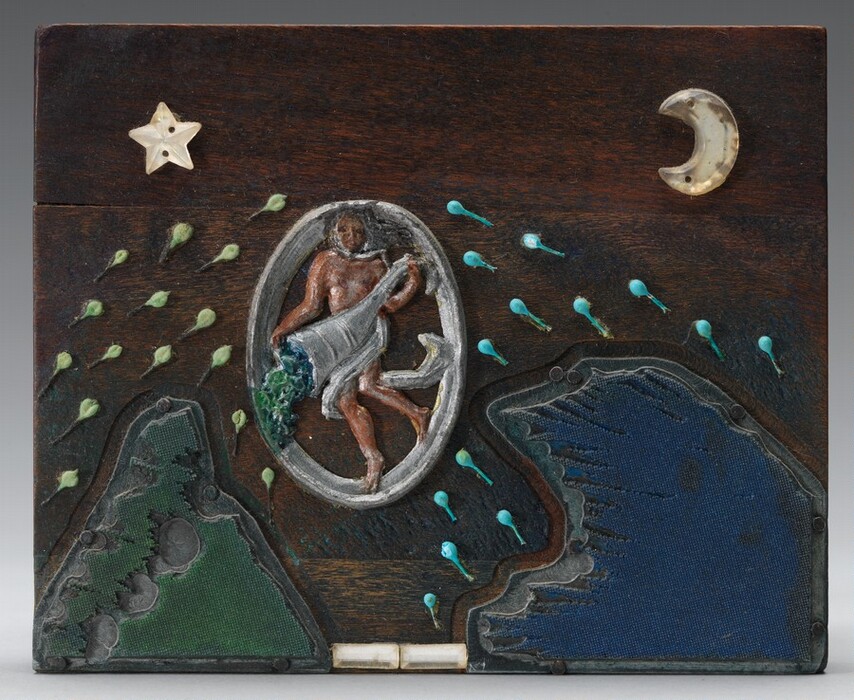
A scene with a person holding a cornucopia is set against a night sky on this wood block. The person has peachy-brown skin and long silvery hair. A piece of drapery, also silver, flows around the hips as the person holds a cornucopia angled down and to the left. Blue and green material pours or hangs out of the horn. The person is contained within a silver oval frame. Fifteen green teardrop- or sperm-shaped orbs approach the oval to the left and fourteen approach from the right. Everything described so far is shown in low relief on the wood block. A translucent star is pinned or nailed to the panel near the top left corner and a translucent, crescent moon to the top right. To either side of the person are textured triangular shapes. The form to the left is green and points up, like a mountain, and the form to the right is blue and points in, like a cresting wave. Both have ragged edges and appear to be carved and affixed with nails, the heads of which are visible. Two translucent rectangles, possibly the same material as the star and moon, lie side-by-side between the green and blue forms on the bottom edge of the block.
Betye Saar, Twilight Awakening, 1978, mixed media on printer's wood block, Gift of Francine Farr in honor of Dr. Samella Sanders Lewis, with gratitude to Scripps College, Claremont, California, 2015.27.1

Betye Saar believes that art can be made from anything. The Los-Angeles–based artist is a pioneer of assemblage, which combines sculpture and collage and uses found materials. For more than 55 years, Saar has explored race, gender, ancestry, and spirituality through her art.

Saar made Twilight Awakening from scavenged and sculpted pieces of plastic, ceramic, and glass on the wooden base of a recycled printer’s block. The central figure is Aquarius, the water bearer. She hovers between sea and land, the moon and star. Saar shows Aquarius pouring water from an urn, as she appears in ancient and medieval images.

Upper Level, Gallery 415B

More artists nearby: Kay Sage, Lee Bontecou, Georgia O’Keeffe
 

Sculpture Garden

1. Louise Bourgeois, Spider  

The sculpture has thin, elongated legs sprawled out in various directions. At the center of all the legs is a cylindrical shape elevated off the ground which appears to be a body. There are grooves and indentations along the legs and body. It has a dark, metallic appearance that contrasts with its surroundings. The setting is outdoors, in a garden or park area, with grass and hedges surrounding the sculpture. In the background, there are trees with foliage in shades of orange and yellow. There are also several outdoor chairs visible under the trees.
Louise Bourgeois, Spider, 1996, cast 1997, bronze with silver nitrate patina, Gift of The Morris and Gwendolyn Cafritz Foundation, 1997.136.1

We see the spider in much of the art French American artist Bourgeois made during the last decade of her life. Spiders reminded Bourgeois of her mother, who died when she was a young woman. As a spider weaves a web, so her mother was a weaver and a restorer of tapestries. While spiders frighten or disgust many people, Bourgeois saw them as clever and protective.

Bourgeois is a significant figure in modern and contemporary art. Through a variety of mediums, from drawing to sculpture, she made works based personal memories and experiences. She often used art to process her emotions.

Sculpture Garden, northwest corner
 

2. Magdalena Abakanowicz, Puellae (Girls)
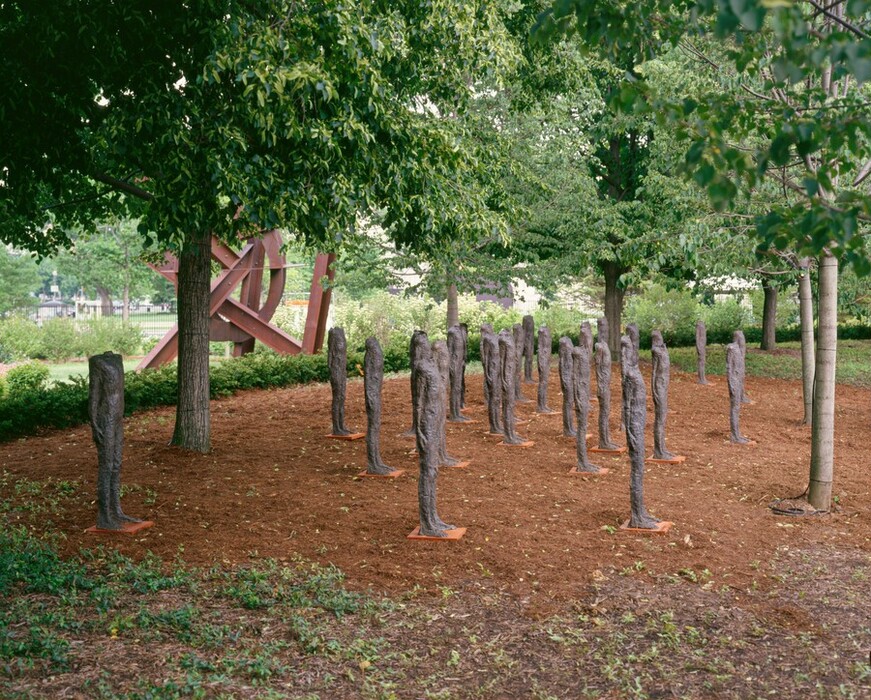
Twenty-one, free-standing, bronze sculptures of headless people are arranged under the green canopies of trees in this horizontal photograph. The earth-brown surfaces of the sculptures are rough. In this view, they cluster together at various distances from each other, and the bodies of all are angled to our right. They stand erect with their legs together and arms pressed tightly along their sides. From this angle, one person is positioned farther from the rest, to our left. Each person stands on a square base that sits on the ground, which appears to be fine mulch or pine needles. Six trees are spaced around the group, and together their canopies fill the top third of this photograph. Beyond the trees is a low, green hedge that encloses the whole group. Sunlight illuminates the front, right-hand surfaces of the sculptures.
Magdalena Abakanowicz, Puellae (Girls), 1992, bronze, Gift of The Morris and Gwendolyn Cafritz Foundation, 1998.148.1

Polish artist Abakanowicz was a pioneer of fiber and installation art in the 1960s and ’70s. After gaining attention for her hanging textile “Abakans” (named for herself), she turned to making figural works. Abakanowicz created several works of headless figures in groups, like this sculpture.

She made these 30 headless bronze sculptures from individually sculpted wax forms based on a body cast of a single child model. Abakanowicz applied burlap to each form before casting it in bronze. Puellae refers to a tragic story about a group of children who froze to death while being transported in cattle cars from Poland to Germany during World War II. What she heard and saw as a child living in Poland under Nazi occupation, and later under a communist regime, deeply impacted the artist.

Sculpture Garden, northeast corner
 

You may also like
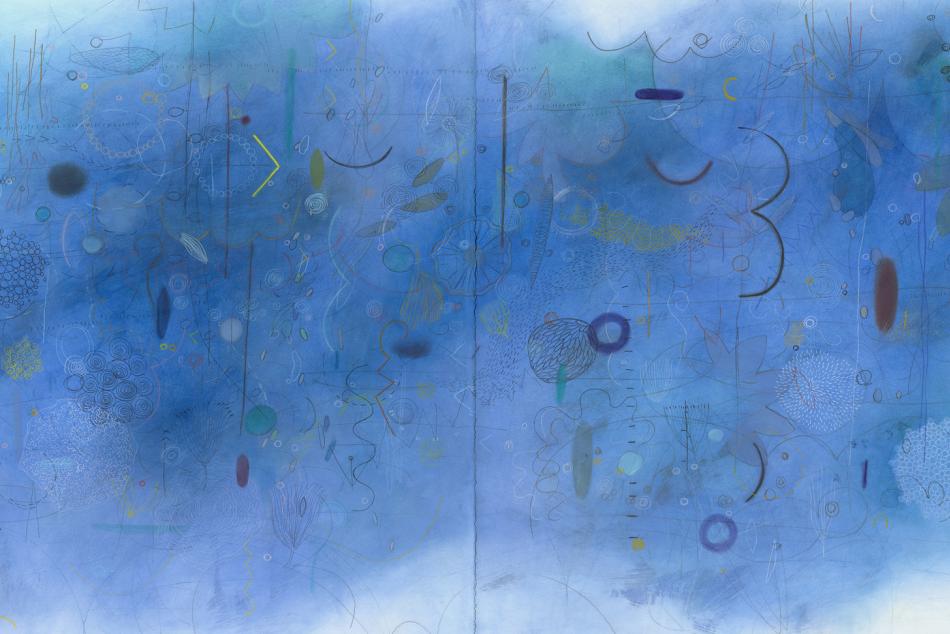
Article:  10 Contemporary Women Artists to Know

See their paintings, sculptures, installations, and more—all new additions to our collection.
Article:  Lavinia Fontana and Lucia Bonasoni Garzoni: Talented 16th-Century Women

Author and art historian Katy Hessel tells the story of these Great Women Artists.