French Paintings

Filter Results

110 artworks on view.

Results

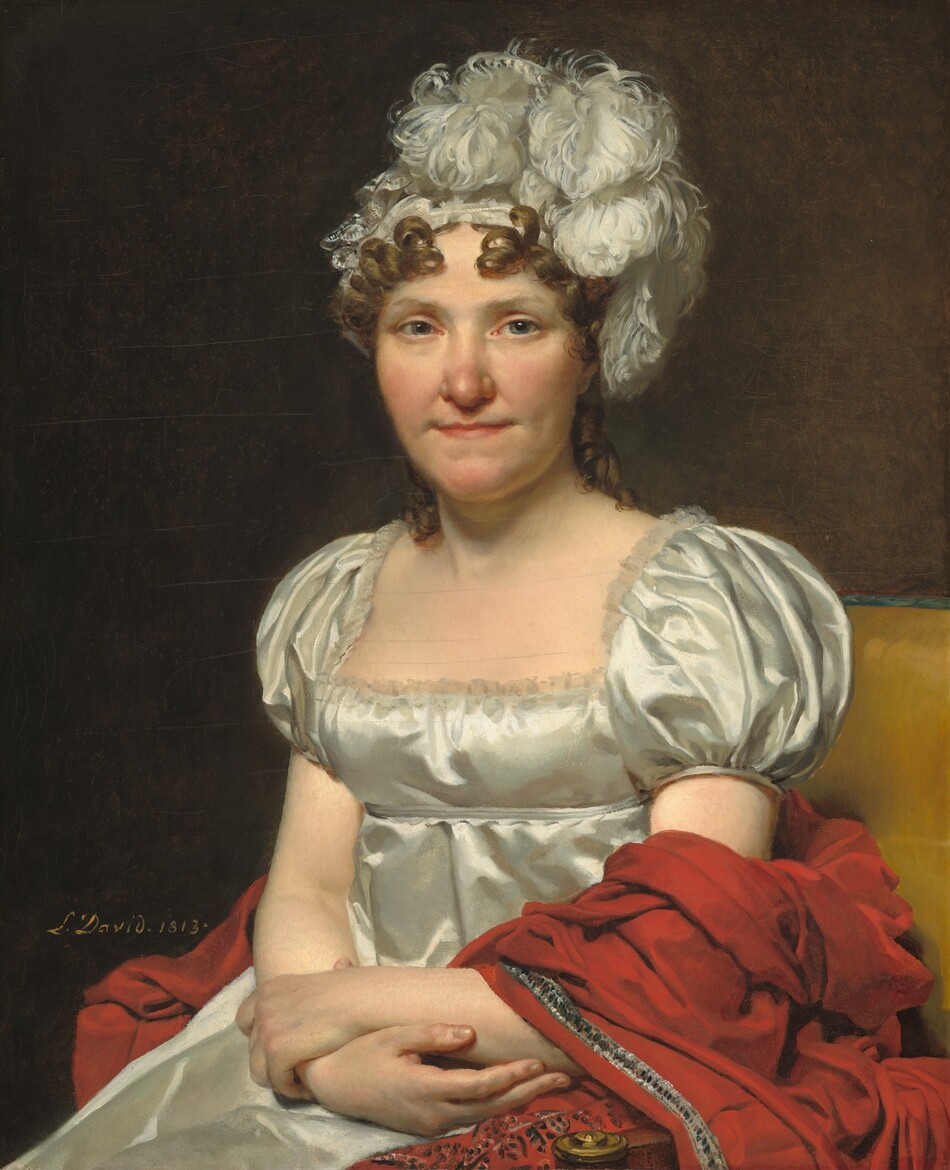
Shown from the lap up, a woman with peachy skin, wearing a white silk dress and feathered headpiece, sits facing and looking at us in a harvest-yellow, upholstered chair in this vertical portrait painting. She has blue-gray eyes and a rounded, slightly pink nose. Her thin lips are closed and pulled back with shallow dimples at the corners of her mouth. Chestnut-brown ringlets frame her face and fall to her shoulders under a white hat or headband covered with curling, billowing white feathers. Light reflecting off the cloth of her high-waisted dress suggests it is silk or satin. It has a lace-lined square neckline and puffed short sleeves. She crosses her arms at the wrist and her hands rest in her lap, holding opposite forearms. A red shawl with silver and blue trim wraps over her left arm, on our right, and bunches up behind her against the yellow chair. The artist signed and dated the work in yellow paint against the dark background behind the woman: “L. David 1813.”

Madame David

Jacques-Louis David

1813

Oil on canvas  Accession ID  1961.9.14

On View: West Building Main Floor, Gallery M56
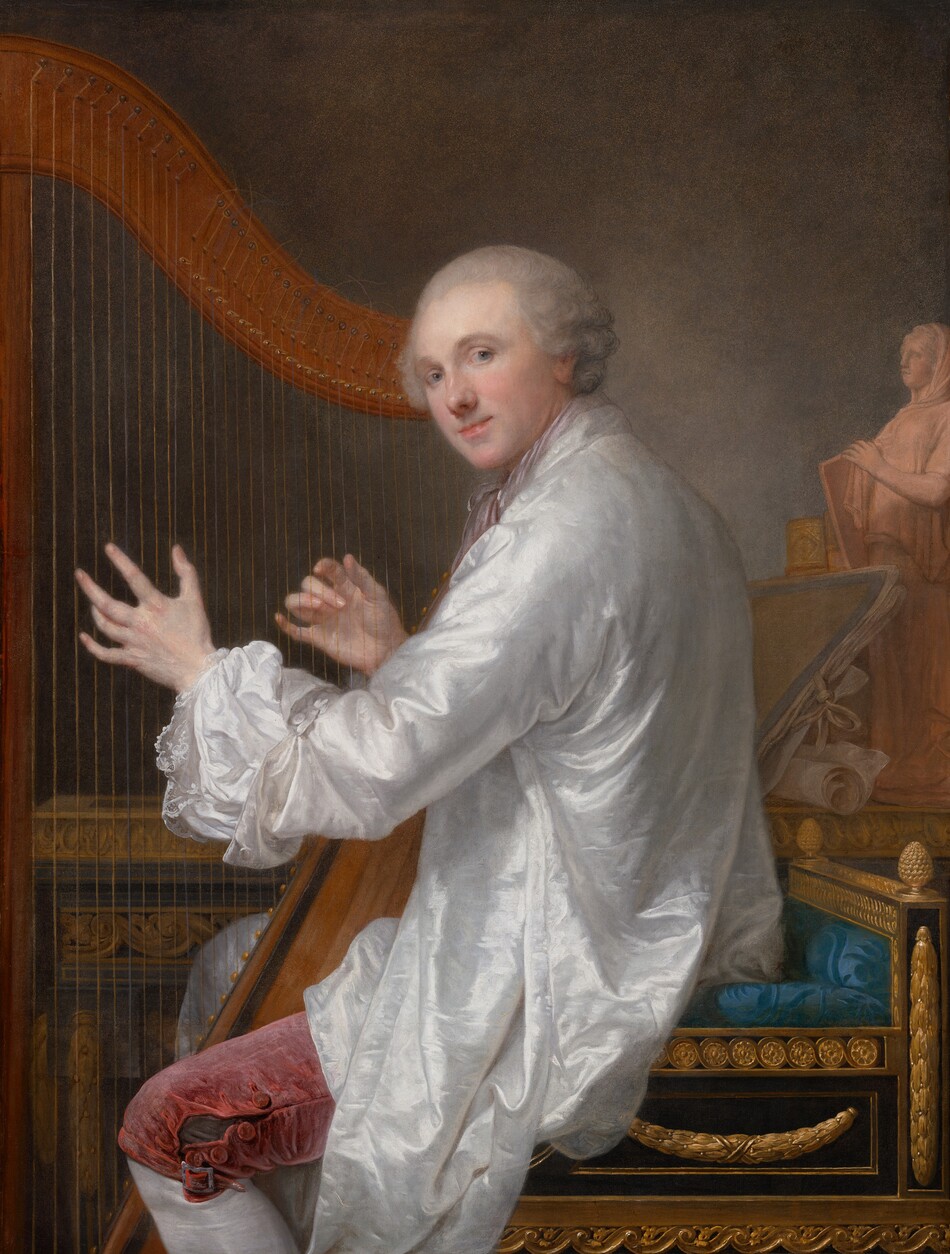
A pale-skinned man sits facing our left as he plays a harp while turning his face to smile at us in this vertical portrait painting. He looks out the corners of his light blue eyes under arched, gray brows. He has a rounded nose, pale pink lips, and a round face. Gray hair is brushed back from his high forehead and curls around his ears. His long fingers rest on the strings of the harp, and the ends of strings curl like wind-loosened strands of hair along the top edge. The man wears a pale mauve-purple cravat, and his snow-white, long-sleeved chemise is untucked and loose around his thighs. The cuff we see is open and folded back over a bright white shirt edged with lace. His dusky rose-pink breeches are unbuttoned at the knee over white stockings. The square-seated chair on which he sits is carved with garlands and floral patterns, which are gilded gold. The seat itself is topaz blue, and it has a low back. A similarly ornamented and gilded table along the back of the room holds a portfolio and roll of papers, the tooled and gilded spines of books, and a statuette to the right. The pale pinkish-orange statuette shows a woman holding a tablet and wearing a long, loose robe and head covering. Her body angles to our left and she looks off in that direction. The wall behind the table is mottled with smoky shades of gray and tan.

Ange Laurent de La Live de Jully

Jean-Baptiste Greuze

probably 1759

Oil on canvas  Accession ID  1946.7.8

On View: West Building Main Floor, Gallery M55
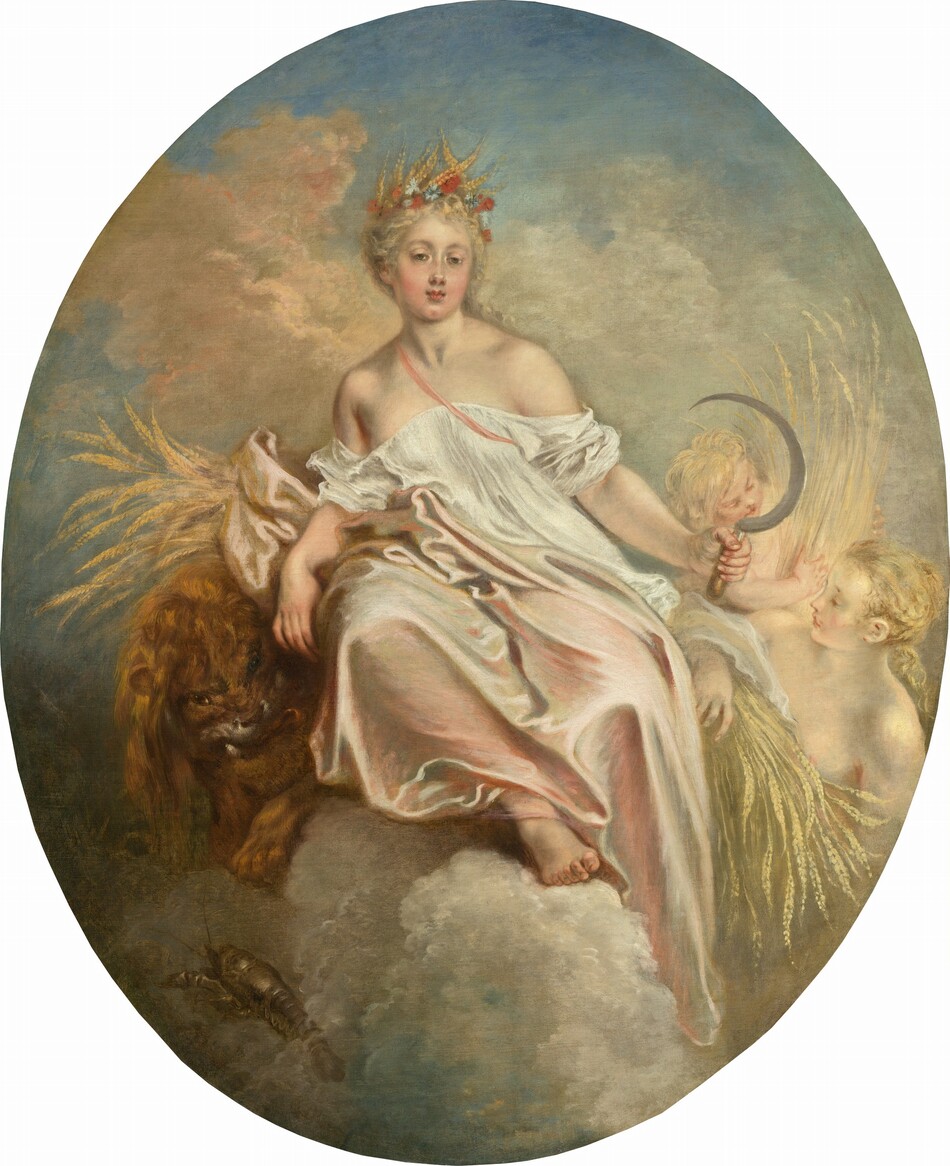
A woman wearing a white and pale pink robe and holding a sickle sits on billowing clouds flanked by a lion and two young people in this vertical, oval painting. All three people have pale skin with rosy cheeks and blond hair. At the center of the composition, the woman, Ceres, sits facing us and she looks at us with lidded, gray eyes under faint brows. She has an oval face, small, pink, bow-shaped lips, and a dimple in her chin. Golden stalks of wheat along with pale blue cornflowers and red poppies create a crown in her upswept blond hair. Her white chemise falls off her shoulders and is loosely held in place with a rose-pink band that wraps around her right shoulder, to our left, and under the opposite arm. Shimmering, shell-pink drapery falls over her legs and covers one foot. Her other bare foot rests on a cloud like a footstool. A bundle of wheat is pinned between the fabric under her right elbow, to our left, and the lion there. With a long mane, his tawny face peers around Ceres’s hip from under the wheat. His mouth is pulled wide to expose one fang, and his pink tongue curls out of the other side. An iron-gray lobster crawls up the lower left side of the clouds beneath the lion. Ceres holds the curving blade of the sickle upright in her other hand by that hip. Near the sickle, a young woman and a child are seen from the chest up, each carrying a bundle of wheat. The young woman faces Ceres and looks off to our left, and the younger child, above her, looks down. Ceres and her companions are set against an arch of pale azure-blue sky filled with tan-colored and light pink clouds.

Ceres (Summer)

Antoine Watteau

c. 1717/1718

Oil on canvas  Accession ID  1961.9.50

On View: West Building Main Floor, Gallery M54
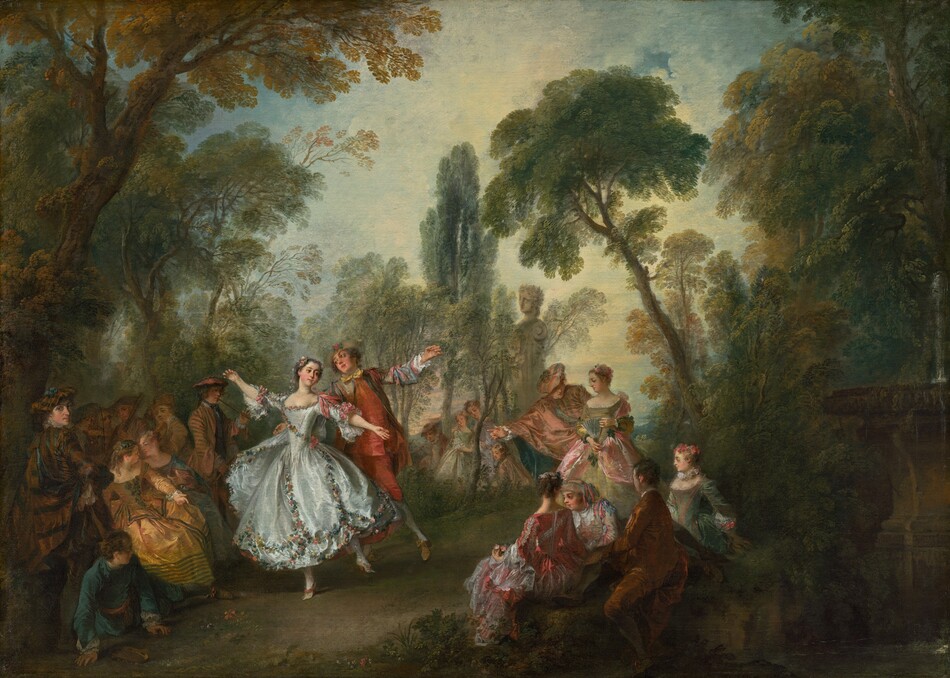
Twenty-one men in long waistcoats and women in elegantly trimmed gowns gather and dance within a verdant landscape in this horizontal painting. The men wear jackets and breeches in ginger brown, pale pink, or spruce blue. The women’s gowns have full sleeves, tight-fitting bodices, and full skirts in shades of bronze, teal blue, butterscotch gold, or rich pink edged with ribbons and lace. Some of them wear floral wreaths or ribbons in their upswept hair. Groups gather around a woman and man who dance together to our left in the scene. Some in the group of onlookers to our left hold musical instruments, including a violin and a pipe. Another group is nestled among trees just beyond the dancers, at the center of the painting, and more sit and stand to our right. The dancing woman wears a gleaming, ice-blue gown with rows of flowers in muted pink, blue, and gold down the full skirt and around the bottom hem, which falls short of her thin ankles. More garlands cross her chest and shoulders, and flowers are tucked into her dark gray hair. She faces us with her head turned to our right as she looks off in that direction with dark eyes under curving brows. She has a delicate nose, rosy, round cheeks, and pink lips. She holds her arms spread wide with the thumb touching the index finger of each hand. The man with whom she dances wears a coral-red tunic and breeches with sleeves decorated with pale pink and blue ribbons. The brim of his brown hat is turned up. His body faces us but he turns his head to look at the woman, his lips parted. The man and woman each have one gracefully pointed foot raised. The dancers and groups are enclosed within a park-like setting with tall trees to either side, and a screen of trees across the back of the space. The trees have slender trunks and canopies in shades of pine, sage, and moss green. Near the back middle of the scene, a stone column topped by a human head wearing a wreath of laurel leaves rises above the central group. A fountain with a vertical jet of water is tucked into the shadows within a grove of trees along the right edge of the painting. The water falls into a pool in the lower right corner.

La Camargo Dancing

Nicolas Lancret

c. 1730

Oil on canvas  Accession ID  1937.1.89

On View: West Building Main Floor, Gallery M54
Shown from the shins up, two elegantly dressed women and two young boys, all with light skin, sit together on a bench in front of a stone balustrade with a forest landscape beyond in this horizontal portrait painting. The people are brightly lit from our left but the darkened sky suggests dusk. The boys lean onto the woman at the center of the composition, and the second woman sits to her right, our left. All of the people have pale skin, rosy cheeks, delicate noses, and their pink lips all turn up in slight smiles. The woman on our left sits with her body angled toward her friend but she turns her face to look at us with brown eyes under curving brows. Her wavy, flint-gray hair is loosely bound up so it frames the sides of her face and curls over her shoulders. Her swirling, white head covering is edged in gold and tied in a bow over her left ear, on our right. Her long-sleeved dress has a tight-fitting bodice and a low, scooped neckline lined with pleated white fabric. Her dress shimmers from sapphire blue to dusky pink, suggesting it is iridescent taffeta. Large pearls hang off the end of round, gold, hoop earrings, and a glimmering gold sash is tied around her waist. She sits with her left hand resting on her friend’s right shoulder, closer to her, and she gestures toward one of the young boys leaning on the friend’s lap with her other hand. The second woman sits with her body facing us, and she looks off to our left with gray-blue eyes. Her silvery gray, upswept hair is covered with a long piece of white fabric with pink stripes, twisted loosely into a turban-like head covering. She wears dangling gold earrings, and her dress is striped with parchment white and rust red. Her right hand, on our left, rests on her friend’s knee, and her other arm is wrapped around the older boy. He kneels on the bench and leans forward, wrapping the arm we can see around her torso. His face near hers, he looks up at her from under his lashes. A dimple marks the flushed cheek we can see. His chestnut-brown hair falls around his shoulders, and he wears a gingerbread-brown suit. The smaller and younger of the two boys rests his head on his crossed hands on her thigh, and looks out at us. He wears a white garment with a lilac-purple sash tied in a bow around his waist. There is a pale pink rosebush in the lower right corner of the painting, near the kneeling boy’s foot. The landscape beyond the balustrade is filled with dark green trees against a slate-blue sky. The painting is created with blended brushstrokes, giving it a soft look.

The Marquise de Pezay, and the Marquise de Rougé with Her Sons Alexis and Adrien

Élisabeth Louise Vigée Le Brun

1787

Oil on canvas  Accession ID  1964.11.1

On View: West Building Main Floor, Gallery M56
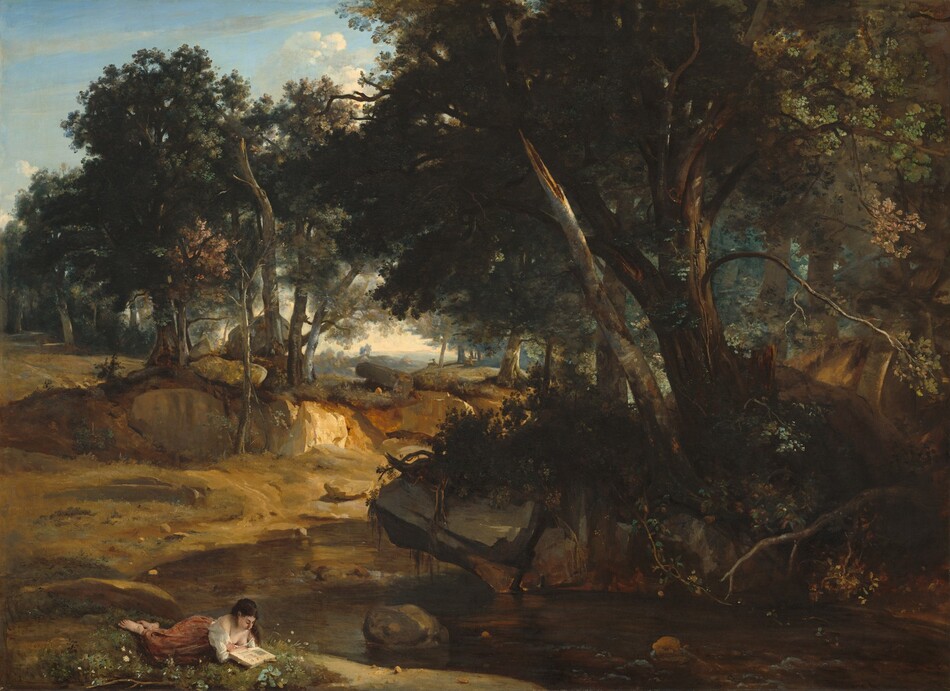
A young woman reclines and reads a book near a stream that winds through a wooded landscape in this horizontal painting. Painted with rich pine green, trees tower along the riverbanks and fill most of the painting. The olive-colored water seems to have cut straight down over time, creating high banks painted with tones of caramel and honey brown. Steel and slate-gray boulders are scattered in intervals near the river. Deep in the hazy blue distance, mountains line the horizon, which comes halfway up the composition. In the lower left corner of the painting, close to the river, the woman lies on her stomach as she props herself up on her elbows to read. She has pale white skin and her long, dark hair falls over her shoulders. Her white shirt hangs low over her shoulders, and her rose-pink skirt falls just short of her bare feet.

Forest of Fontainebleau

Jean-Baptiste-Camille Corot

1834

Oil on canvas  Accession ID  1963.10.109

On View: West Building Main Floor, Gallery M93
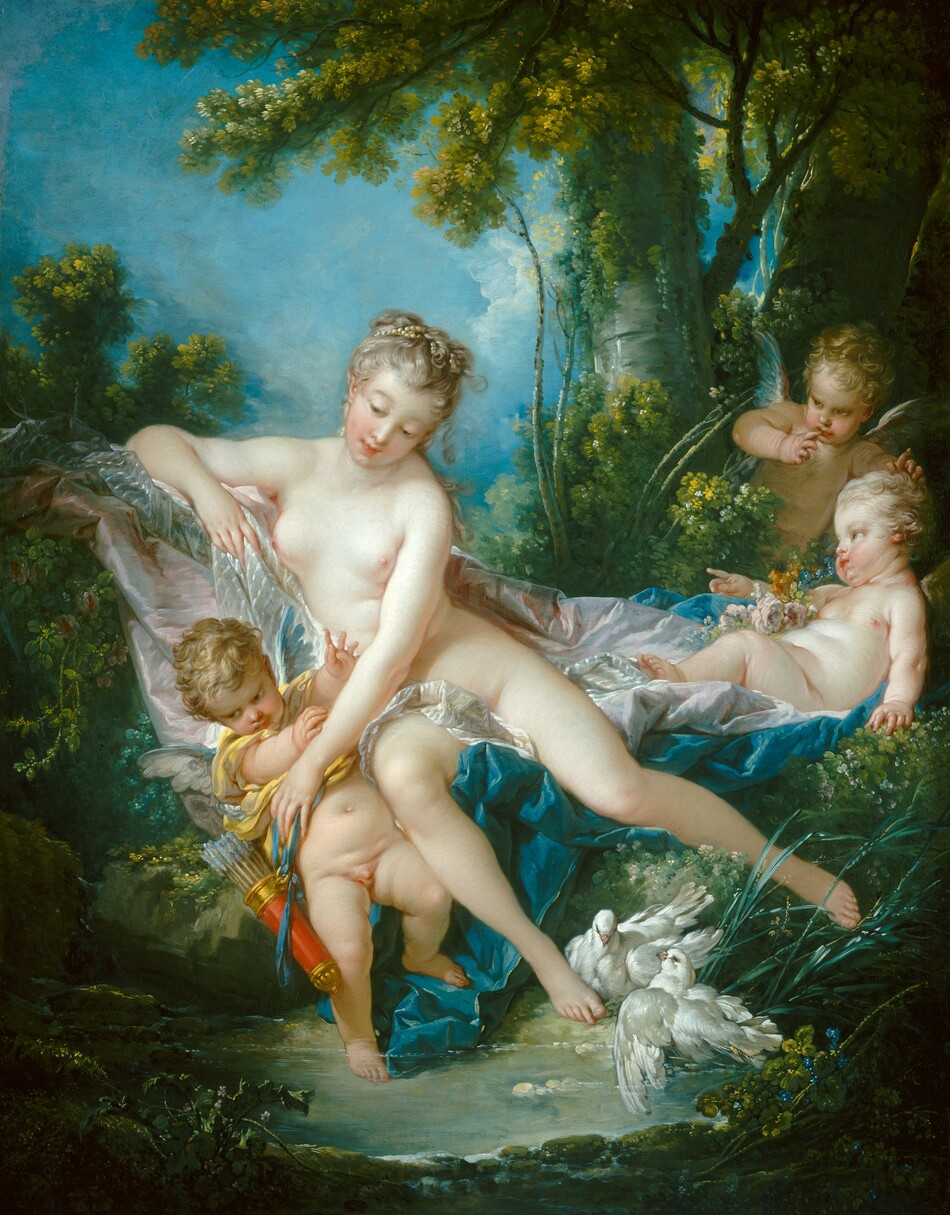
A nude woman and three small, winged children gather among bushes and lush vegetation at the edge of a clear pool in this vertical painting. All four have pale skin and blond hair. The children are pudgy with baby-like proportions and have short gray and blue wings. The woman half reclines on swaths of white, pale pink, and peacock-blue fabric draped across the bushes or the ground. She leans her torso to our left and leans toward that elbow, which is propped up on the fabric. The toes of her right foot, on our left, brush the ground near the water, and her other leg is angled to continue the diagonal created by her elbow and torso. Two white doves nestle by her lower foot. Her ash-blond hair is bound up with pearls, and she has rosy cheeks, pink bow lips, and smooth skin. She reaches across her body and down to our left to touch a nearly nude young boy. He wears a butter-yellow garment pulled up around his chest, perhaps by the woman. A quiver of arrows hangs from a blue ribbon at his side, and he raises his hands before him, toward the woman's arm. To our right, one of the other children reclines on the pink and blue drapery and faces the woman in profile. The third child leans forward from the bushes behind the reclining child. The bushes and trees of the lush forest around the figures creates a V-shape with the people at the center. Vibrant blue sky fills the upper left quarter of the painting.

The Bath of Venus

François Boucher

1751

Oil on canvas  Accession ID  1943.7.2

On View: West Building Main Floor, Gallery M55
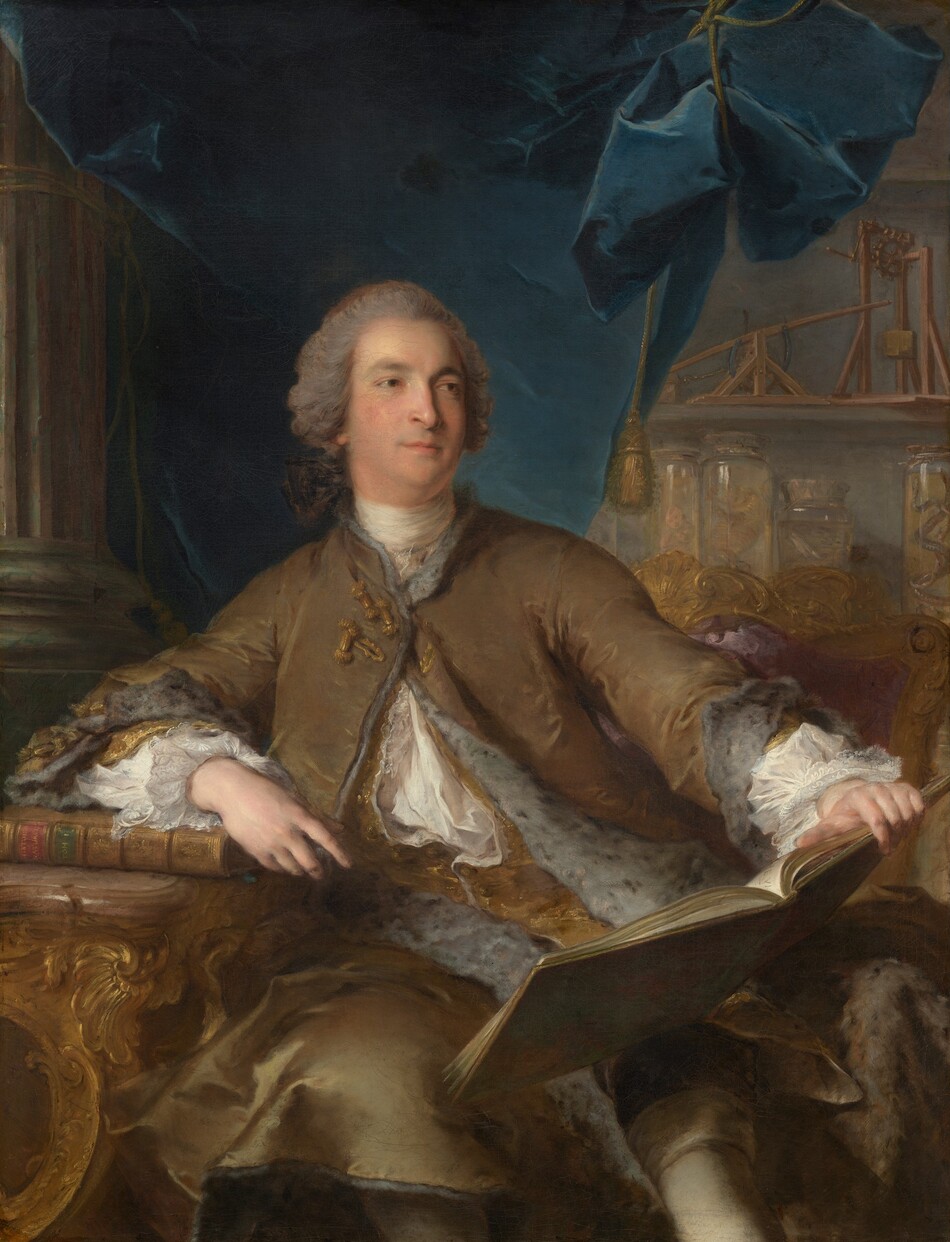
This painting depicts a man seated on an ornate chair, looking to the right. He has fair skin, grey curly hair, and is wearing a brown coat with gold trim and gray fur over a frilly white shirt. He is holding a large book open with his left hand, and his right hand rests on a stack of books. In the background, there is a blue drapery that partially obscures shelves with scientific equipment and glass jars. There is a dark gray column on the left.

Joseph Bonnier de la Mosson

Jean-Marc Nattier

1745

Oil on canvas  Accession ID  1961.9.30

On View: West Building Main Floor, Gallery M53
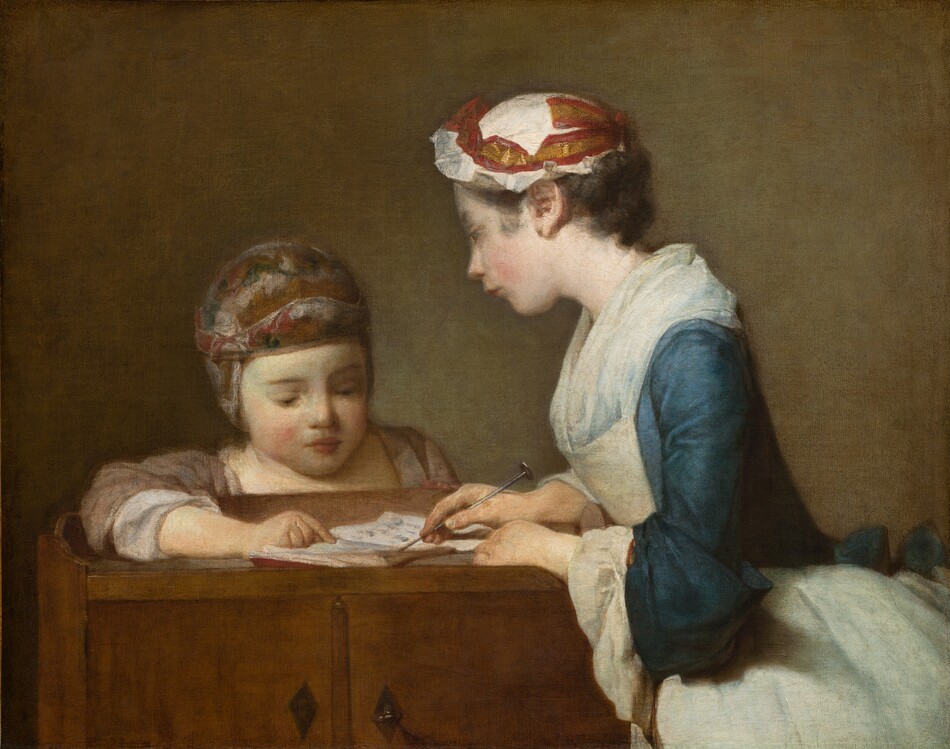
An older girl and a younger child, both with pale skin, bend toward each other as they look at a book spread open on a wooden cupboard in this nearly square painting. Shown from the hips up to our right, the girl leans over the cupboard with her body facing our left in profile. She looks at the child peering over the low ledge at the back of the cupboard with her head tilted slightly in that direction. The older girl has a straight, delicate nose, her smooth cheeks are flushed, and her rosy-red lips are pursed. Her brown hair is tucked under a bright white, ruffled cap encircled with a gold and cranberry-red ribbon. The long sleeves of the muted sapphire-blue dress seem to have been rolled back along the forearms to reveal cascading, white cuffs. A translucent white neckerchief, like a short, full scarf, is tucked into an ivory-white apron that also covers the flaring skirt. With both hands on the open book, she points to one page with a metal pointer like a knitting needle. Facing us, the smaller child looks at the book from behind the wood cupboard, eyes downcast, resting one forearm on the surface and pointing to a detail in the book. The child has delicate brows, a short, wide nose, and full raspberry-red lips are closed. The padded cap the child wears covers the ears and is loosely painted with a pattern of honey brown, silvery white, and slate blue. The nutmeg-brown sleeves are pushed back along the forearm and there are white cuffs or sleeves beneath. The cupboard has two diamond-shaped, iron-gray metal pulls in front. Light illuminating the pair from our left creates a greenish glow on the tawny-brown background behind them.

The Little Schoolmistress

Jean Siméon Chardin

after 1740

Oil on canvas  Accession ID  1937.1.91

On View: West Building Main Floor, Gallery M53
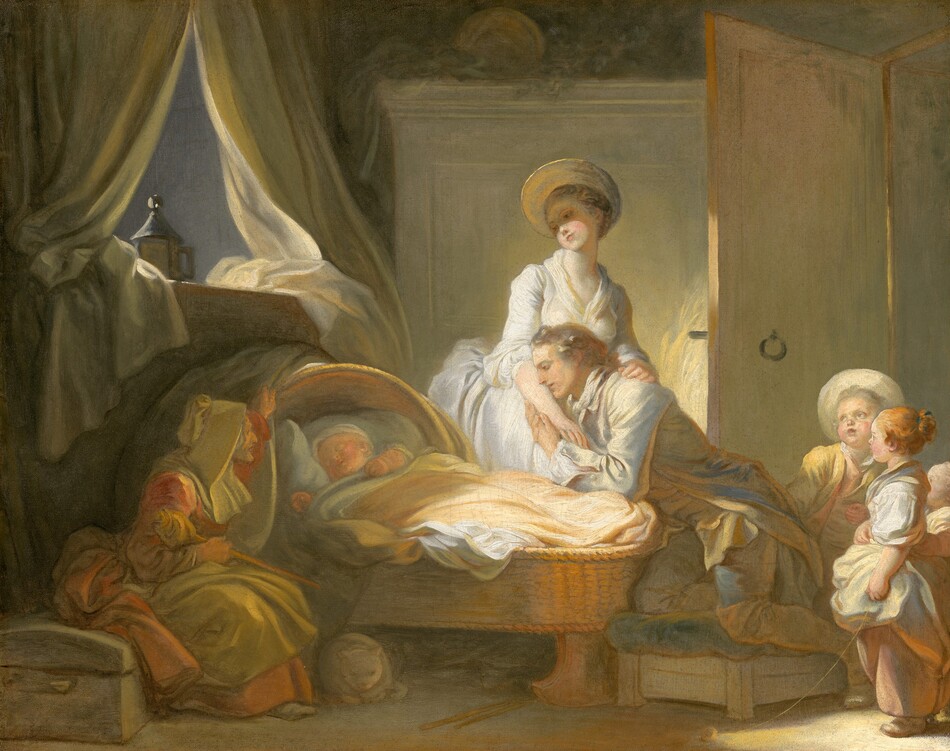
Two women, a man, and three small children gather around a baby sleeping in a wicker cradle near an open window in this horizontal painting. The people all have pale skin with rosy cheeks. The cradle is just to left of center of the composition. It has a half canopy to shade the baby, and it sits on rockers. The baby sleeps with chubby arms over the covers tucked around the body. A woman sits on a low chest next to and on our side of the crib, near the lower left corner of the canvas. She has a prominent nose and jutting chin. She wears an oatmeal-brown bonnet and apron, and a muted red dress. She holds a staff with fabric or a spindle at the top tucked in one elbow, and the other hand rests on the canopy. A white cat lies like a loaf next to her feet. On the far side of the crib, a clean-shaven man kneels on a low platform covered by a pillow at the foot of the cradle and leans into the arms of a standing young woman. The man has a pointed nose and rounded chin, and he looks with heavy-lidded eyes at the baby. His long gray hair is tied at the nape of his neck, and he wears an ice-blue and tan long-tailed coat, breeches, and stockings. He rests one cheek against the arm of the woman who stands at his far shoulder. Her body faces the man, and she rests her other hand on his shoulder as she turns to look at the baby. A round, broad-brimmed hat casts a shadow over her delicate nose and round cheeks, and she wears a white dress with elbow-length sleeves and a full skirt. Three children stand behind the man’s feet and along the right edge of the canvas. The child closest to us has carrot-orange hair tied in a bun with a blue ribbon. She wears a white, puffy-sleeved shirt, and a parchment-white apron bunched over a pale pink skirt. She faces our left in profile, looking at the man, and holds one end of a ball of yarn that has rolled away from her. The boy behind her stands with his body facing us as he looks up and to our left. He wears a yellow jacket and a broad-brimmed hat pushed back on his head. Only the forehead and eyes of an even smaller child standing behind this pair are visible. Voluminous curtains part to either side of a window at the head of the cradle, near the upper left corner of the composition. An unlit lantern sits on the sill, and the sky beyond is dusk-blue. Bright light shines into the room, especially onto the man and woman and three children. A piece of furniture, perhaps a wardrobe, is on the far wall behind the woman, and the door to the room is open behind the children.

The Visit to the Nursery

Jean Honoré Fragonard

c. 1775

Oil on canvas  Accession ID  1946.7.7

On View: West Building Main Floor, Gallery M54
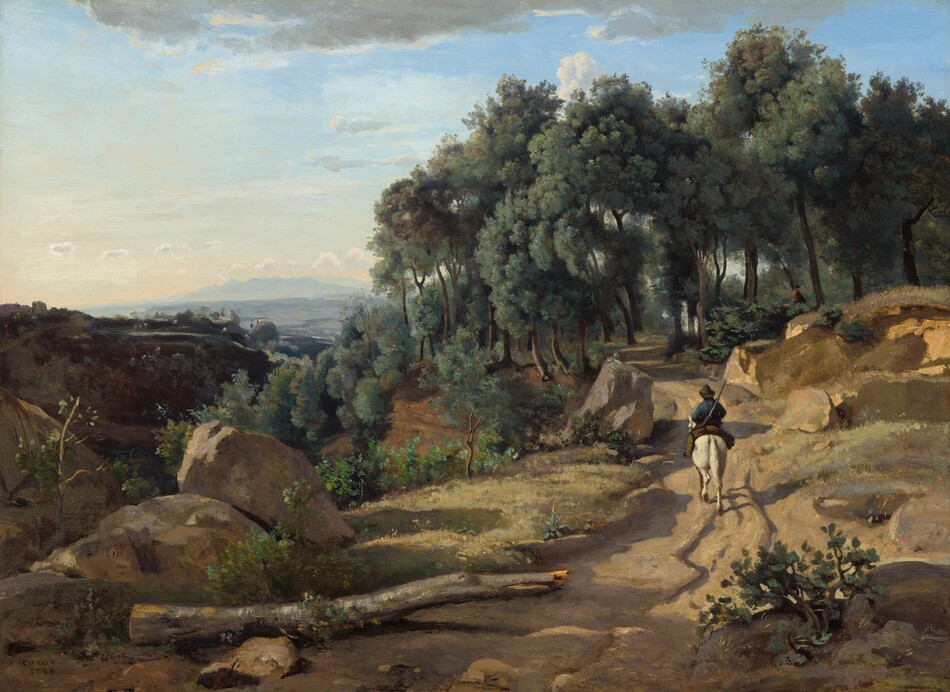
We look slightly down onto a man riding a white horse away from us on a dirt road winding through a sun-drenched, rocky landscape in this horizontal painting. The man wears a cobalt-blue jacket and soft black hat, and the rutted path he follows cuts along the side of a steep hill or mountain peak. The path extends from the bottom center of the composition and stretches up the right side toward a grove of sage-green trees with brown trunks. The trees fill the upper right half of the composition, and the tallest ones almost brush the top edge of the canvas. Closer examination reveals a person in a brown coat in the shade of the trees, just off the path ahead. Seen from the hips up, they face our right in profile. Scrubby plants, bushes, and saplings in tones of kelly, pea, and fern green sprout among the boulders that line the road. A broken, bare, segment of a silvery-gray tree trunk lies along the path to our left. Lit with brilliant sunlight coming from the lower left, the horse and rider, and the boulders lining the path cast mauve-purple shadows along the ochre-brown road. The rocky terrain to the left dips down into a valley and is in deep shadow. A mountain across the valley is also deep in shadow, painted dark brown. The landscape becomes steel gray and then hazy blue as it recedes into the deep distance. The horizon comes about halfway up the canvas. Gray and white clouds are scattered across a sky that deepens from pale blue along the top edge to nearly white at the horizon. The artist signed and dated the work in the lower left, “COROT. 1838.”

A View near Volterra

Jean-Baptiste-Camille Corot

1838

Oil on canvas  Accession ID  1963.10.111

On View: West Building Main Floor, Gallery M93
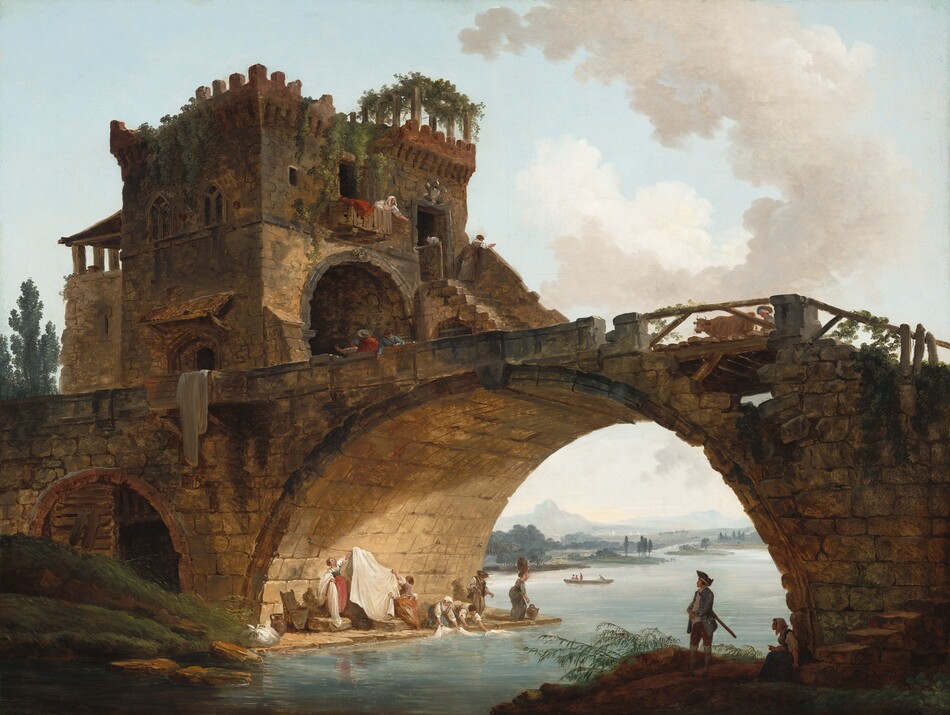
A rustic, arched, stone bridge spanning a shallow river nearly fills this horizontal landscape. From low to the ground, we look up into and through a large arch, which occupies the lower half of the picture and frames a view that opens to a wide expanse of calm, pale blue water, wooded green riverbanks, and a misty, distant view of a village and a mountain. The horizon line comes a quarter of the way up the painting, and a smoke-colored cloud formation curves like a backward C against the ice-blue sky above. The bridge structure is made from stacked, sandstone-colored stone blocks to form heavy piers. Vegetation grows on the crumbing bridge and gaps indicate other stones are missing. The bridge’s deck runs across the center of the painting, rising slightly from left to right. Atop it, occupying the top left quadrant of the painting, sits a square stone two-story tower that encloses an arched passage over the bridge’s roadway. Groups of people, small in scale, are positioned on and around the bridge. At the river level, on a platform around a bridge footing, four women do laundry. Two pull sheets from the water and two bend on their knees to wash the linens in the river. They wear long skirts of slate blue, cranberry red, and ochre yellow with pinafores and white blouses rolled up to the elbows, with their hair pinned up. A bearded man in brown trousers, white shirt, and brown hat appears to talk to them. Another woman standing nearby in a dark, slate-gray dress balances a large, dark brown ceramic ewer on her head and reaches to pick up another resting at her feet. Warm yellow light illuminates this scene and the underside of the bridge, and reflects on the river. On the bridge deck above, a brown steer is herded across the bridge by a person wearing a wide brown hat, while three people in red, slate-blue, and white clothing are about to pass through the tower passage on the left. Immediately above them, a woman in a white blouse and head scarf appears at a small balcony with what looks like a red dress draped over it and gestures with an extended arm toward a white cat crouched on a railing below. Another woman to our right, in a brown dress, white blouse, and brown hair, stands at the top of a flight of steps leading up the far side of the tower with her back toward us, and she gazes out at the view. On the water below, a small boat with several people is rowed across the river in the middle distance. In a shadowed area at the foot of the bridge, closer to us, a man stands wearing a pointed hat, blue jacket with buttons, and high boots with a sword tucked under his arm. Behind him, a woman in a dark green dress and kerchief sits on a stone step. Both look toward the scene under the bridge with the washerwomen.

The Ponte Salario

Hubert Robert

c. 1775

Oil on canvas  Accession ID  1952.5.50

On View: West Building Main Floor, Gallery M55

Loading Results