French Paintings

Filter Results

110 artworks on view.

Results

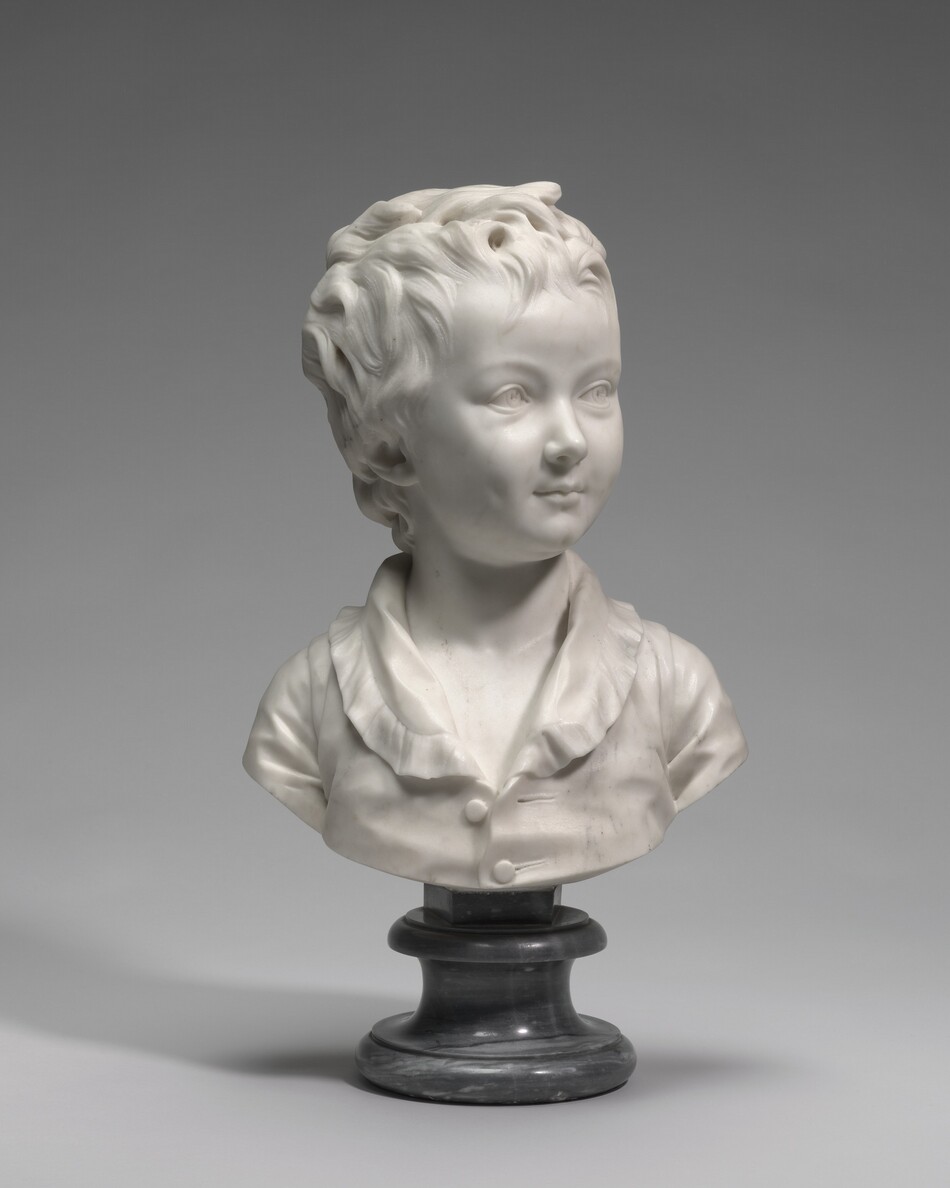
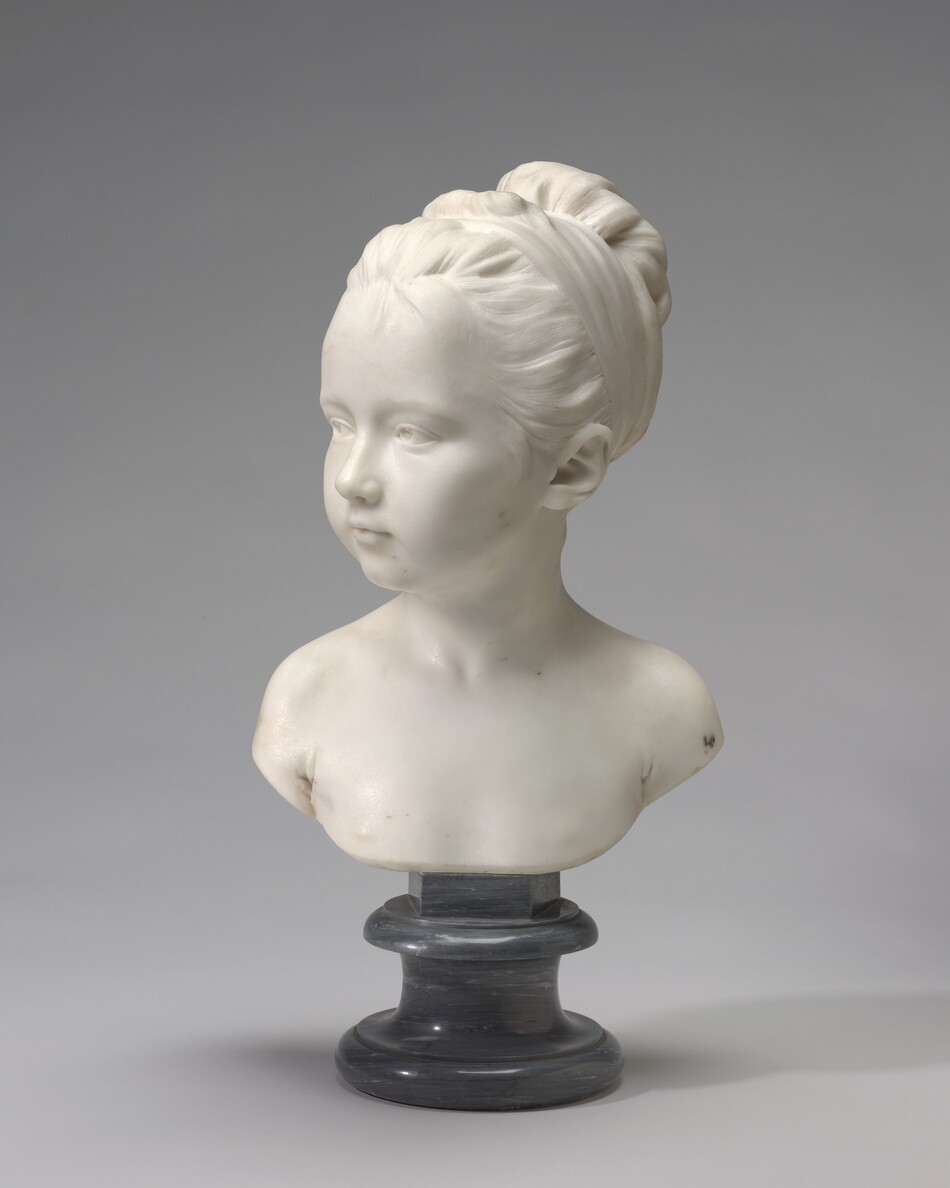
The sculpture shows the bust of a young child with curly hair, smooth skin, and a soft expression. The child wears a garment with a ruffled collar and two buttons going down the front. They look towards the left with wide, inquisitive eyes, and have a small dimple in their cheek next to their small mouth. The sculpture is made of white marble and sits on a dark, glossy round base.

Alexandre Brongniart

Jean-Antoine Houdon

1777

Marble  Accession ID  1942.9.123

On View: West Building Main Floor, Gallery M55
A young woman and two children are shown from the waist up through an oval, stone opening, holding and looking at a wooden box with a lens protruding from one side in this square painting. All three people have pale skin with rosy cheeks. To our right, the young woman’s body is angled to our left as she braces the torso of a young girl. The young woman looks at us from the corners of her sage-green eyes, under lifted brows. Her small, pink mouth is pursed in a slight smile, and she has a faint dimple in her rounded chin. Her heather-gray hair is partially plaited over the crown of her head, and long curls fall over her shoulders. She wears a spruce-blue shawl over the shoulders of her low-cut, olive-green dress. The child she braces has chubby cheeks, and her wavy blond hair is brushed back from her forehead and falls loosely to her shoulders. She wears a blush-pink dress with ruffles on the half-length sleeves and gossamer-white trim around the neckline and cuffs. The top and side rails of a wooden, ladderback chair up against the inside of the opening suggests she stands or kneels on a backward-facing chair. She rests her left hand on the edge of the stone opening and her other hand on the wrist of the boy standing close behind her. Mostly in the shadow behind the others, the boy has small, pointed features and short, curly, sable-brown hair. He wears a tan coat, and a muted blue scarf is tied at his throat. The two children gaze at the wooden box the boy holds, which is about the size of a toaster. A short, cylindrical, brass-lined lens pokes out of the center of the side facing the trio. The oval opening through which we see them is carved on our side with stylized leaves and berries, and the wall around it is the same elephant gray as the carvings. The girl and the box cast a shadow across the opening. The artist signed and dated the painting in the lower left corner, “Amedee Can Loo./1764.”

The Camera Obscura

Charles Amédée Philippe Van Loo

1764

Oil on canvas  Accession ID  1945.10.1

On View: West Building Main Floor, Gallery M53
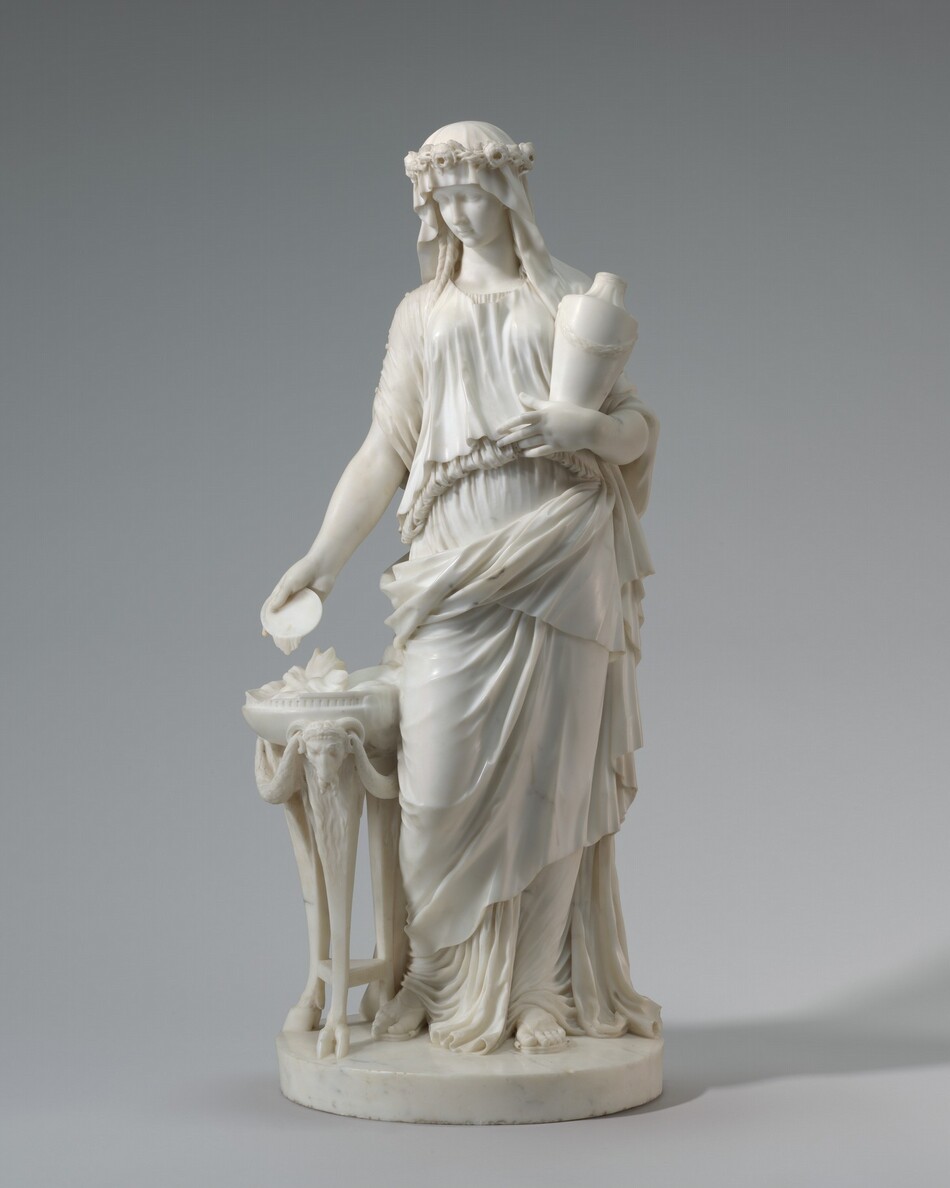
Carved from cream-white marble, a woman stands next to a hip-high, three-legged table in this free-standing sculpture. Her weight rests on her left leg, her right knee bent. She wears a flower crown over a garment that covers her head and falls in sweeping, voluminous folds to her sandaled feet. An urn is tucked into her left elbow and she holds a saucer-like dish in her right hand down by her side to pour oil onto the flames on the altar below. She looks down toward the altar, which is decorated with a ram’s head and garlands.

A Vestal

Clodion

1770

Marble  Accession ID  1952.5.99

On View: West Building Main Floor, Gallery M55
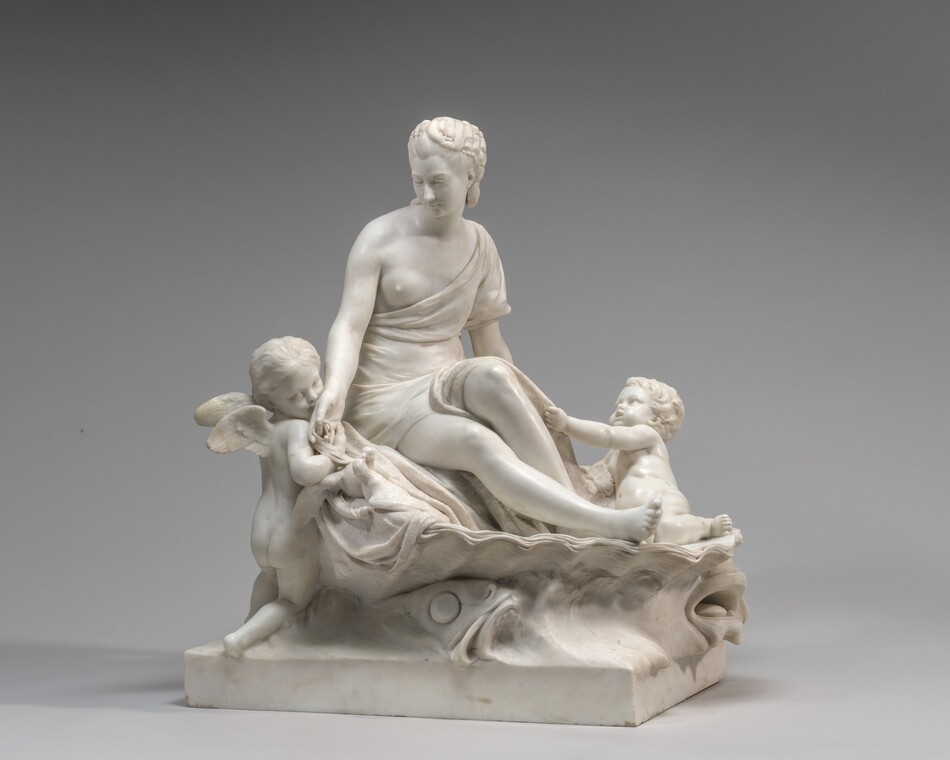
A seated woman with upswept hair is flanked by two chubby male children in this free-standing, white marble sculpture. In this photograph of the sculpture, the woman’s body faces us, and the rectangular base on which they sit is angled slightly away from us to our left. The woman sits in half of an oversized, upturned clam shell with her legs angled to our right. Her near leg is outstretched while the other bends at the knee. Her toga-like garment leaves her near breast exposed and wraps around her back to cover her lower torso and lap. She looks down to the winged boy closest to us, to our left, who half-stands and half-kneels at her side. He holds her hand and kisses the back of it, as he turns his face toward us. Two doves near the boy nestle in the drapery on which the woman sits, their beaks interlocked. On the woman’s other side, to our right, the second boy sits in the shell by her feet. He leans back to look up at her with his mouth open, as he grabs her garment with one hand. Two sea creatures with gaping mouths support the undulating curves of the shell.

Venus of the Doves

Etienne-Maurice Falconet

Marble  Accession ID  1952.5.101

On View: West Building Main Floor, Gallery M55
In a room filled with easels, white plaster heads and statuettes, a box of paints, books, and papers, a young woman stands looking at a sketch and a young girl looks on, seated in an armchair, in this vertical painting. The scene is lit from the upper left, presumably from a window out of our view. Both women have smooth, pale skin, and their hair is swept up with curls framing their faces. They face our right in profile so their faces are in gentle shadow. They have straight noses, and their rose-pink lips are closed. They wear gowns with short sleeves, low, scooped necks, and floor-length skirts cinched under the bust. In the center of the painting, the young woman has chestnut-brown hair and wears a white gown tied with a sky-blue ribbon. She stands in front of a portfolio propped up against a tall easel. The portfolio is made of two stiff boards that tie together with pale blue ribbon to secure large sheets of paper. She rests her right hand, closer to us, on the front board of the portfolio and looks down at the sketch on a gray piece of paper she holds with her other hand. Next to her and closer to us, the younger girl sits in a gold chair upholstered with olive-green velvet. She faces our right almost in profile, and she looks up toward the drawing the other woman holds. The girl in the chair has blond hair and a gold-colored dress. Her feet are propped on a gold footstool, and she holds another portfolio on her lap. She supports the portfolio and holds a piece of paper with one hand, and a stylus or brush in the other hand, up by her chin. To the right of the easel, a wooden table holds a collection of plaster casts of faces, a hand, and small-scale bodies along with a glass vessel and a few other tools. Two translucent green bottles, boxes, a book, and a terracotta vase are collected on the footstool and the floor around the base of the easel. Garnet-red cloths are draped down the front of the table to our right and behind the girl on the chair. Next to her chair, in the lower left corner of the composition, is a wooden box with a paint palette and a handful of thin paintbrushes. A scroll of paper lies next to the box. A shelf at the standing girl’s shoulder height and behind the pair, to our left, is piled with white busts of a man, child, and woman, more figurines, and a brush in a small cup, all arranged across a moss-green cloth. The space with the girls and artist’s tools is enclosed by a large, dark brown form, presumably a canvas in shadow, that leans against the tall easels and mostly cuts off a view into the rest of the room. A glimpse of shadowy capitals is seen over the board, across the top of the painting, to suggest that a row of columns recedes into the space beyond. The artist signed the work as if he had painted his name on the floor next to the scroll, “L. Boilly.”

A Painter's Studio

Louis-Léopold Boilly

c. 1800

Oil on canvas  Accession ID  1943.7.1

On View: West Building Main Floor, Gallery M56
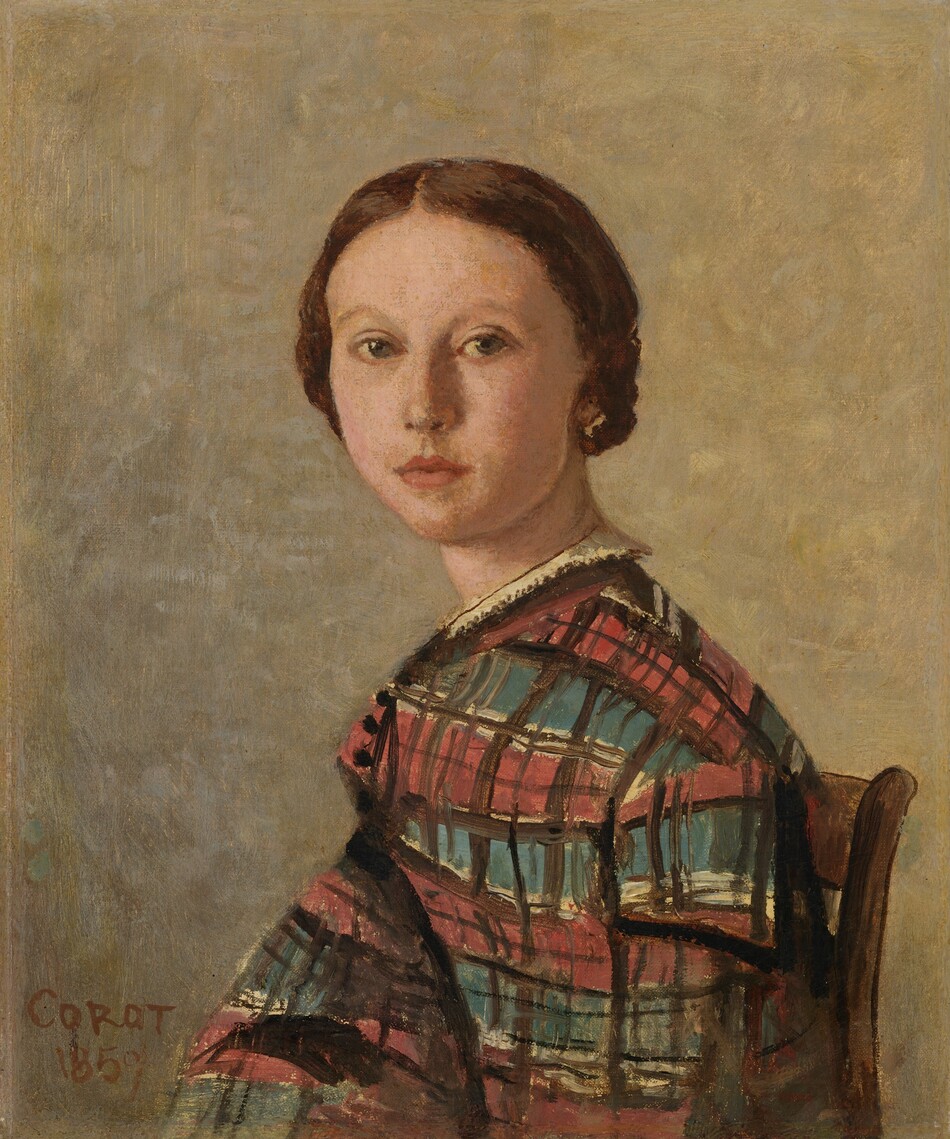
This painting depicts a young woman from the chest upwards, seated in a slightly turned position to the left. She has pale skin, reddish-brown hair styled back in a low bun, green eyes, and small pink lips that are slightly turned up at the ends. She is wearing a patterned garment with a plaid design in pink, light blue, and brown, featuring white trim around the neckline, along with some small black buttons. The background is a mottled gray with shades of light yellow and pale blue. The painting is signed "Corot" and dated "1859" in the bottom left corner.

Portrait of a Young Girl

Jean-Baptiste-Camille Corot

1850 or 1859

Oil on canvas  Accession ID  1963.10.9

On View: West Building Main Floor, Gallery M92
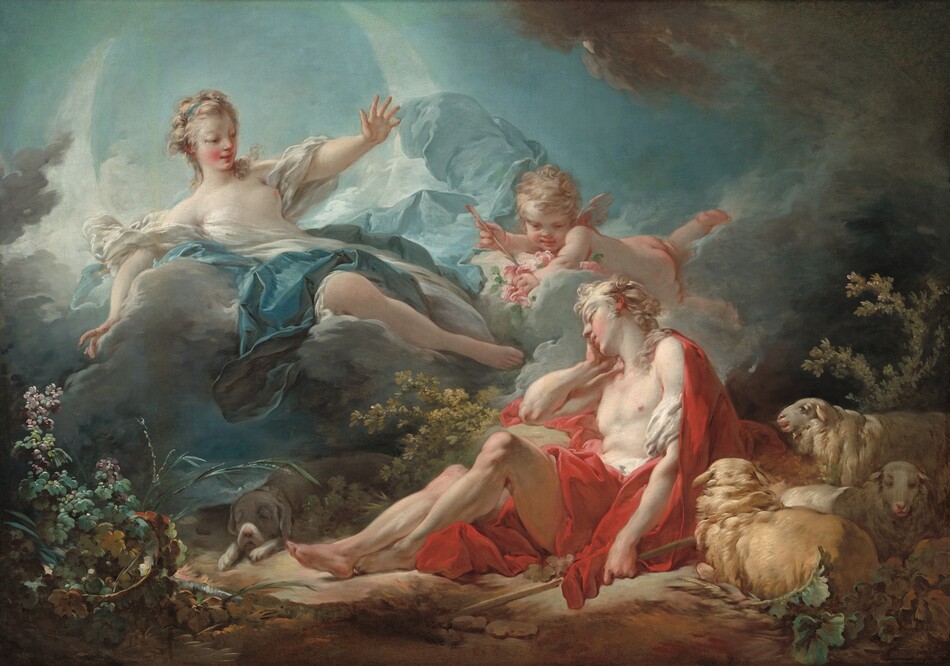
Close to us, a woman and a winged, child-like putto float on clouds above a clean-shaven young man in a forest setting in this horizontal painting. All three people have smooth, pale skin, rosy cheeks, and ash-blond hair. The man reclines with his torso propped so his feet extend along the rocky ground to our left. He rests his head in his right hand, farther from us, with that elbow resting on a rock. We look up onto the underside of his chin and delicate features. A scarlet-red robe falls from his shoulders and across his hips. One knee is propped up, and that foot is tucked behind his other ankle. His muscular torso, arms, and legs are bare. His left hand, closer to us, rests by his side and loosely holds a staff. Three tan-colored sheep with long faces lie or stand behind the man, in the lower right corner of the painting. A light gray hound dog with floppy ears sleeps with its drooping muzzle resting on its paws in the shadows at the man’s feet. The woman floats just above the man, reclining on a fog-gray cloud with her feet angled toward the man’s torso. Her curls are held back by a topaz-blue ribbon, and she looks down at the man, a faint smile on her lips. A loose white garment partially covered by a blue robe falls from her shoulders, leaving one breast and one leg bare. She reaches outward with her left hand, palm out, and the other hand rests down on the cloud alongside her. A sharply pointed, luminous crescent moon curves up to each side behind the cloud. The chubby, nude, baby-like putto nestles on his belly in a cloud between the man and woman. He has short, tousled hair, stubby wings, and his skin is flushed pink. An arrow held in one hand points toward the man, and the putto rests his other hand in a bunch of pink roses. Plants and flowers grow in patches on the ground around the man. The sky above is framed with steel-gray clouds against pale blue.

Diana and Endymion

Jean Honoré Fragonard

c. 1753/1756

Oil on canvas  Accession ID  1960.6.2

On View: West Building Main Floor, Gallery M55
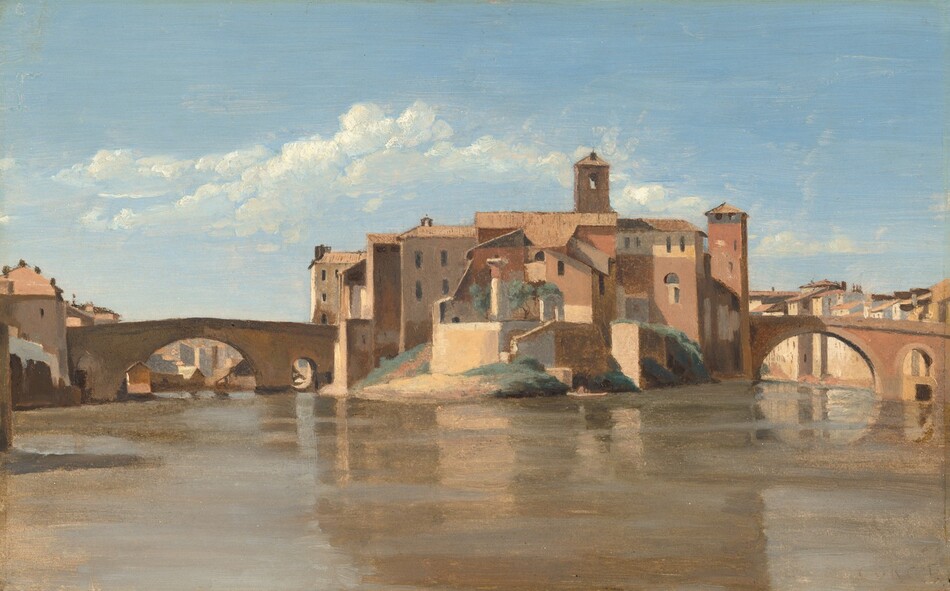
This horizontal landscape painting shows a cluster of tan and rust-brown buildings set on a tiny island at the center of a wide brownish-gray river. We look across the surface of the smooth, glassy river, which spans the width of the composition. Most of the buildings on the island are about the same height, perhaps three or four stories high, except for a bell tower that rises a story above the rest, to our right of center. Sage-green dabs along the ground on the island suggest vegetation. Two arched stone bridges span the river on either side of the island to connect to the city beyond. The color palette is made up entirely of shades of tan, cream white, and brown, except for the blue sky with a band of white puffy clouds above.

The Island and Bridge of San Bartolomeo, Rome

Jean-Baptiste-Camille Corot

1825/1828

Oil on paper on canvas  Accession ID  2001.23.1

On View: West Building Main Floor, Gallery M92
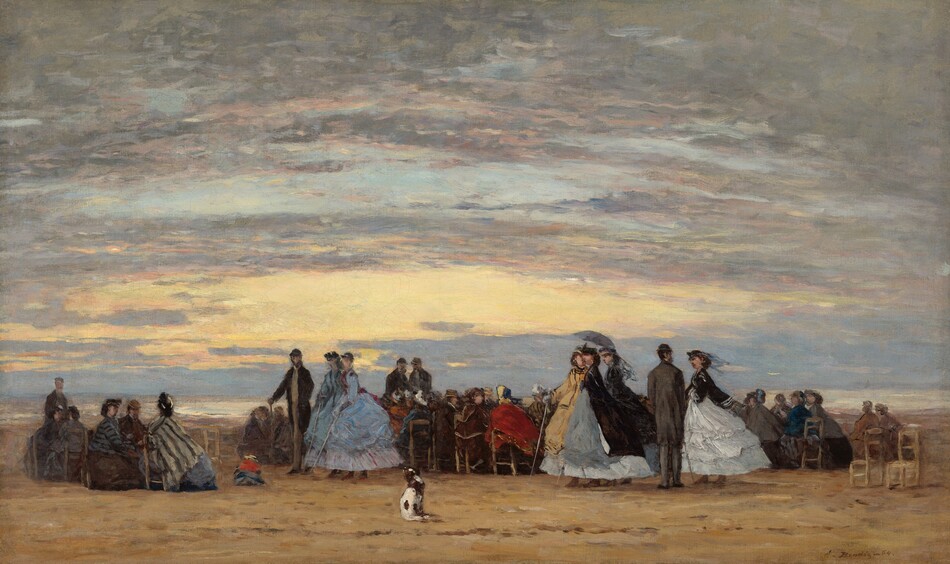
About three dozen men and women sit, stand, or stroll along a sandy beach beneath a sunset-streaked sky in this horizontal landscape painting. The people are small in scale within the landscape, taking up about a quarter of the canvas's height. The scene is loosely painted so many of the facial features are indistinct, but the faces we can see have pale or olive-toned skin. The area closest to us is a strip of sand, and, a short distance away, a brown and white dog sits facing away from us to our left of center. The women all wear dresses with long sleeves, tight bodices, and ankle-length hoop skirts in shades of baby blue, smoke gray, butter yellow, chocolate brown, crimson red, black, or white. Some wear jackets, capes, or shawls, and veils flutter off some of their hats and bonnets. The men wear suits with long tails and rounded hats. Most of the people sit in wooden chairs, and a few stand or walk along the beach. The walking women carrying long sticks or canes. Smudges of ruby red, slate blue, and a touch of straw yellow could be the form of a child crouching in the sand, to our left. Two ladderback chairs sit near the crowd to our right. The horizon comes less than a quarter of the way up the composition. Thin screens of pale gray clouds above are touched on the undersides with petal pink, and they break to show peeks of soft yellow along the horizon and topaz blue a bit higher up.

The Beach at Villerville

Eugène Boudin

1864

Oil on canvas  Accession ID  1963.10.4

On View: West Building Main Floor, Gallery M92
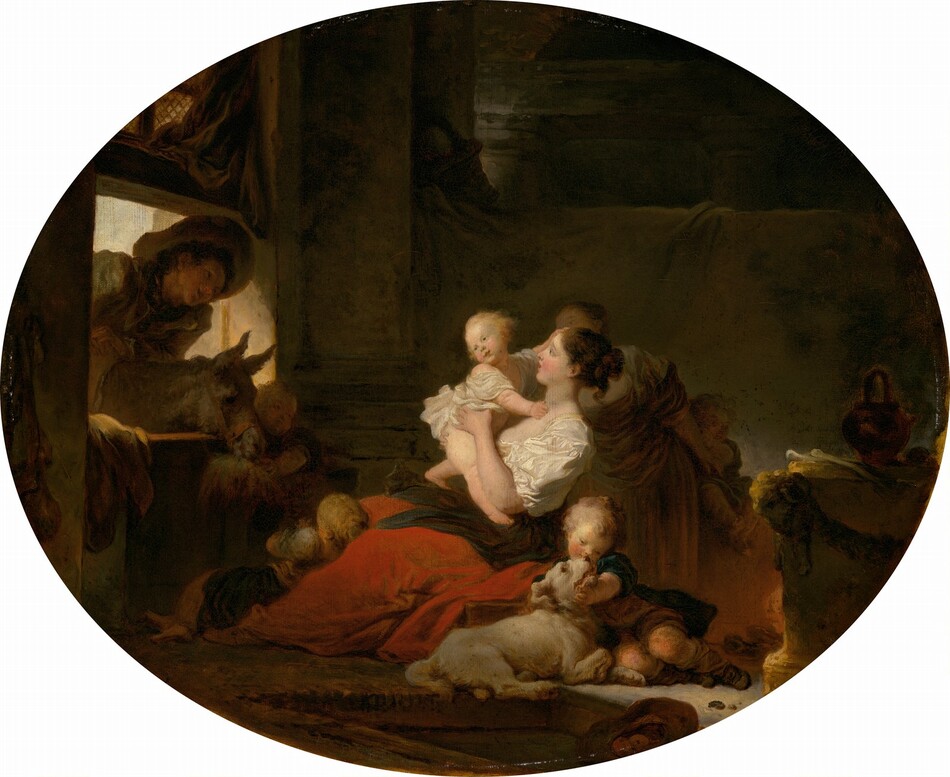
In a deeply shadowed room, two women and several children are gathered at the center of this wide, oval painting, looking toward a young man and donkey who peer in over a half-door to our left. The people all have light skin, and all of the children have blond hair. Light coming into the darkened room falls on a young woman holding a baby at the center of the composition. The woman sits facing our left in profile, looking at or toward the baby with brown eyes and parted lips. She has a long, straight nose, flushed cheeks, and her brown hair is pulled back into a bun at the back of her head. She wears a low-cut, ivory-white bodice with puffy sleeves, a black sash tied around her waist, and a voluminous crimson-red skirt. She props the baby so the child stands braced on chubby legs against her lap as the woman supports the torso and backside. One of the baby’s hands reaches for the woman’s neck and the other for her forehead as the head twists back to look to our left. The child wears a white garment. Two more children rest near the woman, with one leaning back against the woman’s shins and the other sitting with a white dog at the woman’s side, closer to us. Both children wear brown, white, and teal blue. Behind this group, another woman, seen mostly silhouetted against the shadows, reaches back and braces another child who seems to sit on a box or chest. The fifth and final child stands at the head of the donkey who peeks in over the half-door to our left. Above the donkey, a young, cleanshaven man wearing a wide-brimmed hat and baggy coat leans into the room and looks toward the central woman, a smile on his lips. His features are cast into shadow by the light coming in behind him but he has dark hair and dark eyes. The room beyond the women and children is draped with a gray cloth, as if hung over a low beam. The upper regions of the room are swallowed in shadow.

The Happy Family

Jean Honoré Fragonard

c. 1775

Oil on canvas  Accession ID  1960.6.12

On View: West Building Main Floor, Gallery M54
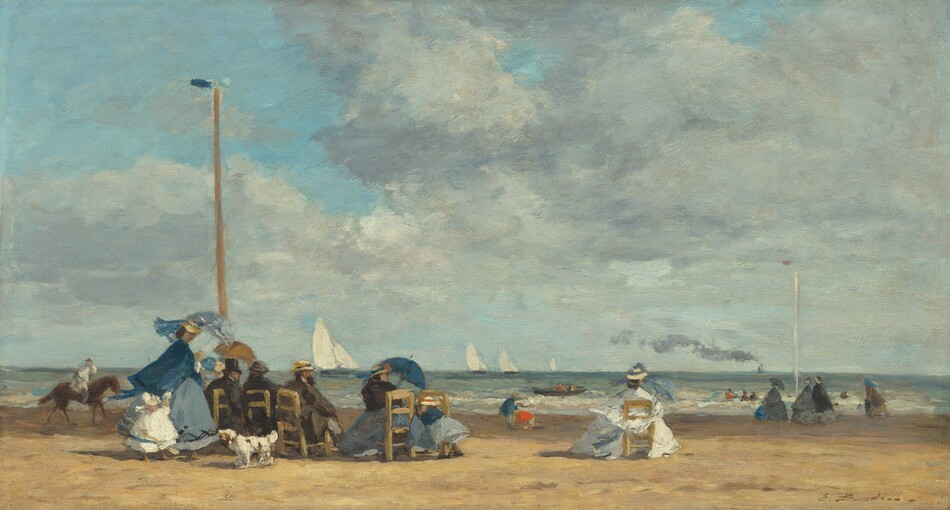
Eight men, women, and children stand or sit in straight-backed, wooden chairs gathered along a sandy beach near low, gently breaking waves with sailboats floating in the ocean beyond in this horizontal landscape painting. The scene is loosely painted throughout, making much of the detail indistinct. Most of the people sit with their backs to us but the faces we can see suggest they have light skin. The people gather in a loose crowd that spans the left half of the composition, except for one woman wearing white and holding a blue parasol who sits to the right. The women wear long dresses with full skirts in shades of black, aquamarine or arctic blue, or snowy white. They all wear straw-colored hats with royal-blue bands. The three men also wear hats and suits in black or pecan brown. Two women, in addition to the one sitting alone, hold up blue parasols. One child wears a white dress and hat, and the other wears shades of blue and a straw hat with a red band. A white dog with brown spots stands on our side of the chairs near a woman and the child wearing white. One tall, wooden pole with a blue banner rises high above the crowd near the left edge of the composition, and another with a red pennant is farther back to the right. Between the group and the water, a person rides a brown horse, several women walk, and two children play in the sand. A rowboat is near the breaking waves and five white sailboats line the horizon, which comes about a quarter of the way up this painting. A steamship leaves a line of muted lilac-purple smoke in the deep distance to the right. A blanket of pale gray clouds cover much of the bright blue sky. The artist signed the lower right corner, “E. Boudin.”

Beach at Trouville

Eugène Boudin

1864/1865

Oil on wood  Accession ID  1970.17.12

On View: West Building Main Floor, Gallery M92
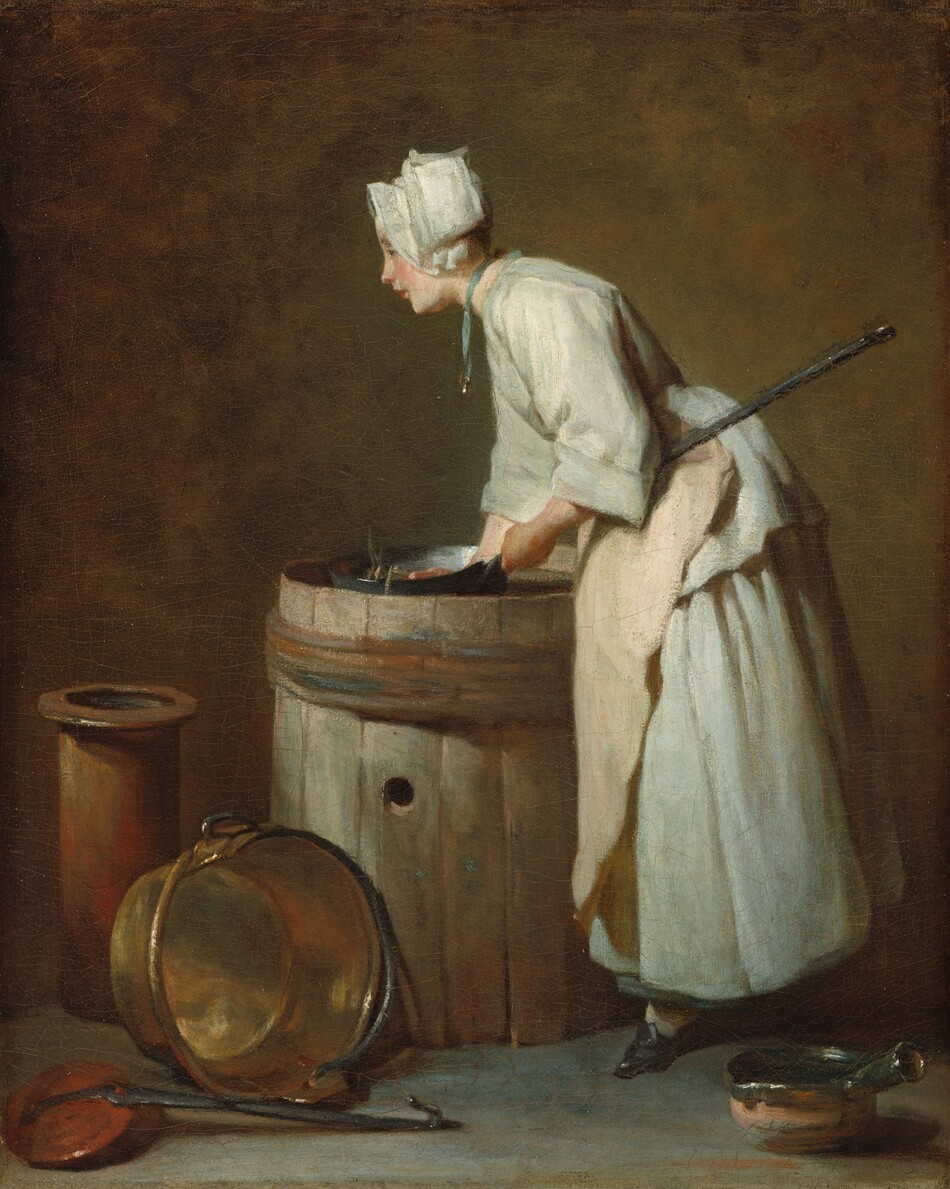
A pale-skinned young woman stands holding a long-handled pot over an open barrel in this vertical painting. The woman faces our left in profile and leans slightly over the thigh-high barrel. The barrel is tinged with moss green, and it has a hole in the side facing us. The woman’s smooth cheeks and lips are tinged with rose red. She has a slender nose, and she looks off to our left with brown eyes. Her jacket, long skirt, and cap are all white, and her apron is light peach. A gold object, like a pendant or bell, dangles from a teal-blue ribbon around her neck. The long handle of the pot is tucked under her bent left arm, and she grasps the handle where it attaches to the pan. Her right hand reaches into the pot, which dips down beneath the lip of the barrel. The woman and the barrel take up most of the height of the composition. Clustered on the floor to the left of the barrel are three vessels, including a tall cylindrical container painted in copper brown with crimson-red streaks, a large brass pot lying on its side so we see its shiny interior, and brick-red pan with a long iron handle that ends in a hook. To our right, a peach-colored clay pot with bands of forest and sage green sits on the floor just behind the woman, with its short handle angled to our right. Light coming from the upper left glints on the edges and interiors of the pots and illuminates the woman. The floor is washed with laurel green and spruce blue, with strokes of mustard yellow. The back wall is mottled in caramel brown and smoke gray.

The Scullery Maid

Jean Siméon Chardin

c. 1738

Oil on canvas  Accession ID  2014.79.708

On View: West Building Main Floor, Gallery M53

Loading Results