French Paintings

Filter Results

110 artworks on view.

Results

Shown from the knees up, a woman stands facing and looking at us with her head tilted a little to our left in this vertical portrait painting. She has pale skin, a heart-shaped face with rosy cheeks, and a rose-pink bow mouth. Thin, arched, sable-brown eyebrows frame her gray eyes. A wreath of pale pink flowers and curling white ostrich feathers crowns her long gray hair, which is piled high on her head. Loose curly tendrils brush both shoulders. Her glowing, silver satin gown is trimmed with delicate sheer lace around the wide, plunging neckline and sleeves, and has a pink sash around her narrow waist. Pearl bracelets adorn her wrists. She leans to her left, our right, to rest her left elbow against a waist-high, cinnamon-brown stone pedestal, which is decorated with a bronze-colored garland and bow on the side facing us. A ring of blue, yellow, red, and pink flowers, woven with strands of ivy, dangles in the hand resting on the pedestal. Her right hand hangs loosely by her side. Along the left edge of the dimly lit background, a tree with a thick trunk angles into the upper left corner. A smaller sapling grows just in front of it. On the right, bushes with olive and fern-green leaves dotted with lilac-purple flecks rise above the pedestal. Dark clouds fill most of the top third of the canvas but they part around her head to reveal the soft blue sky. The artist signed and dated the work in white in the lower right corner, “L. Vigée Le Brun 1782.”

Madame du Barry

Élisabeth Louise Vigée Le Brun

1782

Oil on canvas  Accession ID  2014.136.36

On View: West Building Main Floor, Gallery M54
We look across a sun-drenched canal lined with boats and cream-white buildings under a vivid blue sky in this horizontal landscape painting. A broad, blue swath of water stretches across the lower third of the picture. White, balconied buildings with terracotta-red tiled roofs face the canal on both sides. Closest to us, to our left, a shallow skiff holds a man in a red cap who holds a large rust-red and white sail stretched out along his boat. Behind him is a cluster of other boats, one with a tall, bare mast and two red-capped sailors. On our right, a partially submerged wooden platform provides a resting spot for three swimmers. Beyond them, the blue canal extends toward a hazy distance, where a white tower points up into white clouds. The canal presumably curves around a corner, because our view is enclosed in the distance by a band of buildings and a bridge, which are loosely painted. A bright blue sky, dotted with wispy white clouds, stretches across the top two-thirds of the scene.

The Grand Canal

Richard Parkes Bonington

1826/1827

Oil on canvas  Accession ID  2001.87.1

On View: West Building Main Floor, Gallery M91
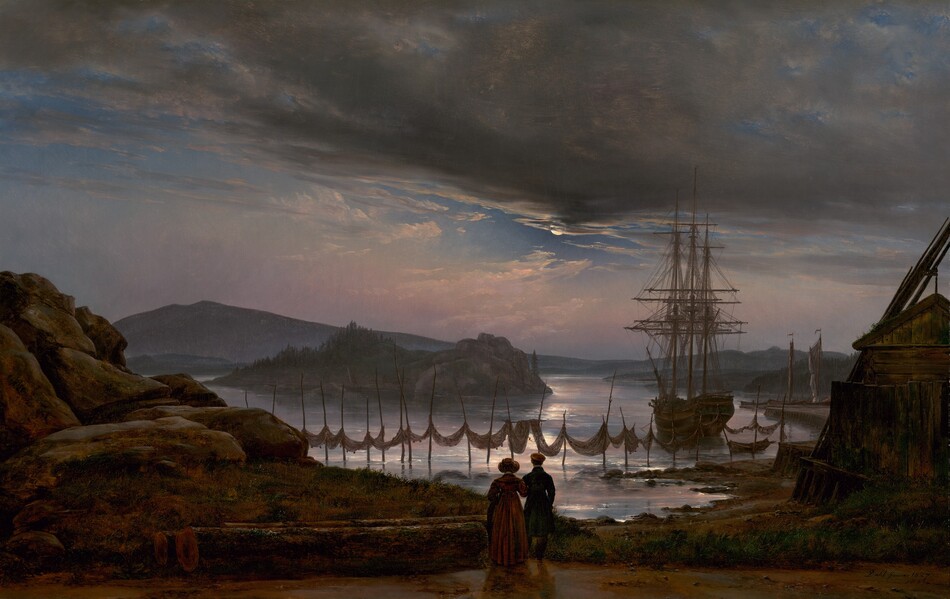
A man and woman stand look away from us toward a moonlit, rocky, coastal inlet with misty, midnight-blue mountains along the horizon in this shadowy, horizontal landscape painting. The sky fills the top two-thirds of the painting, and the people are small in scale against the landscape. Along the horizon, pearl-white clouds float against a lilac-purple and pale pink haze. The sky deepens to ultramarine blue above, and a band of nickel-gray clouds sweeps in across the top edge of the painting to partially obscure the bright white moon, to our right of center. The moonlight gleams on the water below, which winds around the rocky coastline and small islands dotted with trees. Closer to us, the land stretches across the lower edge of the composition. Hulking, rocky formations line the left edge of the painting, and a wooden structure with mossy growth along its roof sits to our right. Long poles lean against the building’s roof. At the lower center of the painting, the woman, to our left, links her arm through the man’s elbow. She wears a long, rust-brown dress and a broad brimmed bonnet, while he wears a dark, knee-length coat and a round cap. They stand near the water’s edge, silhouetted against the bright reflections of the soft purple and pink sky above. Out in the water but close to the shoreline, brown nets hang like slings from a line of twenty-three, irregularly spaced poles. A three-masted ship is anchored near the shore to our right. Two rowboats, one with a person inside, and a few more sailboats are pulled up along a dock beyond the ship. The artist signed and dated the painting in the lower right, “Dahl Januar 1827”.

View from Vaekero near Christiania

Johan Christian Dahl

1827

Oil on canvas  Accession ID  1999.99.1

On View: West Building Main Floor, Gallery M91
A person, tiny in scale, walks along a path between two grassy mounds that lead back to a band of brown buildings that span the width of this horizontal landscape painting. The grassy mounds are covered with frosty and spring green growth, with a few patches of ivory-white dirt. The person wears a brimmed, straw-yellow hat, a long-sleeved white shirt, knee-length brown pants over white stockings, and a red garment slung over one shoulder. He walks away from us toward a tunnel that runs alongside the right-hand mound, into the heart of the town beyond. The buildings are oatmeal brown, beige, or muted red, and have gray roofs. We can see into a few buildings closest to us. To our left, strokes of parchment brown suggest laundry hung across an open space inside one structure. Plants grow over the wide central arch of a partially ruined building beyond this, also to our left. Other buildings are stacked and staggered along the rolling hills into the distance. In the top third of the painting, thin white clouds float across a pale blue sky.

View of the Cloaca Maxima, Rome

Christoffer Wilhelm Eckersberg

1814

Oil on canvas  Accession ID  2004.75.1

On View: West Building Main Floor, Gallery M91
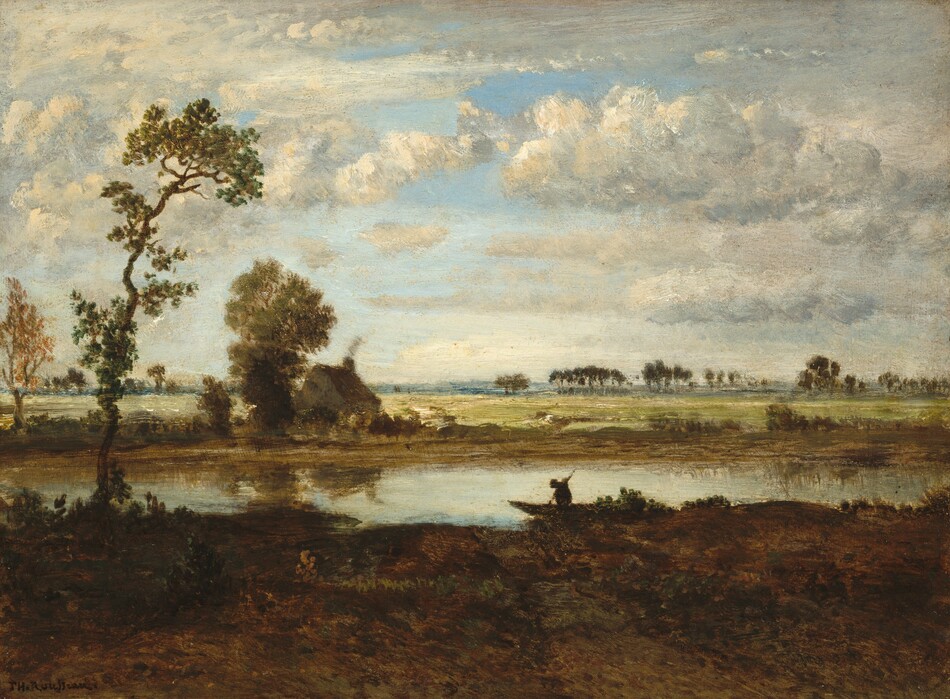
The painting shows a landscape with a calm body of water stretching across the center, beyond a brown bank of rocks and short green grass. A thin tree rises up on the left. To the right of center, a person can be seen on a boat, silhouetted against the blue water. Beyond the water are flat green fields with distant trees. To the left of center, a small gray house can be seen next to a tall tree, wisps of gray smoke rising out of its chimney. The sky above is blue with large clouds in shades of light gray and white, and the distance is illuminated by pale light. The water reflects the blue and white of the sky, along with the green and brown of the house and the distant bank.

Landscape with Boatman

Théodore Rousseau

c. 1860

Oil on wood  Accession ID  1949.1.10

On View: West Building Main Floor, Gallery M92
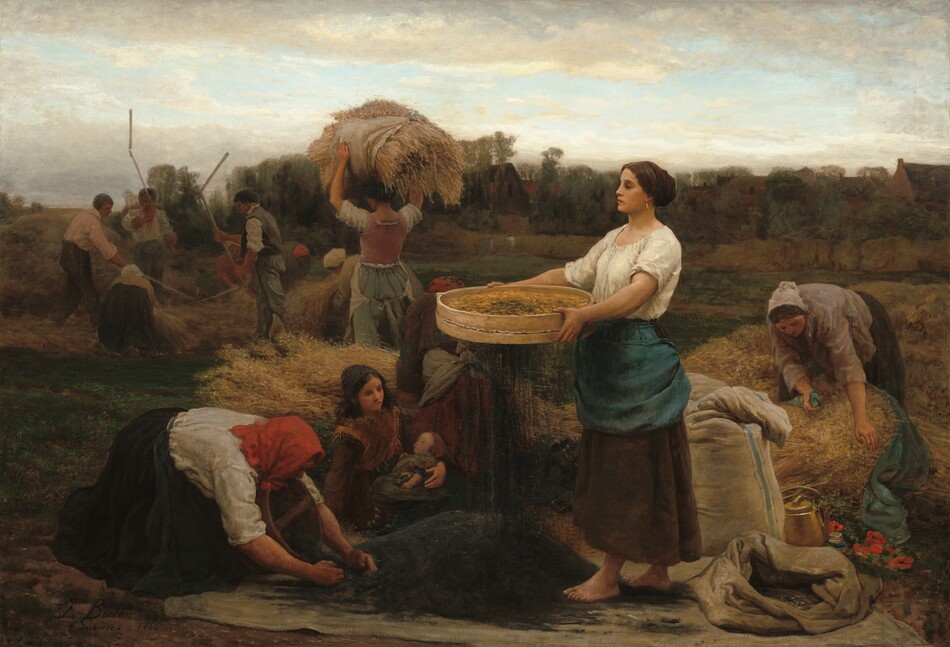
About a dozen women and men, all with pale or suntanned skin, work in a field harvesting grain in this horizontal painting. The women wear long skirts and aprons, and some wear cloths tied around their heads. The men wear long-sleeved shirts rolled up to the elbow and long pants. Closest to us and to our right of center, a woman stands facing our left in profile, holding a large, round sieve. Her dark hair is pulled back, and she wears a gold-colored, teardrop-shaped earring in the ear we can see. The sleeves of her white blouse are rolled up and a teal-blue apron is tied over a brown, ankle-length skirt above bare feet. Black seed pours from the sieve, which she holds in front of her with arms wide, onto a cloth below. To our left, a woman wearing a dark skirt, a white shirt, and a red head covering kneels on the cloth and scoops the black seed into a bucket. Next to her, a girl wearing a brown dress sits on the cloth and watches the seed cascade down as she holds a baby or a doll in her lap. One white bag stands upright behind the woman holding the sieve, while a second bag has been depleted. A brass-colored tea kettle sits between the bags with a vessel, possibly ceramic. Vivid red flowers in that area could be a patch of poppies in the field. A woman behind this group, to our right, wraps a big bundle of stalks in a blue sack while another woman, to our left, carries a bundle of the rapeseed stalks balanced on her head with both hands. A group of men beyond her work in a circle, holding long scythes with straight blades overhead. Another woman kneels with her back to us and others work, hunched over, around the men. The field is enclosed by band of pine-green trees surrounding houses and barns. Gray clouds cover much of the pale blue sky above. The artist signed and dated the work in dark paint in the lower left corner: “Jules Breton Courrieres 1860.”

The Colza (Harvesting Rapeseed)

Jules Breton

1860

Oil on canvas  Accession ID  2014.136.21

On View: West Building Main Floor, Gallery M93
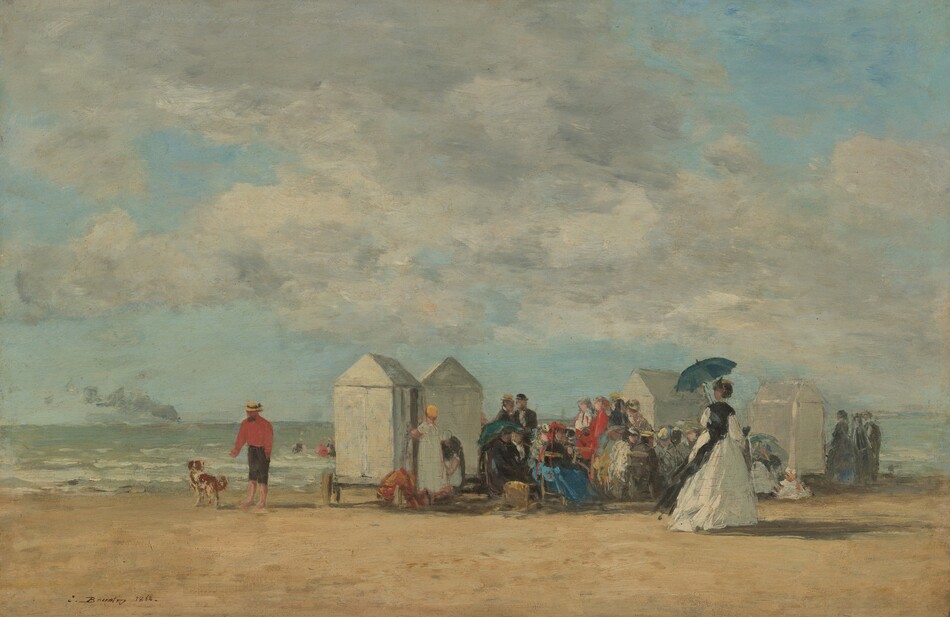
The painting shows a beach scene with several people gathered on the shore. The people are gathered between four white tent-like structures in the center of the painting. All the people are elaborately dressed in colorful gowns or suits, with many wearing hats or holding parasols. Behind the group is the ocean, with a few people swimming on the left. The color scheme includes earthy tones for the sand and beach huts, and brighter colors like whites, blacks, blues, and reds for the people's clothing. The sky is predominantly painted in soft blues and grays with some wispy white clouds.

Beach Scene

Eugène Boudin

1862

Oil on wood  Accession ID  1983.1.13

On View: West Building Main Floor, Gallery M92
This painting shows two people. A woman is leaning over a seated man from the left, with one arm around his shoulder and holding a basket of fruit in her other hand. Her head is slightly tilted as she looks down at the man. She has curly brown hair partially covered by a blue headscarf with a lace border. She wears a white dress with puffed sleeves and a gold necklace, as well as a red cloth draped over one shoulder and down her back. The man is seated at a desk with his body angled slightly to the left, looking upwards toward the woman. He has dark brown sideburns and dark hair. He is dressed in a dark coat with a light-colored waistcoat and a light gray cravat. Both people have pale skin. On the desk are several books, papers, and writing implements, including ink and a wax seal. The man is holding a quill pen in one hand and turning the page of a book with the other. The background features pale greenish drapery and a wooden paneled wall with what looks like a map hanging on the right.

The Cartographer Professor Josef Jüttner and His Wife

Ferdinand Georg Waldmüller

1824

Oil on wood  Accession ID  2006.157.1

On View: West Building Main Floor, Gallery M92
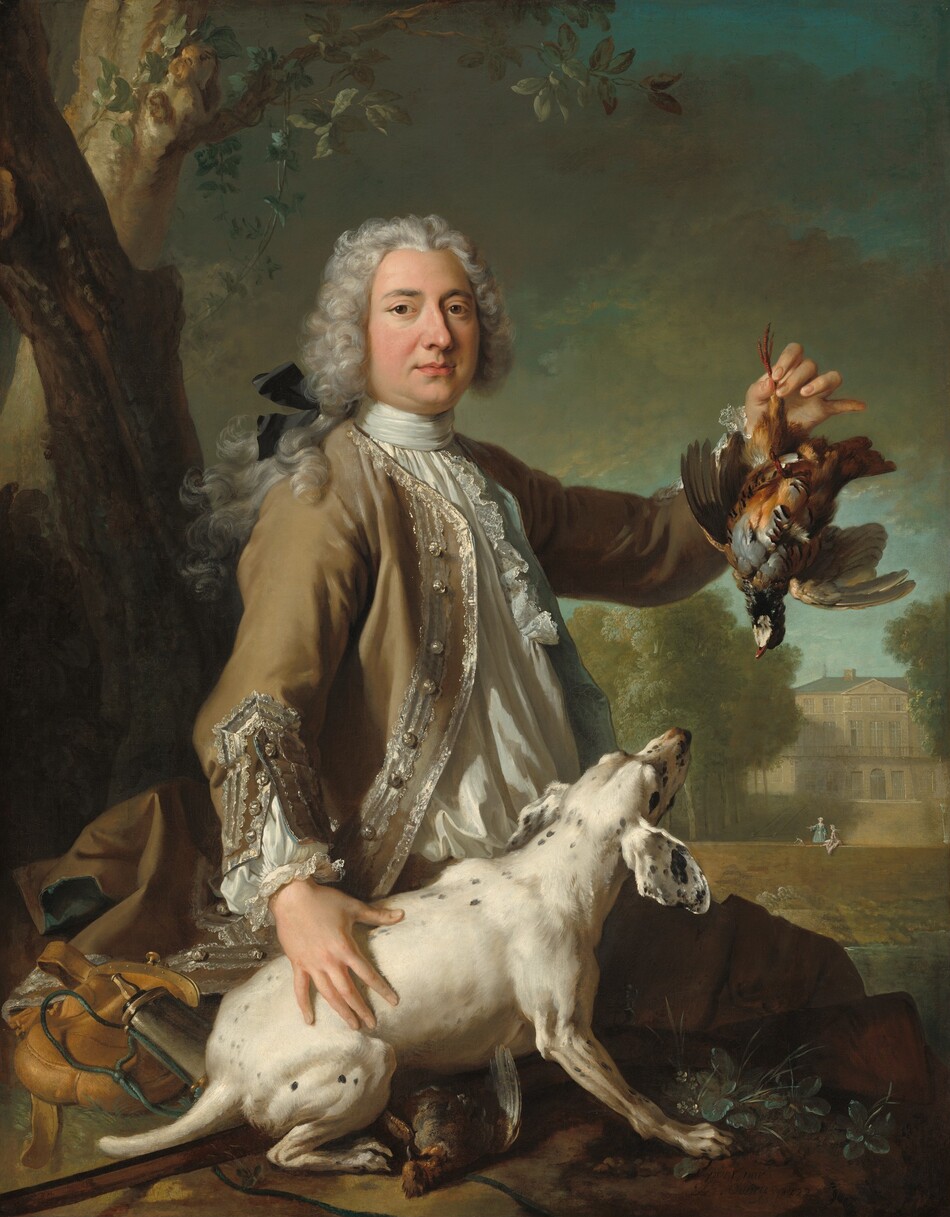
Sitting on a rock and shown from the lap up, an elegantly dressed, light-skinned man holds up a partridge by one leg and sits next to a dog, all against a landscape with trees and a stone manor house in this vertical portrait painting. On the far side of the rock, the man’s legs angle away from us to our right, but he turns his torso to look at us with brown eyes under dark brows. His nose has a bump near the bridge, and his full, pink lips are closed. His rounded cheeks are slightly flushed, and he has a bit of a double chin. His hair curls around his face from a widow’s peak on his forehead, and locks are tied back with a black silk bow. His white shirt is pleated vertically across the front below a high collar, which wraps around his neck. Lace lines the front of the shirt down the chest and the cuffs at the end of puffy sleeves. His camel-brown jacket is lined with topaz blue and edged with silvery lace down the front and at the unbuttoned cuffs. His brown pants are lost in shadow beyond the rock on which he sits. In his raised left hand, on our right, the partridge dangles from one red leg, its brown wings spread and its head hanging back. By the man’s right side and closer to us, the dog is white with a few black spots. It has large floppy ears and a short tail. It crouches on its hind legs, angled to our left, and braces itself on its front paws, looking up at the bird. A second dead bird lies on the rock under the dog’s poised body. A few tufts of plants and grasses grow out of the rock next to the dog’s front feet, and behind the dog and man is a fawn-brown sack and a cylindrical vessel with a spout, a powder horn. Two trees grow beyond the rock, up the left edge of the canvas. To our right, in the distance, two women talk near a low wall. One wears an aquamarine-blue dress and gestures with arm outstretched to our left, and the other, in pale pink, sits looking up at her companion. Beyond, trees line the drive up to the three-story manor house. The middle story is lined with notably tall windows, like a series of French doors. Steel-gray clouds against a few glimpses of turquoise-blue sky fill the top half of the painting above the house. The painting is signed and dated in the lower right corner: “peint par JB. Oudry 1722.”

Henri Camille, Chevalier de Beringhen

Jean-Baptiste Oudry

1722

Oil on canvas  Accession ID  1994.14.1

On View: West Building Main Floor, Gallery M53
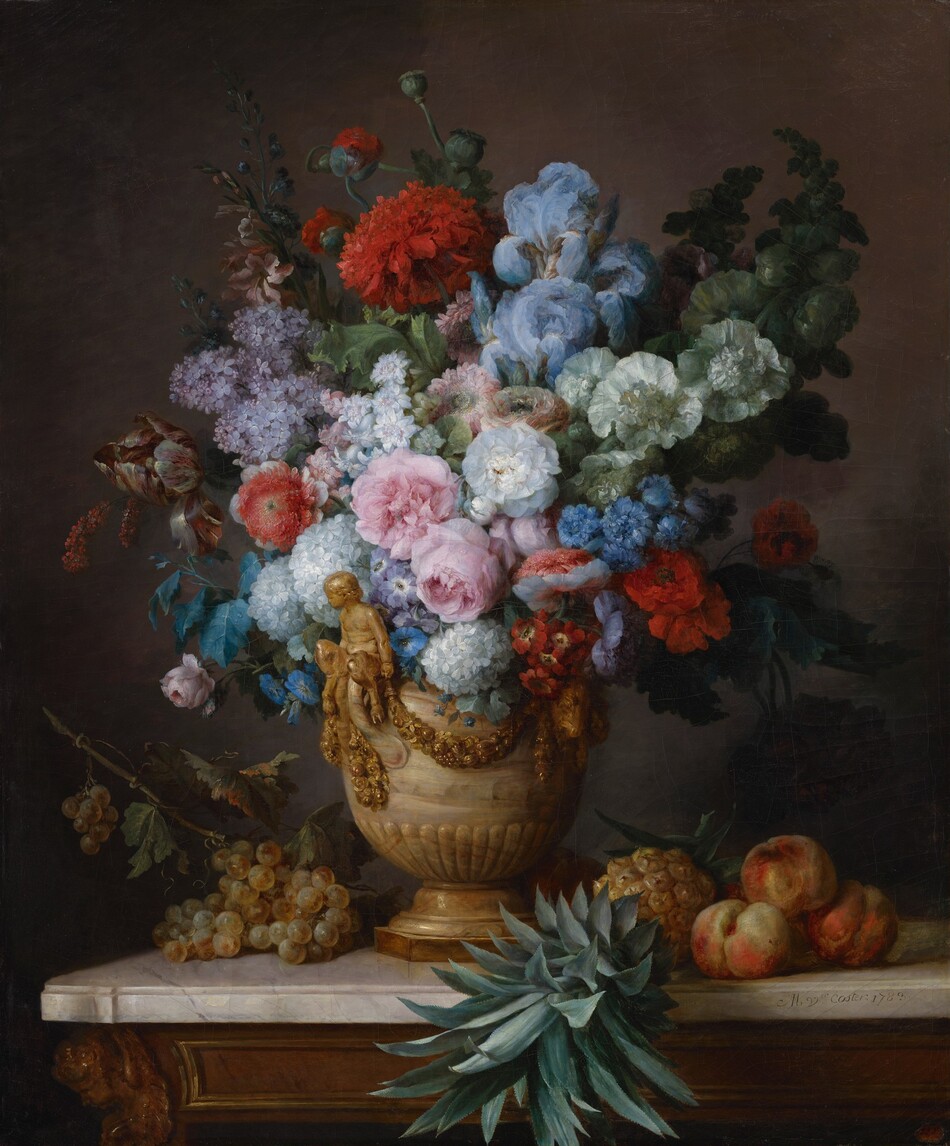
This painting features a large ornate vase overflowing with an arrangement of colorful flowers, including roses, peonies, and poppies. The color palette is vibrant and varied, with hues of red, pink, blue, purple, white, and green. Positioned in the center, the vase is adorned with gold embellishments, including a small carving of a person on its front. The vase stands on a marble surface that also holds a pineapple and peaches to the right. Several leaves and clusters of green grapes rest on the left side of the marble. The light source is at the upper left, illuminating the flowers and casting dark shadows behind them. The background of the painting is dark gray.

Still Life with Flowers in an Alabaster Vase and Fruit

Anne Vallayer-Coster

1783

Oil on canvas  Accession ID  2023.40.1

On View: West Building Main Floor, Gallery M56
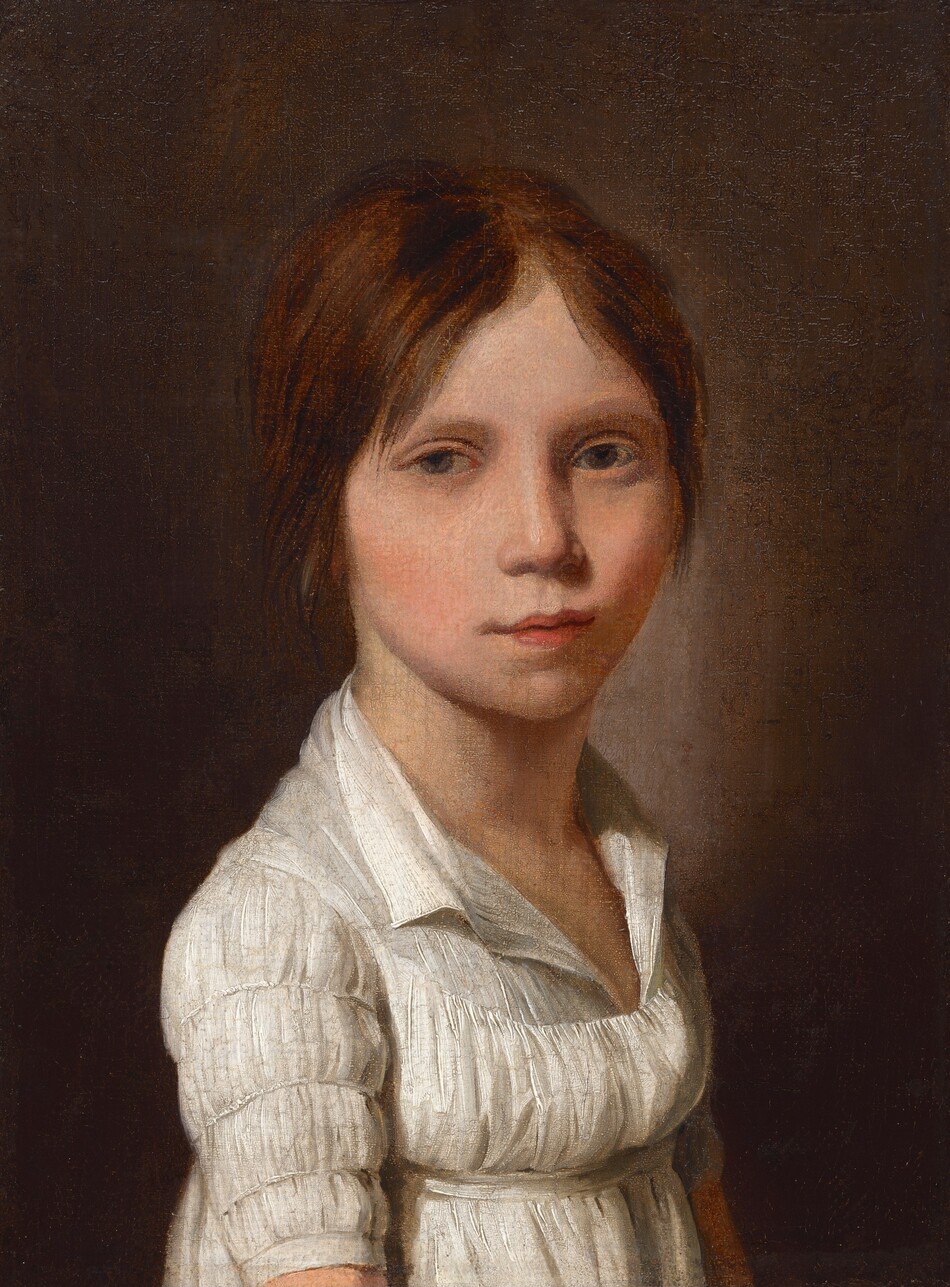
Shown from the waist up and in front of a dark background, a pale-skinned girl looks over her shoulder at us in this vertical portrait panting. She has wide-set hazel eyes under curved brows, a delicate nose, flushed cheeks, and her narrow, pink lips are closed over a pointed chin. Her brown hair falls in bangs to either side of her forehead and is otherwise pulled back. Her body is angled to our right almost in profile. Her white garment has a low neckline, high waist, and short, ruched sleeves. White fabric tucked into the neckline opens out to each side like a collar. The shadowy brown background behind her glows a little brighter around her head and neck.

Caroline Mortier de Trévise

Louis-Léopold Boilly

c. 1810/1812

Oil on canvas  Accession ID  1963.10.2

On View: West Building Main Floor, Gallery M92
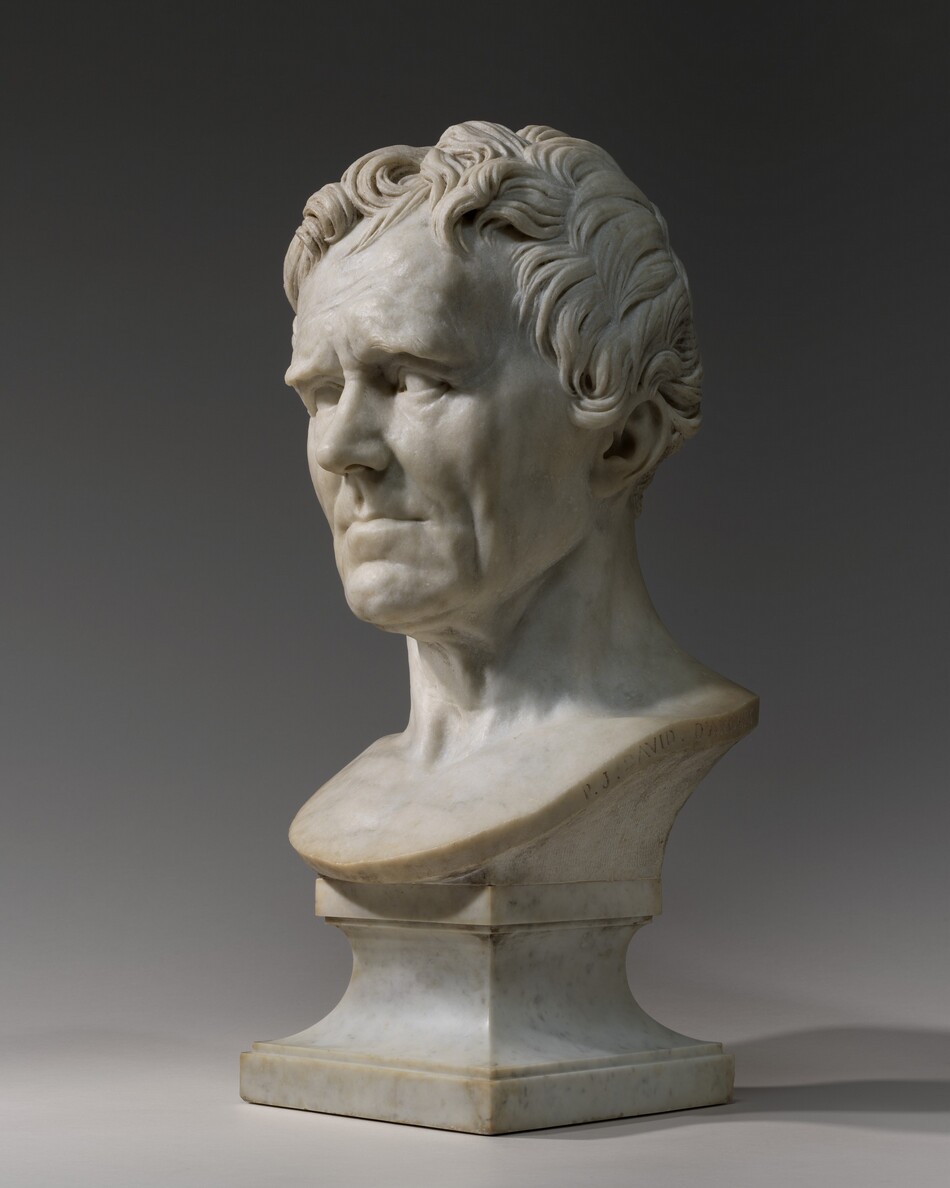
The head and neck of a clean-shaven man with short, curly hair has been carved from white marble in this freestanding sculpture bust. In this photograph, the man’s face is angled to our left. His forehead is lined, and his brow is deeply furrowed. He has a short, straight nose and a deep dimple in his philtrum over his thin upper lip. His mouth is closed in a line, and a crease cuts through his soft cheek on the side closer to us. His hair is swept forward over his high forehead. The tendons stand out in his neck, and the curved bottom edge of the bust sits on a square pedestal with an inward-curving cove. The sculpture is photographed against a gray background.

Comte Antoine Boulay de la Meurthe

Pierre-Jean David d'Angers

1832

Marble  Accession ID  2017.116.1

On View: West Building Main Floor, Gallery M56

Loading Results