French Paintings

Filter Results

110 artworks on view.

Results

This is a painting featuring multiple people in an interior setting. To the left of the center, a bearded man stands, wearing a long red robe draped over a yellow shirt or tunic. His body faces us, but his head is turned to the right, where he gestures with one outstretched hand. In front of him, a crying child in a pale blue robe has his back to us and grabs the man's other wrist. The standing man is gesturing towards a seated woman the right, who has her head resting on one hand, a tear falling down her face and her eyes closed. She is wearing a white dress with a yellow shawl that drapes over her blonde hair and down her back. A naked crying child stands between her legs, clinging on to her arm. On the far right is a second seated woman who wears a red dress with a similar yellow shawl. This woman has dark brown hair, and she looks up towards the standing man from under furrowed brows. She, too, is crying. Her left arm rests on a table behind her which is draped with a blue cloth. On top of this table is an ornate silver helmet with a red interior and a large silver plume topped with red. On the far left, two men stand in front of a green curtain. One of them is turned away from the central man and has his head in his hands. He wears a blue robe. The other man has a dark beard, and he looks toward the central man, his brows furrowed and eyes wide. He wears a light purple tunic with an orange cloth over it. All of the people in the painting have pale skin. The ground beneath the people is made of rectangles of blue-gray stone, and the walls are light blue, with the plaster or paint chipped in places to reveal brown bricks. On the right, beyond the table with the helmet, there is an opening into another room. To the left of this opening is a short white column with a small reddish-brown statue of a wolf on it. In the upper left corner is an arched opening that leads outside, where another cluster of people is visible, along with white buildings, olive green trees, a tall gray mountain, and a cloudy sky in shades of yellow, orange, and pale purple.

Coriolanus Taking Leave of his Family

Anne-Louis Girodet de Roussy-Trioson

1786

Oil on canvas  Accession ID  2019.169.1

On View: West Building Main Floor, Gallery M56
Boulders hulk at the center of a dense forest in this horizontal landscape painting on paper. A clearing along the bottom edge of the composition leads to a person facing away from us while standing at an easel. One hand is lifted to the canvas or paper on the easel, and the person wears a light gray coat. A light brown dog sits attentively at the artist’s back. Sunlight falls from an unseen opening in the canopy onto the boulders, which glow caramel brown and slate gray, and trees curve up and over to enclose the artist and rocks. The scene is loosely painted in earthy greens, and brushstrokes are especially visible in the boulders and the vegetation making a screen in the background.

Forest Interior with a Painter, Civita Castellana

André Giroux

1825/1830

Oil on paper  Accession ID  1994.52.3

On View: West Building Main Floor, Gallery M92
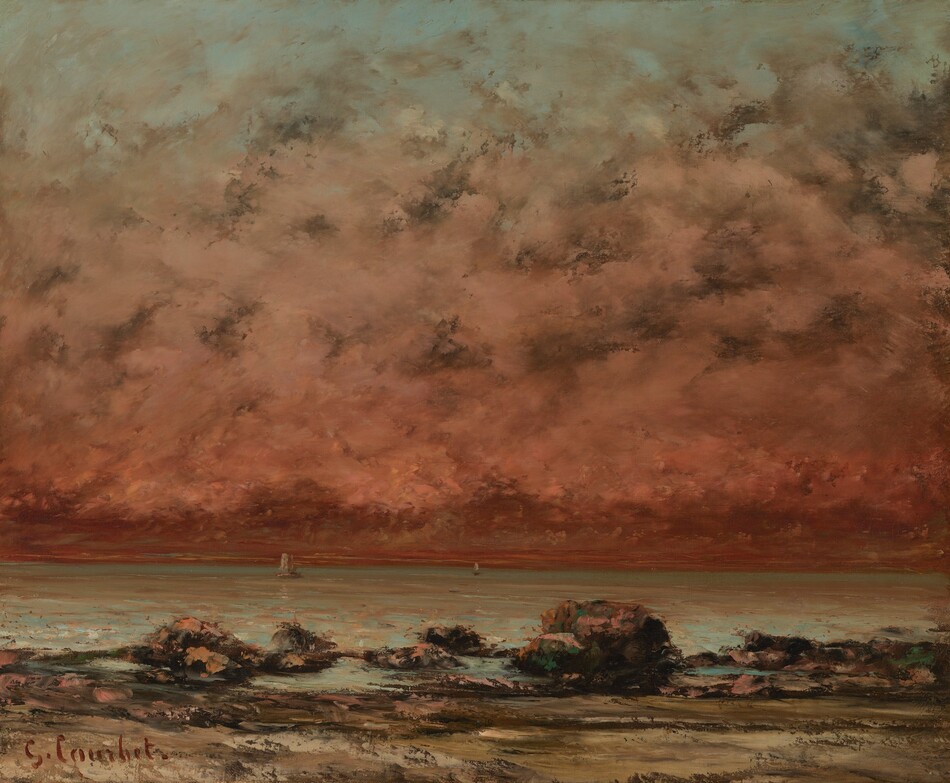
We stand on a beach lined with black rocks and boulders looking out onto the water below a brick-red sky that dominates this nearly square landscape painting. The sky along the top edge of the canvas is turquoise but it quickly fades to rich, salmon pink and then to deep red along the horizon, which comes only a quarter of the way up the composition. Steel-gray clouds ripple across the width of the painting. Two sailboats float in the water in the far distance. The water is painted the same turquoise of the sky with some reflections of the deep pink and red. Close to us, water breaks around the jagged black rocks beyond the a strip of mustard-yellow and tan sand that lines the lowest edge of the canvas. The artist signed the work in dark red paint in the lower left corner: “G. Courbet.”

The Black Rocks at Trouville

Gustave Courbet

1865/1866

Oil on canvas  Accession ID  2011.51.1

On View: West Building Main Floor, Gallery M92
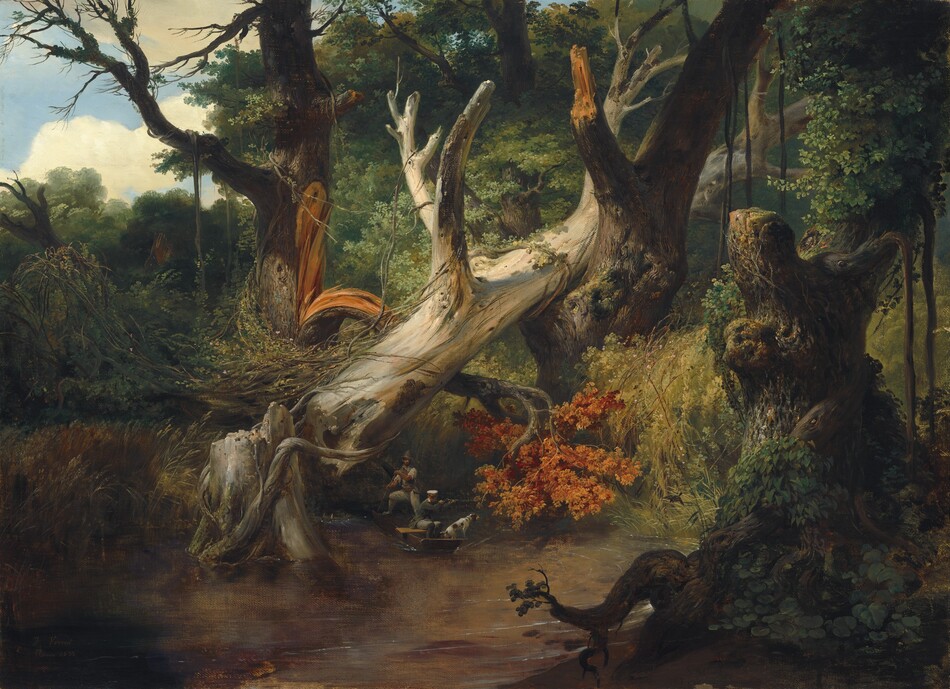
A leafless, ash-white tree trunk has fallen from a broken stump into the wide V of a neighboring tree at the edge of a body of water near a verdant forest in this horizontal landscape painting. The fallen trunk creates a diagonal from near the lower left corner to the upper right. As it fell, it sheared off a substantial branch from a neighboring tree with a dark trunk. The bark where the damaged branch has pulled away is honey-orange, the same color as the leaves at the canopy, which has been pinned under the fallen trunk. Trees, vines, and other vegetation fill the space around and beyond this pair. In the lower right corner of the painting, vines grow over a broken stump, which deep in shadow. Between the stump and fallen tree, the peanut-brown surface of the water is smooth. Tiny in scale beneath the fallen tree and easily overlooked, there are two men and a dog in a boat. One man stands at the back of the boat and pushes it along with a long pole. He wears a tall, brown, cloth hat, a white shirt rolled up to the elbows under a blue vest, and loose-fitting pants. A second man wears a flat-topped, white hat with a black brim, a long, forest-green jacket, and tight-fitting slate-blue pants. He braces a rifle against one shoulder and shoots into the forest. The dog is white with brown spots, and it stands with its front paws on the edge of the boat, presumably ready to spring after the target. A patch of blue sky with puffy white clouds is seen above the trees in the upper left corner. The artist signed and dated the work in the lower right corner: “H. Vernet Rome 1833.”

Hunting in the Pontine Marshes

Horace Vernet

1833

Oil on canvas  Accession ID  1989.3.1

On View: West Building Main Floor, Gallery M93
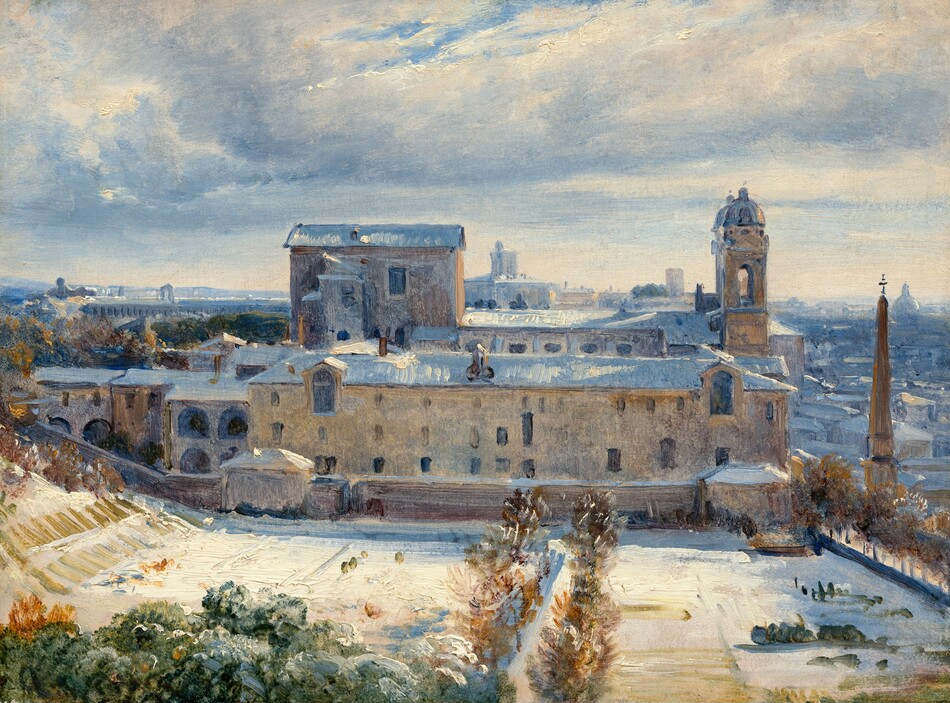
From a high vantage point, we look across a snow-covered expanse at the long side of a pale, parchment-colored building with a town beyond in this horizontal landscape view. The scene is painted loosely and mostly in tones of icy blue, cream white, golden tan, and brown. Closest to us but far below, a hedge of moss-green treetops lines the sun-drenched, ivory-white field. The field slopes up to our left and a path, between two rows of cinnamon-brown trees, leads from the bottom center of the painting to the building. Four stories of mostly rectangular windows pierce the wall of the building in front of us. Shadows on the snow-covered roof are painted with thick strokes of steel blue. On the other side of the building, a second long roofline runs parallel to the first. The short side of the building, to our right, has a tower at each corner. A fawn-brown obelisk, which is a tapering, pointed column, is topped with a cross and stands in front of the building façade. Stacked and overlapping rooflines, painted broadly in azure blue and silvery gray, fade toward the distant horizon, which comes halfway up the canvas. A blanket of white clouds with arctic-blue bottoms sweep across the sky, revealing only a few small patches of vivid blue sky beyond.

Santa Trinità dei Monti in the Snow

André Giroux

1825/1830

Oil on paper on canvas  Accession ID  1997.65.1

On View: West Building Main Floor, Gallery M91
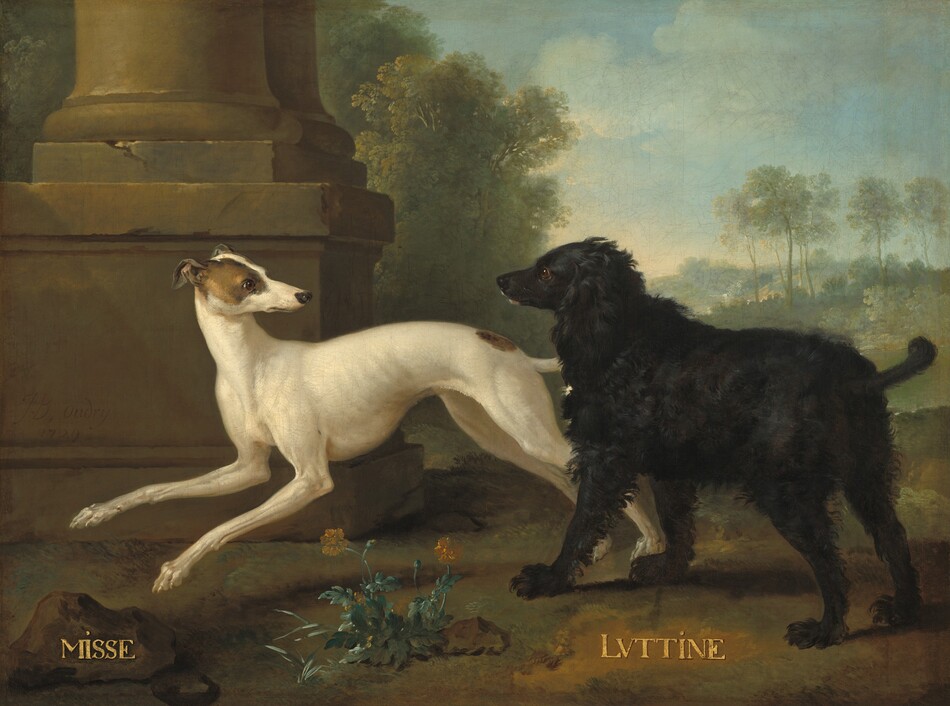
Two dogs, one with short white hair to our left and one with longer black hair to our right, stand in front of the base of a pair of columns set in a landscape in this horizontal painting. Both dogs stand with their heads to our left. The short-haired grayhound to our left leaps or is shown midstride with its front paws off the ground as it turns to look behind it, to our right. It has cream-colored fur with tawny brown spots near the base of its thin tail and covering its right eye and ear. The dog has a long, pointed snout, and its ribs show a little through its thin frame. To our right, the furry black dog has long ears, a short tail, and small white spots on its chest and lower lip. It stands planted on all four feet, looking at the grayhound with brown eyes. The tails of both dogs are raised as if in play. The caramel-brown, stone column base behind the grayhound is chipped and cracked in a few places, but supports a pair of columns that rise off the top edge of the canvas. The landscape beyond the dogs is painted with muted moss-green trees and a pale blue sky. A plant, possibly a marigold, grows from the scrubby green ground under the white dog. Names are written with capital, shiny gold letters under each dog. The name “MISSE” is written against a rock in the lower left corner and “LVTTINE” under the black dog. The artist signed and dated the work as if written on the face of the column base: “J.B, Oudry 1729.”

Misse and Luttine

Jean-Baptiste Oudry

1729

Oil on canvas  Accession ID  1994.53.1

On View: West Building Main Floor, Gallery M53
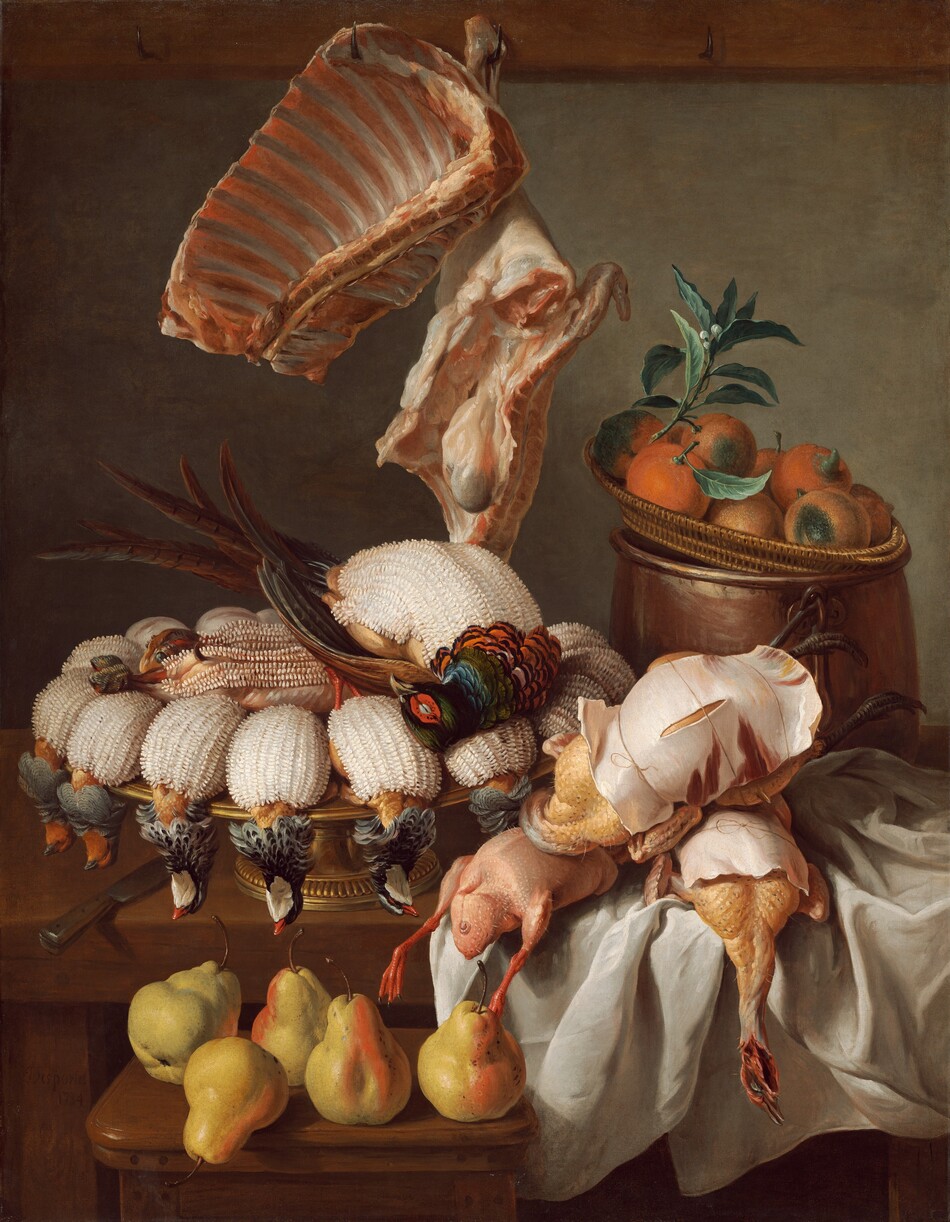
This vertical still life painting shows a display of dead pheasants, slabs of meat and ribs, and fruit, all arranged on a tabletop close to us. Five golden pears sit on a wooden stool in front of the table, to the left of center. More than a dozen pheasants are arranged belly up on a gold platter with pedestal foot on the table to our left. Their plucked bodies are covered with a layer of white, textured lard while the feathers on their heads and neck are left intact. Two of the three fully plucked birds stacked on a tousled white tablecloth to our right are wrapped in what looks like paper at first glance but turns out to be thin slices of meat, and tied with twine. A woven wicker basket with at least eight oranges rests on the opening of a tall copper cooking pot to our right, behind the plucked birds. A rack of ribs and slab of meat with some entrails hang from hooks in a horizontal rail that is cropped by the top edge of the painting. The palette is dominated with warm browns, ochre, and white, with touches of green, orange, and blue.

Still Life with Dressed Game, Meat, and Fruit

Alexandre-François Desportes

1734

Oil on canvas  Accession ID  2012.11.1

On View: West Building Main Floor, Gallery M53

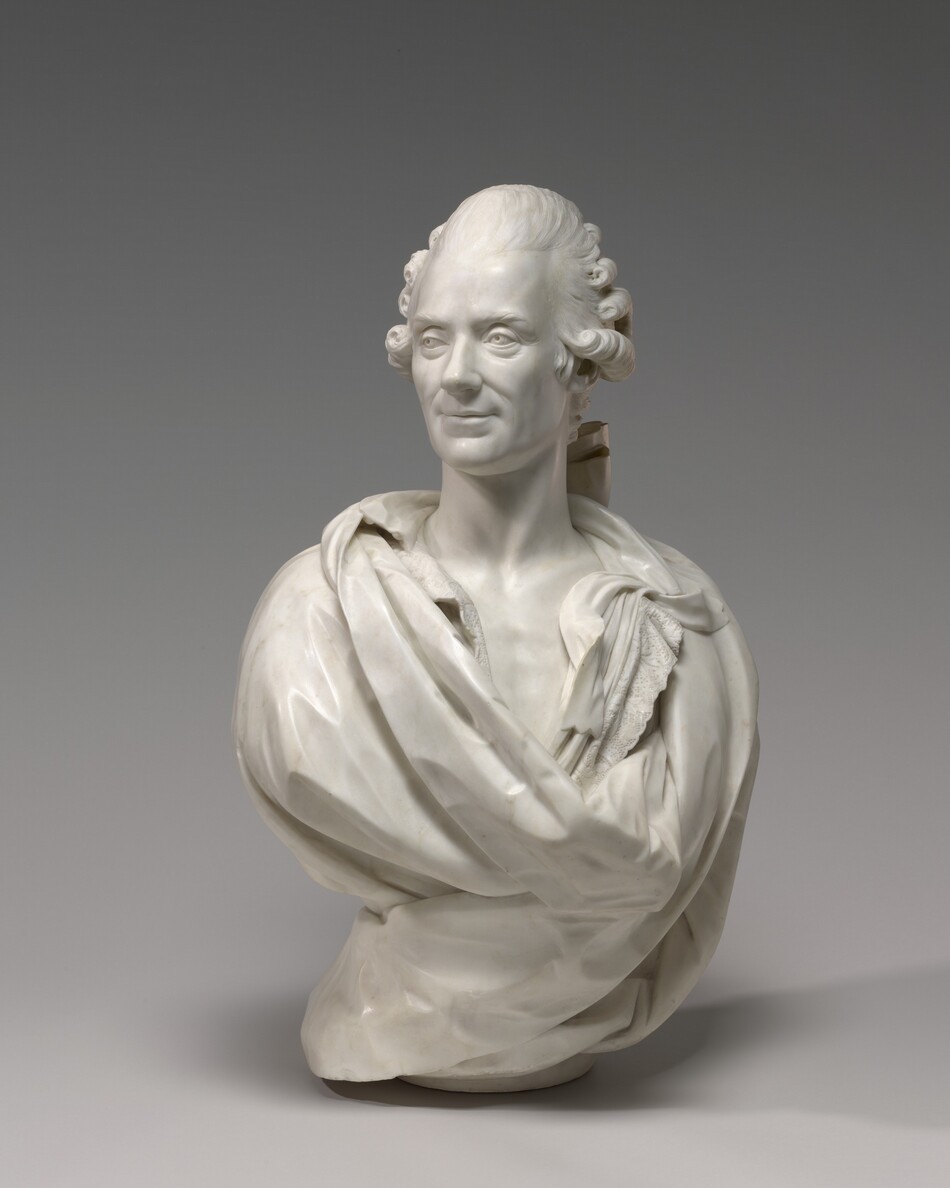
Jules-David Cromot, Baron du Bourg

Jean-Baptiste Lemoyne II

c. 1757

Marble  Accession ID  1985.39.1

On View: West Building Main Floor, Gallery M54
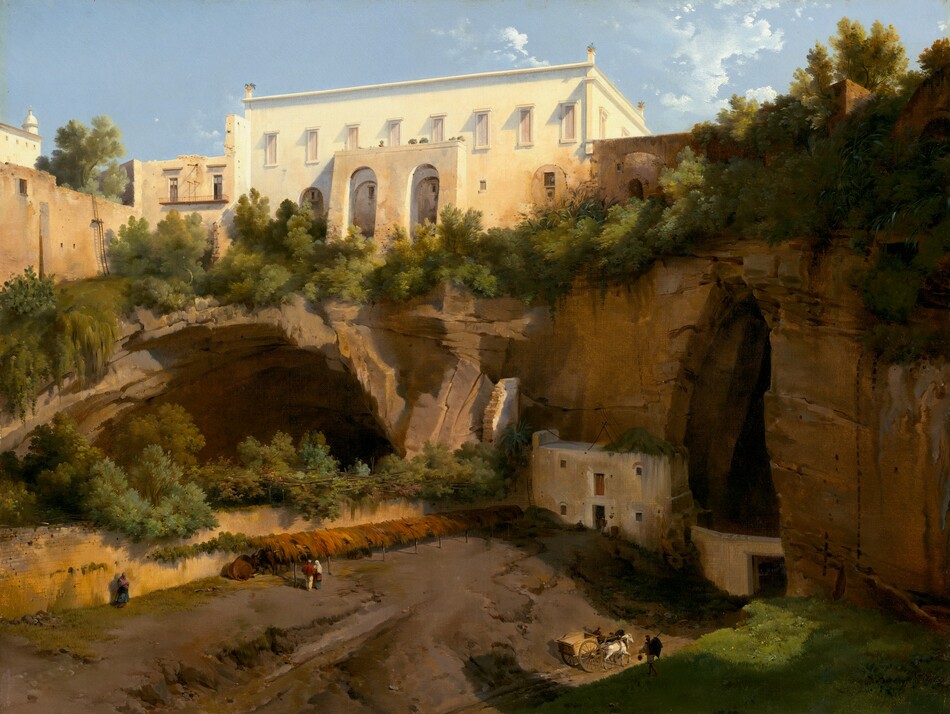
This painting shows a white and tan building on the edge of a rocky cliff, seen from slightly below. There are arched openings within the cliffside, with some other small buildings tucked into them. The ground is brown and covered with leafy greenery on the top of the cliff and in a cave on the left, with a patch of green grass in the bottom right corner. In the center, distant people and a horse-drawn cart walk on a path below the cliff, towards one of the openings. The sky above is blue with scattered white clouds.

View of a Villa, Pizzofalcone, Naples

Lancelot-Théodore Turpin de Crissé

c. 1819

Oil on canvas  Accession ID  1997.102.1

On View: West Building Main Floor, Gallery M91
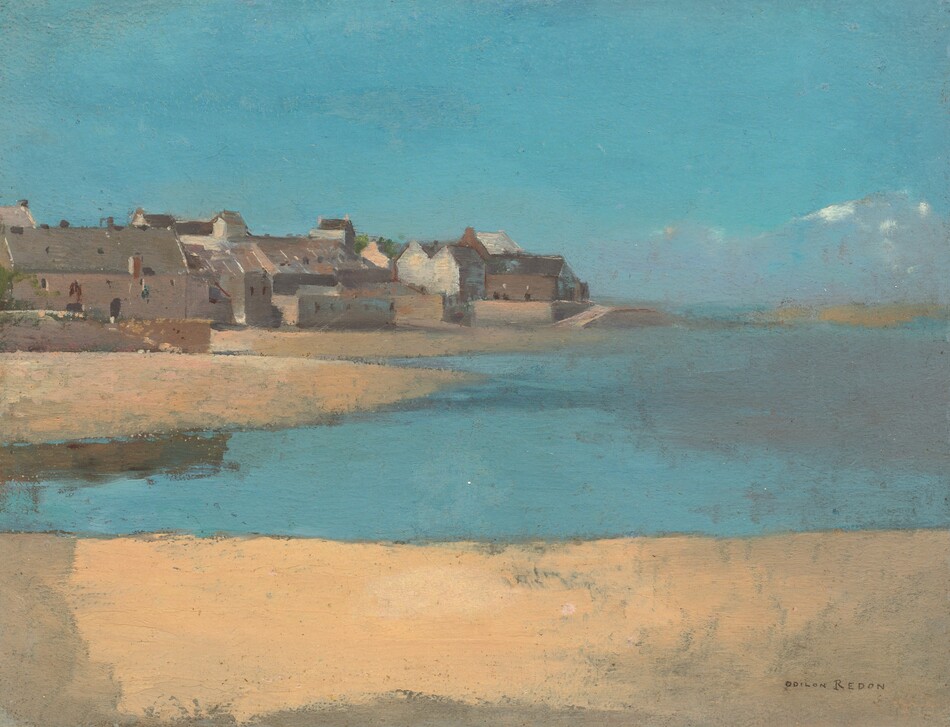
This painting depicts a coastal scene overlooking a quiet shore. At the bottom of the painting, an open sandy expanse leads to blue waters. On the other side of the water, to the left of the painting, is another shoreline with several small white and brown buildings. The buildings have pointed roofs, arched doors, and small chimneys. The sky behind the building is the same bright blue as the water, and on the right is the vague outline of a mountain range in light purple. The brushstrokes are soft and loose, and are especially visible in the shore, water, and sky.

Village by the Sea in Brittany

Odilon Redon

c. 1880

Oil on cardboard on hardboard  Accession ID  2012.89.7

On View: West Building Main Floor, Gallery M91
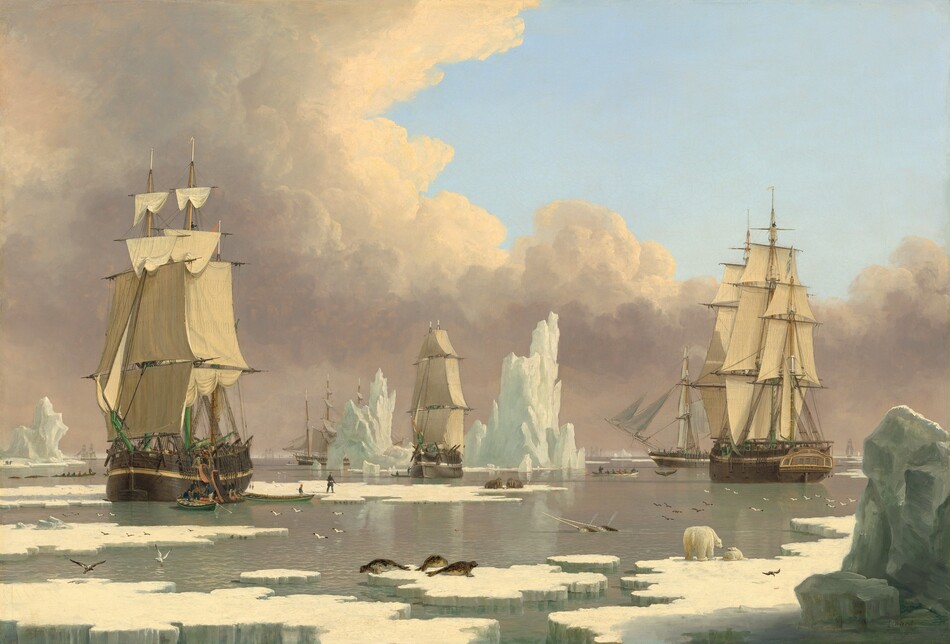
Three tall sailing ships, each with three masts and full sails, float in calm, arctic waters, surrounded by fragments of icebergs and ice floes amid a smattering of arctic animals in this horizontal landscape painting. The horizon line comes about a quarter of the way up the composition so the sails and rigging of the ships are shown against the sky. The clouds have ivory tops and lavender-purple undersides, and they curve in a C-shaped bank to cover most of the left half of the painting and to span the horizon. The three ships closest to us are spaced evenly across the composition, with the left-most the closest, and therefore the largest. The ship to our right is set a bit farther back, and the center ship is the farthest away. A rowboat holding several men has pulled alongside the boat to our left, and more men haul massive slabs of whale blubber up the side of the ship. Others walk on an ice floe nearby. Close inspection reveals more rowboats around and beyond these ships, and several more ships fading into the hazy distance along the horizon. Jagged edged chunks of icebergs as tall as the ships float around them. Closer to us, a trio of seals sits on an ice floe near the lower center of the composition, and a polar bear stands nose to nose with a cub to our right. Two narwhal whales with long tusks break the surface of the water between us and the ships, as does a whale’s tail near the boat to our right. Two walruses with long tusks sit on a floe near the center ship. A couple dozen birds, many white with black wing tips, fly low over the surface of the water across the painting.

The Northern Whale Fishery: The "Swan" and "Isabella"

John Ward of Hull

c. 1840

Oil on canvas  Accession ID  2007.114.1

On View: West Building Main Floor, Gallery M91
Perched on a rocky outcropping in the lower left corner of this landscape, a person sits with their back to us with a canvas near their knees, facing a moss-green, craggy mountain that fills most of our view this horizontal scene. The person wears a floppy-brimmed, straw-yellow hat and a teal-blue smock. He has cream-white pants and black shoes, and sits on a three-legged stool. A canvas rests on or just beyond his knees, and he holds one hand up to its blank surface. A tall, parchment-white umbrella is pitched next to him, to our right, to provide some shade. A few swipes of brick red, brown, and pinkish beige next to him could be bags or other materials leaning against a rock. He sits in the curve of the rocky outcropping, which is painted with dabs and swirls of olive green, butter yellow, and ginger brown. A valley stretches out between the painter and the mountain. Meadows in the valley are painted with pale sage green, and a cluster of tan buildings sits near the edge of an ice-blue body of water. The hill rises steeply from the valley. It dips a bit to our left and comes more than three-quarters up the composition to our right. It is painted in hazy, muted tones of moss green, mauve purple, and smoke gray. The sky deepens from pale lemon yellow along the horizon through light peach to muted blue along the top edge. The artist signed and dated the work in the lower left corner, “Botzen. 1837.”

View of Bozen with a Painter

Jules Coignet

1837

Oil on paper on canvas  Accession ID  1994.52.1

On View: West Building Main Floor, Gallery M91

Loading Results