German and Netherlandish Paintings and Sculptures

Filter Results

91 artworks on view.

Results
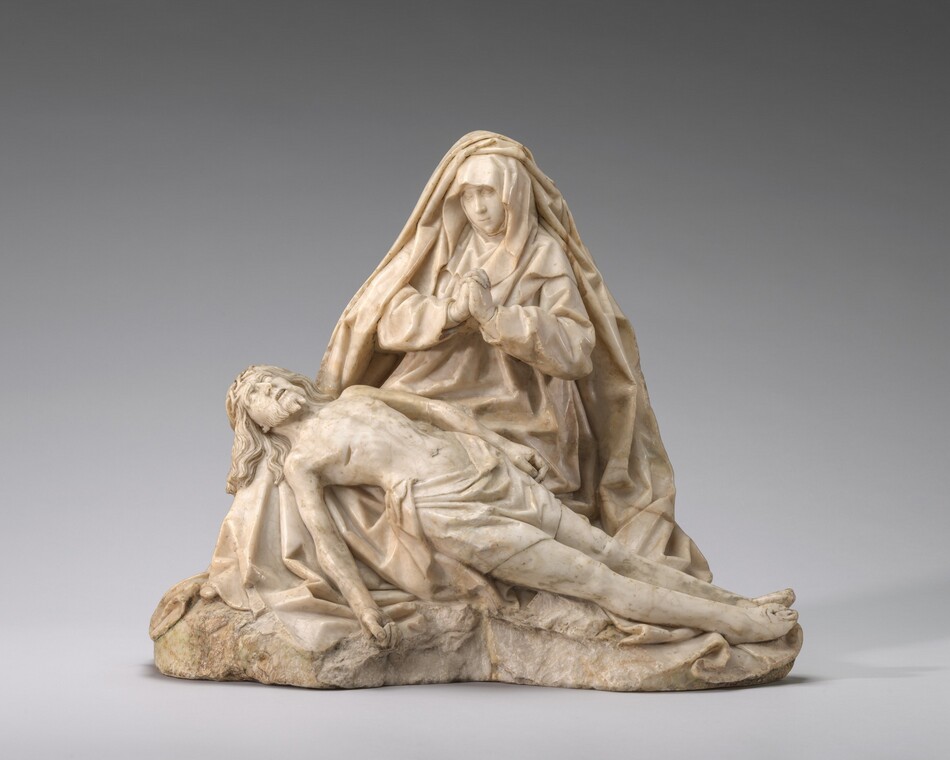
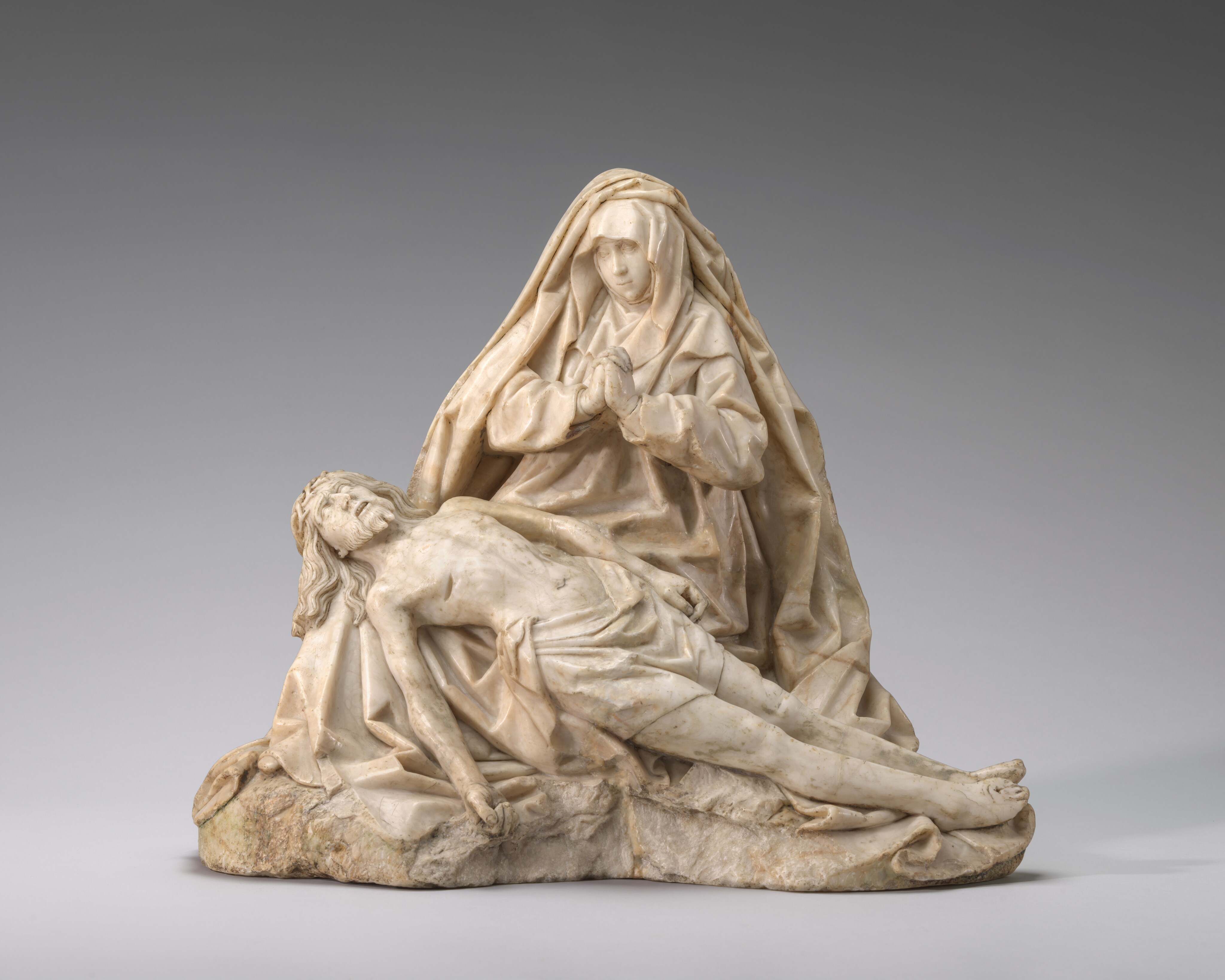
Pietà

South Netherlandish 15th Century

1450/1475

Alabaster with traces of polychromy  Accession ID  1990.13.1

On View: West Building, Main Floor, Gallery M39

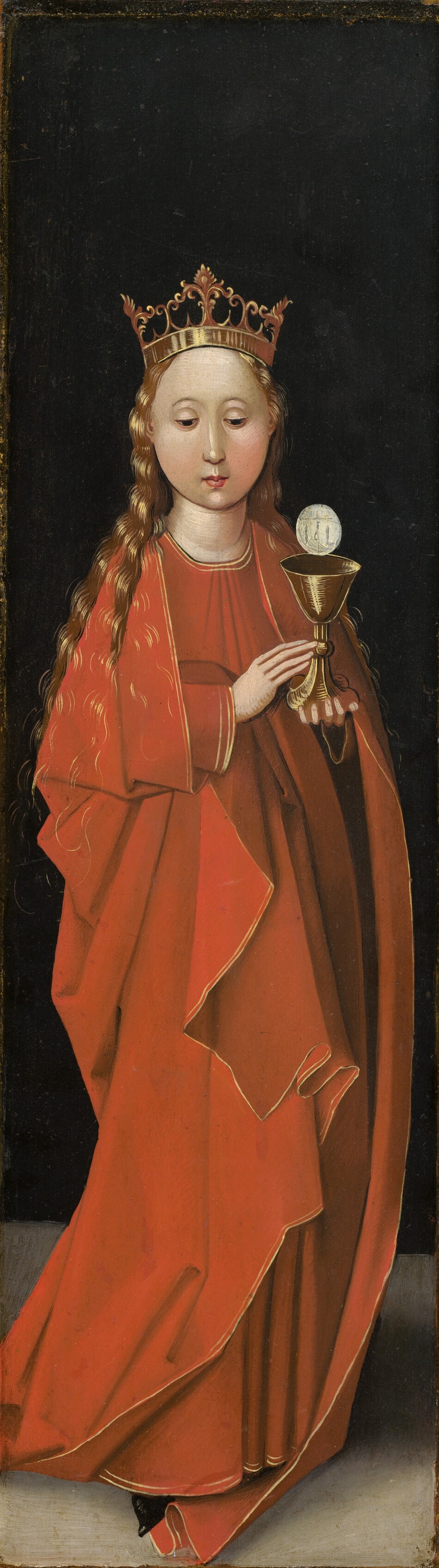
Saint Barbara [left wing exterior]

Master of the Starck Triptych

c. 1480/1490

Oil on panel  Accession ID  1997.100.1.c

On View: West Building, Main Floor, Gallery M35
This painting displays a woman standing upright, turned towards the left. The woman holds a sword vertically, with one hand on the hilt, the long blade pointed downward. She has long blonde hair that falls past her shoulders under an intricate crown. She has fair skin, pale, arched eyebrows, round eyes, and small red lips, and her facial expression is neutral. She wears a red robe over a red dress with a black belt at the waist and a faint pattern of flowers and vines. By her feet appears to be a broken piece of curved wood with thin spokes pointing upward, similar to a broken piece of a wheel. The background is black, and the ground is gray.

Saint Catherine [right wing exterior]

Master of the Starck Triptych

c. 1480/1490

Oil on panel  Accession ID  1997.100.1.b

On View: West Building, Main Floor, Gallery M35
The image shows a man's upper body from the chest up. He is slightly turned to the side with his hands clasped together, holding a folded cloth. The man has a serious expression with prominent cheekbones, a furrowed brow, light facial hair, including a mustache, short brown hair mostly covered by a dark cap, and is dressed in a dark garment with a high, white ruffled collar. A ring is on his left ring finger. The background is muted green.

A Member of the de Hondecoeter Family [obverse]

Antwerp 16th Century

1543

Oil on panel  Accession ID  1953.3.3.a

On View: West Building, Main Floor, Gallery M41

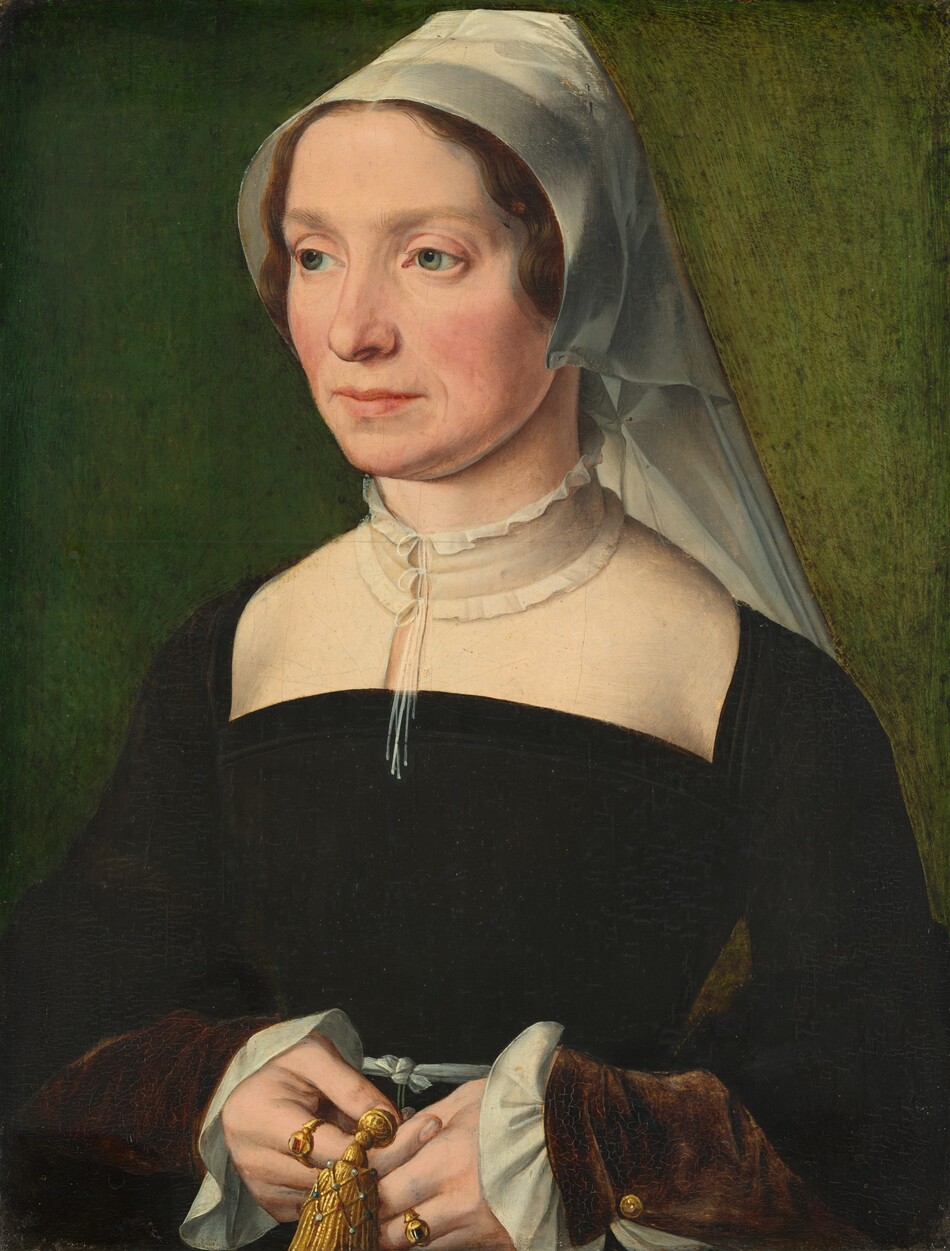
Wife of a Member of the de Hondecoeter Family

Antwerp 16th Century

1543

Oil on panel  Accession ID  1953.3.4

On View: West Building, Main Floor, Gallery M41
This is a painting depicting a heraldic coat of arms. The image features a detailed coat of arms with a central shield, adorned with black and gold sections, and additional decorative elements above it. There is a figure resembling a unicorn emerging from the crest. The background is a deep red hue. The artwork is displayed within a wooden frame with crossbars. This style is associated with displaying family crests and lineage.

Hans Roth [reverse]

Bernhard Strigel

1527

Oil on panel  Accession ID  1947.6.4.b

On View: West Building, Main Floor, Gallery M35
The image shows a pattern of vertical and horizontal wooden bars forming a grid-like design. In the center, there is a rectangular panel with a decorative emblem against a red background. The emblem features swirling shapes. The structured wooden grid and ornate emblem suggest a vintage heraldic shield or coat of arms.

Margarethe Vöhlin [reverse]

Bernhard Strigel

1527

Oil on panel  Accession ID  1947.6.5.b

On View: West Building, Main Floor, Gallery M35
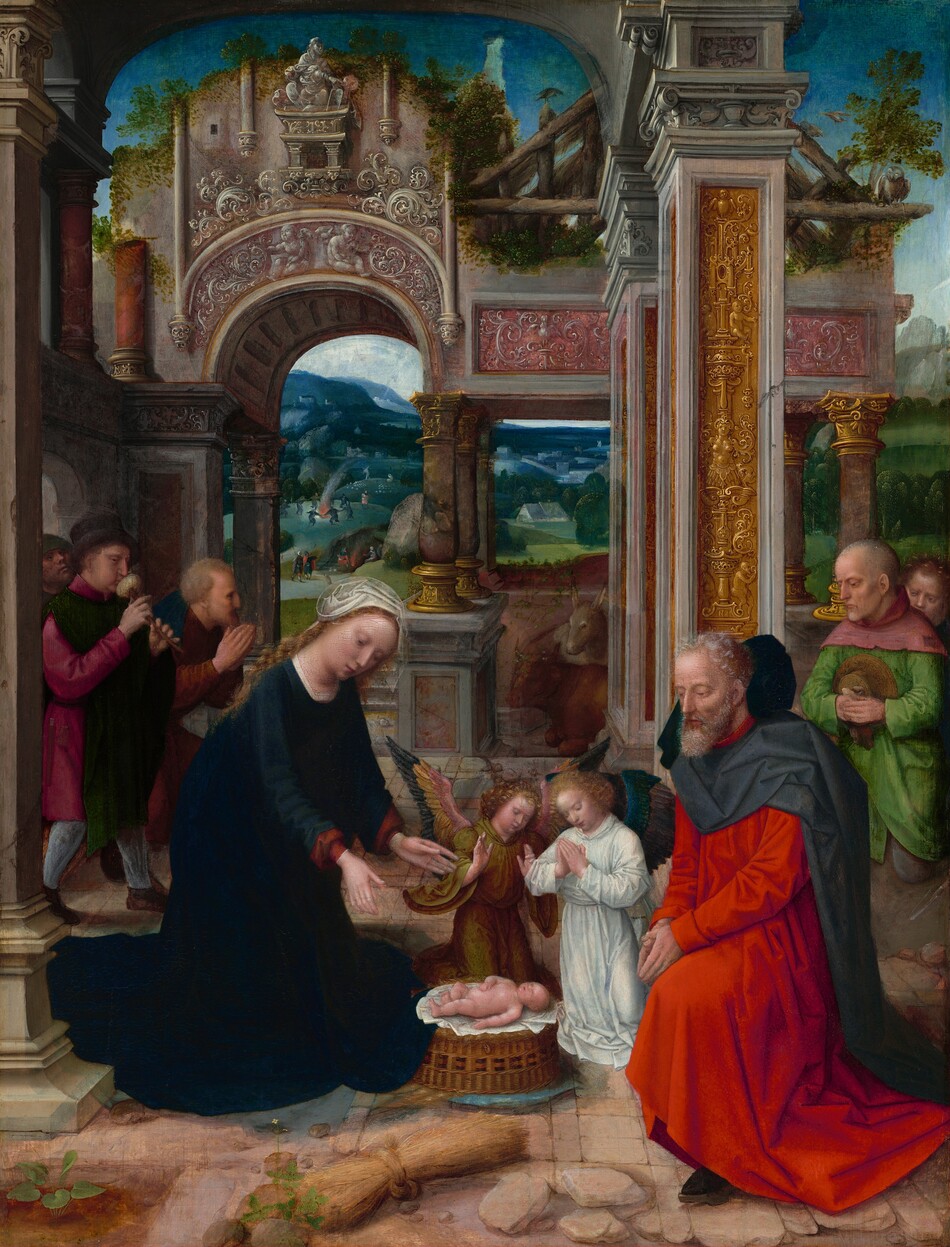
A young woman and older man accompanied by two winged angels kneel to gaze at a tiny infant lying on an overturned basket in this vertical painting. They and the five men standing or kneeling to each side all have pale skin. The woman, Mary, is on our left and leans forward with her hands stretched out toward the infant. Her long, honey-blond hair is covered with a pleated white cloth, and she wears a marine-blue gown over a garment with garnet-red sleeves. The older man, Joseph, kneels opposite her. He has a gray beard and hair and wears a charcoal-gray cloak over a scarlet-red robe. The nude infant, Jesus, lies on the basket between them next to a bundle of wheat. The angels are about half the size of Mary and Joseph and kneel just beyond Jesus. They both have blond hair and wings striped in shades of carnation pink, canary yellow, and celestial blue. The angel on our left wears an olive-green robe, and the other wears a white robe shaded with arctic blue. Mary, Joseph, Jesus, and the angels gather on a worn, tiled stone floor outside the ruins of a building with an exposed interior. Ornamented bronze and rose-pink panels are set into pillars and over openings. Ivy grows along the upper edges of the partially ruined walls, and small tree branches sprout on the roof. An owl and another bird perch on the remains of a wood roof tucked behind the first structure. An ox and a donkey are tucked into a back corner of the building below. Three men dressed in burgundy and black enter the ruins from the left. One wears a soft black hat and holds a musical instrument to his lips. Two more men kneel beyond Joseph on the right, and one wears pea green with a rose-pink cape. The background beyond the building and people is filled with a green and blue landscape scattered with buildings and tiny people walking and dancing around a fire.

The Adoration of the Shepherds

Adriaen Isenbrant

probably 1520/1540

Oil on panel  Accession ID  1978.46.1

On View: West Building, Main Floor, Gallery M41
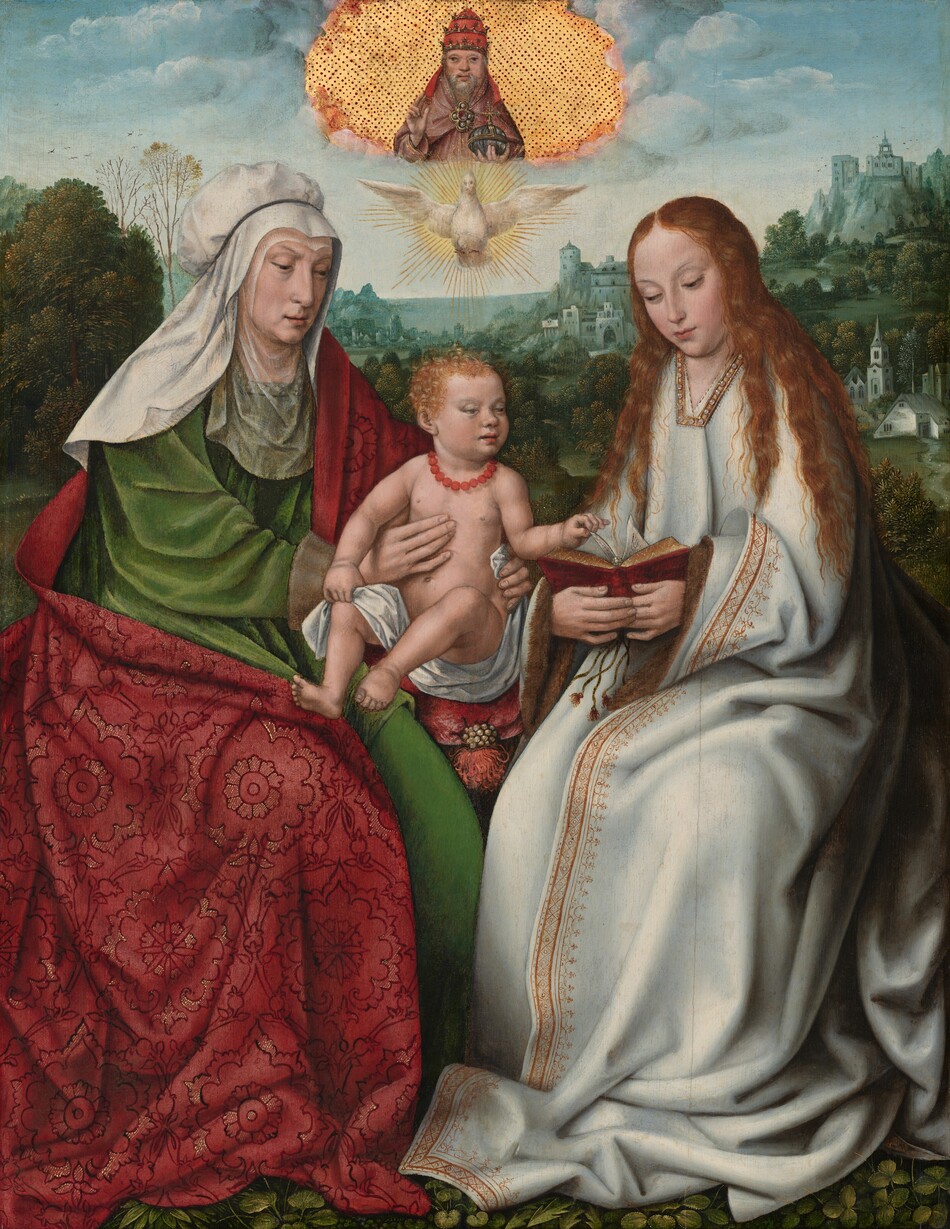
This painting depicts three people seated side-by-side outdoors. The central person is a young, nude child with curly, reddish hair and a red beaded necklace, sitting on a red cushion. Their head is turned to the right. The woman on the left wears a white head covering, a sheer veil around her neck, a green dress, and a red cloak with floral designs. She holds the torso of the child and drapes a white cloth around its legs. The woman on the right has long, flowing reddish hair and wears a white dress or robe with gold detailing down the front, on the neckline, and on the wrists. She holds an open red book, and the child is turning one of the thin pages. All three people have pale skin. Above them, in the cloudy blue sky, there is a white dove with its wings outstretched, gold lines radiating from it. Above the dove, there is an image of a crowned bearded man with pale skin, wearing red robes and holding an orb. He is against a golden background with red dots that breaks through the pale clouds. The background shows a landscape with green trees, hills, and pale blue buildings.

Saint Anne with the Virgin and the Christ Child

Master of Frankfurt

c. 1511/1515

Oil on panel  Accession ID  1976.67.1

On View: West Building, Main Floor, Gallery M39
We look slightly down onto a scene with people gathering in small groups in a cobblestone town square lined with rows of brick, wood, and stone buildings, many with stepped rooflines, in this horizontal painting. Singly or in pairs or trios, men, women, and children walk across the square, move goods around, or talk to merchants. All the people have light skin. Many of the men have mustaches and wear hats, and some carry swords. In tones of black, olive green, brick red, and plum purple, they wear hip-length cloaks over jackets, with white collars or ruffs and brass buttons, and knee-length breeches over yellow or black stockings. The women all wear long dresses in salmon pink, coral red, or golden yellow, with white collars or ruffs, and many wear black, ankle-length cloaks, some with hoods. Closest to us, a sumptuously dressed man and woman walk toward us while another similarly elegant couple walks away. Also facing away from us, to our left, a man wearing a large drum strapped around his waist raises one drumstick as he looks over his left shoulder. Nearby, a woman peers up out of a cellar door that opens on an angle to the street. More couples gather around a well across the square, and two women and a child talk to a third woman selling wares at a wooden table to our right. A pair of hooded priests or monks walk near a man blowing on a trumpet on horseback. The buildings are mostly shades of brick red and brown, and most have three or four stories with steeply pitched roofs. More people walk along side streets leading off the main square. One gap in the buildings across from us leads to a nickel-gray stone church with a pointed spire and square tower. A grassy, green hill rises steeply beyond the buildings to our right, leading down to a waterway that extends up and away into the distance. A few boats float in the water, which reflects the leaden-gray sky. Beyond the town square, a brown stone structure like a fortress with turret towers and crenellated walls looms along the ridge of the hill to our right. Tiny in scale, people on horseback and tending sheep dot the hillside below. The date “1590” is painted on the front of one of the buildings across from us while another date, “1597,” is painted on the end of a short wall near the lower left corner.

The Marketplace in Bergen op Zoom

Abel Grimmer

probably 1590 and 1597

Oil on panel  Accession ID  1979.50.1

On View: West Building, Main Floor, Gallery M41

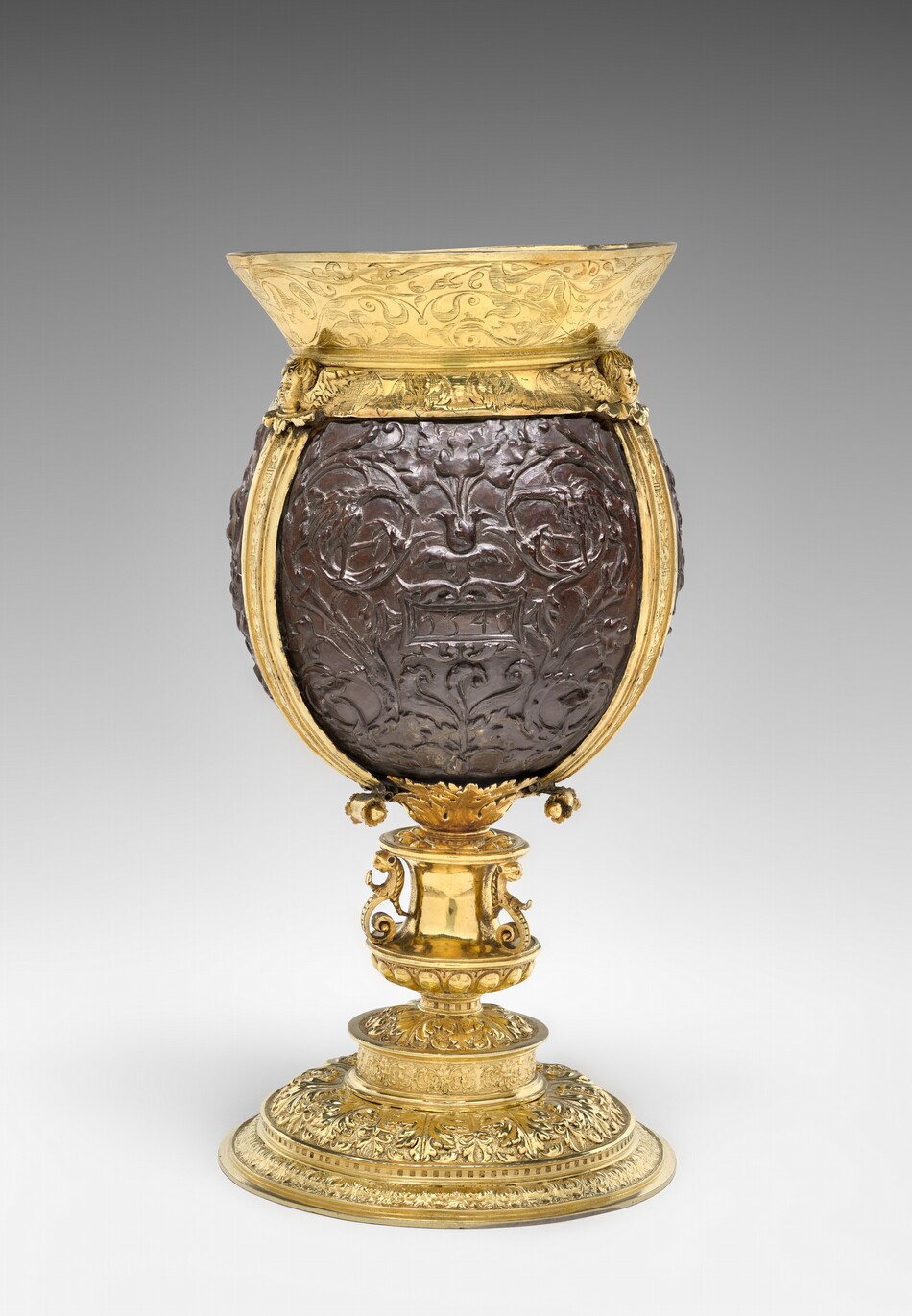
Coconut Cup with Silver Gilt Mounts

Netherlandish 16th Century

c. 1540

Coconut mounted in gilded silver  Accession ID  2024.125.1

On View: West Building, Main Floor, Gallery M35
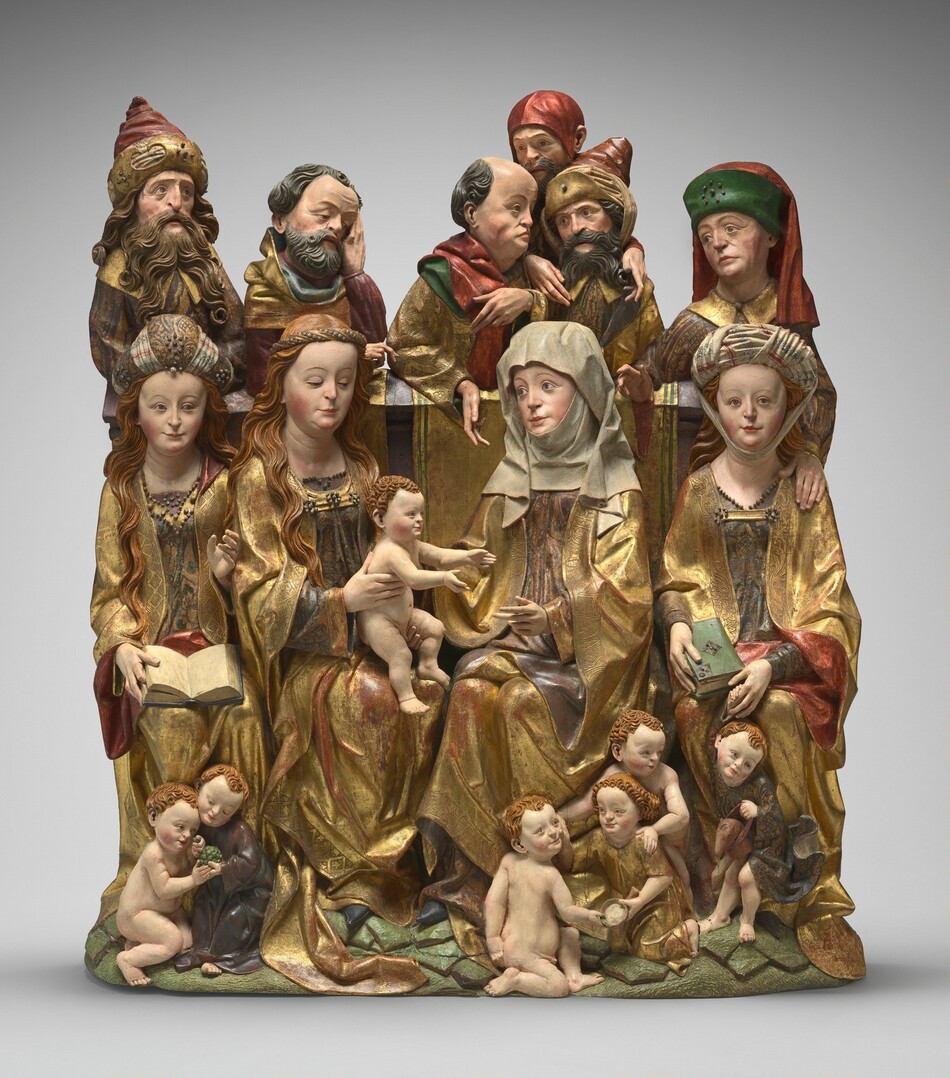
Four women, six men, and seven babies and children are gathered in three rows in this freestanding, painted wooden sculpture. The people all have pale, peachy skin with rosy cheeks, round faces with double chins, and thin, curving brows under high foreheads. They mostly wear gold robes over garments in gray, dark blue, plum purple, spruce green, or red. The four women sit hip-to-hip across the middle of the grouping. The two center women angle slightly in toward each other. To our left in that pair, Mary holds a nude baby Jesus on her lap. Mary’s long, loose, light brown hair is held back with a twisted band. The chubby Jesus on her lap reaches for the woman to our right, Saint Anne, who wears a voluminous wimple that covers her face, chin, neck, and shoulders. The women to either side of the central pair hold books, one open and one closed, and wear turban-like headdresses over long, wavy hair. Six children play together in two groups at the women’s feet. Some are nude and others wear dark or gold robes. A pair eat grapes to our left. The right-most child rides a hobby horse and holds onto the hand of the woman behind him with his tiny hand. In the top row, a man stands behind each of the four women except for Saint Anne, who has three men standing over her shoulder. Two of the six men are cleanshaven, and the others have beards. Some are bareheaded and others wear turbans or a cap. Their faces are lined, and they look down or off into the distance, most under furrowed brows. The gold on the robes is tooled to create patterns.

The Holy Kinship

South German 15th Century, Swabian 15th Century, Franconian 15th Century

c. 1480/1490

Polychromed wood  Accession ID  2002.13.1

On View: West Building, Main Floor, Gallery M35

Loading Results