Impressionism and Post-Impressionism

Filter Results

138 artworks on view.

Results

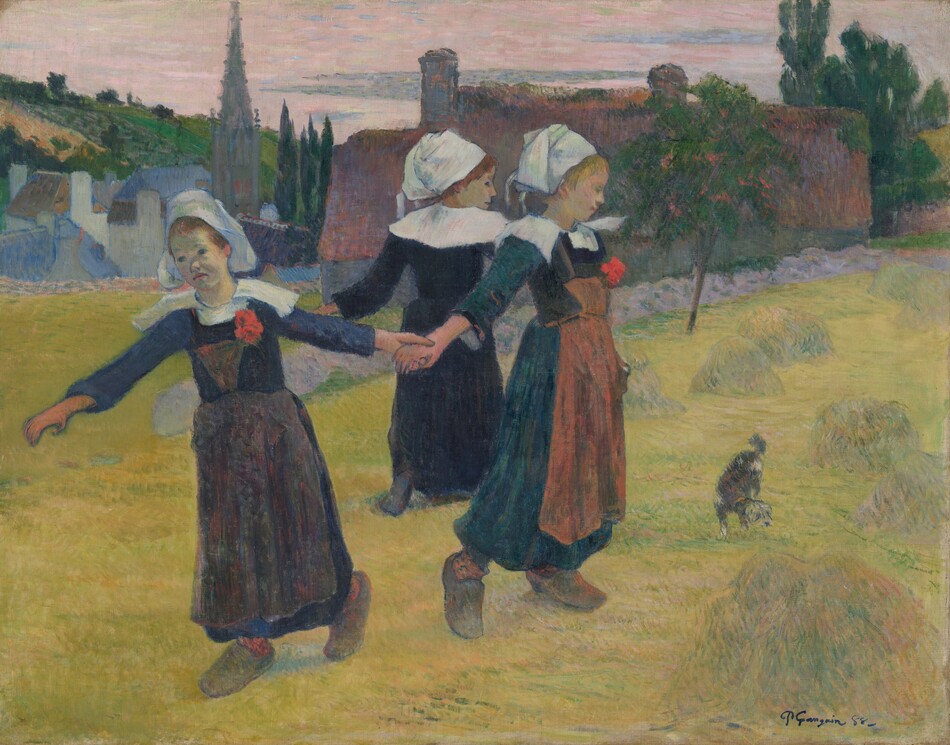
Three light-skinned girls hold hands to create a loose ring with their arms extended, in a grassy field in this horizontal painting. All three girls wear white headdresses, ankle-length, long-sleeved dresses, and clogs. Each dress has a wide white collar that extends beyond the shoulders. A ruby-red flower is pinned to the brown apron on the two girls whose fronts we see. Their features and clothing are outlined in cobalt blue and filled in with parallel, often visible strokes. To our left, a girl stands with both arms stretched out, one holding the hand of the girl next to her, to our right. The first girl looks off into the distance to our left with dark eyes. She has a button nose, and her peach-colored lips curve down at the corners. Her auburn-red hair is tucked back under her bonnet. Her dress is navy blue, and her stockings are brick red. She steps forward onto her right foot, to our left. The second girl, holding the first girls’ hand, stands facing our right in profile, looking slightly down. Her features are indistinct, but she also seems to have a snub nose and her pink lips are closed. She has blond hair and an emerald-green dress. Her hazelnut-brown stockings match her apron. She also steps forward, but onto her left foot. The third girl stands with her back to us, seen between the first two, as she looks over her shoulder to our right in profile. Her left arm is also raised but her right arm is hidden behind the second girl. The third girl has brown hair and a pointed nose. Her dress is black, and she steps forward onto her right foot. A small dog with brown and white speckled fur sniffs at the grass to our right of the girls. Piles of long grass or hay dot the lemon-lime green field, which dips down behind the girls and to our left to meet a low, stone gray wall. Buildings in plum purple, ivory white, terracotta orange, and ocean blue span the width of the painting beyond the wall. One narrow spire reaches above the other rooflines. Tall, narrow, dark green trees are interspersed among the buildings, and a hill climbs nearly to the top of the canvas to our left. A few thin slate-gray clouds float across a narrow band of shell-pink sky above. The artist signed and dated the work in lower right corner, “P. Gauguin 88.”

Breton Girls Dancing, Pont-Aven

Paul Gauguin

1888

Oil on canvas  Accession ID  1983.1.19

On View: West Building Main Floor, Gallery M83
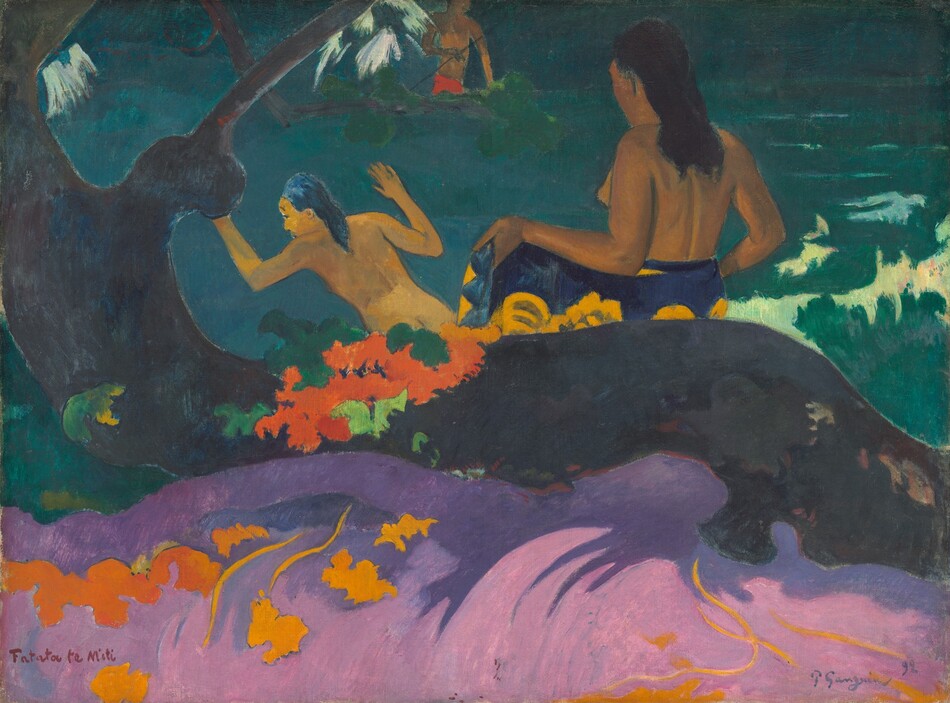
Two nude women with brown skin and long black hair stand with their backs to us at a riverbank in this stylized horizontal painting. The body of the woman to our left is angled to our left with her hands raised, presumably about to plunge into the teal-colored water. The woman to our right unwraps a cloth patterned with bright yellow flowers on a deep purple background from her waist. Between the women and farther away, a bare-chested man, also with brown skin, wears a tomato-red garment across his hips as he stands hip-deep in the water holding a long spear. The top of his head is cropped by the top edge of the painting. Along the left edge of the canvas, a gnarled tree is painted as a flat field of dark, charcoal gray, and it rises off the side and top of the composition. An area of the same color, perhaps a thick root or the trunk growing nearly horizontally, spans the width of the painting, separating the women from us. The area around the trunk to our left and right is painted with fields of evergreen and cool mint. Closer to us, along the front of the root, a field of rosy pink swirls with grape purple to suggest sand. This area is dotted with harvest-yellow and pumpkin-orange vines and stylized flowers. A bunch of vivid orange flowers with pine and spring-green leaves sits on the root near the trunk, to our left. Most of the painting, especially the landscape, is painted with areas of mostly flat color. In the bottom left corner, the artist has written the title of the painting in darkred paint: “Fatata te Miki.” In the lower right corner, he signed and dated the work with periwinkle blue: “P. Gauguin 92.”

Fatata te Miti (By the Sea)

Paul Gauguin

1892

Oil on canvas  Accession ID  1963.10.149

On View: West Building Main Floor, Gallery M83
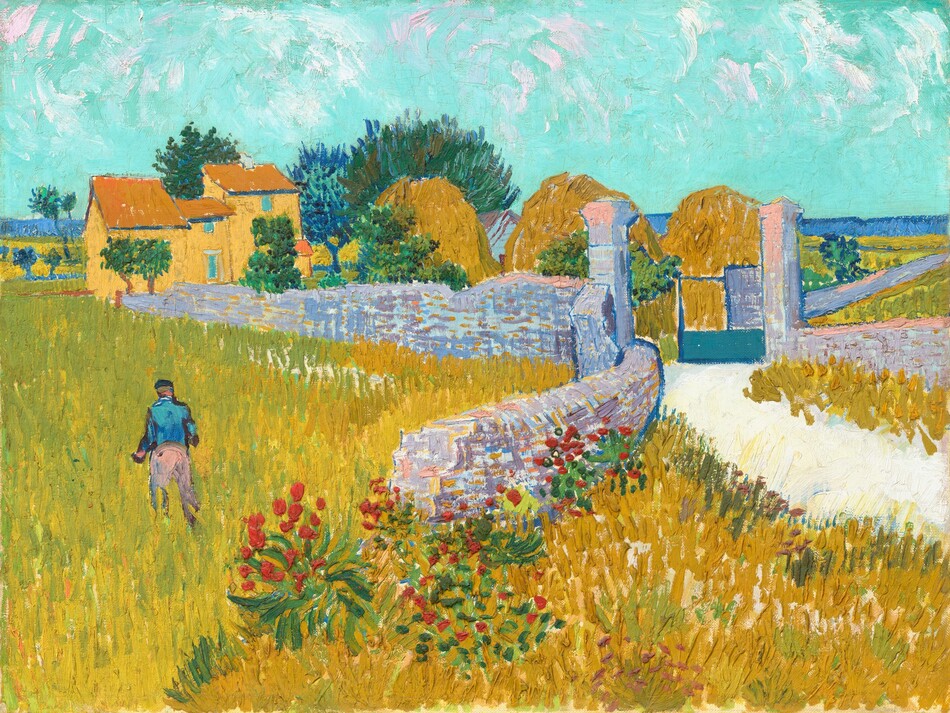
A white path and gray stone wall wind through ochre and harvest-yellow fields beneath a brilliant, turquoise sky in this stylized, horizontal landscape painting. The scene is created with long, visible brushstrokes of vivid color. Closest to us, the field is painted with vertical strokes of golden yellow and pea green. Touches of cardinal red and slashes of pine green create flowers around the end of the stone wall, which curves toward us from the background, at the center of this painting. The wall is painted with horizontal dashes of lilac and lavender purple, salmon pink, and periwinkle blue. A person wearing peach-colored trousers, a peacock-blue shirt, and a dark hat walks away from us, into the field, to our left of the wall. The white road enters the scene from the right, and meets the stone wall and a second wall on the far side of the road at a gate. Two columns rise from the walls to mark the spot of the gate, which opens into a property with three tall haystacks and a house. To our left, the house is painted with areas of warm yellow for the walls, honey brown for the roof, which is outlined in navy blue, and turquoise for the doors and windows. A few green trees, made of dots of bottle and forest green, are scattered near the house and haystacks. One sapphire-blue tree grows near the house. A band of azure blue along the horizon, which comes about two-thirds of the way up the painting, suggests a mountain range in the distance. Swirls of white suggest clouds in the turquoise sky. The paint is visibly textured throughout.

Farmhouse in Provence

Vincent van Gogh

1888

Oil on canvas  Accession ID  1970.17.34

On View: West Building Main Floor, Gallery M83
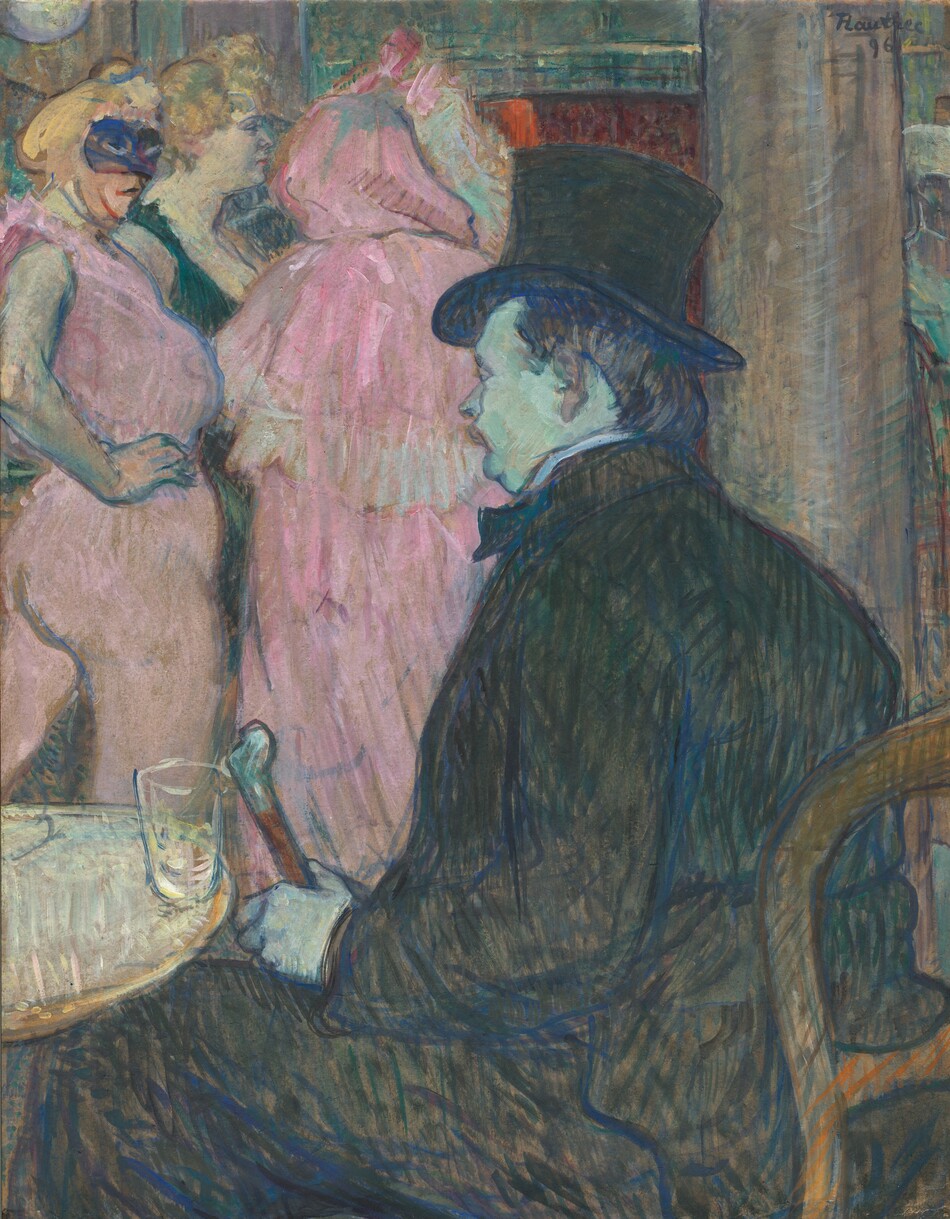
Shown from the lap up, a man wearing an ash-brown suit and top hat sits turned mostly away from us, next to a round table, facing a group of at least three women farther back in the room in this vertical painting. The scene is loosely painted with visible, mostly vertical strokes, and most of the forms, clothing, and objects are outlined in cobalt blue. Sitting in a wooden, ladderback chair, the man’s body takes up the bottom right quadrant of the painting. His skin is painted pale turquoise. His face turns away from us so we see the tip of his nose and the lines of his cheek and double chin. He has short brown hair under his top hat. He holds a silver-topped cane in one hand, which rests in his lap. A glass with some clear liquid sits on the table in front of him, to our left.  A peanut-brown column spans the height of the painting just beyond him, near the right edge of the composition. Three women stand closely together in the near distance, in the upper left corner of the painting. At the front of the trio, a woman with a peach-colored face wears an indigo-blue mask over her eyes. A few swipes of paint indicate blond hair, possibly pulled up. She faces our right in profile and stands with her right hand, closer to us, planted on her hip. She wears a bubblegum-pink sleeveless top and form-fitting pants. The skin of her arm and the skin on the face of the woman standing just beyond her is a cream-white tinged with blue. That second woman faces our right in profile, and her blond hair is either short or also pulled up. A teal-green strap of a low-cut dress crosses over the shoulder we can see. A third woman stands in front of this pair, between them and the seated man. She faces away from us and wears a cotton candy-pink robe and hood that completely covers her body. The wall at the back of the room is painted with areas of brick red, moss green, and a grayish mauve pink.

Maxime Dethomas

Henri de Toulouse-Lautrec

1896

Oil on cardboard  Accession ID  1963.10.219

On View: West Building Main Floor, Gallery M80
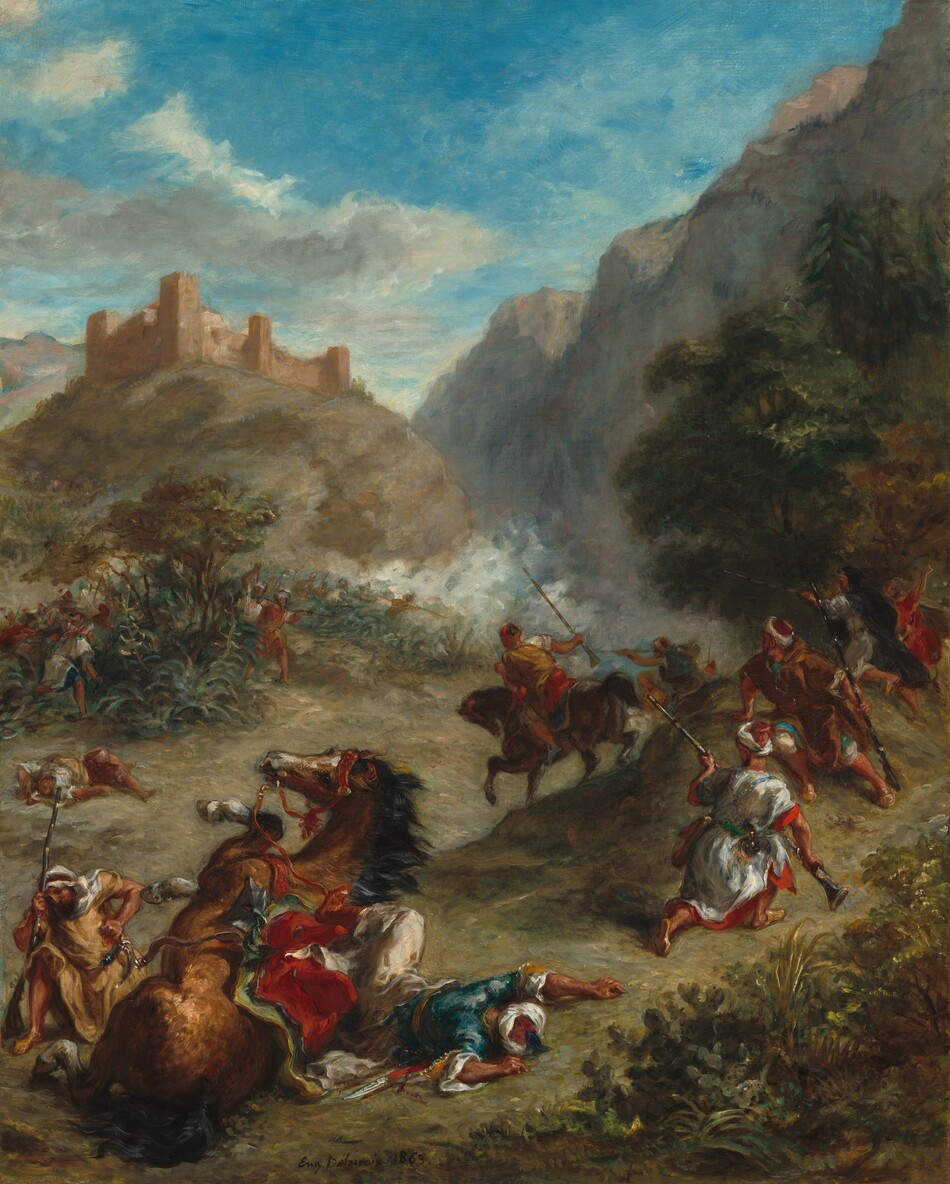
Set in a valley carpeted in sage green, about a dozen armed men, on foot and horseback, close to us, line up and face off against an attack advancing from the back left in this vertical painting. The men, clothing, and horses closest to us are painted with dashes and swirling brushstrokes, which contrasts with the soft look of the approaching crowd and landscape beyond, which are painted indistinctly with loose and blended brushstrokes. All the men we can see have medium brown skin and are armed with rifles. The men close to us wear long tunics and boots in shades of teal blue, ivory white, crimson red, earth brown, and golden yellow. Most of them wear turbans and some have straight or curved daggers hanging from their waists. Closest to us in the bottom left, a chestnut-brown horse with a black mane collapses on its rider, who sprawls along the ground with arms overhead. The horse lifts its head and twists back toward us facing our left, so the white blazes down its nose are visible. Near the horse’s legs and along the left edge of the painting, a man wearing a mustard-yellow tunic kneels and leans his forehead against the barrel of his rifle, which he braces like a walking stick. His other hand rests on the hilt of his dagger at his waist. To our right of the fallen horse, six men line up along a low rise that angles to our right and into the distance, where it meets a grove of green trees. At the front of that group, near the lower center of the composition, a rider on a dark horse charges the approaching men. Those men emerge from a line of emerald-green trees and growth at the foot of a steep, rocky hill. These men are more loosely painted so details are difficult to make out, but several are backlit by white smoke, presumably from firing their rifles. The hill above is mottled with warm taupe, light gray, cinnamon-brown, and moss-green growth. Atop the hill and to our left, a walled building complex with thick, square towers faces a row of sheer cliffs that march in from the upper right to enclose the space. Their jagged faces are shadowed with cool tones of slate blue, pewter gray, and touches of rust red. An azure-blue sky, scattered with thin layers of steel-gray and white clouds, spans the top of the composition. Bright sunlight flows in from the upper right, illuminating the fallen horse and the men near it. Sunlight also warms the face of the terracotta building and the hill, as well as the peaks of the mountains on the right. The artist signed and dated the work in black in the lower center: “Eug. Delacroix 1863.”

Arabs Skirmishing in the Mountains

Eugène Delacroix

1863

Oil on canvas  Accession ID  1966.12.1

On View: West Building Main Floor, Gallery M81
Shown from the knees up, a young woman wearing a white gown and bonnet sits in front of a balcony railing on a sunny day, holding a small dog on her lap in this vertical portrait painting. The scene is painted with visible brushstrokes, which are especially broad in the background and clothing. The woman sits with her body angled to our left, and she looks down in that direction with blue eyes. She has a short, snub nose, rosy cheeks, and her full, pink lips are parted. The woman’s bonnet is tied under her chin with a pale yellow bow. Her dress has a tightly-fitting bodice, elbow-length sleeves, and a long skirt. The bonnet and dress are painted with strokes of faint sky blue, petal pink, lavender purple, and mint green, with cream-white highlights and some darker cobalt-blue and apricot-peach strokes for shading. The dog on her lap lies with its head to our left, lifted as it looks out onto the landscape. The tan glove the woman wears on the arm we can see reaches her elbow, and she rests that hand on the dog’s back. Her right arm, to our left, is hidden below the elbow by the dog. The animal has charcoal-gray fur along its back and tan fur on the legs and shaggy face. The woman sits in a wicker armchair with a crimson-red medallion next to her left shoulder, to our right. The black balcony railing spans the width of the painting at the level of her nose, and has vertical bars. In the landscape beyond, trees to the right are painted loosely with sage green and mustard yellow. Buildings in the distance fill the top quarter of the composition, and are loosely painted with strokes of slate and aquamarine blue. The sky above is streaked with pale blush pink and ice blue. The artist signed the painting in the lower right corner, “Mary Cassatt.”

Young Girl at a Window

Mary Cassatt

c. 1883-1884

Oil on canvas  Accession ID  2014.79.9

On View: West Building Main Floor, Gallery M86
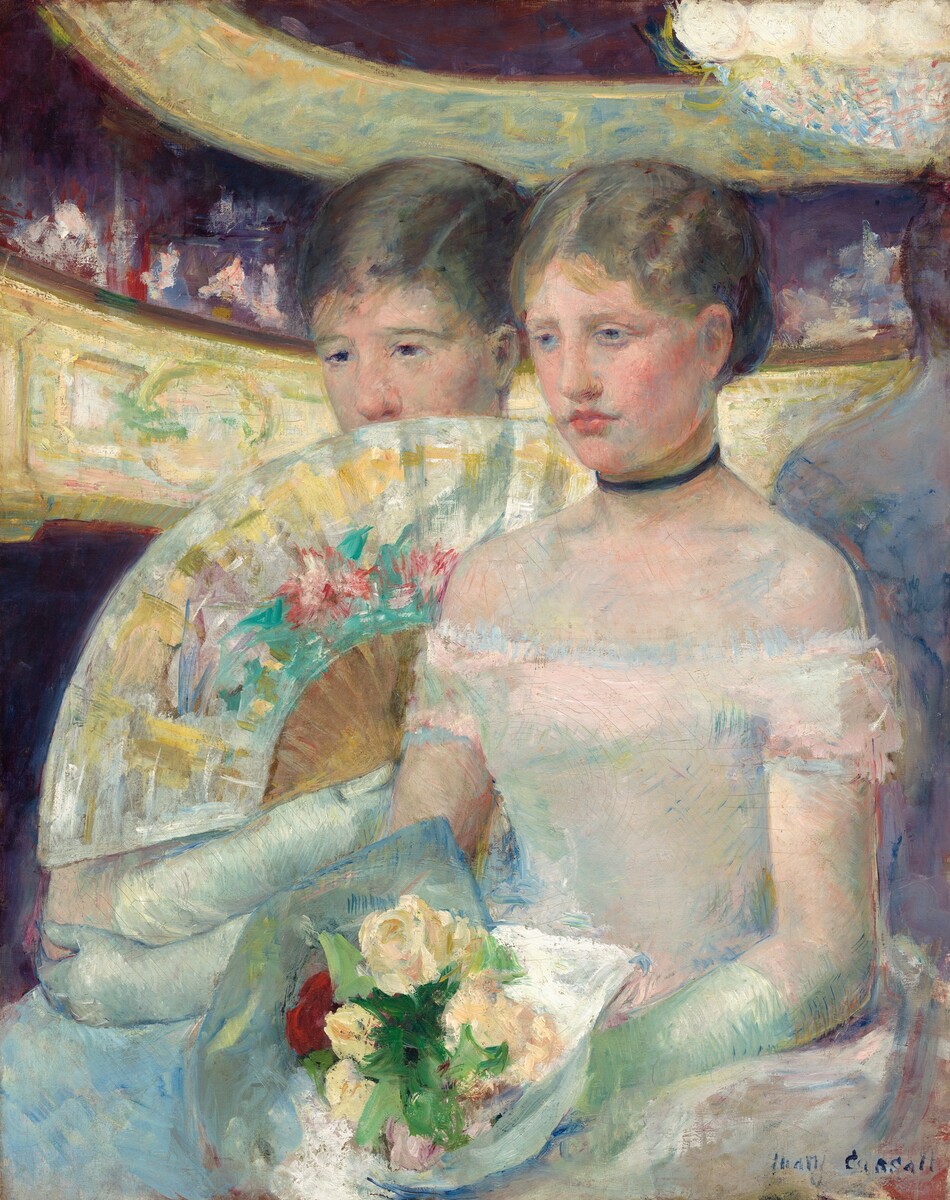
Shown from the knees up, two young women with pale, peachy skin wearing white gowns sit close together and almost fill this vertical painting. The women are angled to our left and look in that direction. The young woman on our right has a heart-shaped face, dark blond hair gathered at the back of her head, and light blue eyes. Her full, coral-pink lips are closed, the corners in greenish shadows. Her dress is off the shoulders, has a tightly fitted bodice, and the skirt pools around her lap. The fabric is painted in strokes of pale shell pink, faint blue, and light mint green but our eye reads it as a white dress. She wears a navy-blue ribbon as a choker and long, frosty-green gloves come nearly to her elbows. She holds a bouquet in her lap, made up of cream-white, butter-yellow, and pale pink flowers with grass-green leaves and one blood-red rose. Her companion sits just beyond her on our left and covers the lower part of her face with an open fan. The fan is painted in silvery white decorated with swipes of daffodil yellow, teal green, and coral red. She has violet-colored eyes, a short nose, and her dark blond hair is smoothed over the top of her head and pulled back. She also wears long gloves with her arms crossed on the lap of her ice-blue gown. Along the right edge of hte painting, a sliver of a form mirroring the torso, shoulder, and back of the head of the young woman to our right appears just beyond her shoulder, painted in tones of cool blues. Two curving bands in golden yellow and spring green swiped with darker shades of green and gold arc behind the girls and fill the background. The space between the curves is filled with strokes of plum purple, dark red, and pink. The artist signed the lower right, “Mary Cassatt.”

The Loge

Mary Cassatt

c. 1878-1880

Oil on canvas  Accession ID  1963.10.96

On View: West Building Main Floor, Gallery M86
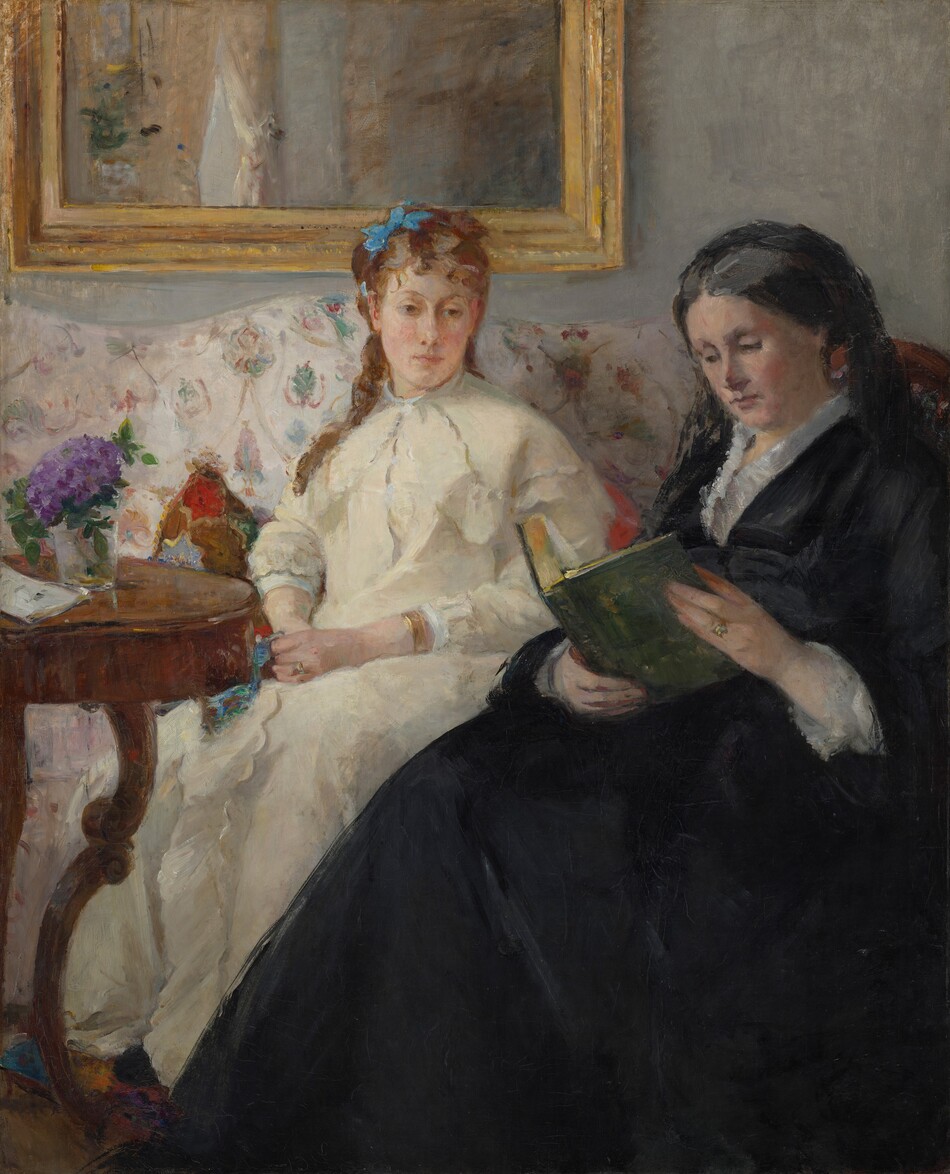
An older woman wearing a long black dress sits reading a book in front of a younger woman wearing cream white, who sits on a couch just beyond, in this vertical portrait painting. The scene is loosely painted with some visible brushstrokes, especially in the furniture, clothing, and room. Both women have pale skin and wear dresses with long sleeves and skirts. To our right, the older woman sits in a chair with a curved back, which runs parallel to the right edge of the canvas. The full skirt of her black dress angles down across the picture, almost spanning the bottom edge of the composition. Her gray hair is pulled back and covered by a black cloth or veil, which falls to her shoulder and blends with her dress. The collar is lined with a white ruffle, and white lace cuffs encircle her wrists. Her face is painted with rosy tones. She looks down at her book with dark eyes, and her rose-pink lips are closed. She wears a gold ring with a light stone on her left ring finger, and the book she holds has a moss-green cover. Her skirt overlaps the younger woman sitting nearby on the couch, which runs along the back wall of the room. The young woman’s knees are angled to our left but she looks slightly back to our right, to gaze down and into the distance with brown eyes. Her skin is paler, but she has lightly flushed cheeks and her petal-pink lips are also closed. An azure-blue bow is tied in her chestnut-brown hair. A few tendrils fall down her back and over one shoulder. Her dress falls loosely over her torso and legs. She wears a gold ring on her left hand and a gold bracelet on that wrist. She fingers a piece of lapis-blue fabric in one hand. The couch behind her has a pattern with stylized flowers or leaves floating within rose-pink ribbons that hang in swags, against a white background. Pillows patterned with ruby red, sky blue, and fawn brown peek out from behind the young woman. A round or oval wooden table with curving legs to our left holds a glass vase with a violet-purple flower, perhaps a hydrangea. A slip of paper or envelope sits on the table next to the vase. The wall behind the couch is fog gray, and the bottom edge of a gold frame hangs behind the young woman.

The Mother and Sister of the Artist

Berthe Morisot

1869/1870

Oil on canvas  Accession ID  1963.10.186

On View: West Building Main Floor, Gallery M89
We look slightly down into a lime-green and white rowboat carrying a woman holding a baby and a man in this nearly square painting. The man wears midnight-blue shoes, pants, jacket, and soft, floppy cap. He sits with his back to us, bending forward to row the boat, which is cropped by the bottom edge of the canvas. The left side of his ruddy face is visible over his left shoulder. The woman and baby both have pale skin. The woman and baby sit across from the man, facing us to our left in the bow. The woman’s long-sleeved, sky-blue dress is crosshatched with pink lines. The baby leans back in the woman’s arms, and wears a pink dress, blue socks, and brown shoes. The wide-brimmed hats on both the woman and baby are painted pale celery green. They gaze toward or just past the man. The corner of the boat’s sail, also painted pale green, is pulled taunt by the wind to our left. Azure-blue water surrounds the boat up to the high horizon line, which brushes the top edge of the painting. The shoreline in the distance is lined with trees and dotted with white houses with red roofs.

The Boating Party

Mary Cassatt

1893/1894

Oil on canvas  Accession ID  1963.10.94

On View: West Building Main Floor, Gallery M86
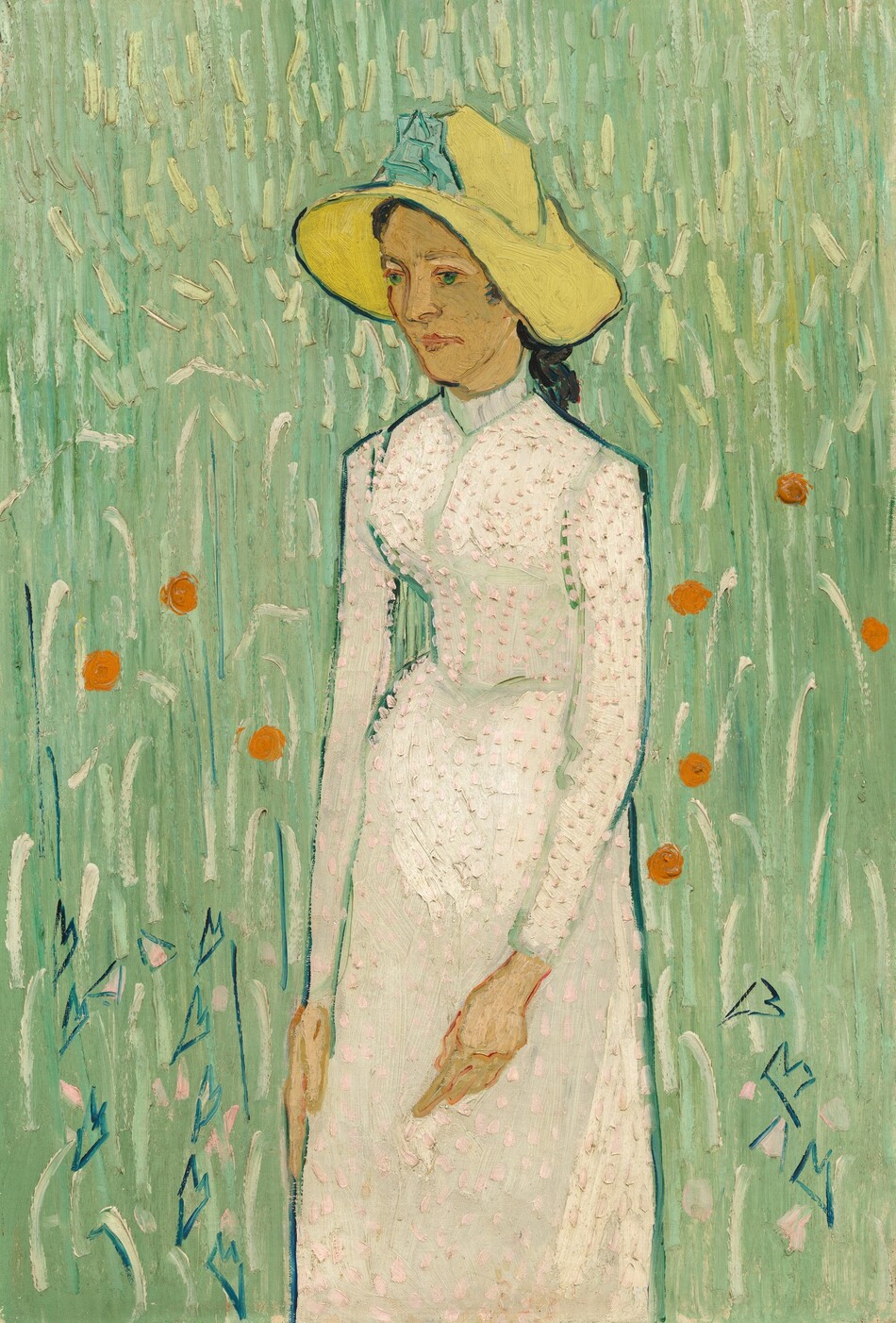
Shown from the knees up, a pale-skinned woman wearing a floppy, canary-yellow hat and a long white dress stands in a field of spring green in this vertical painting. Brushstrokes and loose dabs of paint are visible throughout. The woman’s body is angled to our left, and she looks off in that direction with bright green eyes. Her nose, eyebrows, and narrow chin are outlined with medium brown, and her pink lips are closed. Her black hair is pulled back under the hat, the wide brim of which droops down either side of her face. A sky-blue ribbon or decoration is on the front of the crown. Her dress has a high collar, a fitted bodice, long sleeves, and a long skirt. Pale pink daubs on the white dress are thickly applied so the texture of the paint can be seen on the surface of the canvas. The background is painted with long and short curved dashes of celery green layered over laurel and cool green. Several tangerine-orange dots, a few shell-pink dabs, and some angular, heart-shaped forms in cobalt blue to each side of the woman suggest flowers.

Girl in White

Vincent van Gogh

1890

Oil on canvas  Accession ID  1963.10.30

On View: West Building Main Floor, Gallery M83
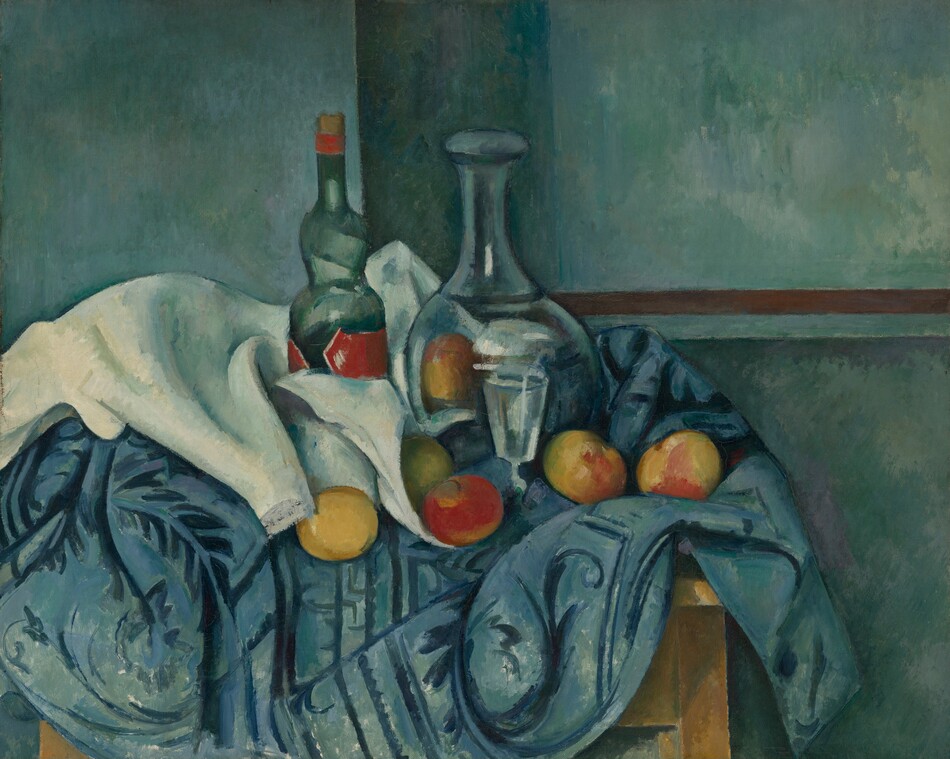
A glass bottle, a glass carafe, a stemmed glass, several pieces of fruit, and white and blue cloths are arranged on a wooden table in this horizontal still life. The bottle and carafe are at the center of this composition. The bottle has a crimson-red label, and the carafe has a tall, narrow neck and a rounded body. The stemmed glass has straight, flaring sides, and it sits on the table just in front of the carafe. Several pieces of fruit, painted in reds and yellows, are interspersed on the white cloth that surrounds the glassware. The muted, celestial-blue tablecloth is patterned with scrolls and leaves, and it bunches around the objects on the tabletop. The wall behind the table is mottled with cool blues and greens, and a brown line, perhaps a chair rail, runs from behind the still life to the right edge of the painting. Short brushstrokes are visible throughout.

The Peppermint Bottle

Paul Cezanne

1893/1895

Oil on canvas  Accession ID  1963.10.104

On View: West Building Main Floor, Gallery M84
Four young women with medium brown skin sit or stand on a pumpkin-orange ground in this horizontal painting. The women are divided into pairs by a broad, gold, undulating brushstroke running down the middle of the ground they occupy. They are mostly nude, and three have long black hair while one has flame-red hair. To our left, the woman with red hair stands facing us, wearing a glittering, silver necklace as she gazes off to our right. She presses a white patch, perhaps the end of a loincloth, to her upper leg with both hands. Seated next to her is a woman with most of her body turned away from us. She leans over onto her left arm and turns her head over that shoulder to look down and off to our right. Both women to our right are seated close to each other, their shoulders overlapping. One woman wears a white cloth around the hip we can see, and the other wears knee-length breeches. They both look toward us. Beyond the women is what appears to be a stream running diagonally from the lower left to end in a small pool in the middle right. It transitions from muted oranges and green to smoky blue and gray. Opposite us, more orange ground is lined with dense groves of dark green trees that wind into the distance. A woman wearing a coral-colored hood and blue robe holds the arm of a child, and a black dog crouches at their feet. They stand near a slightly larger-than-life-sized topaz-blue statue of a standing woman with her elbows bent and arms raised. The sky beyond the trees is streaked and swirled with bright orange, yellow, and blue. The artist signed and dated the painting, along with the title, in the lower left corner, “Paul Gauguin 98 TE PAPE NAVE NAVE.”

Te Pape Nave Nave (Delectable Waters)

Paul Gauguin

1898

Oil on canvas  Accession ID  1973.68.2

On View: West Building Main Floor, Gallery M83

Loading Results