Impressionism and Post-Impressionism

Filter Results

138 artworks on view.

Results

Two pale-skinned little girls sit back-to-back on a sandy beach, almost filling the width of this vertical painting. The girls wear matching pale, ice-blue pinafores over short sleeve, ocean-blue dresses. Both sit with their legs stretched in front of them and angled to our right. The girl closest to us, to our left, looks down at the denim-blue pail and wooden shovel she holds between her ankles. She holds the long-handled shovel in her near hand with the end inside the pail. She has a chubby, flushed, round face with blond hair and rosy arms and legs. She wears black shoes and appears to have a brown sock on her near leg but a dark blue sock on the other. Her companion sits just beyond her and to our right with her body turned away from us. Her wide-brimmed straw hat is trimmed with a tomato-red ribbon tied in a bow at the front. The hat hides her face, and her outstretched legs are encased in olive-green stockings. Her near hand reaches across her lap to grab the pail sitting on the far side of her legs. The beach meets the pale blue and aquamarine ocean in the upper third of the painting. A patch of strokes and daubs of dark blue and peach near the upper left and a tan wedge in the water to our right are painted loosely along the shoreline. Two white sailboats and a horizontal white dash with three dark blue dots drift on the water. The artist signed the lower right, “Mary Cassatt.”

Children Playing on the Beach

Mary Cassatt

1884

Oil on canvas  Accession ID  1970.17.19

On View: West Building Main Floor, Gallery M86
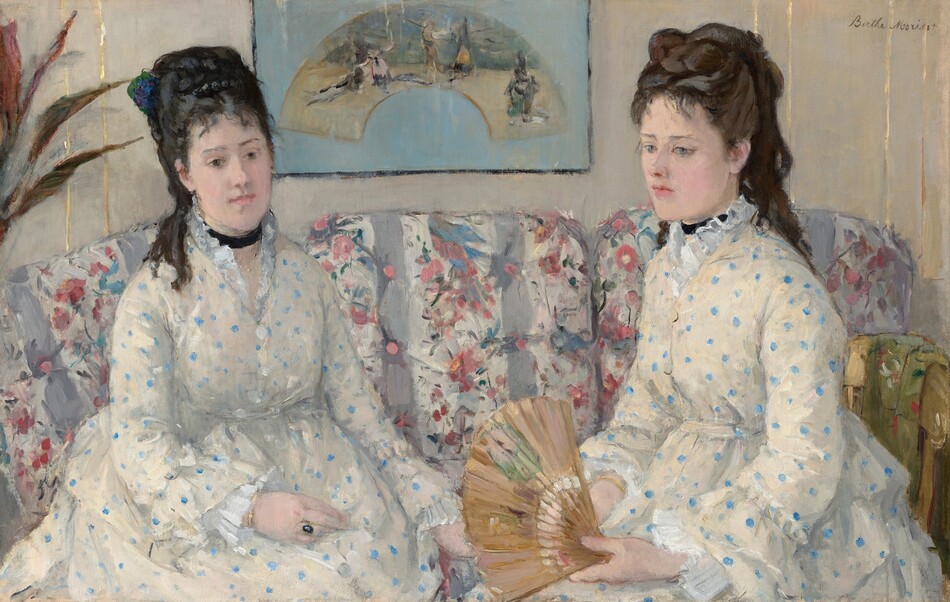
Shown from the lap up, two women with pale skin and dark hair pulled up and back, wearing white dresses with baby-blue polka dots, sit on a couch in this horizontal portrait painting. Both women have straight, dark brows, delicate noses, smooth skin, and their small, rose-pink mouths are closed. Wispy bangs brush their foreheads, and their hair is piled high with long ringlets falling down their backs. Both wear black ribbons like chokers around their necks. Their dresses have high necks with ruffles along the necklines, ruffles at the wrists, and are gathered under the bust. They sit angled in toward each other. The woman on our left has black hair, and she looks down and to our right with dark eyes. She wears a gold ring with a dark, oval stone on one hand resting in her lap. The other woman has chestnut-brown hair and looks down and off to our left with ice-blue eyes. She holds an open fan in her hands in her lap. The fabric on the couch has vertical white and lilac-purple stripes, and is overlaid with a pattern of pink flowers and green leaves. A framed picture hanging on the bone-white wall behind the women shows an arched painting against a sky-blue background. A few spiky leaves from a houseplant are cut off by the left edge of the painting. The portrait is loosely painted throughout, especially in the couch and background. The artist signed the painting in the upper right corner, “Berthe Morisot.”

The Sisters

Berthe Morisot

1869

Oil on canvas  Accession ID  1952.9.2

On View: West Building Main Floor, Gallery M89
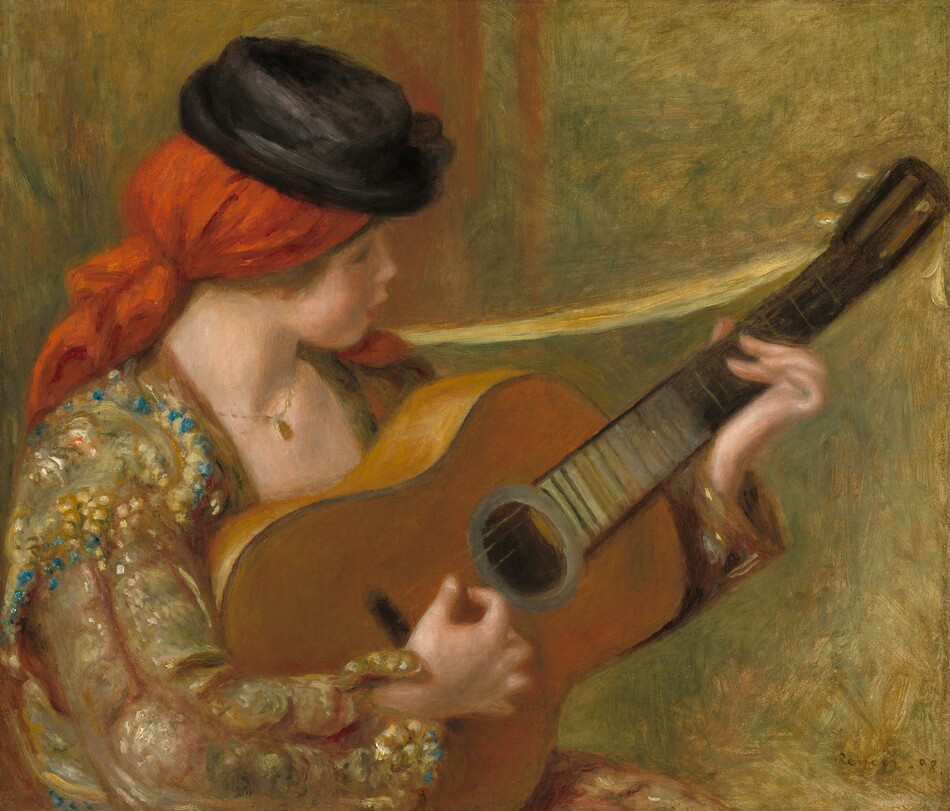
A young woman with pale, peachy skin and flushed cheeks sits facing our right in profile as she plays a guitar in this horizontal painting. The scene is painted with blended strokes, giving it a soft look and making some of the details indistinct. At the center of the composition, the guitar rests against the woman’s shoulder so it almost spans the width of the painting. The instrument has a caramel-brown body, and the dark brown neck lightens to slate gray by the sound hole. The woman’s eyes are lowered as she looks toward her left hand, her long fingers pinning the strings along the fretboard. She plucks the strings with her other hand.  Her hair is covered in a red headscarf tied at the nape of her neck. One end rests on her left shoulder, farther from us, and the other hangs down her back. A low, flat-topped, black, brimmed hat sits atop the scarf. The woman’s features are delicate, and her pink lips are parted. She wears a gold chain with an oval pendant around her neck. Her jacket is gold with a pattern loosely painted with dabs of lapis blue, butter yellow, and rose pink. A yellow ribbon or band is tied to the neck of the guitar and slung over her shoulder. The indistinct space behind her is painted with strokes of moss green, goldenrod yellow, and a few swipes of marigold orange near her face. The artist signed and dated the painting in brown in the lower right corner: “Renoir.98.”

Young Spanish Woman with a Guitar

Auguste Renoir

1898

Oil on canvas  Accession ID  1970.17.76

On View: West Building Main Floor, Gallery M81
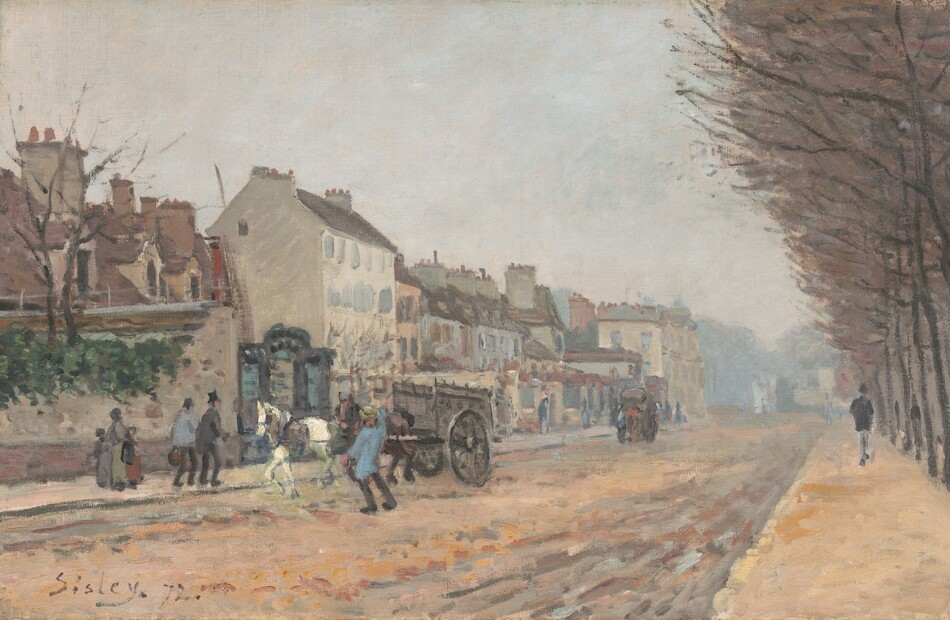
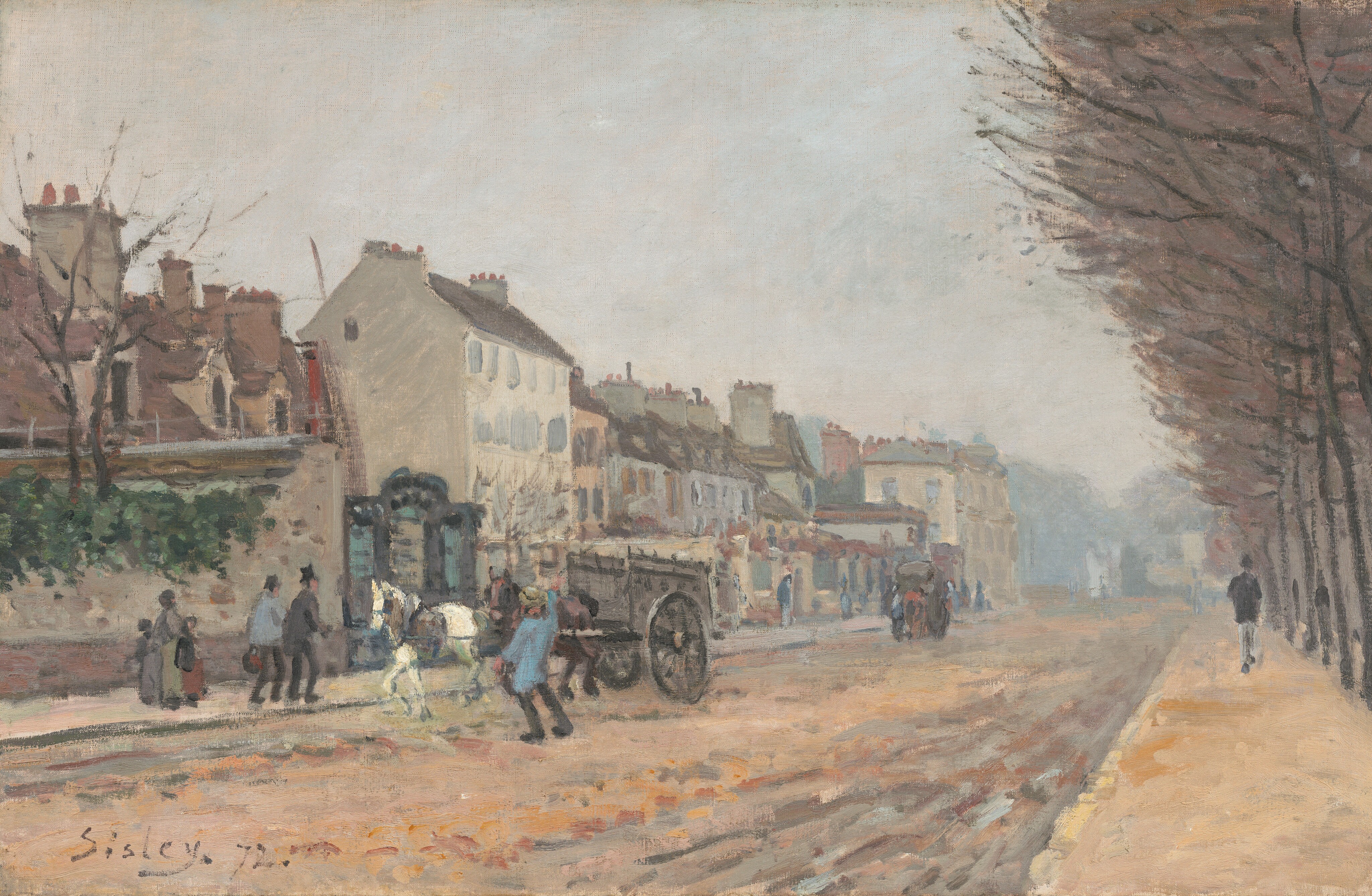
People and a horse-drawn wagon move along a street lined with buildings on the left and trees on the right in this loosely painted horizontal landscape. The wide street angles from the bottom left of the composition to the middle right. The surface of the road is painted with strokes of apricot orange, light gray, rust red, and olive green, and it leads back to a slate-blue, blurred area suggesting trees in the distance. The two, three, or four-story buildings are close together or may be joined. They are painted in muted tones of parchment white, pale peach, and blue gray. Closest to us and to the left, a long brown roof and two bare trees sit beyond an ivy-covered stone wall. The people are indistinct and small in relation to the scene and are dressed in black, brown, olive-green, and slate-blue clothing. One of two carriages is across the road from us and the second one is farther back. On our side of the road, a man wearing a long black jacket and gray pants strolls away from us past a neat row of trees lining the peach-colored sidewalk. The overcast gray and pale pink sky is above. The artist signed and dated the lower left corner, “Sisley. 72.”

Boulevard Héloïse, Argenteuil

Alfred Sisley

1872

Oil on canvas  Accession ID  1970.17.82

On View: West Building Main Floor, Gallery M82
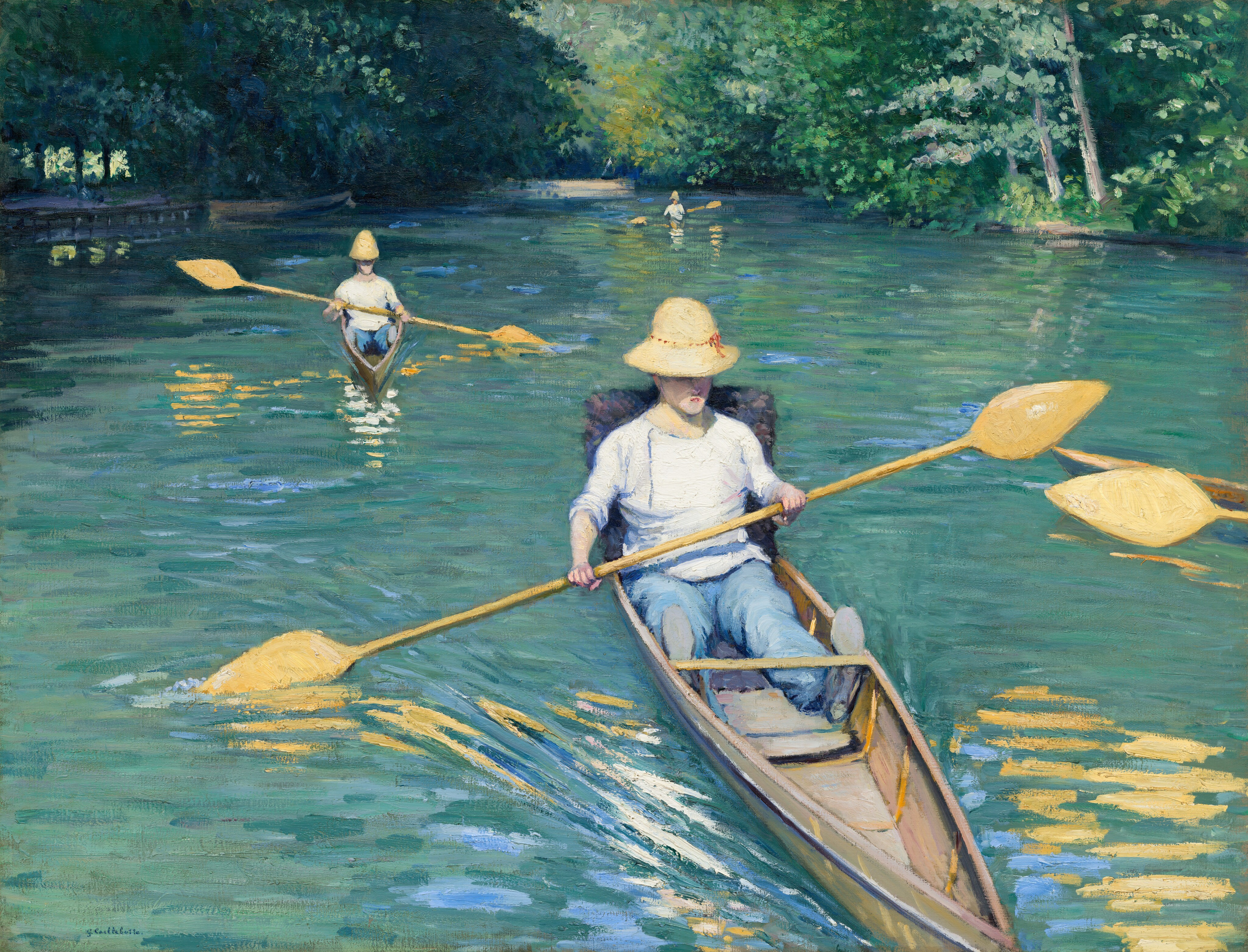
We look slightly down onto the surface of a river in which three narrow canoes, each paddled by a single person, are being rowed toward us in this horizontal landscape painting. The rowers wear white shirts rolled up to the elbows, light blue pants, and straw-yellow, wide-brimmed hats pulled down over the eyes. They sit in the bottom of their boats with legs extended and the handle of the double-bladed paddle straddling the boat over their laps. The canoe closest to us comes almost directly toward us, angled slightly to our right as it cuts through the surface of the river, its tip extending off the bottom edge of the canvas. The second canoe is a couple of boat lengths behind and to our left of the closest canoe. The third is small in the distance, near the horizon that comes three-quarters of the way up the composition. The back end of a fourth canoe and a single paddle extends into the scene from the right edge of the canvas. The butter-yellow paddles are reflected in the pale sage green and sky blue of the river’s surface. The river is lined on both sides with lush trees and vegetation, which fills the top quarter of the painting above the horizon.

Skiffs

Gustave Caillebotte

1877

Oil on canvas  Accession ID  1985.64.6

On View: West Building Main Floor, Gallery M85
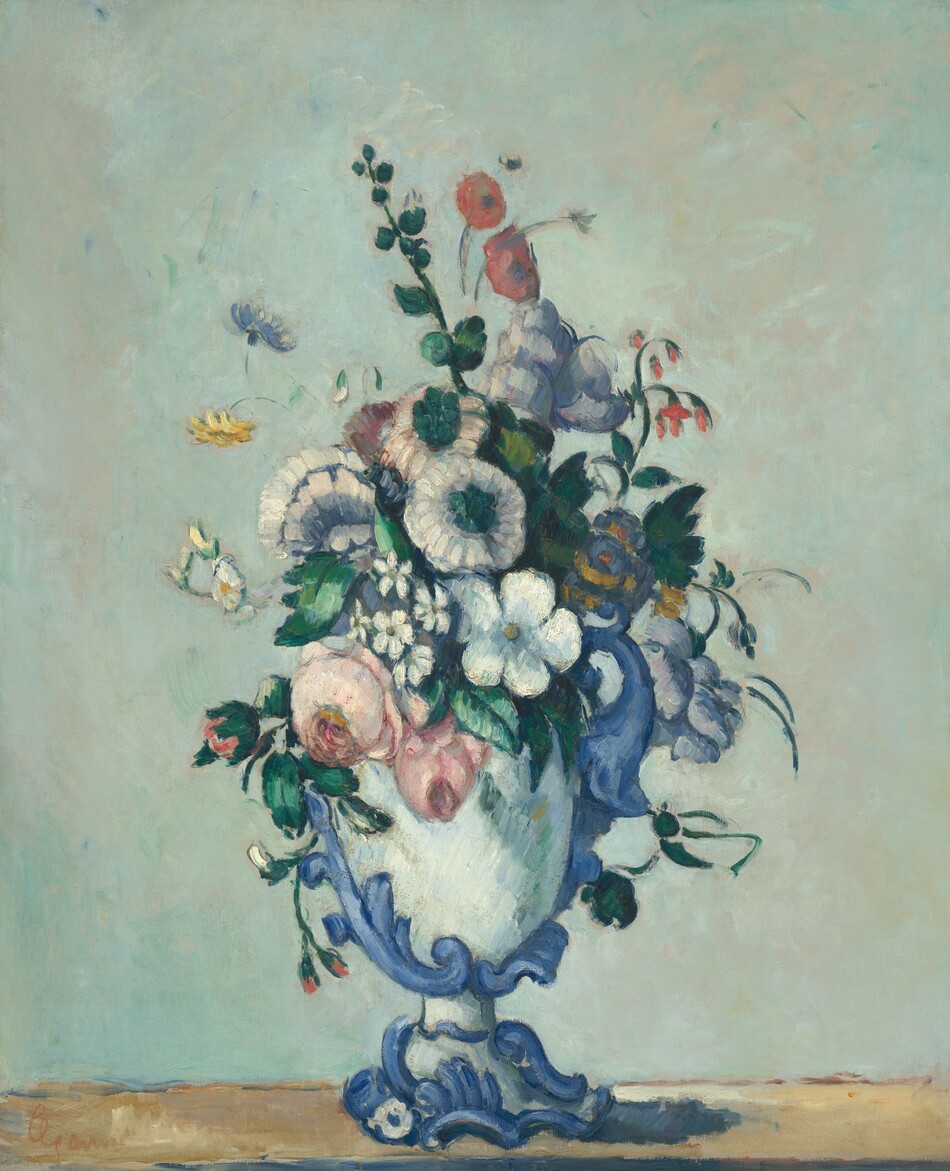
Rose and coral pink, vivid white, delphinium blue, and buttercup yellow flowers with deep green leaves are arranged in a blue and white vase in front of a pale sea-green background in this vertical still life painting. The vase has a white cup on a flaring foot. The vase is encircled with a twisting, decorative blue vine and scrolls. It sits on a band of peanut brown, suggesting a wooden tabletop. The still life is painted with blended strokes, giving the composition a soft, almost mottled appearance. The artist signed the painting in the lower left corner, “Cezanne.”

Flowers in a Rococo Vase

Paul Cezanne

c. 1876

Oil on canvas  Accession ID  1963.10.105

On View: West Building Main Floor, Gallery M84
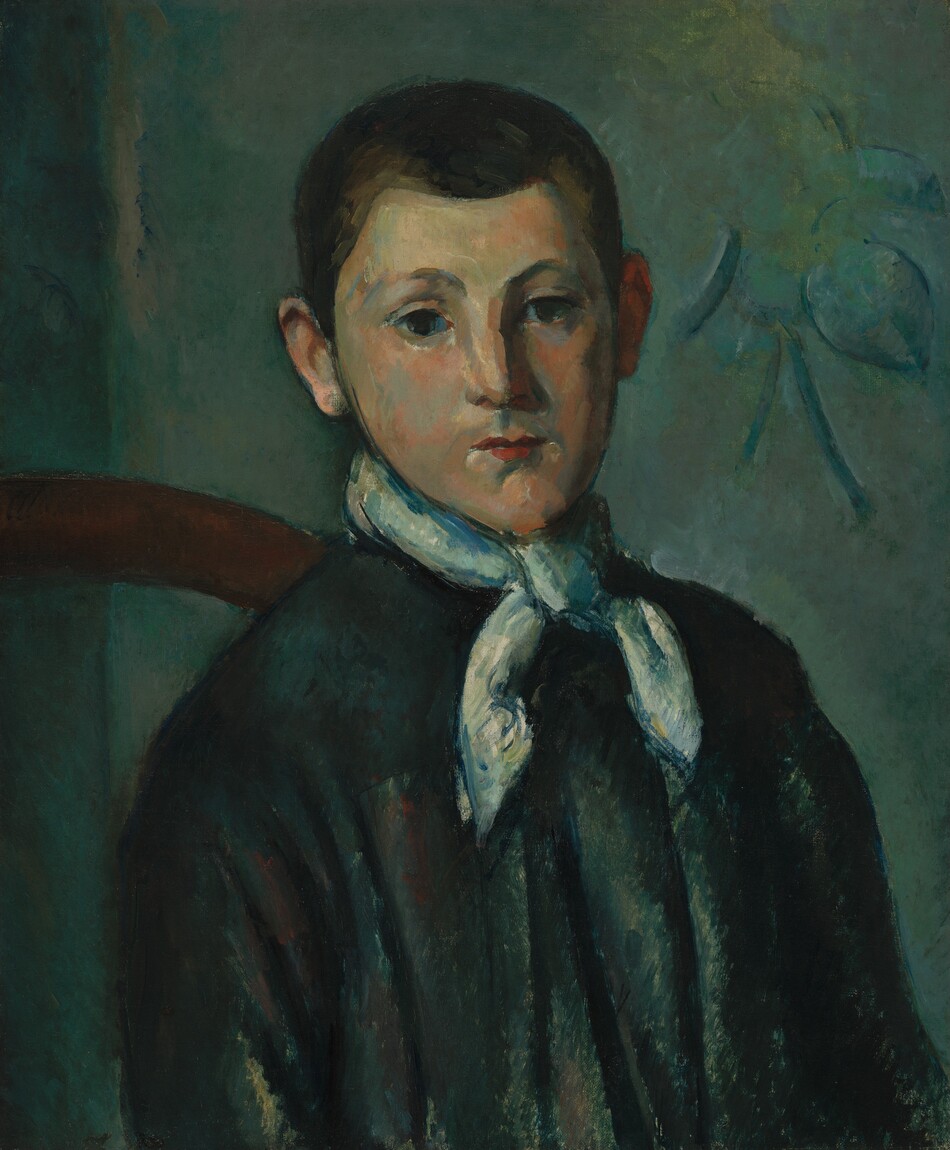
Shown from the chest up, a young boy wearing an aquamarine-blue jacket sits facing us in this vertical portrait painting. His body is slightly angled to our right and he looks just over our right shoulder. He has close-cropped, dark hair. His features and clothing are painted in patchworks of colors. For example, his pale face is painted with swipes of peach, straw yellow, stone blue, and olive green, especially around his large, dark eyes and small, cherry-red mouth. The scarf knotted around his neck is painted with daubs of light and azure blue, teal, putty gray, and white. His voluminous jacket has touches of red, blue, and lighter shades of green. He sits in a corner with walls washed with shades of aqua and turquoise. The rail of a brown chair curves behind his right shoulder, on our left, and is cut off by the left edge of the canvas. A cluster of darker green, leaf-like shapes suggest a design on the wall to our right.

Louis Guillaume

Paul Cezanne

1879-1890

Oil on canvas  Accession ID  1963.10.101

On View: West Building Main Floor, Gallery M84
Six jockeys wearing colorful silks sit astride brown and black horses on a grassy field in this horizontal painting. Two more riders wearing top hats sit a bit farther back from the group, and two horses run on a grass track behind that. Five of the jockeys are together in the lower left quadrant. From left to right, they wear a black jersey with white sleeves, pink with black sleeves, black with sky-blue sleeves, emerald green, and canary yellow. The sixth jockey approaches from the right and wears white. The horizon comes about a third of the way up the composition, and the lawn is painted with blended strokes of spruce green and tawny brown. Three smokestacks belching smoke line the horizon, and three towers, two with spires, presumably represent a church in the deep distance to the left. Strokes of ochre yellow, beige, cream white, and brown represent houses clustered along the horizon. Lilac-purple-tinged clouds sweep across the watery blue sky above. The landscape is loosely painted with visible or blended strokes. The artist signed the lower right corner, “Degas.”

The Races

Edgar Degas

1871-1872

Oil on wood  Accession ID  1942.9.18

On View: West Building Main Floor, Gallery M82
Two women, one holding a baby on her lap, sit on the long bench seat of an omnibus in this vertical, colored print. The women and their full skirts take up almost the width of the composition against the peacock-blue bench, which extends off both sides. The women and baby’s skin are the color of the cream-white paper. The woman to our left wears a tan-colored, high-collared dress, gloves, and hat. She looks off to our right, almost in profile. She has a round face and the hint of a double chin. One gloved hand rests on a cane. The other woman holds the baby and tips her head down toward the child. That second woman wears a tea rose-pink dress and a hat with areas of darker pink, fern green, and straw yellow. Both women’s black hair is pulled up under their hats. The baby’s ruffled white bonnet, blousy garment, stockings, and shoes are also the white of the paper, though the hair is picked out with yellow, the lips with pink, and the ball held in one hand with brown. The structure of the women’s bodices, puffy long sleeves, and long skirts as well as the baby’s clothing are outlined in black. A row of windows behind them, parallel to the top of the bench, open onto an arched bridge spanning a river with boats. To our left, the water’s edge is lined with spruce green trees. Back inside, the panel behind the women’s legs is peanut brown, and the top of the omnibus is muted mauve purple. The artist signed the work with her initials in graphite in the bottom left, “MC.”

In the Omnibus

Mary Cassatt

1890-1891

Color drypoint, softground etching, and aquatint on laid paper  Accession ID  1943.3.2764

On View: West Building Main Floor, Gallery M87
We look across a strip of tall grass and flowers at a river that winds into the distance in this loosely painted, horizontal landscape. The lower half of the composition is a mass of tall wildflowers created with daubs of lemon yellow and white among vertical strokes of moss, laurel, and pine green. The river beyond is painted with horizontal dashes of arctic, denim, and cobalt blue. The horizon comes about two-thirds of the way up the composition and is lined with tall, narrow trees, trees with rounded canopies, and a blanket of green growth loosely painted and shaded with touches of blue. The sky above is painted with blended strokes of slate blue and cream white. The sky is paler to the right, suggesting sunlight breaking through some of the clouds. The artist signed and dated the painting with red in the lower right corner: “Claude Monet 80.”

Banks of the Seine, Vétheuil

Claude Monet

1880

Oil on canvas  Accession ID  1963.10.177

On View: West Building Main Floor, Gallery M80
A band of several galloping horses and riders move across the center of this vertical painting. The color palette is dominated by blended earthy brown, green, and pale pink. The horses, which have reddish-brown coats and tails, nearly span the width of the painting. They move to our left with their legs fully extended. Underneath the horses’ flying legs lies the body of a man. The felled rider faces upward, his eyes closed and his legs splayed. He has a light brown beard, mustache, and hair, and pale tan skin. He wears brown riding boots with black tops, white breeches, and a pink jersey with black sleeves. His riding helmet, with a matching pink cover, lies behind his head on the ground. At least three additional horses are in the band, and the two foremost have empty saddles. The two horses beyond them, farther into the picture, have male riders, who wear riding outfits and helmets in colors of smudged and blended orange, lavender purple, and green. They also have brown mustaches and beards. The band races through a field painted with a muddy green interspersed with strokes of orange and white. The horizon line is high, just above the level of the horses’ backs, about four-fifths of the way up the painting. Blue sky peeks out amid a mixture of pale pink and yellow clouds above. There are trees in the background indicated by a few strokes and dashes of paint. The painting style is loose and brushy throughout, without sharp detail or lines, except for the sketched-in black lines that delineate the bodies and tack of the horses.

Scene from the Steeplechase: The Fallen Jockey

Edgar Degas

1866, reworked 1880-1881 and c. 1897

Oil on canvas  Accession ID  1999.79.10

On View: West Building Main Floor, Gallery M83
Two sailboats and a rowboat float on a glistening, azure-blue river spanned by a stone bridge to our right in this horizontal landscape painting. The scene is loosely painted with visible strokes and dashes throughout so some details are indistinct. An area of asparagus and moss-green dabs creates a patch of grassy riverbank in the lower right corner of the painting. The rippling, sun-dappled surface of the river is created with short parallel strokes of pale pink, caramel brown, white, sage green, and light blue. An empty sailboat, with its sails tightly furled or removed all together, floats near us to our left of center. It has a single tall, pale wood mast. A similar pole rises from the bottom edge of the picture, presumably the mast of another ship below us or out of our view. Farther out on the water and to our left is another sailboat with full white sails catching the sunlight. The final vessel is loosely painted with a few swipes of goldenrod yellow, black, white, and pink to suggest two people sitting in a rowboat, one of them holding a pink parasol. The gray stone bridge is shaded on our side with denim blue along the faces of the four arches we can see. Several people, painted with a few touches of peach and black, stand at the railing. The bridge angles from near the upper right corner of the canvas to almost the middle of the composition, where it meets a narrow, three-story coral-pink and light gray building. A two-story, white building sits a short distance to its left. They bask in warm sunlight against a row of emerald and olive-green trees. A baby-blue sky scattered with puffy white clouds spans the upper half of the composition. The artist signed the lower right with dark red letters, “Claude Monet.”

The Bridge at Argenteuil

Claude Monet

1874

Oil on canvas  Accession ID  1983.1.24

On View: West Building Main Floor, Gallery M85

Loading Results