Impressionism and Post-Impressionism

Filter Results

138 artworks on view.

Results

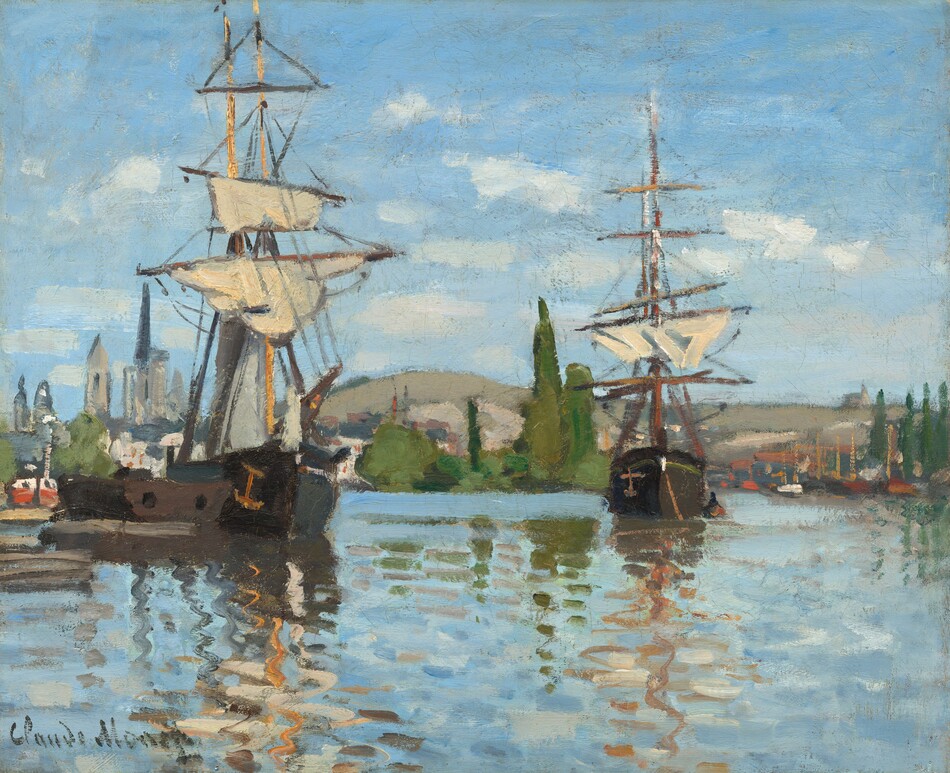
We look across the water at two sailing ships with cream-white sails and dark rigging floating in a shimmering, ice-blue river against a distant shore lined with trees, hills, and buildings in this nearly square landscape painting. The horizon comes about halfway up the painting, and the ships’ masts and sails are silhouetted against a topaz-blue sky with wispy white clouds. The scene is loosely painted with visible brushstrokes throughout so many of the details are indistinct. One boat floats near the left edge of the painting and the second is situated a little father back, to our right of center. Both have rust-orange anchors painted near the pointed bows, which face us. Tall, narrow, asparagus-green trees line the far riverbank between the boats. Tall spires and towers of buildings rise in a cluster to our left near that edge of the canvas, and boats cluster near the distant shore to our right. Oatmeal-brown hills rise beyond the trees and town. The trees and boats are reflected in the water, which is painted with horizontal dashes and squiggles. The artist signed the painting in the lower left, “Claude Monet.”

Ships Riding on the Seine at Rouen

Claude Monet

1872/1873

Oil on canvas  Accession ID  1970.17.43

On View: West Building Main Floor, Gallery M82
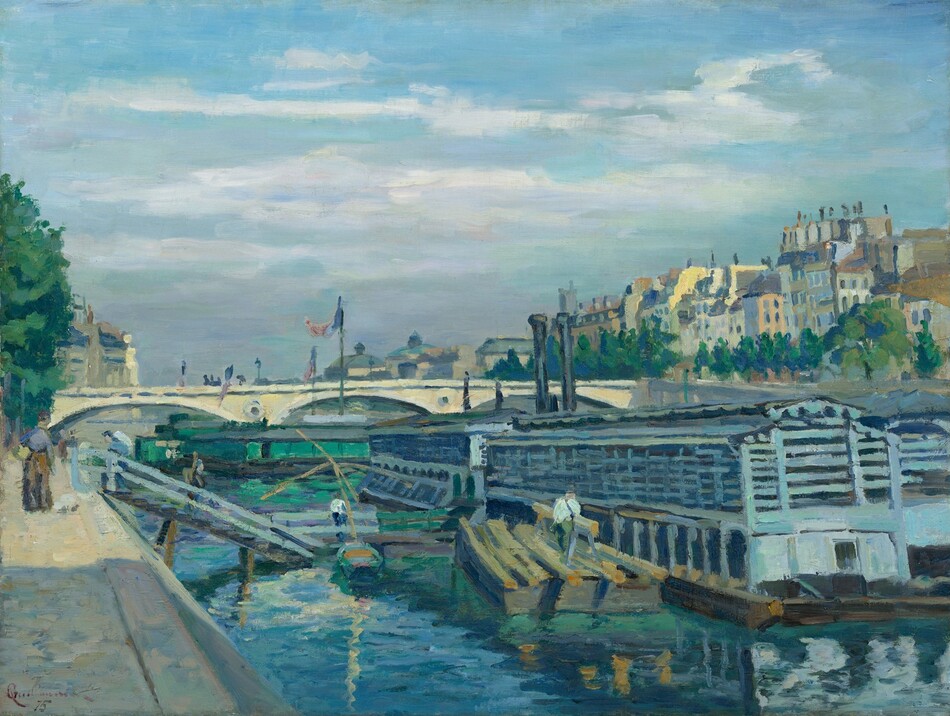
This painting shows a riverside with a cream-colored bridge cutting horizontally across the scene in front of a bustling city. The bridge is decorated with flags that have stripes of red, white, and blue. Closest to us, at the bottom of the painting, large white barges are moored on the reflective blue river, with small people in white shirts floating nearby on wooden platforms. On the left, a pale gray path stretches along the side of the river, with some pedestrians walking on it. In the distance on the right, tall buildings are visible in shades of yellow, blue, peach, and cream. They have pointed roofs with many dark chimneys sticking up into the air. The sky above is blue and full of soft white clouds. The brushstrokes in the painting are thick and visible, and details are suggested with dashes of paint, rather than illustrated clearly.

The Bridge of Louis Philippe

Jean-Baptiste-Armand Guillaumin

1875

Oil on canvas  Accession ID  1963.10.155

On View: West Building Main Floor, Gallery M82
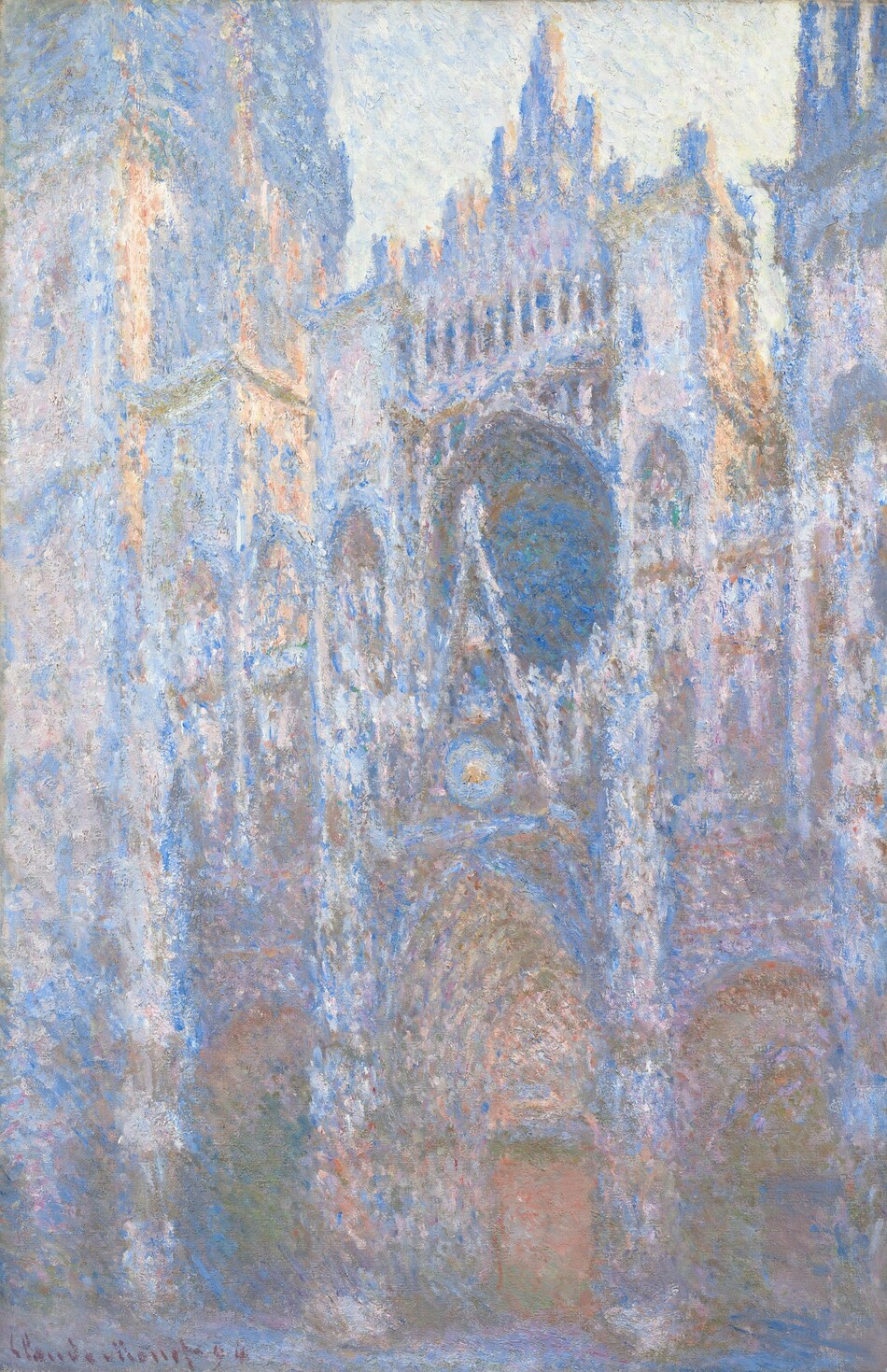
We look up at the exterior of a church that soars the height of this vertical painting. The church is painted with visible dabs and strokes of azure blue, peach, lavender purple, and camel brown to create a blurred look, as if seeing a reflection in the rippling surface of a puddle. The church façade is angled to our left, away from us. The main door and its surround takes up the center of the composition, where a rectangular door is set within nested, pointed arches that lead up to a narrow, tall, triangular gable. The point of that gable overlaps the round, dark rose window, which is the same width as the portal surround below. Spires flank the central section and rise precipitously off the top edge of the painting. The sky above is painted with daubs of white and pale blue. The artist signed and dated the lower left, “Claude Monet 94.”

Rouen Cathedral, West Façade

Claude Monet

1894

Oil on canvas  Accession ID  1963.10.49

On View: West Building Main Floor, Gallery M80
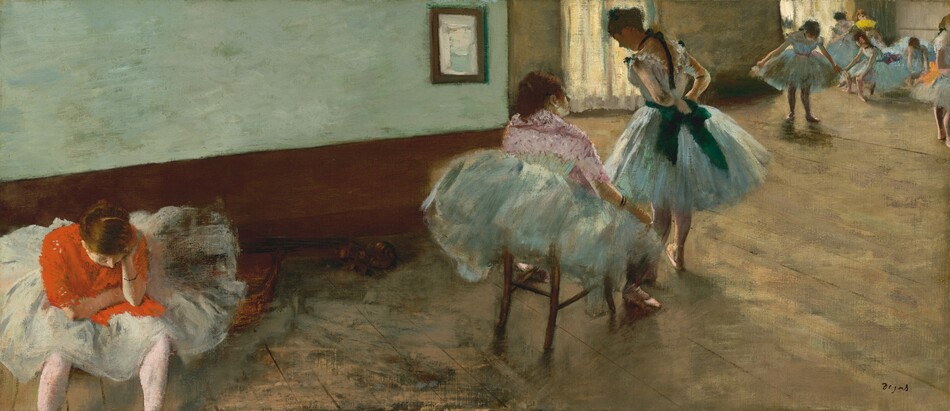
A long, brightly lit room is filled with at least nine young ballerinas in robin’s egg-blue dance costumes and pale pink shoes in this wide, horizontal painting. They all have light skin and brown or dark blond hair. The studio is lit from the left, and more light pours in through two windows toward the back. The wall closest to us is mint green with brown wainscoting covering the lower half, and a small mirror hanging a short distance down the wall. The walls of the space farther from us and the scuffed, worn floor are both painted with tan layered with washes of moss green and denim blue. A dancer in the lower left faces us and sits near a cello lying on the floor. The instrument’s curved upper body and neck emerge from the tutu near her left hip, on our right. She leans forward with her right arm, on our left, draped across her lap, and she rests her head on the other hand, propped up on her elbow. We look slightly down on her so only see the top of her head and the point of her nose. She wears a red jacket with her ice-blue, knee-length tutu spread around her. Her splayed feet are cropped by the bottom edge of the canvas. In the center are two dancers, one seated and the other standing. The seated girl is perched on a wooden chair with the back of her tutu draped over its top. She also wears a petal-pink jacket dotted with darker mauve. She gazes at the girl in front of her. That girl stands with her back to us, bowing her head slightly as she adjusts the bow of her emerald-green belt at the small of her back. At least six more dancers sit or stand along the far wall, in the upper right corner of the composition. One looks down at her tutu spread wide between her hands, and another holds a canary-yellow fan up to her face. The features of this group are loosely painted, making them indistinct. The artist signed the lower right, “Degas.”

The Dance Lesson

Edgar Degas

c. 1879

Oil on canvas  Accession ID  1995.47.6

On View: West Building Main Floor, Gallery M83
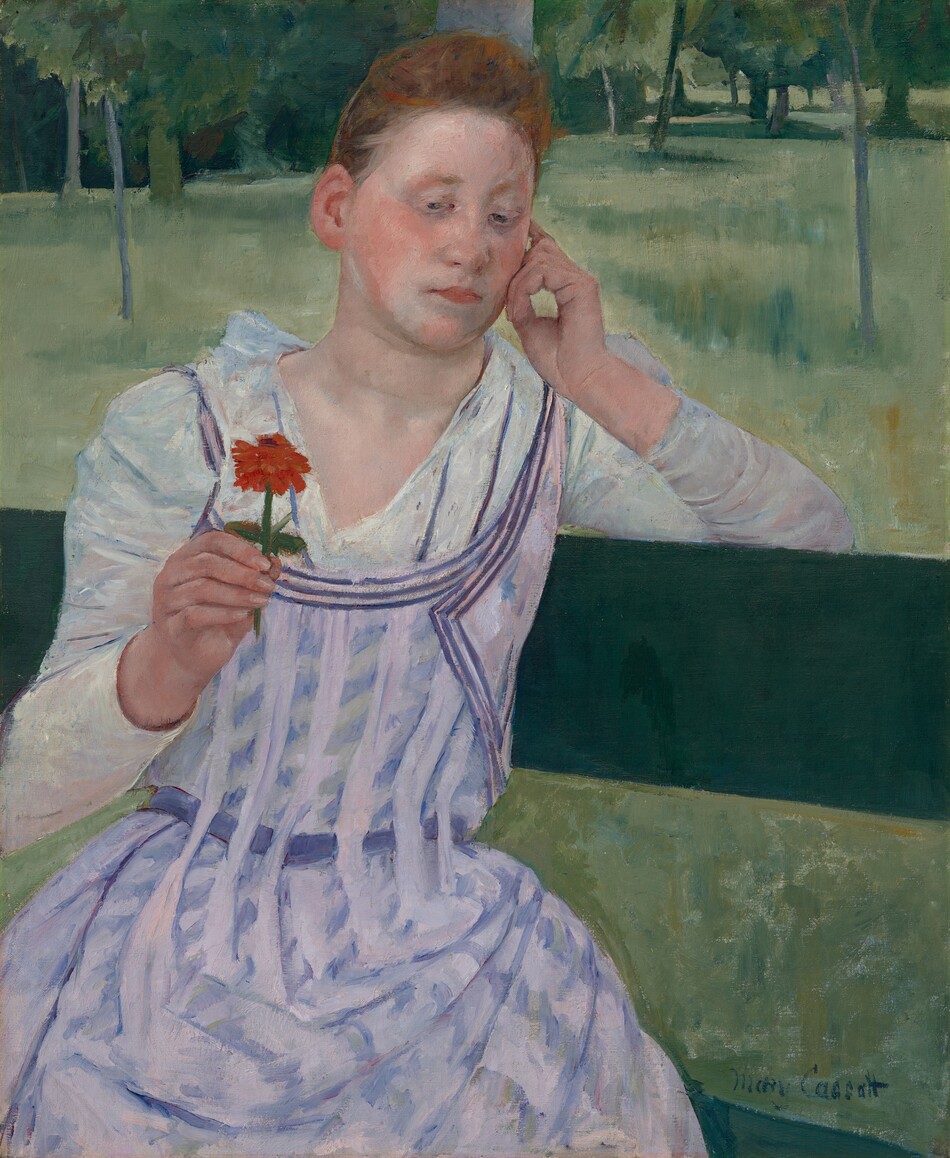
Shown from the knees up, a young woman with peachy skin and red hair sits facing us on a pine-green bench in this vertical painting. She sits with her body angled to our right, and her left elbow, on our right, hooks over the top slat of the bench. Her head tilts slightly to our right to rest on the curled fingers of that hand. In her other hand, she holds up a red flower on a short stem. Her hair is pulled up and back over a high forehead, and her cheeks are deeply flushed. Her pink lips are closed, and she looks down and to our left at the flower with gray eyes. She has an oval-shaped face and a hint of a double chin. Her white dress is painted with ice-blue shadows and folds. It has a deep V neck that reaches to an apron-like pinafore patterned with vertical bands of pale lilac that alternate with angled daubs of blue. Beyond her is a loosely painted landscape with grassy areas and clusters of tall trees painted in spring, emerald, and sea glass green. The edge of the grassy field nearly brushes the top edge of the canvas, and the trees are cropped by it. The artist signed the lower right, “Mary Cassatt.”

Woman with a Red Zinnia (Revery)

Mary Cassatt

1891-1892

Oil on canvas  Accession ID  1963.10.99

On View: West Building Main Floor, Gallery M86
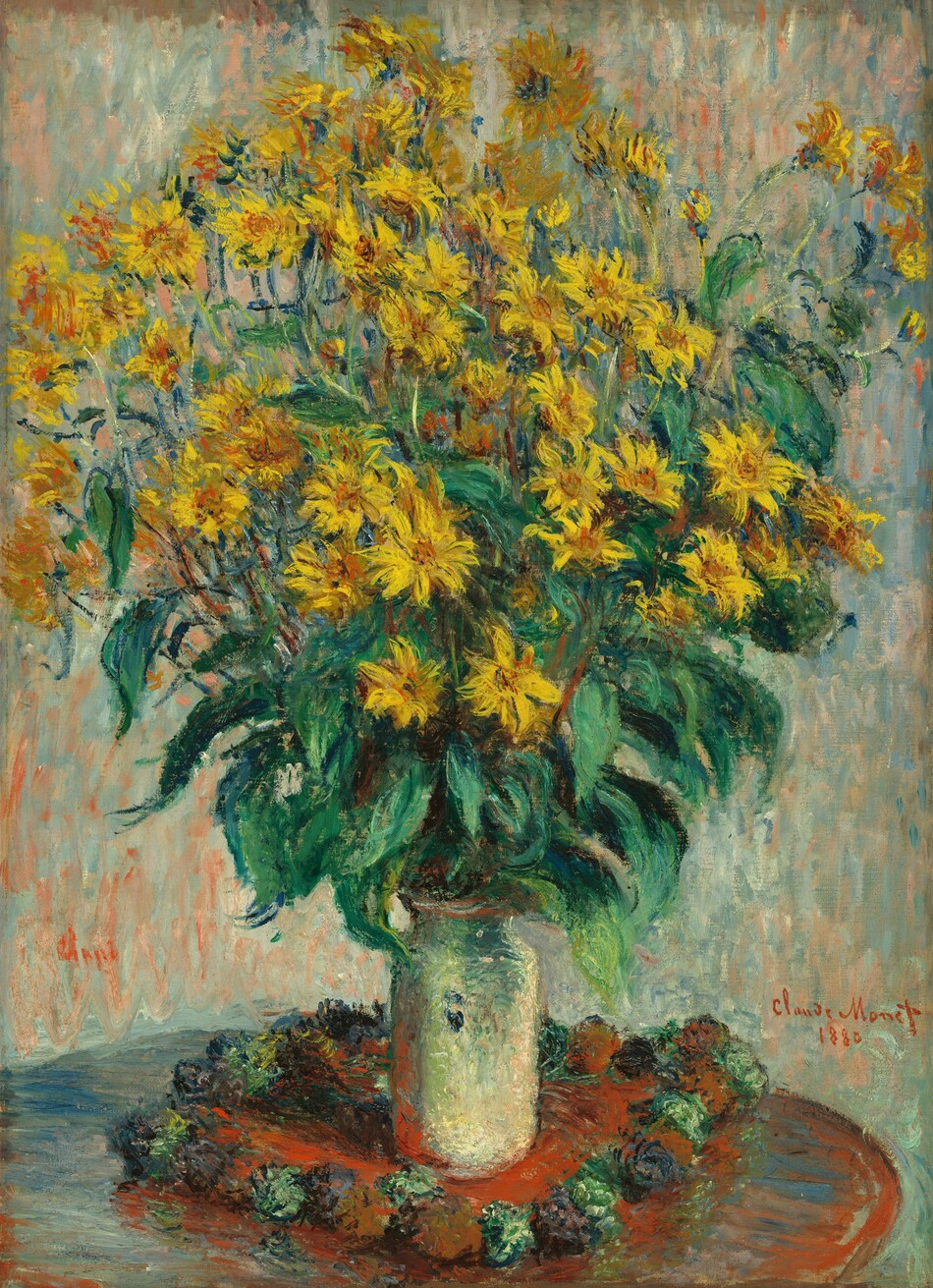
A cloud of canary-yellow flowers with pumpkin-orange centers on tall stems with emerald and pine-green leaves fills the top half of this vertical still life painting. The flowers, vase, the round tabletop on which they sit, and the background are loosely painted with visible brushstrokes of vibrant color. The flowers have long, pointed petals like daisies. The bouquet is rimmed with a ring of verdant leaves near where the stems gather in the narrow neck of the cylindrical, ivory-white vase. The vase might sit on a circular cloth edged with alternating sage-green and plum-purple forms like pompoms, but the loose painting style makes these details difficult to make out. The round tabletop is cropped by left and bottom edges of the canvas. The background behind the bouquet and table is painted with long, vertical brushstrokes in salmon pink, pale turquoise, denim blue, and creamy white. The artist signed and dated the painting in red in the lower right corner: “Claude Monet 1880.”

Jerusalem Artichoke Flowers

Claude Monet

1880

Oil on canvas  Accession ID  1963.10.181

On View: West Building Main Floor, Gallery M80
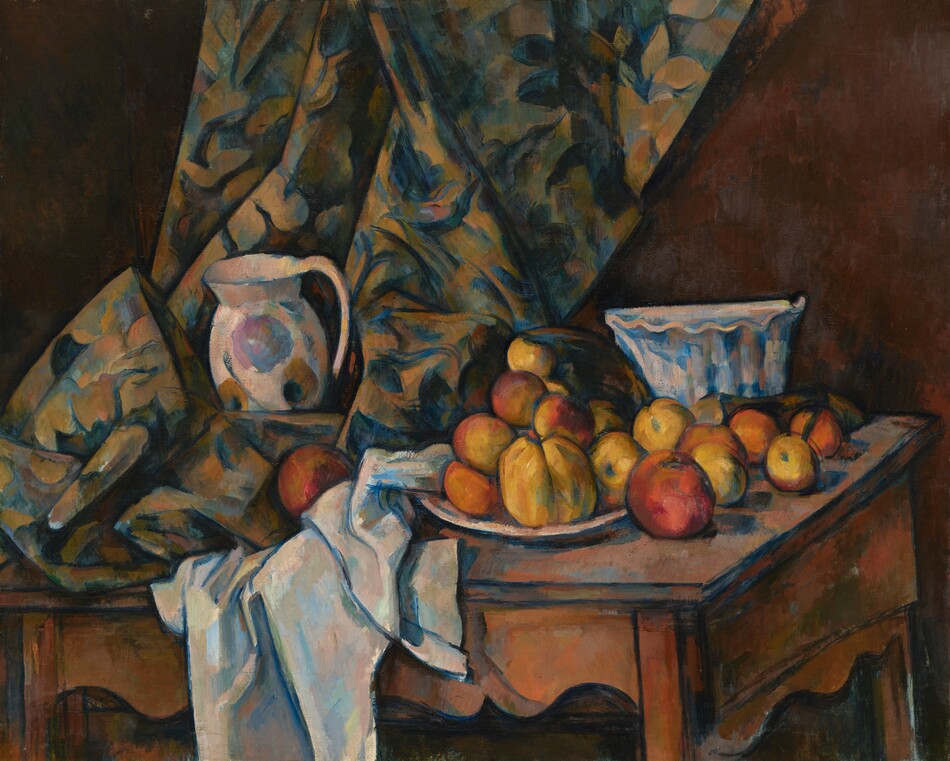
About a dozen rust-orange and golden yellow apples and peaches are arranged on a white plate next to white and floral-patterned cloths nestled around a white pitcher and bowl, all on a wood tabletop that tilts toward us in this nearly square still life painting. A curtain patterned with royal blue, olive green, and beige falls along or near the back wall of the room and rests on the table to our left. The white pitcher is painted loosely with the suggestion of harvest-gold and pale lilac-purple flowers, and it sits amid the pooling folds of the curtain to our left. The white tablecloth is bunched under and next to it to our right, at the middle of the composition. The fruit is arranged on and around a white plate next to the tablecloth. A tall bowl with fluted sides and a ruffled, scalloped rim sits behind the fruit, near the right edge of the table. The curving skirt of the table reaches nearly to the bottom edge of the canvas. All the objects in the painting are outlined with dark blue and the shadows are painted with patches of spruce and cobalt blue.

Still Life with Apples and Peaches

Paul Cezanne

c. 1905

Oil on canvas  Accession ID  1959.15.1

On View: West Building Main Floor, Gallery M84
A dozen men, women, and children walk, stand, or sit on a waterside wharf that spans this horizontal painting. A jetty stretches into the distance at a right angle, starting to the left of center. Dozens more people pack the jetty. The people close to us all appear to have pale skin. The men wear suits and hats in brown or black, and the women wear long hoop skirts, capes, and hats, some with veils, in shades of sky blue, red, gray, or mustard yellow. A man and woman sit on an ice-blue bench near a solitary streetlamp at the center of the composition. A small brown dog runs toward the bench from the right, and a black and white dog sniffs the ground to the left. Facing away from us, a man and woman lean onto a white fence at the water’s edge near the entry to the jetty. A dock is across a strip of topaz-blue water, where a sailboat kicks up some white ripples. Two flag-topped masts rise beyond the crowded jetty, and a steampipe between them pours charcoal-gray smoke into the pale blue sky. Paler gray clouds line the top edge of the painting, and a loose band of white clouds lines the horizon, which comes about a quarter of the way up the composition. The scene is loosely painted so people’s features and many details are indistinct. The artist signed and dated the lower right, corner, “E. Boudin. 63.”

Jetty and Wharf at Trouville

Eugène Boudin

1863

Oil on wood  Accession ID  1983.1.9

On View: West Building Main Floor, Gallery M82
We look slightly down onto a woman dressed in golden yellows, sitting in a pale green chair, with a nude child sitting in her lap as they both gaze into a mirror in this vertical portrait painting. Both the people have pale, peachy skin. The chair is angled to our left so the woman’s knees and child cant down toward the lower left corner of the composition, and the woman leans onto the arm closer to us. The chair is painted mint green and the rose-pink upholstery is visible on the seat and a corner behind the woman’s shoulder. To our right, the woman’s vibrant, copper-colored hair is pulled loosely to the back of her head. She has a rounded nose, flushed cheeks, and her full, coral-pink lips are closed. Her long dress has a low, U-shaped neckline. The fabric shimmers from pale, cucumber green to light sunshine yellow. The sleeves of the dress split over the shoulder and a second long, goldenrod-yellow sleeve falls from her elbow off the bottom edge of the canvas. An oversized sunflower, larger than the woman’s face, is affixed to her dress near her left shoulder, closer to us. She looks with dark eyes down toward the small, gold-rimmed mirror she holds in her right hand, farther from us. The child also holds the handle of the mirror with both hands, and in the reflection, the child looks back at us with dark eyes, a button nose, and pink lips. The child’s hair in the reflection is the same copper color as the woman’s, but the child on her lap has blond, shoulder-length hair. The woman rests one hand on the child’s left shoulder, closer to us. The child has a rounded belly and smooth, rosy limbs. The woman and child are reflected in a second mirror hanging on the wall alongside them, opposite us. Their reflections are very loosely painted. The wall behind the pair is sage green across the top and it shifts to fawn brown across the bottom. Brushstrokes are visible throughout, especially in the woman’s dress and hair, and are more blended in the bodies and faces. The artist signed the painting in the lower right corner, “Mary Cassatt.”

Woman with a Sunflower

Mary Cassatt

c. 1905

Oil on canvas  Accession ID  1963.10.98

On View: West Building Main Floor, Gallery M86
A pale-skinned woman, nude from the waist up, gathers her hair in her raised hands as she sits before a mirror in this vertical, colored print. The large mirror is to our right, and the woman’s body is mostly turned away from us. Her head is bowed but a loose tendril of brown hair hanging beside one cheek is reflected in the mirror. Her lower body is wrapped in a voluminous off-white cloth as she leans forward on a curved terracotta-red and white striped armchair. Her facial features, the contours of her body, and the folds of the towel are all delineated with thin strokes of tawny brown. The mirror is set into a tan wall, and the wall beyond and carpet below her covered with abstract floral patterns. The wall has a dusty-rose motif over an off-white background with washes of light gray while the carpet pattern is tan over a peach background. The wall and chair are reflected in the mirror in paler tones.

The Coiffure

Mary Cassatt

1890-1891

Color drypoint, softground etching, and aquatint on laid paper  Accession ID  1943.3.2758

On View: West Building Main Floor, Gallery M87
A woman standing on a ladder propped against a wall hands fruit down to a nude child held by a second woman in this vertical colored print. The scene is printed with areas of mostly flat color in shades of vivid green, earthy browns, and pastel pinks and blue. The women and child have peachy-toned skin and brown hair. Both women wear long, floral-patterned dresses with long, loose sleeves, and their hair is pulled back in buns at the napes of their necks. The ladder, to our left, leans against the verdant green vines growing up the brown wall. The woman standing on the ladder wears a powder-blue dress over an apricot-orange and white patterned kerchief around her neck. She looks down in profile at the child to our right. The child sits facing away from us in the other woman’s arms, bare buns squished along one forearm. The child reaches for the fruit, perhaps a cluster of small grapes. The second woman wears rose pink, and her face is hidden by the child’s head. An opening in the wall to the right leads back to an open space with more greenery. The sky above is a strip of topaz blue along the top edge of the print.

Gathering Fruit

Mary Cassatt

c. 1893

Color drypoint, softground etching, and aquatint on laid paper  Accession ID  1943.3.2757

On View: West Building Main Floor, Gallery M88
An arched bridge faintly materializes in a haze of soft turquoise blue and mint green in this horizontal landscape painting. The bridge has four arches under a flat deck, and it extends off each side of the canvas. Running across the middle of the composition, it angles slightly away from us to our right. The bridge is painted in strokes of slate blue and muted lavender purple, with darker shades on the shadowed undersides of the arches. Touches of rose pink and white along the deck suggest lights moving across the bridge. The water below is sky blue and seafoam green. A few vertical swipes of teal blue in the background suggest towers or tall buildings in the distance on the opposite shore. The sky above is painted with long strokes of lime green and robin’s egg blue. The artist signed the painting with cobalt blue in the lower right corner, “Claude Monet.”

Waterloo Bridge, London, at Dusk

Claude Monet

1904

Oil on canvas  Accession ID  1983.1.27

On View: West Building Main Floor, Gallery M80

Loading Results