Impressionism and Post-Impressionism

Filter Results

138 artworks on view.

Results

In the Omnibus [recto]

Mary Cassatt

1890-1891

Black chalk and graphite on wove paper  Accession ID  1948.11.51.a

On View: West Building Main Floor, Gallery M87
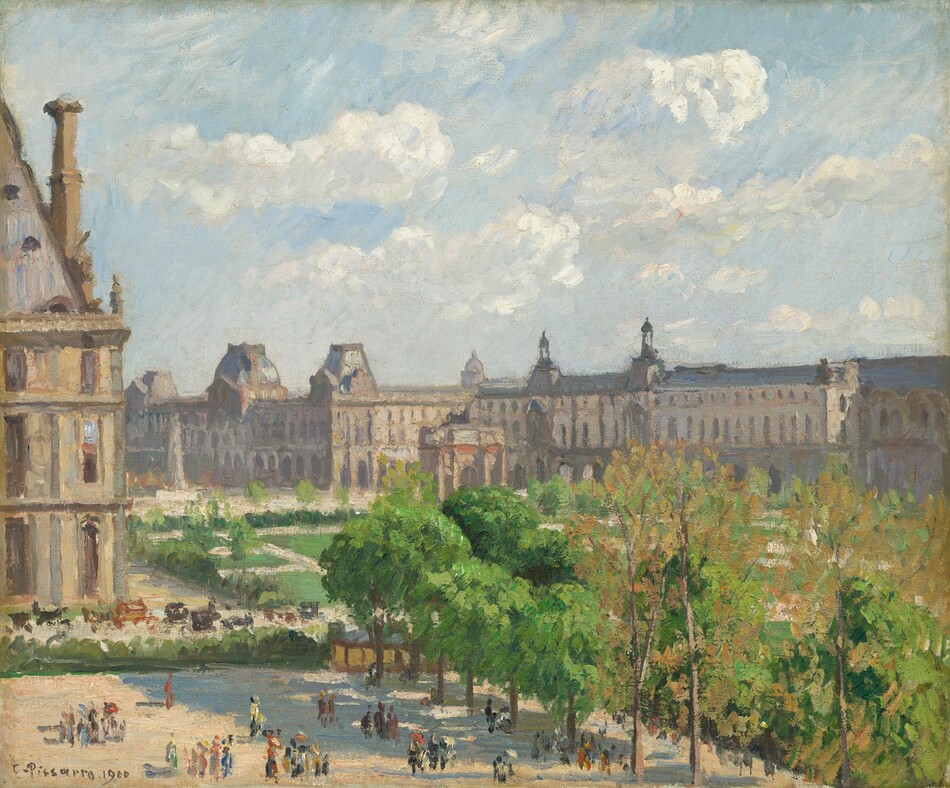
We look down onto a plaza with a sliver of a tall building rising along the left edge of the painting, a row of verdant, green trees to our right, and a row of buildings enclosing the space in the distance in this nearly square landscape painting. The peanut-brown building to our left nearly reaches the top edge of the canvas. It has three oversized, tall stories under a high, sloping roof with a slender chimney. A promenade with carriages runs in front of the tall building. In the plaza closer to us but tiny in scale, people gather in small and large groups, along the bottom edge of the composition. They are painted with dabs and short strokes of cobalt blue, butter and golden yellow, brick red, black, and white. The trees create a diagonal line running from the lower right corner into the scene, along the edge of the plaza to our right. Beyond the plaza and trees, the corners of a formal garden with sand-white walking paths stretch back to the row of buildings in the distance, which come halfway up the painting. That long line of buildings is painted with tones of light brown with rows of tall, narrow windows. The roofs are slate gray, and several cupolas and towers are spaced along its length. The buildings span the width of the painting and disappear behind the tall building to our left. Loosely painted, white, puffy clouds float across the ice-blue sky above. The artist signed and dated the work with brown paint in the lower left corner: “C. Pissarro. 1900.”

Place du Carrousel, Paris

Camille Pissarro

1900

Oil on canvas  Accession ID  1970.17.55

On View: West Building Main Floor, Gallery M89
A man and two women standing near a bar nearly fill this vertical painting. Though made with oil on cardboard, the paint is applied in thin strokes, so parts of the painting look more like a drawing, and the tan of the cardboard is visible in many areas. Shown from the thighs up at the center of the composition, the man stands with his back to us, looking away from us to our left, almost in profile. The camel-brown of the cardboard acts as the color of his jacket and the skin of his face, which are otherwise delineated with cobalt-blue and violet-purple lines. He wears a dark bowler hat, and a white cigarette dangles in his lips. A few scribbled black lines could suggest a mustache. Hands thrust into his pockets, he looks down at the bar, which a runs along left edge of the composition. Squeezed between the man and the glasses on the bar, a woman wearing a teal-blue feather boa leans one elbow on the bar and looks back at the man from the corners of her eyes. Her skin is rose-pink and she has curly red hair. Her arched, thin eyebrows and snub nose are set in a round face with a double chin, and her crimson-red lips are pursed. She wears a ruby-red dress or coat and a turquoise-blue, wide-brimmed hat with bubblegum-pink ribbons or feathers. Two small, stemmed glasses sit on the bar in front of the man and woman. Behind the bar, along the left edge of the painting, a man wears a dark vest over a shirt with sky-blue sleeves. A light cloth lies over the shoulder closer to us and he has dark hair. The rest of his features are lost behind the woman’s hat. To our right, beyond the man’s shoulder, a woman stands with her body facing us as she tips back and looks off to our right. She wears a long, black tie over a pale blue, high-necked shirt. One hand is tucked into a pocket on the front of her jacket, which is streaked with mint green over the brown cardboard. Loosely painted vertical stripes below her waist suggests she wears a skirt, indicating this is a woman, though it might otherwise be difficult to tell. She wears a low, royal-blue cap with an emerald-green feather curling up from the back over a cloud of yellow hair. Only the gray bowler hat, ruddy skin around the ear, and a teal-green jacket of a fifth person are visible between that woman and the right edge of the composition. The wall at the back of the space is tan with shell-pink streaks, and a sign with a red triangle against a turquoise background is cropped by the right edge of the painting. The scene is sketchily painted so features are outlined with blue or brown and filled in with streaks of pale color. The artist inscribed the painting in the lower right corner, “pour Metenier d'apres son Alfred la Guigne HTLautrec,” with the HTL overlapping to create a monogram.

Alfred la Guigne

Henri de Toulouse-Lautrec

1894

Oil on cardboard  Accession ID  1963.10.220

On View: West Building Main Floor, Gallery M80
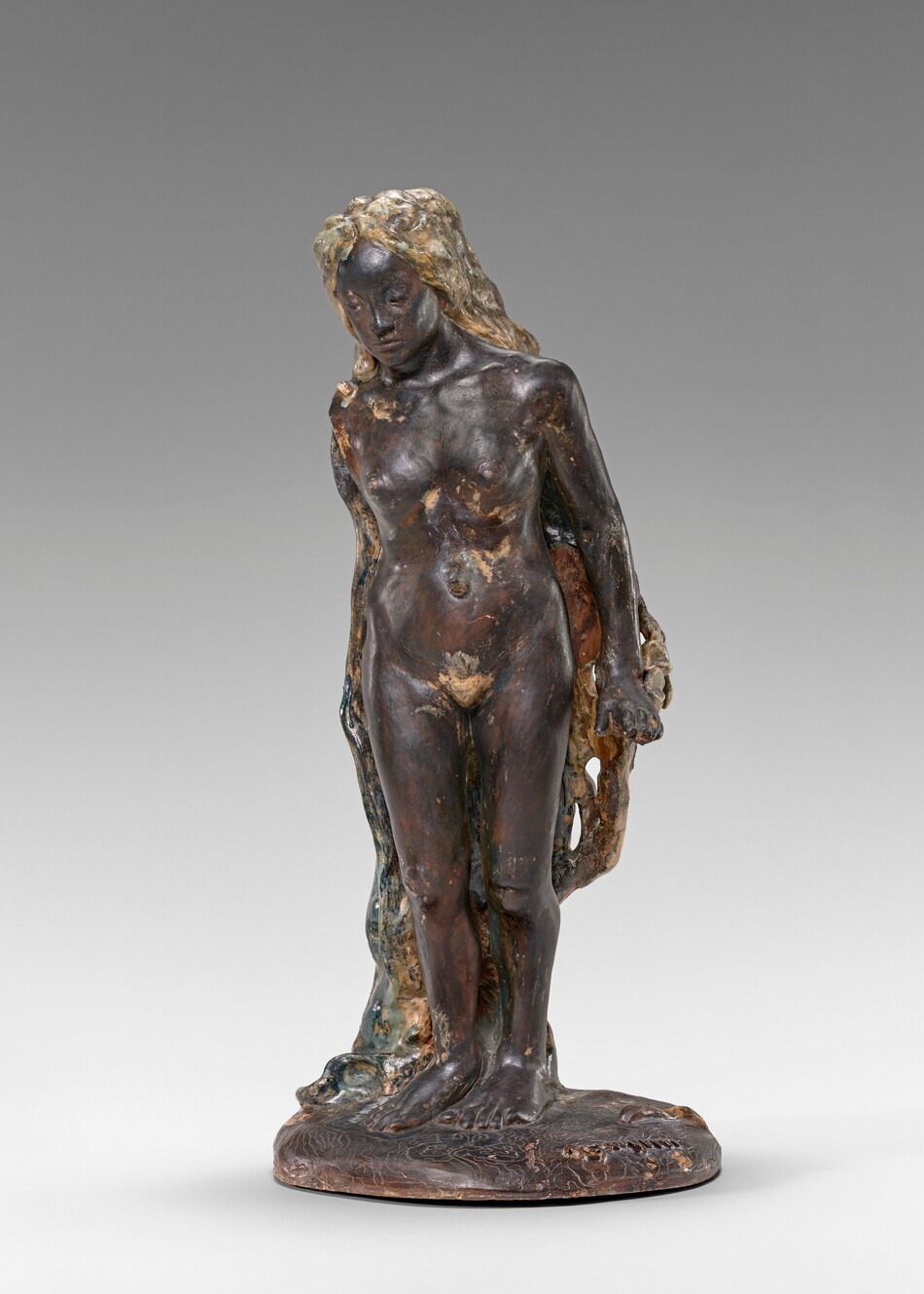
The sculpture depicts a standing nude female figure with long golden hair cascading over her shoulders and down her back. Her arms are by her sides, and she stands upright, looking down and to the left. The material of the sculpture is dark, and her skin is a dark brown color. There are some small dots of gold on her torso and around her groin. The figure stands on a round base with an uneven surface.

Eve

Paul Gauguin

1890

Glazed ceramic  Accession ID  1970.30.1

On View: West Building Main Floor, Gallery M83
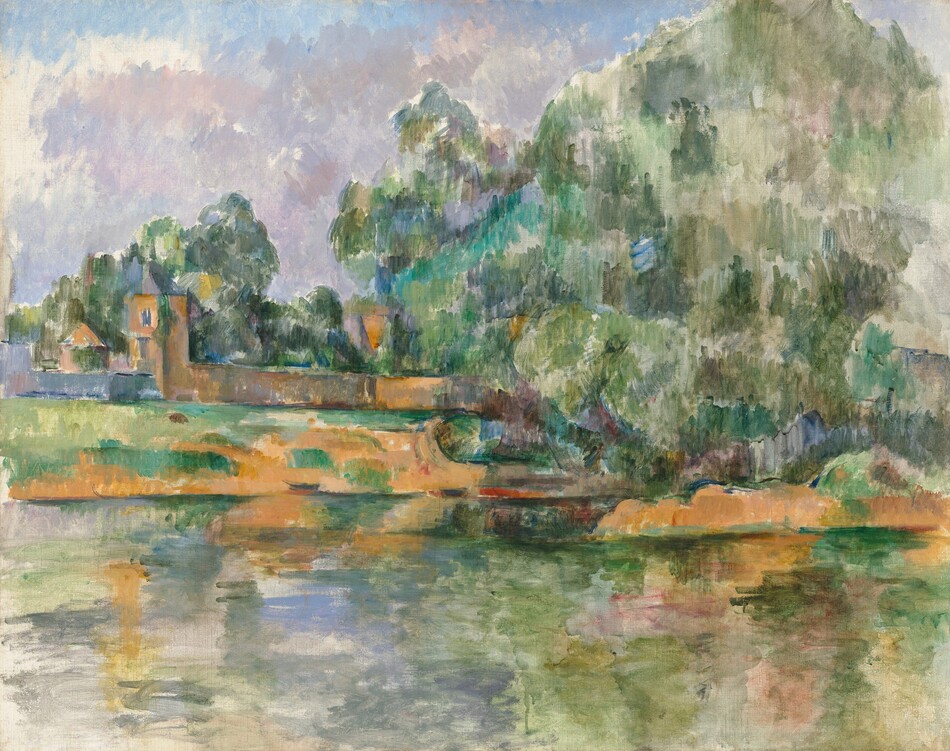
A row of structures and a massive weeping willow tree line the clay-orange riverbank opposite us in this horizontal landscape painting. The scene is painted loosely with long, visible brushstrokes. Taking up much of the right side of the painting, the tree has emerald, moss, fern, and olive-green leaves with brown and purple trunk and roots. It casts long, gently rippling reflections in the water. The structures to our left are enclosed behind a terracotta-colored wall with a square tower. A second segment of wall, to our left, is charcoal gray. Trees grow up behind the structures. The sky above is painted with mingled strokes of lavender purple, baby blue, and white.

Banks of the Seine at Médan

Paul Cezanne

c. 1885/1890

Oil on canvas  Accession ID  1970.17.21

On View: West Building Main Floor, Gallery M84
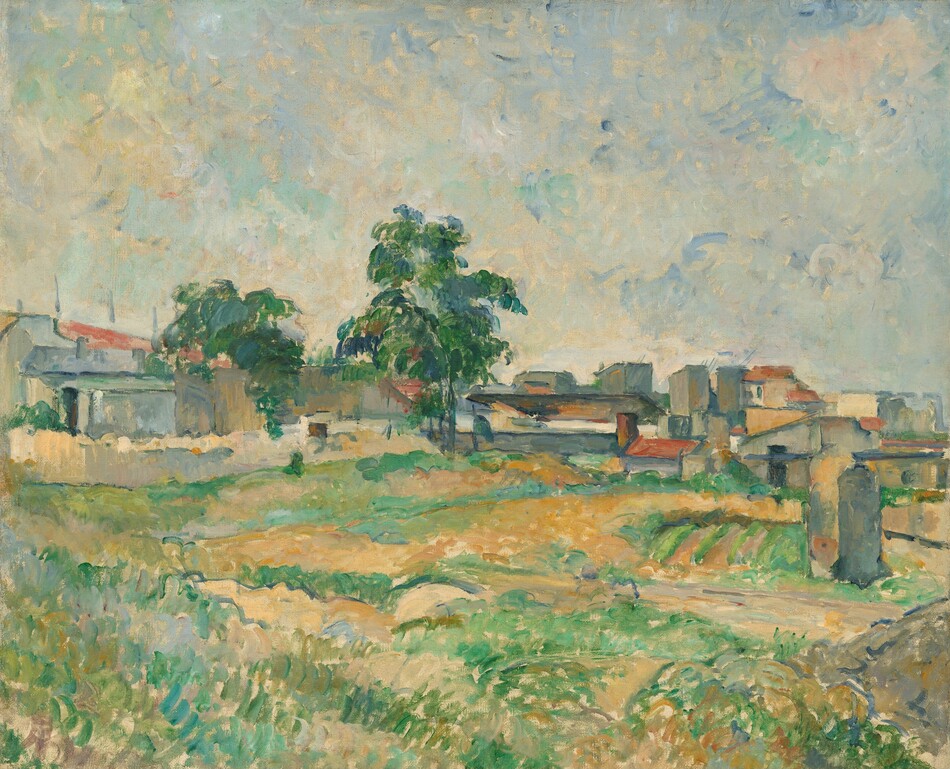
Across a grassy field, a row of buildings and two trees line the horizon, which comes about halfway up this nearly square landscape painting. The field is painted with visible brushstrokes of sage, moss, and mint green as well as caramel brown, parchment white, and turquoise blue. The trees, to our left of center, are painted with dark green. The buildings have charcoal-gray or terracotta-red roofs with cream-white or slate-blue walls. The sky above is painted with dabs and strokes of ice and baby blue, with areas of pale peach and ivory white to suggest clouds.

Landscape near Paris

Paul Cezanne

c. 1876

Oil on canvas  Accession ID  1963.10.103

On View: West Building Main Floor, Gallery M84
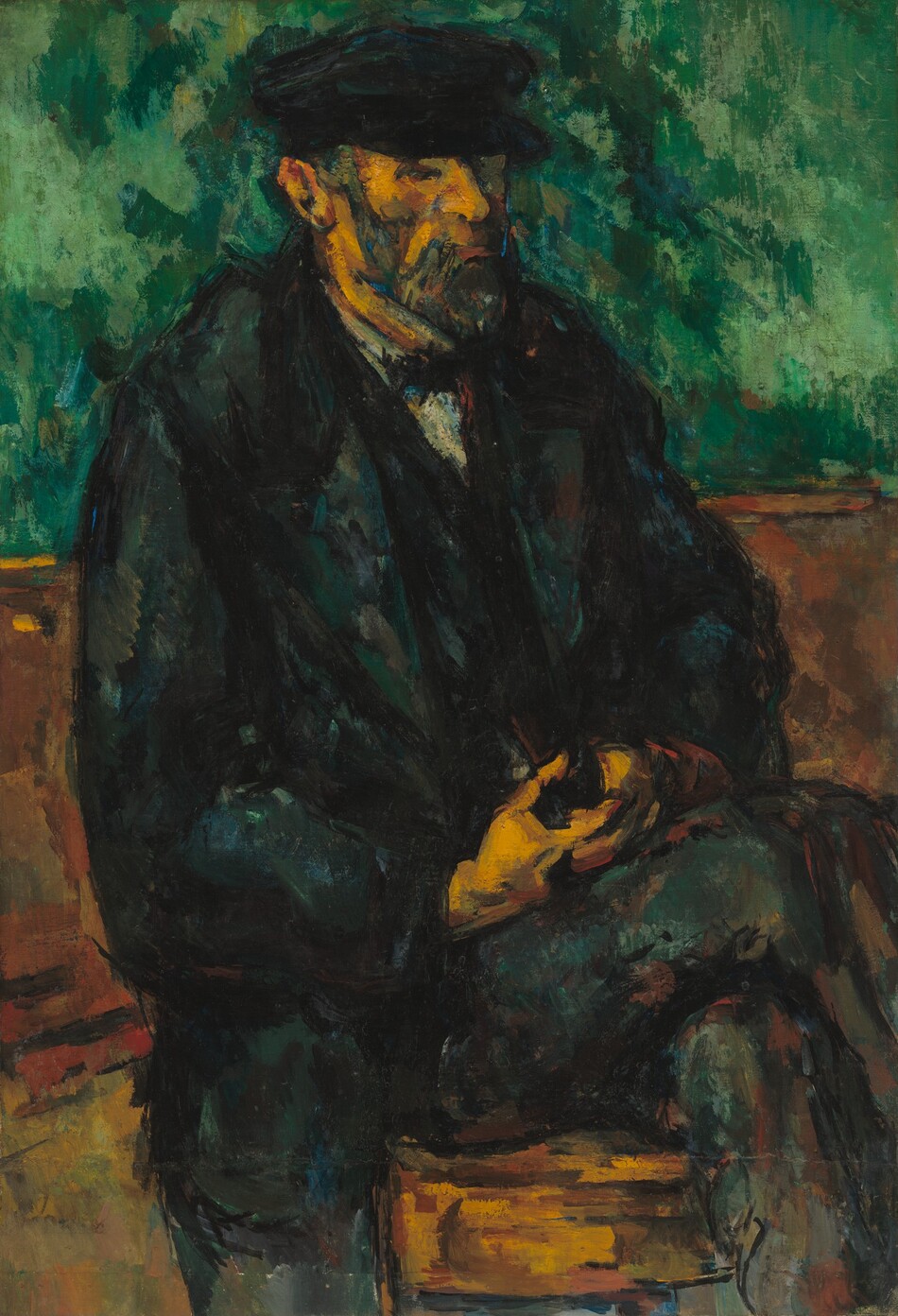
A bearded man with a coppery-peach completion, wearing a dark, navy-blue brimmed cap, vest, jacket, and pants sits on a wooden bench or chair against a green background in this vertical portrait. The scene is loosely painted with thick, visible brushstrokes in kelly and shamrock green, deep, midnight blue, tawny brown, and charcoal gray to create a mottled effect. The man’s body is angled to our right and he looks in that direction. His legs are crossed and are cropped below the knees by the bottom right corner of the canvas. His fingers are interlaced in his lap with one thumb hooked between buttons on his vest. He has a long nose and his lips are closed. Touches of vibrant robin’s egg blue, sage green, pumpkin orange, and brick red enliven the dark clothing and shadows on the man’s features.

The Gardener Vallier

Paul Cezanne

1906

Oil on canvas  Accession ID  1959.2.1

On View: West Building Main Floor, Gallery M84
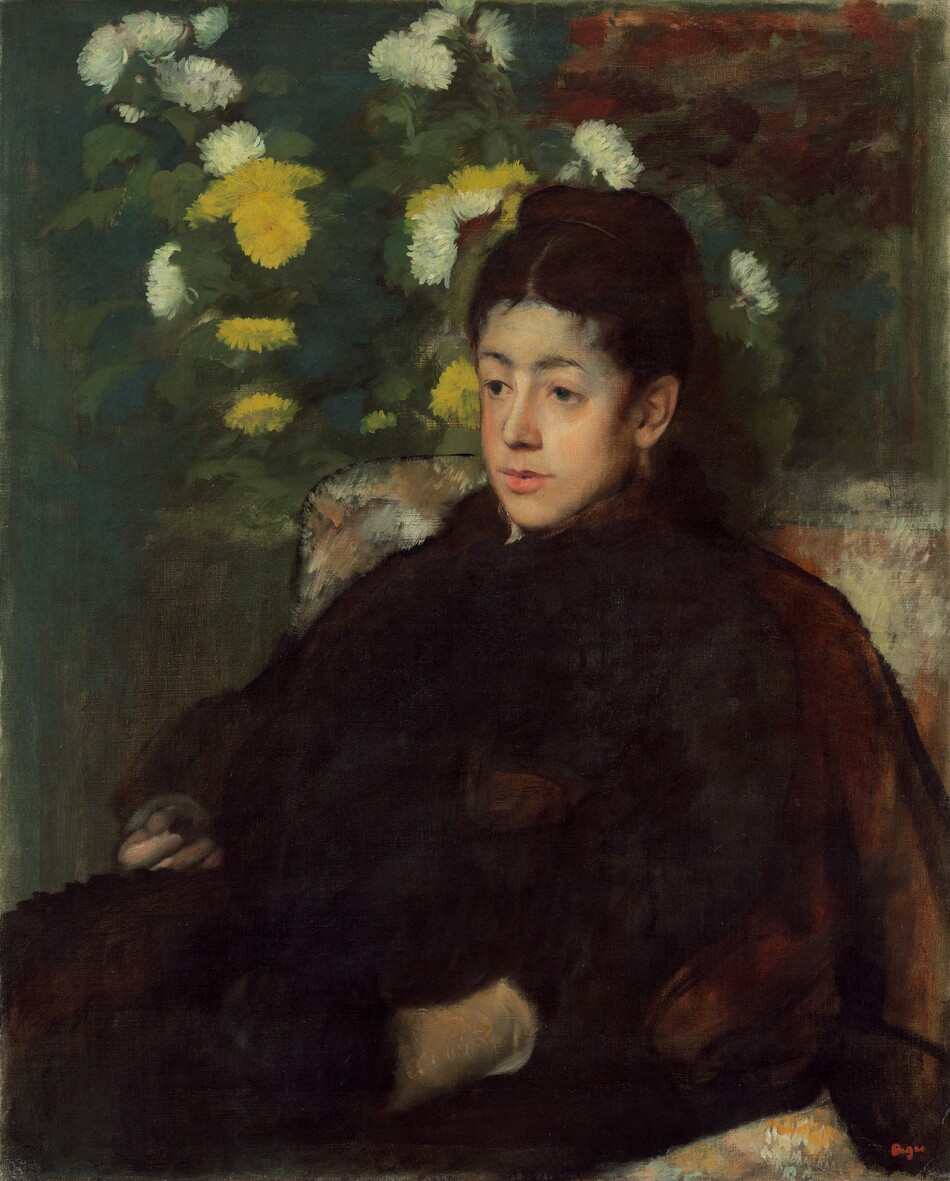
Shown from about the hips up, a woman whose pale face is deep in shadow stands with her back to us, wearing a black and gray dress and hat, in front of a colorful but loosely painted, indistinct background in this nearly square painting. She stands just to our right of center with her elbows bent, perhaps to clasp her hands in front of her. Her head is turned slightly toward us so we see the line of her forehead, nose, and chin almost in profile facing our left. Her auburn hair seems to be pulled up under a black hat that sits on the back of her head. Her high-necked, charcoal-gray vest-like bodice has a line of white at the neck, suggesting lace or an undershirt. The bodice covers a black shirt with ruffles that fall at least to her elbows, and the long dress drapes close along the contours of her legs. She looks to the far wall, which is painted with sketchy, visible brushstrokes in marigold orange, lemon-lime green, brown, black, and pale yellow to create the impression of paintings in gold frames. The artist signed the painting in dark red in the lower right corner: “Degas.”

Woman Viewed from Behind (Visit to a Museum)

Edgar Degas

c. 1879-1885

Oil on canvas  Accession ID  1985.64.11

On View: West Building Main Floor, Gallery M89
Painted almost entirely in tones of topaz, lapis, and sky blue, the façade of a building abutting a waterway fills this horizontal painting. Brushstrokes are visible throughout and they blend to make the scene appear hazy. The top two-thirds of this painting shows the front of a building with two stories of rows of pointed, arched windows. Two long, low boats, gondolas, are pulled up side-by-side to one of the arched openings at the water level of the canal, to our right. A few touches of amethyst purple and mauve pink delineate some of the architectural features and shadows amid a field of denim and pale blue. The water below is painted with short, horizontal strokes to create a shimmering effect. The building’s reflection is captured with touches of emerald and cool green against the blue water. The artist signed and dated the work with cobalt-blue paint in the lower left: “Claude Monet 1908.”

Palazzo da Mula, Venice

Claude Monet

1908

Oil on canvas  Accession ID  1963.10.182

On View: West Building Main Floor, Gallery M80
Shown from the knees up, two pale-skinned women stand in profile facing our left, holding their skirts around their waists so their buttocks and thighs are exposed in this vertical painting. The scene is streaked with opalescent, loose strokes and stringy lines that resemble drawing. Both women wear dark green, thigh-high stockings and step forward onto one foot. They faintly smile as they look ahead of them with heavy-lidded eyes. The woman on our left has blond hair gathered at the back of her neck and a fleshy, jowly face. Her lilac-purple, sleeveless garment hangs loosely from her shoulders. The woman on our right has flame-red hair, a flushed face, and round cheeks. Her mint-green garment is hooked over her shoulders like a short cape. Strokes of light brown, petal pink, teal blue, and dusty rose are layered over their pale buttocks and thighs. A third woman behind them and to our right faces away from us. Her dress is blocked in with spruce green, and she has brown hair. The walls of the room are painted with crimson-red lines against the brown of the cardboard on which this is painted. A shimmering blue rectangle could be a window or reflective surface on the far wall. The artist signed the lower right corner with interlocking capital H, T, and L.

Rue des Moulins, 1894

Henri de Toulouse-Lautrec

1894

Oil on cardboard on wood  Accession ID  1963.10.69

On View: West Building Main Floor, Gallery M80
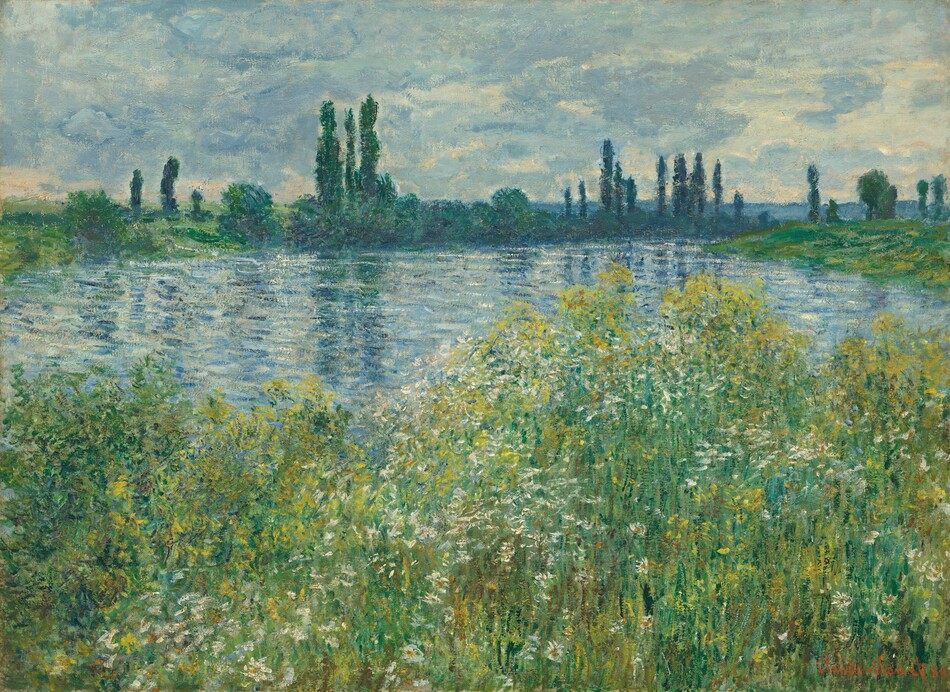
Between us and a river lined with buildings on the far bank in the distance, tall willow trees nearly span the height of this horizontal landscape. The scene is loosely painted, and the color palette is almost completely dominated by cool tones of spring, sage, celery, and kelly green, and steel and sea blue. The grasses near us are painted with diagonal strokes that alternate direction and color as they move back toward the river. Golden yellow daubs in the lower right suggest blooms, and leaves on the trees are created with thin, upward strokes and dabs along slender branches. The trees reach high into a sky filled with sweeps of beige, blush pink, and spring green layered over pale blue. The river is a lavender gray, and the low, tightly clustered buildings are painted with a mix of ochre, peach, and denim blue. The artist has signed and dated the work in the lower right corner, though the final digit is illegible: “Claude Monet 188.”

The Willows

Claude Monet

1880

Oil on canvas  Accession ID  2015.19.65

On View: West Building Main Floor, Gallery M80
We look across a placid pond at sandstone-white buildings with brown and terracotta-red roofs nestled within a grove of green trees and plants in this vertical landscape painting. To our left, the brown roofs cover extensions to the main building, which has the terracotta roof. Between us and the buildings, the remains of a slate-gray wall are partially hidden by a vine or tree. The plants in front of the buildings are created with short daubs of yellow and green with touches of blue. The pond or other small body of water close to us spans the lower width of the canvas. The plants are reflected in the water's smooth surface. The trees to our right and behind the house have olive-green trunks stretching beyond the top edge of the composition. Their leaves blend together to fill the space next to and behind the house with a patchwork of shades of emerald, pine, and celery green. These greens are layered with short, angled strokes over smoother patches, and they fill the upper third of the composition. Patches of orange and a slice of azure-blue sky are visible among the leaves on the left side over the brown roofs. The artist has signed and dated the painting in the lower left corner, “P. Cezanne 73.”

House of Père Lacroix

Paul Cezanne

1873

Oil on canvas  Accession ID  1963.10.102

On View: West Building Main Floor, Gallery M82

Loading Results