Italian Medieval and Renaissance Paintings and Sculptures

Filter Results

367 artworks on view.

Results

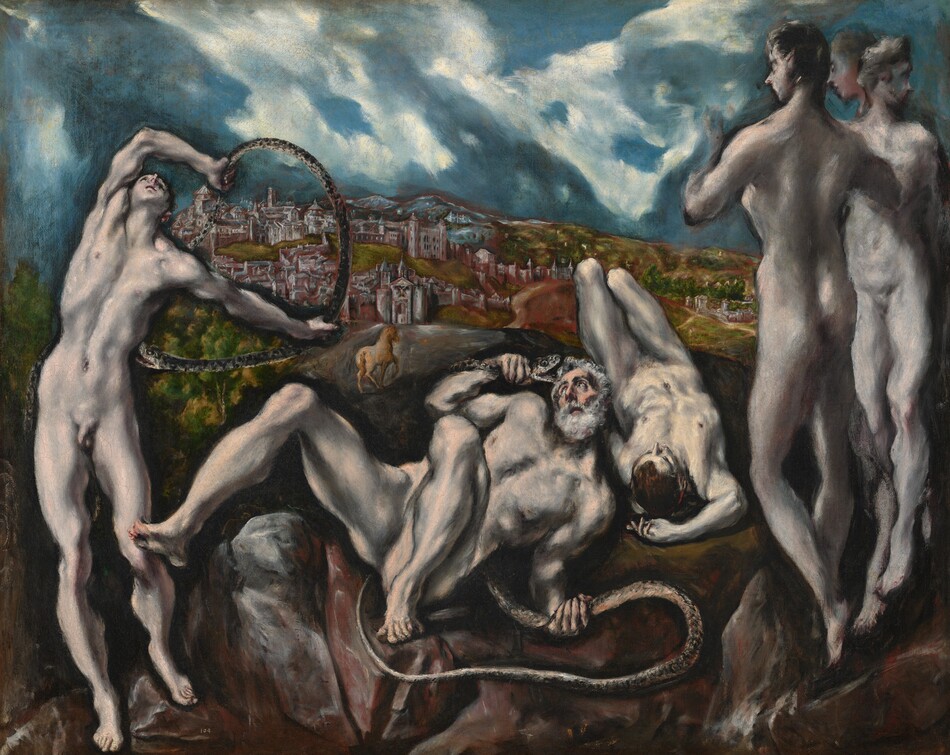
Close to us, six people, all nude with light skin, stand or lie intertwined with snakes on a bank of rocks in this horizonal painting. Beyond them, the deep, distant landscape has a brown horse, tiny in scale, headed for a city of stone buildings beneath a vivid blue sky filled with twisting white clouds. The people’s bodies are sinewy and elongated, and their skin is painted in tones of ivory white, warmed with peach highlights and streaked with deep gray shadows. At the center, a man with a white beard and white, curly hair lies back on the charcoal-gray rock with his knees bent and his shins splayed out. With his body angled away from us to our right, he holds the body of a long, silvery-gray snake in his left fist, on our right, down by his hip. The snake curves behind the man’s body and he grips the snake behind its head. The man has high cheekbones and sunken cheeks, and rolls his eyes up and back to look at the snake, whose wide-open mouth nearly touches his hair. To our left, a cleanshaven young man stands with his body facing us but he arches back, holding an arcing snake in his hands. The young man’s right hand, on our left, bends at the elbow so he can grasp the snake’s tail and his other arm stretches straight back, holding the snake’s body as it curls around so its fangs nearly reach the young man’s side. To our right, next to the older man, a second, dark-haired young man lies on the rocks with his head toward us. His feet are on the ground, so we look onto the tops of his thighs. He lies with one hand resting on the ground, overhead. Three people seem to float, feet dangling, alongside the right edge of the painting. The person closest to us looks onto the writhing people in profile, back to us. A second person just beyond also looks to our left. A third head turns the opposite direction and looks off to our right. In the distance, the golden-brown horse is angled away from us, one front leg raised, on a path that moves from behind the rocky outcropping to the far-off town. Nestled in a shallow valley, buildings in the town are mostly painted with rose pink and red walls and smoke-gray roofs. The land dips to a deeper, green valley to our right, lining the horizon that comes two-thirds of the way up the composition. The standing people are outlined against the sapphire-blue sky and knotted, gray and white clouds.

Laocoön

El Greco

c. 1610/1614

Oil on canvas  Accession ID  1946.18.1

On View: West Building Main Floor, Gallery M28
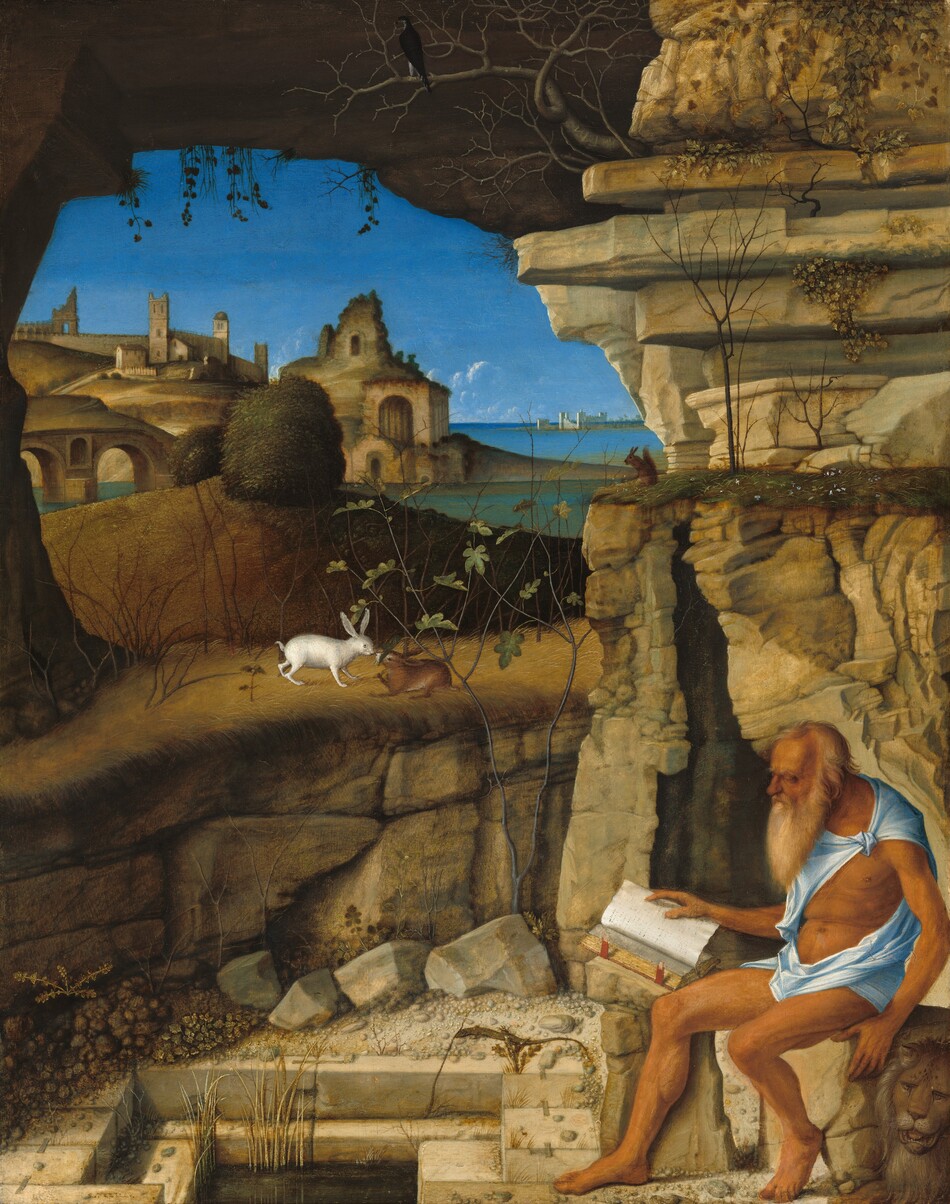
A bearded and balding man with deeply tanned skin, dressed only in a strip of robin’s egg-blue fabric around his shoulders and hips, sits reading a book on a rock at the entrance to a craggy cave, in front of a landscape in this vertical painting. In the lower right corner of the composition, the man, Saint Jerome, faces our left in profile, his head bowed toward the open book propped on the rock near the knee farther from us. His hair and beard are parchment white, and he has a prominent brow ridge, a long, hooked nose, and sunken cheeks. His arms and legs are sinewy and his torso is muscled. The blue cloth is knotted over his left shoulder and wraps around his hips. A lion lies next to Saint Jerome in lower right corner, his face toward us with his mouth open. There is a rectangular pool lined with blocky, cream-white stones at Saint Jerome’s feet, to our left. The cave behind him, to our right, has a jagged, narrow, vertical entrance, and there are rocky outcroppings above and to our left, over the pool. A stone arch spans the top edge of the painting, enclosing the scene below. Other animals appear around Saint Jerome, including a lizard near the pool; a squirrel on the grassy top of the cave entrance; and a black bird in the barren branches of a tree growing from the rocks above the cave. On the far side of the pool, two rabbits, white and brown, touch noses on a grass-topped, low, rocky wall. There is a hill with two dark green bushes beyond that. In the distance, a cluster of tan-colored, stone buildings, some in ruins, spread down a hillside to the water’s edge. Across the water to our right, deep in the distance, white buildings line the horizon, which comes about two-thirds of the way up this painting. A few puffs of white clouds float along the waterline against a vivd, azure-blue sky above.

Saint Jerome Reading

Giovanni Bellini

1505

Oil on linden panel  Accession ID  1939.1.217

On View: West Building Main Floor, Gallery M10
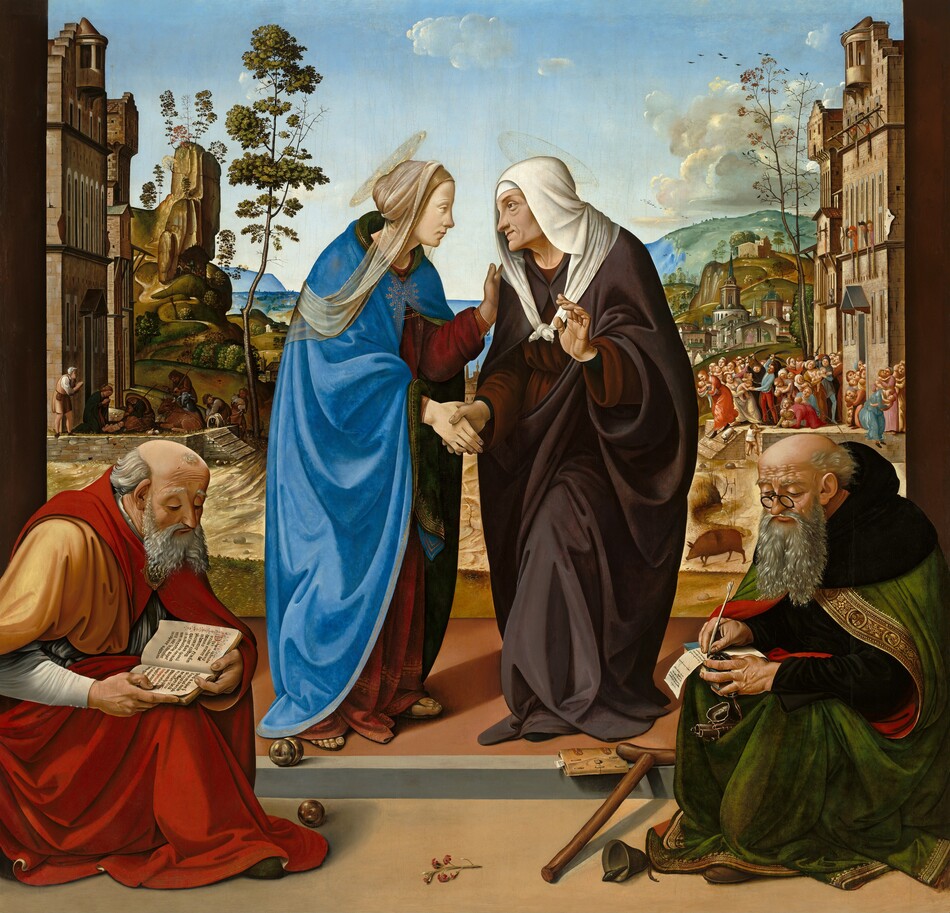
Two women stand clasping hands between two seated men, all against a deep landscape with hills and a town in this nearly square painting. Dozens of people are gathered in the town to our right, and several cluster in front of a building to our left. All the people have pale, peachy skin. Close to us, the two women both have translucent, plate-like halos. They stand with their bodies angled toward each other, and they look at each other. The woman to our left, Mary, has smooth skin with a delicate profile. She wears a gold-edged, ultramarine-blue robe lined with forest green over a long-sleeved, ruby-red dress. Sandaled toes peek under the hem. An eggshell-white and gold scarf drapes over her blond hair, which is pulled back, and over her shoulders. Leaning toward her companion, Mary gazes directly into the eyes of the older woman, Elizabeth. They clasp their right hands, and Mary touches Elizabeth’s shoulder. They stand close together, so only a sliver of the background landscape is visible between their cloaks. Elizabeth wears a maroon-red dress mostly covered by a wine-red cloak that wraps around her body. Her opaque, white scarf drapes over her head and ties loosely on her chest. Her free, left hand is raised, the palm facing Mary. The women stand on a slightly raised platform as the elderly men sit on either side, their bodies angled toward the women. Both men have faint, barely visible halos floating over their balding heads. They have fringes of gray hair and long, gray beards. Their foreheads are deeply lined with wrinkles, and they look down long, straight noses at their laps. To our left, the man wears a scarlet-red cloak over a harvest-yellow garment with gray sleeves. He hunches over a book in his lap. Three gold balls lie next to him, near Mary’s feet. On our right, the second man wears black, round spectacles perched on his nose. The hood of his black robe lies across his shoulders, over an olive-green cape. The cape has gold trim, and the underside is scarlet red. He writes on a narrow piece of parchment with a quill on a closed, blue-covered book. He braces the book and an ink pot with one hand, and a leather pouch hangs from a cord in that hand. At his feet lie an iron-colored bell, a wooden cane, and a brown book. A single sprig of garnet-red flowers lies on the stone floor between the two men. Beyond the four people, the sand-colored land dips down between the town to our right and the building to our left. Dozens of women holding babies struggle against men with swords on a platform in the town. Four people look on from windows above, and buildings continue into the distance along high, steep hills. One of the buildings there is topped by a cross, and the side of that structure is painted with a scene showing a kneeling, winged angel holding a white lily toward a woman dressed in green, who kneels and crosses her arms over her chest. To our left and deep in the shadow cast by a tall building there, a woman and several men gather and some kneel around a baby. Beyond, the land extends to body of vivid blue water, which leads back to a pale blue mountain in the deep distance. A few puffy clouds float across the sky above, which deepens from powder blue along the top edge to nearly white along the horizon.

The Visitation with Saint Nicholas and Saint Anthony Abbot

Piero di Cosimo

c. 1489/1490

Oil on panel  Accession ID  1939.1.361

On View: West Building Main Floor, Gallery M19
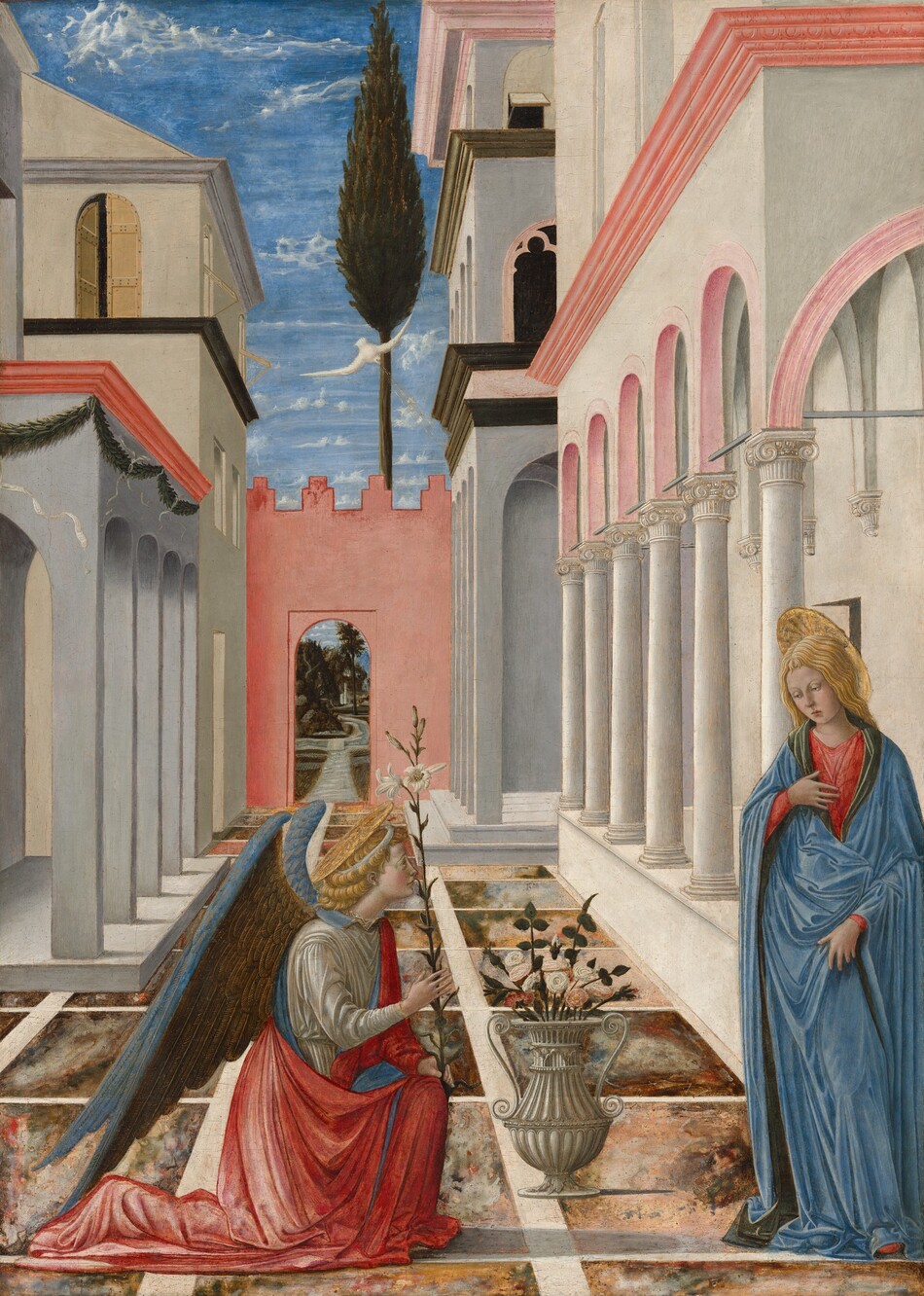
On a tiled courtyard between buildings with arches and columns, a winged angel kneels and looks up at a woman standing to our right in this vertical painting. Both people have pale skin, blond hair, and plate-like gold halos at the back of their heads. To our left, the angel wears a silvery-white tunic under a scarlet-red cloak lined with cobalt blue. The wings are fawn brown on the underside, closer to the body, and aquamarine blue on the outside. Gold lines delineate feathers. The angel holds a white lily with two blooms and four buds on a long stem in the hand farther from us, which rests on a bent knee. The other hand is raised in front of the chest. The woman, Mary, stands along the right edge of the painting, her body angled toward the angel. Mary’s long, wavy hair falls to her shoulders, and she wears a lapis-blue robe with a pine-green lining over a red dress. She holds her right hand, farther from us, to her chest and touches the fabric of her cloak with the other, by her hip. The tip of one red shoe peeks out under her voluminous robe. Between the angel and Mary is a stone-white urn with scrolled handles, holding a bouquet of pink and white roses with dark green foliage. The ground is tiled with squares marbled in pale pink, sky blue, rust red, charcoal gray, and brown. Narrow, white panels between the tiles create a grid. The buildings around the pair are fog gray, parchment white, shell pink, or coral red, and are trimmed in black, red, or pink. Rows of arches recede into the square behind the angel and woman, ending at a coral-red wall that encloses the courtyard. An arched doorway in that wall opens onto a pathway leading over a small brook and into a hilly forest. A narrow, conical tree outside the courtyard reaches over the wall, into the vibrant blue sky above. A white dove descends from among the few scattered clouds with golden beams projecting toward the woman to our right.

The Annunciation

Fra Carnevale

c. 1445/1450

Tempera on panel  Accession ID  1939.1.218

On View: West Building Main Floor, Gallery M4
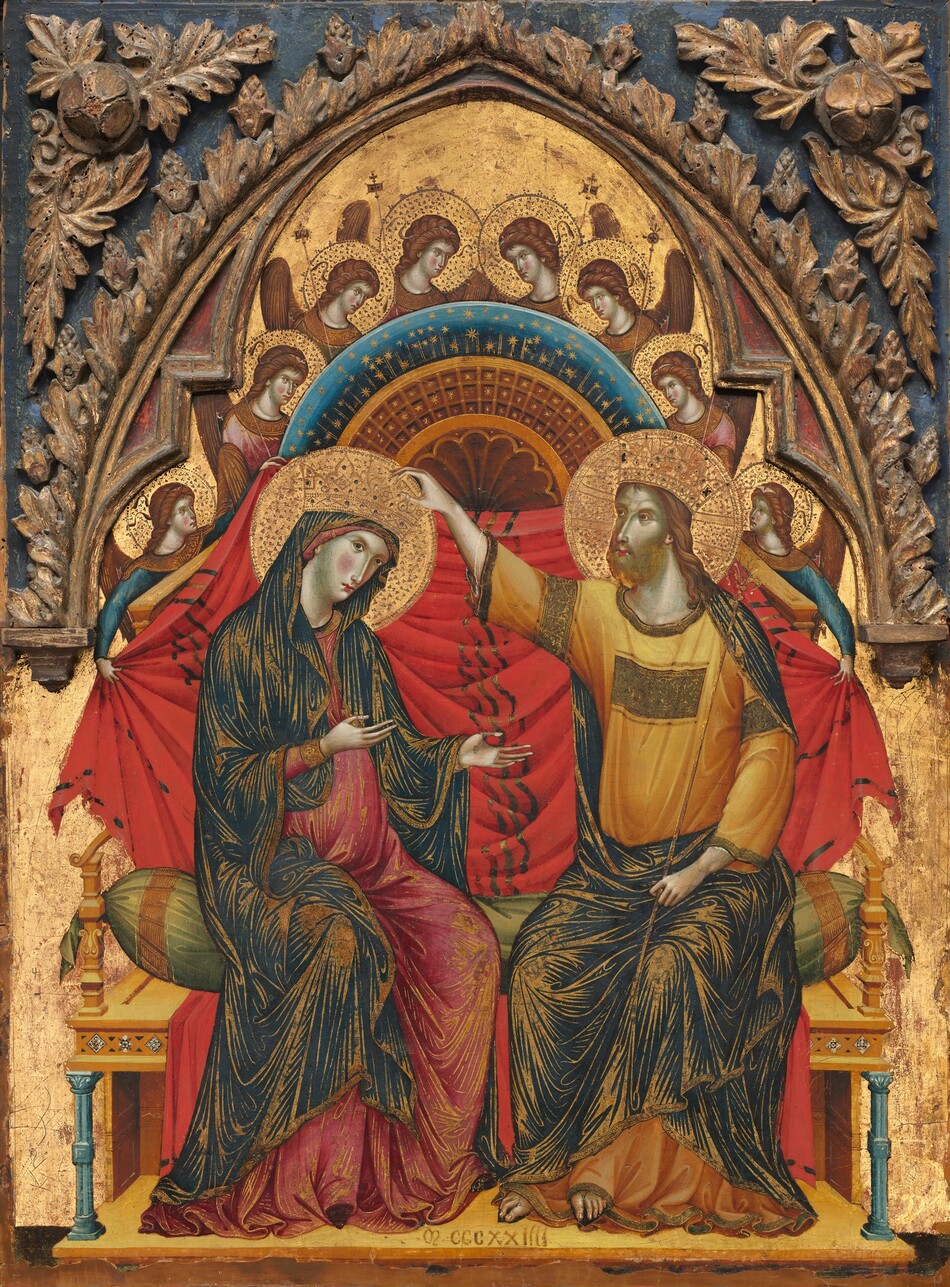
Against a gold background, a man places a crown onto a woman’s head as they sit side-by-side on a wide throne surrounded by winged angels in this vertical painting. The arched area over the throne comes to a point, and is carved with leaves around the arch. The three-dimensional leaves are painted gold against the ocean-blue background. All the people and angels have pale skin with a greenish cast, though their cheeks are blush pink. They all have dark eyes, long, straight noses, and their small red mouths are closed. They all have long, wavy, blond hair except for the woman, Mary, whose head is covered. The flat gold halos around every person and angels’ heads are punched with clusters of three dots. The man, Jesus, sits to our right on the throne and looks toward Mary as he places a crown on her bowed head with one hand. He holds a long staff in his other hand, which rests in his lap. His hair falls around his shoulders, and he wears a gold-trimmed, buttercup-yellow robe under a lapis-blue cloak that wraps over one shoulder and across his lap. The woman looks at us while holding both hands up to gesture toward Jesus. She wears a rose-pink dress under a blue mantle, which drapes over her head, shoulders, and arms. Her mantle and Jesus’s robe are painted with gold lines to indicate folds. One shoe peeks out from under Mary’s hem, and Jesus’s feet are bare. They both sit on an olive-green cushion on the gold throne. The eight angels are spaced over the throne, and are smaller in scale, about half the size of Mary and Jesus. Each looks across toward the others, and they wear robes of rose pink, lapis blue, or forest green. The round neckline of each has a wide gold band, and many hold long staffs. Two angels hold up a ruby-red cloth behind Mary and Jesus, and the back of the throne curves in a half moon above the cloth. The half moon has a shell design at the center and is painted with gold stars against a cobalt-blue background along the top, curving edge. The roman numerals “CCCXXIIII” are painted on the base of the throne, near Jesus’s feet.

The Coronation of the Virgin

Master of the Washington Coronation

1324

Tempera on poplar panel  Accession ID  1952.5.87

On View: West Building Main Floor, Gallery M1
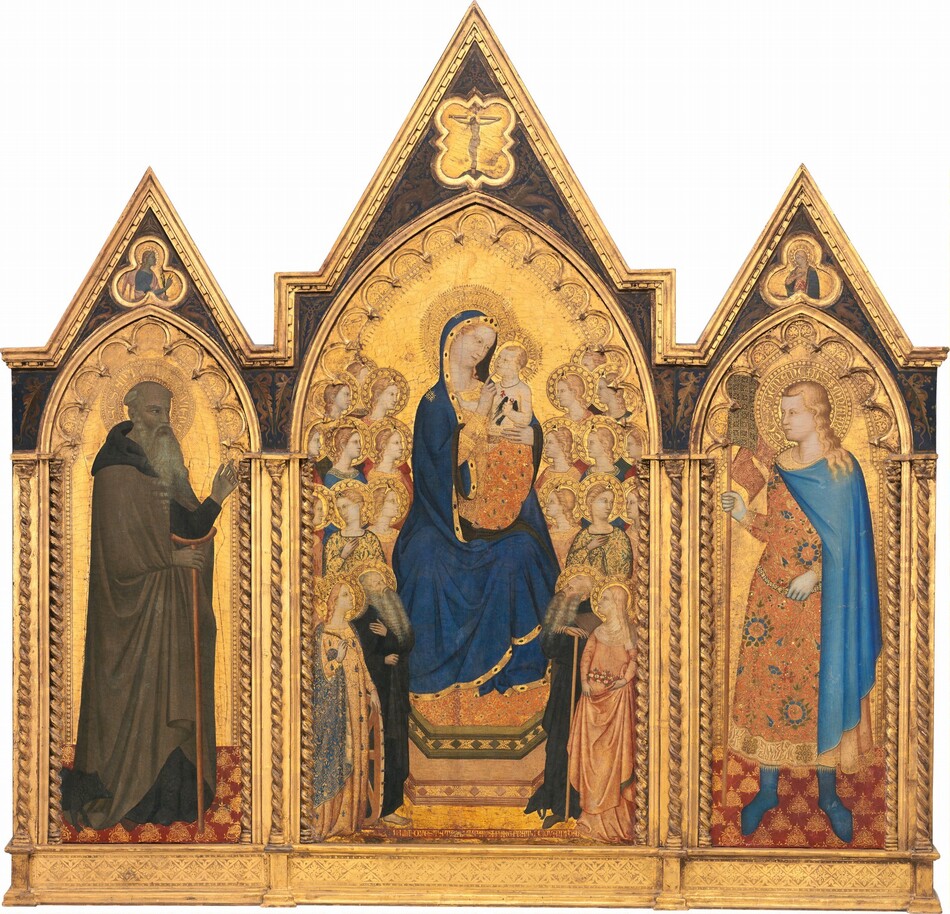
This altarpiece is made up of three panels, with a single man standing in each of the narrow wings to the left and right and a wider panel at the center, which shows a woman holding a baby as twenty-two people look on. The background behind all the people is gold, and the top of each panel comes to a rounded, pointed arch under a second taller, sharper point. Spiraling columns frame the left and right sides, and rows of semicircular shapes, like inverted scallops, run inside the curving arches. In the central panel, the woman, child, and people around them all have pale skin and blond hair except for two elderly men with gray hair and beards. They all have plate-like gold halos that overlap, sometimes obscuring the face of another person. The woman and child, Mary and Jesus, sit on an unseen chair on two wide steps. They gaze at each other while Mary gently touches Jesus’s chin. Her lapis-blue mantle covers her hair and wraps around her body. The robe is edged with gold and has gold starbursts on one shoulder and on the crown of her head. Jesus’s garment is patterned with blue and gold against a dark orange background, and it wraps around his lower body. He holds a bird in one hand, touches Mary’s robe with the other, and a piece of coral hangs from a cord around his neck. Most of the people on each side wear azure-blue, pale peach, or brick-red garments decorated with gold. There are three inscriptions in this central panel. Mary’s halo is inscribed with “SCA MARIA MATER DEI” and Jesus’s halo reads, “IIS XRO M.” A third inscription across the bottom of the panel is partially damaged, but some of it reads, “LIIII QUESTA TA ATTA FRE FRATE GIOVANNI DA.” In the wing to our left, a balding, bearded man wearing a brown cloak over a black robe stands facing our right almost in profile. His pale skin has a dark, ash-gray cast. The hood of the black robe lies across his shoulders. He holds a wooden crutch with a curved top in the hand closer to us, and holds up his other hand with his palm facing us, fingers slightly curled in. A halo around his head is incised into the gold background and is filled with letters reading, “SaS ANTONIVS O VIENA.” Nearly lost against his dark robes, a black boar or pig stands near his feet. The floor here and in the right panel have a brocade-like pattern with three-lobed, gold designs against a field of brick red. The right wing is filled by a blond, cleanshaven young man standing facing our left as he looks toward Mary and Jesus in the center. He wears a long orange tunic decorated with blue flowers, and has a peacock-blue cloak and matching boots. Flags patterned with gold against black or red backgrounds flutter from a staff he holds with his right hand, farther from us. His other hand rests on the gold belt at his waist. His inscribed halo reads, “SCS. VENANCIVS MRTIRI.” The three panels are separated by spiraling gold columns and topped with triangular gables. The gables are filled with stylized leaves and animals in muted shades of brown against a black background. Near the pointed tops of the panels, the side wings have three-lobed shapes filled with a winged angel on the left and a person with a halo holding a hand to the chest on the right. The central gable has a four-lobed shape showing a man hanging on a cross.

Madonna and Child Enthroned with Four Saints and Eighteen Angels [middle panel]

Puccio di Simone, Allegretto Nuzi

1354

Tempera on panel  Accession ID  1937.1.6.b

On View: West Building Main Floor, Gallery M3
This altarpiece is made up of three panels, with a single man standing in each of the narrow wings to the left and right and a wider panel at the center, which shows a woman holding a baby as twenty-two people look on. The background behind all the people is gold, and the top of each panel comes to a rounded, pointed arch under a second taller, sharper point. Spiraling columns frame the left and right sides, and rows of semicircular shapes, like inverted scallops, run inside the curving arches. In the central panel, the woman, child, and people around them all have pale skin and blond hair except for two elderly men with gray hair and beards. They all have plate-like gold halos that overlap, sometimes obscuring the face of another person. The woman and child, Mary and Jesus, sit on an unseen chair on two wide steps. They gaze at each other while Mary gently touches Jesus’s chin. Her lapis-blue mantle covers her hair and wraps around her body. The robe is edged with gold and has gold starbursts on one shoulder and on the crown of her head. Jesus’s garment is patterned with blue and gold against a dark orange background, and it wraps around his lower body. He holds a bird in one hand, touches Mary’s robe with the other, and a piece of coral hangs from a cord around his neck. Most of the people on each side wear azure-blue, pale peach, or brick-red garments decorated with gold. There are three inscriptions in this central panel. Mary’s halo is inscribed with “SCA MARIA MATER DEI” and Jesus’s halo reads, “IIS XRO M.” A third inscription across the bottom of the panel is partially damaged, but some of it reads, “LIIII QUESTA TA ATTA FRE FRATE GIOVANNI DA.” In the wing to our left, a balding, bearded man wearing a brown cloak over a black robe stands facing our right almost in profile. His pale skin has a dark, ash-gray cast. The hood of the black robe lies across his shoulders. He holds a wooden crutch with a curved top in the hand closer to us, and holds up his other hand with his palm facing us, fingers slightly curled in. A halo around his head is incised into the gold background and is filled with letters reading, “SaS ANTONIVS O VIENA.” Nearly lost against his dark robes, a black boar or pig stands near his feet. The floor here and in the right panel have a brocade-like pattern with three-lobed, gold designs against a field of brick red. The right wing is filled by a blond, cleanshaven young man standing facing our left as he looks toward Mary and Jesus in the center. He wears a long orange tunic decorated with blue flowers, and has a peacock-blue cloak and matching boots. Flags patterned with gold against black or red backgrounds flutter from a staff he holds with his right hand, farther from us. His other hand rests on the gold belt at his waist. His inscribed halo reads, “SCS. VENANCIVS MRTIRI.” The three panels are separated by spiraling gold columns and topped with triangular gables. The gables are filled with stylized leaves and animals in muted shades of brown against a black background. Near the pointed tops of the panels, the side wings have three-lobed shapes filled with a winged angel on the left and a person with a halo holding a hand to the chest on the right. The central gable has a four-lobed shape showing a man hanging on a cross.

Saint Anthony Abbot [left panel]

Puccio di Simone, Allegretto Nuzi

1354

Tempera on panel  Accession ID  1937.1.6.a

On View: West Building Main Floor, Gallery M3
This altarpiece is made up of three panels, with a single man standing in each of the narrow wings to the left and right and a wider panel at the center, which shows a woman holding a baby as twenty-two people look on. The background behind all the people is gold, and the top of each panel comes to a rounded, pointed arch under a second taller, sharper point. Spiraling columns frame the left and right sides, and rows of semicircular shapes, like inverted scallops, run inside the curving arches. In the central panel, the woman, child, and people around them all have pale skin and blond hair except for two elderly men with gray hair and beards. They all have plate-like gold halos that overlap, sometimes obscuring the face of another person. The woman and child, Mary and Jesus, sit on an unseen chair on two wide steps. They gaze at each other while Mary gently touches Jesus’s chin. Her lapis-blue mantle covers her hair and wraps around her body. The robe is edged with gold and has gold starbursts on one shoulder and on the crown of her head. Jesus’s garment is patterned with blue and gold against a dark orange background, and it wraps around his lower body. He holds a bird in one hand, touches Mary’s robe with the other, and a piece of coral hangs from a cord around his neck. Most of the people on each side wear azure-blue, pale peach, or brick-red garments decorated with gold. There are three inscriptions in this central panel. Mary’s halo is inscribed with “SCA MARIA MATER DEI” and Jesus’s halo reads, “IIS XRO M.” A third inscription across the bottom of the panel is partially damaged, but some of it reads, “LIIII QUESTA TA ATTA FRE FRATE GIOVANNI DA.” In the wing to our left, a balding, bearded man wearing a brown cloak over a black robe stands facing our right almost in profile. His pale skin has a dark, ash-gray cast. The hood of the black robe lies across his shoulders. He holds a wooden crutch with a curved top in the hand closer to us, and holds up his other hand with his palm facing us, fingers slightly curled in. A halo around his head is incised into the gold background and is filled with letters reading, “SaS ANTONIVS O VIENA.” Nearly lost against his dark robes, a black boar or pig stands near his feet. The floor here and in the right panel have a brocade-like pattern with three-lobed, gold designs against a field of brick red. The right wing is filled by a blond, cleanshaven young man standing facing our left as he looks toward Mary and Jesus in the center. He wears a long orange tunic decorated with blue flowers, and has a peacock-blue cloak and matching boots. Flags patterned with gold against black or red backgrounds flutter from a staff he holds with his right hand, farther from us. His other hand rests on the gold belt at his waist. His inscribed halo reads, “SCS. VENANCIVS MRTIRI.” The three panels are separated by spiraling gold columns and topped with triangular gables. The gables are filled with stylized leaves and animals in muted shades of brown against a black background. Near the pointed tops of the panels, the side wings have three-lobed shapes filled with a winged angel on the left and a person with a halo holding a hand to the chest on the right. The central gable has a four-lobed shape showing a man hanging on a cross.

Saint Venantius [right panel]

Puccio di Simone, Allegretto Nuzi

1354

Tempera on panel  Accession ID  1937.1.6.c

On View: West Building Main Floor, Gallery M3
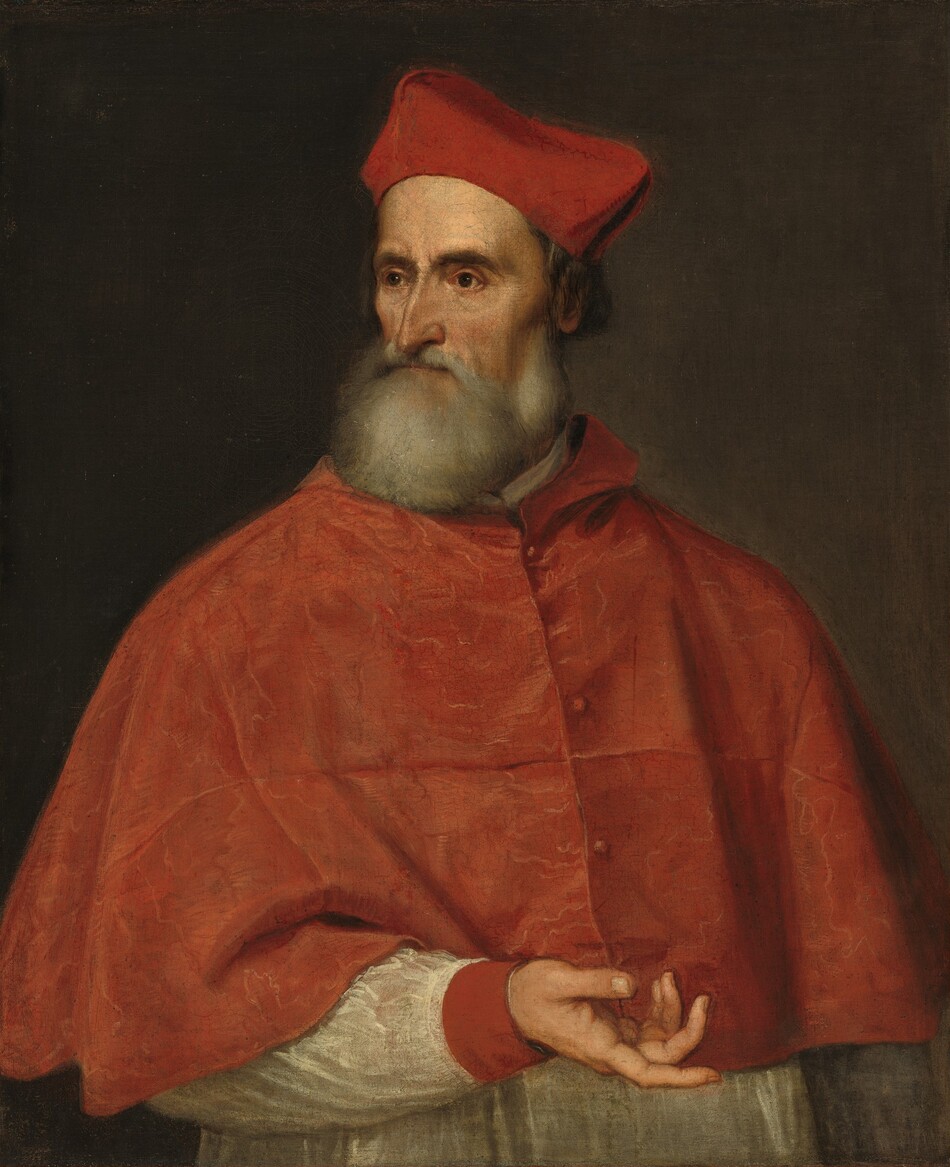
Shown from the waist up, an older, pale-skinned man wearing clerical robes gestures to our right with one hand and turns his head to look off to our left in this vertical portrait painting. His shoulders angle to our right, and that arm hangs by his side. His other arm is bent at the elbow, and the hand is held palm up so the fingers loosely point to our right. His gaunt face turns to our left, and he looks off with dark, deep-set eyes under heavy, curved brows. He has a high forehead, a long, thin, hooked nose, and hollow cheeks. His full, smoke-gray beard is painted with blended strokes so appears soft. His crimson-red hat comes to four rounded points over ear-length, dark gray hair. An elbow-length red cape has buttons down the front, and he wears a white garment with a red cuff around the hand we can see. The man is lit from our left in front of a brown background.

Cardinal Pietro Bembo

Titian

1539/1540

Oil on canvas  Accession ID  1952.5.28

On View: West Building Main Floor, Gallery M23
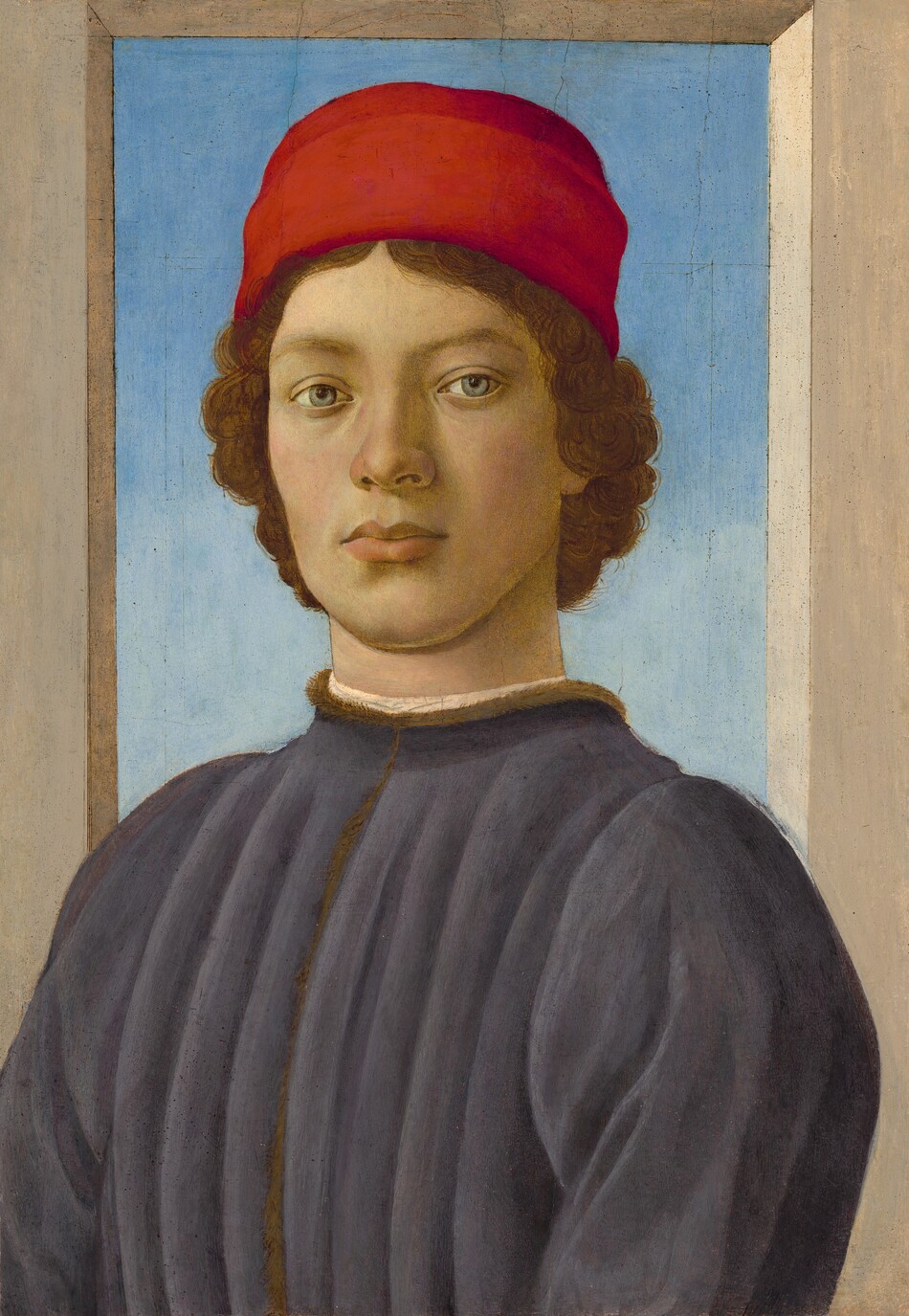
This vertical portrait painting shows the head, shoulders, and chest of a pale-skinned young man in front a cream-white, stone window that opens onto blue sky. The man’s body is angled slightly to our left and he looks directly at us with wide-set, pale blue eyes. He has smooth skin, a rounded nose, a wide jawline, and full, light pink lips. He wears a brimless crimson-red cap over brown hair that curls over his ears and down to the nape of his neck. His slate-blue jacket is lined with brown, perhaps fur, around the high neck and down the front. The jacket has puffy sleeves and vertical pleats over the chest. He is positioned in front of the stone opening, the edges of which run parallel to top and sides of the composition. Vivid blue sky fills the opening behind the young man.

Portrait of a Youth

Filippino Lippi

c. 1485

Oil and tempera on panel  Accession ID  1937.1.20

On View: West Building Main Floor, Gallery M6
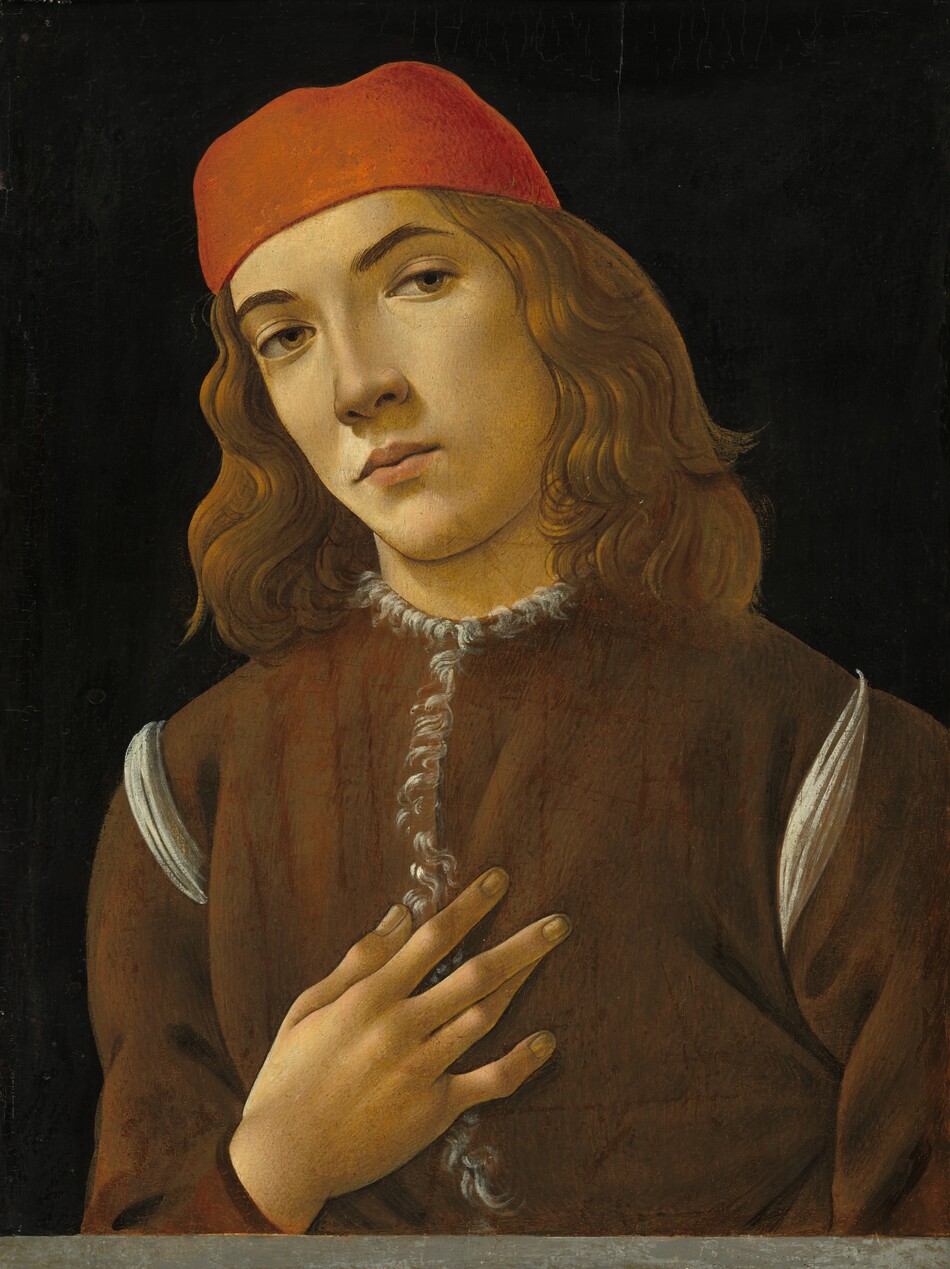
This vertical portrait shows the head, shoulders, and chest of a young man with smooth, pale skin and shoulder-length, dark blond hair positioned behind a narrow gray, stone ledge. Shown against a black background, the man tilts his head to our left and his eyes cut to our right. His left eyebrow, on our right, is slightly arched over brown eyes. He has a long, straight nose, pale pink lips, and his hair falls down the sides of his face from beneath a crimson-red, flat-topped cap. He wears a brown garment with white linen peeking through at the shoulder seams. The neck and seam down the front are lined with white, perhaps fur. He holds his right hand to his chest with his middle finger overlapping his ring finger.

Portrait of a Youth

Sandro Botticelli

c. 1482/1485

Tempera on poplar panel  Accession ID  1937.1.19

On View: West Building Main Floor, Gallery M6

Loading Results