Italian Medieval and Renaissance Paintings and Sculptures

Filter Results

367 artworks on view.

Results

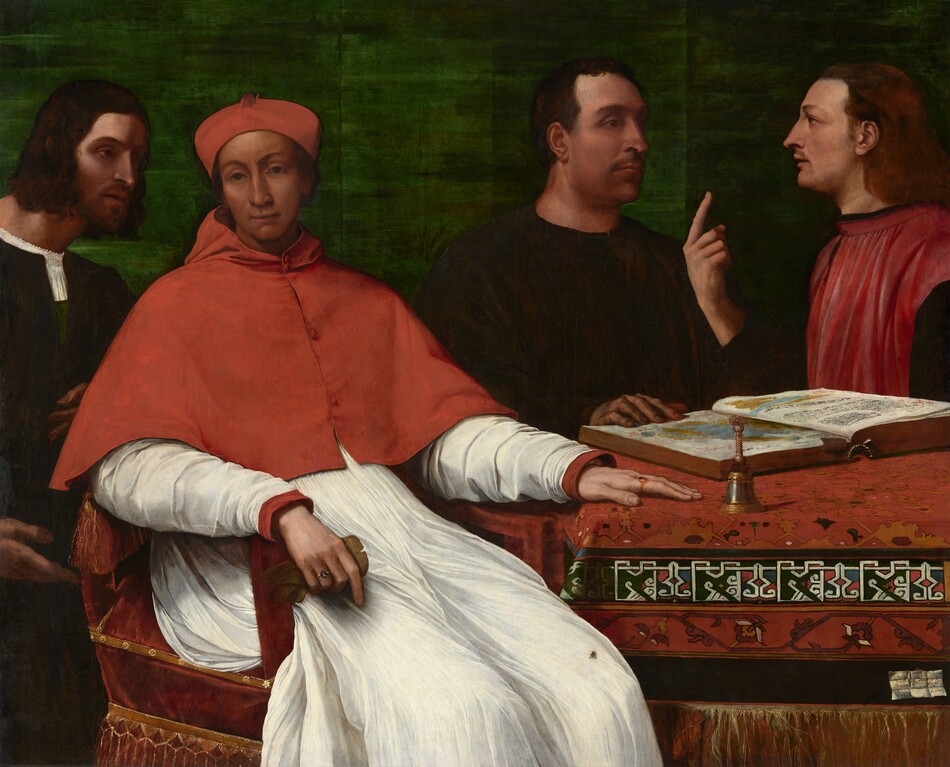
Four light-skinned men gather around a table in front of a forest-green background in this horizontal painting. In the right half of the picture, two men behind the table are shown from about the waist up. The third man, Cardinal Sauli, sits at the narrow end of the table to our left, and his legs are cropped by the bottom edge of the painting below the knee. The fourth man leans toward the cardinal, and is shown from about the knees up along the left edge of the painting. Cardinal Sauli dominates the composition. His body is angled to our right, and he turns his head to look at us with dark eyes under arched brows. He has a narrow face, a wide nose, and his lips are closed over a round chin. He wears a red cap over brown hair and a red, waist-length cape that buttons down over his chest. His voluminous, long-sleeved, bright white robe has red at the cuffs. Upon closer inspection, what appears to be a black speck on his knee turns out to be a fly painted to look as if it had landed on the surface of the panel. The cardinal’s elbows rest on the arms of a wine-red velvet chair. His right hand, to our left, holds what may be green leather gloves, and he wears a gold ring with a dark oval stone on that ring finger. He rests his other hand palm down on the table, and wears a gold ring with a red stone on the index finger of that hand. Just beyond that hand, a pewter-silver bell edged with wide bands of chased gold sits on the table, which is covered with a cloth patterned with crimson red, harvest yellow, black, and white. At our far left, the man leans toward Cardinal Sauli’s right shoulder, facing our right almost in profile. He has dark, chin-length hair, black eyebrows, a long, straight nose, and a dark, trimmed mustache and beard. His mouth is slightly open. He wears a bright white embroidered, collarless shirt under a black tunic. The fingers of his left hand rest on his chest and he barely touches the back of the velvet chair with his other hand. Behind the table, to our right, the final two men face each other in profile. The man to the left in this pair, closer to Cardinal Sauli, has close-cropped dark hair, a prominent nose, and black eyebrows. His hooded, dark eyes look off to our right, and a mustache frames his closed lips. He rests his right hand on an open book, illustrated with maps, on the table in front of him. The man on the far right holds up his right hand at chest height, and points his right index finger straight up. He has a pointed nose and dark eyes, and his lips are parted under a faint mustache. His brown hair falls to the collar of his ruby-red robe, which falls in vertical pleats from the high neckline. The deep green background seems close to the group, creating a shallow space. The artist signed and dated the painting as if he had written on a piece of paper stuck to the front of the table, but the writing is nearly illegible.

Cardinal Bandinello Sauli, His Secretary, and Two Geographers

Sebastiano del Piombo

1516

Oil on panel  Accession ID  1961.9.37

On View: West Building Main Floor, Gallery M22
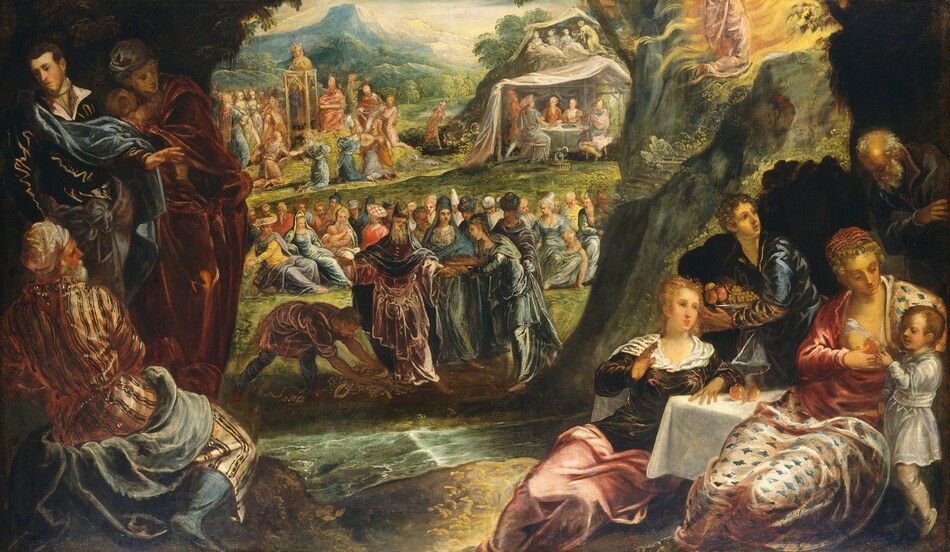
Dozens of men, women, and a few children gather in groups amid a grassy landscape with a mountain in the distance in this horizontal painting. All of the people have pale or ruddy skin and wear flowing cloaks over long tunics or gowns. Warm light from the upper left illuminates the two groups closest to us, which cluster along the left and right edges of the canvas. Each group is set against a dark background suggesting cave walls or rocky outcroppings. On our left, an elderly man sits with his back to us as he looks across this shoulder to our right. He wears an amber-brown robe with darker brown stripes, and a denim-blue boot on the foot we can see. His head is wrapped in a white turban, and his tan face is framed by a salt-and-pepper beard. Steel-blue fabric drapes across his hips. A man and woman stand just beyond him, facing us. The young, bearded, dark-haired man wears a gleaming sea-blue cloak over a burgundy-red garment. The woman is wrapped in a rust-red cloak and holds an infant close to her cheek. Along the right edge of the painting, two blond women and a young child gather around a table covered with a white cloth. The woman seated on the far side of the table wears a velvety, chocolate-brown gown with a white kerchief around her shoulders, and rose-pink fabric drapes across her lap. She faces us with her upper body turned to our right as she gazes up and to our right with one hand raised. A youth cradling a silver bowl filled with fruit stands behind her with his head also turned to look in the same direction. Along the rightmost edge of the canvas, a woman sits facing us, wearing a coral-red gown with one breast exposed along a low neckline. Blush-pink fabric patterned with teal-blue diamonds drapes over one shoulder and across her lap. She tilts her head to our right and gazes down at the child standing by her side. The child wears a silver-gray tunic and has closely cropped brown hair. The woman offers the child an orange fruit. An elderly, balding man with a long silver-gray beard and hair stands behind the woman, at the top of the group. His arms cross his chest while he bows slightly. Between the rocky outcroppings behind both groups, a grassy meadow stretches to a hazy blue mountain in the distance. A narrow stream runs across the painting just beyond the outcroppings. Several people at the far side of the stream flank a tall man with a long beard who stands facing us. He wears a full-length, brick-red robe with a black mantle draped over his head, across his arms, and down his back. A headdress over the mantle has peaks like a narrow crescent moon. To his right, our left, a man also wearing a red tunic and spruce-blue leggings bends down to place a gold circle or dish on a pile of other gold objects on the ground. Two women and two men stand clustered to his left, our right. The women wear blue-green robes, and the men have lead-gray cloaks. About twenty-five men and women along with two small children sitting on the ground create a band across the landscape beyond the group at the stream. They wear gold, aquamarine-blue, canary-yellow, and scarlet-red garments. To the left beyond this group, a crowd circles around a tall narrow structure supporting a gold-colored calf. The people look up at the animal while four women kneel in front, playing instruments. To our right, in the distance, four men and women sit around a cloth-covered table under a tent-like canopy. There are dishes on the table and a fifth person stands nearby, presumably serving the group. On a hill that rises steeply behind the tent, another group of four people recline in a similar canopied structure. At the center of the painting, between the tents and the group around the calf, a single bearded man with white hair walks toward our right in profile, the arm we can see extended. The landscape beyond the people has a lake lined with trees at the foot of the hazy mountain, which almost reaches the top of the composition. Finally, in the upper right corner, atop the rocky outcropping close to us, a person, seen from the waist down, kneels, wearing a rose-pink garment. Golden yellow flames flicker out around and behind the person.

The Worship of the Golden Calf

Italian 16th Century

c. 1594

Oil on canvas  Accession ID  1939.1.180

On View: West Building Main Floor, Gallery M28
A man is nailed to a wooden cross, and two people sit, one to each side, on the sand-colored ground with their bodies angled inward, all against a gold background in this horizontal painting. All the people have pale skin with a greenish cast, and gold halos. The crossbar of the T-shaped cross nearly touches the top edge of the composition. On the cross, Jesus’s body and head are angled to our left. His head tips down, and his eyes are dark slits. Scarlet-red blood streams down his arms from nails in each hand and spurts from a gash over his right ribs. Blood pours from the nail pinning both feet to a shallow ledge down to the ground below. His wavy, honey-blond hair falls over his shoulders, and he has a full, forked beard. Touches of red indicate blood at the points of a ring of thorns around his head. He is nude except for a white loincloth lined with gold down the front around his hips. His body is thin, his ribs visible. The ground around the cross is painted a flat, brown color, which rises in a low mound behind the base of the cross, and up to each side to indicate hills. To our left, a woman sits with one leg folded under her, her other knee raised by her intertwined hands. She looks up at Jesus, her mouth parted and lined with wrinkles. Her brows are gathered over brown eyes. Her face is framed by a white veil, and the powder-blue hood and robe she wears over it is edged with gold. The underside is canary yellow where it turns back across her lap and down the sides of her face. Her raspberry-pink dress underneath is also trimmed with gold at the high neckline and cuffs. She and the person to our right both have rosy cheeks. The person to our right sits with fingers intertwined around one raised knee. That person has chin-length blond hair, a short fringe of bangs across the forehead, arched brows, a long nose, and delicate pink lips are parted. A sky-blue robe is covered with a rose-pink cloak, both edged with gold. The gold background behind all the people is visibly cracked and some areas of red show through. Across the top of the panel is a band of punched dots and incised lines to create a floral pattern. The halos are created with concentric bands of dots and rings punched into the gold background.

The Crucifixion

Sano di Pietro

c. 1445/1450

Tempera on poplar panel  Accession ID  1939.1.45

On View: West Building Main Floor, Gallery M8
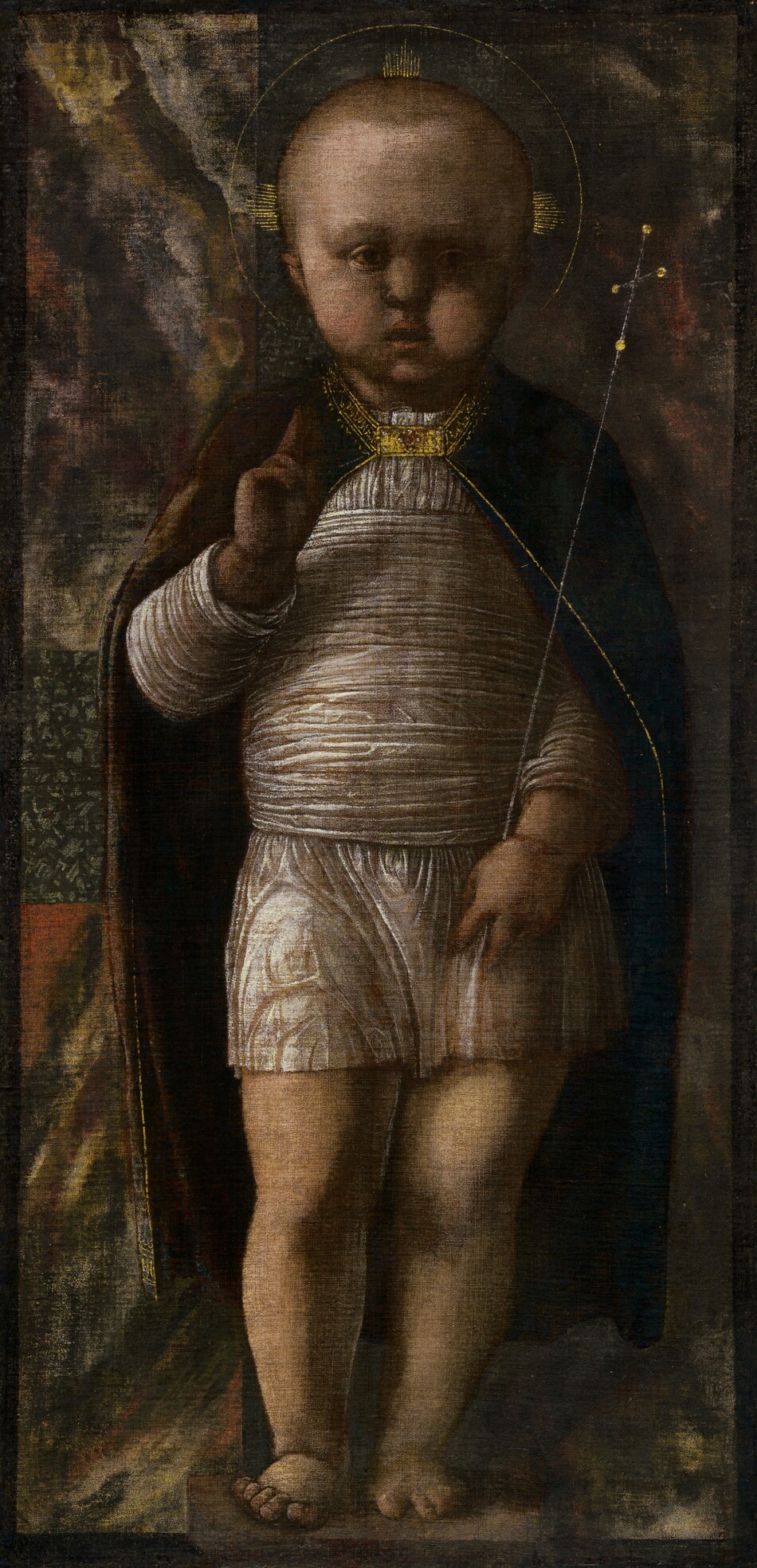
Nearly filling this vertical painting, a young, light-skinned child stands with a delicate scepter tucked into one elbow as he holds up his other hand with the first two fingers raised. The child is lit from our left, but the overall tone of the painting is shadowy and dark. His body faces us, and he looks off to our right with round, deeply shaded eyes. He has short blond hair and a tall forehead, chubby cheeks, and his bow lips are parted. Short, gold rays emanate from the sides and top of his head within a thin gold band to create a halo. He wears a thigh-length, white tunic, and more of that fabric is wrapped around his torso. His dark, burgundy-red cape falls open across his shoulders and down to his calves, and is edged with gold around the collar and down the front. A rectangular, jewel-encrusted gold clasp holds it closed at the throat. He stands with most of his weight on his left leg, to our right, on bare feet. His right hand, to our left, is raised to his chest with the first two fingers extended up. The delicate silver scepter he holds with his other hand is topped with a cross. Swirling patches of muted brick red, harvest yellow, pine green, and off white behind him could be a tapestry. A thin, dark band creates a border around the edges of the painting.

The Infant Savior

Andrea Mantegna

c. 1460

Tempera on canvas  Accession ID  1952.5.67

On View: West Building Main Floor, Gallery M13
Shown from the waist up, a young, pale-skinned woman faces our left in profile, filling the height of this vertical portrait painting. She is brightly lit from the left and set against an inky black background. A faint eyebrow arches over the green eye we can see, and her blush pink lips are closed. Her auburn-red hair is pulled back with a few loose strands brushing her pale cheek. A cluster of jewels, like a brooch, is affixed to a thin, black band that encircles her brow, over her ear. The brooch has an azure-blue jewel over a knot of four topaz-brown gems, all set in gold. Four pink pearls hang from the bottom edge, and a banner with the words “MERITO ET TEMPORE” intertwines among the jewels along the top. Long, black loops hang from the headband to brush the woman’s shoulder. The headband wraps over an elaborate headdress that covers the back of her head like a cap. The headdress is a golden net adorned with pearls, garnets, and other gems. A thick ponytail falls down her back past her waist, and is wrapped with crisscrossing strands of black and white pearls. Her dress has a low-cut, square neckline, a tight-fitting bodice, and a flaring skirt. The fabric is patterned with stylized flowers and leaves outlined in brown against honey gold. A strand of gleaming white pearls hangs around her thin, long neck over a gold chain with a pendant made up of black and ruby-red gems. One more teardrop-shaped pearl hangs from the bottom of the pendant. A gem-studded, gold belt wraps around her waist. A red carnation is tucked into the belt near her elbow. The sleeve we can see is tied onto the bodice at the shoulder with black cord over cream-white fabric, which cascades out from the wide seams across the shoulder and down the back of the arm.

Bianca Maria Sforza

Ambrogio de Predis

probably 1493

Oil on poplar panel  Accession ID  1942.9.53

On View: West Building Main Floor, Gallery M18
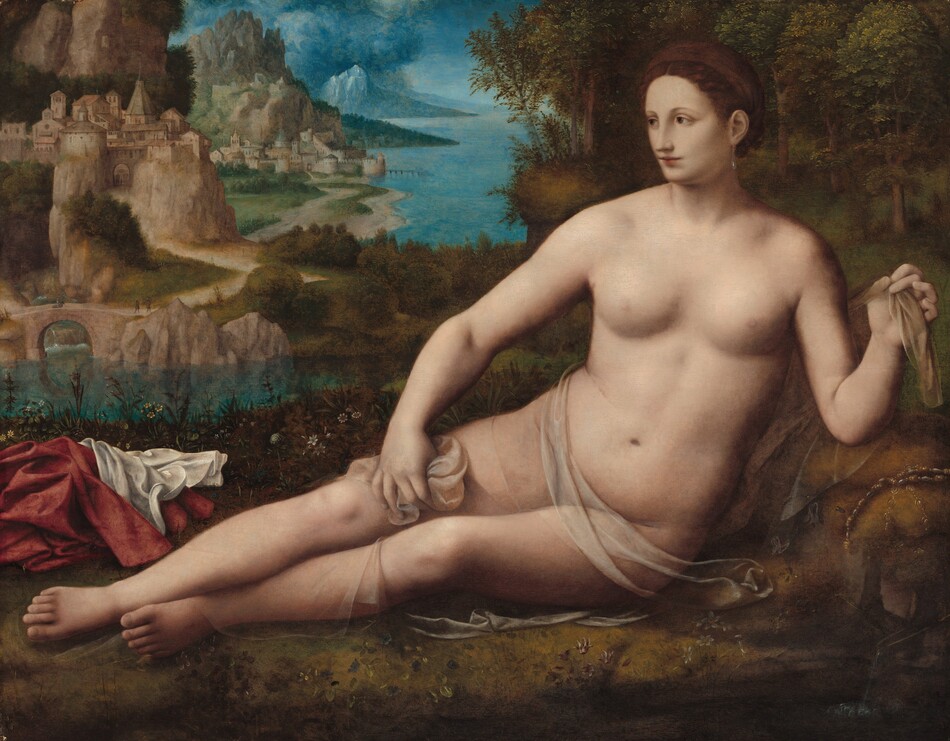
A nearly nude woman with pale, pink skin reclines along golden-yellow grass with a grove of trees behind her to our right and a landscape with rocky cliffs along a rippling shoreline to our left in this horizontal painting. Her legs extend to our left, and her body is tipped to face us, her hips stacked. Her left elbow, to our right, is propped on a swell in the ground to lift her torso. She looks off to our left with hazel-brown eyes under faint, curving brows. Her skin is smooth and shadows blur the corners of her eyes and mouth. She has a straight, long nose, and her rose-pink lips are closed. Her copper-brown hair is pulled back and up, and wraps around her head. A long, teardrop-shaped pearl hangs from the ear we can see. With both hands, she holds the ends of a translucent cloth that wraps around her hips, legs, and across her back, leaving her round, high breasts exposed. Ruby-red and white fabric lies in a heap near her feet, and a gold and pearl piece of jewelry, perhaps a necklace, drapes over the swell in the ground near her propped elbow. Small, finely detailed mauve-pink, white, or butter-yellow flowers grow in the grass around her. The land curves back along the right edge of the painting, to a grove of trees with sage and deep green leaves. An aquamarine-blue river separates her and the trees from the rocky outcroppings and towns beyond. An arched bridge spans the river and leads to a path that winds along the undulating shoreline. Buildings cluster on a rocky cliff near the bridge and a second grouping indicates another town farther along the shore. Topaz-blue clouds billow up over indigo-blue mountains in the deep distance, against a sky painted in the same jeweled blue tones.

Venus

Bernardino Luini

c. 1530

Oil on panel  Accession ID  1939.1.120

On View: West Building Main Floor, Gallery M18
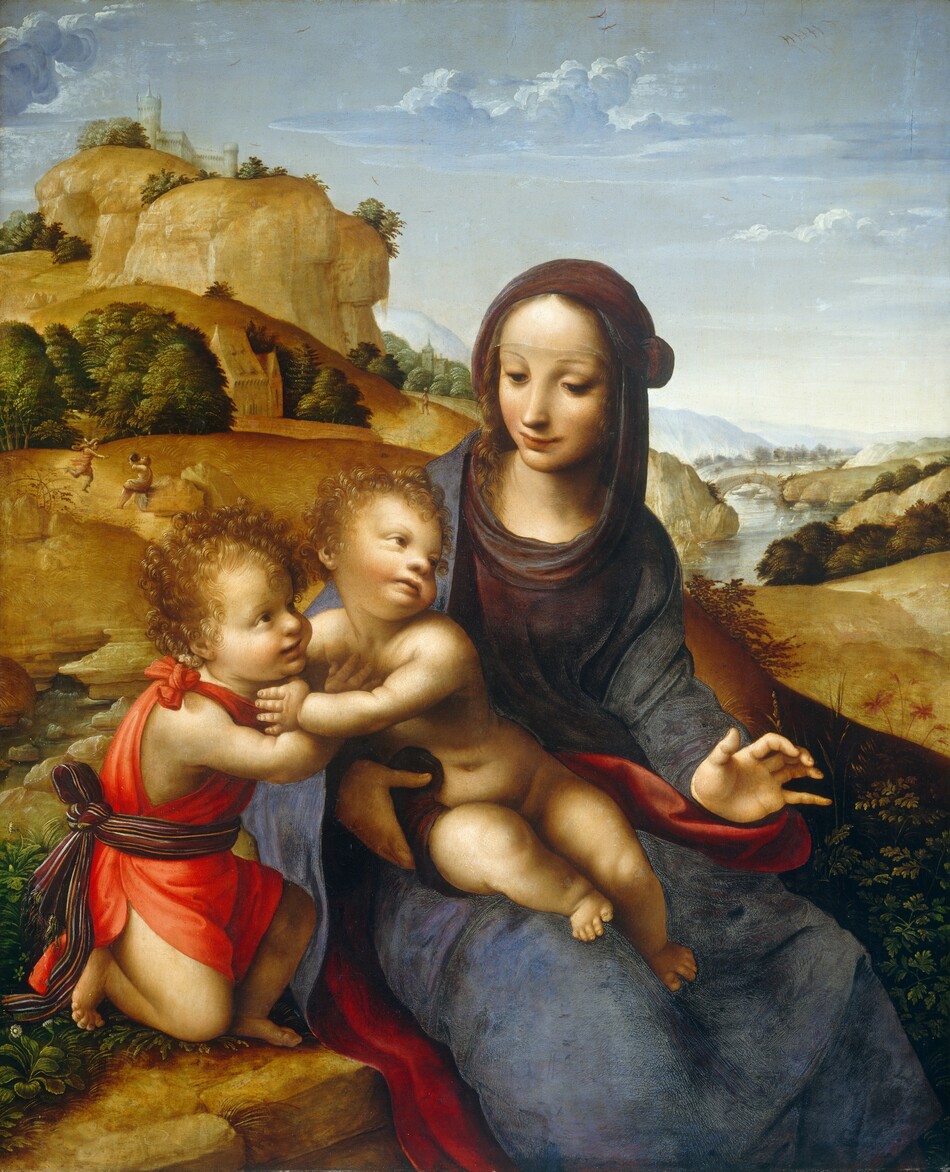
A woman and two small children, all with pale skin, sit on a rocky ledge in front of a hilly landscape in this vertical painting. The woman, to our right, holds one child on her lap and that child reaches to embrace the second child kneeling next to the woman, to our left. The woman, Mary, sits with her knees angled slightly to our right. She turns her face toward the child in her lap, to our left, but looks with shadowed eyes down in front of her. She has a long, delicate nose, rose-blushed cheeks, and her pale lips curl gently in a smile. Golden brown hair is parted down the middle over a high forehead, which is covered with a transparent veil that comes nearly to her faint eyebrows. A maroon-red hood covers her head and drapes across her shoulders under a slate-blue robe. Near one arm, the hem of the robe is turned back to reveal scarlet-red lining. She holds her left hand, to our right, slightly up with her palm facing us. Her other arm wraps around the nude child in her lap and rests against his hip. This child, Jesus, has a snub nose, rounded cheeks, and a pudgy body. He reaches to our left so his body is angled in that direction, but he turns his head back to look into the distance with pale brown eyes. To our left, the second child, Saint John, kneels and touches Jesus’s chest with one hand as he looks up and smiles at Mary. Saint John wears a ruby-red tunic tied at his right shoulder and a striped, wine-red sash around his waist is tied at his back. Both boys have reddish-blond curly hair, rosy cheeks, and are barefoot. Plants and flowers grow on the rocky ledge where they sit. To our left, beyond the trio, golden hills lead up to a ghostly gray castle on the highest peak. Closer to us but tiny in scale in the background, a person runs toward a man sitting on a rock and drinking out of a jug. A shallow waterfall emerges from the rocky base of the hill closest to us, just over John’s shoulder. The hills descend sharply to a river winding into the distance to our right, over Mary’s shoulder. Two white birds swim in the river near an arched bridge spanning the waterway. The river winds back to pale blue mountains along the horizon, which comes about two-thirds of the way up this painting. A few more people walk along paths and cross the bridge in the background. A few thin, white clouds float across the pale blue sky above.

Madonna and Child with the Infant Saint John

Fernando Yáñez de la Almedina

c. 1505

Oil and tempera on panel  Accession ID  1939.1.305

On View: West Building Main Floor, Gallery M19
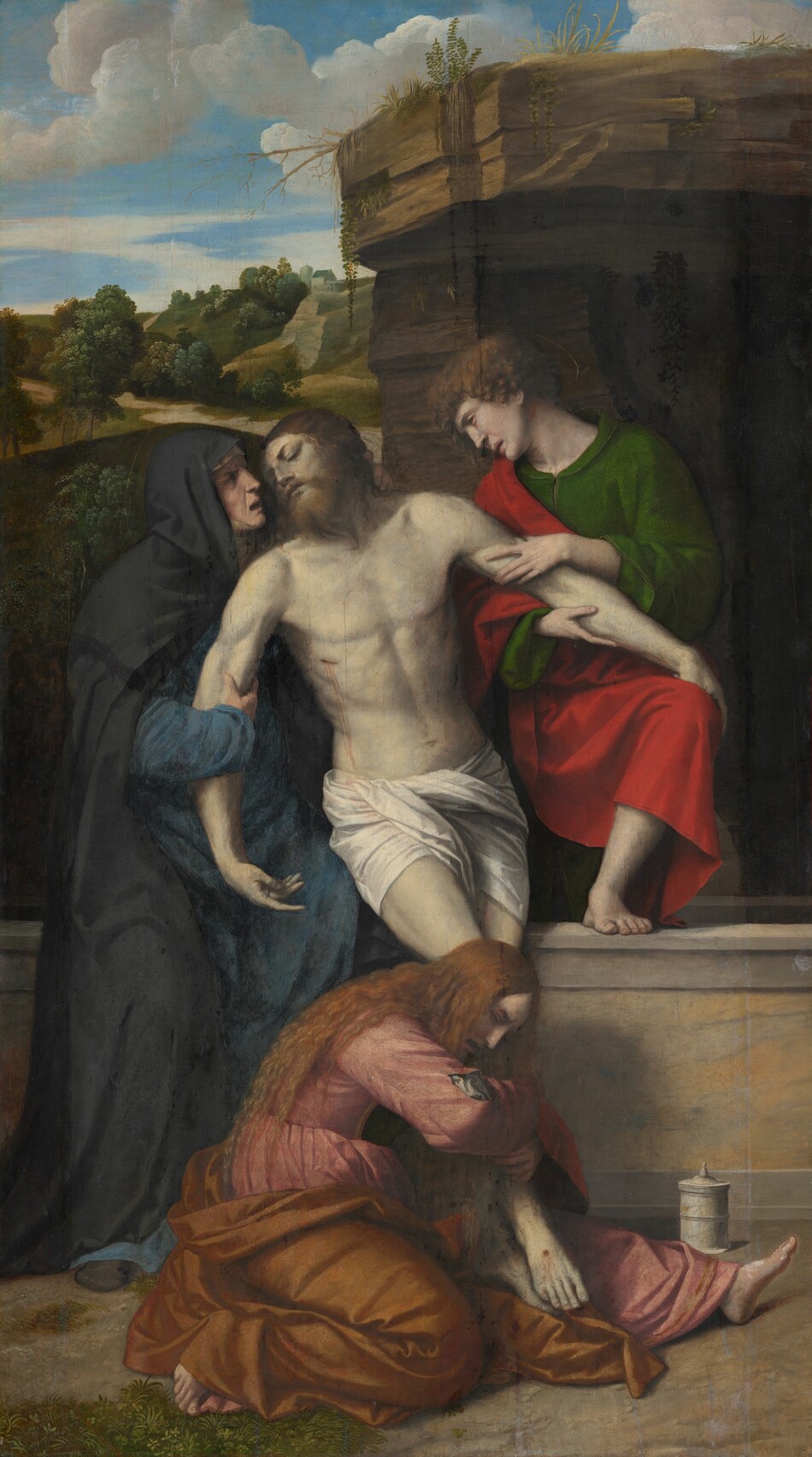
Two women and a man support the gray, lifeless body of a nearly nude man along a stone ledge in this vertical painting. The people have pale skin, except for the dead man at the center, Jesus, who has ash-white skin with dark shadows around his closed eyes. He has a long straight nose, and his lips are slightly parted. He has a brown beard, and his long, wavy hair falls away from his face. A white cloth wraps across his hips, and blood trickles from a gash over his right ribs and holes in his feet. A woman and man prop him up on either side, each holding Jesus by a limp arm, and each has a faint, gold halo encircling their heads. To our left, the woman holds her face close to his, her brows deeply furrowed and her mouth wide open, teeth showing. Her forehead, chin, and neck are covered by a white veil, worn under navy-blue cloak that covers her head and body. The cloak falls open over one arm and a bent knee to reveal her long-sleeved, lighter blue dress. On Jesus’s other side, a cleanshaven man with curly brown hair holds Jesus’s arm with both hands. The man’s eyes squint with tears as he tips his head toward Jesus. His pink lips are parted, and the corner of the mouth we can see is pulled down. He wears an emerald-green, long-sleeved tunic under a vivid red cloth that wraps around his right arm, waist, and left leg. The fourth and final person is a woman sitting on the ground, her arms wrapped tightly around Jesus’s crossed ankles. She sits with one foot tucked under her body and the other leg out straight. Waist-length, wavy, auburn-brown hair falls freely over her shoulders and across her face, but we can see her downturned, open mouth and nearly closed eyes. She wears a rose-pink dress, cinched at the waist. A brown cloth wraps around her waist and right leg. A cylindrical, lidded, white jar sits on the dirt ground nearby. The group is arranged in front a thigh-high stone ledge, except for the man in green and red, who steps into what is presumably the coffin. A rocky outcropping to our right has a cave-like opening with grasses and growth along the top. The landscape beyond has a dirt path winding between pine-green hills dotted with trees. Two slate-blue buildings perch atop one hill. White clouds float across the blue sky above.

Pietà

Moretto da Brescia

1520s

Oil on panel  Accession ID  1952.2.10

On View: West Building Main Floor, Gallery M22

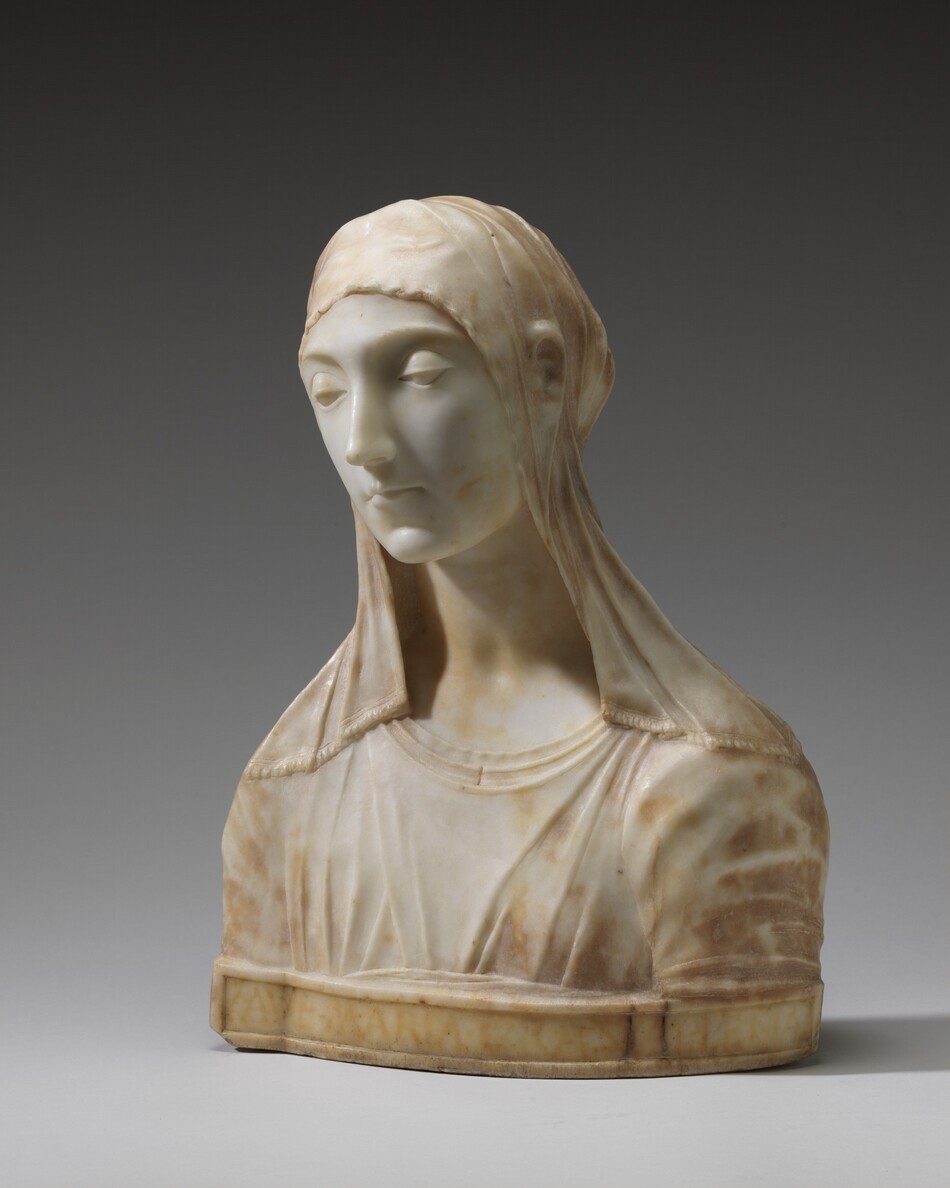
The Virgin Mary or Saint Catherine of Siena

Mino da Fiesole

c. 1455/1460

Marble  Accession ID  1943.4.71

On View: West Building Main Floor, Gallery M5
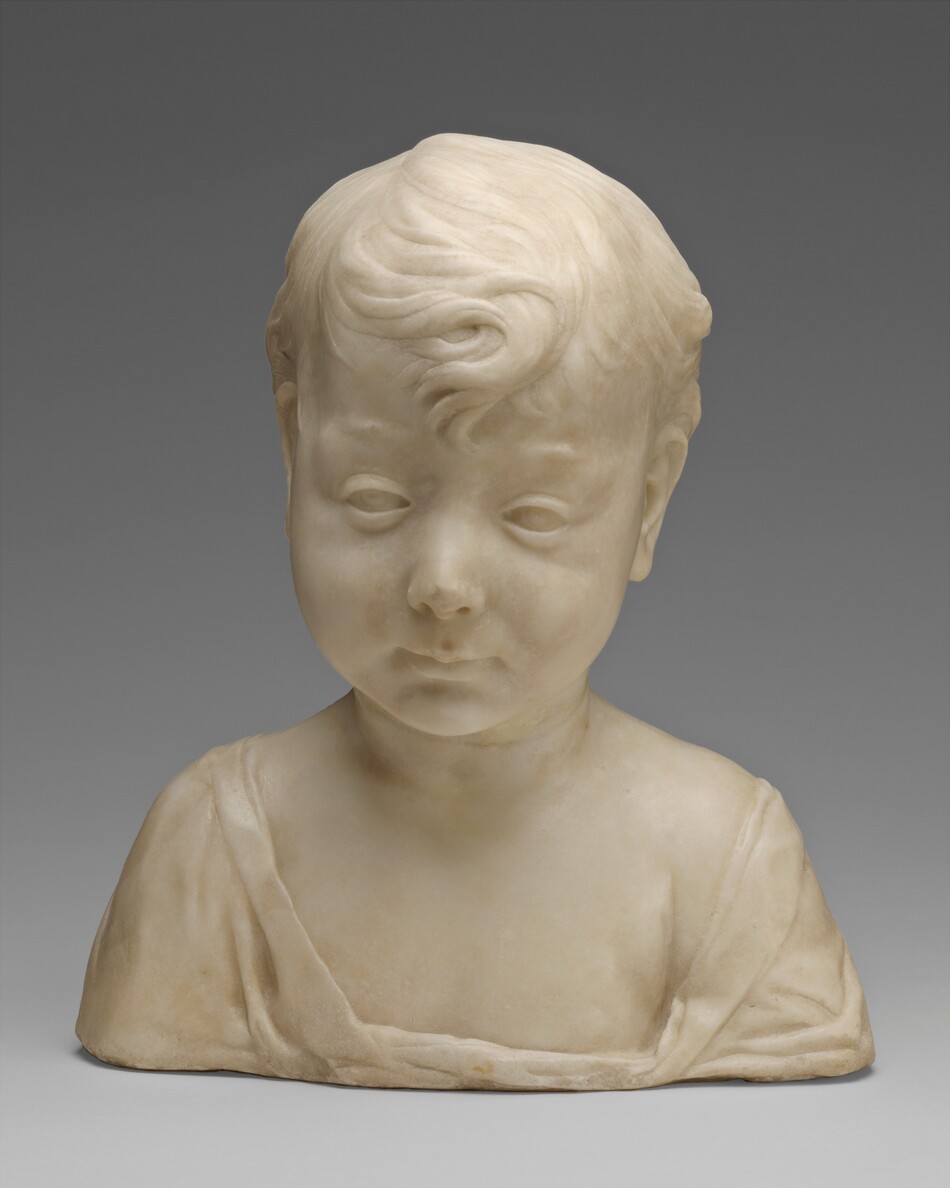
The sculpture depicts the bust of a young child with heavily lidded eyes, thin lips, and chubby cheeks, their face in a neutral expression. The child has short, wavy hair, one prominent curl falling onto their forehead. The child's gaze is directed towards us. They are wearing a draping garment with a wide neckline. The sculpture is made of smooth, light-colored material.

The Christ Child (?)

Desiderio da Settignano

c. 1460

Marble  Accession ID  1943.4.94

On View: West Building Main Floor, Gallery M6
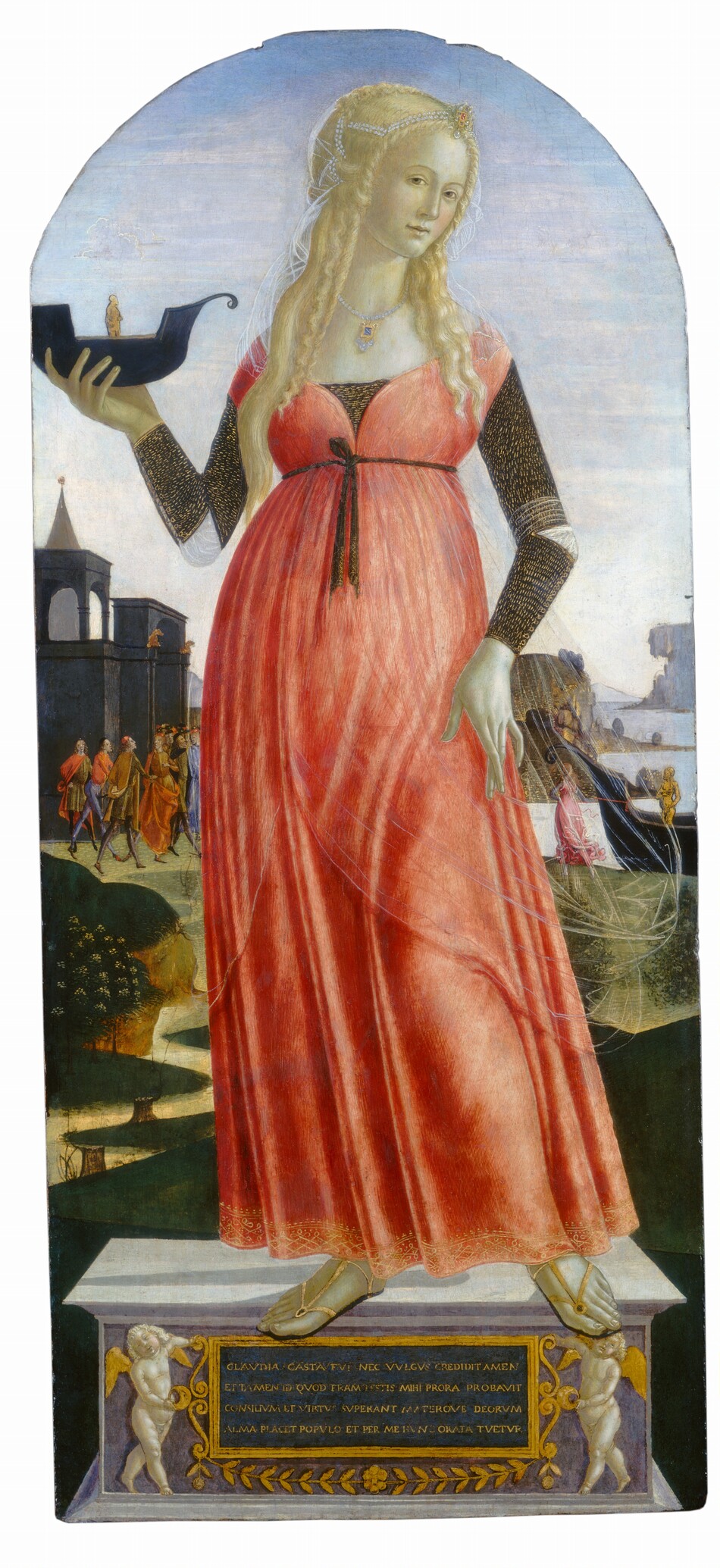
A young, pale-skinned woman with long, blond hair and wearing a coral-red gown stands on a pedestal before a landscape filled with people in this vertical painting. The painting has an arched top, and the woman who fills most of the view is Claudia Quinta. Her hair is adorned with strands of pearls, and a larger pearl hangs from a piece of jewelry like a brooch at the top center over her forehead. A sheer veil covers the back of her head. Her body faces us but she turns her head slightly to our right, so she gazes at us from the corners of her light hazel eyes. A pearl necklace with a square gold, sapphire-blue jewel and pearl pendant encircles her neck. The brown sleeves of her dress are flecked densely with short gold lines, and white fabric shows at gaps over the elbows. The red bodice has a high waist tied with a brown belt, which also holds sheer fabric in place so it falls to her knees over the long red skirt. The skirt is bordered with a gold geometric design along the bottom hem, which stops just short of her sandaled feet. In her right hand, on our left, she holds a small, navy-blue boat with a gold figure standing in it. Her other hand rests by her left thigh, to our right. She balances near the front edge of the rectangular pedestal, which is pale violet purple. On the front face, two winged, chubby children are painted white to resemble stone carvings. They brace a panel bordered in gold. The plaque has a teal-blue background, and gold letters read, “CLAVDIA CASTA FVI NEC VVLGVS CREDIDIT AMEN ET TAMEN ID QVOD ERAM TESTIS MIHI PRORA PROBAVIT CONSILIVM ET VIRTVS SVPERANT MATERQVE DEORVM ALMA PLACET POPVLO ET PER ME HVNC ORATA TVETVR.” Beyond Claudia Quinta a river winds in a tight S-curve through dark green hills. Farther back, to our left, a group of people with thin, elongated bodies dressed in blue, light brown, and orange walk in front of a tall dark blue building as they head toward a river on the right side. The building has an arched opening and a tower topped with a taupe-brown spire. To our right of Claudia Quinta, a woman wearing a rose-pink dress holds a rope around the prow of a boat at the edge of the river. Like the boat held by Claudia Quinta, it is navy blue and has the same shape. The pale lavender-purple river continues into the distance, where it meets rocky outcroppings along the horizon, which comes about halfway up the composition. A pale blue sky above is filled with wispy bands of clouds.

Claudia Quinta

Neroccio de' Landi

c. 1490/1495

Tempera on poplar panel  Accession ID  1937.1.12

On View: West Building Main Floor, Gallery M8
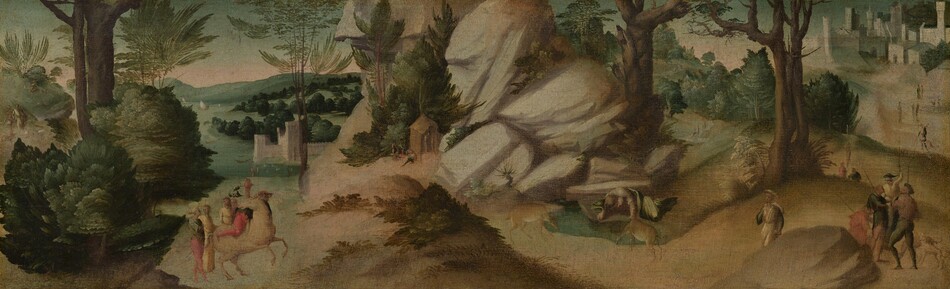
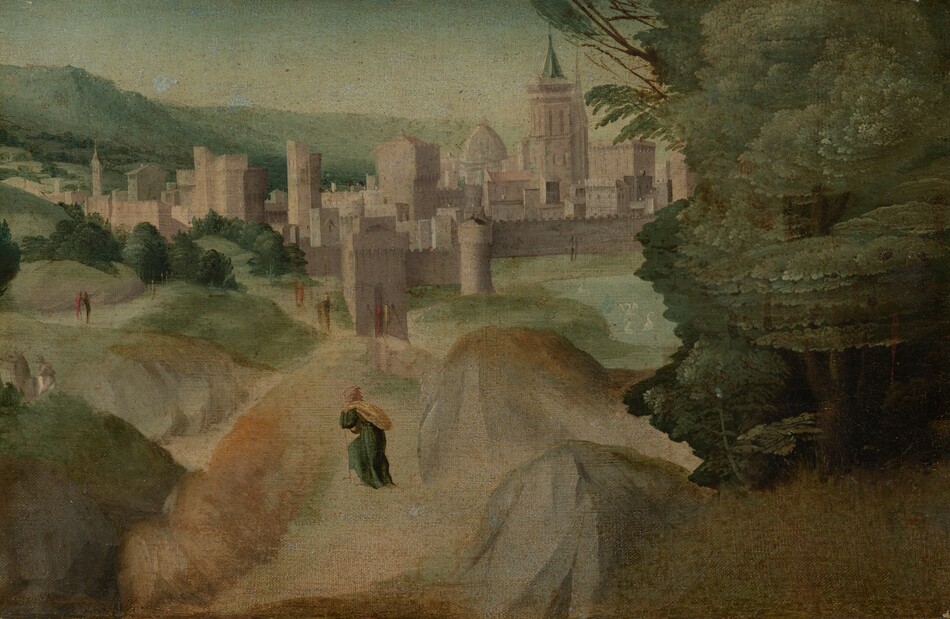
A person walks across a rocky path with a fortified, wall-enclosed town in the distance in this horizontal painting. The person wears a dark green robe and pink hood or cap, carries a yellow sack slung over one shoulder, and uses a walking stick. Boulders surge to either side of the path, and leafy green trees grow up the right side of the composition. Several swans float on a lake just beyond the trees. Painted in shades of gray, a person rides a camel just beyond a boulder to the left. Other forms painted with thin strokes of red or black could be people walking through the landscape in the distance. A city gate, the walls, and some of the buildings have crenelations. Trees nestle between hills that roll back to hazy, sage-green mountains along the horizon, which almost reaches the top edge of the painting. The sky above is muted blue.

Scenes from a Legend

Giovanni Larciani (Master of the Kress Landscapes)

probably c. 1515/1520

Oil on canvas  Accession ID  1939.1.344.c

On View: West Building Main Floor, Gallery M19

Loading Results