Modern Art 1910–1940

Filter Results

50 artworks on view.

Results

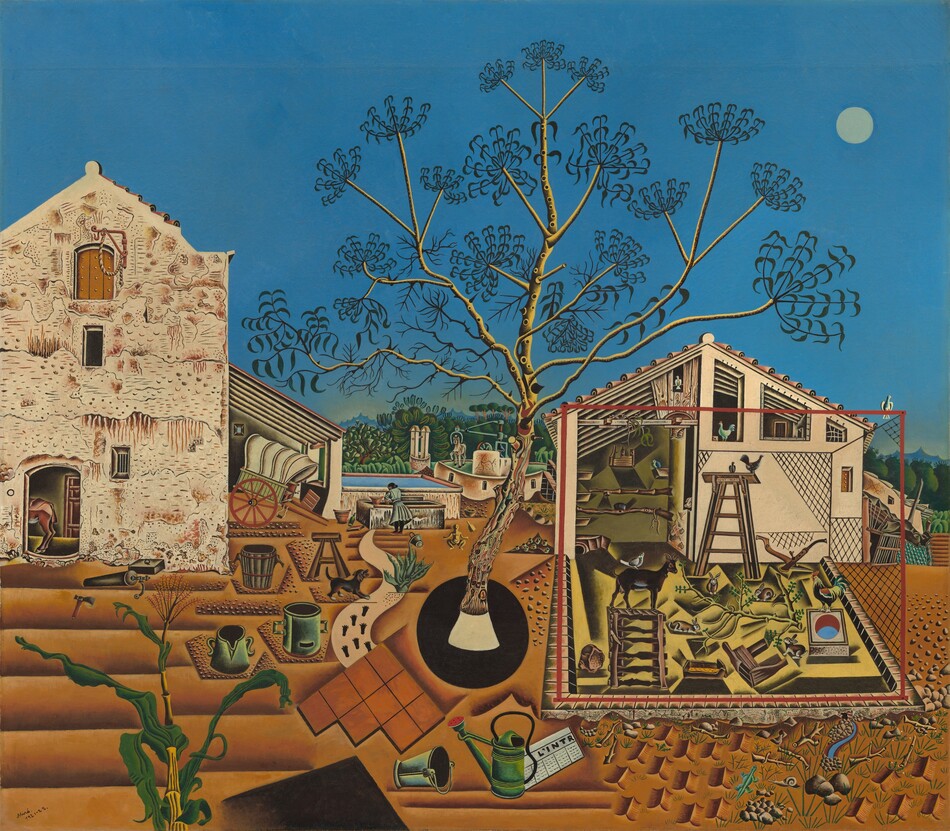
Two angular, cream-white buildings flanking a central, stylized tree are surrounded by brown soil, small animals, and farmhouse objects like watering cans and buckets beneath a clear, azure-blue sky in this square landscape painting. We look straight onto the buildings and slightly down onto the earth in front of us. About a third of the way up the composition, the horizon is lined with trees and mountains in the deep distance. The long, spindly branches of the central tree nearly reach the top edge of the painting and abstracted, sickle-shaped leaves are silhouetted against the sky so no leaves overlap. The far edge of the whitewashed structure to our left is cropped. The façade is pierced by two small rectangular windows and an arched hatch at the top under a winch. The back end of a horse is visible through an open door at the bottom center. Horizontal bands in front of the building suggest furrows in plowed earth, and a single stalk of corn grows up into the scene, seeming close to us. A pen protected by netting stretches out in front of the second structure, to our right of center. That wood-frame building has a triangular peaked roof, and the left half is open, like a lean-to. A goat, rooster, birds, and several rabbits occupy the pen. Watering cans, buckets and pails, a hoe, newspaper, lizard, and snail are spaced around the buildings. A tiny stylized person, perhaps a baby, appears in the distance between the buildings near a well where a woman works. A covered wagon, a round mill, trees, and plants fill the rest of the space between the buildings. A disk-like moon hangs in the sky to the right of the tree. The artist signed and dated the lower left corner, "Miro. 1921-22."

The Farm

Joan Miró

1921-1922

Oil on canvas  Accession ID  1987.18.1

On View: East Building Upper Level, Gallery E415
A baby nestles in a mass of frilly white fabric atop a colorful patchwork, perhaps a pile of quilts, against a sage and spring-green background in this square painting. The baby’s face and right hand peeks out from the mountain of fabric at the top center of the composition. The infant has ash-white skin with pink cheeks and lips, and looks down toward us with large dark eyes. The pile of fabric creates a mosaic-like mix of pattern and color with vibrant royal and baby blue, sage green, turquoise, butter yellow, and shell and salmon pink. Some patterns are outlined in black while brushstrokes swirl together in other areas. The background is mottled with cool mint and asparagus-green strokes against pale beige.

Baby (Cradle)

Gustav Klimt

1917/1918

Oil on canvas  Accession ID  1978.41.1

On View: East Building Upper Level, Gallery E415
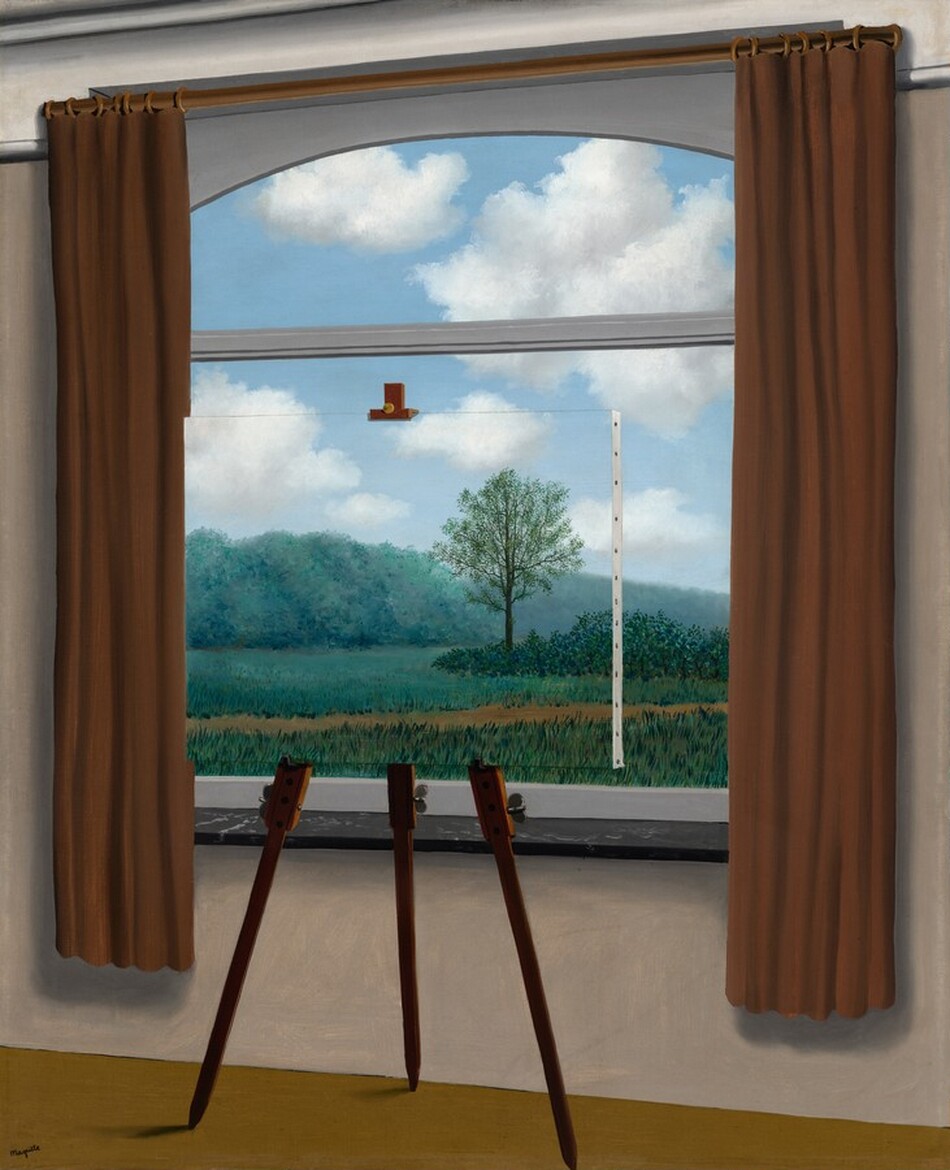
An interior window framed by brown curtains shows a view into a landscape with grass, shrubs, trees, and a dirt path beneath a blue sky with white clouds in this vertical painting. Upon closer inspection, the three legs of a wooden easel, the clip holding a canvas at the top, and a white, stapled edge draws our attention to the fact that a painted canvas rests directly in front of the window. 

La condition humaine

René Magritte

1933

Oil on canvas  Accession ID  1987.55.1

On View: East Building Upper Level, Gallery E415
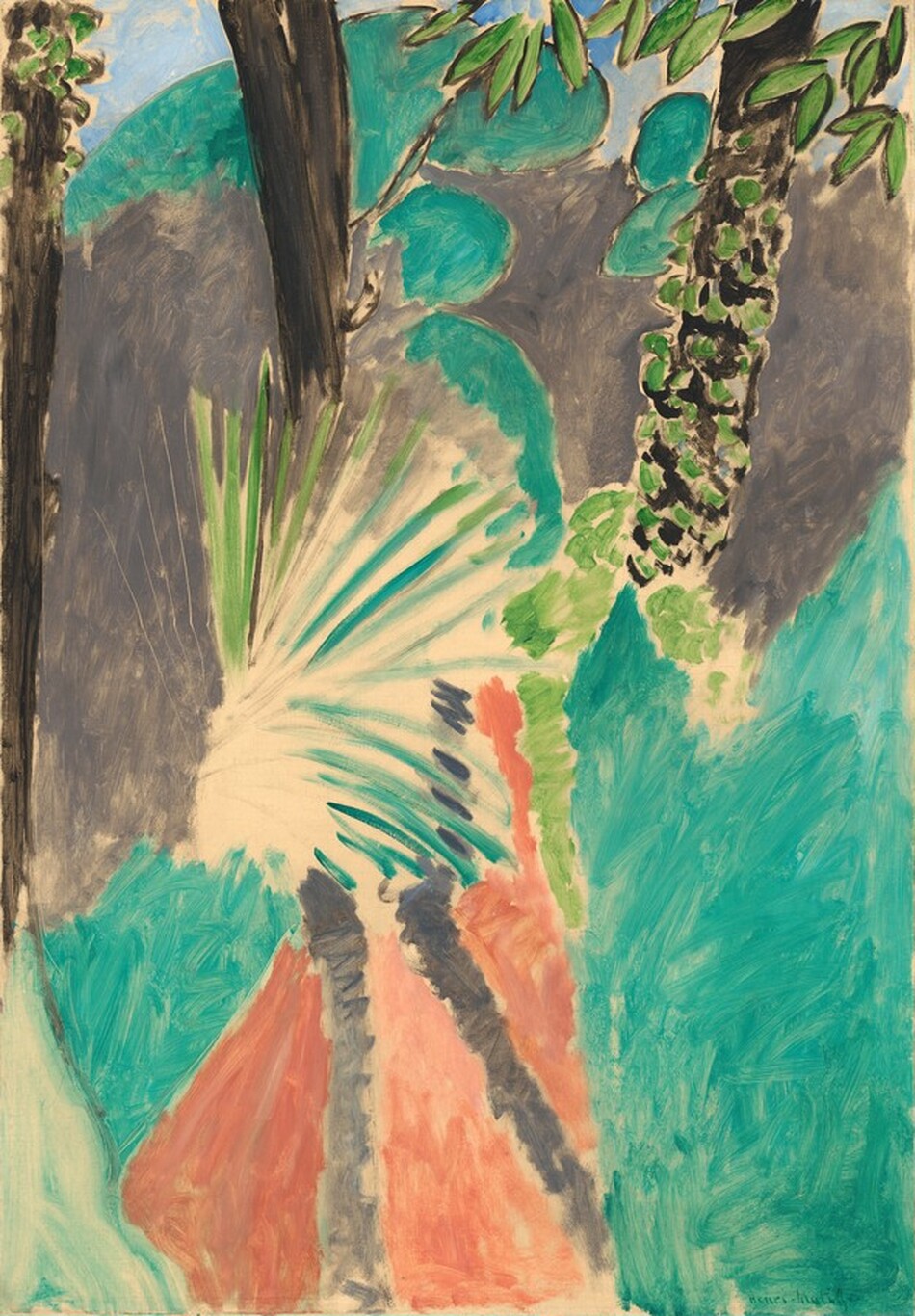
Fields of elephant gray, coral orange, and turquoise surround a fan-like, abstracted palm frond near the center of this vertical, abstract painting. The fronds of the palm radiate like a starburst against unpainted, cream-white canvas. Three black, vertical bands spaced behind the palm suggest tree trunks, with the rightmost trunk dotted with spring green, perhaps representing moss or the leaves of a vine. The fields of gray to either side of the frond, the turquoise areas below the gray, and the coral at the bottom center are painted with visible brushstrokes, creating a mottled effect. Rounded turquoise forms above the gray are silhouetted against a field of pale blue, perhaps representing the sky along the top edge. A few pointed, oval leaves painted spring green with black outlines dip into the scene from the top of the composition. The artist signed the work in dark green paint in the lower right: “Henri-Matisse.”

Palm Leaf, Tangier

Henri Matisse

1912

Oil on canvas  Accession ID  1978.73.1

On View: East Building Upper Level, Gallery E415
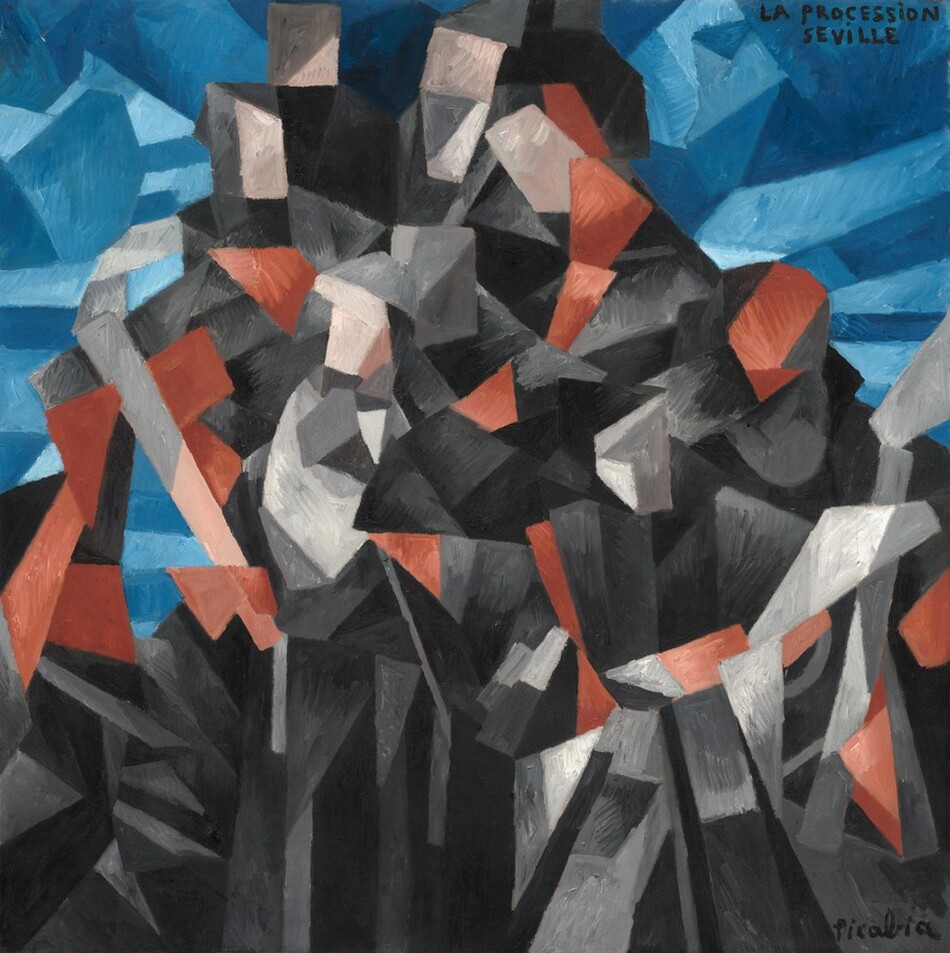
Angular, geometric shapes in charcoal and smoke black, pewter and silver gray, white, pale pink, and coral orange pile up to form a rough pyramid shape that fills the height of this square, abstract painting. More fragmented shapes in cobalt, azure, and light blue fill the upper left and right corners to either side of the apex, and one triangular space on its middle left. The artist has inscribed, “LA PROCESSION SEVILLE” in black capital letters near the top right edge and “Picabia” in the lower right.

The Procession, Seville

Francis Picabia

1912

Oil on canvas  Accession ID  1997.43.1

On View: East Building Upper Level, Gallery E415
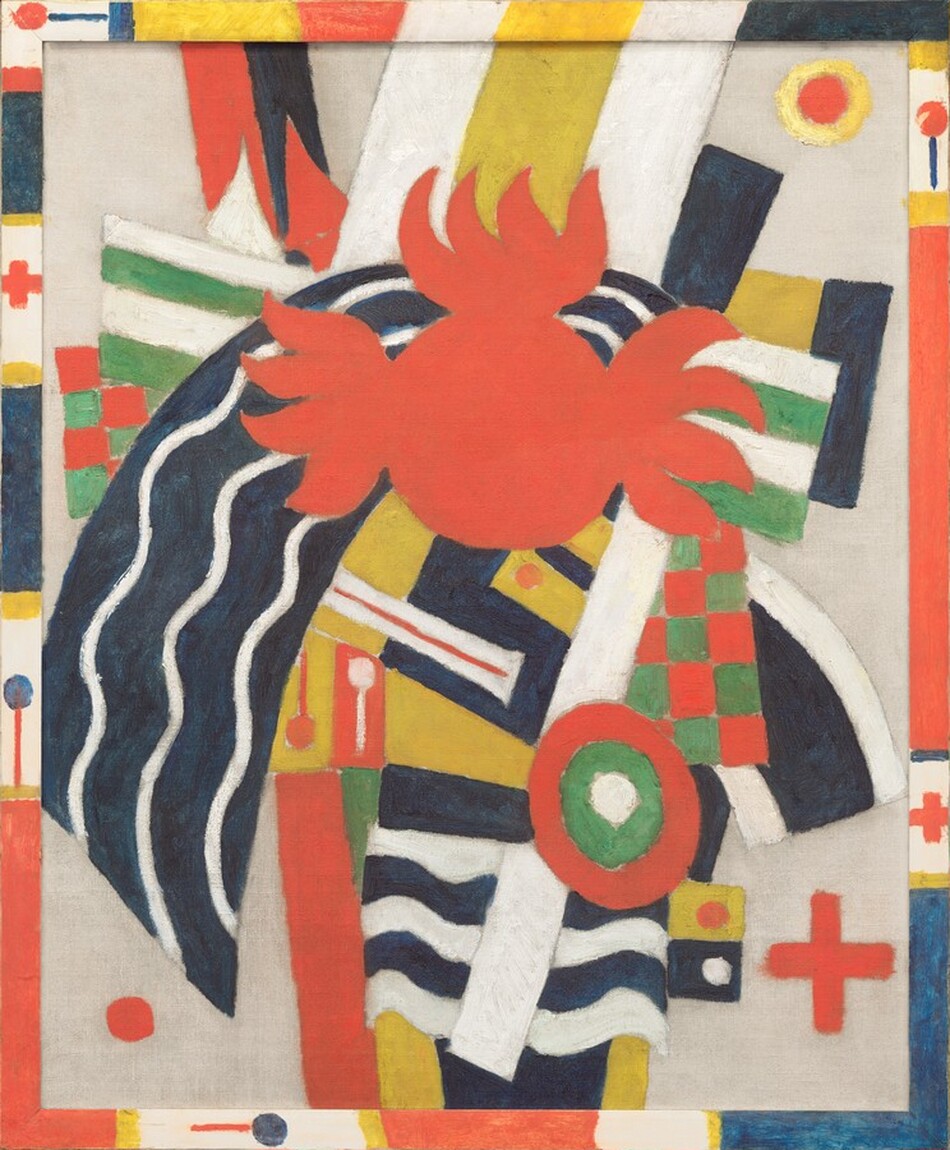
Layered circles and dots, crosses, checkered patterns, curved and wavy lines, and other geometric shapes in tomato red, shamrock green, buttercup yellow, royal blue, black, and bright white float against a field of unpainted canvas in this vertical, abstract painting. The shapes are most densely packed at the center of the composition. The eye is drawn to a red circle with flame-like forms at the sides and top, about three-quarters of the way up the canvas. Immediately underneath it and arcing out to our left is navy-blue band with three white, wavy lines. Other patterns to either side of the central red shape include two flag-like squares of alternating green and white stripes near two other patches containing a red and green checkered pattern. Other areas are patterned in black and yellow stripes, and blue and white stripes. Dots, lines, and lollipop-like shapes are scattered sparsely through the rest of the composition. Three shapes float near three of the corners, not touching anything in the layered, central portion: a red circle within a yellow ring at the upper right; a red dot at the lower left; and a red cross at the lower right. The frame was painted by the artist in the same colors as the canvas, with bands of color separating dots, crosses, and the lollipop-like form.

The Aero

Marsden Hartley

c. 1914

Oil on canvas  Accession ID  1970.31.1

On View: East Building Upper Level, Gallery E415
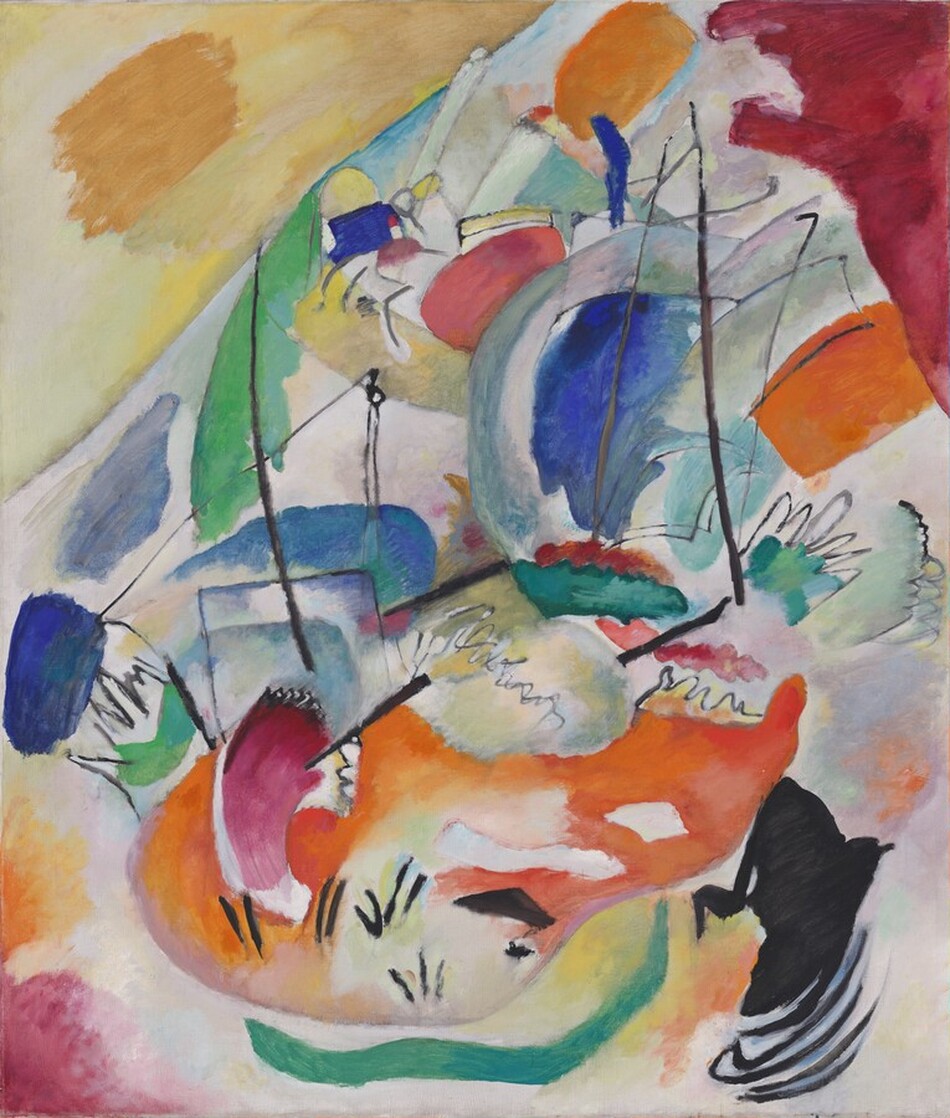
Black lines and one small, black triangular shape stand out against patches of color, in indigo and sky blue, pumpkin orange, butter yellow, emerald green, and ruby red, against a white background in this vertical, abstract painting. The paint seems thinly applied, resembling watercolor. Near the lower right corner, the black shape is roughly triangular and has five curving, parallel lines emanating from the bottom. Given the title of this painting, Improvisation 31, Sea Battle, the black lines could represent tall masts and outlines of sails amid areas of vibrant color that make up a boat and water around it.

Improvisation 31 (Sea Battle)

Wassily Kandinsky

1913

Oil on canvas  Accession ID  1978.48.1

On View: East Building Upper Level, Gallery E415
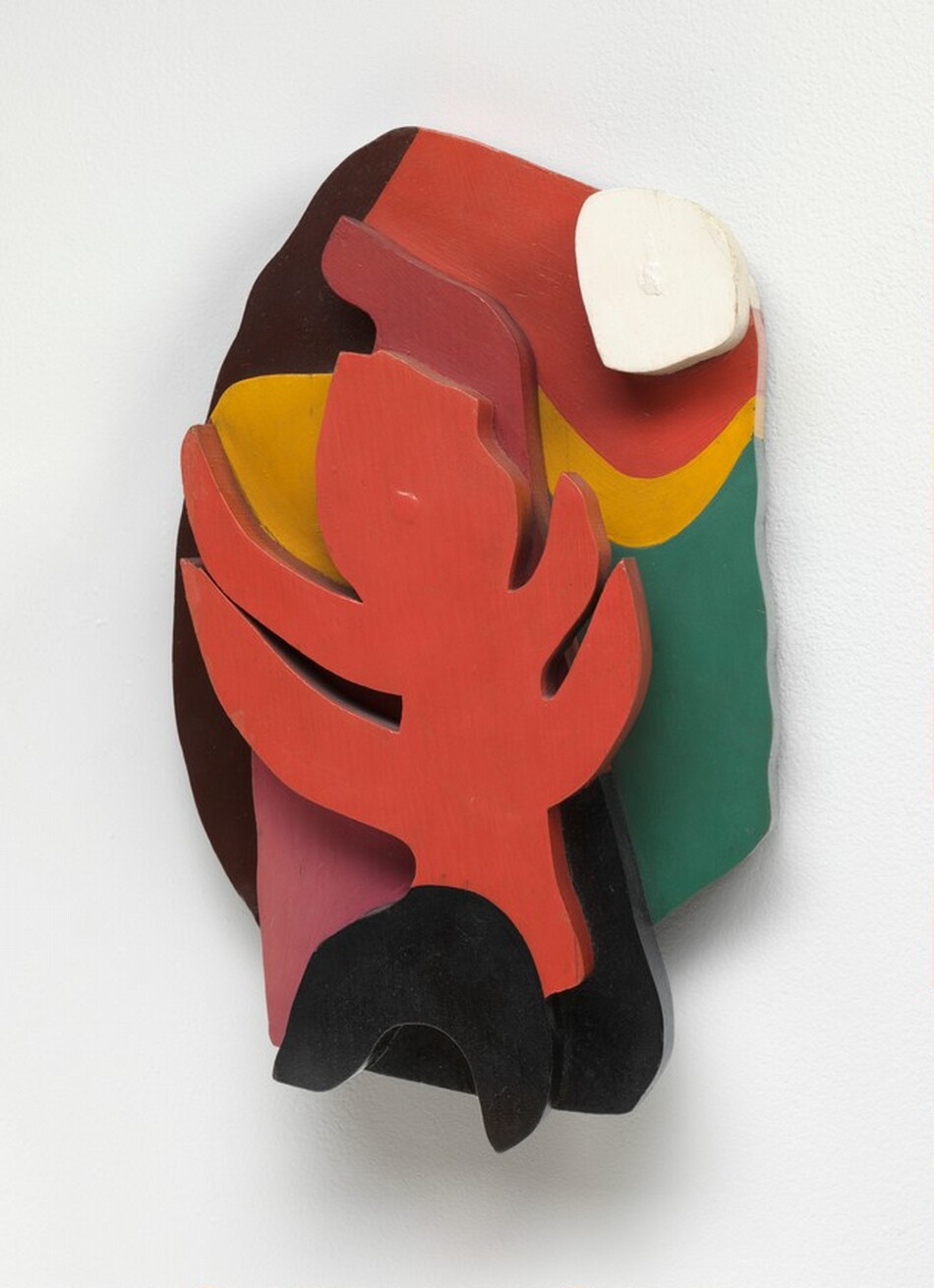
The sculpture displays three layers of overlapping abstract shapes, each painted in distinct colors. The colors across the three layers include red, yellow, green, black, white, and pink. The shape at the front looks almost like a human shape with an extra set of arms coming from the torso, with the upper body and head painted red and the legs painted black. The shape of the layer behind this one is hard to determine, but it appears to be painted in hot pink and black. The shape of the last layer is a large, uneven oval, painted in red, yellow, green, and black. A small, round, white shape is set on top of this bottom shape in the top right. The sculpture is set against a plain white background.

The Forest

Jean (Hans) Arp

1916

Painted wood  Accession ID  1977.20.1

On View: East Building Upper Level, Gallery E415
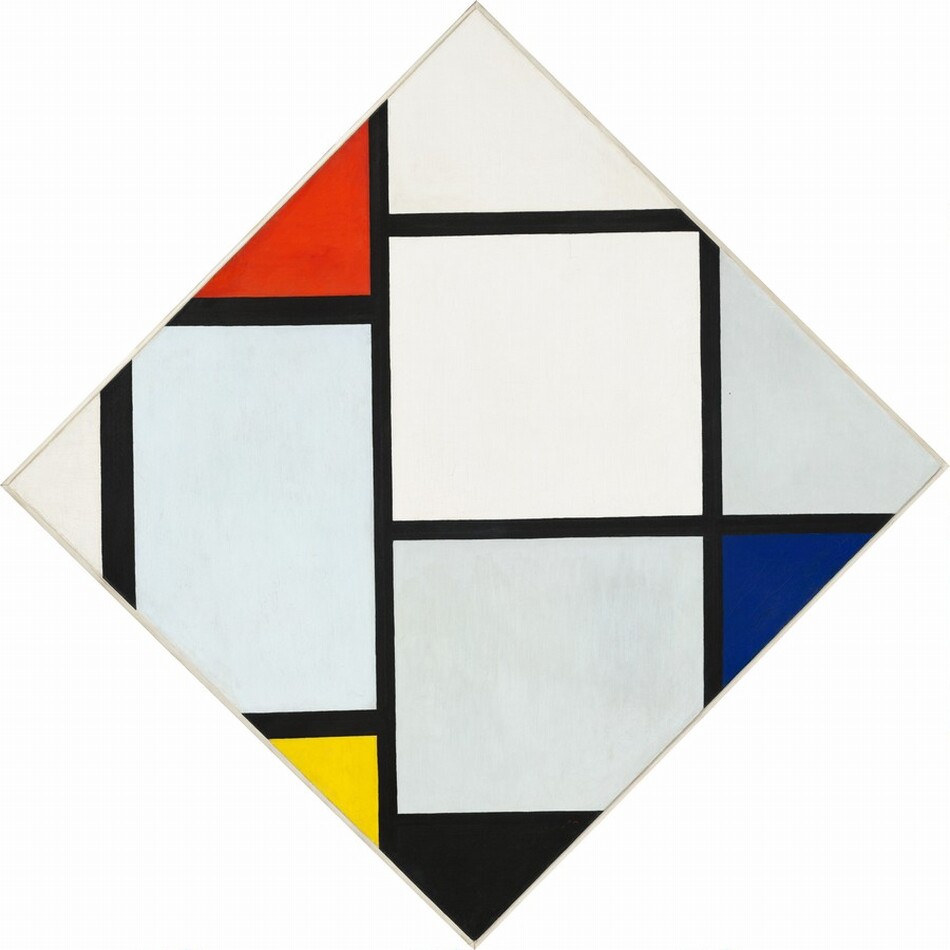
This abstract, geometric painting has been tipped on one corner to create a diamond form rather than a square. The surface of the canvas is crisscrossed by an irregular grid of black lines running vertically and horizontally like offset ladders. The black lines create squares and rectangles of different sizes, and the width of the lines vary slightly. One complete square sits at the center of the composition and is painted white. Other rectangles are incomplete, their corners sliced by the edge of the canvas, and each is a different shade of white with hints of pale blue and gray. The black grid creates triangular forms where it meets the angled edge of the canvas in some places, and some of these are filled with flat areas of color. A tomato-red triangle is placed to the left of the top center point, and a vibrant yellow triangle is to the left of the lower center point. A black triangle is next to it at the bottom center, and a cobalt-blue triangle is situated just below the right point. The painting is signed with the artist’s initials at the lower center: “PM.”

Tableau No. IV; Lozenge Composition with Red, Gray, Blue, Yellow, and Black

Piet Mondrian

c. 1924/1925

Oil on canvas  Accession ID  1971.51.1

On View: East Building Upper Level, Gallery E415
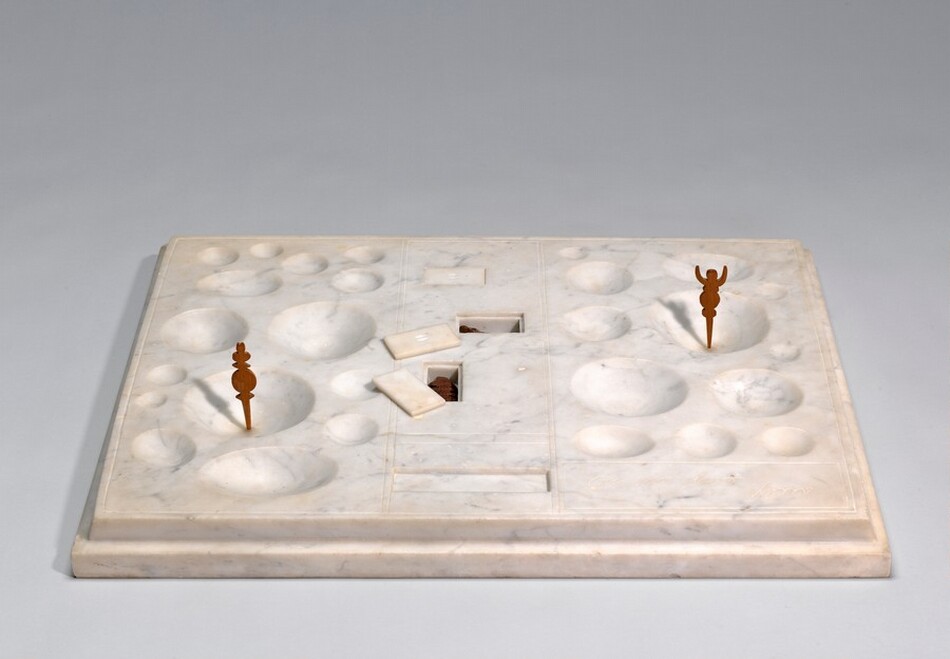
Carved from a slab of white marble, the top surface of this sculpture is covered with shallow, cuplike and deep rectangular depressions of various sizes. We look slightly down onto the slab in this photograph. The surface is divided into three vertical sections, which are defined by incised lines. The cuplike depressions are in the sections to the left and right. Two tiny, carved, dark wooden objects, like game pieces, stand upright in a cup with one the left and one to the right. Each piece is flat with a symmetrical design and a point at the bottom that inserts into the cup. The left piece has a disk flanked by triangular protrusions with a clover shape at top. The second piece has four stacked, small circles, and a U-shaped form to suggest the outline of a person with raised arms. Three smaller but deep rectangular cavities are carved into the middle section, and each one has a lid. Two lids sit askew on the top surface of the board near their respective openings, and inside are additional wooden pieces. A blank, rectangular section outlined with lightly inscised lines in the lower right is carved with reversed script letters that read, “on ne joue plus.” The entire surface has beveled edges, so it sits on a stepped base.

No More Play

Alberto Giacometti

1931-1932

Marble, wood, and bronze  Accession ID  1991.40.1

On View: East Building Upper Level, Gallery E415
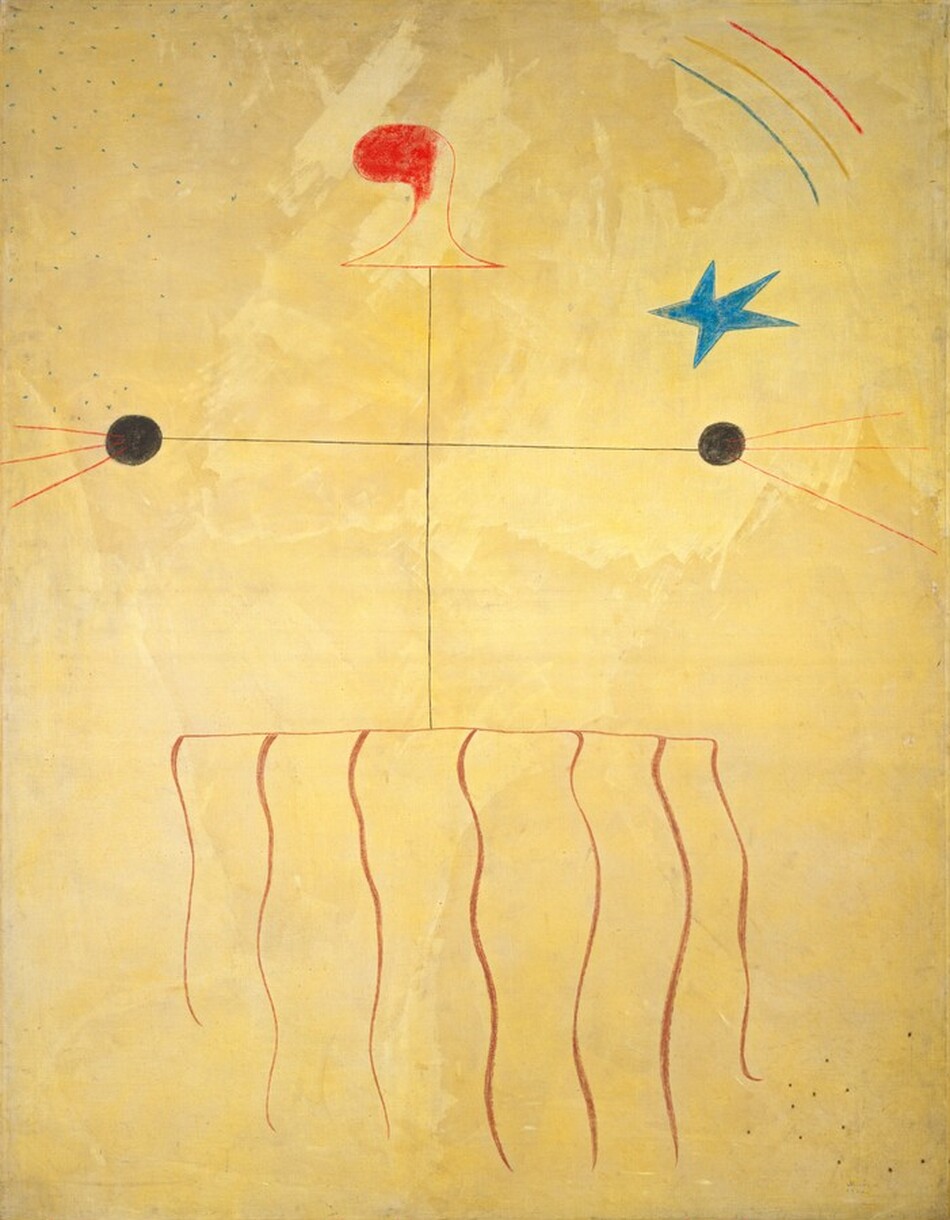
Two thin, black, straight lines create a cross above a band of widely spaced, vertical, wavy lines, all against a golden yellow background in this abstract, vertical painting. The cross and the band of wavy lines at its base nearly fill this canvas. Each end of the horizontal line of the cross ends with a black disk. Three crimson-red lines emanate like rays from the sides of each disk. The top of the vertical line of the cross ends with a scarlet-red form that flares into a straight line across the bottom and curves up and over, to our left. That shape is outlined in red and partially filled in with the same color at the curving end. At the bottom of the cross, seven vertical wavy lines are spaced along a horizontal line, all in maroon red. A turquoise-blue star floats over the black disk to our right, and three curved lines in blue, yellow, and red arch in a short, stylized rainbow near the upper right of the painting. The background is mottled with tan and ochre yellow, and speckled with topaz-blue dots mostly in the upper left and the lower right corners. The artist signed and dated the work in tiny letters near the lower right: “Miró 1924.”

Head of a Catalan Peasant

Joan Miró

1924

Oil and crayon on canvas  Accession ID  1981.9.1

On View: East Building Upper Level, Gallery E415
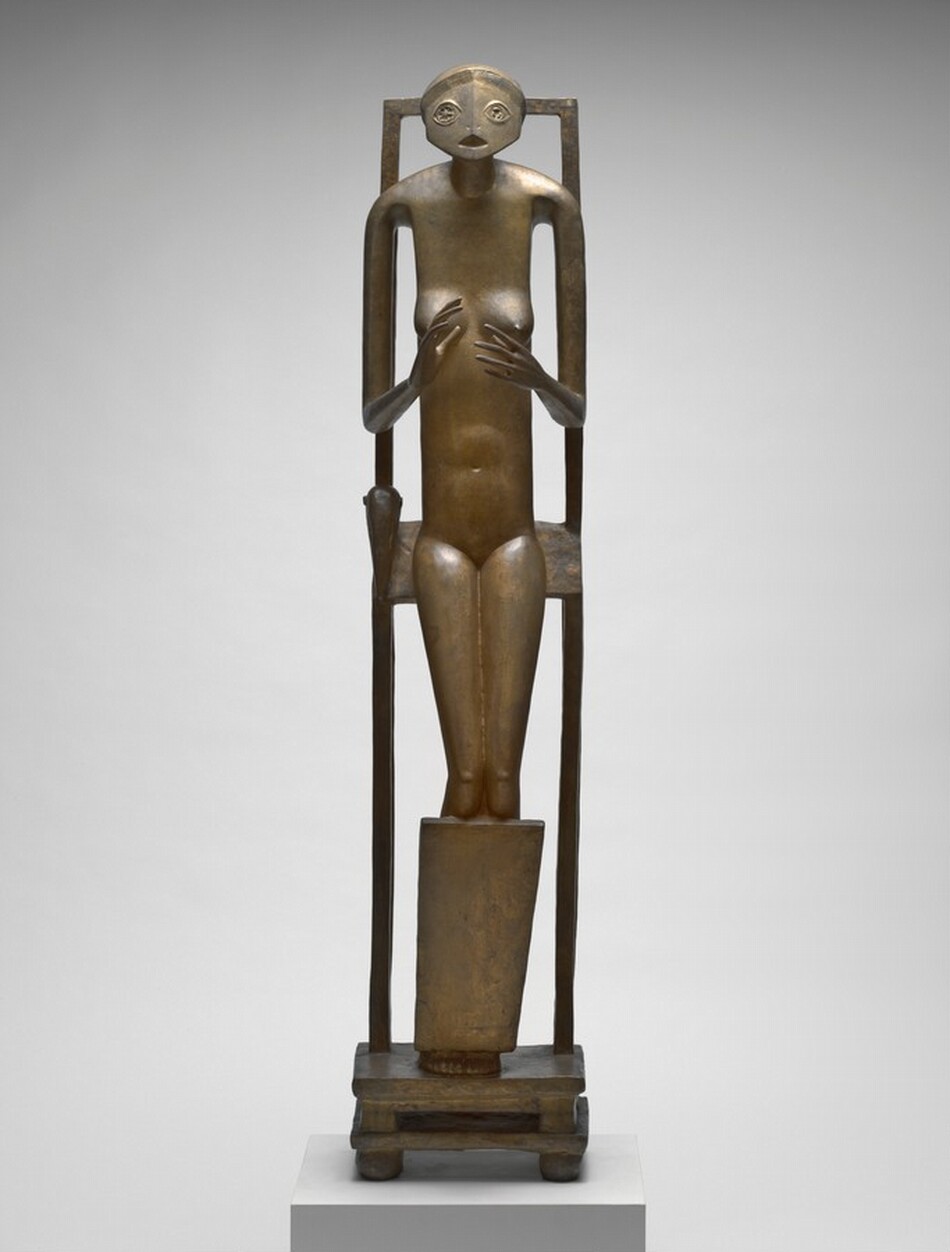
An abstracted, thin, nude woman with a round face half sits, half leans back against a tall, narrow support in this free-standing bronze sculpture. Her body faces us in this photograph. Her wide, oval face has two stylized, star-like eyes and a triangular opening for a mouth. The torso is tall and thin, and her limbs elongated. With thin arms, she holds up open hands with palms facing each other at the level of her round breasts. Her fingers are long and delicate. She is encased within a tall, rectangular frame. With knees slightly bent and resting against a panel that runs in front of her shins, she leans against a slat against her backside, perhaps the seat to a stylized chair. Her feet are pressed together on a double-tiered, low, square base with four bulbous feet at the corners.

The Invisible Object (Hands Holding the Void)

Alberto Giacometti

model 1934, cast 1935

Bronze  Accession ID  1973.27.1

On View: East Building Upper Level, Gallery E415

Loading Results