Talks & Conversations

Finding Awe: Billy Morrow Jackson’s Eve 

This painting shows a side view of a two-story house with a wrap-around porch. The house occupies most of the frame, with a faint, blurred horizon at the bottom left. The siding of the house is in shades of white and gray, and the roof is a slightly darker blue-gray color. Many windows are visible, partially or entirely covered by window shades in pale yellow, light green, and light blue. Near the center of the image, a large American flag is hung on the side of the building under the porch. It ripples slightly in the wind. On the left, by the red door of the house, an indistinct person sits on a bench or swing on the porch, wearing a teal jacket. The sky is white, and the ground beneath the house is a pale yellowish-green color.
Billy Morrow Jackson, Eve, 1967, oil on hardboard, Gift of the Artist, 1970.15.1

Explore how awe propels creativity and learn how Billy Morrow Jackson packed a complex array of emotions into scenes of everyday life.

During this 90-minute pause from your daily route, we’ll look slowly and mindfully at Billy Morrow Jackson’s Eve. You’ll be invited to look closely, wonder, and share your insights with the group. Together, we’ll learn “awe practices” that you can bring to your everyday life.

When the workshop is full, the registration button will stop working. Due to last-minute cancellations, check back on the morning of the April 17th or April 18th workshop for available tickets. Questions? Email us at [email protected].

"Finding Awe" is grounded in the National Gallery’s mission to welcome all people to explore and experience art, creativity, and our shared humanity. It offers new “awe practices” drawn from the research of Dacher Keltner, professor of psychology at the University of California-Berkeley, director of The Greater Good Science Center, and author of Awe: The New Science of Everyday Wonder and How It Can Transform Your Life (2023). Research shows that experiences of awe help support mental and physical wellbeing and open us up to greater creativity and deeper empathy. Explore awe at the National Gallery of Art.
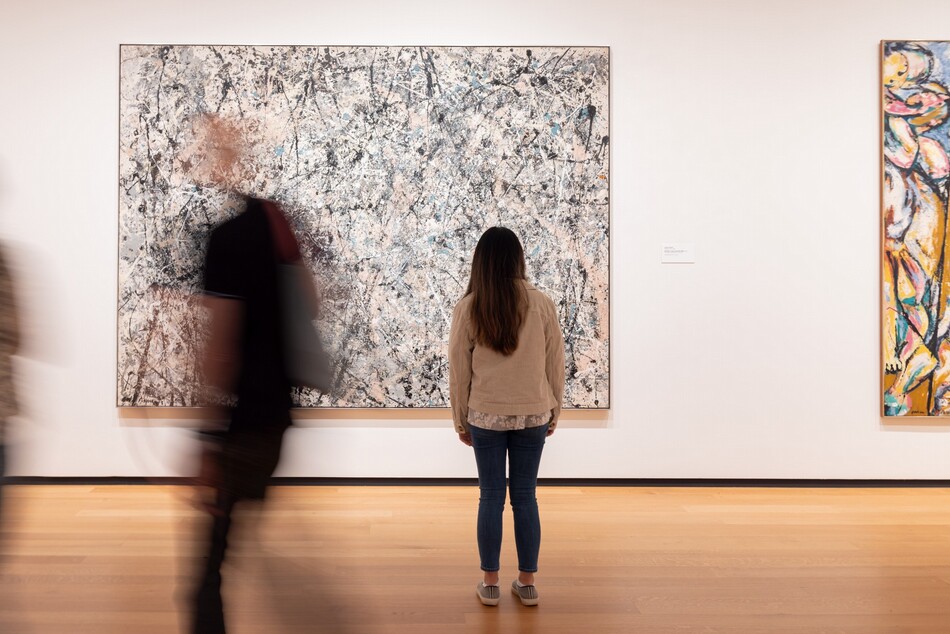
Awe at the National Gallery of Art

Find ways to nurture an awe mindset—both at the museum and at home.

You may also like
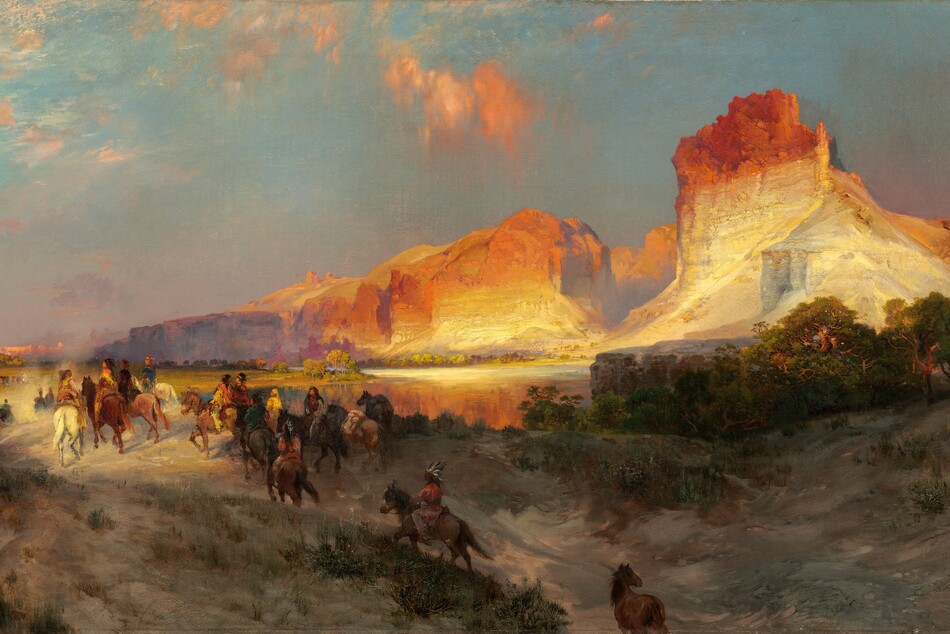
Sheer, vertical, cliffs, brightly lit in cream white and rust orange by the low sun, tower over a band of people riding horses into the distance in this long, horizontal landscape painting. The glowing cliffs dominate the upper right quadrant of the painting. They lighten from burnt orange along the jagged tops to flame orange down the steep sides, and are and warm, parchment white near the earth. One tall, narrow promontory to our right looms over a range of lower, rounded cliffs. As the cliffs move into the distance, they are shrouded with a lavender-purple haze. The land closest to us dips into a shallow valley at the bottom center of the composition, leading away from us. The dirt-packed earth is dotted with pine-green, scrubby bushes and vegetation and a grove of low, gnarled trees a short distance to our right. One chestnut-brown horse walks along the path at the bottom center of the composition, lagging behind a cluster of at least two dozen horses and riders winding into the distance. The horses range from ivory white to tawny brown and charcoal gray. The riders are loosely painted so some details are indistinct, but they all seem to have brown skin and dark hair. They wear feathered headdresses and garments in teal blue, fawn brown, or golden yellow. They ride over a low hill toward a crystal-blue river, and then back along a flat expanse toward a row of minuscule, triangular tepees lining the horizon in the deep distance. The horizon comes halfway up the composition, and the tepees are backed by a row of rose-pink, flat-topped cliffs. A pale yellow disk hangs low in the sky, over the distant cliffs. The sky above deepens from soft, lilac purple along the horizon to ice and sapphire blue along the top. A few wispy clouds are burnished orange in the sunlight. The artist signed and dated the painting in the lower right corner, “TYMoran 1881,” with the T, Y, and M overlapping to make a monogram.

Talks & Conversations:  Finding Awe: Thomas Moran’s Green River Cliffs, Wyoming 

Registration Required
Sheer, vertical, cliffs, brightly lit in cream white and rust orange by the low sun, tower over a band of people riding horses into the distance in this long, horizontal landscape painting. The glowing cliffs dominate the upper right quadrant of the painting. They lighten from burnt orange along the jagged tops to flame orange down the steep sides, and are and warm, parchment white near the earth. One tall, narrow promontory to our right looms over a range of lower, rounded cliffs. As the cliffs move into the distance, they are shrouded with a lavender-purple haze. The land closest to us dips into a shallow valley at the bottom center of the composition, leading away from us. The dirt-packed earth is dotted with pine-green, scrubby bushes and vegetation and a grove of low, gnarled trees a short distance to our right. One chestnut-brown horse walks along the path at the bottom center of the composition, lagging behind a cluster of at least two dozen horses and riders winding into the distance. The horses range from ivory white to tawny brown and charcoal gray. The riders are loosely painted so some details are indistinct, but they all seem to have brown skin and dark hair. They wear feathered headdresses and garments in teal blue, fawn brown, or golden yellow. They ride over a low hill toward a crystal-blue river, and then back along a flat expanse toward a row of minuscule, triangular tepees lining the horizon in the deep distance. The horizon comes halfway up the composition, and the tepees are backed by a row of rose-pink, flat-topped cliffs. A pale yellow disk hangs low in the sky, over the distant cliffs. The sky above deepens from soft, lilac purple along the horizon to ice and sapphire blue along the top. A few wispy clouds are burnished orange in the sunlight. The artist signed and dated the painting in the lower right corner, “TYMoran 1881,” with the T, Y, and M overlapping to make a monogram.

Talks & Conversations:  Finding Awe: Thomas Moran’s Green River Cliffs, Wyoming 

Registration Required
Sheer, vertical, cliffs, brightly lit in cream white and rust orange by the low sun, tower over a band of people riding horses into the distance in this long, horizontal landscape painting. The glowing cliffs dominate the upper right quadrant of the painting. They lighten from burnt orange along the jagged tops to flame orange down the steep sides, and are and warm, parchment white near the earth. One tall, narrow promontory to our right looms over a range of lower, rounded cliffs. As the cliffs move into the distance, they are shrouded with a lavender-purple haze. The land closest to us dips into a shallow valley at the bottom center of the composition, leading away from us. The dirt-packed earth is dotted with pine-green, scrubby bushes and vegetation and a grove of low, gnarled trees a short distance to our right. One chestnut-brown horse walks along the path at the bottom center of the composition, lagging behind a cluster of at least two dozen horses and riders winding into the distance. The horses range from ivory white to tawny brown and charcoal gray. The riders are loosely painted so some details are indistinct, but they all seem to have brown skin and dark hair. They wear feathered headdresses and garments in teal blue, fawn brown, or golden yellow. They ride over a low hill toward a crystal-blue river, and then back along a flat expanse toward a row of minuscule, triangular tepees lining the horizon in the deep distance. The horizon comes halfway up the composition, and the tepees are backed by a row of rose-pink, flat-topped cliffs. A pale yellow disk hangs low in the sky, over the distant cliffs. The sky above deepens from soft, lilac purple along the horizon to ice and sapphire blue along the top. A few wispy clouds are burnished orange in the sunlight. The artist signed and dated the painting in the lower right corner, “TYMoran 1881,” with the T, Y, and M overlapping to make a monogram.

Talks & Conversations:  Finding Awe: Thomas Moran’s Green River Cliffs, Wyoming 

Registration Required