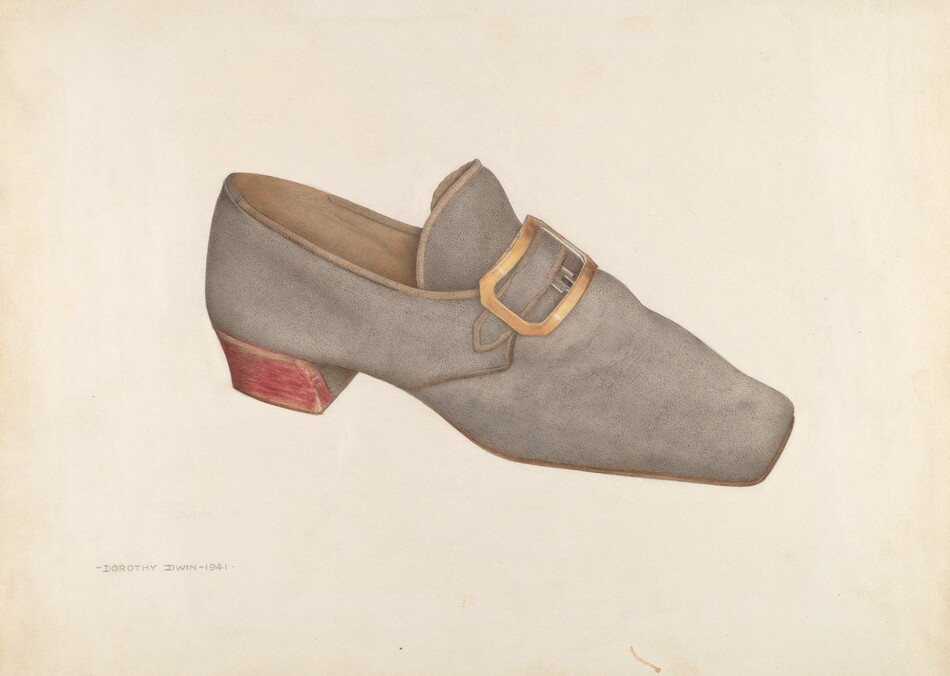
The image depicts a gray shoe with a buckle and a red sole. The shoe is placed centrally, tilted slightly upwards and towards the right, on a light background.
Dorothy Dwin, Man's Shoe, 1941, watercolor and graphite on paper, Index of American Design, 1943.8.1977

Index of American Design

The Index is made up of 18,257 watercolor works by some 1,000 artists. A Federal Art Project dating to the Great Depression, it sought to identify and preserve a national, ancestral aesthetic for the United States. The watercolors depict American folk and decorative arts objects from the colonial period through 1900.
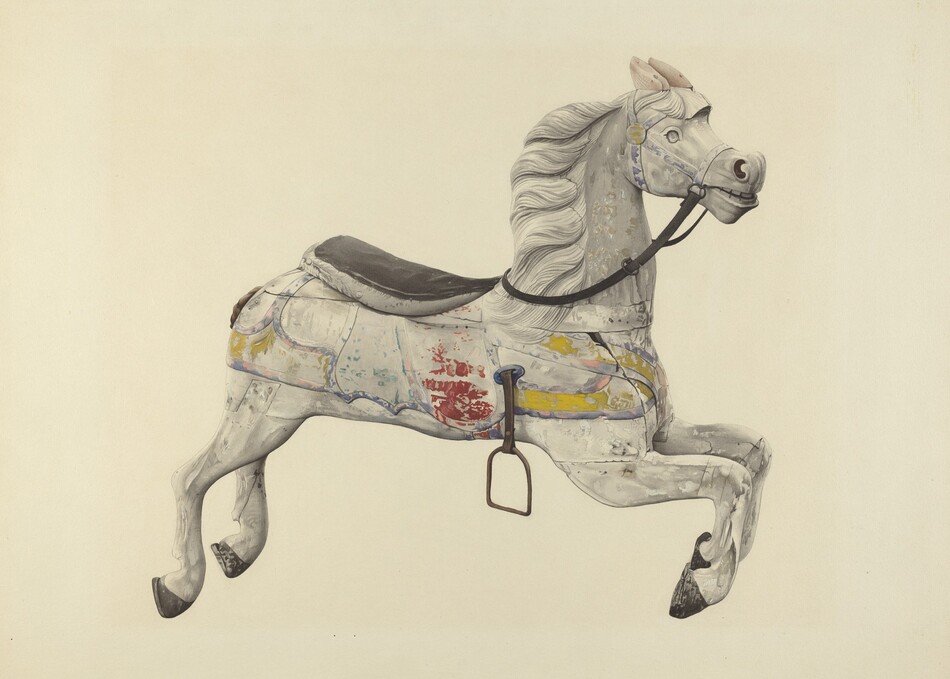
  • A carousel horse is drawn in graphite, colored pencil, and watercolor against a cream-white board in this horizontal illustration. The rendering is so detailed that at first (and even second) glance, it appears to be a photograph of the three-dimensional object. The white horse’s head is to the right, and its thick white mane blows back. Lines across the horse’s body suggest that the wood has split or it has been repaired over time. Traces of red, blue, pink, and yellow paint decorate the horse’s body where a blanket might lie across the back. Reins lead back from the horse’s parted lips and blocky teeth to reach the long, padded, dark gray seat. The stirrup we see emerges from the horse’s side. All four legs are lifted and hooves point lightly down and back.
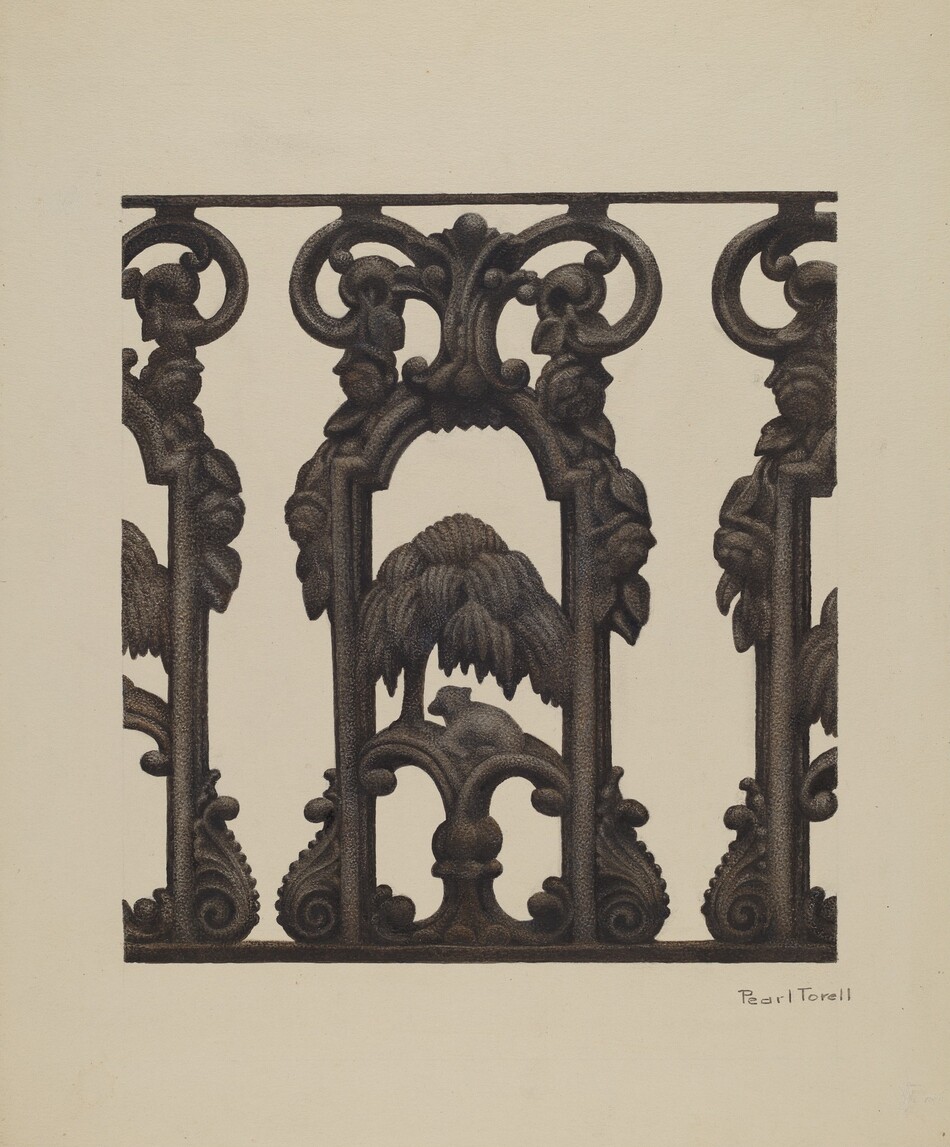
  • This is a drawing of intricate ironwork. The image features a detailed representation of an iron railing or gate with ornate designs. The central motif includes elegant curves and embellishments resembling foliage and possibly animal forms. The ironwork displays craftsmanship with shadows and highlights depicted for depth and texture. The background is plain.
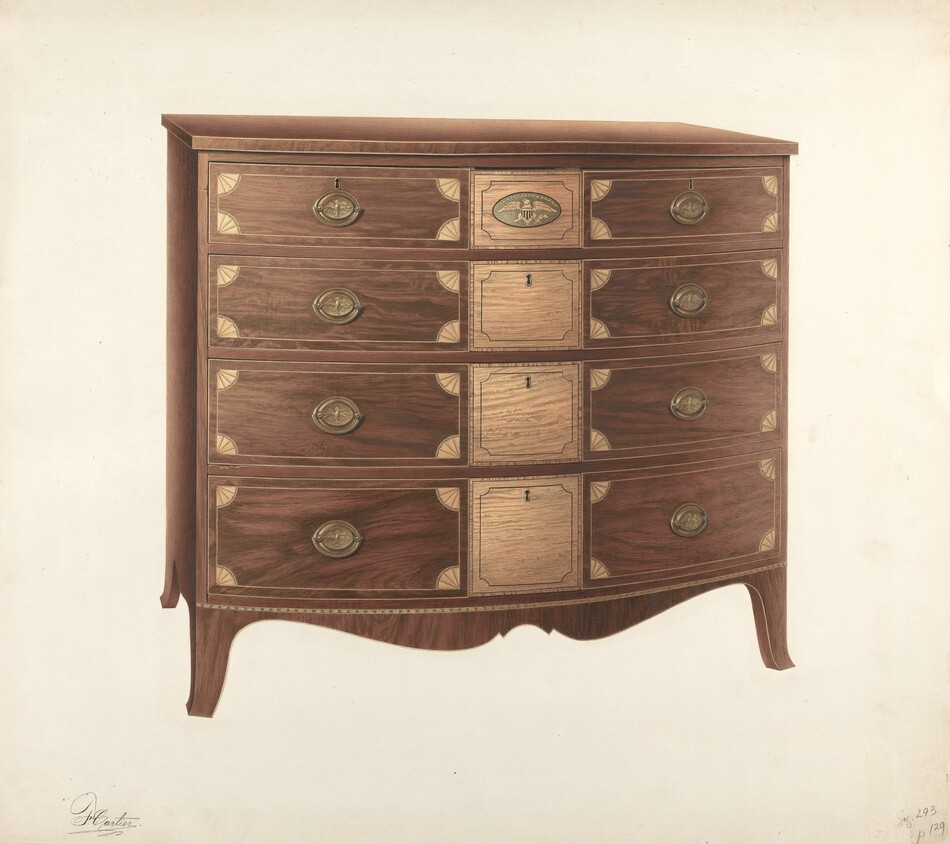
  • The image displays a wooden dresser with four drawers, decorative inlays, brass handles, a slightly curved front, and four curved legs. The dresser is against a plain background.
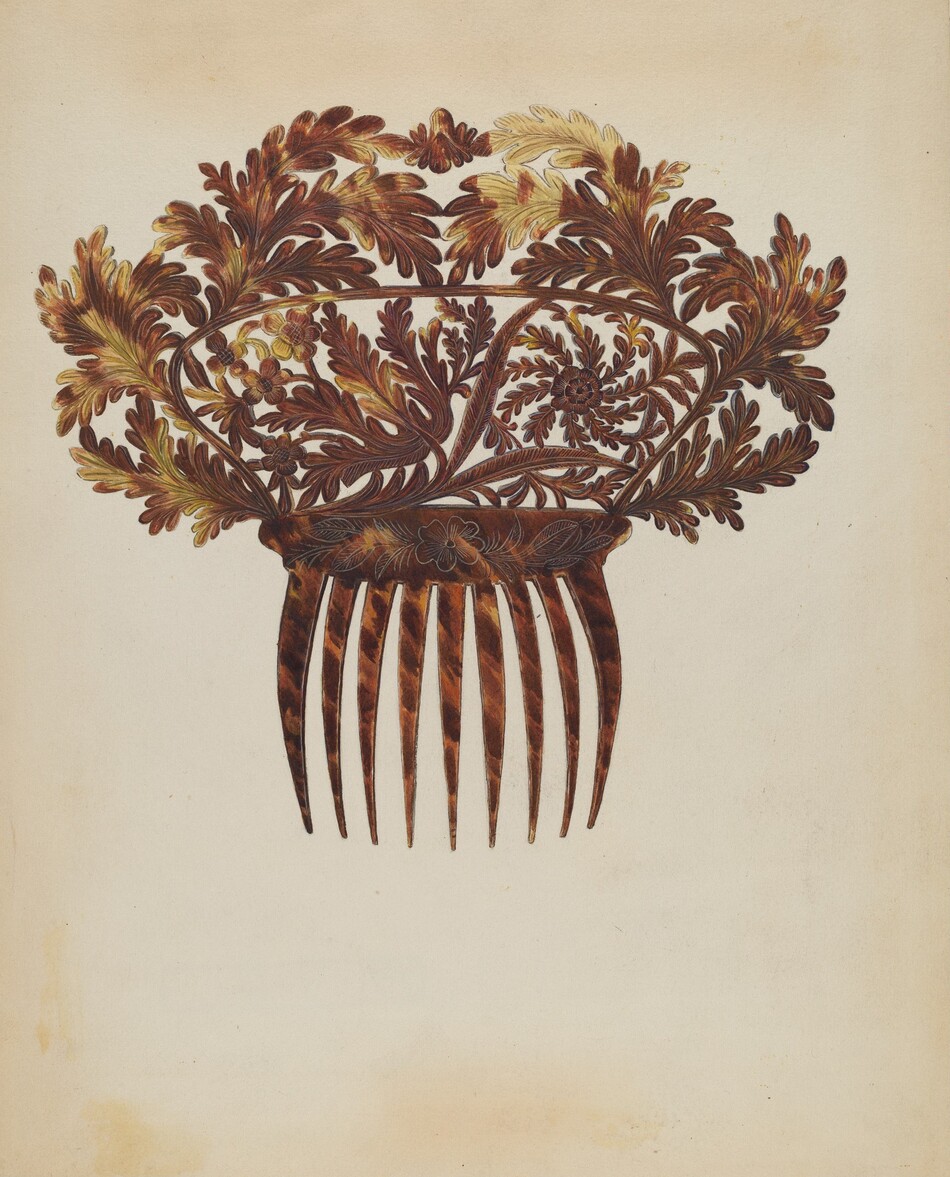
  • This is a painting of a decorative comb with intricate floral motifs, leaves, and blossoms crafted in a rich brown pattern. The upper portion of the comb is adorned with delicate leaf and flower designs, giving it a crown-like appearance. The elements are carved or etched in a symmetrical design on a plain off-white background.
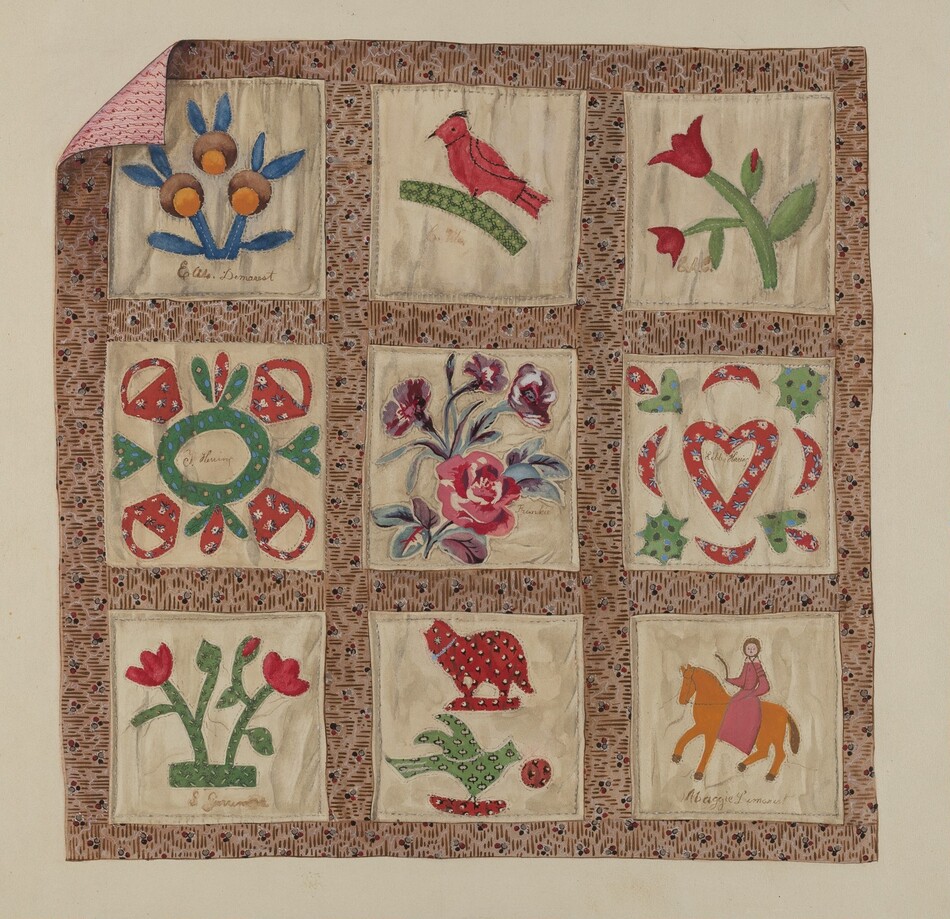
  • This is a painting of a quilt with nine fabric panels. Each panel has unique and colorful patterns, including flowers, a red bird, an abstract floral design, a heart with circular elements, and figures of a person riding a horse. The patches are bordered, giving the appearance of a patchwork quilt. The colors are bright and varied.
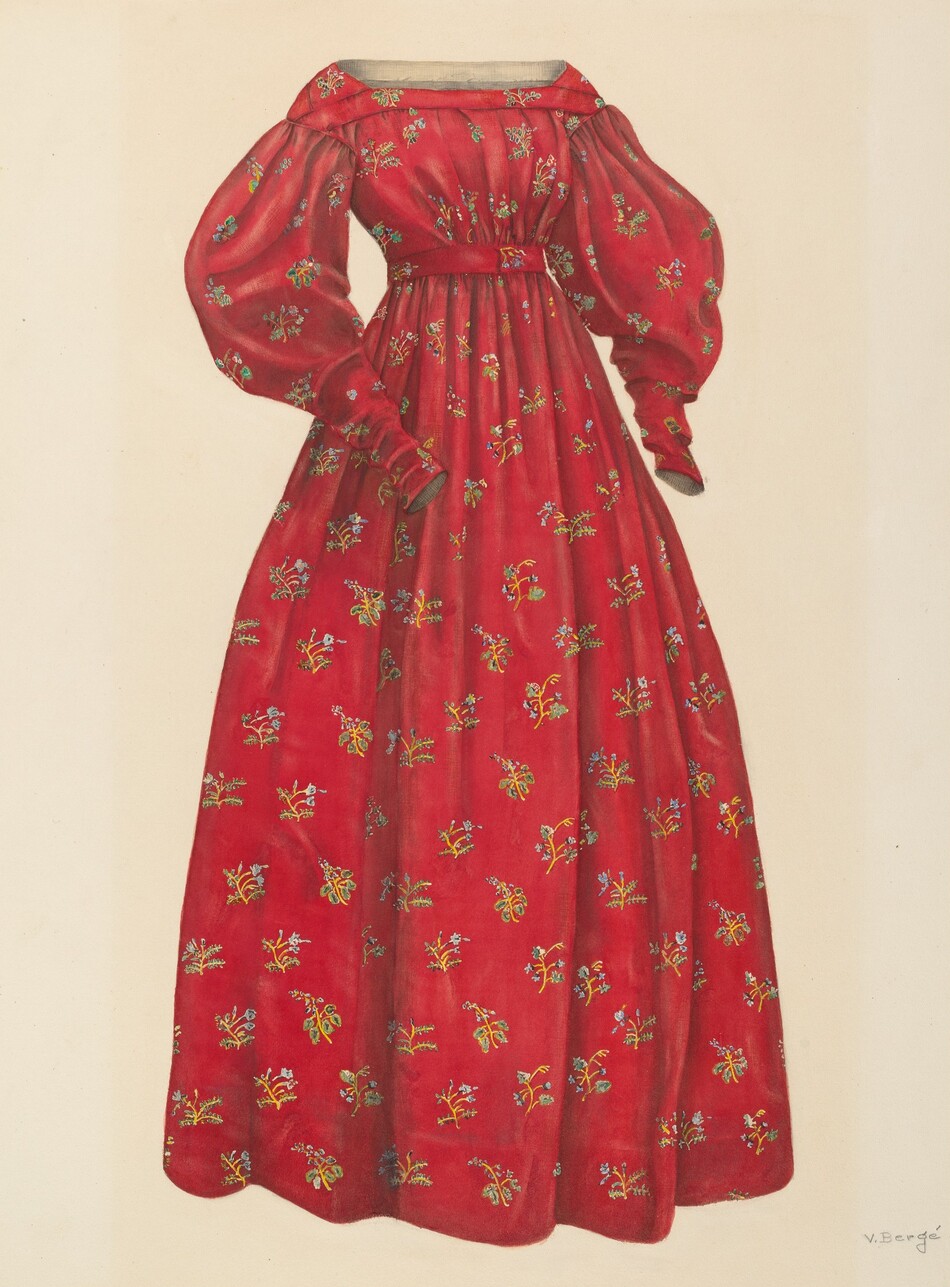
  • This is a drawing of a red dress with floral patterns. The dress features voluminous sleeves, a gathered waist, and a wide neckline, highlighted by small, colorful floral motifs scattered across the fabric.
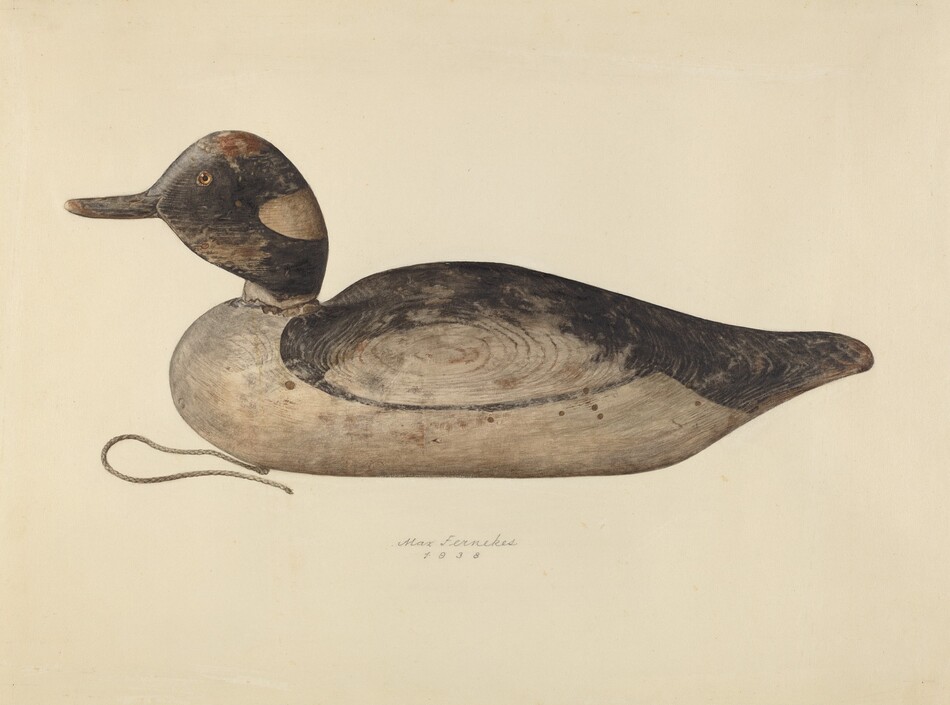
  • This painting displays a duck decoy carved and painted with various shades of brown, black, and beige on an off-white background. The decoy’s head is turned to the left, and the body is oriented horizontally. A cord hangs from the bottom, and the artist's signature "Max Fernekes 1938" is at the center bottom of the painting.
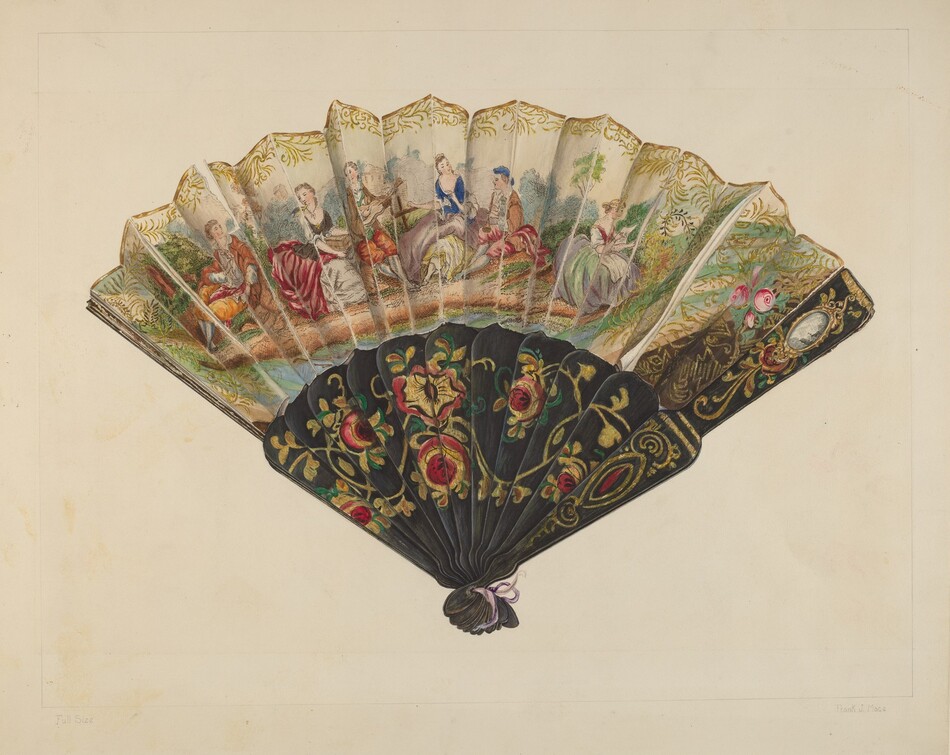
  • This is a painting of a decorative folding fan. It depicts an intricately designed folding fan with a detailed and colorful composition. The upper part features a pastoral scene with elegantly dressed figures engaging in activities. The people are adorned in 18th-century-style clothing. The lower part and handle of the fan have rich, floral patterns in vivid colors on a dark background with gold embellishments. The fan's artwork is framed by a border with swirling gold motifs, emphasizing its ornate design. This painting captures the refinement and artistry of decorative fans and is in the style of an 18th-century European artisan.
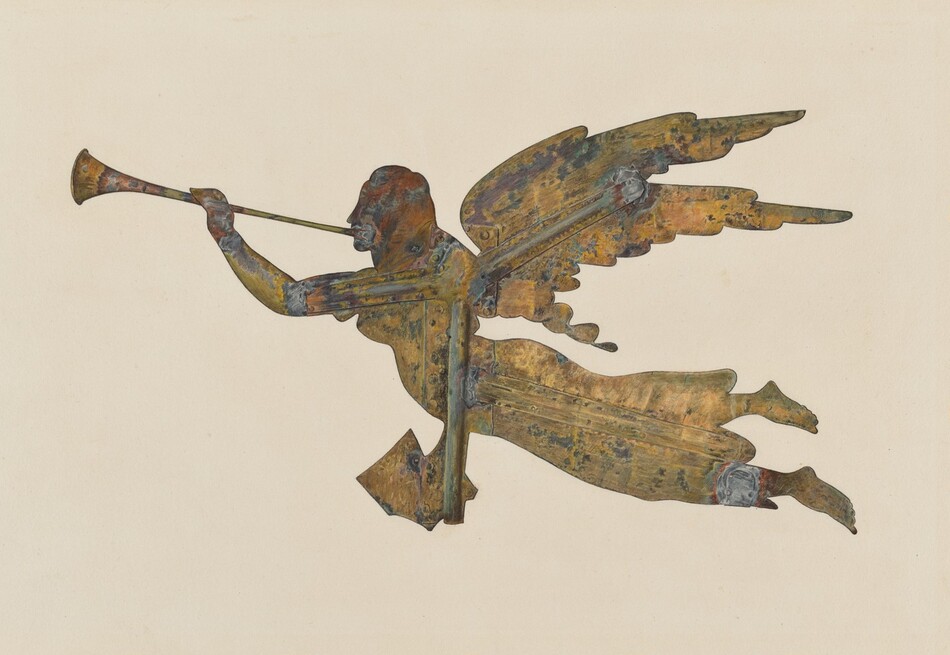
  • This painting depicts an angel in flight, facing the left and playing a trumpet. The angel's wings are spread out behind them, and their feet are extended out horizontally to the right. A small rod or post extends downward from the torso of the angel. The angel is entirely painted in shades of yellow, reddish-brown, and gray, reminiscent of weathered metal with patches of rust. Small rivets are visible at joints and edges of the angel, which appears to be comprised of small panels. The background of the painting is plain beige paper.
  • The image depicts a gray shoe with a buckle and a red sole. The shoe is placed centrally, tilted slightly upwards and towards the right, on a light background.
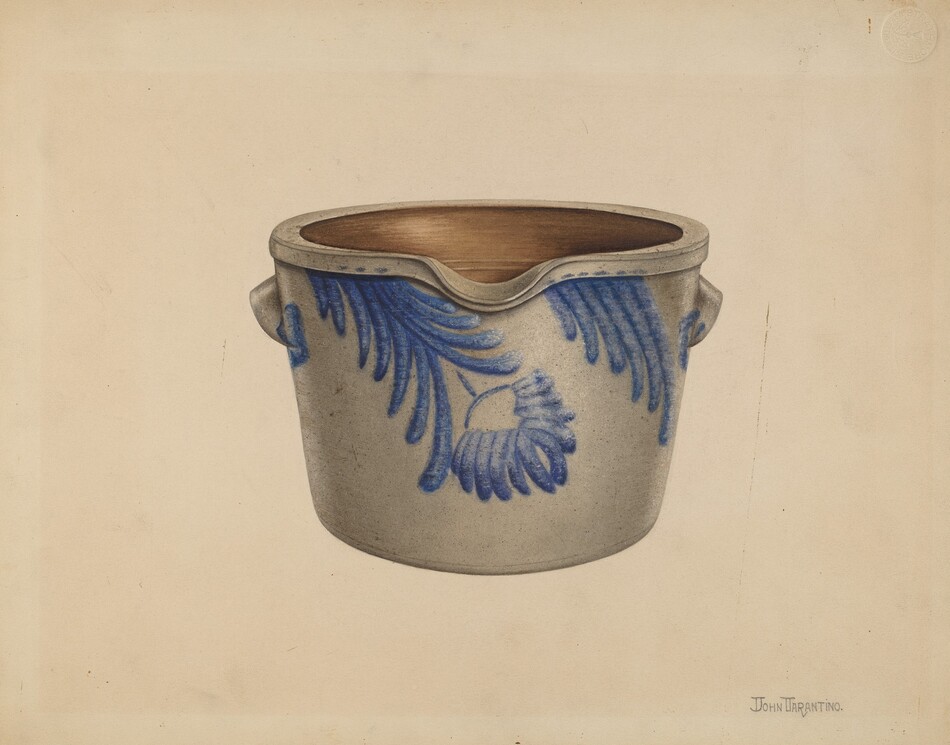
  • The image shows a ceramic pot with a wide, round body decorated with blue floral patterns. The primary color palette consists of neutral beige and vivid blue. Positioned centrally on a plain background, the pot has a slightly oval opening at the top, with handles on either side and the decorative design concentrated on the upper body portion.
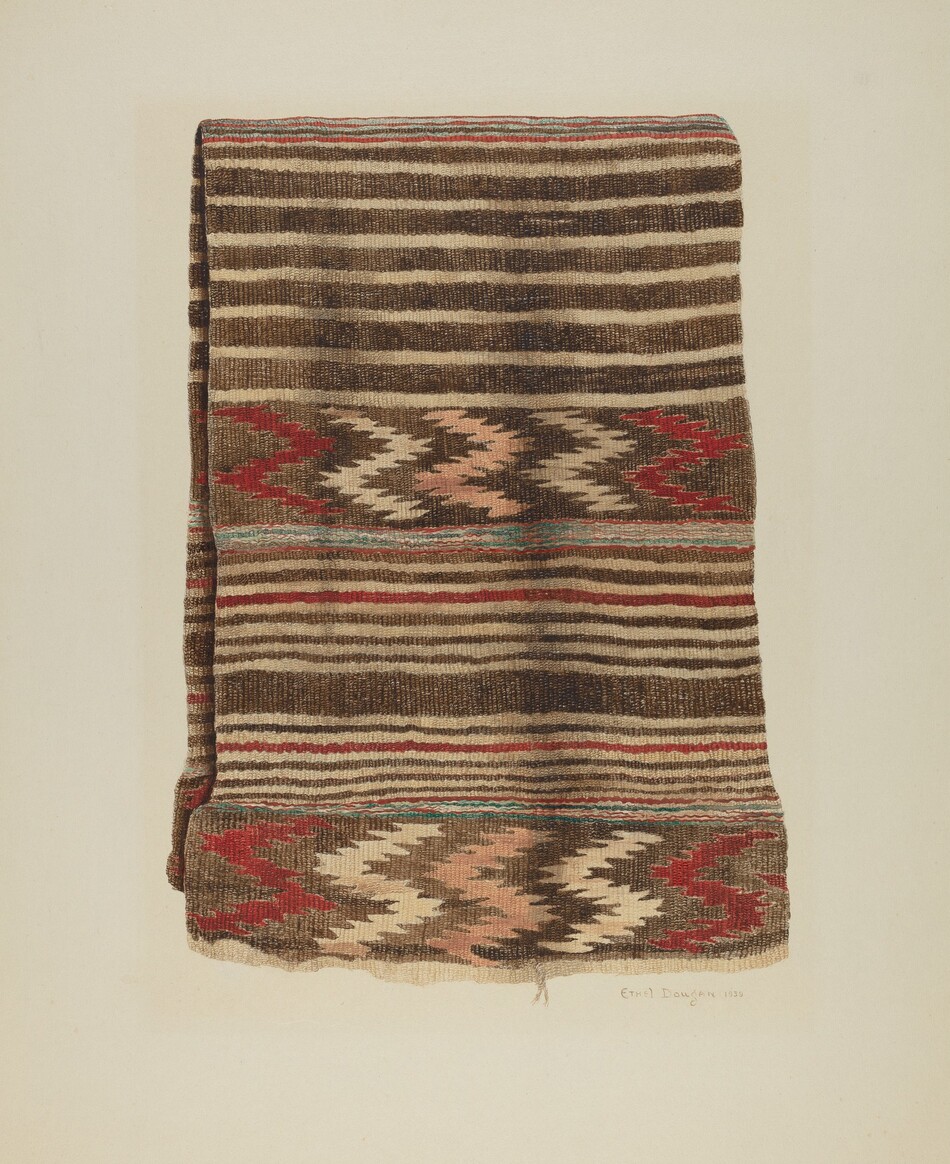
  • The image shows a folded woven textile with a pattern of alternating horizontal stripes and zigzag motifs. The colors include brown, beige, muted red, green, and pink. The textile is centered, with a slightly curved bottom edge and the left corner tucked in more than the right. The top section is dominated by horizontal stripes, while the lower third features more prominent zigzag patterns.
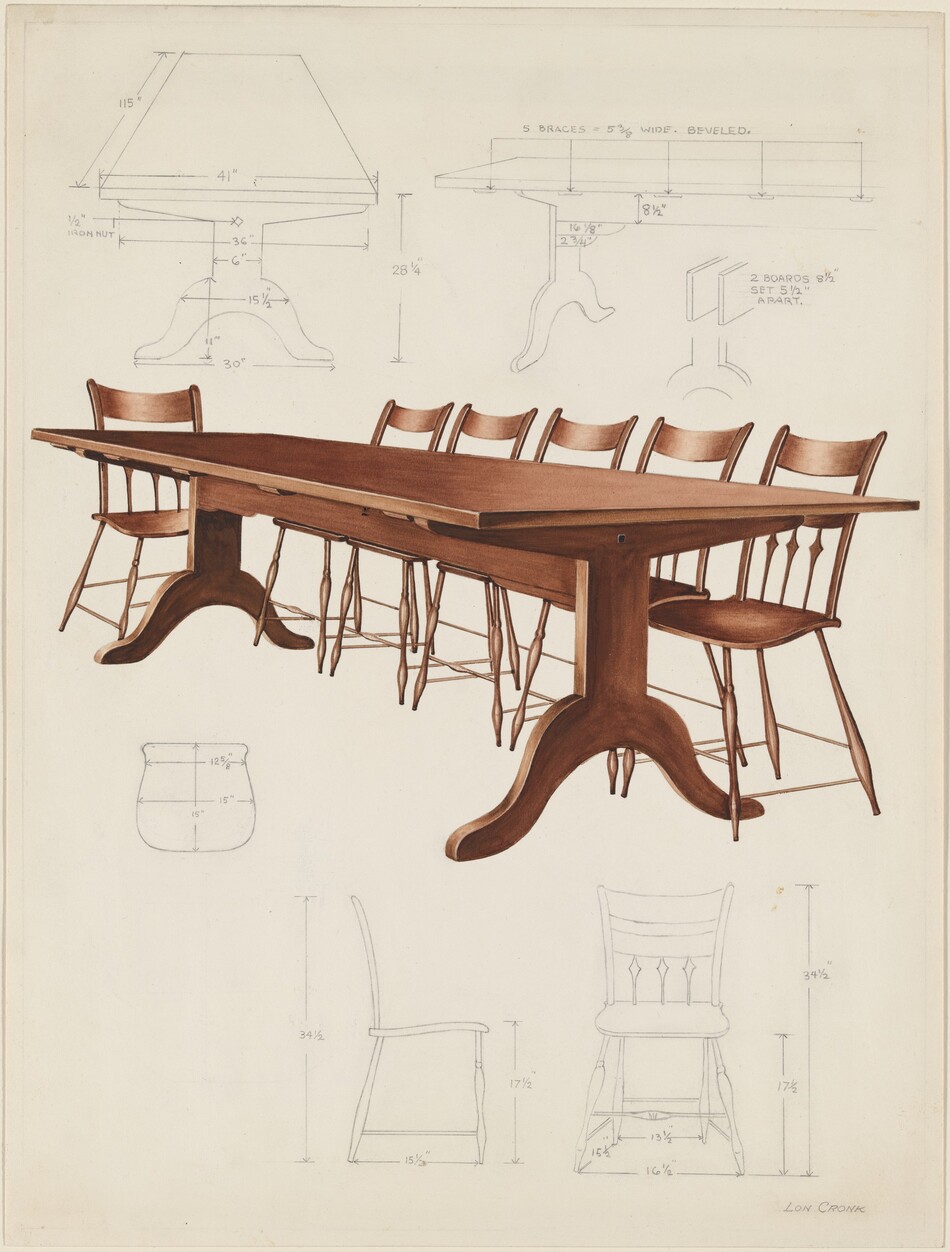
  • The image shows a wooden dining table with six matching wooden chairs. The furniture is in warm brown tones and is surrounded by line drawings and measurements of the pieces. On the left are pencil sketches of the table, and on the right are detailed illustrations of the chair design with dimension notations.
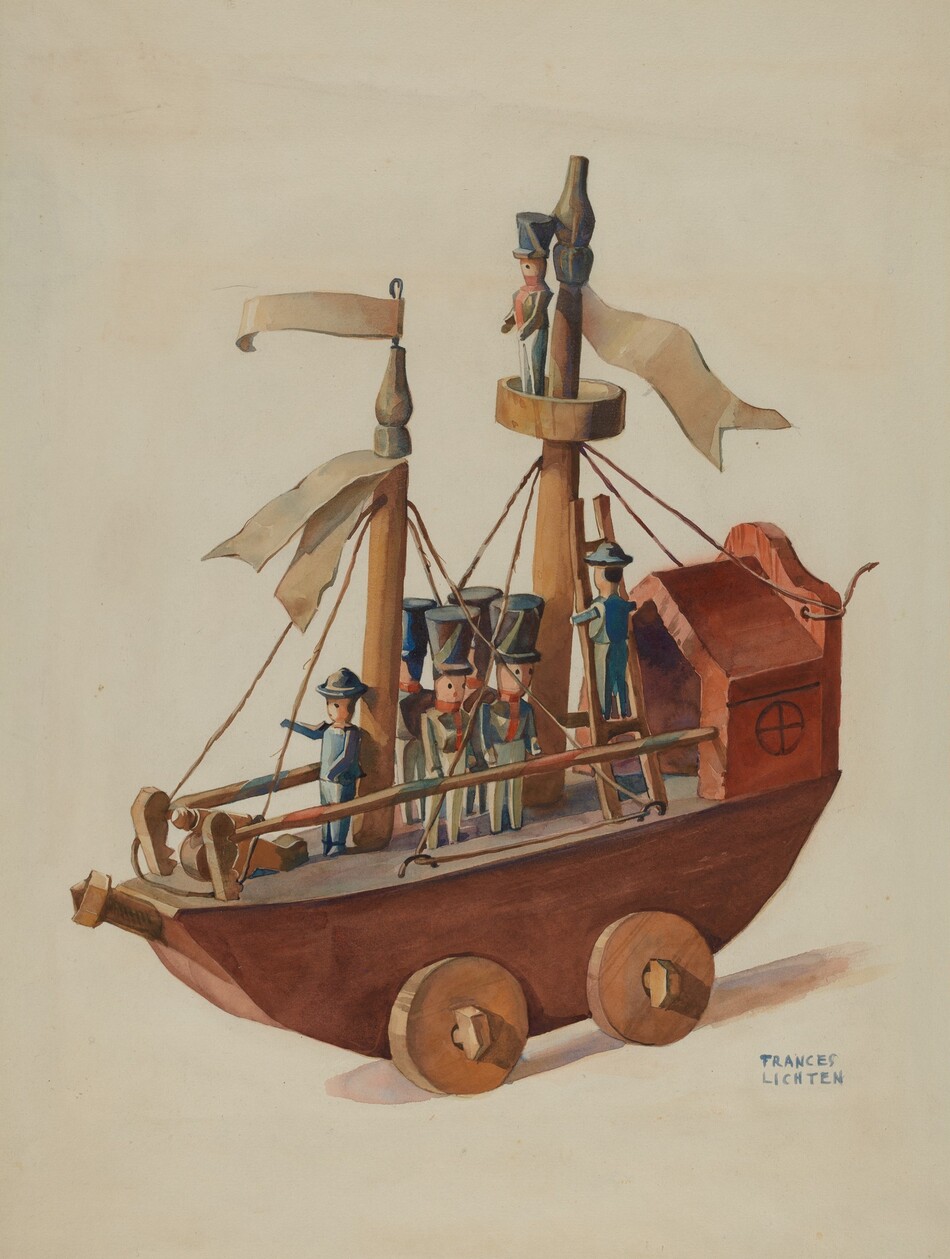
  • A wooden toy ship with soldiers stands on wheels. The ship is primarily brown with unpainted wood elements, while the soldiers are dressed in shades of blue, green, and black. The ship features multiple sails and a tall central mast, with a soldier figure positioned near the top. The soldiers are arranged along the length of the ship, with ropes and flags adding detail to the scene. The ship is placed centrally within the image, viewed slightly from above.
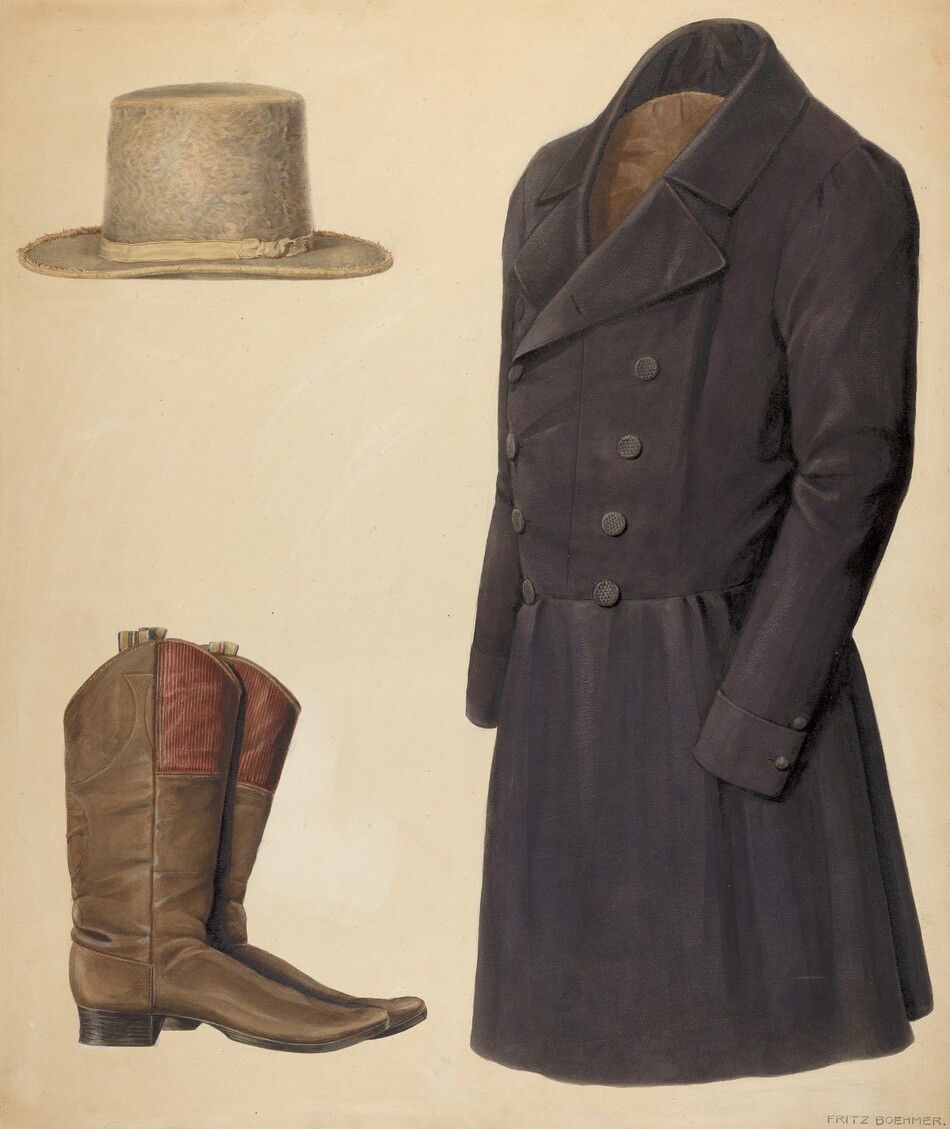
  • The image shows a dark, double-breasted coat, a pair of tall brown boots, and a light-colored straw hat. The color palette includes earthy tones such as brown, black, tan, and beige. The coat is on the right side, the boots are below on the left, and the hat is above the boots on the top left.
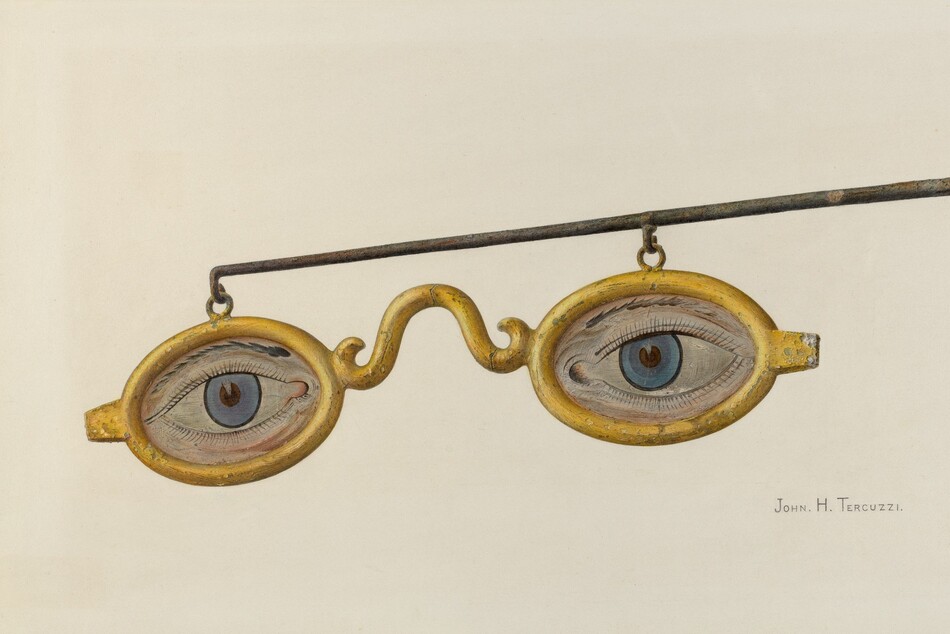
The image shows a pair of decorative eyeglasses with realistic painted eyes in each lens, enclosed in a golden yellow frame. The color palette includes shades of golden yellow, gray, blue, and black. The eyeglasses are positioned centrally within the image, with a black rod extending horizontally above them. The artist's name, John H. Tercuzzi, is written in the lower right corner.

Want to see more?

From weather vanes and pie plates to roller skates and drums, there is no shortage of curious and beautiful examples of American design to discover.

Explore more

A black and white drawing of a Sony Walkman with wired headphones

Article:  Create with Us: How Drawing Can Teach You to See Your Belongings in a New Light

Sketch everyday objects, inspired by the Index of American Design.
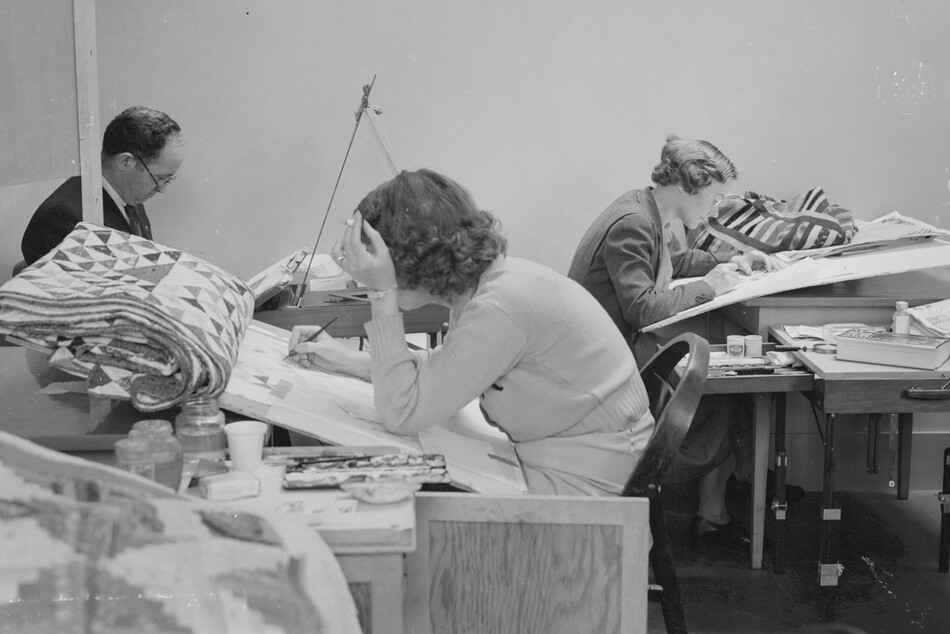
Article:  Creating an Index of American Design

The US government once employed artists to draw pictures of designs from historical objects. The idea is reimagined by artists today.
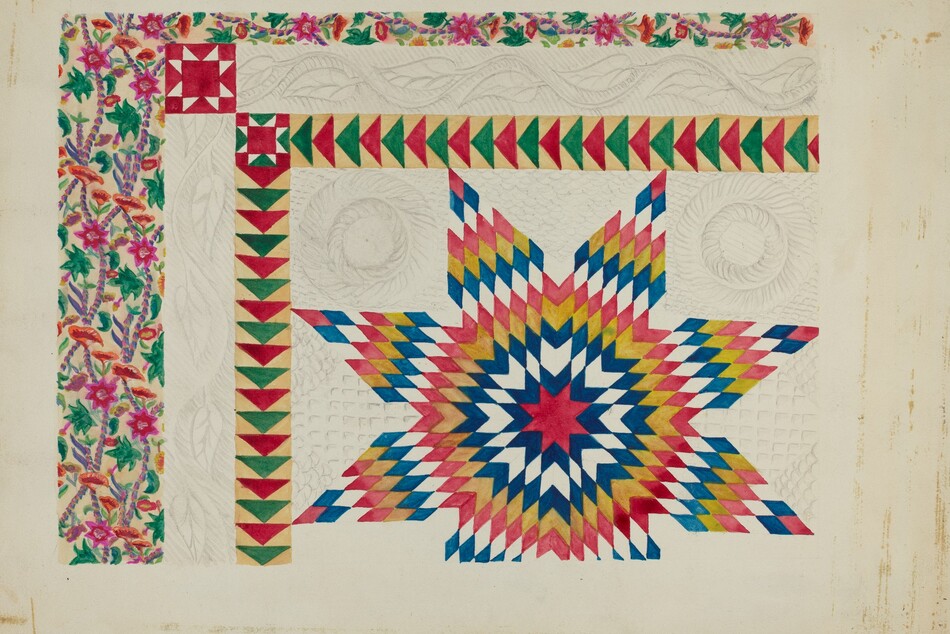
The image depicts an intricate assembly of geometric shapes converging to form a large central star pattern. The design features vibrant hues of red, blue, yellow, and white. The central pattern is surrounded by a frame composed of smaller triangles in a repeating sequence. Along the border, the design includes floral motifs filled with pink and green. The composition draws connections to traditional quilt patterns, resembling a textile art piece crafted with colorful patches.

Interactive Article:  How the Index of American Design Kickstarted Edward Loper’s Art Career

The acclaimed Delaware artist first brought his artistic ambitions to life drawing decorative art objects for the Work Progress Administration project.
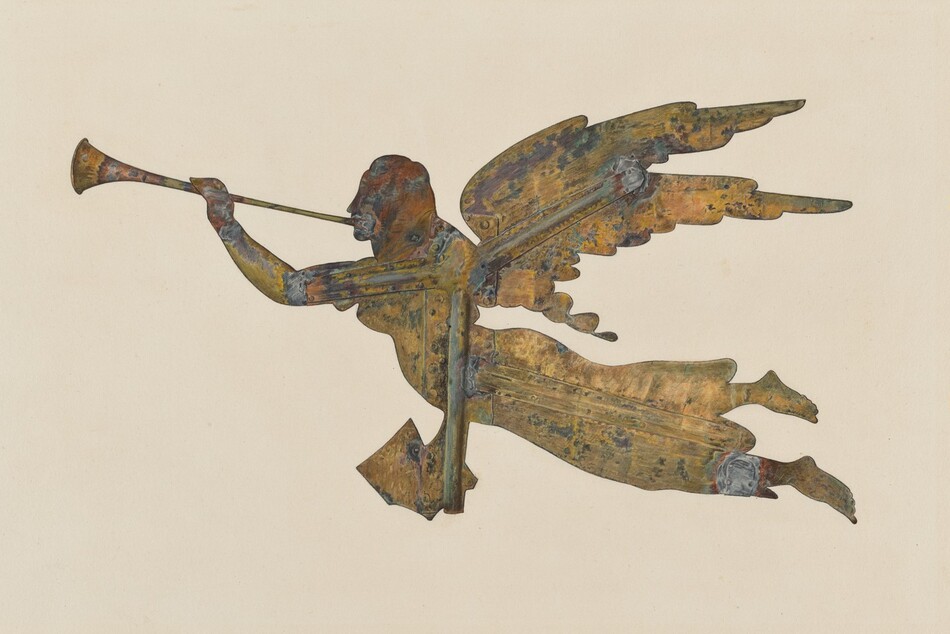
This painting depicts an angel in flight, facing the left and playing a trumpet. The angel's wings are spread out behind them, and their feet are extended out horizontally to the right. A small rod or post extends downward from the torso of the angel. The angel is entirely painted in shades of yellow, reddish-brown, and gray, reminiscent of weathered metal with patches of rust. Small rivets are visible at joints and edges of the angel, which appears to be comprised of small panels. The background of the painting is plain beige paper.

Article:  Seven Highlights from the Index of American Design

Peer into the American past with a collection of Great Depression–era watercolors.
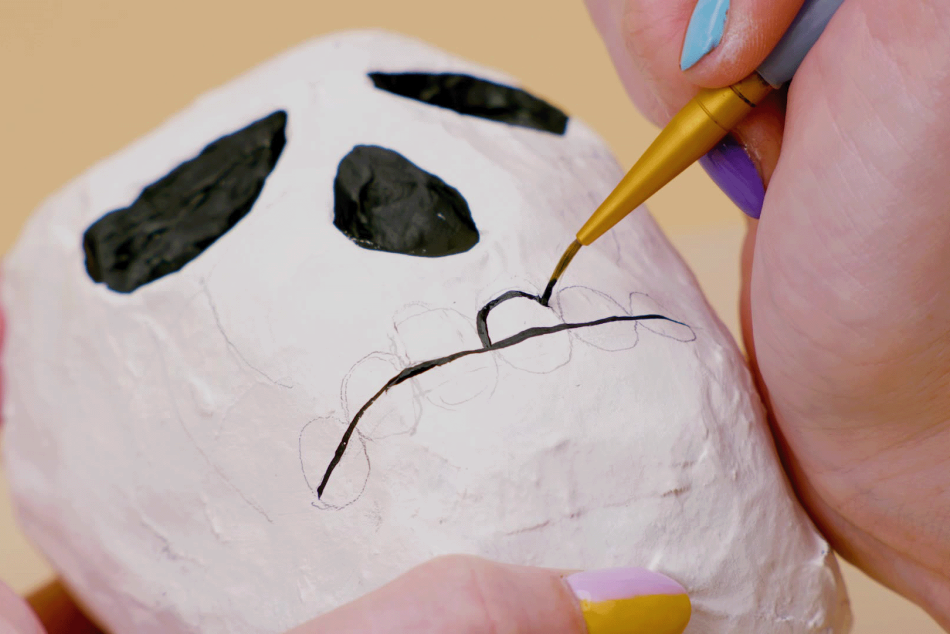
Video:  D.I.Y. Art: Skeleton Marionette Inspired by George File

Watch and learn how to make a marionette inspired by George File's 1936 watercolor Skeleton Marionette.
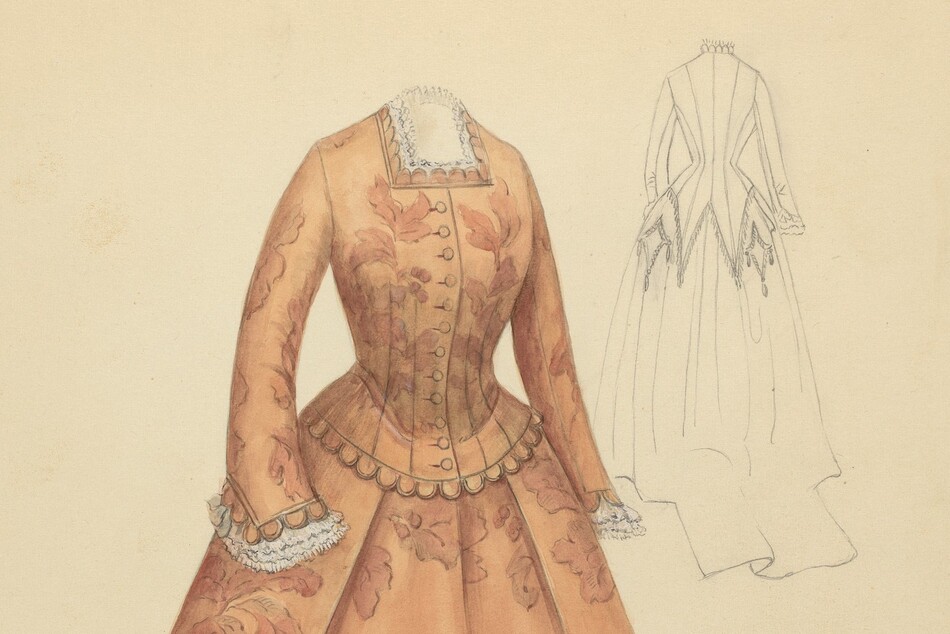
This is a drawing featuring a woman's historical dress design, likely from the 18th century. The dress includes a fitted bodice with buttons down the front, a full-length skirt, and a floral pattern with large leaves and flowers. Lace trims the cuffs and neckline. The drawing includes a faint sketch of the back of the dress, showcasing pleats and a similar style. The illustration demonstrates a detailed and precise design commonly found in fashion drawings.

Article:  Dressing for Dinner in the Gilded Age

This 19th-century dinner dress captured in the Index of American Design gives us a glimpse of how the wealthy dressed for dinner.

You may also like
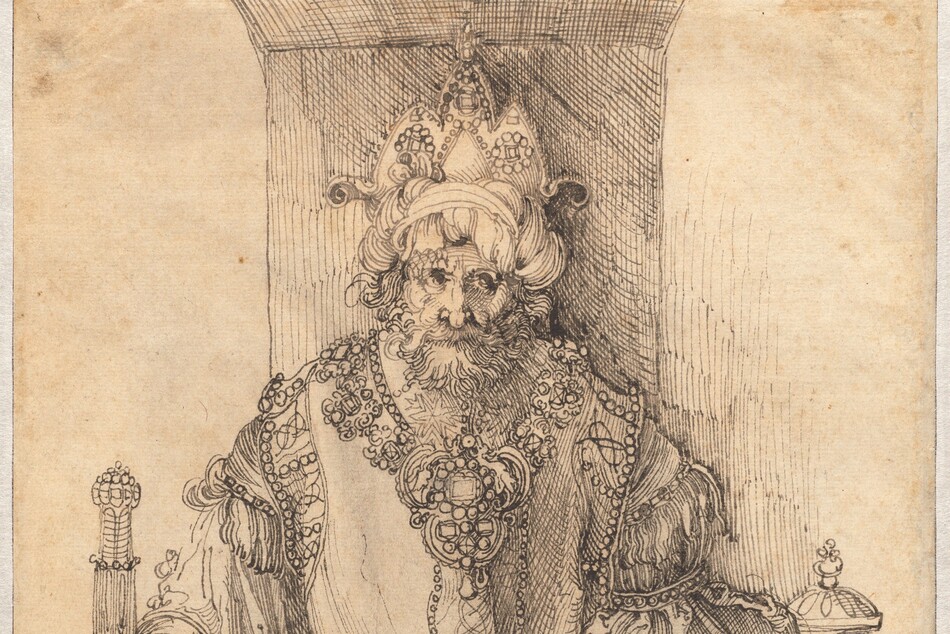
A crowned, bearded man sits facing us on a throne, and he holds a sword and orb in this vertical drawing, which was made using black ink on parchment-colored paper. A three-peaked, jeweled crown nestles in a twisted turban on the man’s head. He faces us but his eyes look to our right, and he has a long, hooked nose and flowing hair and beard. A band of ornate jewels could be a collar resting over his shoulders and on his chest, or it could be that the edge of his robe is elaborately decorated. His robe has voluminous, flowing long sleeves and his garment is decorated with bands of jewels and fringe at the shoulders, hem, and down the front. His left hand, on our right, rests on a round orb about the size of an orange, and he holds the hilt of a jewel-encrusted sword upright with his other hand so the tip of the sword rests on the ground. The artist signed the work with his initials at the bottom center: “AD.”

Drawing

Nearly every artist makes drawings at some point. Some use them as a way of thinking, jotting ideas down as quickly as they occur. Such rough sketches can offer fascinating glimpses into the artist’s imagination or their process. Meanwhile, many artists make elaborate drawings as finished works.
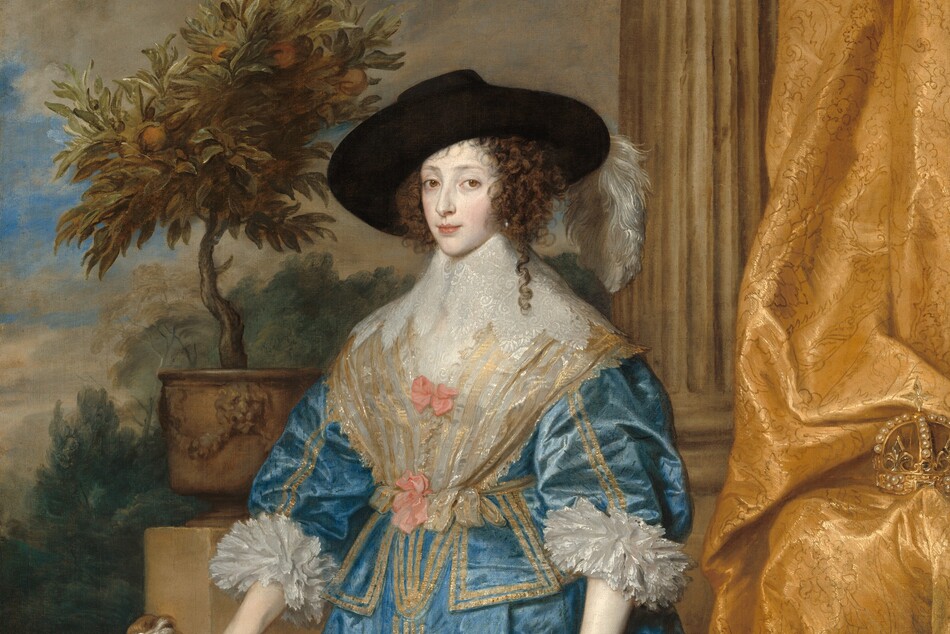
A woman with pale skin, wearing a shimmering, azure-blue gown, stands next to a child with a pale pink complexion, wearing a flame-red suit in this vertical portrait painting. The woman stands at the center of the composition with her body angled to our left, but she looks at us from the corners of her brown eyes. She has a straight nose, softly arched brows, and her full, coral-pink lips are closed. A hint of a shiny silver earring pokes through brown ringlets, and one curl falls over one shoulder. Two long, white feathers droop off the side of her wide brimmed, black hat. The bodice and full skirt of her blue dress are trimmed with bands of gold along the hems, down the sleeves, and down the front of the skirt. The blue fabric is covered with short, diagonal strokes of lighter blue. White fabric covers the front of her bodice under a tall, wide, stiff, lacy white collar that extends from her chin to her shoulders. Two rose-pink bows are tied on the white fabric on her chest. The cuffs of her elbow-length sleeves have layers of white ruffles. She touches her skirt with her left hand, to our right, and with the other touches a monkey on the boy’s shoulder. To our left, the boy’s body faces us but he looks up at the woman with dark eyes. He has rounded cheeks, and his lips are parted in a slight smile. His shoulder-length blond hair reaches to his wide, lacy collar. His red suit has long sleeves, and the coat is buttoned down the front. Ivory-white gloves reach back over his forearms, and the tops of his knee-high, fawn-brown boots are folded over. He raises his left arm, closer to the woman, to hold a monkey on a tether. The monkey stands with its feet on the boy’s forearm and its front paws on the boy’s shoulder. The woman and boy stand on a wide, curved, peanut-brown stone step. A fluted column rises to our right of the woman, and a gold, brocade curtain hangs down the right edge of the canvas, partially in front of the column. A pearl-encrusted crown is tucked into the folds of the curtain. On a ledge to our left of the woman, a miniature orange tree grows in a pot. The landscape beyond has soft green trees against a blue sky mostly screened with parchment-brown clouds.

Fashion

Artworks provide an invaluable record of fashion throughout history. We can use art to trace the evolution of style. See how meticulously artists represent details in clothing and accessories, from the sheen of silk to reflections in a pearl.