Results

Exhibition: George Bellows
Closed October 8, 2012
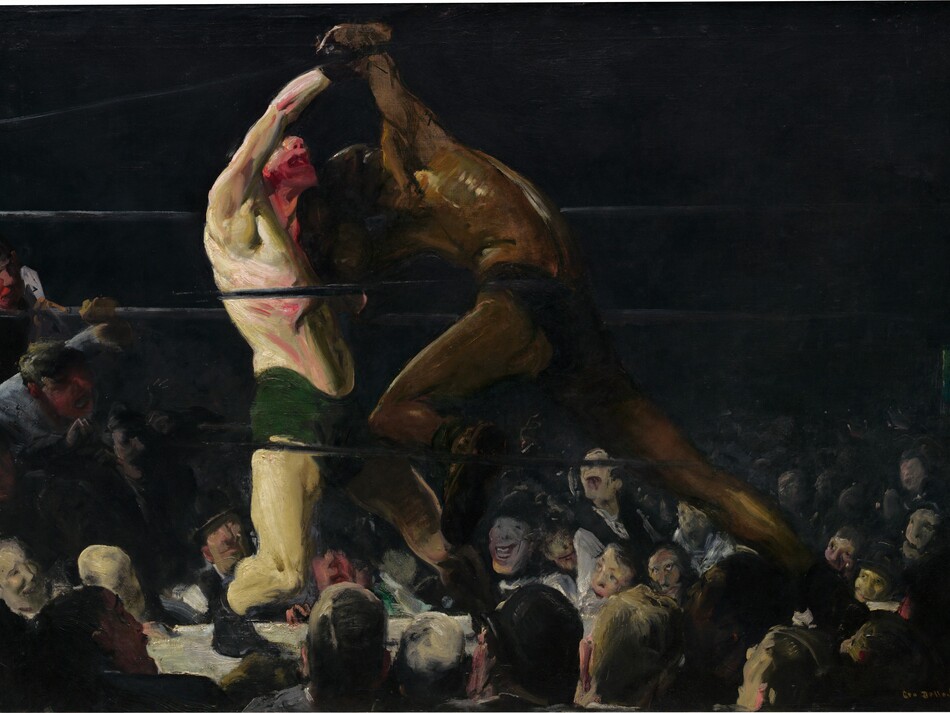
From a darkened arena around a boxing ring, we look up at two bare chested men, one with pale, white skin and the other with brown skin, who lock arms in a boxing match in this horizontal painting. The brushstrokes are loose and visible throughout, making some details difficult to make out. The boxer to our left wears drooping, forest-green trunks and black shoes. He leans back on his bent right leg, closer to us, and tilts his face up. His mouth gapes open and his nose, chin, and neck are smeared with scarlet red, suggesting blood. His pale skin has a green cast, and his chest, arms, and legs are sinewy and muscular. His right arm is raised or pulled up overhead by the boxer to our right. Wearing dark briefs, the second boxer hunches over with head lowered toward the other man’s shoulder. He surges forward onto his deeply bent left knee, closer to us, pushing powerfully off his back leg. His face is lost in shadow and his body has less detail than his opponent, though light glints off his arching back to create gold highlights against his brown skin along his spine, ribs, and muscles of the shoulder. The men’s bodies nearly span the height of the canvas. The black ropes of the boxing ring pass in front of and behind the boxers, and the space around the ring in the top half of the painting is nearly black. Heads and faces of the spectators in the first few rows are lit by the main event and are crowded into the bottom third of the painting. Two spectators on our far left have climbed up and lean on and through the ropes, their mouths open. The crowd, which appears to be all light-skinned men and boys, are painted loosely but their mouths widen in toothy grins or are agape. The artist signed the work in yellow letters against black in the lower right corner: “Geo Bellows.”
Warhol: Headlines
Closed January 2, 2012
This vertical painting imitates the front page of a newspaper, with mostly black text in different sizes against a white background. The bottom two-thirds is dominated by a black and white photograph of a woman and three lines of a single, large headline. To our left, the narrow, vertical portrait shows a smiling woman looking off to our left from the corners of her eyes. She has prominent, arching eyebrows and wears a white, possibly fuzzy hat over dark hair. The background behind her is charcoal gray. The largest text on the page fills the space next to her, to our right. It reads, “A BOY FOR MEG” in slanted letters. Under her portrait is the caption, “See Page 3” in small text. Moving to the top third of the painting: at the top left is a square portrait showing just the face of a man wearing a fedora, done in sky and royal blue. The caption under the portrait reads, “In the Magazine.” The headline that runs next to it has white text against ocean blue, and it reads, “Sinatra and his ‘Rat Pack’ TODAY: The Leader Himself (Con’t).” In the horizontal zone beneath the blue banner and above the portrait and headline about Meg, the title of the newspaper is the “New York Post.” To the left, a box reads, “WEATHER Fog tonight. in the 60s. Tomorrow: cloudy and warm, chance of showers.” In a box under the newspaper name, it reads, “NEW YORK, FRIDAY, NOVEMBER 3, 1961 10 Cents.” A secondary headline, to our right, reads, “LATEST STOCK PRICES Pages 85-88.”
Venice: Canaletto and His Rivals
Closed May 30, 2011

20 paintings by Canaletto together with 34 paintings by his contemporaries, including Gaspar Vanvitelli, Luca Carlevarijs, Michele Marieschi, Bernardo Bellotto, and Francesco Guardi, were shown in this exhibition, which explored cityscapes of Venice and the styles and rivalries of the artists. Works on view were from the collection of the National Gallery of Art, and loans from public and private collections in Europe and the United States. 2 historical cameras obscura, on loan from the Museo Correr, Venice, also were shown, together with 3 modern examples to illustrate use of the tool in creating accurate landscape images. A 35-foot-long gondola that once belonged to the American painter Thomas Moran, on loan from the Mariners' Museum, Newport News, Virginia, was shown on the East Building Mezzanine. The exhibition was part of ITALY@150, a series of activities in Washington, DC, and throughout the United States celebrating the 150th anniversary of the unification of Italy.

Dozens of men with several women and a few children gather in pairs or small groups across a sun-drenched plaza in front of a domed church next to a long, pale pink building in this horizontal painting. The people’s faces and hands we can see have pale, peachy skin. The men wear hats and shin-length capes or jackets over stockings in tones of charcoal gray, olive green, butterscotch yellow, black, and brown. The women wear black capes covering their heads and long, full skirts. The ash-brown plaza has two zones where geometric patterns are picked out in a lighter, oatmeal brown. Three coral-red flagpoles are spaced along the center of the plaza parallel to the two buildings. Each flagpole rests on an olive-green base about a third of the height of the pole. Tables under open umbrellas clustered around the outer two flagpoles display piles of cloth, and a few people gather around the wares. The domed building extends into the scene from the left edge of the painting, and reaches about a third of the way across as it angles away from us. It has a central portal with nested arches, flanked to each side by a pair of slightly smaller, arched portals. Scenes against gold backgrounds appear in the archway of each of the five doors. There is a second level of arches above. The smaller arches to either side are decorated with more scenes of people against gold backgrounds. Four gold horses stand atop the central, lower arch, each with one front and one back hoof raised. The arch behind them is dim, the back side of a stained-glass window. The stone of the arches and front of the building are light brown. The upper arches are lined with pale, slate-gray spires and curling tracery. The three-story pink building sits close by to our right, extending into the distance on the same angle as the church, and as tall as its neighbor. The lowest level is a series of open, pointed arches. The second level is also a row of arches, but more closely spaced. People walk and stand under both covered walkways. The top half of the building has a carnation-pink façade with seven windows evenly spaced across its width. The central window is surrounded by carved stone ornament. Along the right edge of the painting and closer to us than the large buildings is the corner of a two-story building. The lower level is in shadow under a sloping awning, creating a merchant’s stall, and the second level has a rounded, arched window. One person stands at the front corner of the roof and looks down into the square. In the narrow gap between the row of buildings to our left and the smaller structure to our right is a winged lion atop a tall column. Beyond that is sparkling blue water with several masted ships and long, narrow gondolas. The sky above has thin white clouds against a pale blue sky. The artist signed the lower left, “A.C.F.”
In the Tower: Nam June Paik
Closed October 2, 2011
Harry Callahan at 100
Closed March 4, 2012
The image features a person's face and partial upper body, with arms raised to cross the forehead and partially covering one side of the face. The person looks directly at the viewer with a neutral expression. The image is set against a bright white background, highlighting the facial features and arm position. The person appears unclothed or wearing a garment that blends into the background. No jewelry or objects are visible.
Gauguin: Maker of Myth
Closed June 5, 2011

108 works by French artist Paul Gauguin were shown in this exhibition, which brought together self-portraits, still lifes, and landscapes from every period of the artist's career to explore Gauguin's use of religious and mythological symbols. Oil paintings, pastels, prints, drawings, and sculptures from the collection of the National Gallery of Art and loans from public and private collections in Europe and the United States were included. The exhibition was organized by theme: Artist as Creator; Quest for Spirituality; Earthly Paradise/Paradise Lost; Re-creating the Past; Archetypal Females; and Religious Commonalities.

Two nude women with brown skin and long black hair stand with their backs to us at a riverbank in this stylized horizontal painting. The body of the woman to our left is angled to our left with her hands raised, presumably about to plunge into the teal-colored water. The woman to our right unwraps a cloth patterned with bright yellow flowers on a deep purple background from her waist. Between the women and farther away, a bare-chested man, also with brown skin, wears a tomato-red garment across his hips as he stands hip-deep in the water holding a long spear. The top of his head is cropped by the top edge of the painting. Along the left edge of the canvas, a gnarled tree is painted as a flat field of dark, charcoal gray, and it rises off the side and top of the composition. An area of the same color, perhaps a thick root or the trunk growing nearly horizontally, spans the width of the painting, separating the women from us. The area around the trunk to our left and right is painted with fields of evergreen and cool mint. Closer to us, along the front of the root, a field of rosy pink swirls with grape purple to suggest sand. This area is dotted with harvest-yellow and pumpkin-orange vines and stylized flowers. A bunch of vivid orange flowers with pine and spring-green leaves sits on the root near the trunk, to our left. Most of the painting, especially the landscape, is painted with areas of mostly flat color. In the bottom left corner, the artist has written the title of the painting in darkred paint: “Fatata te Miki.” In the lower right corner, he signed and dated the work with periwinkle blue: “P. Gauguin 92.”