Results

The Monuments Men and the National Gallery of Art
Closed January 4, 2015

This archival display of photographs, documents, and memorabilia describes the seminal role the National Gallery of Art played in the creation of the Monuments, Fine Arts, and Archives program and the Roberts Commission and explores the real-life experiences of a few of the monuments men.

Albrecht Dürer: Master Drawings, Watercolors, and Prints from the Albertina
Closed June 9, 2013

This groundbreaking exhibition presents 91—including most—of the superb Dürer watercolors and drawings from the Albertina and 27 of the museum’s best related engravings and woodcuts. It also includes 19 closely related drawings and prints from the Gallery’s own collection.

Machine Age Modernism
Closed May 29, 2018

Mammoth cranes, soaring skyscrapers, bulky industrial tanks — the “stupendous magnitude of the new American environment,” as artist Louis Lozowick declared, held a powerful allure for artists in the United States during the peak of the machine age, between World Wars I and II. The works on view here testify to that allure. They also reveal the variety of methods that artists used in evoking a machine age modernism: angling their sights up or down along towering buildings, streamlining and abstracting forms, exposing the underlying geometry of architecture and machinery, treating dark shadows as solids, and focusing on interlocking parts, such as the gears in Ralph Steiner’s Portrait of Louis Lozowick or the components in Paul Landacre’s The Press.

The image shows a composition of geometric shapes and bold lines creating depth and movement. Shapes such as circles, triangles, and rectangles interlock and overlap. There are zigzag lines on the left, a curved form resembling a fire hydrant, and a heart-shaped form with eye-like circles in the center. Vertical shapes resemble buildings, some with striped patterns and signs saying "Shop" and "Cafe."
Titian’s Danaë from the Capodimonte Museum, Naples
Closed November 6, 2014

Titian’s Italian Renaissance paintings Danaë, Venus with a Mirror, and Venus and Adonis will be on view to celebrate the commencement of Italy’s Presidency of the Council of the European Union. These paintings are examples erotic mythologies genre in Western art popularized by Titian.

The Dying Gaul: An Ancient Roman Masterpiece from the Capitoline Museum, Rome
Closed March 16, 2014

This exhibition marks the first time the Dying Gaul, created in the first or second century AD, has left Italy since 1797, when Napoleonic forces took the sculpture to Paris, where it was displayed at the Louvre until its return to Rome in 1816.

Exhibition: Hubert Robert, 1733–1808
Closed October 2, 2016

With some 50 paintings and 50 drawings, this monographic exhibition, is the first in more than 80 years to encompass Robert’s entire career and to survey his achievements as both a painter and a draftsman.

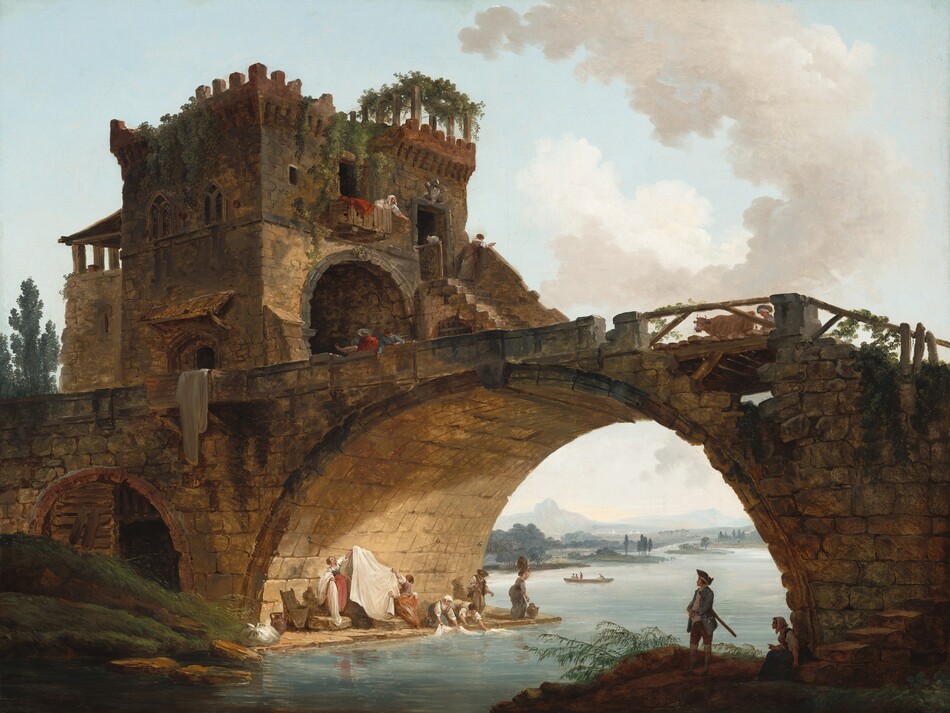
A rustic, arched, stone bridge spanning a shallow river nearly fills this horizontal landscape. From low to the ground, we look up into and through a large arch, which occupies the lower half of the picture and frames a view that opens to a wide expanse of calm, pale blue water, wooded green riverbanks, and a misty, distant view of a village and a mountain. The horizon line comes a quarter of the way up the painting, and a smoke-colored cloud formation curves like a backward C against the ice-blue sky above. The bridge structure is made from stacked, sandstone-colored stone blocks to form heavy piers. Vegetation grows on the crumbing bridge and gaps indicate other stones are missing. The bridge’s deck runs across the center of the painting, rising slightly from left to right. Atop it, occupying the top left quadrant of the painting, sits a square stone two-story tower that encloses an arched passage over the bridge’s roadway. Groups of people, small in scale, are positioned on and around the bridge. At the river level, on a platform around a bridge footing, four women do laundry. Two pull sheets from the water and two bend on their knees to wash the linens in the river. They wear long skirts of slate blue, cranberry red, and ochre yellow with pinafores and white blouses rolled up to the elbows, with their hair pinned up. A bearded man in brown trousers, white shirt, and brown hat appears to talk to them. Another woman standing nearby in a dark, slate-gray dress balances a large, dark brown ceramic ewer on her head and reaches to pick up another resting at her feet. Warm yellow light illuminates this scene and the underside of the bridge, and reflects on the river. On the bridge deck above, a brown steer is herded across the bridge by a person wearing a wide brown hat, while three people in red, slate-blue, and white clothing are about to pass through the tower passage on the left. Immediately above them, a woman in a white blouse and head scarf appears at a small balcony with what looks like a red dress draped over it and gestures with an extended arm toward a white cat crouched on a railing below. Another woman to our right, in a brown dress, white blouse, and brown hair, stands at the top of a flight of steps leading up the far side of the tower with her back toward us, and she gazes out at the view. On the water below, a small boat with several people is rowed across the river in the middle distance. In a shadowed area at the foot of the bridge, closer to us, a man stands wearing a pointed hat, blue jacket with buttons, and high boots with a sword tucked under his arm. Behind him, a woman in a dark green dress and kerchief sits on a stone step. Both look toward the scene under the bridge with the washerwomen.
Los Angeles to New York: Dwan Gallery, 1959–1971
Closed January 29, 2017

This exhibition will trace Virginia Dwan's activities and the emergence of an avant-garde gallery in an age of mobility, when air travel and the interstate highway system linked the two coasts and transformed the making of art and the sites of its exhibition.