Results

Let the World In
Closed March 30, 2008
The Age of Watteau, Chardin, and Fragonard
Closed January 11, 2004

Scenes of daily life by Antoine Watteau, Jean Siméon Chardin, Jean-Honoré Fragonard, Jean-Baptiste Greuze, François Boucher, Louis-Léopold Boilly, and other 18th-century French artists were presented in this exhibition of 106 paintings and one drawing.

Fourteen men, women, and children focus their attention on a man fanning out a deck of cards in a town street in the right half of this horizontal painting. More men and women stand in small groups or walk in the left half. The women wear bonnets and long dresses and cloaks. The men wear jackets, slacks, and hats. The people all have pale or peachy skin. The man holding out the cards wears a plumed, bicorn hat, a thick white scarf around his neck, and a long, dark coat. His long gray hair is looped into a knot on his upper back, and a thick white sideburn curls along the cheek we see. He has a prominent nose, thin mustache, and his lips are parted as he faces our left in profile. Glints of gold on his hat and back of his coat could be bells, and he wears a gold hoop earring. A young woman with smooth skin, a low-cut, very pale green dress and matching bonnet reaches out to take a card. Another wearing a mob cap and cloak stands at her far shoulder, and two children stand between her and the cardsharp. A pair of young boys stand with the cardsharp, facing away from us and looking down at the cards. More men and women in earth-toned clothes, some tattered, gather in a tight cluster around a wooden table beyond this grouping. On the table is a metal cup and some glass balls, perhaps marbles. A small, furry, brown dog sits and looks up and to the right with dark eyes in the bottom right corner of the painting. This group is backed by a high wall, presumably enclosing a private garden. Trees reach into the cloud-streaked blue sky beyond the wall. Two more dogs walk among the townspeople who move along the street to the left. Building facades on the far side of the walkway are in shadow, but one is labeled Patissier. The artist signed and dated the painting near the lower left corner, “L. Boilly 1806.”
Art Nouveau, 1890-1914
Closed January 28, 2001

This comprehensive exhibition of the international art nouveau style included some 380 paintings, works of sculpture, graphics, ceramics, glass, textiles, furniture, jewelry, and architectural structures and designs.

A baby nestles in a mass of frilly white fabric atop a colorful patchwork, perhaps a pile of quilts, against a sage and spring-green background in this square painting. The baby’s face and right hand peeks out from the mountain of fabric at the top center of the composition. The infant has ash-white skin with pink cheeks and lips, and looks down toward us with large dark eyes. The pile of fabric creates a mosaic-like mix of pattern and color with vibrant royal and baby blue, sage green, turquoise, butter yellow, and shell and salmon pink. Some patterns are outlined in black while brushstrokes swirl together in other areas. The background is mottled with cool mint and asparagus-green strokes against pale beige.
Hudson River School Visions: The Landscapes of Sanford R. Gifford
Closed September 26, 2004

70 landscape paintings were displayed in this survey of the work of American painter Sanford R. Gifford. Inspired by the natural world, Gifford explored the effects of light and atmosphere in his depictions of the Hudson River valley, the Catskill Mountains, and various sites abroad.

A dirt path winds through a field of gold-green grass back to a town built on low hills in this horizontal, densely hazy landscape painting. Several minuscule people walk on the path and at least one person rides a horse. More people are gathered by a domed, white structure in the distance, where the winding path meets a straighter road leading up into the town near the left edge of the canvas. At least six people sit or stand near a conical white tepee to the right, in the lower quadrant. Two horses and about two dozen smaller animals graze nearby. In the town, the cluster of low, flat-topped buildings, the one domed building with two slender minarets, and palm trees are painted in tones of muted mauve pink and peach. The sun is painted as a hot blaze of light low in the washed-out sky over rocky mountains, which stretch across the left half of the composition. The artist signed and dated the painting with angular red letters in the lower right corner, “S.R. Gifford 1874.”
The Art of the American Snapshot, 1888-1978: From the Collection of Robert E. Jackson
Closed December 31, 2007

249 images by unknown photographers were shown in this survey of snapshots from the time the Kodak camera and roll film were introduced in 1888 through the 1970s. Works in the exhibition were selected from the collection of Robert E. Jackson and from his recent gifts to the National Gallery of Art.

The image is a collage of twelve circular photographs, each featuring different scenes from a picnic in 1889. In the top row, the first photograph displays an outdoor setting with a horse-drawn carriage and a group of people. The second and third photographs show individuals framed within a porch area; one is sitting upright while the other is lounging on a chair. Moving to the middle row, group scenes feature women and men in outdoor, grassy areas, with women wearing long white dresses and wide-brimmed hats, typical of late 19th-century fashion. The men are sporting hats and dark suits. The backgrounds depict open fields with clear skies. The bottom row includes people engaging in outdoor activities, such as riding a bicycle and climbing over a wooden fence. The countryside provides a serene backdrop for these activities.
American Impressionism and Realism: The Margaret and Raymond Horowitz Collection
Closed May 9, 1999

49 American impressionist and realist paintings and works on paper from the Margaret and Raymond Horowitz collection were presented, including works by William Merritt Chase, Childe Hassam, George Bellows, Maurice Prendergast, William Glackens, and Theodore Robinson.

This painting depicts a white house in a lush green setting. The house has dark windows and a red chimney, partially obscured by trees that cast dappled shadows on the house's facade. The front door appears to be open. A light brown path runs parallel to the house at the bottom of the image, and small gray steps lead up the grass towards the house. The color palette includes vibrant greens for the foliage and a light blue for the sky behind the house. The brushstrokes are loose and impressionistic, creating a soft and textured appearance in the trees, grass, and building.
Thomas Moran
Closed January 11, 1998

This first retrospective of Moran's works included 97 paintings and watercolors and 17 photographs. Some of the watercolors were lent by the National Park Service as part of the 125th anniversary celebration of the creation of Yellowstone National Park.

Sheer, vertical, cliffs, brightly lit in cream white and rust orange by the low sun, tower over a band of people riding horses into the distance in this long, horizontal landscape painting. The glowing cliffs dominate the upper right quadrant of the painting. They lighten from burnt orange along the jagged tops to flame orange down the steep sides, and are and warm, parchment white near the earth. One tall, narrow promontory to our right looms over a range of lower, rounded cliffs. As the cliffs move into the distance, they are shrouded with a lavender-purple haze. The land closest to us dips into a shallow valley at the bottom center of the composition, leading away from us. The dirt-packed earth is dotted with pine-green, scrubby bushes and vegetation and a grove of low, gnarled trees a short distance to our right. One chestnut-brown horse walks along the path at the bottom center of the composition, lagging behind a cluster of at least two dozen horses and riders winding into the distance. The horses range from ivory white to tawny brown and charcoal gray. The riders are loosely painted so some details are indistinct, but they all seem to have brown skin and dark hair. They wear feathered headdresses and garments in teal blue, fawn brown, or golden yellow. They ride over a low hill toward a crystal-blue river, and then back along a flat expanse toward a row of minuscule, triangular tepees lining the horizon in the deep distance. The horizon comes halfway up the composition, and the tepees are backed by a row of rose-pink, flat-topped cliffs. A pale yellow disk hangs low in the sky, over the distant cliffs. The sky above deepens from soft, lilac purple along the horizon to ice and sapphire blue along the top. A few wispy clouds are burnished orange in the sunlight. The artist signed and dated the painting in the lower right corner, “TYMoran 1881,” with the T, Y, and M overlapping to make a monogram.
Gabriel Metsu, 1629–1667
Closed July 24, 2011
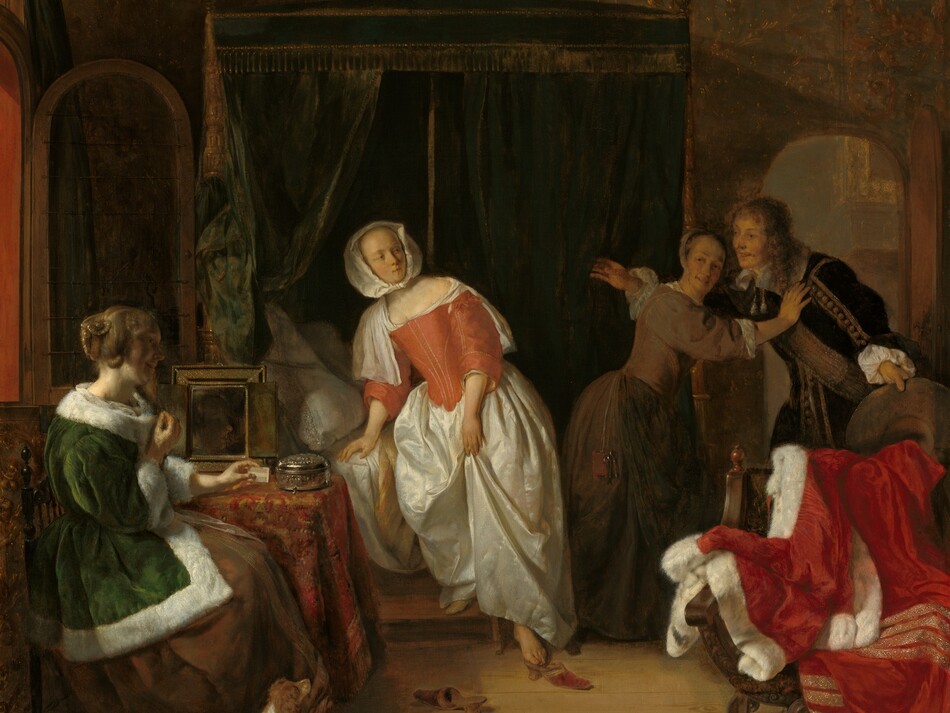
A young, smiling man bursts through the door of a dimly lit bedroom occupied by three women in this vertical painting. All four people have pale skin. The arched door is to our right and the man faces our left with his arms spread wide. He leans slightly forward as he holds the wide brim of his hat out by his left side, to our right. Shoulder-length chestnut-brown hair frames his face, and he wears a velvety brown jacket trimmed with tan stripes and pompoms down the front and along the sleeve we can see. A broad sash crosses his chest and tassels hang from his wide, white collar. Between us and him, a wooden chair is draped with a crimson-red cloak trimmed with white fur and bands of gold. A pewter pitcher and candlestick rest on the pine floor in front of it, near the lower right corner of the painting. The man is stopped at the door by a woman wearing a sable-brown gown with a tight-fitting bodice and a white cap on the back of her head. Her body faces the man as she leans toward him with her outstretched right hand resting on his shoulder, and she turns her smiling face back over her shoulder. Light from an open window on the left illuminates the woman in the center, who steps down from a bed enclosed by forest-green, velvet curtains trimmed with gold fringe and tassels. The curtains are parted behind her to reveal white pillows. She wears a long, gleaming white satin skirt topped by a tight-fitting coral-red bodice stitched with thin lines of gold. A white neckerchief covers her shoulders and is partially tucked into the bodice. Her head is covered by a white kerchief knotted under her chin. Her body faces us with one foot on a step stool, and the other foot reaches down to a gold and red shoe on the floor. Its mate lies nearby, pointing away from us. Her head is turned to our right to look at the man. She has a thin face with a high forehead, and small mouth is closed or pursed. Closest to us and near the lower left corner of the painting, the third woman sits alongside a small table under the open window. She wears a long, pine-green jacket trimmed with white fur over a brown skirt. Her auburn hair is partially coiled around her head, while some locks fall in bunched curls. She sits facing our right in profile with her back to the window, so her smiling face is mostly in shadow. Her left arm rests on the table, which is draped with a red and copper patterned cloth, and she holds a white comb in that hand. A mirror and round silver box sit on the table next to her. A small brown and white dog stands by her feet, its head tilted up to look at the others. The far wall of the room is covered with a faint pattern of golden brown vines and leaves against a forest-green background. The artist signed the painting on the face of the step leading up to the bed, “G. Metsu.”
Looking In
Closed April 26, 2009