Results

The Golden Age of Chinese Archaeology
Closed January 2, 2000

The exhibition featured 206 objects created between 5000 B.C. and 960 A.D., representing 5 dynasties of Chinese rule. The objects included sculpture, ritual implements, musical instruments, paintings, calligraphy, and other decorative objects in ceramic, jade, stone, wood, bamboo, lacquer, gold, silver, and bronze

Spaces: Works from the Collection, 1966–1976
Closed February 18, 2019

This installation features five significant minimal and post-minimal sculptures inspired by presentations of single-room artworks at the Dwan Gallery and the exhibition Spaces at the Museum of Modern Art.

Long prisms hang in rows within a nickel-gray room in this installation. The prisms come toward us in this view. A row of long prisms hang closely together to our right, and shorter prisms are hung in groups farther away from us. They cast long silvery-gray and black shadows on the ground, and hints of rainbows stripe the walls.
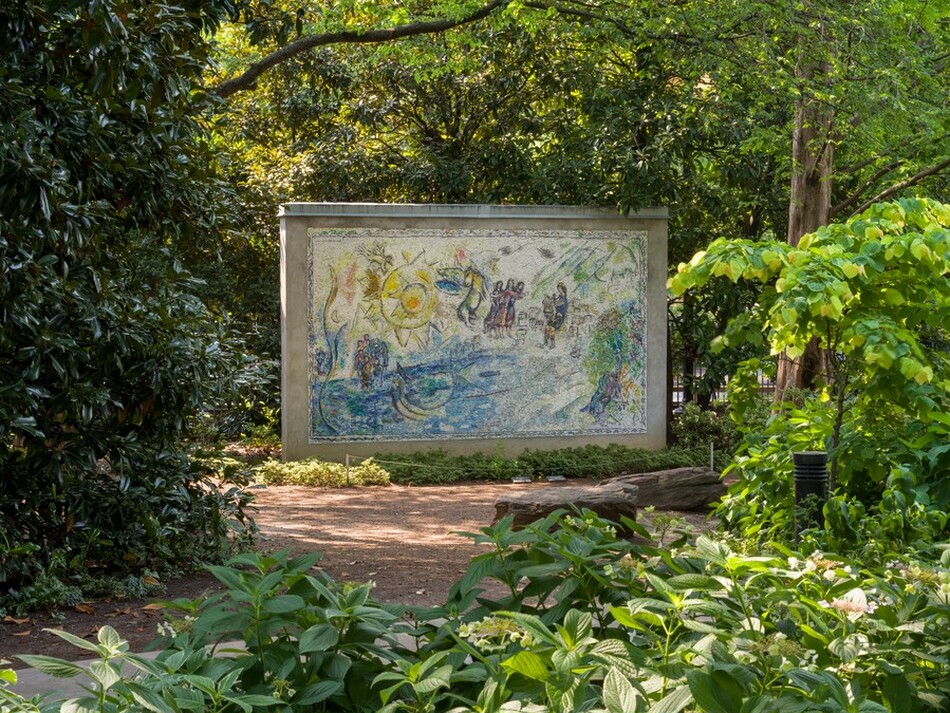
Marc Chagall
Orphée

Hidden in a corner of our Sculpture Garden stands a large-scale mosaic which combines narratives from Greek mythology with the artist's personal experience escaping Nazi-occupied France.

Sculpture Garden, Northwest Corner
The Age of Sultan Suleyman the Magnificent
Closed January 17, 1988

Decorative arts from the Ottoman empire during the reign of Sultan Suleyman I (1520–1566) were shown including 68 illustrated books and manuscripts; 55 kaftans, embroideries, and rugs; 51 ceramics and tiles; and 40 imperial items of gold, silver, and rock crystal embellished with gems. More than 130 objects came from the Topkapi Palace Museum and other national museums in Istanbul. Others were lent by European, Middle Eastern, and American museums and collections.

The Sculpture of Indonesia
Closed November 4, 1990
The Art of Power
Closed November 29, 2009
A stepped, ornately decorated structure made up of forty-four individual woodcuts and etchings printed with black ink on ivory-white paper fills this vertical composition. The structure has a tall central tower flanked by two shorter towers on each side. All three have an arched opening at the bottom. The outer towers are then flanked by three columns. Almost every inch of the structure is densely covered with architectural ornaments, coats of arms, Gothic text, and panels showing scenes with people in interiors or huge crowds in landscapes. Some scenes show soldiers engaged in battle, groups of kings and clergy, or individual men. Architectural ornament includes mythical creatures, gargoyles, saints, kings, and cherubs. The arched openings are tall and narrow, and have checkered floors. Words in elaborate Latin script appear inside the top of each of the three arches. Two ringed-tailed creatures resembling monkeys prowl outside the central arch. Two shallow steps lead down from the structure to five panels that line the base of the composition. Those five panels are filled with Gothic text. The date, "1515," appears at the base of the outermost column to each side.