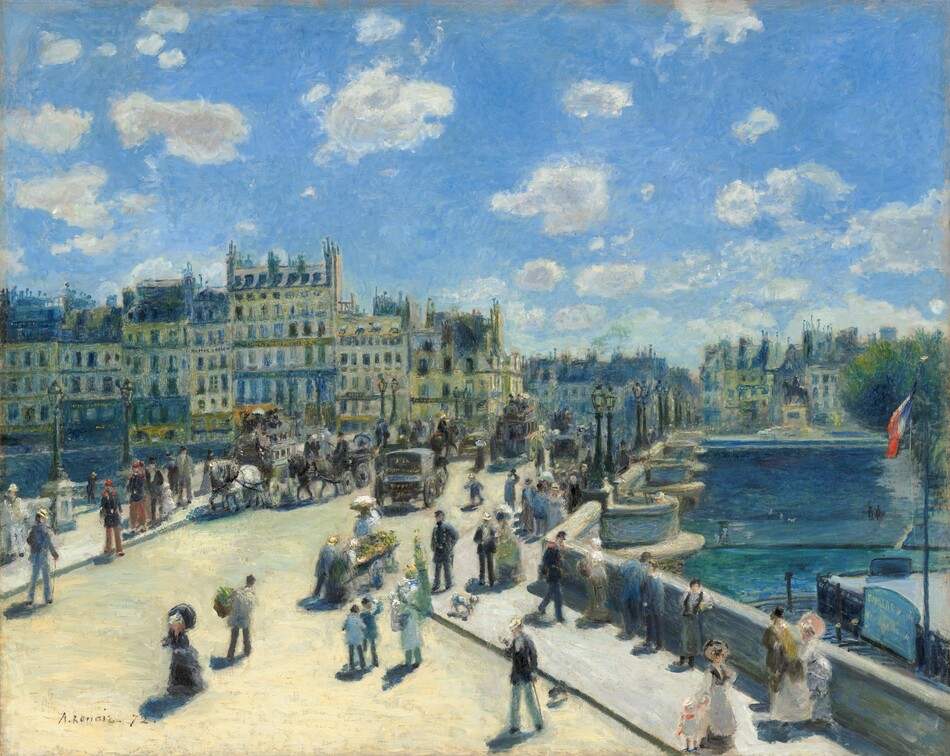
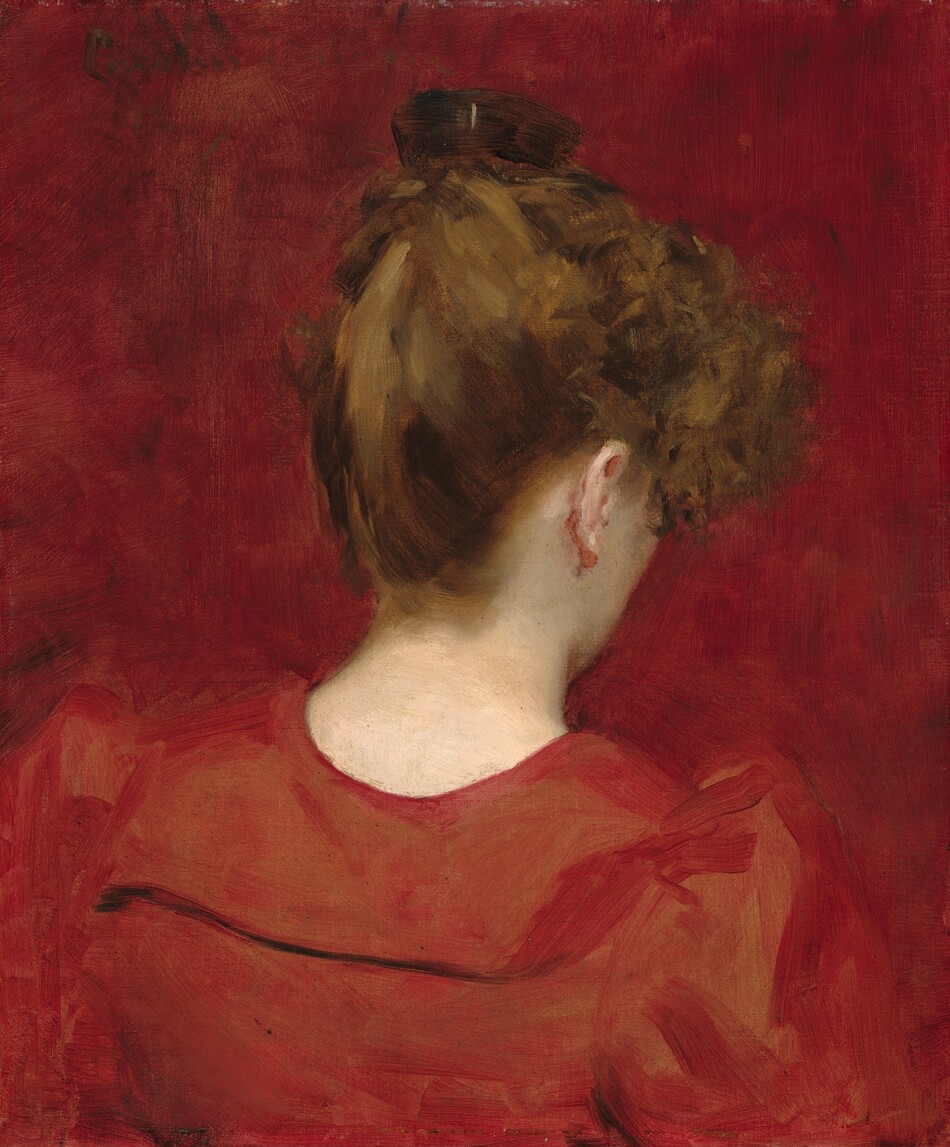
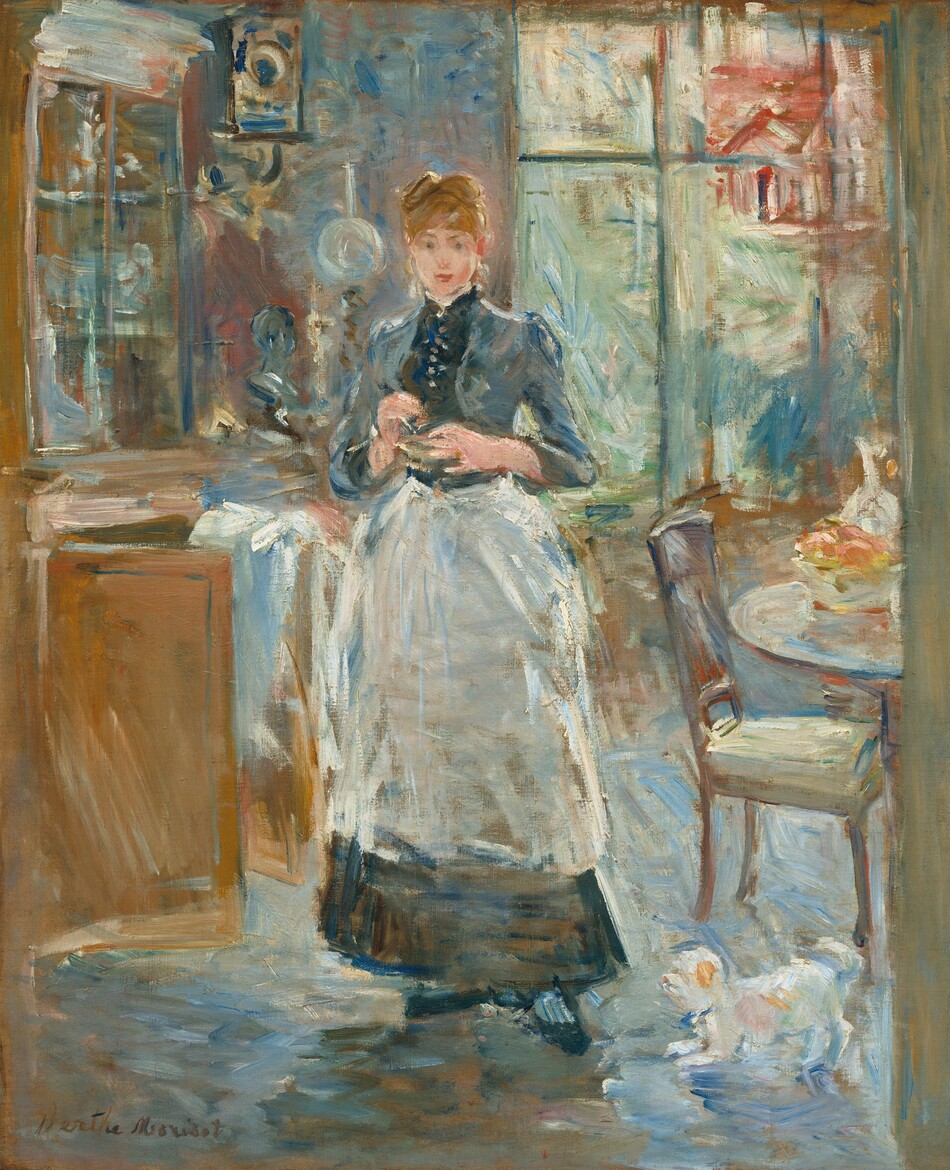
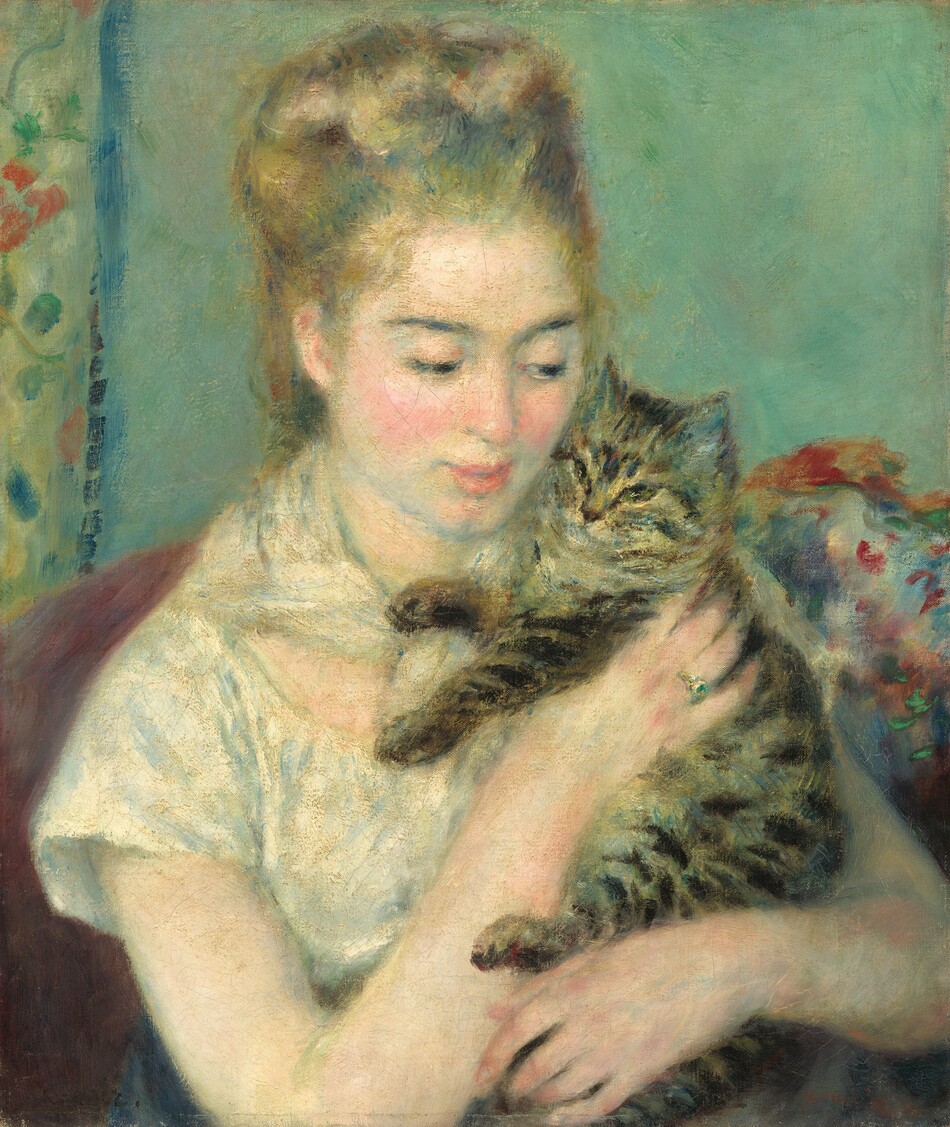
Open Call Artwork Inspiration

We’ve put together a list of 100 artworks for you to choose from. Find the one that inspires you most and use it as the spark for your proposal. This will be the piece you reinterpret in your 15- to 30-second video.

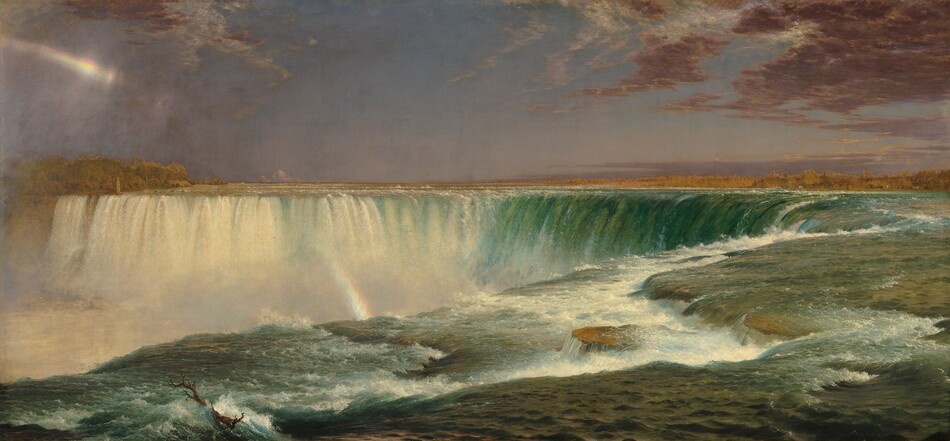
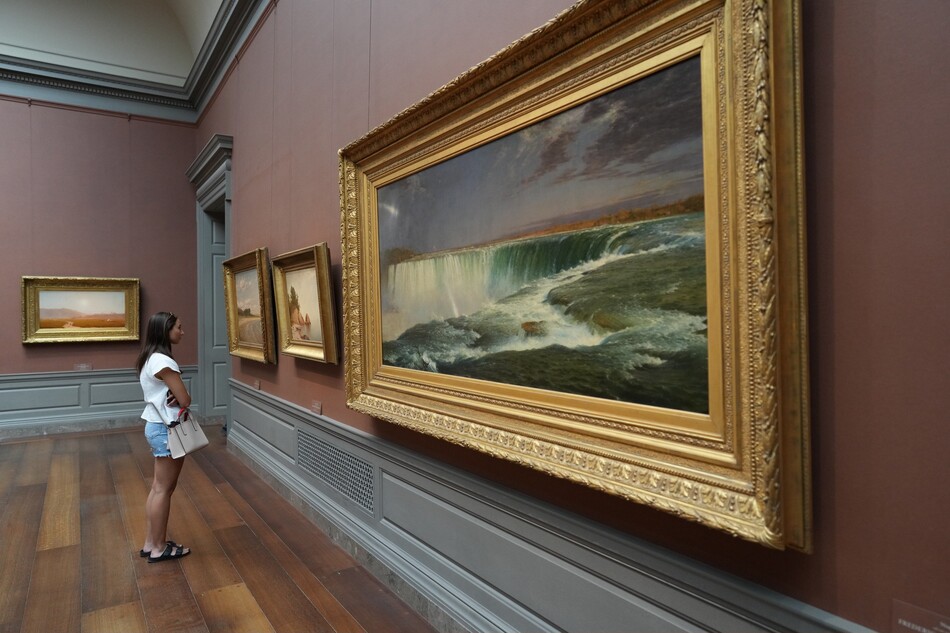
  • We hover over the bottle-green surface of a river as it rushes toward a horseshoe-shaped waterfall that curves away from us in this horizontal landscape painting. The water is white and frothy right in front of us, where the shelf of the riverbed changes levels near the edge of the falls. Across from us, the water is also white where it falls over the edge. A thin, broken rainbow glints in the mist near the upper left corner of the painting and continues its arc farther down, between the falls. The horizon line is just over halfway up the composition. Plum-purple clouds sweep into the composition at the upper corners against a lavender-colored sky. Tiny trees and a few buildings line the shoreline to the left and right in the deep distance.
  • This painting is a full-length portrait of a man. He stands facing forward, with his hands on his hips. He has light brown skin with warm orange undertones and a short black mustache and beard, and his mouth is closed in a neutral expression. He has round glasses and a light blue hat or beanie over his head. He is wearing a denim jacket over a brown turtleneck shirt and denim pants with a wide black belt. The cuff of the jacket is visible on his left wrist. Over the denim, he wears a long black cape with a high collar that covers most of his arms. His feet are bare, and the one on the left is flexed upward while the one on the right is pointed down. The background is plain gray.
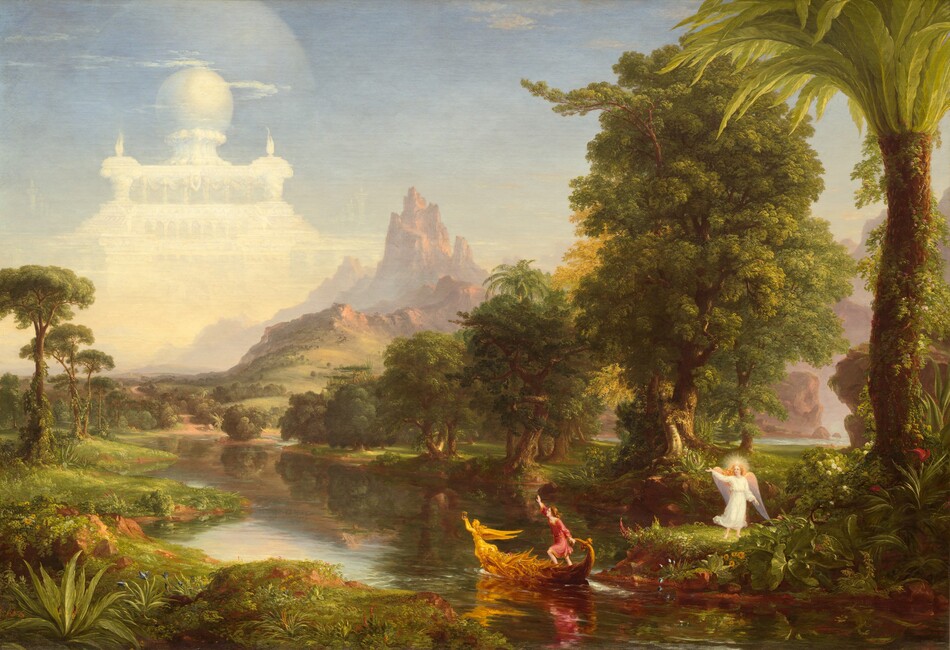
  • A young man sets out in a golden boat on a river that winds from the bottom right corner of this horizontal painting across a lush landscape and into the distance before disappearing beyond two rocky outcroppings far off to our right. Hazy in the distance, the jagged peaks of a barren red mountain rise into an almost cloudless blue sky. To our left, a semi-transparent, white palace looms above and beyond the mountain, filling most of the upper left quadrant of the composition. Hills and valleys leading from the mountain and palace are dotted with trees and carpeted with grass. A winged and haloed angel wearing a white robe stands on the bank of the river under a towering palm tree in the foreground, in the bottom right corner of the canvas. The angel has pale skin and long golden hair. One hand is lifted toward the palace or a young man in a boat in the river nearby. The small boat is angled away from the riverbank to our left and toward the palace. The boat is ornately decorated and at its bow, a winged, golden figure holds an hourglass aloft above her head. The young man has pale skin, shoulder-length brown hair, and he wears a red and gold tunic. A profusion of flowers and trees line the riverbank.
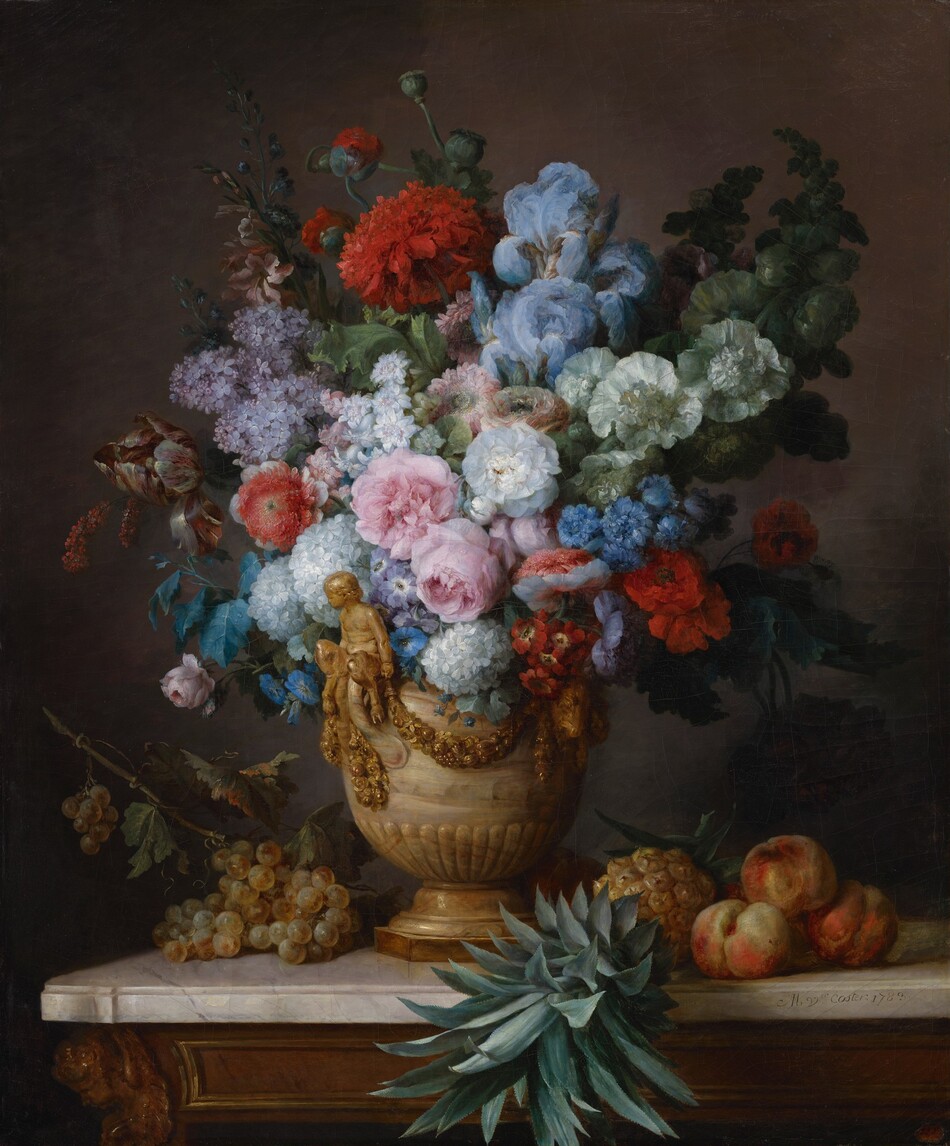
  • This painting features a large ornate vase overflowing with an arrangement of colorful flowers, including roses, peonies, and poppies. The color palette is vibrant and varied, with hues of red, pink, blue, purple, white, and green. Positioned in the center, the vase is adorned with gold embellishments, including a small carving of a person on its front. The vase stands on a marble surface that also holds a pineapple and peaches to the right. Several leaves and clusters of green grapes rest on the left side of the marble. The light source is at the upper left, illuminating the flowers and casting dark shadows behind them. The background of the painting is dark gray.
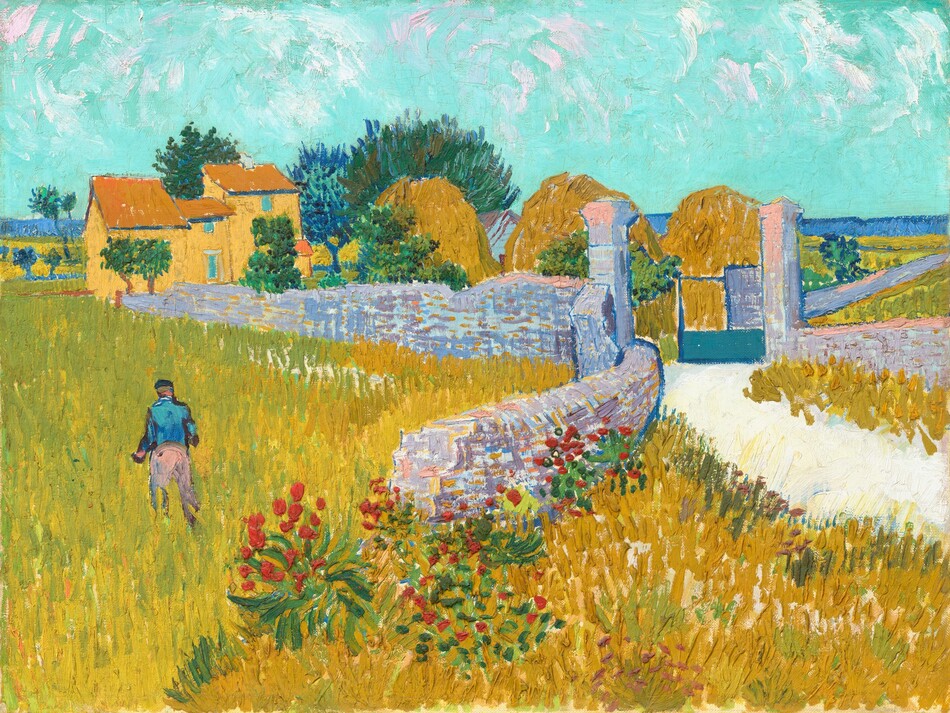
  • A white path and gray stone wall wind through ochre and harvest-yellow fields beneath a brilliant, turquoise sky in this stylized, horizontal landscape painting. The scene is created with long, visible brushstrokes of vivid color. Closest to us, the field is painted with vertical strokes of golden yellow and pea green. Touches of cardinal red and slashes of pine green create flowers around the end of the stone wall, which curves toward us from the background, at the center of this painting. The wall is painted with horizontal dashes of lilac and lavender purple, salmon pink, and periwinkle blue. A person wearing peach-colored trousers, a peacock-blue shirt, and a dark hat walks away from us, into the field, to our left of the wall. The white road enters the scene from the right, and meets the stone wall and a second wall on the far side of the road at a gate. Two columns rise from the walls to mark the spot of the gate, which opens into a property with three tall haystacks and a house. To our left, the house is painted with areas of warm yellow for the walls, honey brown for the roof, which is outlined in navy blue, and turquoise for the doors and windows. A few green trees, made of dots of bottle and forest green, are scattered near the house and haystacks. One sapphire-blue tree grows near the house. A band of azure blue along the horizon, which comes about two-thirds of the way up the painting, suggests a mountain range in the distance. Swirls of white suggest clouds in the turquoise sky. The paint is visibly textured throughout.
  • In this vertical painting, a woman stands near the corner of a dimly lit room, facing our left in profile and looking down at a balance she holds suspended in her right hand over a wooden table. She wears a peacock-blue velvet jacket with a white hood and fur lining, and a voluminous, mustard-yellow skirt. A window near the upper left corner is partially covered by a canary-yellow curtain. Light coming in through that window falls on the pale skin of the woman's face and hands, and highlights the white trim of her garment. Her left hand, closer to us, rests on the edge of the table near two open boxes, and a blue cloth is bunched at the back of the table to our left. Gold chains and pearl strands drape over the edge of one box. The woman stands in front of a framed painting. Much of the detail is lost in shadow but at the top center of the painting, a person surrounded by a golden halo floats in the sky with both arms raised, and is flanked by people encased within a bank of clouds. Nude people on the ground below in the painting, seen to either side of the woman, writhe, twist, and point upward.
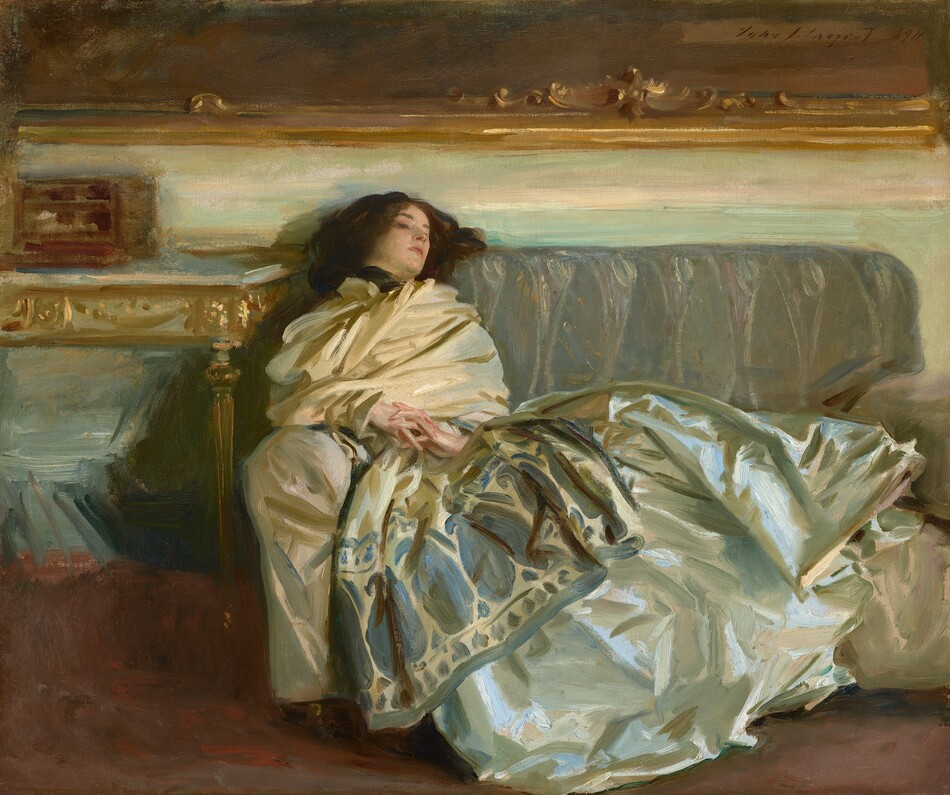
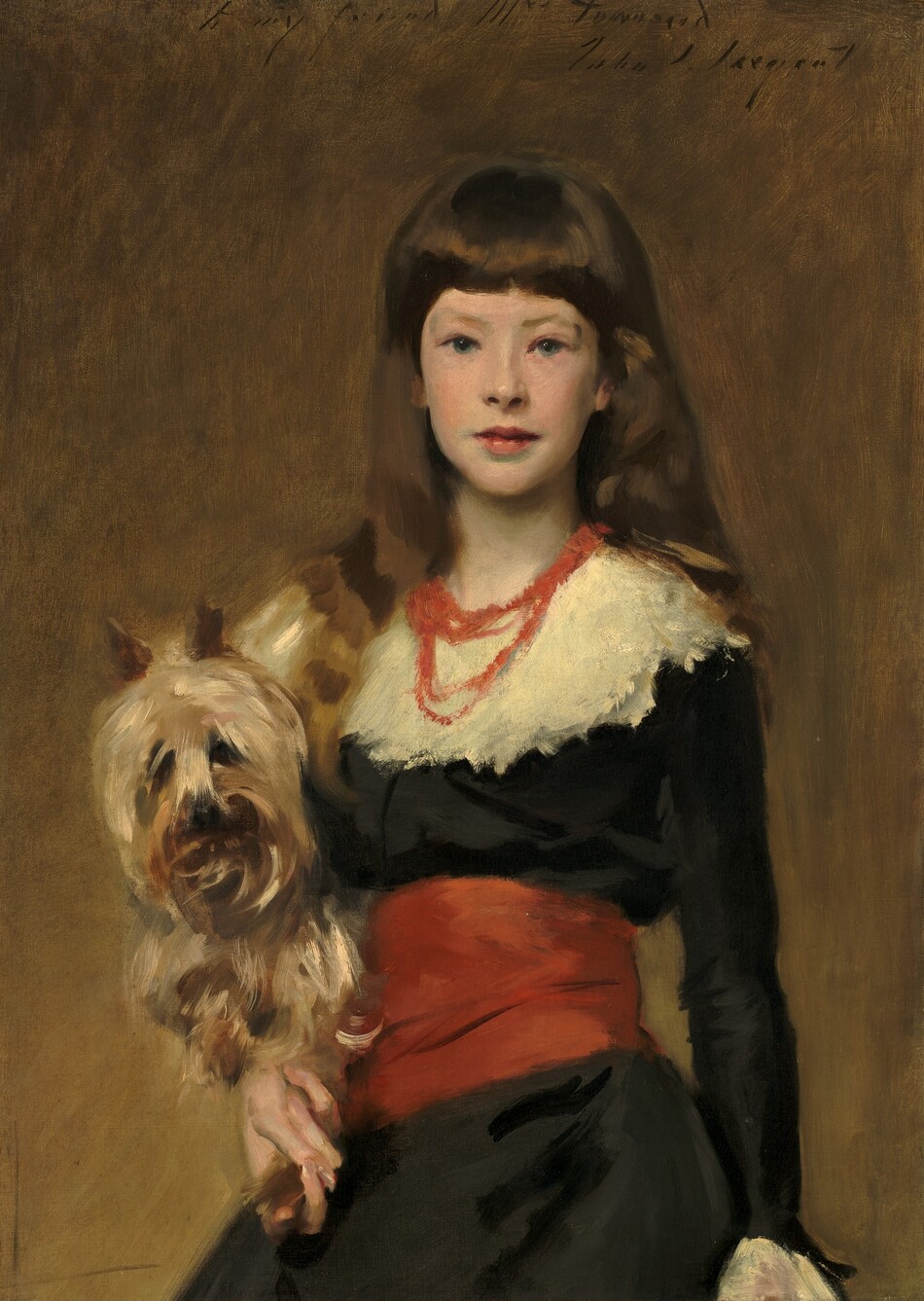
  • A woman with pale skin and dark brown hair is swathed in silky fabric as she reclines along a gray couch in this horizontal painting. Her head rests along the backrest of the sofa to our left, so her body extends to our right. Her torso is wrapped in a voluminous, ivory-white scarf or wrap. The scarf wraps tightly around her neck, and the bottom edge, near her knees, has a wide, indigo-blue pattern of ovals and vegetal forms. Her shimmering silver gray skirt is painted loosely with baby and sky blue, olive and sage green, and white strokes, and it drapes over the cushions and down the front of the couch. Her hands are clasped so her interwoven fingers rest at her navel. She looks down and off to our right. A table to our left is edged with gold. The wall behind her, above the couch, is painted with long streaks of eggshell white and pale turquoise. The gold frame of a dark painting hanging over the couch spans the width of the composition. Near the upper right corner of the canvas, the artist included a signature and as if he had signed the painting within this painting with loose, dark letters: “John S. Sargent 1911.”
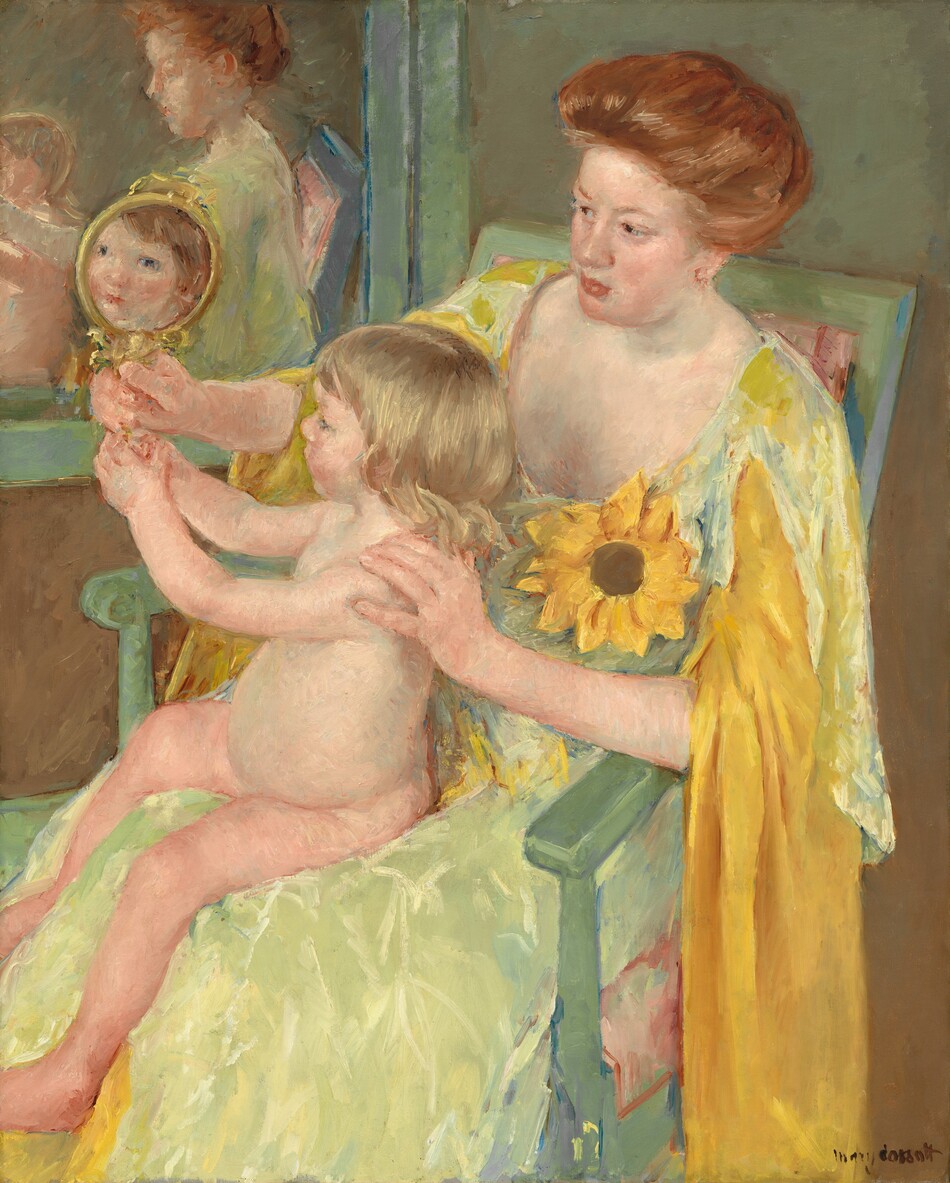
  • We look slightly down onto a woman dressed in golden yellows, sitting in a pale green chair, with a nude child sitting in her lap as they both gaze into a mirror in this vertical portrait painting. Both the people have pale, peachy skin. The chair is angled to our left so the woman’s knees and child cant down toward the lower left corner of the composition, and the woman leans onto the arm closer to us. The chair is painted mint green and the rose-pink upholstery is visible on the seat and a corner behind the woman’s shoulder. To our right, the woman’s vibrant, copper-colored hair is pulled loosely to the back of her head. She has a rounded nose, flushed cheeks, and her full, coral-pink lips are closed. Her long dress has a low, U-shaped neckline. The fabric shimmers from pale, cucumber green to light sunshine yellow. The sleeves of the dress split over the shoulder and a second long, goldenrod-yellow sleeve falls from her elbow off the bottom edge of the canvas. An oversized sunflower, larger than the woman’s face, is affixed to her dress near her left shoulder, closer to us. She looks with dark eyes down toward the small, gold-rimmed mirror she holds in her right hand, farther from us. The child also holds the handle of the mirror with both hands, and in the reflection, the child looks back at us with dark eyes, a button nose, and pink lips. The child’s hair in the reflection is the same copper color as the woman’s, but the child on her lap has blond, shoulder-length hair. The woman rests one hand on the child’s left shoulder, closer to us. The child has a rounded belly and smooth, rosy limbs. The woman and child are reflected in a second mirror hanging on the wall alongside them, opposite us. Their reflections are very loosely painted. The wall behind the pair is sage green across the top and it shifts to fawn brown across the bottom. Brushstrokes are visible throughout, especially in the woman’s dress and hair, and are more blended in the bodies and faces. The artist signed the painting in the lower right corner, “Mary Cassatt.”
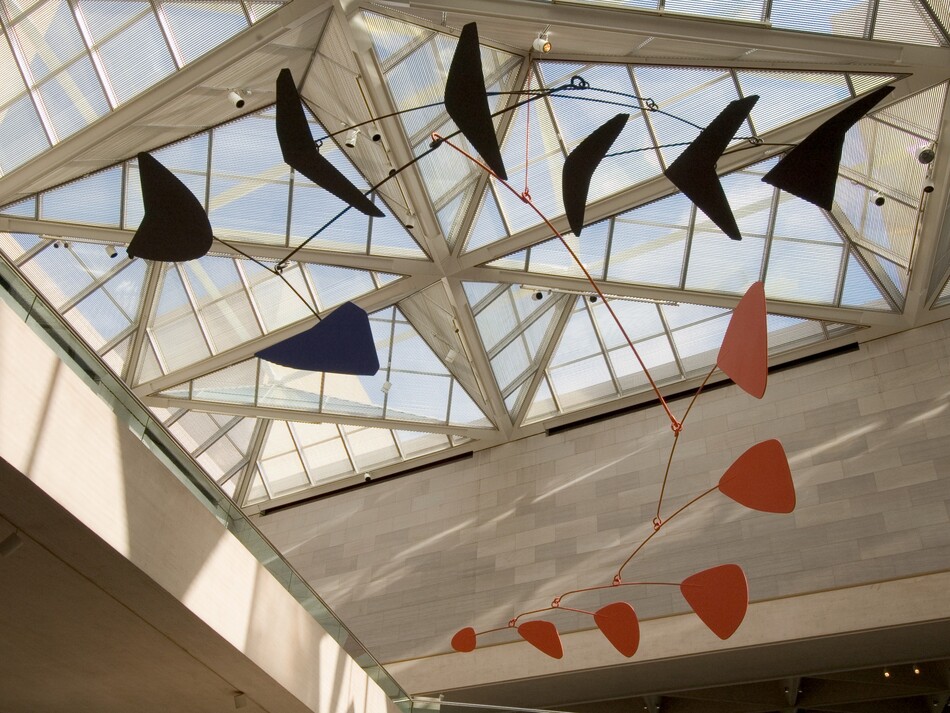
  • Six black, wedgelike shapes, one dark blue arrowhead shape, and six red triangular shapes with rounded corners are connected with thin rods to form this abstract sculpture. In this photograph, we look up at the piece to where it hangs from the glass ceiling of a light-filled interior space with marble walls. The paddle-like shapes are attached to the end of the curved rods, which are linked together like branches. In our view, the black arm curves up across the top of the picture and the red arm curves down into the lower right corner, and to our left. Each red paddle is smaller as they move from the central armature to the end of the branch.
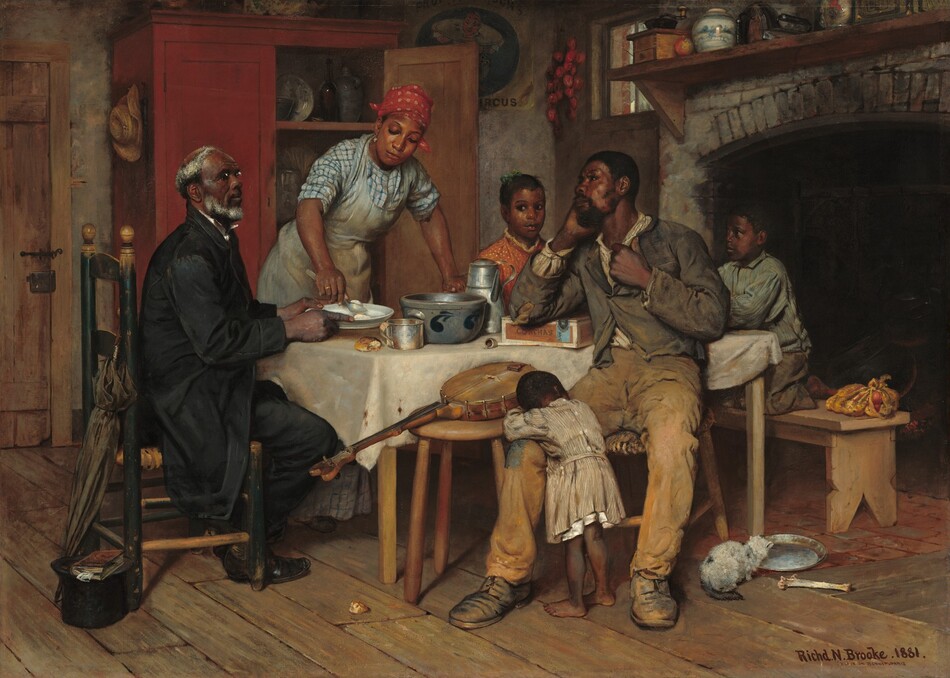
  • Two men, a woman, and three children, all with brown skin, gather around a table in a house in this horizontal painting. A bespectacled, white-haired man sits to our left, wearing a black coat and suit. He looks up and to our right, his chin slightly lifted. A black top hat and a book sit near his feet, and a gray umbrella leans against the back of his worn wooden chair. Opposite him, to our right, a younger man has short black hair and a trimmed beard. He props one elbow on a cigar box on the table and rests his chin in that hand. With his other hand, he grasps the lapel of his slate-blue jacket, which is worn over a cream-white shirt. There is a patch in one elbow of the jacket and on one of the knees in his tan-colored pants. Two small children gather around him. The smallest child turns away from us as they rest their folded arms and head on one of the man's knees. That child wears a knee-length, dress-like garment striped with parchment brown and beige. Behind the man, to our right, a slightly older boy kneels on a bench on the far side of the table and rests his elbows on the white tablecloth. That boy wears an aquamarine-blue shirt and dove-gray pants. Both children are barefoot. On the far side of the table, near the older man, a woman stands and leans forward to spoon food into the white dish he holds. She wears a red kerchief tied around her head and a fog-blue apron over a white shirt patterned with a muted indigo-blue grid. A young girl, the oldest child, stands on the far side of the table between the younger man and woman. Seen from the chest up, the girl's face and body are angled to our right, toward her father, but she looks to our left from the corners of her eyes. She wears a coral-red, high-collared garment with white polka dots. On the table is a serving bowl, cup, and a kettle. Behind the woman, one door of a tall  brick-red cupboard is ajar. Plates and vessels line the shelves within. A fireplace to the right has an opening as tall as the stooping woman. The mantle is lined with a manual coffee grinder, a white jar painted with a blue design, and clothes irons. A circus poster hangs behind the open door of the cupboard. A string of dried red chilis hangs next to a window between the poster and fireplace mantle. A banjo rests on a stool in front of the table, and a white cat licks a pie plate near the father's feet. The aritst signed and dated the painting in the lower right corner, "Richd. N. Brooke. 1881 (ELEVE DE BONNAT - PARIS)."
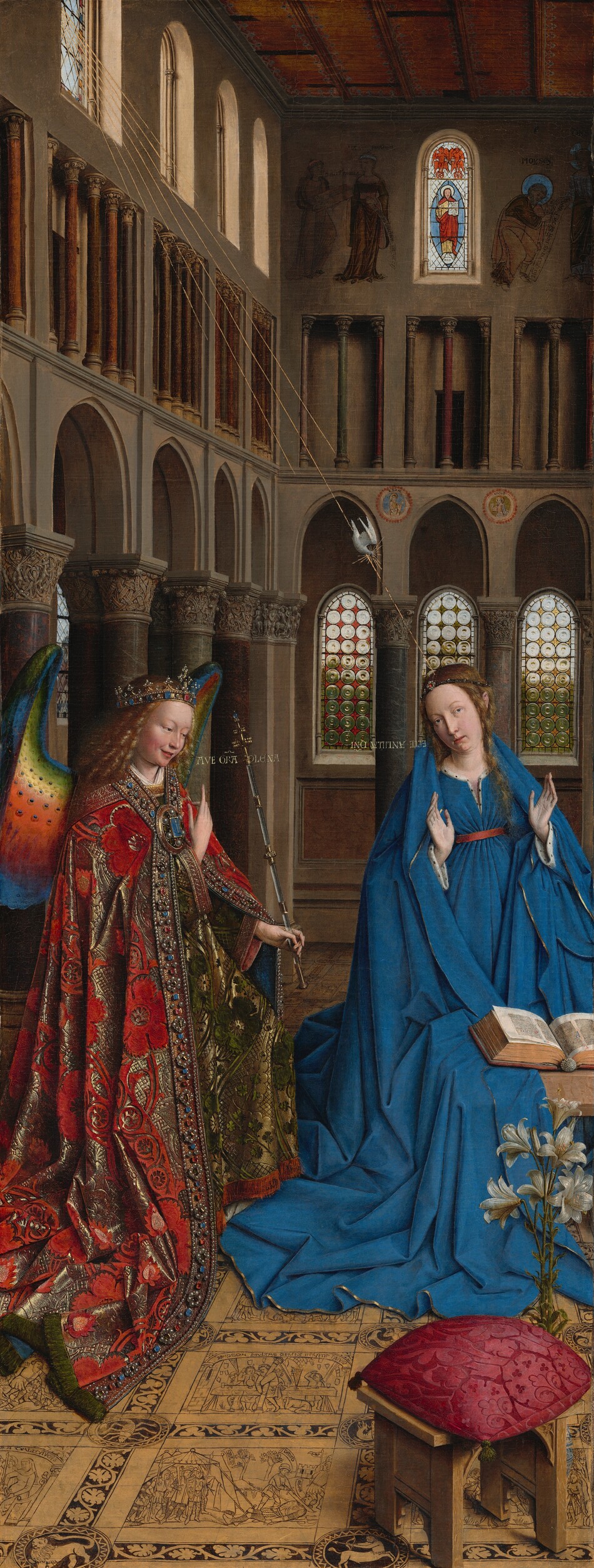
  • A woman and winged angel, both with pale, peach skin, are situated in a church interior in this tall, narrow painting. To our left, the angel has long, blond, curly hair, smooth skin, and is smiling. The wings are outlined in royal blue, and they blend from blue to green to yellow to crimson. The angel holds one hand, closer to us, up at chest height with the index finger subtly pointing upward. Holding a long scepter in the other hand, the angel angles their body toward the woman to our right. The angel wears a gold jewel and pearl-encrusted crown and a jeweled long, voluminous robe in scarlet-red and shimmering gold brocade. The neck and along the opening down the front are lined with pearls and jewels. The angel looks toward the woman, who wears a royal-blue dress tied with a red belt at the high waist. Her long brown hair is tied back but one tendril falls over her left shoulder, to our right. She kneels facing us with her raised hands facing outward. Her head is tipped a bit to our left, and she looks up and into the distance to our right with lips slightly parted. She kneels behind a book lying open on a low table. A vase of white lilies and a red cushion lies on the floor in front of the table, close to us. The floor is decorated with people and scenes outlined in black and set into square panels, as if inlaid with wood. The church behind and above the people has a row of tall, narrow arches with bull’s-eye glass windows. A walkway lined with columns runs above the arches, and sunlight comes in through arched windows under the flat wood ceiling. A white dove flies toward the woman on gold lines from a window at the upper left of the painting. Latin words painted in gold capital letters are exchanged between the people. The angel says, “AVE GRA PLENA.” The letters of the woman’s response are painted upside down and backward: “ECCE ANCILLA DNI.”
  • Sculpted with rich brown wax, a young ballerina stands with her arms straight, hands clasped behind her back, and one foot in front of the other on a square wooden base. Her body is angled to our left in this photograph. Both feet are splayed outward, and her right foot is placed far in front of her left. Bangs cover her forehead, and she has a heart-shaped, upturned face with a squat nose and slightly pursed lips. Her heavy-lidded eyes are nearly closed and her hair is pulled back and tied with a wide, cream-white ribbon. She wears a fabric costume with a sleeveless, gold-colored bodice, a gray tulle skirt, and ballet slippers. Her body is sculpted from dark brown wax, and a layer of wax covers her hair, bodice, and ballet slippers.
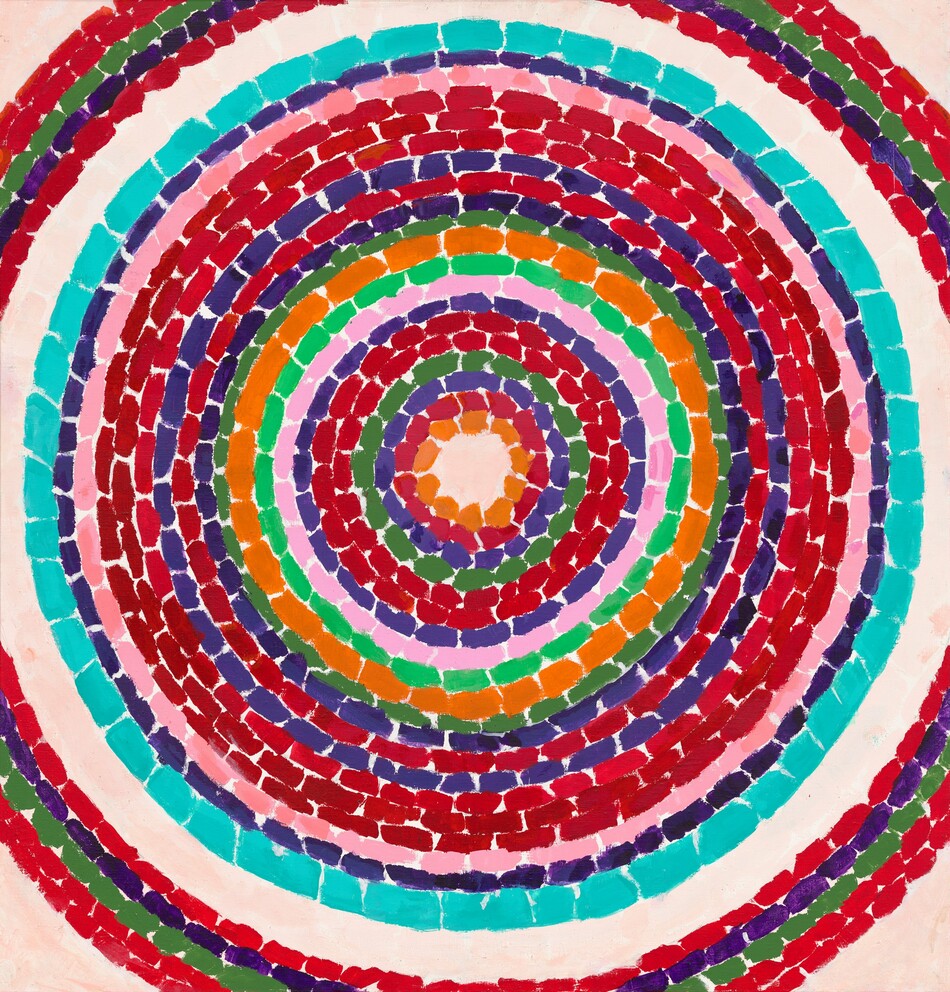
  • This nearly square, abstract painting is filled with circles within circles, like nested rings, each of a single bright color against the ivory white of the canvas. Each ring is made up of a series of short, rectangular dashes, and some bands are narrower while others are a bit wider. The majority of the rings are crimson and brick red, and they are interspersed with bands of lapis blue, army green, and pale pink. One of two pumpkin-orange bands is the smallest, innermost ring at the center. There is one aqua-blue colored ring just inside a pale, shell-white ring, which is the first to get cropped by the edges of the canvas. A few red, green, and blue rings beyond the white band are only seen at the corners of the canvas.
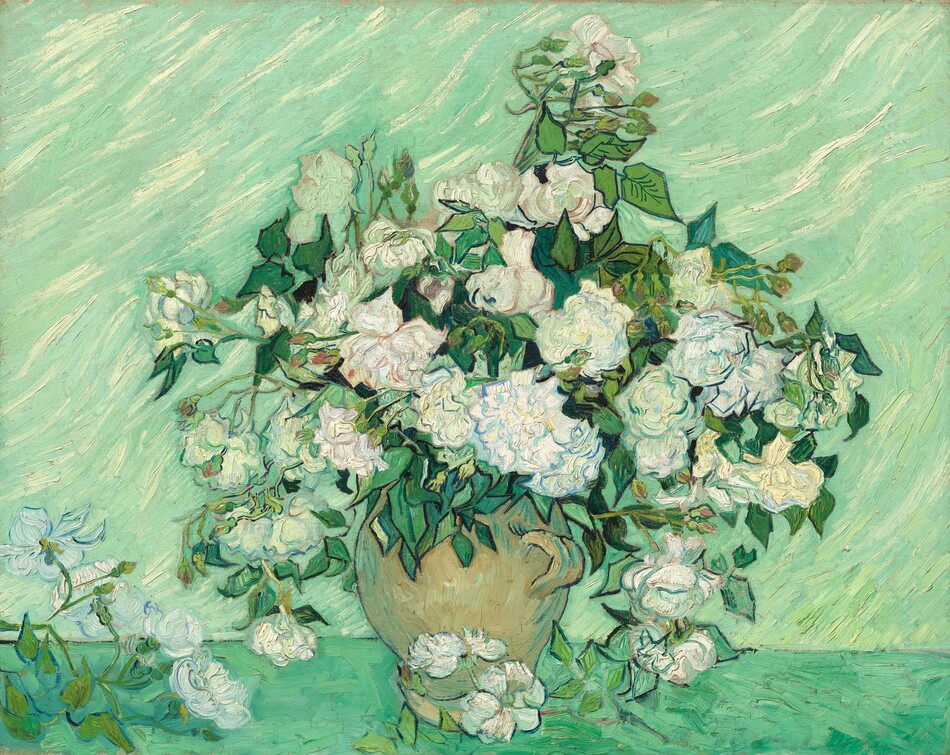
  • A profusion of white roses bursting from the neck of a tan jug almost fills the height of this horizontal still life painting. The roses have large, round blooms with petals tinged with denim and aquamarine blue, sage green, mauve pink, teal, and butter yellow. Emerald-green leaves fill the spaces between blossoms. The jug has a short, rounded handle and sits on a sea glass-green surface. A few blooms lie in the lower left corner and at the foot of the vessel. Many of the flowers, leaves, and vase are outlined with navy blue or black. A mint-green wall with wavy, diagonal streaks of cream white fills the background. The paint is applied thickly with visible strokes.
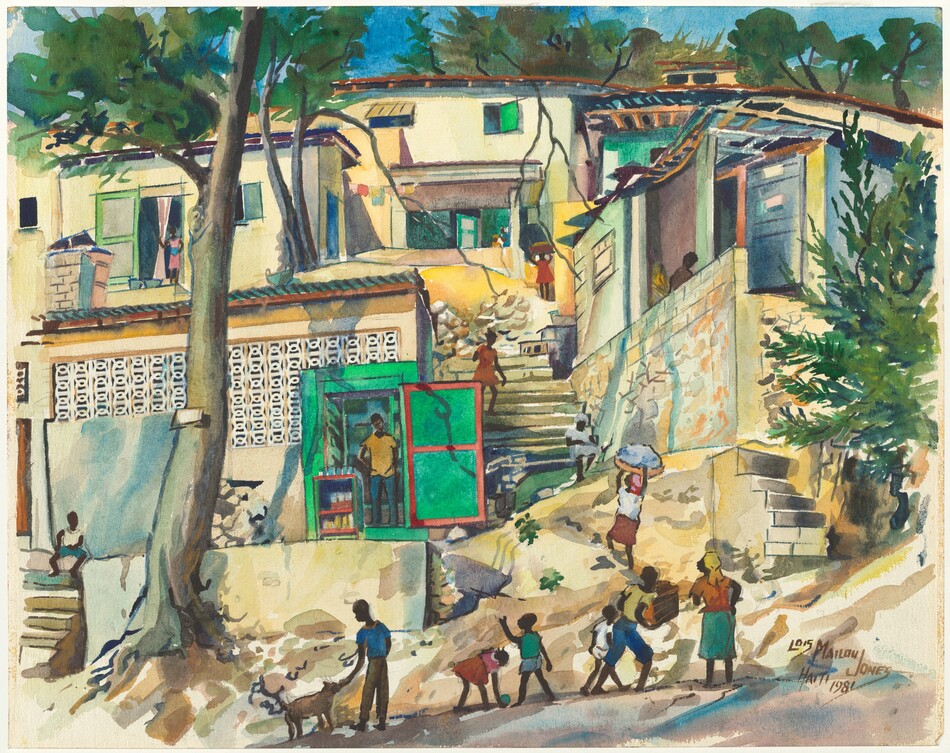
  • This is a painting of a street scene filled with activity. On top of a hill are various structures, trees, and people. The buildings are predominantly green and yellow, arranged in a staggered manner up the incline. There are doors and windows in bright colors, most notably a green door in the center of the painting. The color scheme is vibrant, combining earthy tones with green, blue, and red accents. People of different ages are present, engaging in various activities: some carrying items, petting animals, or playing together. They all appear to have dark brown skin and wear clothing in bright shades of red, yellow, green, and blue. Trees and foliage are visible along the sides of the image and at the top.
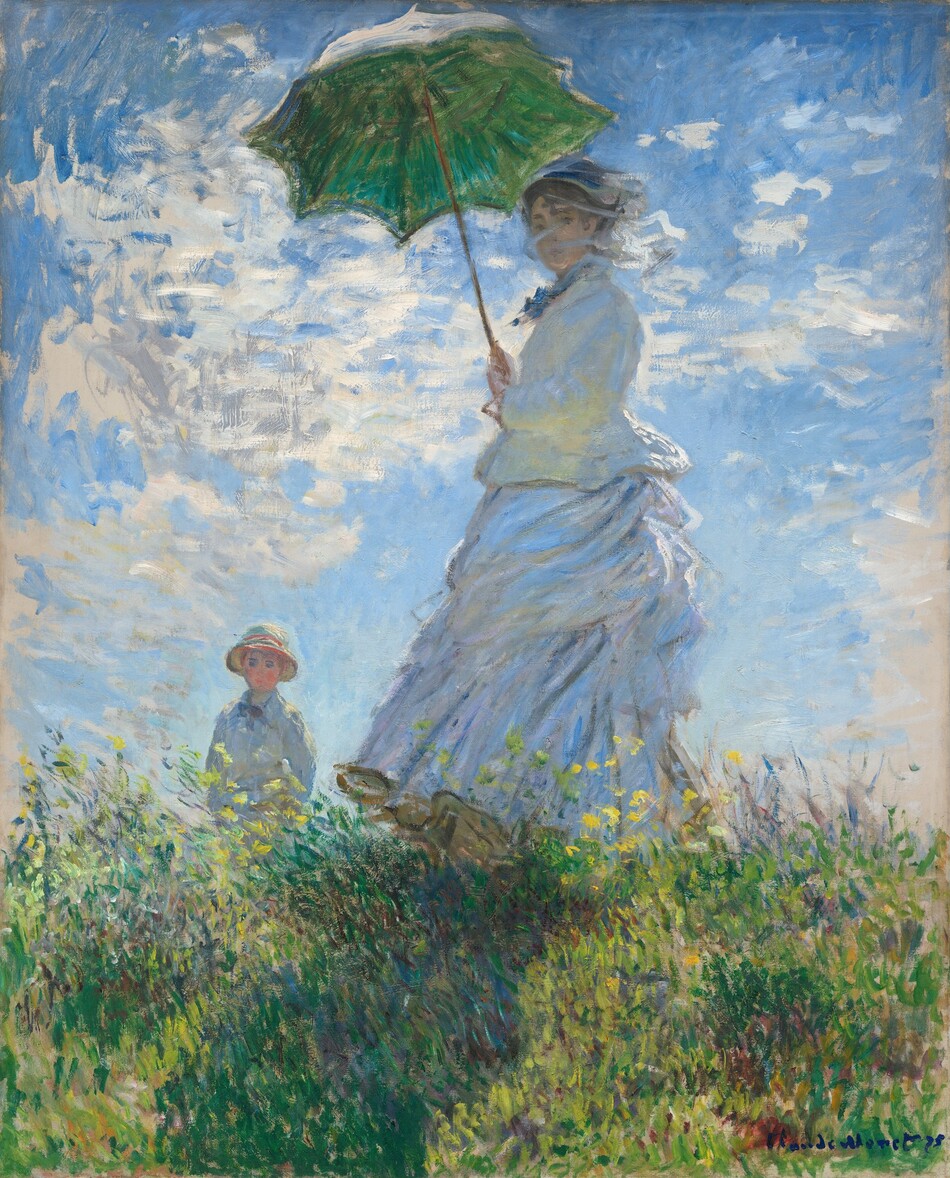
  • From low on a hillside, we look up at a light-skinned woman and boy standing in tall grass against a sunny blue sky in this vertical painting. The woman stands at the center of the composition, and the moss-green parasol she holds over her head almost brushes the top edge of the canvas. Her body faces our left but she turns her head to look at us. Her long dress is painted largely with strokes of pale blue and gray with a few touches of yellow. Her voluminous skirts swirl around her legs to our left. She holds the parasol with both hands, and her brown hair is covered with a hat. Long strokes of white paint across her face suggest a veil fluttering in the breeze. The tall grass she stands in is dotted with buttercup yellow and plum purple, and she casts a long diagonal shadow along the grass toward us. The young boy seems to stand on the other side of the hill, since the grass and flowers comes up to his waist. He wears a white jacket and pale yellow straw hat. His arms are by his sides, and he seems to look off into the distance to our left. A sunny blue sky behind the people is dotted with bright blue clouds. The painting is created with loose brushstrokes throughout, and they are especially choppy in the clouds. The artist signed and dated the painting in royal-blue letters at the lower right: “Claude Monet 75.”
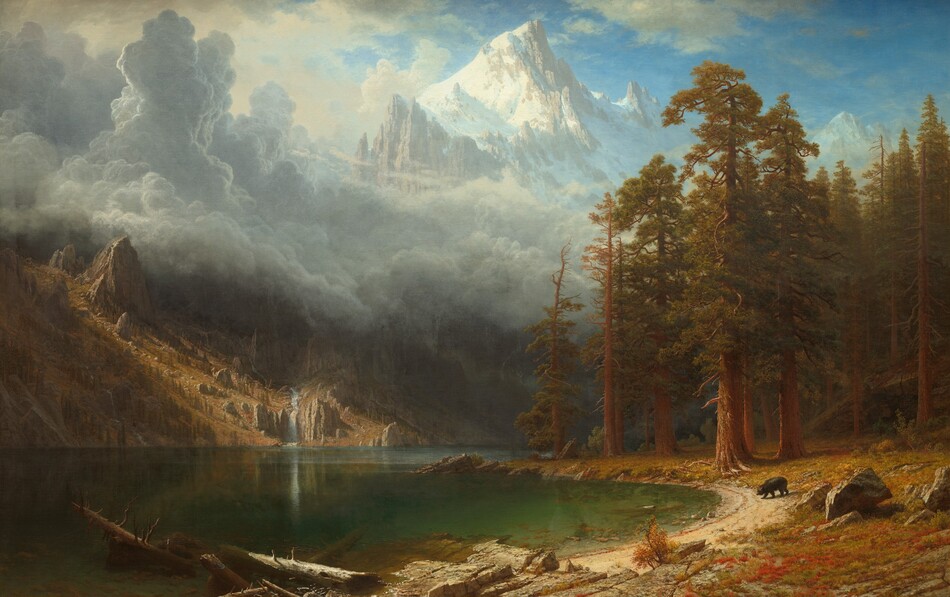
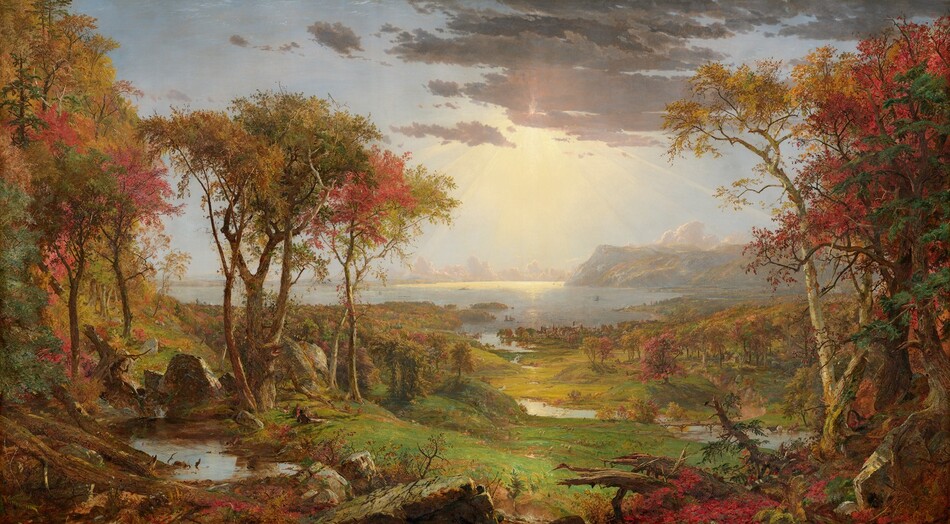
  • We look across the gleaming, forest-green surface of a lake at the foot of tall, jagged mountains in this horizontal landscape painting. The lake is flanked by a steep, gingerbread-brown hill on the left and a shoreline that forms a backward C curving from the lower center around and back along the right side of the composition. Strong sunlight from the upper left illuminates the center of the left-hand hill and the shoreline. The ground to our right is carpeted in rust-red, sage-green, and tan growth and is dotted with boulders. Tall trees with rust-brown trunks, crooked branches, and narrow canopies of caramel-brown and olive-green leaves fill the far end. Closest to us are dead tree trunks jutting out of the water and or lying on a flat, rocky outcropping nearby. Beyond the outcropping is a small black bear wandering down a sliver of sand-colored ground at the water’s edge. The hill on the left is covered with vertical rows of upright jagged boulders and slender, dark green trees marching up its slopes. A narrow, artic-blue waterfall cascades down its right side to empty into the lake. A thick layer of towering blue-gray clouds rises over the hill and lake, stretching back to the looming, snow-covered peaks that nearly brush the top edge of the canvas. The sky around the peak is vivid blue, scattered with high white clouds. The artist signed the lower right, “ABierstadt” with the A and B joined as a monogram.
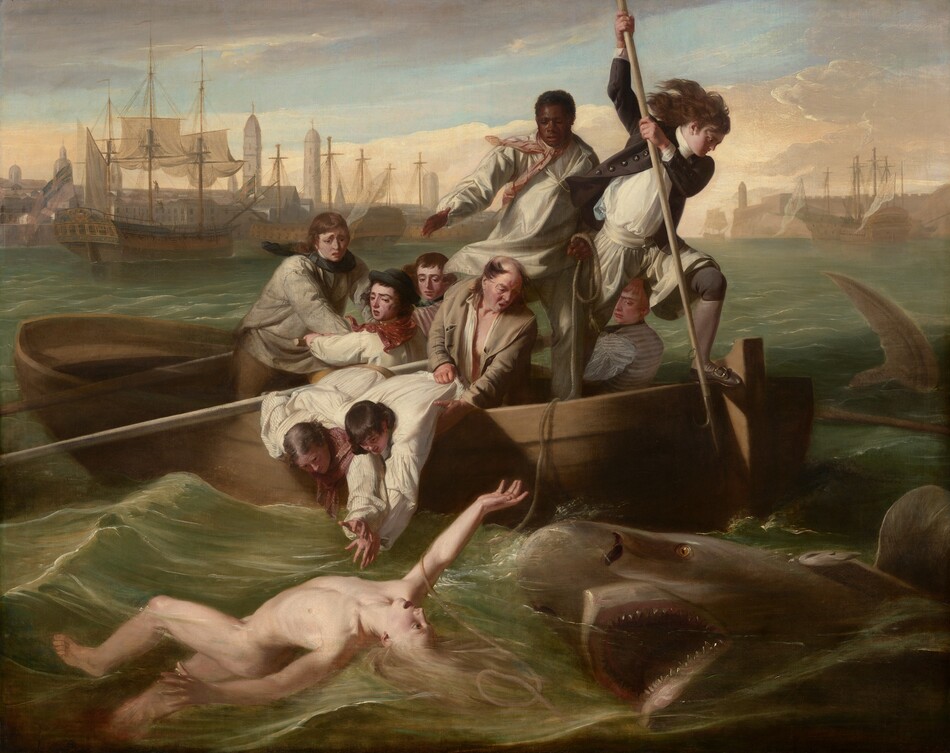
  • We look onto the side of a rowboat crowded with nine men trying to save a pale, nude young man who flails in the water in front of us as a shark approaches, mouth agape, from our right in this horizontal painting. In the water, the man floats with his chest facing the sky, his right arm overhead and the other stretched out by his side. Extending to our left, his left leg is bent and the right leg is straight, disappearing below the knee. His long blond hair swirls in the water and he arches his back, his wide-open eyes looking toward the shark behind him. To our right, the shark rolls up out of the water with its gaping jaws showing rows of pointed teeth. In the boat, eight of the men have light or tanned complexions, and one man has dark brown skin. The man with brown skin stands at the back center of the boat, and he holds one end of a rope, which falls across the boat and around the upper arm of the man in the water. Another man stands at the stern of the boat, to our right, poised with a long, hooked harpoon over the side of the boat, ready to strike the shark. His long dark hair blows back and he wears a navy-blue jacket with brass buttons, white breeches, blue stockings, and his shoes have silver buckles. Two other men wearing white shirts with blousy sleeves lean over the side of the boat, bracing each other as they reach toward the man in the water. An older, balding man holds the shirt and body of one of this pair and looks on, his mouth open. The other men hold long oars and look into the water with furrowed brows. The tip of a shark’s tail slices through the water to our right of the boat, near the right edge of the canvas. Along the horizon line, which comes three-quarters of the way up the composition, buildings and tall spires line the harbor. The masts of boats at port creates a row of crosses against the light blue sky. Steely gray clouds sweep across the upper left corner of the canvas and the sky lightens to pale, butter yellow at the horizon.
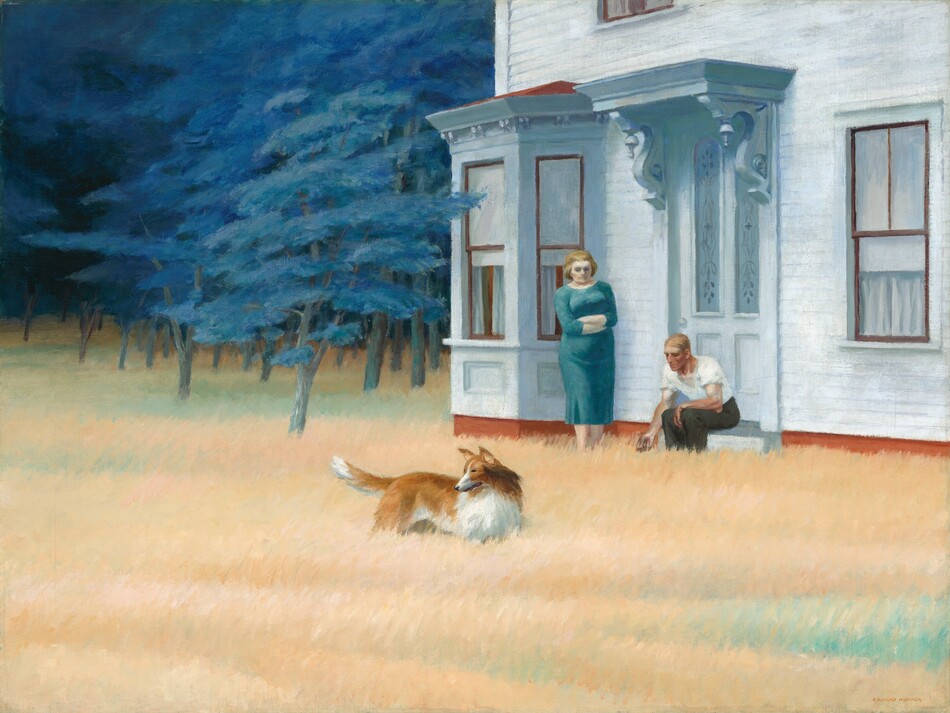
  • A light-skinned man and woman and a collie dog are outside a white house at the edge of a pale peach field of grass in this horizontal painting. Taking up a bit more than the top right quadrant of the composition, the house is white with pale blue shadows. Near the back, left corner of the house, the door has two tall, inset frosted glass panels and a shallow roof supported with scrolling, carved corbels. The door is flanked by a bay window on the left and a single window on the right. A shadowy grove of blue-green trees grows to the left of the house with one branch reaching toward the bay window. The woman faces us and stands between the bay window and door with downcast eyes and folded arms. Her blond hair is pulled or brushed back, and she wears a snug fitting, calf-length teal-blue dress. The man sits on the doorstep so his knees are angled to our left. His near arm drapes over his left knee and his far hand reaches toward the dog, his fingers and thumb touching. He has short blond hair and a ruddy face, and he wears a white t-shirt and olive-green pants. The dog stands in the middle of the field with its body angled to our right, its pointed ears and tail pricked up as it swivels its head to look to our left. It has an auburn-brown coat with white belly, chest, and tip of the tail. There are a few areas of spearmint green in the otherwise peach-colored grass, which is tall enough to brush the belly of the dog. The artist signed the lower right, “EDWARD HOPPER.”
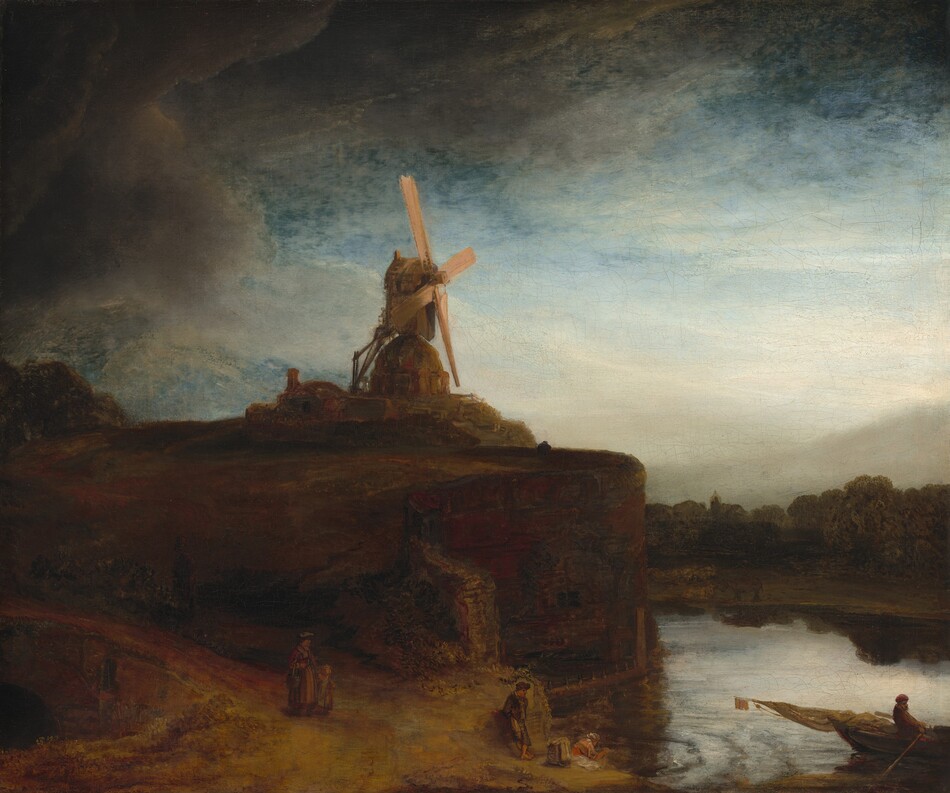
  • A windmill stands on a promontory cutting into a waterway under a partially stormy sky in this square landcape painting. The promontory and mill are painted in muted tones of brown and rust orange, while steel-gray and white clouds encircle a topaz-blue sky above. The promontory juts into the scene from our left, and the front of the windmill is angled to our right so its golden-tan sails catch the light. Silvery water winds around the base of the promontory and extends to a dark green, shadowy bank on the far side. A boat in the lower right corner of the composition is rowed by a man wearing a red jacket and cap. A path runs to the water’s edge from the left edge of the painting, in front of the promontory’s retaining wall, which is shored up with stones or panels. A person in dark clothing close to the windmill seems to rest their arms on the retaining wall, their back to us. Closer to us, a woman holds a child’s hand as they walk down the path to the bank. A bearded man with tattered brown clothes and bare feet stands leaning against the wall near a woman wearing burnt-orange garment. She sits or kneels at the water’s edge in front of a basket of clothes and holds up a brown cloth. The olive-green forms of the trees on the far bank are reflected in the water, and closer inspection reveals two cows near the water there. Charcoal-gray clouds pile up along the left of the painting and span the top edge. There is a brilliant blue sky beyond and a screen of white clouds near the horizon, which comes about a third of the way up the canvas.
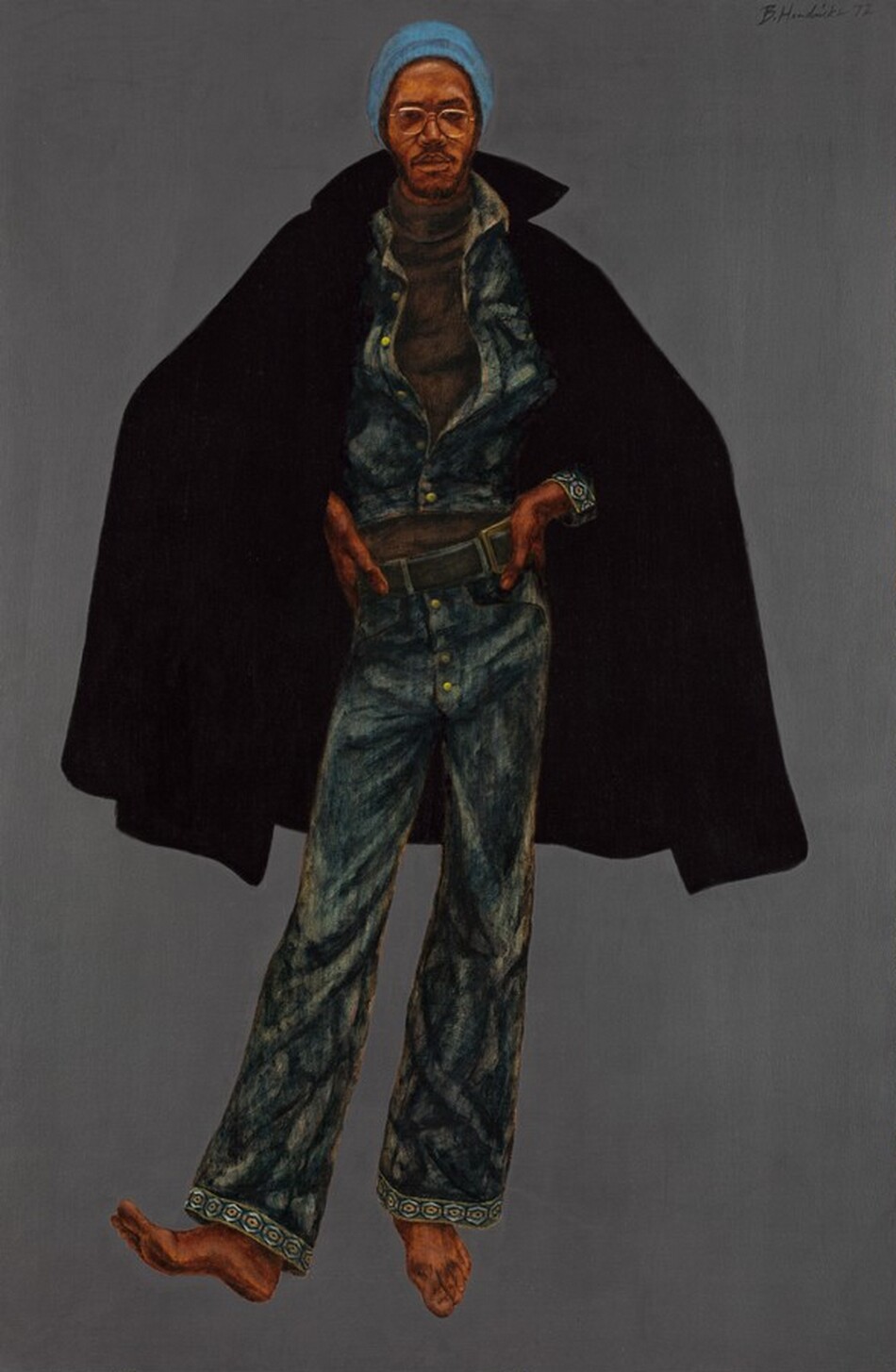
  • A man with dark brown skin, a black afro, mustache, and goatee, and wearing a cardinal-red coat over a black suit, is shown three times in this vertical portrait painting. The version at the center stands with his back to us and those to each side face the left and right edges of the canvas, respectively. They stand close enough for their shoulders to touch, and all three views of the man float against a paper-white background. The man has a deep-set eyes under black brows and high cheekbones. His thin mustache frames full lips, which are closed in all three views, and a line of black hair grows down his pointed chin. He wears a jet-black suit over a bright-white turtleneck shirt, and honey-brown and ivory-white wingtip dress shoes. The collar of his shin-length, red coat is popped up, and the belt hangs loose. In the version to our left, he faces that direction in profile with his eyes closed as he pulls the coat back to tuck his left hand, closer to us, into the pocket of his suit jacket. At the center of the canvas, the man turns his face to our left so we see the side of his cheekbone, the tip of his nose, and his eyelashes outlined against the white background. In the view to our right, his body faces that direction with the hand closer to us tucked into the coat pocket. He turns his head to look toward or at us with shadowed eyes. The artist signed and dated the painting in the upper right corner: “B. Hendricks 72.”
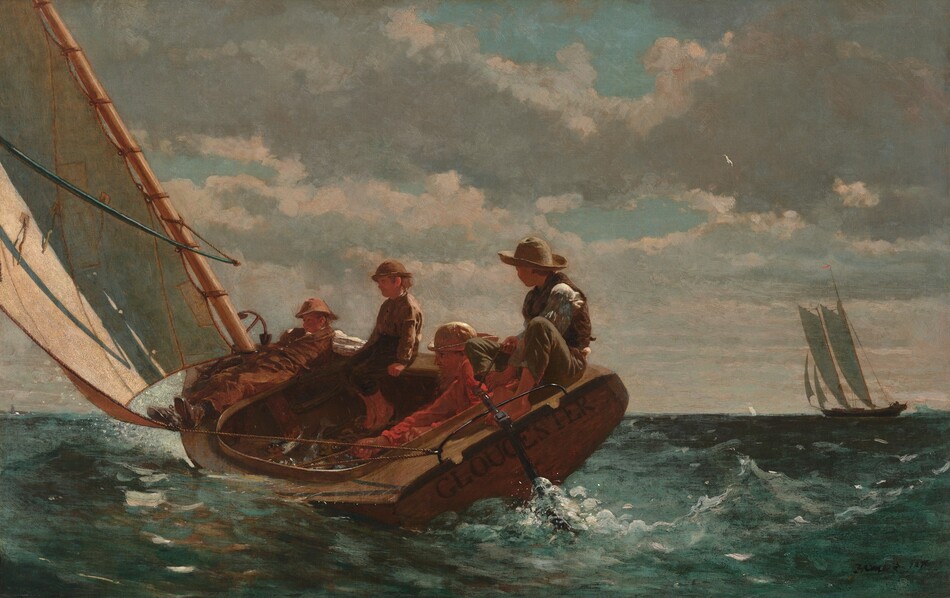
  • Close to us, a young man and three boys sit or recline in a small sailboat that tips to our left on a choppy dark green sea in this horizontal painting. The billowing sail extends off the top left corner of the canvas and is echoed in the background to our right by the tall sails of another ship in the distance. The horizon line comes about a third of the way up the composition, and puffy gray and white clouds sweep across the turquoise sky. The sun lights the scene from our right so the boys’ ruddy faces are in shadow under their hats. The young man and boys all face our left so they lean against and into the boat as it cants up to our right. The boy nearest the sail to our left reclines across the bow. Next to him to our right, a younger boy perches on the edge of the boat and holds on with both hands. The oldest, in a red shirt, sits on the floor of the boat as he maneuvers the sail with a rope. Closer to us and to our right, a younger boy sits with his bare feet pressed together in front of his bent knees on the back edge of the boat, gazing into the distance over his right shoulder as he handles the tiller. The artist signed and dated the painting in dark letters in the lower right corner: “HOMER 1876.”
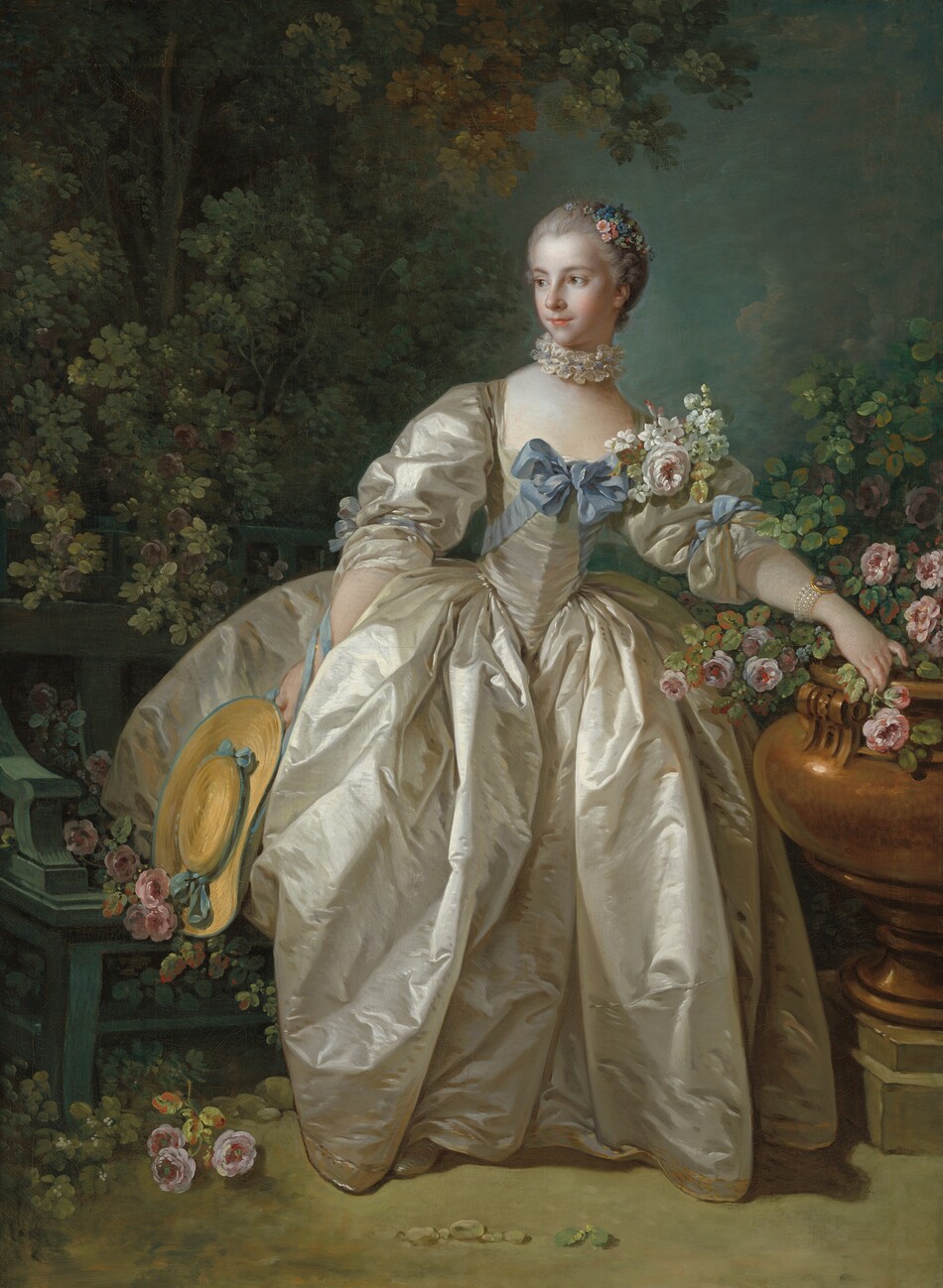
  • A young woman with light skin stands in a garden, wearing a voluminous, full-length, silvery, shimmering gown in this vertical portrait painting. Her body faces us, as she looks into the distance to our left. She has rosy cheeks, gray-green eyes under gently arched, light brown brows, and her coral-pink, thin, closed lips curve in a slight smile. Her ash-brown hair is pulled back and adorned with tiny shell-pink and azure-blue flowers along the left side top of head, to our right. A pleated lace ruffle encircles her smooth neck. Her gown is parchment white where the light glints off the stiff fabric and is silvery gray in the shadows, creating a silk-like sheen. The dress is cut low across the chest, fits tightly around her narrow waist, and has puffy sleeves tied at the elbows with topaz-blue bows. Another blue bow is tied at her chest, and the ends wrap around her back along her waist. A corsage at her left shoulder, to our right, is a profusion of white flowers around a pale pink rose. In her other hand, to our left, she holds a straw hat with a shallow crown and a wide brim, trimmed with sky-blue ribbon. The arm holding the hat is nearly engulfed in the deep folds of her full skirt. She holds a pink rose in her other hand, which rests on the lip of a shiny, copper-colored urn filled with pink flowers and delicate green leaves. On that wrist she wears a bracelet with four strands of white pearls holding a cameo. She stands on a pale, dirt ground. A teal-blue bench in the lower left corner of the painting is tucked into sage-green shrubbery. Sprigs of pink roses are strewn across the seat and on the ground. The woman is framed to either side with olive and celery-green trees and vegetation, which blend into the hazy distance beyond her head.
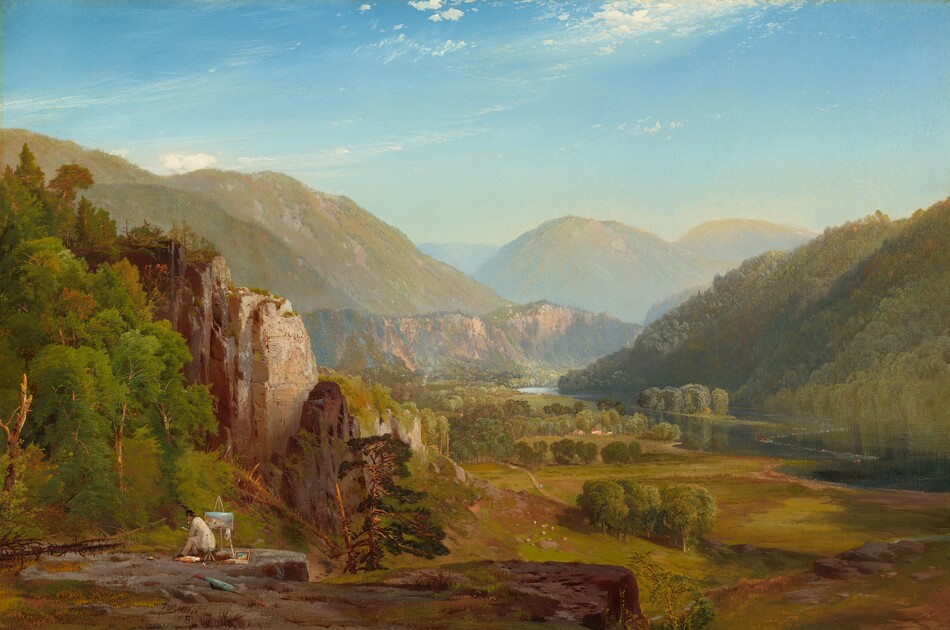
  • Far below us, a river winds through a valley lined with hazy mountains in this horizontal landscape painting. In the distance, the line of mountains emerges from the left, near the top of the canvas, and marches down toward the center, growing lighter and mistier in the distance. Streaks of olive-green growth drape down their sides, and pale sunlight from the upper right warms their craggy faces, which are painted in tones of peach, tan, taupe, and parchment white with pewter-gray fissures. The mountains move across the canvas and angle way from us, to our right. There, they are overlapped, just off center, by a tree-covered slope that emerges from the right. At its foot is a steel-gray river that winds from the lower right toward the center of the composition. The land sweeps down from the left side, spreading out into meadows that meet the river. They are carpeted in moss green with streaks and patches of rust-brown earth and scattered with clusters of trees painted in tones of celery, olive, and pine green. Closest to us and near the lower left corner of the painting, is a man, tiny in scale, on a flat bluff. He wears a white coat and trousers, and sits hunched on a stool facing our left. He looks toward a grove of trees with pea-green leaves and ginger-brown trunks that tower over him, along the left edge of the composition. He has turned away from a painting on an easel that stands just beyond him, and an open wooden box that sits on the ground behind him. A closed, seafoam-green parasol also lies nearby. Just beyond the lip of the bluff and down in the valley are creamy white dots that suggest livestock. Farther back, near the foot of the mountains, a cluster of buildings sit near the tree line in the meadow. Wispy white clouds drift through the light azure-blue sky. The artist signed and dated the painting in the lower left corner, “THOS.MORAN.1864 OP.8.”
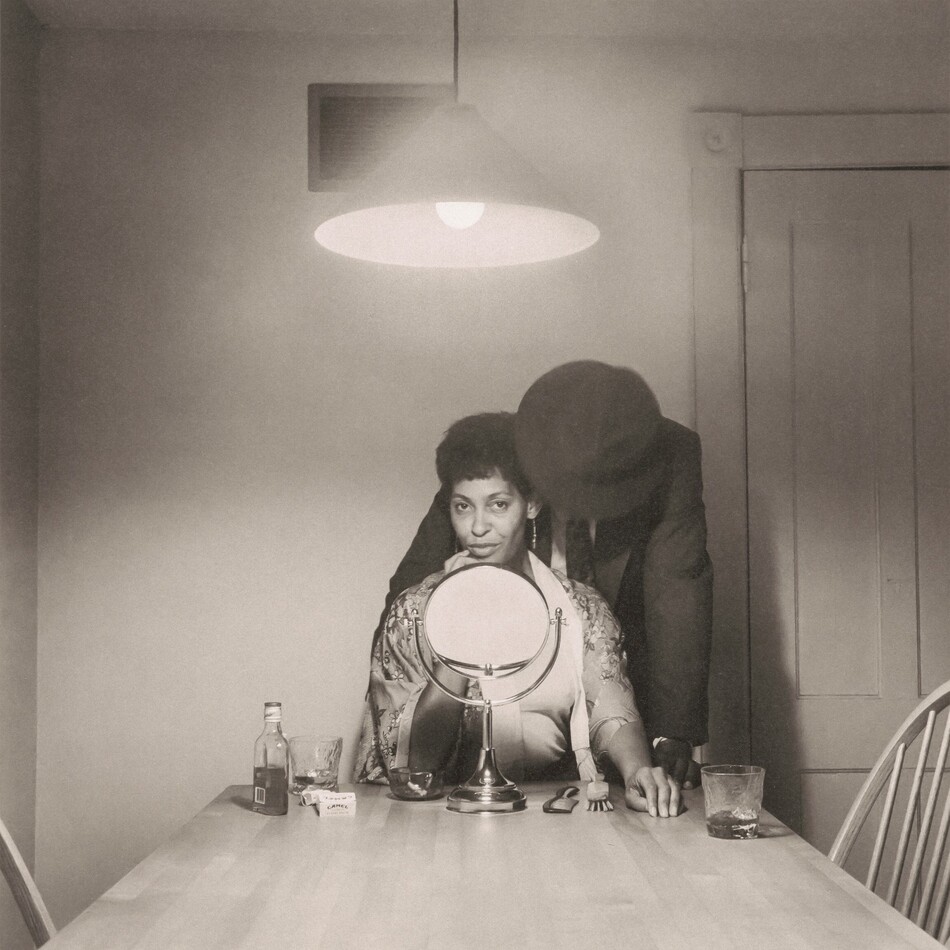
  • Twelve lines of black text in all capital letters are printed on a square, beige-colored sheet of paper. The lines are centered down the page and divided into four groups set in progressively smaller type sizes. Near the top, the largest text reads, “THE KITCHEN TABLE SERIES.” In smaller text below, “CARRIE MAE WEEMS.” Immediately below that, again in smaller text, “A PORTFOLIO OF TWENTY PLATINUM PRINTS, FOURTEEN TEXT SHEETS, EDITION OF TEN, TWO ARTIST’S PROOFS, WINTER 2003.” The remaining text is printed in five lines at the bottom center of the sheet: “DESIGNED WITH PAMELA VANDERZWAN, PHOTOGRAPHS PRINTED BY JOHN MARCY OF NORTHAMPTON PHOTOGRAPHIC, TEXT PRINTED BY PETER KRUTY EDITIONS, FUNDED WITH GENEROUS SUPPORT, BY PETER NORTON.” Between the text at the center of the sheet and the five lines along the bottom, the artist signed the sheet in graphite: “Carrie M. Weems 9/10.”
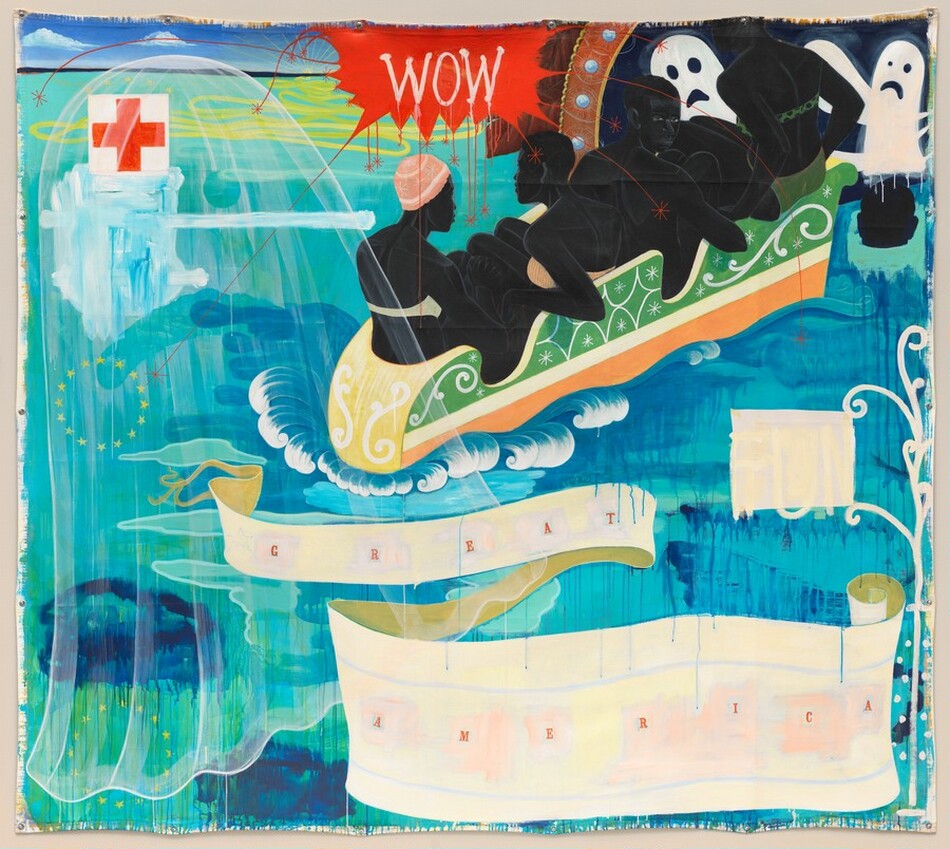
  • Four people with black skin are squeezed into a narrow boat on bright, turquoise-colored water that nearly fills this stylized, square painting. All four sides of the unstretched canvas are lined with six gromets spaced along each edge. The boat approaches a carnival-like tunnel near the upper right corner. Cartoon ghosts loom at the tunnel entrance and a translucent, veil-like ghost hovers over the left half of the painting. The horizon comes almost to the top of the canvas, where white clouds float against an azure-blue sky. A long, lemon-yellow line curls back and forth in a tight, curving zigzag pattern that widens out from a tiny sun setting on the horizon. A red cross on a white field floats near the upper left. At the top center, the word “WOW” appears in white letters within a crimson-red, bursting speech bubble with long trailing tendrils, like an exploded firework. Below the boat and against the water to our right, the word “FUN” has been overlaid with a white square so the tall, white letters are barely visible. The words “GREAT AMERICA” appear in a curling banner across the bottom half of the painting.
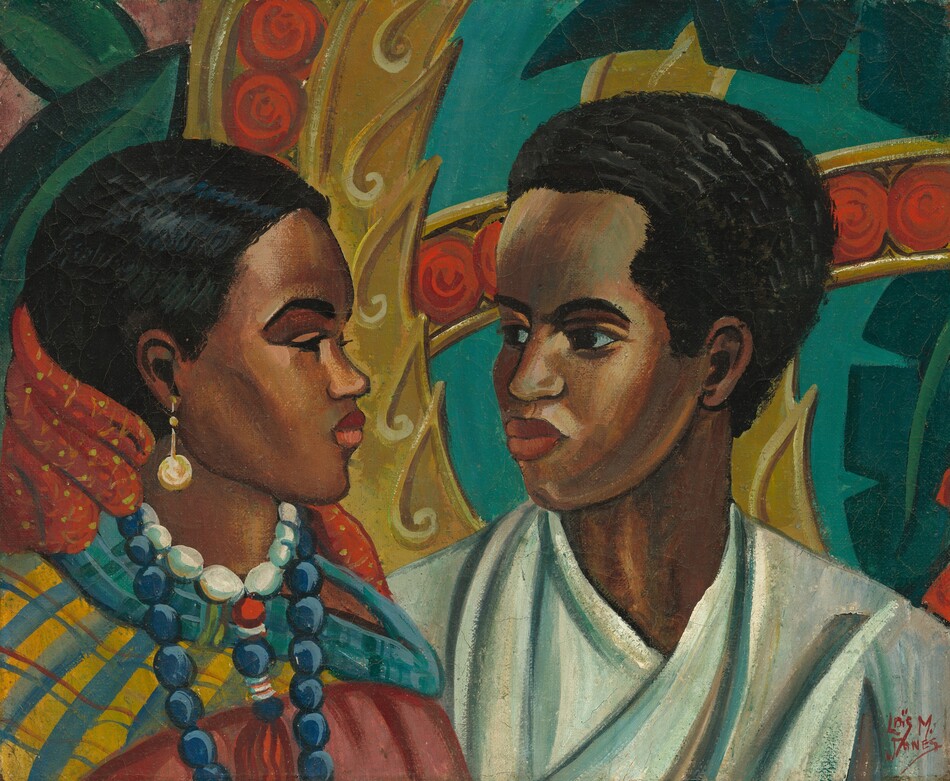
  • Shown from the shoulders up, a woman and man, both with brown skin, look at each other in this horizontal portrait painting. Their bodies are angled toward each other and both have black hair, dark eyebrows, and full, coral-red lips. To our left, the woman faces our right in profile. She has a delicate nose and high cheekbones. Her eyes are painted with black lashes over black eyes, without the white of the eye. A gold disk earring hangs from the ear we can see, and she wears white and royal-blue beads in two necklaces. Her hair is combed or styled close to her head, and a swath of brick-red fabric, flecked with golden yellow, wraps around the back of her neck. A scarf with butter-yellow, denim-blue, and red stripes in a plaid pattern is draped across her shoulders, over a rose-pink garment. To our right, the man’s face is angled toward the woman but we see both eyes and the far cheek. His hair is closely cropped and he has a rounded nose, curving brows, and full cheeks. The shadows and folds of his white garment are painted with streaks of teal blue. The background behind the pair is patterned with bands and geometric designs of mustard yellow, scarlet red, and teal, with some stylized leaves in emerald and forest green. The artist signed the work in red paint in the lower right corner, “Lois M. Jones.”
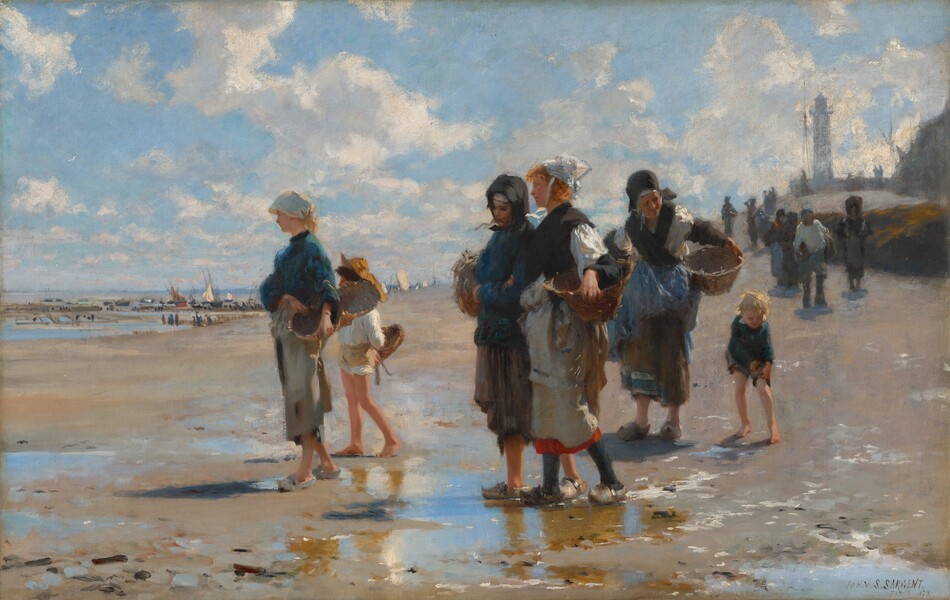
  • Four women and two children, all with pale skin, carry baskets as they walk along a beach under a brilliant blue sky in this horizontal painting. The scene is painted with visible dabs and blended strokes. The women all wear long-sleeved shirts, calf-length skirts and aprons, head coverings, and gray clogs. The group walks to our left, amid shallow pools that reflect the topaz-blue sky. At the front of the group, to our left, a young woman wears a white kerchief tied at the back of her neck, under her blond hair. She wears a navy-blue shirt and a gray skirt, and she carries a shallow, woven, straw basket against her left hip, closer to us. On her other side, a barefoot child walks beside her. The child wears a white, long-sleeved shirt tucked into tan-colored shorts and a wide-brimmed, golden yellow hat. He holds a basket at the small of his back. To our right, near the center of the composition, a pair of women walk with their heads tipped toward each other. The woman closer to us has bright, copper-blond hair under a white bonnet tied under her chin. A black shawl crosses over her white shirt, and black coverings are pulled up over the forearms of her white shirt. Her beige apron mostly obscures her crimson-red skirt. Wearing dark stockings, she is the only woman whose shins are not bare. The woman next to her, farther from us, wears a dark gray head covering and skirt, and a navy-blue shirt. The chin straps on the bonnets of both of these women flutter in the breeze. Behind that pair, to our right, and older woman also wears a black shawl and sleeve protectors over a white shirt. Her apron is aquamarine blue and she lifts it over a brown skirt. She has stopped to gaze down at the second child, standing next to her. Sunlight sets the child’s blond hair aglow as he reaches down to tug at the leg of his dark gray shorts. He wears a teal-blue, long-sleeved shirt and is also barefoot. Touches of white paint on the beach around the group makes the sand seem to shimmer. More people approach the beach from the upper right corner, where the dune leads back to a lighthouse. The structure is a hazy, slate-gray silhouette against the bright white clouds in the vivid blue sky above. The beach slopes down to our left into the distance, where sailboats and people are suggested with a few swipes of paint. The artist signed and dated the painting in the lower right corner, “John S. Sargent. Paris 1878.”
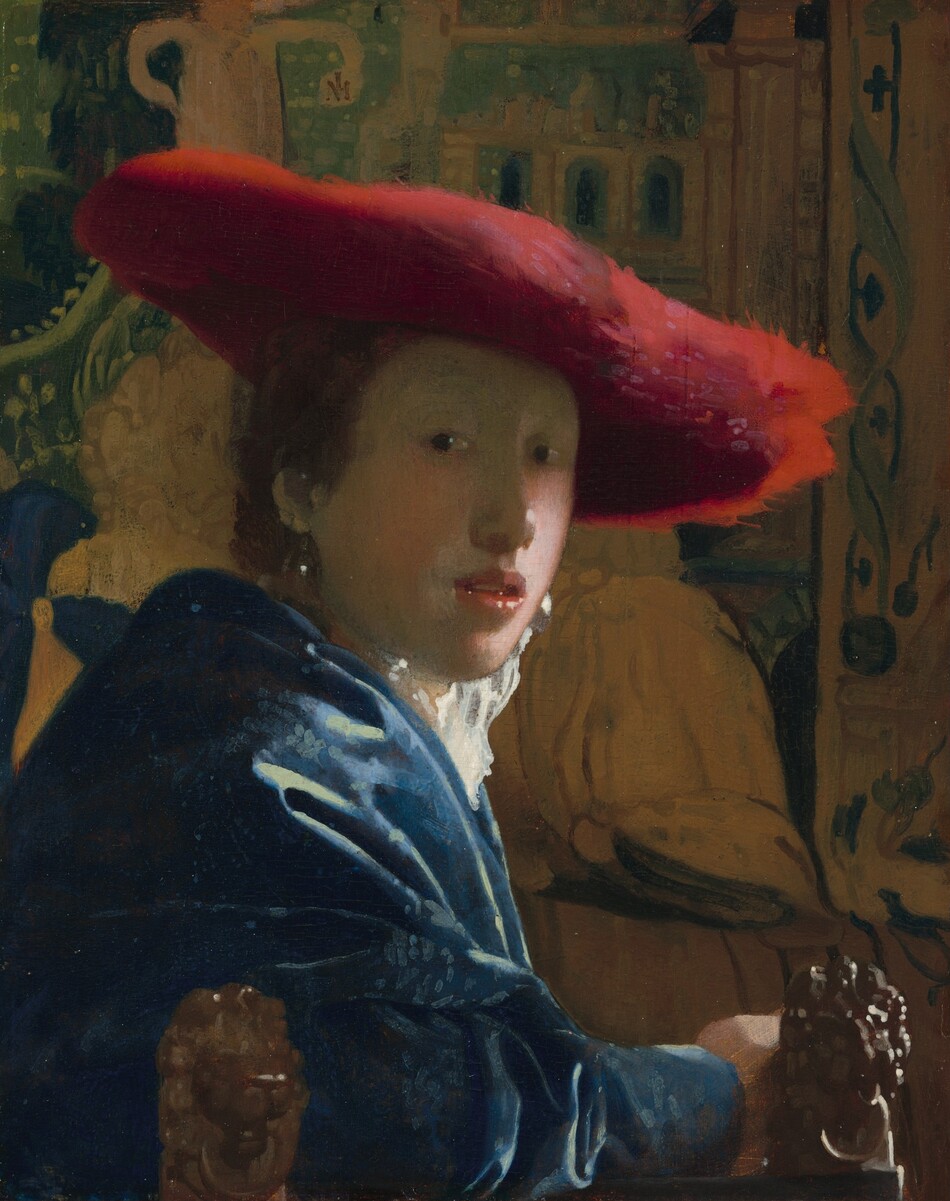
  • Shown from the elbows up, a young person with pale skin and brown hair wearing a wide, scarlet-red hat sits in front of a tapestry in this vertical portrait painting. She sits with her body facing our right in profile but she turns her face to look at or toward us with dark eyes. She has a rounded nose, rather flat cheeks, and a sliver of teeth is visible through parted coral-pink lips. The wide brim of the red hat seems to be made of a soft, almost feathery material, and it casts a shadow across her face. She wears a high-collared white garment that catches the light, a royal-blue, possibly velvet, robe or overcoat, and large, teardrop pearl earrings. Her arm runs along the bottom edge of the panel in front of two carved, wooden lion finials that could be the arm or back of the chair. The tapestry behind her is painted in tones of pale caramel brown and pine green. The painting has a soft, hazy look, and light glints with bright white specks off the pearl earrings, the tip of her nose, her lips, and the lion finials.
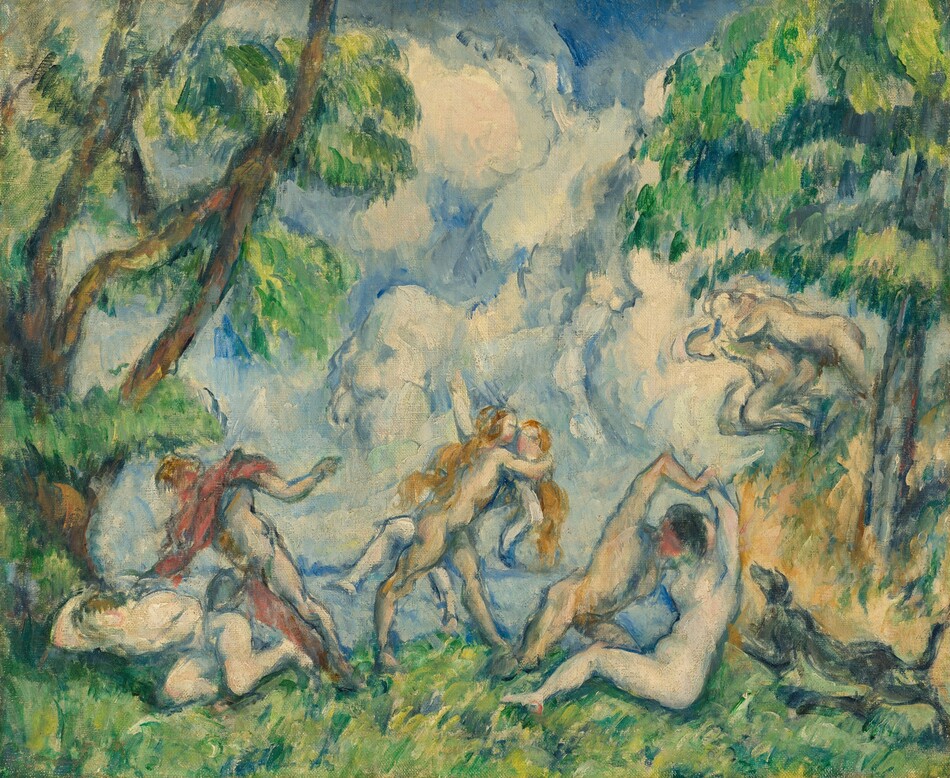
  • Painted with loose, visible brushstrokes mostly in shades of spring green, sky blue, straw yellow, and ivory white, four couples lock in intense embraces across a landscape in front of a body of water in this nearly square painting. Trees rise up and off the top edges to both sides of the canvas, and a band of green grass runs across the width. Just beyond, a body of pale blue water extends to the horizon, which comes about a quarter of the way up the composition. Off-white clouds swirl against the topaz-blue sky above. Three pairs of people are spaced evenly across the grass, close to us, and the fourth pair are on a steep rise to our right. The people all have pale or slightly peachy skin, and most of them have honey-yellow hair. The painting technique is loose throughout, making many details, especially facial features and some body parts, indistinct. Near the lower left corner, a nude person crouches on the ground with an arm raised overhead while another person, nude except for a few swipes of brick red to suggest a cape, stands above with one arm raised. At the center of the painting, two people with long, blond hair seem to embrace, though the one farther from us is partially or wholly lifted off the ground. To our right, a tanned person kneels over a pale, nude woman with rounded breasts and hips. Their heads blend together, possibly to suggest that they kiss, and one of them has black hair. They hold hands locked overhead. Dark gray strokes nearby in the lower right corner of the painting suggest a dog leaping at this couple. The fourth pair is on a sand-colored rise, about halfway up the right edge of the composition. They are even more loosely painted, but one person seems to grab onto the other as they tip toward the ground or water below.
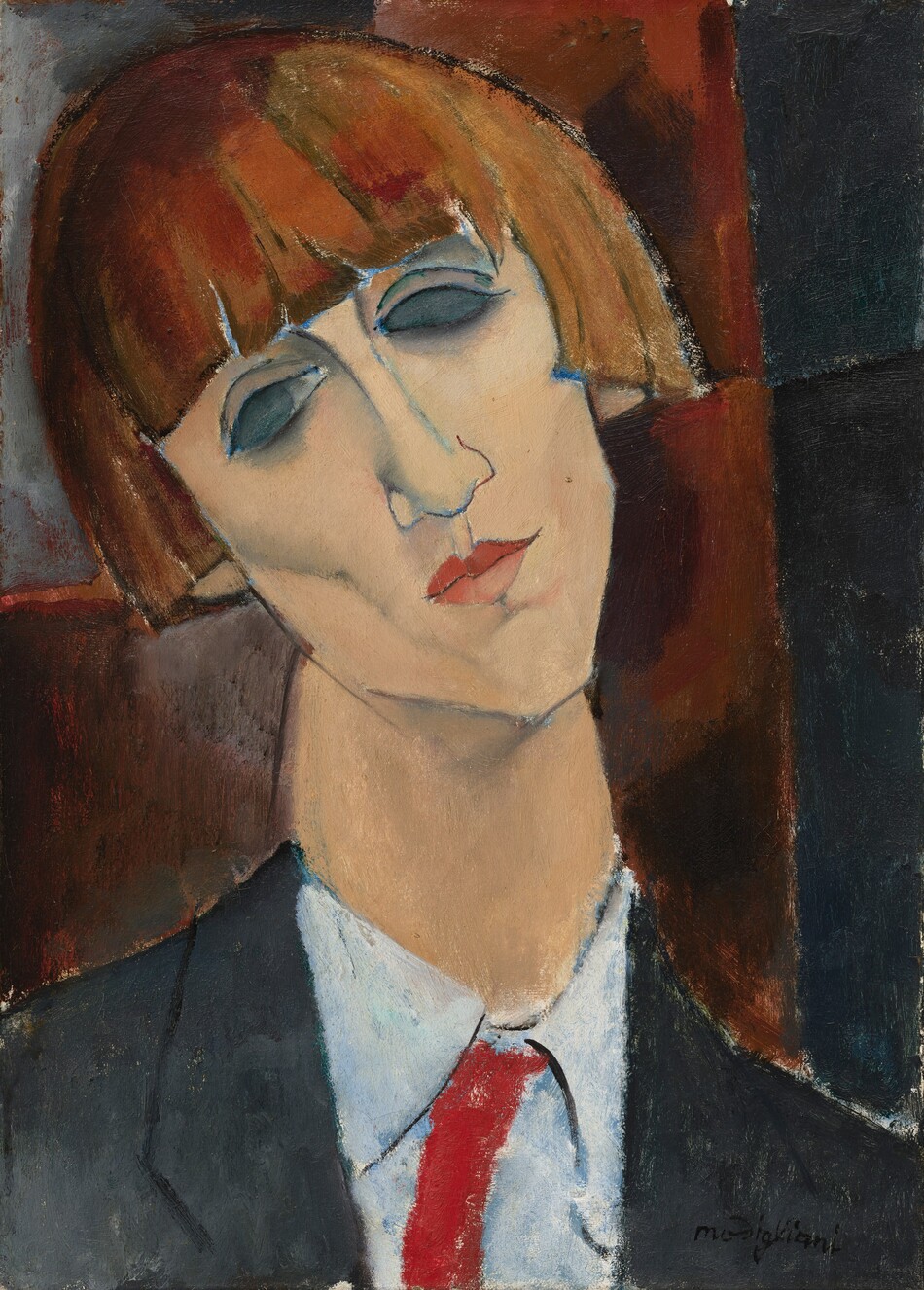
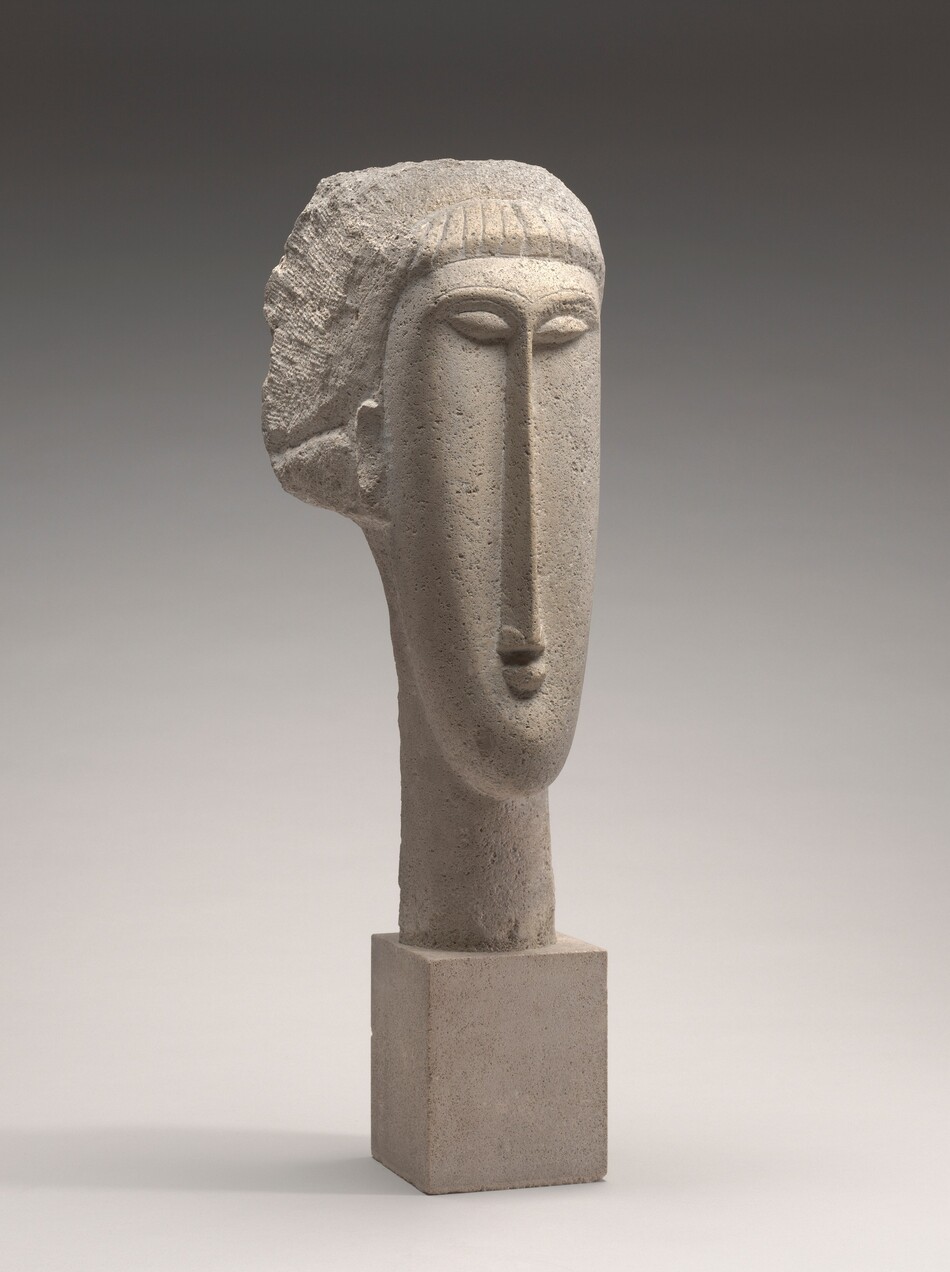
  • This vertical portrait painting shows the head and shoulders of a person with pale peach skin and an auburn, cheek-length bob hairstyle. The person has high cheek bones, deep pink lips, and an angular, pointed chin. The head is cocked to our left, and almond-shaped eyes are nearly blacked out. The black jacket has lapels over a white, collared, buttoned-up shirt with a crimson-red necktie. Shown against brick-red and black background, the portrait is painted with areas of relatively flat color but with loose brushstrokes that create a textured, mottled effect. The artist signed the work with black paint in the lower right corner: “modigliani.” 
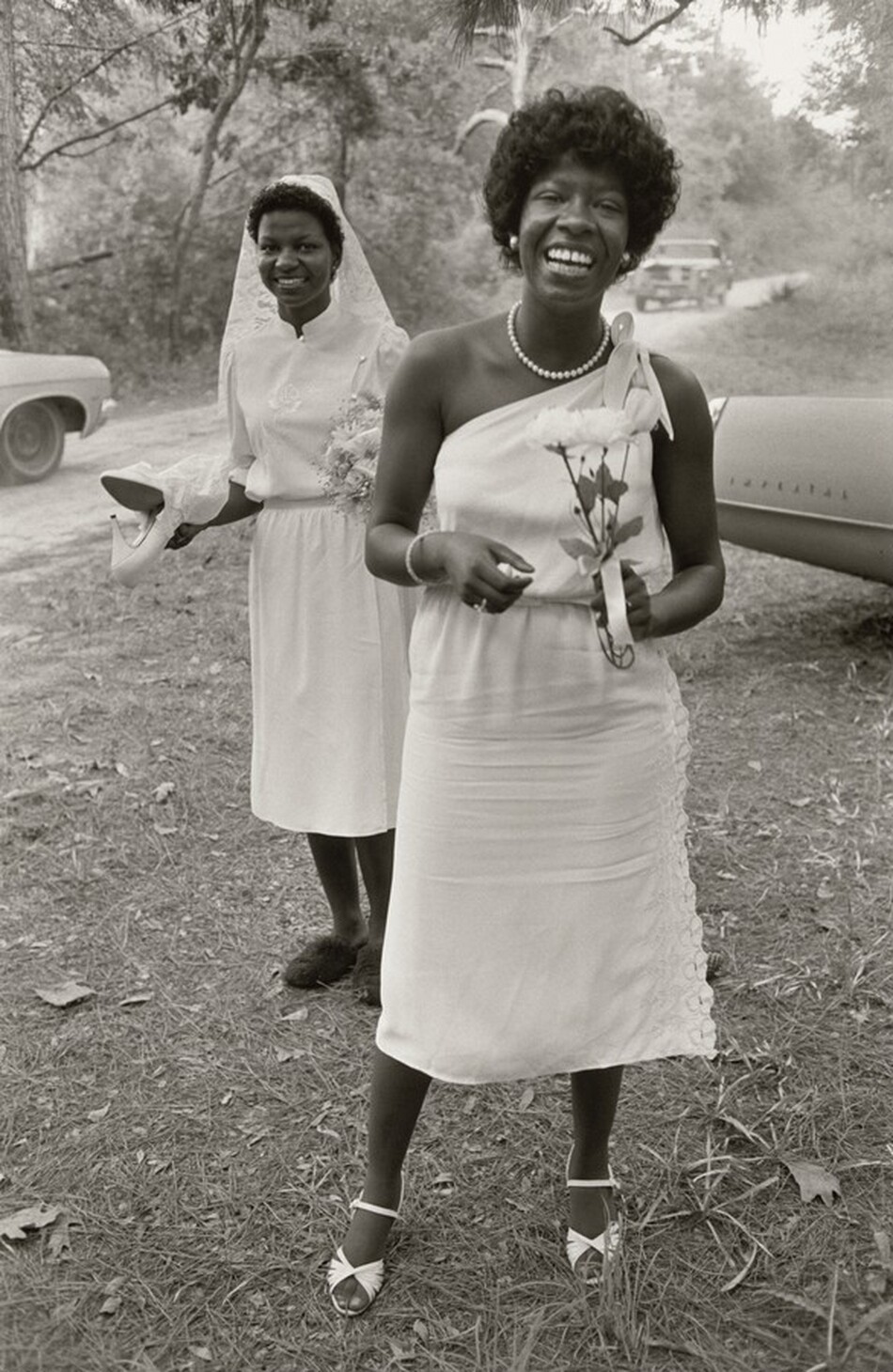
  • This is a black-and-white photograph showing two women standing outdoors. The woman closest to is smiling widely, looking right at us. She has dark skin and short, curly, black hair. She is wearing a white one-shoulder dress with a lacy floral design on the side, a string of pearls around her neck, a white bracelet, a ring, and round earrings. She is holding a bouquet of three white flowers tied with a ribbon, and she has white high heels on her feet. Behind her on the left is the second woman, who also looks out at us, smiling. She is wearing a high-necked white dress and a long, lacy veil. She also has dark skin and short, dark, curly hair under the veil. She holds a large bouquet of light-colored flowers in one hand, and a pair of white high heels in the other hand. On her feet she wears fuzzy gray slippers. The ground beneath the women is covered with grass and a few fallen leaves, and behind them is a dirt road with two cars passing by. Another car is partially visible on the right. Beyond the road are tall gray trees with a sliver of white sky visible near the upper right corner.
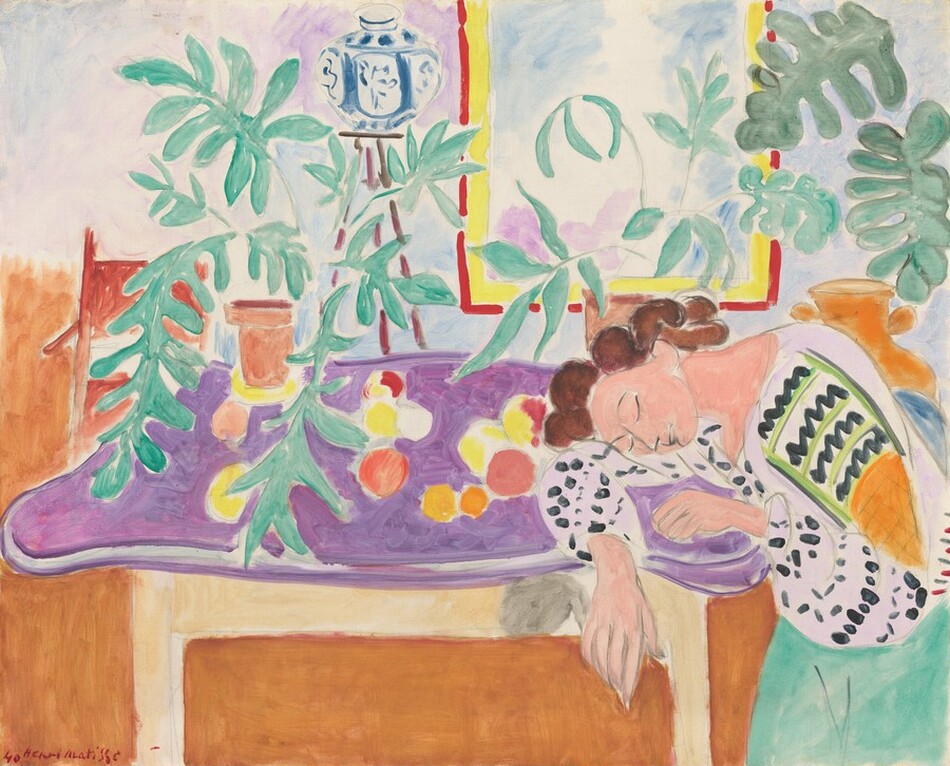
  • To our right in this vibrantly colored, stylized, nearly square painting, a woman with light, peach-colored skin and chestnut-brown hair sits slumped along a table as she sleeps, her head resting on one extended arm. The lilac-purple tabletop has round forms representing fruit scattered around a potted plant. Many of the forms are outlined with gray and filled in with mostly flat areas of color in mint and sage green, icy blue, coral red, orange, and lemon yellow. The tabletop curves around its edges and the surface is vivid purple, while the skirt and legs of the table are pale ginger brown. The woman’s head rests facing us on her bent right arm, that hand dangling over the front edge of the table. She rests her other hand, closer to us, near the crook of her elbow. She wears a white, blousy top with rows of navy-blue zigzags on the shoulder and elongated dots on the sleeves, and a light, mint-green skirt. Her brown hair seems to be pulled back and gathered into bunches of curving waves. Her stylized eyes, nose, and mouth are drawn simply with gray lines. The round orange, peach, and yellow fruit on the table are scattered near her arm and across the table to the other side, close to a plant in a brown clay pot. The plant has shoots of long, curving stems with vibrant spruce-green leaves. Two more plants are behind the woman near the back wall, in front a rectangular opening over the woman that could be a window or mirror. The glass is painted with streaks of baby blue and pale magenta pink around a field of white, and is outlined with a band of sunshine yellow and then scarlet red. The wall around it is also painted with watercolor-like, soft fields of pale blue and pink. The floor under the table and to our left is a flat field of caramel brown. Behind the table and to our left, forms suggest a wooden chair and a blue and white ceramic pot on a tall, spindly stand. In the lower left corner of the canvas, the artist signed and dated the work with dark red paint: “40 Henri Matisse.”
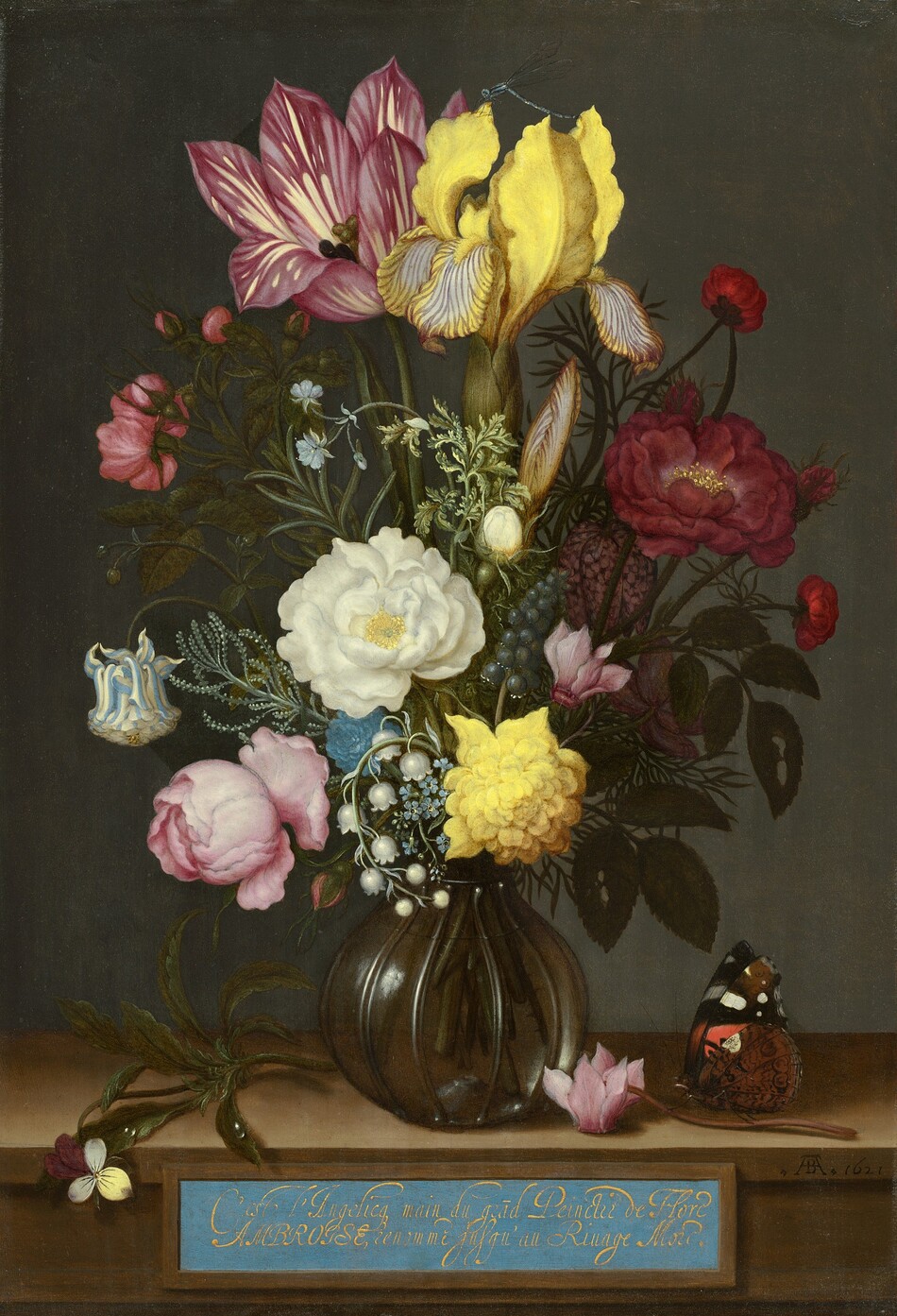
  • Gathered in a round glass vase, a tall bouquet of flowers in shades of light and deep pink, sunshine yellow, and white with pine-green leaves nearly fills this vertical still life painting. Shown against an gray background, the vase sits on a narrow ledge, perhaps made of wood. A label with looping, cursive French text painted in gold against a baby blue background is affixed to the front of the ledge, along the bottom edge of the composition. The text reads, “C'est l'Angelicq main du grad Peinctre de Flore AMBROISE, renommé jusqu' au Rivage Moré.” A few of the flowers draw the eye, including a tulip and iris at the top of the bouquet. To our left, the tulip is mauve pink with cream-colored streaks, and one petal folds down to reveal the stamen inside. Next to it, a damselfly, an insect like a delicate dragonfly, rests on the vibrant yellow iris. The petals curling down from the iris are veined in muted burgundy red. Flowers filling in the bouquet below include a shell-pink cyclamen, a white gardenia, a closed blue and white striped columbine, a slate-blue grape hyacinth, lily of the valley, pale blue forget-me-nots, and a pink peony interspersed with leaves and greenery. The round glass vase has a narrow opening. A sprig of viola rests to our left of the vase on the ledge, and an orange, black, white, and brown butterfly perches on the stem of a pink cyclamen laying to our right of the vase. The artist signed the painting with a monogram and dated it in dark paint to our right on the face of the ledge: “AB 1621.”
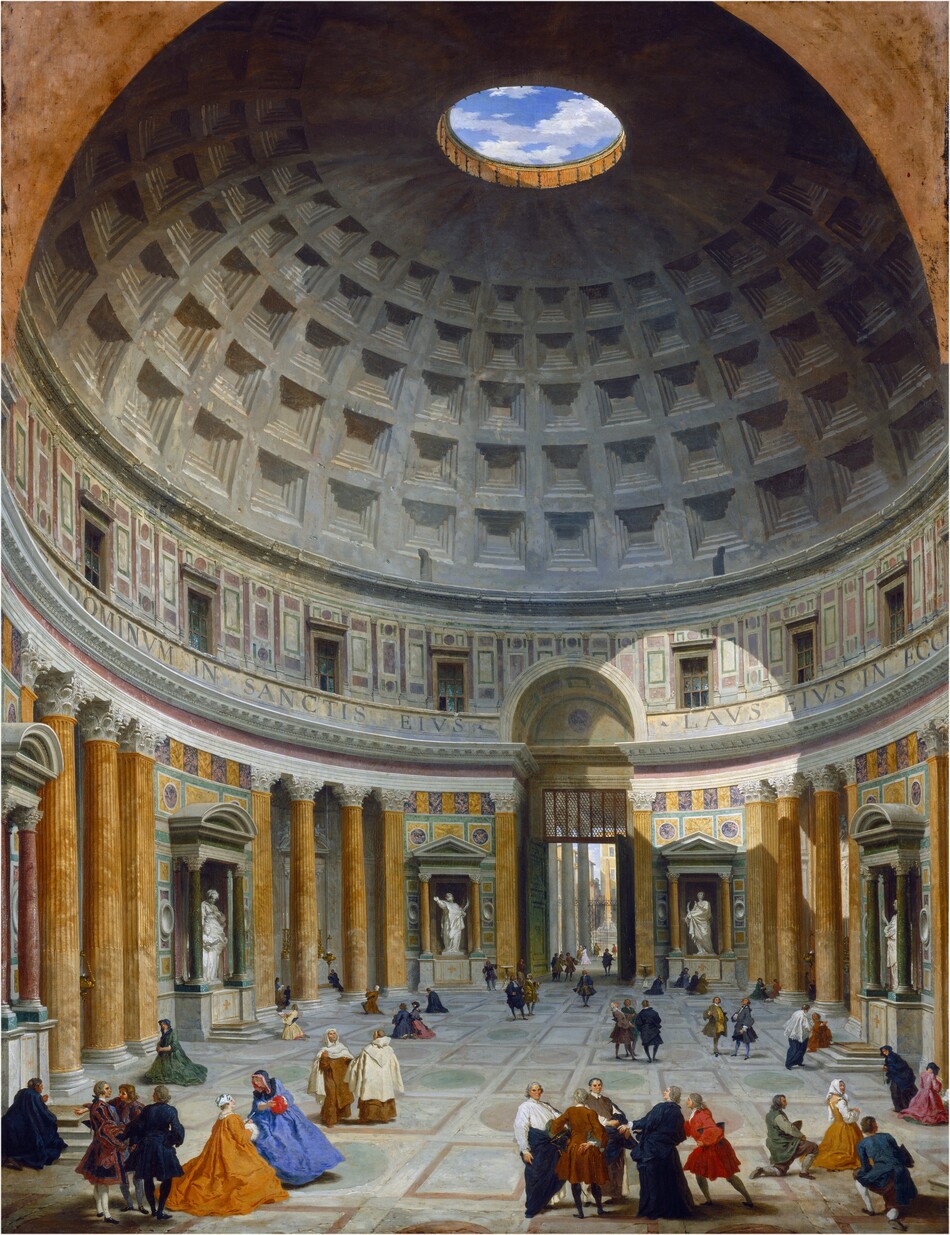
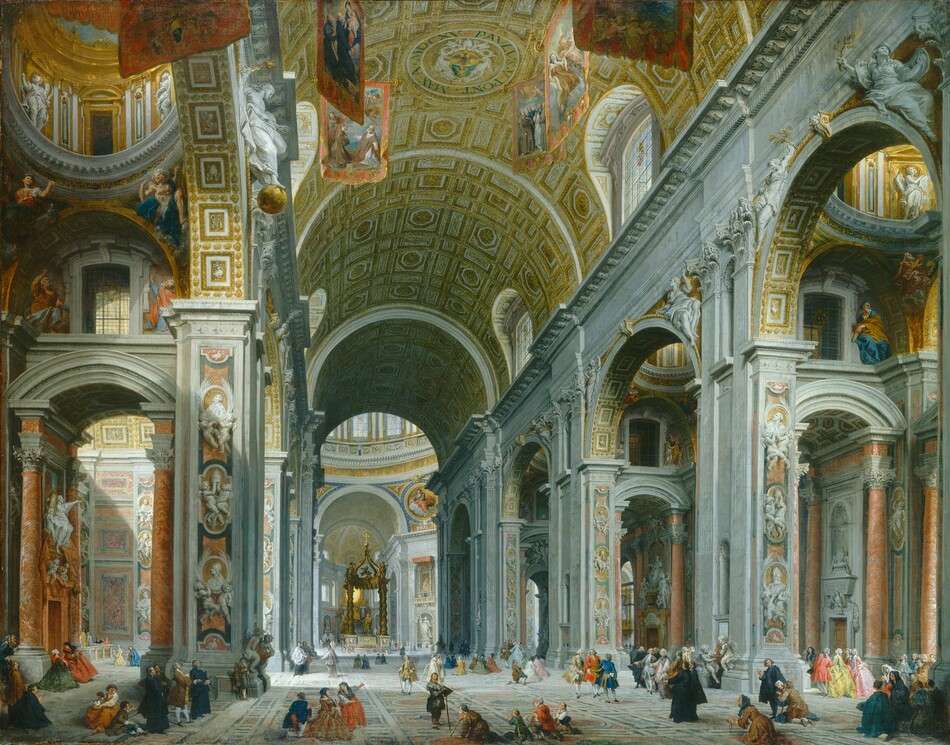
  • Dozens of men and women wander through a tall interior space lined with statues and columns and topped by a soaring domed roof in this vertical painting. The people are small in scale within the cavernous space. The women wear long, full dresses and the men wear knee-length waistcoats and stockings in shades of dark blue, crimson red, pine green, marigold orange, or brown. Three people wear clothing of the clergy: two of them, on our left, wear long, ginger-brown robes under white mantles, and a third person on our right wears a hip-length, diaphanous white cape over a long dark blue robe. The crowd strolls, kneels, converses, or leans back to look up at the high ceiling overhead, which has a round opening at its apex. A glimpse white of azure-blue sky with white clouds is visible through the opening. The interior is divided into three levels. The ground level has five niches lining the walls, each with a white stone statue of a man or woman standing inside. Each statue is at least three times the height of the people in the space below. The three niches closest to us on our left and right have semicircular pediments with garnet-red or moss-green columns flanking the statues. Two niches at the far end have triangular pediments and honey-gold columns. Each niche sits on a wide base, presumably an altar, and is surrounded by marbled gold and purple panels set against a sage-green background. Sets of three honey-gold columns line the wall between each niche. Oversized, copper-green double doors are swung inward at the far side of the space. More people, a sunlit obelisk, blue sky, and slivers of other buildings are visible through the doorway. The second level of the interior has windows spaced across walls otherwise covered with white, blue, and mauve-pink panels. An inscription running around the building between the first and second level reads, “DOMINVM IN SANCTIS EIVS LAVS EIVS IN ECCLE.” The third level is the domed pewter-gray ceiling with coffers, like inwardly stepped panels. The floor is patterned with alternating circles and rectangles in sage green or light brown.
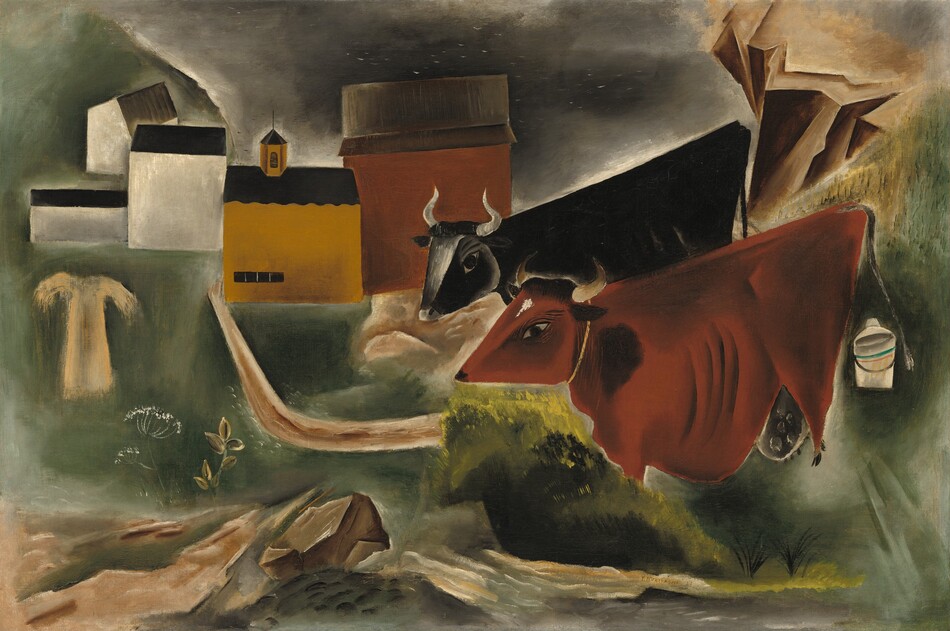
  • Two cows stand side-by-side to our right with a path leading to a row of buildings in the distance to our left in this dreamlike, stylized landscape painting. The forms are simplified, angular, and blocky, and seem to be overlapping, though most of the shapes painted with blended strokes. To our right, a black cow stands beyond a brown cow, both facing our left in profile. The heads are triangular and come to exaggerated points under curving horns, and the ribs of the cow closer to us are painted with curving black lines down the body. Their legs also taper to exaggeratedly pointed, tiny hooves. A milk jug sits to our right, behind them. The row of five buildings to our left are created with blocks of white, golden yellow, brick red, and black. A sprig of leaves and a lacy white flower grow to our left on the row of oatmeal-brown rocks jutting up along the bottom edge of the composition. An abstracted shirt-like form floats to our left against the background of teal green that covers the bottom two-thirds of the painting. The area above the buildings is painted with a field of silvery charcoal gray. The artist signed and dated the painting with tiny letters under the brown cow: "Y. Kuniyoshi 23."
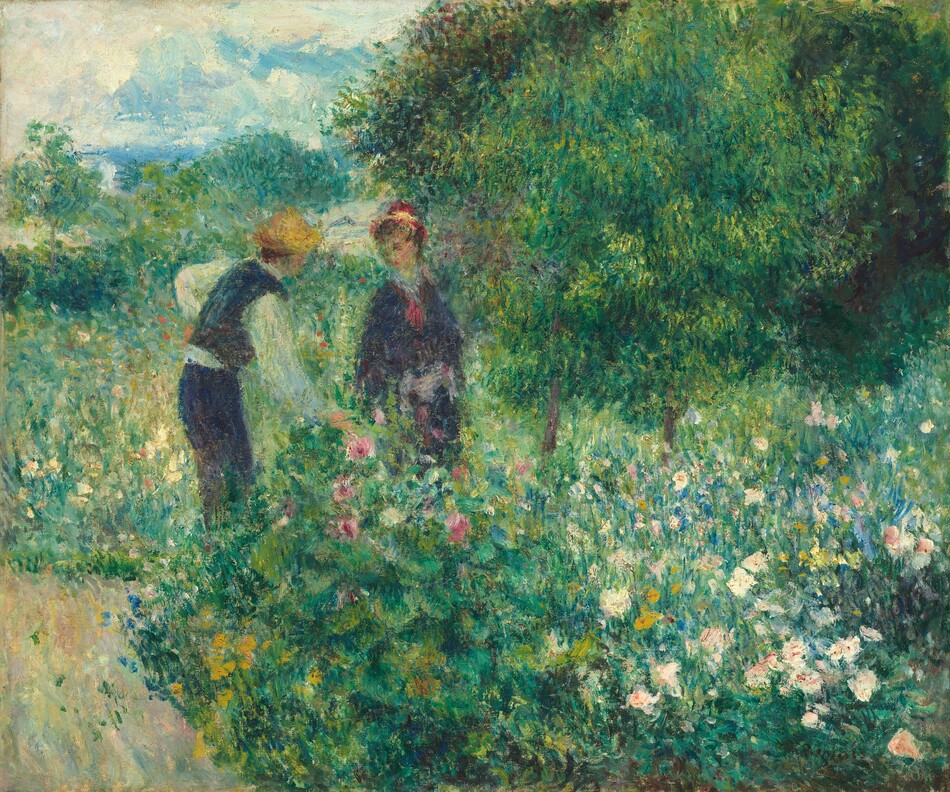
  • A light-skinned man and woman stand looking at each other, surrounded by blooming flowers and lush green trees in this square landscape painting. The palette is dominated by shades of vibrant green and blue, and is loosely painted with daubs and short strokes, making details indistinct. The people stand to our left of center and both are dressed in navy blue. The man stands facing our right, almost in profile, and bends forward slightly with one hand gesturing toward the flowers. He wears a vest and trousers, a white shirt, and a butterscotch-gold hat. The woman stands near him to our right, and faces us with her head turned to look at the man. She wears a long gown, a cherry-red hat, andwhat appears to be a denim-blue and cherry-red scarf around her neck. The trees fill right half of the painting, and the profusion of flowering bushes closest to us almost spans the width of the scene. Their blooms are suggested with touches of rose and petal pink, cream white, mustard yellow, and azure blue. More flowering bushes behind the man and woman are suggested by loosely painted areas of parchment white and laurel green, with scattered dots of poppy red. Pale pink clouds swirl through the topaz-blue sky in the upper left corner. The artist signed the painting in the lower right, “Renoir.”
  • This square portrait shows the head and shoulders of a young woman in front of a spiky bush that fills much of the background except for a landscape view that extends into the deep distance to our right. The woman's body is angled to our right but her face turns to us. She has chalk-white, smooth skin with heavily lidded, light brown eyes, and her pale pink lips are closed. Pale blush highlights her cheeks, and she looks either at us or very slightly away from our eyes. Her brown hair is parted down the middle and pulled back, but tight, lively curls frame her face. Her hair turns gold where the light shines on it. She wears a brown dress, trimmed along the square neckline with gold. The front of the bodice is tied with a blue ribbon, and the lacing holes are also edged with gold. A sheer white veil covers her chest and is pinned at the center with a small gold ball. The bush fills the space around her head with copper-brown, spiky leaves. A river winds between trees and rolling hills in the distance to our right. Trees and a town along the horizon, which comes about halfway up the painting, is pale blue under an ice-blue sky.
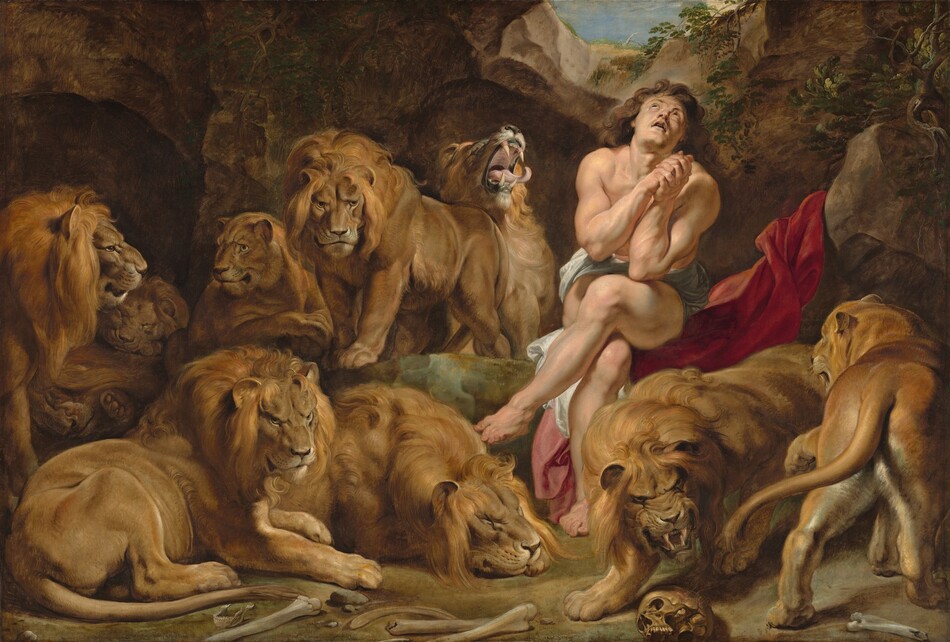
  • A nearly nude, muscular man with pale, peachy skin sits in an underground cave among seven male and two female lions in this horizontal painting. The man sits to our right of center with his legs crossed, elbows close to his body with hands clasped by his chest. His head tips back to look up through a small opening above. He has long, wavy, chestnut-brown hair and dark eyes. A white cloth wraps across his hips, and he sits on a scarlet-red swath of fabric draped up over a rock next to him. The nine lions stalk, sit, or lie down around the man. One male lion next to the man, to our left, opens his mouth with his head thrown back, curling tongue extended beyond long fangs. A human skull and other bones are strewn on the dirt ground close to us. The rocky cave curves up around the animals and man to a narrow, round opening showing blue sky above.
  • A mound of creamy, yellow butter sits to our left of center on a wooden table against an olive-green background in this horizontal still life painting. White cloth, presumably the wrapper or cover, is pushed down around the base of the mound to expose the heap of butter. The top of the mound has a few gouge marks and furrows. A long, narrow wooden paddle is stuck vertically into the right side of the mound, and is submerged almost up to the handle in butter. Two white eggs rest on the table in front of the white fabric, to our right of center. Loose brushstrokes are visible throughout, so the swipes of paint seem to almost become the butter. The artist signed the painting with black letters in the lower left corner: “A. Vollon.”
  • We look slightly down onto a stage, at a woman who dances at the center of this square painting. The pale, white skin on her face is tinged with slate-blue shadows and heightened noticeably with pink blush at the cheekbones. She wears crimson-red lipstick and her dark brown eyebrows are peaked over blue eyes. Two flaring pink flowers, each about the size of the woman’s face, are pinned in the woman’s flame-red hair. The black bodice of her dress has puffed, elbow-length sleeves and a low-cut square neckline. The lime-green skirt flares around her dancing feet to billow up and reveal layers of bubblegum pink underneath. Her body is angled to our left as she points her left, black-stockinged foot and holds her arms by her sides. Behind her, thirteen people dressed in sapphire-blue, ocean-green, and black costumes suggest a royal court, including a dark-haired man who wears a brick-red bolero style suit. He stands near the woman to our right, watching her dance.
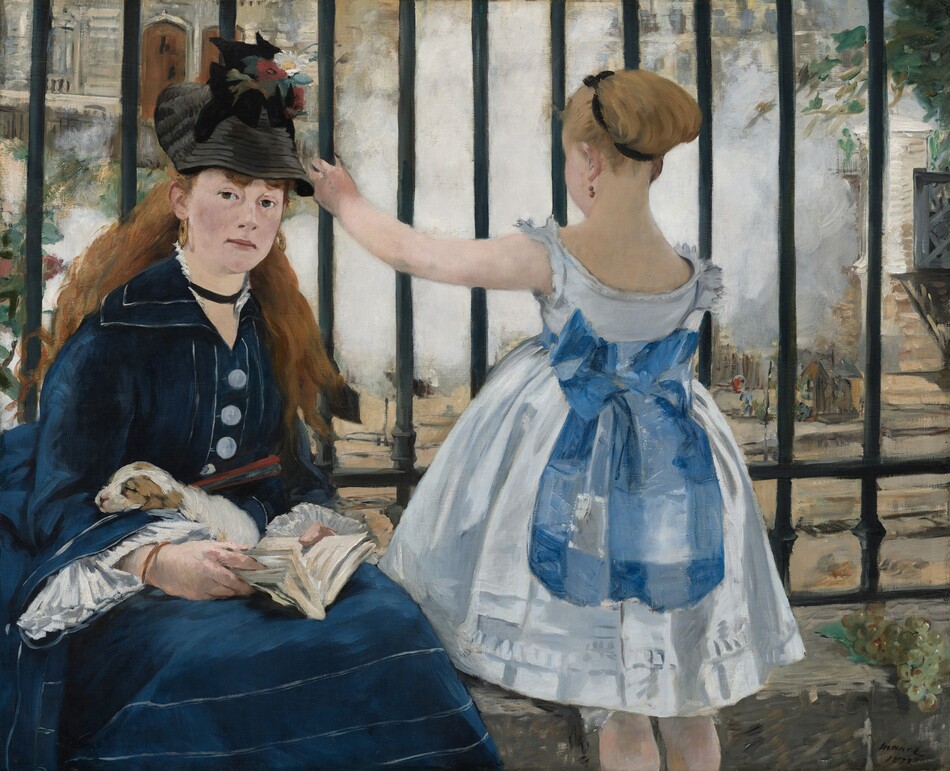
  • To our left, a young woman sits facing us on a low stone wall at the base of the vertical, black bars of an iron fence and a young girl stands facing away from us to our right in this horizontal painting. Both have pale skin. The woman looks directly at us with dark eyes as she holds an open book, a closed red fan, and a sleeping brown and white puppy in her lap. Her long auburn hair falls down over her shoulders. Her navy-blue dress is accented with white piping on the skirt, collar, and sleeves, and has three large, white buttons down the front and her black hat is adorned with two red poppies and a daisy. The girl wears a sleeveless white, knee-length dress belted with a marine-blue sash tied in a large bow at her back. The girl’s blond hair is pulled up and tied with a black ribbon. She raises her left hand to grasp the bar of the fence she faces. A bunch of green grapes lies on the low wall to our right. A plume of steam fills much of the space beyond the black fence, which spans the width of the painting and extends off the top edge. A few details can be made out beyond the fence, including a stone-gray building with two wooden doors to our left and a bridge along the right edge.
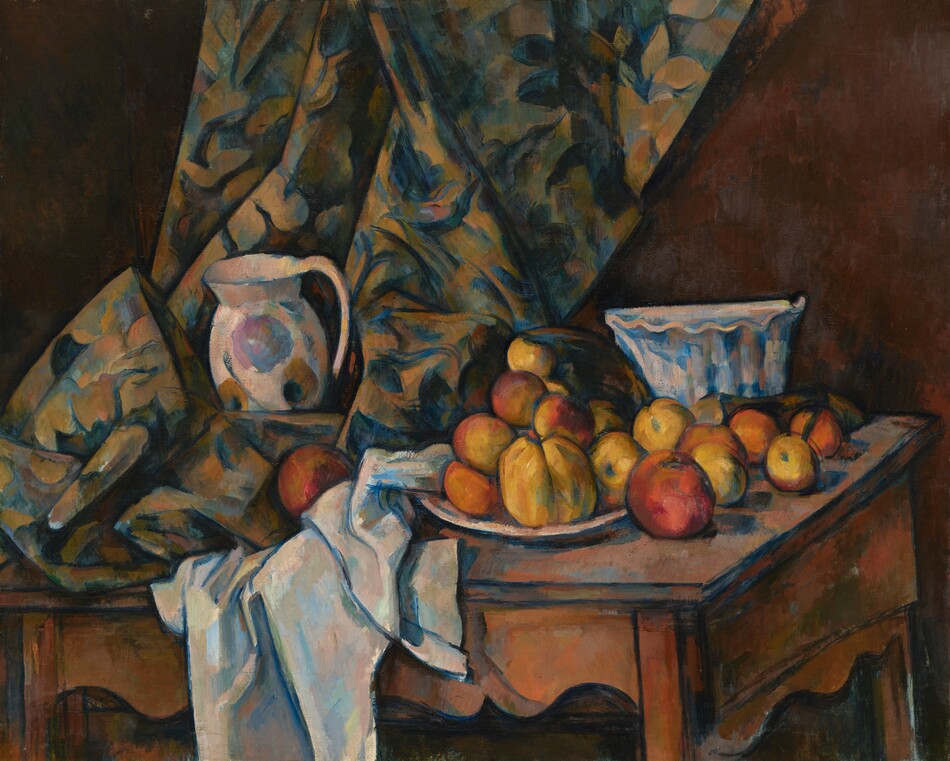
  • About a dozen rust-orange and golden yellow apples and peaches are arranged on a white plate next to white and floral-patterned cloths nestled around a white pitcher and bowl, all on a wood tabletop that tilts toward us in this nearly square still life painting. A curtain patterned with royal blue, olive green, and beige falls along or near the back wall of the room and rests on the table to our left. The white pitcher is painted loosely with the suggestion of harvest-gold and pale lilac-purple flowers, and it sits amid the pooling folds of the curtain to our left. The white tablecloth is bunched under and next to it to our right, at the middle of the composition. The fruit is arranged on and around a white plate next to the tablecloth. A tall bowl with fluted sides and a ruffled, scalloped rim sits behind the fruit, near the right edge of the table. The curving skirt of the table reaches nearly to the bottom edge of the canvas. All the objects in the painting are outlined with dark blue and the shadows are painted with patches of spruce and cobalt blue.
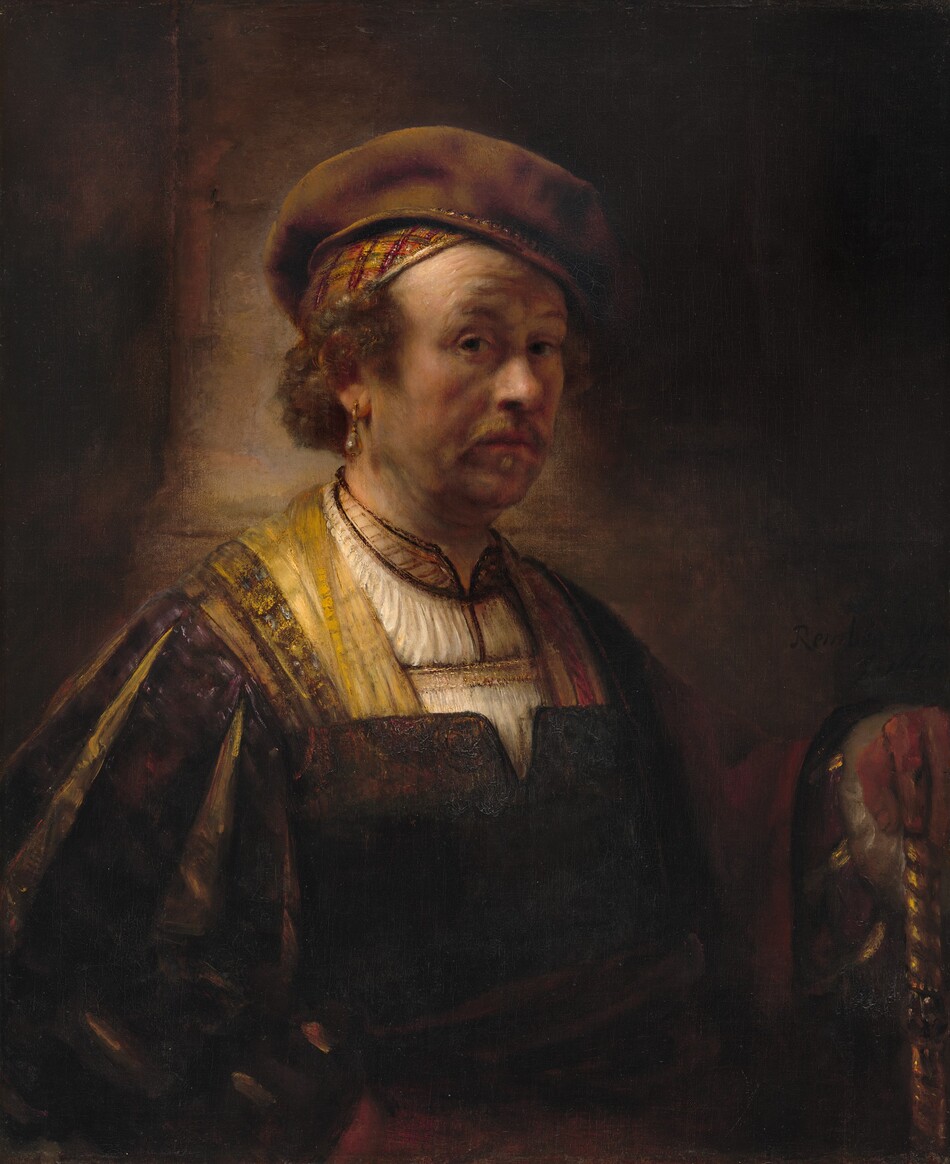
  • Shown from the waist up, a man dressed in fine clothing looks out at us from against a deeply shadowed background in this vertical portrait painting. The man’s pale, peachy skin has a warm undertone that glows in a stark light source from our left. His body and face are angled to our right, and he cuts his dark eyes back to look at us under raised brows. He has a rounded, bulbous nose, and a wispy golden-brown goatee frames his closed pink lips. Shadows on his cheeks and jowls suggest soft flesh and a five o’clock shadow. Wiry brown hair curls out over his temples and down to the nape of his neck beneath a green, gold, orange, and burgundy-red skullcap. A soft brown beret rests on top of his skullcap tipped at an angle away from us. A teardrop-shaped pearl earring hangs from a gold setting in the ear we can see. He wears a cream-white tunic with gold and brown detailing along the hemlines. Over that is a dark brown, vest-like garment. The sleeves are slashed so the outer fabric is eggplant purple, and the inner slashes are golden yellow. A red cloth drapes over his left arm, farther from us, and that hand rests on a gold, spiraling shaft. A dark sash may be tied around his waist, and it seems that his other hand rests against his hip, to our left. The lower half of his chest and the background fall into deep shadow, though, so some the details there are difficult to make out. The painting is signed and dated in dark letters in a shaded area, so is nearly invisible in the lower center right; it reads, “Rembrandt f. 1650.”
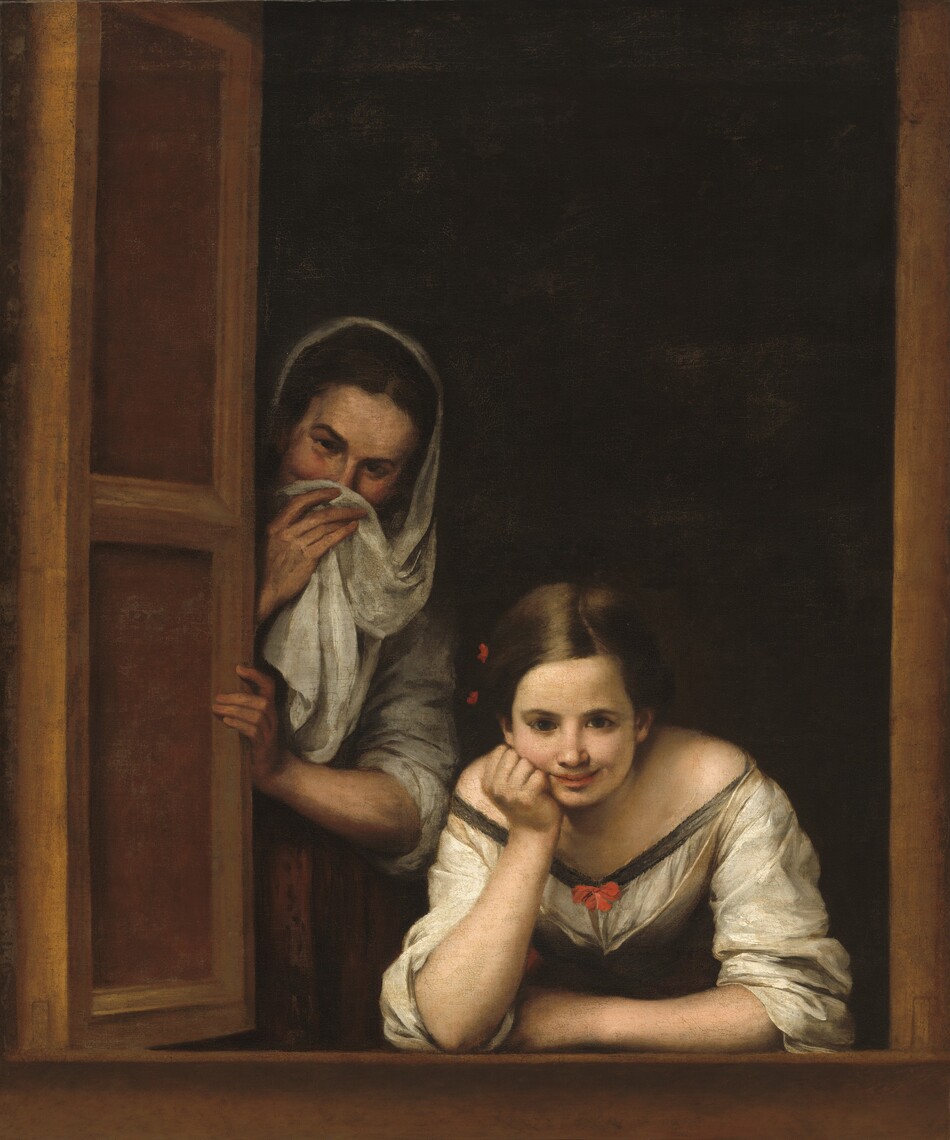
  • Two women with pale skin look out at us from the other side of a rectangular window opening with a shadowy interior behind them in this vertical painting. On our right, in the lower third of the composition, one young woman leans toward us over her left arm, which rests along the window ledge. She bends her right arm and props her chin on her fist. She looks at us with dark brown eyes under dark brows. She has shiny chestnut-brown hair with a strawberry-red bow on the right side of her head, to our left. She has a straight nose, and her full pink lips curve up in a smile. She wears a gossamer-white dress with a wide neckline trimmed in dark gray, with another red bow on the front of her chest. Her voluminous sleeves are pushed back to her elbows. To our left, a second woman peeks around a partially opened shutter. She is slightly older, and she stands next to the first woman with her body facing us. She tilts her head and also gazes at us with dark eyes under dark brown brows. She has dark brown hair covered by an oyster-white shawl. She holds the shawl up with her right hand to cover the bottom half of her face. Her mouth is hidden but her eyes crinkle as if in a smile. Her left arm bends at the elbow as she grasps the open shutter. She also wears a white shirt pushed back to her elbows, and a rose-pink skirt. The frame of the window runs parallel to the sides and bottom of the canvas. The room behind them is black in shadow.
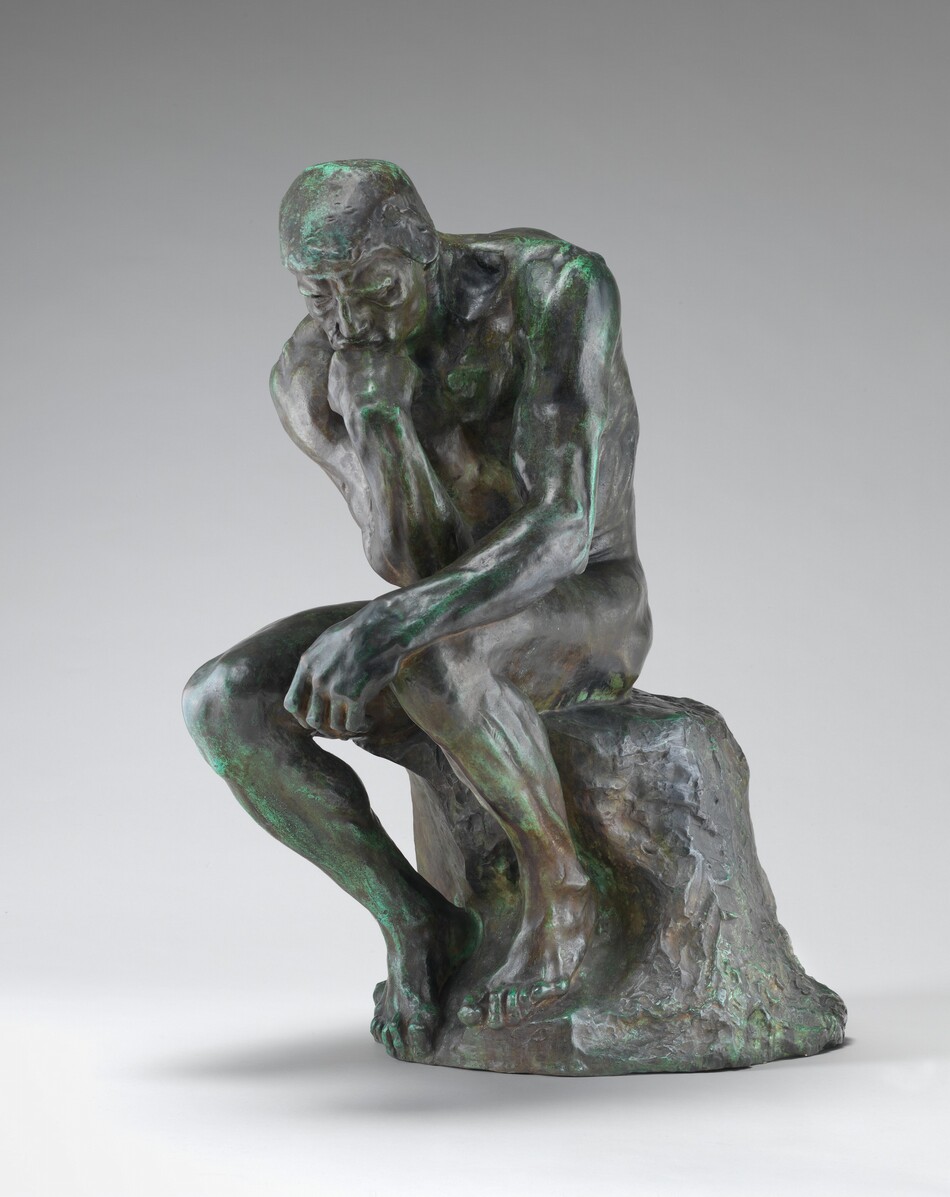
  • This free-standing bronze sculpture shows a nude, muscular man sitting on a rock and resting his chin on the back of his right hand, with that elbow propped on his left knee. In this photograph, the man’s body is angled slightly to our left. He hunches a bit as his body twists so his right elbow, on our left, reaches the opposite knee. His other rests along his leg so the hand dangles beyond the knee. The man has short-cropped hair, a furrowed brow, an angular nose, and lines around his mouth and eyes. The foot on our right rests higher on the rock so that knee juts up a little higher than the other. The bronze has a greenish patina, especially noticeable along the top of the man’s head and shoulders and the front of his lower legs.
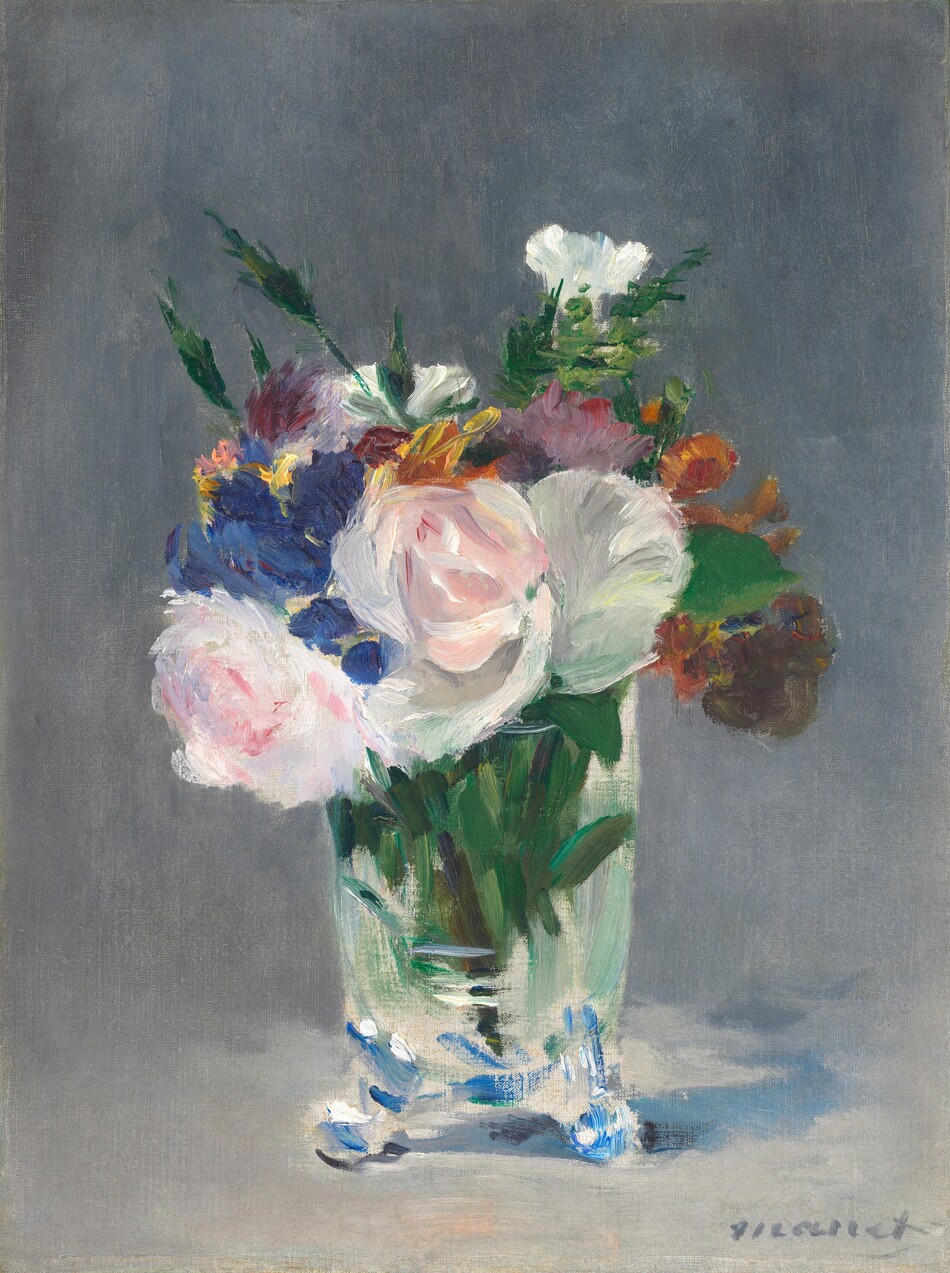
  • A bouquet of cut flowers in a clear glass vase nearly fills this vertical painting. The vase has straight sides and the rounded bottom is supported by short, round feet. Some of the flowers can be identified as white roses and carnations but other less defined flowers are executed in quick touches of delphinium blue, marigold orange, brick red, and butter yellow. Green stalks and leaves are interspersed throughout, and green stems fill the vase. Some of the flowers and vegetation are thickly painted, and these contrast with other areas where the paint is more thinly applied. The bouquet is set against a pale gray background, and the vase casts a subtle blue shadow to our right. The artist signed the painting in gray letters at the lower right: “Manet.”
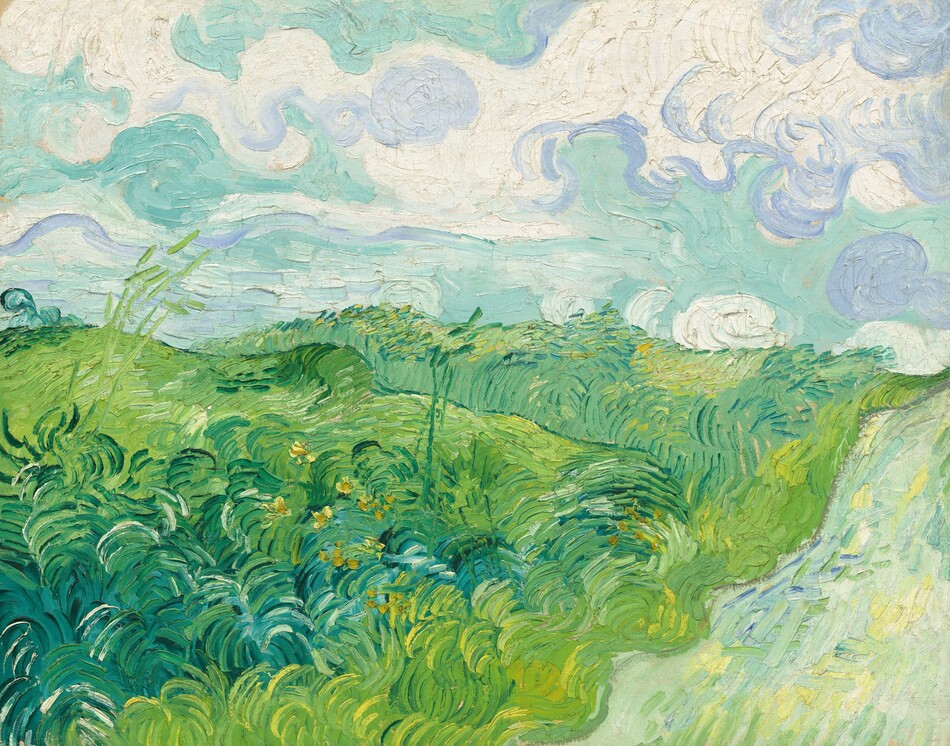
  • Verdant green fields roll in undulating waves back alongside a road in this horizontal landscape painting. The fields take up the left and center of the composition and are painted with thick, curling strokes of emerald, pea, and celery green, and corn yellow to suggest grasses and plants. The pale green road runs up along the right edge of the painting, and is layered with strokes and daubs in butter yellow, spring green, and faint blue. The fields and road meet the horizon line about halfway up the canvas, where an aquamarine-blue sky swirling with white and periwinkle-blue clouds fills the top half of the painting.
  • We look slightly down into a lime-green and white rowboat carrying a woman holding a baby and a man in this nearly square painting. The man wears midnight-blue shoes, pants, jacket, and soft, floppy cap. He sits with his back to us, bending forward to row the boat, which is cropped by the bottom edge of the canvas. The left side of his ruddy face is visible over his left shoulder. The woman and baby both have pale skin. The woman and baby sit across from the man, facing us to our left in the bow. The woman’s long-sleeved, sky-blue dress is crosshatched with pink lines. The baby leans back in the woman’s arms, and wears a pink dress, blue socks, and brown shoes. The wide-brimmed hats on both the woman and baby are painted pale celery green. They gaze toward or just past the man. The corner of the boat’s sail, also painted pale green, is pulled taunt by the wind to our left. Azure-blue water surrounds the boat up to the high horizon line, which brushes the top edge of the painting. The shoreline in the distance is lined with trees and dotted with white houses with red roofs.
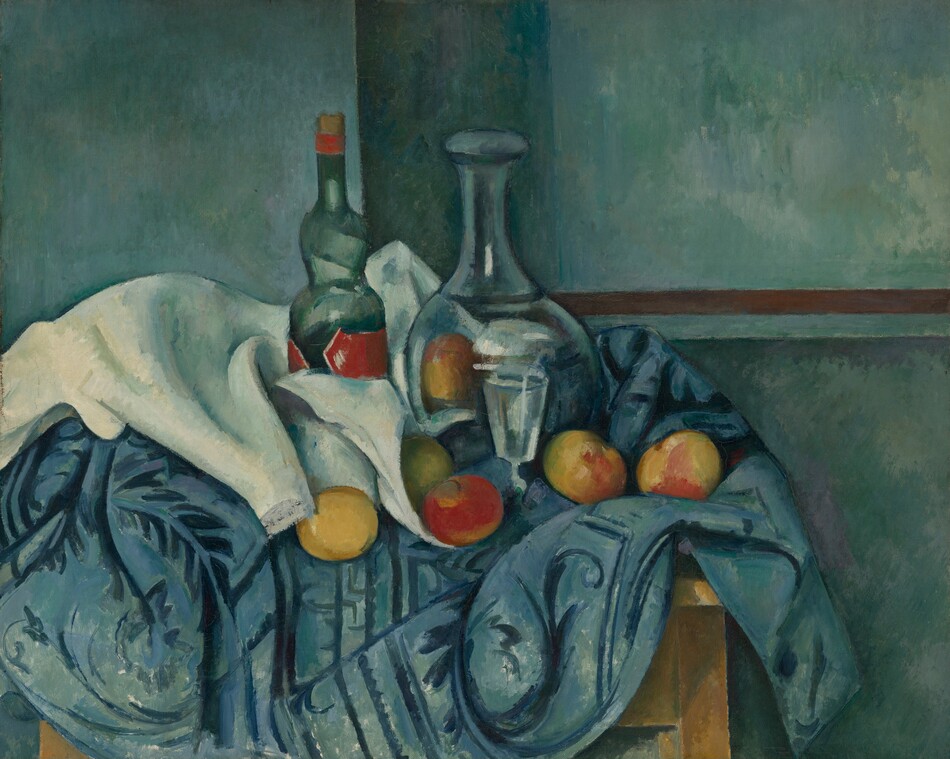
  • A glass bottle, a glass carafe, a stemmed glass, several pieces of fruit, and white and blue cloths are arranged on a wooden table in this horizontal still life. The bottle and carafe are at the center of this composition. The bottle has a crimson-red label, and the carafe has a tall, narrow neck and a rounded body. The stemmed glass has straight, flaring sides, and it sits on the table just in front of the carafe. Several pieces of fruit, painted in reds and yellows, are interspersed on the white cloth that surrounds the glassware. The muted, celestial-blue tablecloth is patterned with scrolls and leaves, and it bunches around the objects on the tabletop. The wall behind the table is mottled with cool blues and greens, and a brown line, perhaps a chair rail, runs from behind the still life to the right edge of the painting. Short brushstrokes are visible throughout.
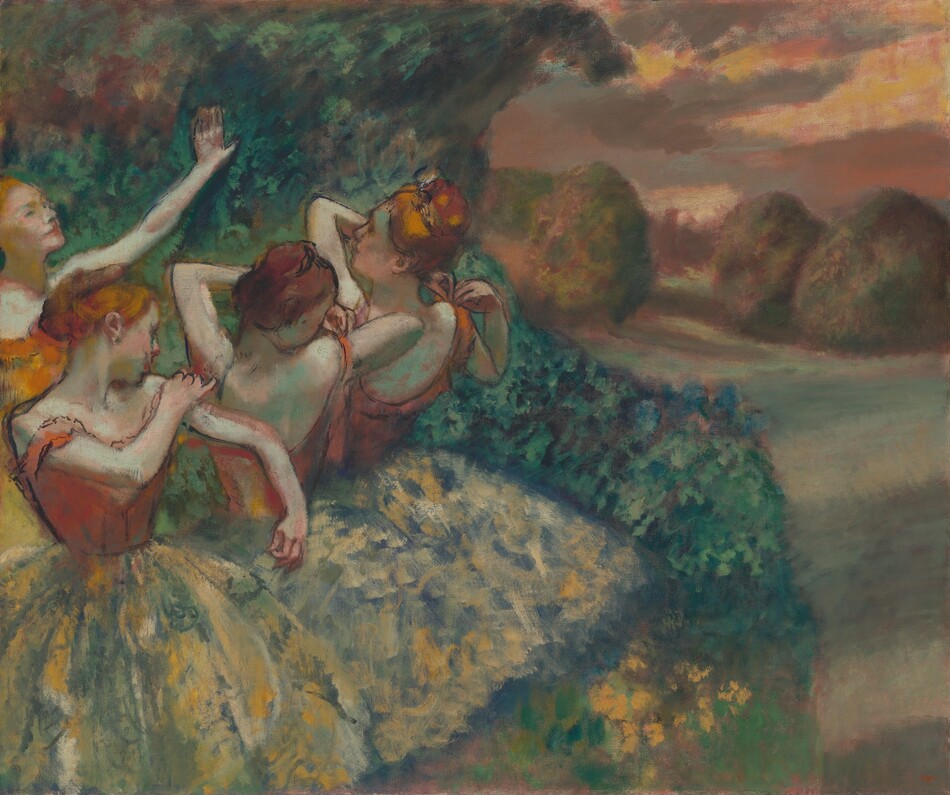
  • Four light-skinned ballerinas with russet-orange hair tied back in buns adjust the straps of their bodices as they gather close together, their bodies and wide, knee-length tutus taking up the left half of this horizontal painting. The background or backdrop beyond them shows a grove of deep green trees to our left and a sunset view of meadows leading back to trees to our right. Three of the dancers stand in a row that extends from the lower left corner to our right and away from us. All three wear rust-orange bodices over tutus that are painted loosely with flecks of pale celery green and buttercup yellow against a muted royal-blue background. Their bodices and upper bodies are outlined with black. The woman closest to us stands with her body angled to our right. Her face turns away as she looks to her left and adjusts that shoulder strap. The two dancers farther from us stand with their backs to us, their bodies angled away from us to our left. The middle dancer looks back over her right shoulder as she lifts the other elbow to adjust that strap. The third dancer in the row holds both hands to her right strap as she looks off into the distance, to our left. The fourth ballerina, to our far left beyond this trio, stands with the arm we can see, her left, lifted with her hand held high as she looks off to our right. Her bodice is a brighter carrot orange, and is more loosely painted. The green foliage behind the dancers extends off the top edge of the painting. The pale sage-green field to the right stretches before puffy, rounded trees daubed with mauve-pink highlights. The coral-pink and golden yellow sky is streaked with lavender-gray clouds. The artist signed his name in red paint with tiny, almost illegible letters in the lower right corner, “Degas.”
  • A pale turquoise footbridge arching over a pond lined with tall grasses and filled with petal-pink and butter-yellow waterlilies spans this horizontal landscape painting. The scene is loosely painted with touches of vibrant color. In the top third of the composition, the shallowly arched bridge nearly touches the top edge of the canvas, and it extends off each side. The shadows on the bridge are painted with eggplant purple. Bands of waterlilies gently zigzag into the distance on the surface of the water. The spring and emerald-green grasses growing along the banks fill the space around and over the pond, and they blend into a screen of trees beyond that enclose the scene. The green of the grasses and trees is reflected in the surface of the water, as is the underside of the bridge. The artist signed and dated the work with dark paint in the lower right corner: “Claude Monet 99.”
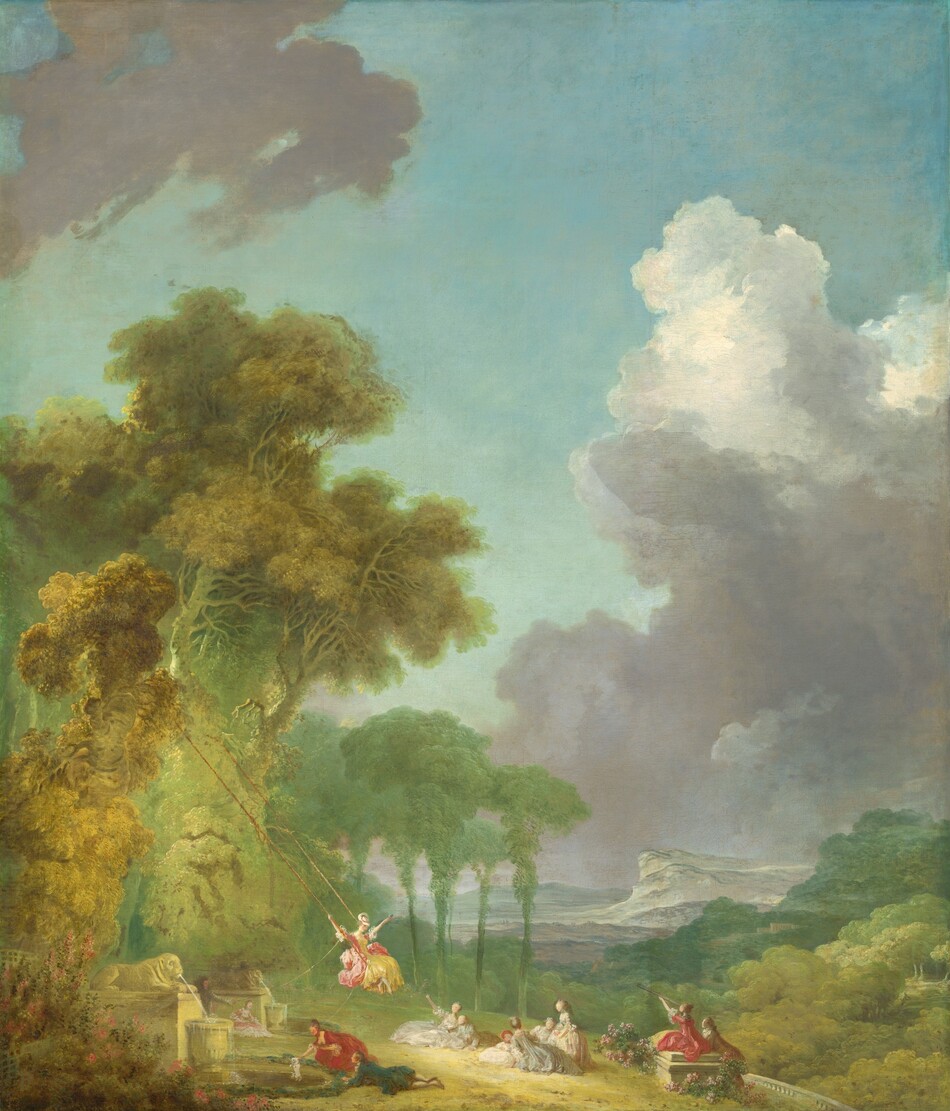
  • From a distance, we look down onto and across a lush park filled with elegantly dressed, light-skinned adults and children gathered in small groups as one woman swings from tall trees in this vertical painting. The color palette is dominated by celery and avocado green and soft straw yellow. An aquamarine-blue sky with towering white and ash-gray clouds fills the upper three-quarters of this painting. On our left, soaring trees reach two-thirds of the way up the composition. Two walls mark an entrance to the garden in the lower left. Stone fountains carved into the shape of lions sit on top of the walls with streams of water pouring from their mouths to urns below. People gather next to the entrance and further down a slope to our right. They relax together in pairs except for one group, which has two women and two children. The women’s long dresses have ruffled sleeves that come to their elbows, and the men wear long jackets and knee-length britches over stockings. A woman wearing a butter-yellow and rose-pink ball gown sits on a swing with ropes tied back into the trees to our left. She swings out diagonally high above the other people. Below the woman, some of the people watch and point to her as she swings. To our right, a woman in a crimson-red and yellow gown sits on a boxy, stone structure and looks through a telescope while a man leaning onto the box, wearing a brown coat, looks on. A woman in a strawberry-red dress and a man in a teal-blue jacket play with a small white dog at the edge of the pool in front of the entrance while another woman and man sit and stand between the entrance walls. In the distance to our right, trees and shrubs grow in front of pewter-gray hills under the lavender-purple horizon.
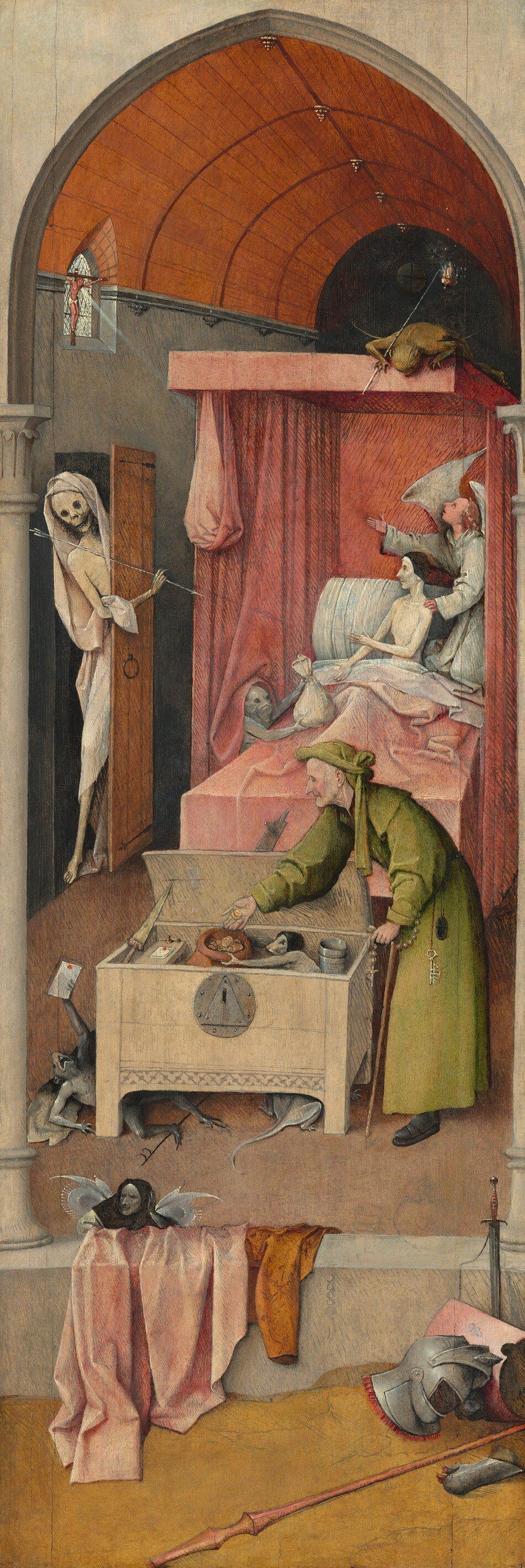
  • A naked man with ghostly white skin sits upright in a canopied bed set in a narrow room in this tall, vertical painting. Wearing a black cap, he looks to our left in profile toward a skeleton who comes through a door along the left edge of the composition. The man gestures at the skeleton with one hand and, with the other, toward a bag of money held up by a small demon next to the bed to our left. The skeleton wears a white shroud and holds an arrow. A winged angel kneels next to the man in the bed, one hand on the man’s shoulder and the other lifted to gesture at a crucifix hanging in the window over the door. A small devil on the canopy above looks down onto the bed. At the foot of the bed, a man wearing a green robe and headdress drops coins into a sack held by another demon. Three more demons crawl about and hide under the chest. Pieces of armor and weapons lie on the ground to the right in front of a stone ledge in the foreground. Two pieces of clothing drape over the ledge to our left.
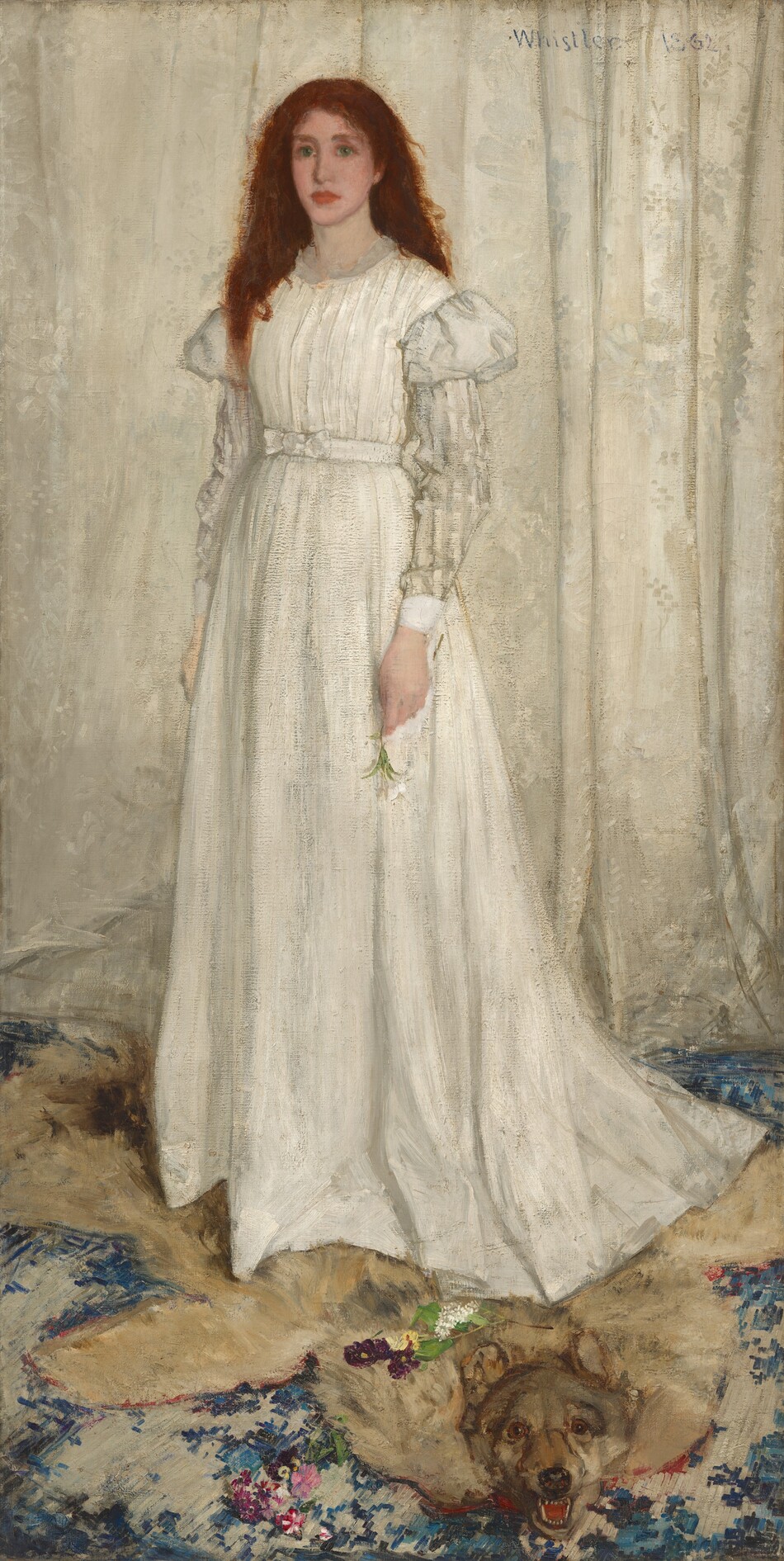
  • A young woman with pale, peachy skin, wearing a long, flowing white dress, stands in front of a white curtain in this vertical portrait painting. Her auburn-red hair cascades down over and behind her shoulders. She looks to our left with green eyes, and her pink, full lips are closed. Her dress has puffed shoulders above a white-on-white striped pattern on the long sleeves. She stands on an animal pelt; it is not clear whether it is a wolf or a bear. The pelt spans the width of the painting and overlaps a blue patterned carpet. The animal’s mouth gapes to show sharp teeth. Its glassy eyes are wide open, and it seems to look at us. The edges of the animal skin are red. The woman holds a white lily by her side in her left hand, while yellow and purple flowers lie scattered on the pelt.
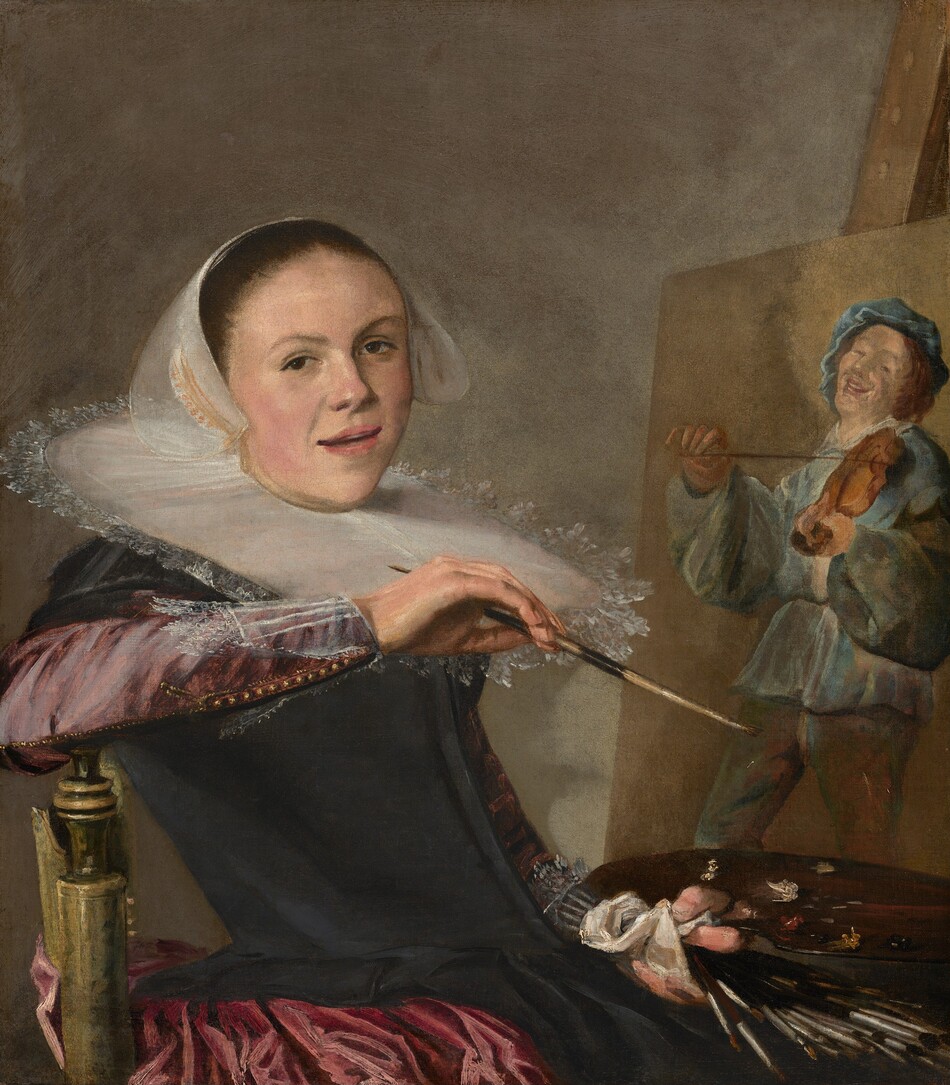
  • Shown from about the waist up, a woman with smooth, pale skin sits in a chair facing our right in front of a canvas on an easel in this vertical portrait. She leans onto her right elbow, which rests on the seat back. She turns her face to look at us, lips slightly parted. Her dress has a black bodice and a deep rose-pink skirt and sleeves. She wears a translucent white cap over her hair, which has been tightly pulled back. A stiff, white, plate-like ruff encircles her neck and reaches to her shoulders. She holds a paintbrush in her right hand and clutches about twenty brushes, a wooden paint palette, and a rag in her left hand, at the bottom right of the canvas. The painting behind her shows a man wearing robin's egg-blue and playing a violin.
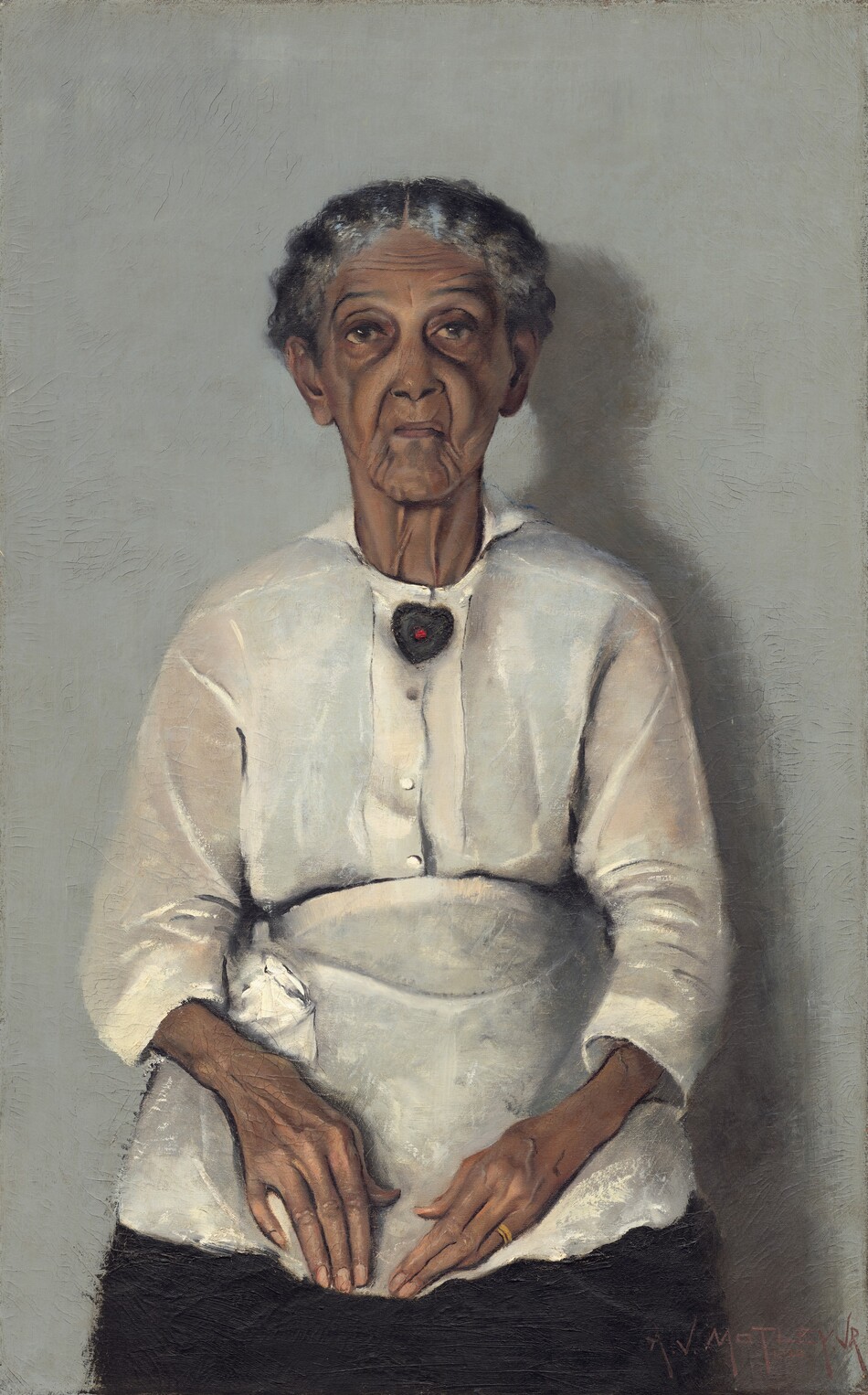
  • Shown from the knees up, a woman with brown, wrinkled skin, wearing a white blouse, apron, and black skirt is shown in front of a pale gray background in this vertical portrait painting. Straight-backed, she faces and looks at us with her hands resting in her lap. Her wavy, iron-gray hair is parted in the center and pulled back from her face. Her eyebrows are slightly raised, and her face is deeply lined down her cheeks and around her mouth. She wears a heart-shaped brooch with a red stone at its center at her neck and a gold band on her left ring finger. The light coming from our left casts a shadow against the wall to our right. The artist signed and dated the painting in the lower right corner: “A.J. MOTLEY. JR. 1922.”
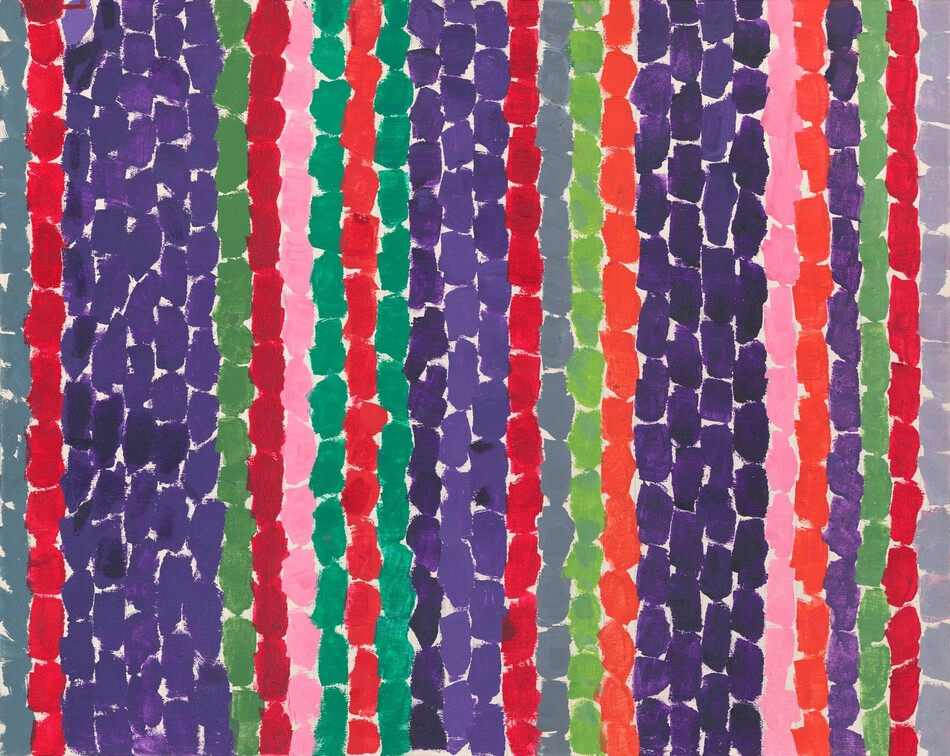
  • This painting is a composition of vertical lines made up of irregular segments. These lines are in various colors, and have been made with short, distinct brushstrokes. The lines are in purple, green, pink, red, and gray hues. Some of the white of the canvas is visible between the brushstrokes.
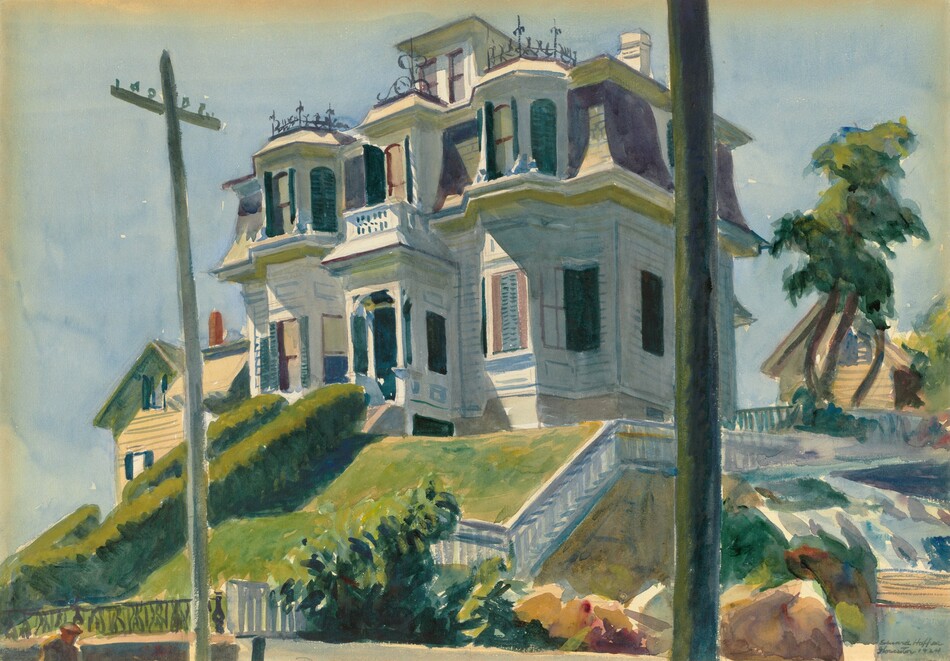
  • From the bottom of a hill, we look up at a house with white siding and pine green shutters flanking several bay windows in this horizontal watercolor painting. Two powerlines rising from the street in front of us visually frame the house, and the right-hand pole reaches off the top edge of the composition. Spring-green grass and trimmed box hedges presumably flank unseen stairs leading up to the front door, which sits within a narrow, covered porch. There are two bay windows on the first floor, one on either side of the central porch. Three-sided bay windows on the second floor mirror those on the first, and the central window, over the front door, also sits within a narrower bay. The uppermost story is seen only as a pair of windows either set into a gable or dormer. The roof on the second level, around the bay windows, is slate gray, and the shadows are painted deep plum purple. Curling ironwork lines the second-story bays in front of the dormer, and a chimney rises to our right. The house is silhouetted against a pale blue sky with a tree to our right and white picket fencing descending along the line of the hill below. Next to the fence, it seems that the ground drops off to a sheer wall, perhaps to an adjacent street. Two smaller homes with pale butter-yellow siding peek over the hill in the distance, one on each side of the house. The artist signed and dated the painting with the location in blue paint in the lower right corner: “Edward Hopper Gloucester 1924.”
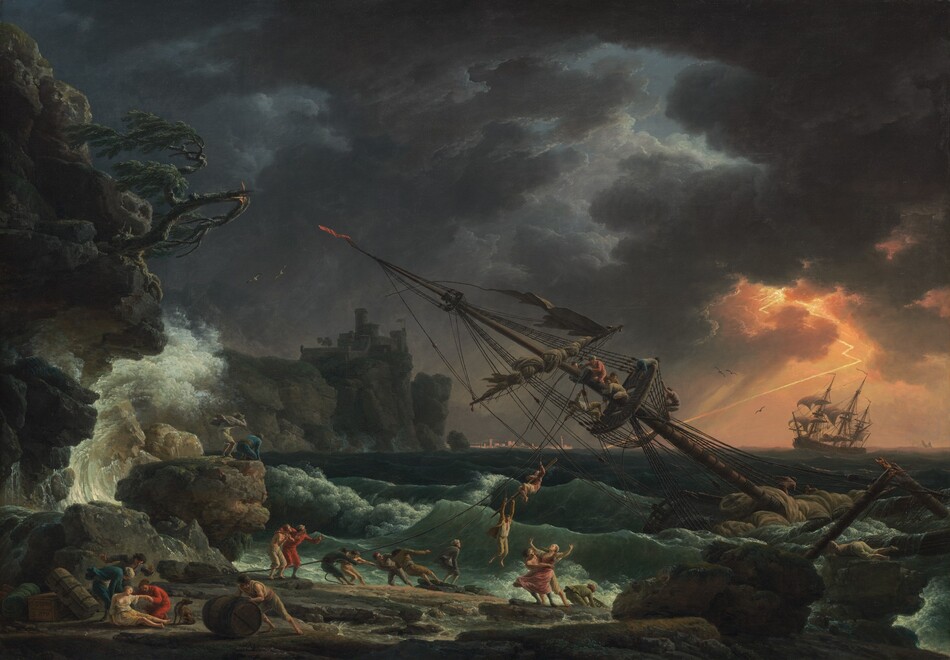
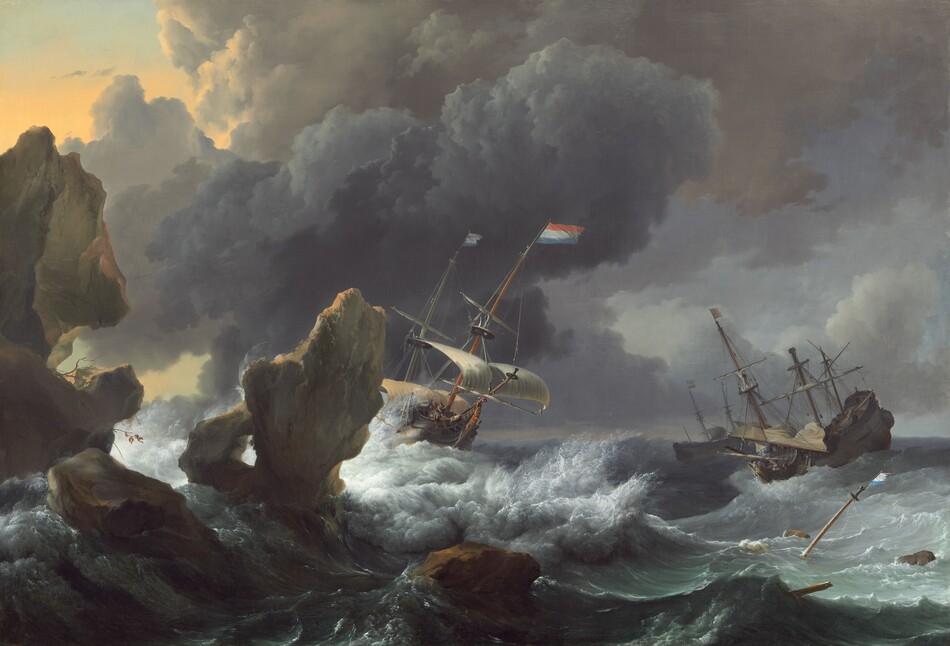
  • A masted ship with tattered sails crashes near a rocky shore among choppy waves, beneath a sky filled with charcoal-gray clouds in this horizontal landscape painting. More then two dozen men and women are scattered among the wreckage and along the shore. They all have pale skin and are small in scale within the landscape. Some of them are barefoot, and they wear clothing in ivory white, ruby red, slate gray, beige, or teal blue. The tall mast of the ship pitches at a steep angle from near the lower right corner of the canvas toward the upper left. A narrow red flag streams in the wind from the top of the mast. Seven men cling to the crow’s nest, a platform near the top of the mast, and on the mast around it. More people work amid a fallen sail on the ship’s deck and dangle from the rigging that is being pulled ashore by others. The ship’s second mast is broken in half, splintered where it has fallen against jagged boulders in the lower right corner. On the shore, a woman wearing a pink dress and blue stockings holds her arms up to the sky as a bare-chested man wraps his arms around her waist. A man nearby hunches over as he hauls in a cage from the surf. To our left, a second woman is surrounded by three men, two of whom support her torso. She wears a pale yellow skirt and her white shirt has fallen to expose one breast. Two trunks and a large roll of cloth are piled behind the trio, to our left. On the other side of the group, a brown dog sits and looks back over its shoulder toward a man who rolls a barrel onto the beach. A rocky, vertical cliff nearly spans the height of the left edge of the painting, and the cliffs continue along the waterline into the distance. Two people perch on a rocky outcropping near those on the beach, and a tree with a cracked, splintered trunk is doubled back by the wind above the pair. Water sprays high against the cliffs beyond, and a fortress with a castle sits atop the cliffs in the distance. Farther out in the water and to our right, a second ship with sails bulging in the wind lurches to the right. A streak of bright, golden-yellow lightning zigzags in the bank of clouds over this ship and reaches the horizon to our left, illuminating the low skyline of a town in the deep distance, beyond the cliffs. The clouds around the lightning are bathed in coral-peach light, but the surrounding clouds are dark gray. The artist signed and dated the work as if he had inscribed the side of one trunk, near the lower left corner, “J. Vernet F. 1772.”
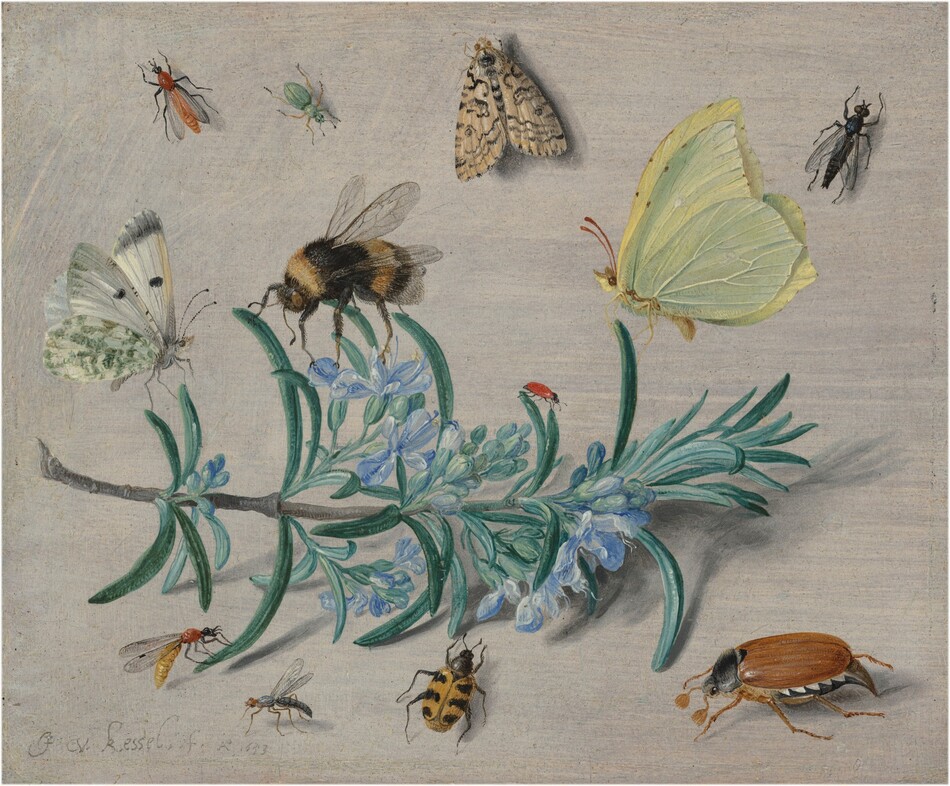
  • A sprig of flowering rosemary lying against an ivory-white background and the twelve insects that surround it fills this horizontal painting. Stretching nearly the length of the composition with the cut end to our left, the rosemary has blunted, needle-like, gently curling teal-green leaves and small periwinkle-blue flowers along the ash-brown stem. Several insects perch on the sprig while others are seen as if looking from overhead, resting on the white background. The three largest insects perch along the top of the sprig, with an ivory-white butterfly with moss-green and black markings to the left, a black and golden, fuzzy bumblebee near the center, and a lemon-yellow butterfly with red antennae to our right. A tiny red insect, perhaps a ladybug without spots, sits on a leaf between the bee and yellow butterfly, and a small wasp-like insect rests on a leaf in at the lower left. Another mosquito-like insect alights on the surface nearby, next to a beetle with a honey-orange body with black, almost tiger-like stripes. A large cockroach sitting near the lower right corner has six spindly legs, a mahogany-colored abdomen, a black thorax, and tiny, black head. Spaced somewhat evenly across the top of the panel are a brick-red, winged insect to the left, a mint-green, beetle-like bug near a moth patterned with bone white and black, and a black, fly-like insect to our right. Lit from the upper left, the rosemary and insects cast shadows on the surface. The artist signed and dated the work with gray in the lower left corner: “J v. kessel . . f. Ao 1653.”
  • Holding a bunch of peonies in one hand, a woman with brown skin leans forward, toward us from behind a large basket holding dozens of flowers in this horizontal painting. The basket holding the flowers spans the width of the canvas, and the woman is shown behind it from the chest up. She wears a cream-white, long-sleeved blouse with scalloped trim around the high neck. She wears coral-red earrings, and a plaid cloth in tones of rust red, slate blue, pale purple, and black is tied tightly over her black hair, which is visible over her ears. Her brow is slightly furrowed, and she looks at us with large, dark eyes. Her full mouth is closed, the corners faintly downturned. She reaches her right arm, on our left, toward us with a bouquet of three pink-and-white peonies and greenery. Her basket is filled with yellow and red tulips, pink roses, white and purple lilac, and other white, pink, yellow, and blue flowers, and it takes up the bottom third of the composition. The woman and basket are shown against a dove-gray background. The artist prominently signed and dated the work with red letters near the upper right corner, near the woman’s head: “F. Bazille. 1870.”
  • Against a distant, hazy, verdant forest, a petal-pink and amethyst-purple orchid grows from a mossy branch close to us, to our left, while three jewel-toned hummingbirds gather around a nest to our right in this horizontal painting. Two pale pink, ruffled petals of the orchid flare up and out from the hot-pink, furled center. The lip-like petal below is amethyst purple brushed with pale yellow along its top. Three narrow, pink petals create a triangle behind the center of the bloom. Some of the pale honeydew-green pods and leaves growing from the base of the plant are speckled with brown spots. The orchid grows on a gnarled brown branch painted with daubs of white, burnt orange, goldenrod yellow, and scarlet red along its length, which spans the width of the painting. Three hummingbirds with narrow, pointed beaks tend a nest built further along the branch to the right of the orchid. The largest is perched with its back to us. It has a vibrant green body and a two-pronged, crimson-red tail. Its head is turned up and to our left, looking at the second bird fluttering on a branch across the nest. The second bird’s avocado-green and dusty rose-pink body curves downward from outstretched wings. The third bird is perched on a nearby branch to our left, its head turned to the right to look at the others. Two white eggs are partially visible in the nest, which is shaped like an upside-down cone. The nest is woven with wavy, dangling strands of burnt-orange plant material. The orchid, birds, and nest fill the center of the composition. The scene is brightly lit from upper left. More leafy branches covered with hanging vines rise on either side of the painting. The background is filled with a dense growth of plants and trees, painted with blended shades of muted greens and pinks creating a diffuse, watery haze. The sky takes up the upper third of the composition and is filled with smoke-gray clouds except for a small circle of blue sky peeking through the branches of the tree in the upper right.
  • Sheer, vertical, cliffs, brightly lit in cream white and rust orange by the low sun, tower over a band of people riding horses into the distance in this long, horizontal landscape painting. The glowing cliffs dominate the upper right quadrant of the painting. They lighten from burnt orange along the jagged tops to flame orange down the steep sides, and are and warm, parchment white near the earth. One tall, narrow promontory to our right looms over a range of lower, rounded cliffs. As the cliffs move into the distance, they are shrouded with a lavender-purple haze. The land closest to us dips into a shallow valley at the bottom center of the composition, leading away from us. The dirt-packed earth is dotted with pine-green, scrubby bushes and vegetation and a grove of low, gnarled trees a short distance to our right. One chestnut-brown horse walks along the path at the bottom center of the composition, lagging behind a cluster of at least two dozen horses and riders winding into the distance. The horses range from ivory white to tawny brown and charcoal gray. The riders are loosely painted so some details are indistinct, but they all seem to have brown skin and dark hair. They wear feathered headdresses and garments in teal blue, fawn brown, or golden yellow. They ride over a low hill toward a crystal-blue river, and then back along a flat expanse toward a row of minuscule, triangular tepees lining the horizon in the deep distance. The horizon comes halfway up the composition, and the tepees are backed by a row of rose-pink, flat-topped cliffs. A pale yellow disk hangs low in the sky, over the distant cliffs. The sky above deepens from soft, lilac purple along the horizon to ice and sapphire blue along the top. A few wispy clouds are burnished orange in the sunlight. The artist signed and dated the painting in the lower right corner, “TYMoran 1881,” with the T, Y, and M overlapping to make a monogram.
  • This painting depicts a man seated in a chair and facing forward, with his head slightly turned to the left. He has light brown skin, short black hair, prominent sideburns, and brown eyes, with his face is in a neutral expression. His left arm rests over the back of the gilded wooden chair he sits in, and his right hand is tucked into his suit jacket. He is dressed in a black coat with large gold buttons running down the front and on the cuffs. Under the coat is a stiff white collar and a black kerchief or tie, as well as a square orange gem set in gold. The background is mostly a gray-green wall, but on the left side there is a thin vertical window showing a view of a green river with a steamboat on it and rocky red cliffs covered in green trees under a cloudy blue sky.
  • A tall goblet made with a spiraling nautilus shell on a gold and silver stem, a blue and white lidded, porcelain bowl, an orange, a cut lemon, and a bunched up, woven rug are gathered on a tabletop in front of a black background in this vertical still life painting. Light falling on the objects from our left contrasts sharply with the deep shadow beyond, which makes some details difficult to make out. The objects might be gathered on a silver tray. At the center of the composition, the flagon is made with a shimmering, ivory-colored nautilus shell with its wide opening facing up. The stem is made of gold bands coiling around a silver figurine, which is nearly lost in shadow. To our right, a white porcelain bowl has a rounded bottom and tall sides. It is painted with blue designs around a raised relief showing two people in crimson-red and harvest-gold garments. A utensil sits in the bowl to our right, and the lid, which has a finial in the shape of an animal, rests angled upward, partially in the bowl and partially on the stem of that utensil. A translucent, cylindrical knife handle protrudes toward us, angled to our right, in front of the bowl. A rug with a geometric pattern of rust red, tan, and pine green is bunched next to the bowl, along the right side of the painting. To our left of the nautilus cup, an orange with a stem and green leaves sits next to a bright, glistening lemon at the foot of the cup. Between the two pieces of fruit, the vivid yellow lemon rind has been peeled into a long, curling strip that curves off the front edge of the table.
  • This horizontal painting is tightly packed with colorfully dressed groups of soldiers and knights on horseback surging toward each other. The scene is created with small areas of vivid, mostly flat color, almost like a collage. Long lances and spears create a forest of diagonals among the battling men. The hands and the few faces we can see are painted with pale, peachy skin. The soldiers on the left side wear tunics and leggings in tones of pumpkin orange, sage green, rose pink, ruby red, or azure blue. Most wear pointed, silver helmets with wide brims, and many hold lances as they charge the knights to our right. Near an ash-gray tree in the upper left, a rust-brown horse rears up among the throng, as his rider leans back and pulls on the reins. One person has been lifted off the ground while trying to hold the horse’s bridle. More knights on horseback sweep in from the right wearing silver armor, and riding gray, saffron orange, or brown horses. Several aim carrot-orange lances wrapped with white stripes at the enemy. The horses lunge forward with gaping mouths and wide eyes, their front legs outstretched. A band of knights in the distance in the upper right hold butter-yellow, celery-green, powder-blue, and white pennants that snap in the wind. The blue sky above the battle is scattered with white clouds on the right that transition to darker, tan clouds on the left. The artist signed the lower left corner, “M. Boutet de Monvel.”
  • Painted in mostly in jewel tones of topaz and aquamarine blue, and sage, spring, and pine green, a meadow is enclosed by a wooden fence, against a landscape of gently rolling hills under a vibrant sky in this horizontal painting. The scene is loosely painted with visible brushstrokes. Touches of white, cotton candy-pink, ruby-red, and azure-blue paint in the long grasses close to us could be wildflowers. A few swipes of straw yellow and pale and lapis blue could represent two people, standing and kneeling, in the field close to the fence. The rickety fence starts at the right edge of the canvas and extends into the distance, angling away from us to our left. Rolling hills beyond are a patchwork of emerald green and caramel brown, and are dotted with trees with full, dark green canopies. One brown building sits on the crest of a hill to our right of center. The horizon comes about halfway up this picture, and the turquoise-colored sky is dotted with white puffs of clouds. The artist signed and dated the painting in the lower right corner, “Sisley 75.”
  • The soaring, gilded vault of a central aisle of the inside of a church fills this horizontal painting. The ceiling of the nave curves up and away from us like a tunnel. It is lined with coffers, which have inset panels, decorated with gold. The light-filled nave angles down from the top center of the composition toward the lower left as it moves away from us. The white stone pillars supporting the barrel vault are intricately carved and decorated with pudgy, winged cherubs holding portraits of men, and aisles run parallel to the central nave to our left and right. In the side aisles, pink marble columns flank altars in chapels. At the far end of the church, the nave is interrupted where it opens into the light-filled crossing, before continuing beyond. Marking the space where the long hall of the church is intersected by a shorter arm to create a cross shape is a structure made of four twisting columns supporting a pointed canopy, all cast in bronze. Tiny men and women pray or gather in pairs and small groups along the nave. Some wear tattered clothing and others are elegantly dressed.
  • We look out onto a sweeping, panoramic view with trees, their leaves fiery orange and red, framing a view of a distant body of water under a sun-streaked sky in this long, horizontal landscape painting. The horizon comes about halfway up the composition, and is lined with hazy mountains and clouds in the deep distance. Close examination slowly reveals minuscule birds tucked into the crimson-red, golden yellow, and deep, sage-green leaves of the trees to either side of the painting. Closest to us, vine-covered, fallen tree trunks and mossy gray boulders line the bottom edge of the canvas. Beyond a trickling waterfall and small pool near the lower left corner, and tiny within the scale of the landscape, a group of three men and their dogs sit and recline around a blanket and a picnic basket, their rifles leaning against a tree nearby. The land sweeps down to a grassy meadow crossed by a meandering stream that winds into the distance, at the center of the painting. Touches of white and gray represent a flock of grazing sheep in the meadow. A low wooden bridge spans the stream to our right, and a few cows drink from the riverbank. Smoke rises from chimneys in a town lining the riverbank and shoreline beyond, and tiny white sails and steamboats dot the waterway. Light pours onto the scene with rays like a starburst from behind a lavender-gray cloud covering the sun, low in the sky. The artist signed the painting as if he had inscribed the flat top of a rock at the lower center of the landscape with his name, the title of the painting, and date: “Autumn – on the Hudson River, J.F Cropsey, London 1860.”
  • Beyond several craggy boulders that loom in the lower left corner of this horizontal painting, three sailing ships pitch wildly in crashing waves beneath towering clouds. At the center, a large ship tips sharply to our right with billowing ivory sails and two red, white, and blue striped flags whipping in the wind. White spray kicks up against the side of the boat and in the waves surrounding it. The sails of the second ship, to our right, are furled except for one that crashes down onto the deck. Tiny people scurry around inside the ship, which tilts steeply up on a high wave. The third ship floats beyond this, its sails also tied up. The top of a tall wooden mast along with a broken wooden pole poke up from emerald-green waves in the lower right corner, near a barrel and two bundles wrapped in cloth and tied with rope that bob nearby. One of the brown, jagged rocks to our left nearly spans the height of the painting while others jut from the water like crooked teeth. A bank of billowing, slate-gray clouds at the center of the sky separates a fog-gray sky and puffy clouds to our right from a patch of golden sunlight to our left, in the upper corner of the canvas. The artist signed and dated the work as if written on a rock at the bottom center of the canvas, “LBackh 1667.”
  • Several pieces of fruit, a bunch of green grapes, a stem of raisins, and several types of nuts in their shells are piled on a putty-brown tabletop or ledge with rounded corners against a dark background in this horizontal still life painting. The food is brightly lit from the front, and we look slightly down onto the table. There are two round red apples and two pieces of small yellow fruit, perhaps quinces, flanking a golden yellow pear at the back center. The bunch of grapes drapes over the fruit to our right and the raisins lie between the apples. Thirteen walnuts, peanuts, almonds, hazelnuts, and perhaps a brazil nut are scattered in a loose band in front of the fruit. The surface on which the still life sits becomes swallowed in shadow behind the fruit, and blends into the dark brown background. The artist signed and dated the work in dark paint in the lower right corner, almost lost in shadow under the ledge: “R.S. Duncanson 1848.”
  • This is a sculpture of a rooster that is entirely colored in flat, vibrant blue. The material of the sculpture is smooth and solid. The blue rooster is in profile, facing the right, with the comb on its head sticking up and its tail feathers fanned out. In the background is a wall made of rectangular beige stone tiles. Below the rooster’s feet is a flat stone surface with geometric patterning.
  • Shown from the shins up, two elegantly dressed women and two young boys, all with light skin, sit together on a bench in front of a stone balustrade with a forest landscape beyond in this horizontal portrait painting. The people are brightly lit from our left but the darkened sky suggests dusk. The boys lean onto the woman at the center of the composition, and the second woman sits to her right, our left. All of the people have pale skin, rosy cheeks, delicate noses, and their pink lips all turn up in slight smiles. The woman on our left sits with her body angled toward her friend but she turns her face to look at us with brown eyes under curving brows. Her wavy, flint-gray hair is loosely bound up so it frames the sides of her face and curls over her shoulders. Her swirling, white head covering is edged in gold and tied in a bow over her left ear, on our right. Her long-sleeved dress has a tight-fitting bodice and a low, scooped neckline lined with pleated white fabric. Her dress shimmers from sapphire blue to dusky pink, suggesting it is iridescent taffeta. Large pearls hang off the end of round, gold, hoop earrings, and a glimmering gold sash is tied around her waist. She sits with her left hand resting on her friend’s right shoulder, closer to her, and she gestures toward one of the young boys leaning on the friend’s lap with her other hand. The second woman sits with her body facing us, and she looks off to our left with gray-blue eyes. Her silvery gray, upswept hair is covered with a long piece of white fabric with pink stripes, twisted loosely into a turban-like head covering. She wears dangling gold earrings, and her dress is striped with parchment white and rust red. Her right hand, on our left, rests on her friend’s knee, and her other arm is wrapped around the older boy. He kneels on the bench and leans forward, wrapping the arm we can see around her torso. His face near hers, he looks up at her from under his lashes. A dimple marks the flushed cheek we can see. His chestnut-brown hair falls around his shoulders, and he wears a gingerbread-brown suit. The smaller and younger of the two boys rests his head on his crossed hands on her thigh, and looks out at us. He wears a white garment with a lilac-purple sash tied in a bow around his waist. There is a pale pink rosebush in the lower right corner of the painting, near the kneeling boy’s foot. The landscape beyond the balustrade is filled with dark green trees against a slate-blue sky. The painting is created with blended brushstrokes, giving it a soft look.
  • A cup carved from stone is mounted in gold fittings to create a jeweled chalice with handles that curl up each side and a tall, flaring foot below. The stone of the cup is swirled with shell pink and rust brown, and carved to create vertical ridges. The gold rim around the lip flares outward and is set with a band of alternating pairs of small, white pearls and mostly garnet-red stones, though one stone to our right is a muted blue. In this photograph, the handles curve up each side from the base of the stone cup to the gold lip, where the handle divides into two scrolling tendrils on either side of a teardrop shaped center, like curling petals. The base and foot are as tall as the stone cup and gold lip. A knob-like form just below the stone cup is set with deep red and jade green stones around its center, and rows of small pearls around the narrow top and bottom of the knob. The knob is chased to create a pattern of scrolling vines, like tracery. The flaring foot below is also chased with the same pattern, surrounding gold, oval medallions set at regular intervals in the foot. In our view, the medallion to the left shows a bunch of grapes and the center is a portrait of a bearded man with a halo, holding his right hand up with his first two fingers raised. The details on the medallion to our right are difficult to make out but it could be a sheaf of wheat. Small, round jewels are set above and below each medallion, and between each one.
  • Shown under an ornately carved stone arch, a young woman holds a baby on her lap as she sits on a curving gold chair flanked by two kneeling angels in this vertical painting. All of the people have pale skin. The woman has long blond hair, a straight nose, and a small pink mouth. Her body faces us but she gazes down. She wears a gold-trimmed, deep blue robe under a crimson-red mantle that covers her shoulders and drapes over her lap and to the floor. She holds an open book with her left hand, on our right, and supports the sitting baby’s body with her other hand. The baby is nude except for a piece of white fabric across one thigh. The baby touches the open book with one hand and reaches toward a small, round piece of fruit the angel on our left offers. That angel has blond hair and sapphire-blue wings, and wears a pale blue garment under a red and gold patterned robe. The angel holds out the fruit with the right hand and in the other, holds an instrument like a violin and bow. The angel to our right has similar hair and facial features, and has blue wings and a sky-blue robe. Both hands strum a harp as the angel gazes to our left almost in profile. Behind the chair, a cloth patterned in pine green and gold hangs vertically from a curving red overhang between tall, narrow archways that open onto a landscape. In the distance, people move through green fields and along a river winding toward a castle to our left beneath a clear blue sky. The angels' wings overlap with the stone archway that frames the scene. It is carved along the inner edge of the arch with vines, lizards, and snails. Two columns flank the arch and atop each is a bearded man, as if carved from the same cream-colored stone of the arch. The man to our left holds a harp and the one to our right holds a saw. Winged, nude, child-like people, putti, hold orbs aloft in the upper corners.
  • We look slightly down onto a crush of pedestrians, horse-drawn carriages, wagons, and streetcars enclosed by a row of densely spaced buildings and skyscrapers opposite us in this horizontal painting. The street in front of us is alive with action but the overall color palette is subdued with burgundy red, grays, and black, punctuated by bright spots of harvest yellow, shamrock green, apple red, and white. Most of the people wear long dark coats and black hats but a few in particular draw the eye. For instance, in a patch of sunlight in the lower right corner, three women wearing light blue, scarlet-red, or emerald-green dresses stand out from the crowd. The sunlight also highlights a white spot on the ground, probably snow, amid the crowd to our right. Beyond the band of people in the street close to us, more people fill in the space around carriages, wagons, and trolleys, and a large horse-drawn cart piled with large yellow blocks, perhaps hay, at the center of the composition. A little in the distance to our left, a few bare trees stand around a patch of white ground. Beyond that, in the top half of the painting, city buildings are blocked in with rectangles of muted red, gray, and tan. Shorter buildings, about six to ten stories high, cluster in front of the taller buildings that reach off the top edge of the painting. The band of skyscrapers is broken only by a gray patch of sky visible in a gap between the buildings to our right of center, along the top of the canvas. White smoke rises from a few chimneys and billboards and advertisements are painted onto the fronts of some of the buildings. The paint is loosely applied, so many of the people and objects are created with only a few swipes of the brush, which makes many of the details indistinct. The artist signed the work with pine-green paint near the lower left corner: “Geo Bellows.”
  • This sculpture is a large ceramic jar. It is made from brown, glazed material with a glossy finish. The jar is cylindrical with a wide opening at the top and two small, rounded handles near the rim. There are carved lines of text or markings around the upper portion of the jar near the rim.
  • The elongated head and neck of a person with stylized features is carved from beige-colored limestone for this freestanding sculpture. Though mostly carved smooth, the surface of the porous limestone is pocked and textured. In this photograph, the face is angled to our right. Short bangs line the narrow forehead of the tall, oval face. The hair flaring around the crown and behind the tidy, oval ear we see is roughly carved. The marquis-shaped eyes are set high on the face. Eyebrows immediately over the eyes join to make a long, blade-like nose that nearly reaches the bottom of the oval face. The arrow-shape of the nose ends just above a half-moon-shaped lip over a round chin. The long neck continues to a block of limestone that acts as the base. The sculpture is photographed in front of a background that lightens from charcoal gray across the top to nearly white across the bottom.
  • This drawing shows a profile of a woman's head and upper torso, facing the right. The woman appears old, with wrinkly skin and white hair gathered into a bun. She has a wrinkled, sloping brow, a pointed, upturned nose, and thin, downturned lips. She has a hunch in her back, and the skin on her neck sags. She wears a low-cut, off-the-shoulder garment that appears to have laces in the front. A flower appears to be stuck between her breasts. The background is plain, off-white paper within a rectangular gold border.
  • This is a drawing of a park scene with numerous figures engaged in leisure activities. People are sitting or in motion, creating a dynamic atmosphere. The park is surrounded by large trees, offering shaded areas with sunlight filtering through. Some figures hold umbrellas. The drawing captures the play of light and shadow, emphasizing a lively yet relaxed mood.
  • Shown from the hips up, a man with pale skin and shoulder-length brown hair, wearing a long-sleeved, rose-pink satin jacket and pants, props a flagpole with a voluminous blue flag against one shoulder in this vertical portrait painting. He stands with his body facing our left in profile with his left hand on his hip, elbow jutting out at us. He turns his face to look directly at us with dark eyes. He has a straight nose, rosy cheeks, and a mustache and narrow goatee below his lips, which are slightly parted. He wears a wide-brimmed black hat generously adorned with pale blue, turquoise, pale yellow, and orange plumes. The fabric of his pink clothing reflects the light in wide patches of white, creating the impression of a satin sheen. Wide, pale gray lace lines the front opening of the jacket, the shoulders, the arms, and the sides of the trousers. His white lace collar is tied with a pale celery-green bow and a bow of the same color ties the lace cuff of the wrist we can see. A baby-blue sash wraps around his waist and is tied in a large rosette at the back. Both hands are covered with ivory-white gloves. His left wrist rests against his hip so the underside of those fingers dangle down, while the other hand supports the flag pole, which is wrapped in blue fabric. A sword hangs from his front hip. The topaz-blue fabric of the flag, or standard, drapes down from the flag pole, which extends off the top right corner of the canvas. A coat of arms, about the size of a person’s palm, hangs from a nail with a string in the upper left corner on the taupe-colored wall behind the man. The coat of arms is made up of three fleur-de-lis lined up in a diagonal band and the remaining two corners are filled with stylized lions, long tongues curling out. The artist dated the work “1640” in the lower left corner.
  • Shown from the hips up, a pale-skinned young girl wearing an ink-black garment with a cream-white collar and a coral-red sash and necklaces holds a terrier dog as she looks at us in this vertical portrait painting. The artist used brushstrokes throughout, especially in the hair, clothing, dog, and background. The girl’s body is slightly angled to our left but she turns her oval face to us. She slightly cocks one faint brow as she gazes out with large, pale blue eyes. She has smooth cheeks, and her full, red lips are closed. Her chestnut-brown hair curtains her forehead in thick bangs and falls down past her shoulders. Her black dress has long, tightly-fitting sleeves and is cinched with a wide, oversized red sash, presumably tied at the back. A multi-stranded, coral-red necklace lies over her layered, cream-white lace collar, which extends just past her shoulders. A long, white cuff falls over her left wrist, down by her side. With her other hand, to our left, she supports the terrier against her right hip. The long fur around the dog’s dark eyes is shimmering, flax brown. Caramel-brown ears poke up on its shaggy head. The girl holds the dog's tail in that hand. The background behind the pair lightens from fawn brown across the top to golden brown along the bottom edge. The artist inscribed and signed the painting in slanting, cursive letters at the top right corner: “to my friend Mrs Townsend John S. Sargent.”
  • A partially nude woman with pale, peachy skin sits to our left looking into a mirror held up by a nearly nude, winged child to our right in this vertical painting. The woman’s body is angled to our left but she looks across her body to our right. She holds her left hand to her chest, and her right hand grips the fur-lined edge of the scarlet-red, velvet fabric that drapes over that upper arm and around her hips. Her blond hair is coiled up in rows of pearls, and she has dark eyes, a straight nose, and her pale pink lips turn up in a subtle smile. A teardrop pearl earring hangs from the ear we can see, and she wears rings and gold bracelets. The child-like figure to the right stands on a gold-striped cushion facing away from us as he holds up the rectangular, black-framed mirror. He has small silver wings and a sash of golden yellow hangs from one shoulder around the opposite hip. A second child reaches from behind the mirror to hold up a ring of laurel leaves. A forest-green curtain is gathered in the upper left corner and the beige wall beyond falls into shadow to our right.
  • Set in a landscape, a young man holding a broken lance lunges over the neck of his horse to look at the body of a forest-green dragon on the ground beneath them, while a young woman looks on from our left in this vertical painting. The man and woman both have light skin. The horse and rider are in the center, facing our right, and the man’s scarlet-red cape flutters upward. His right arm, to our left, is bent sharply as he thrusts the shard of the red-and-white striped lance down. His eyebrows are drawn together, and his mouth is open, the corner we can see pulled down. Form-fitting, royal-purple armor protects his torso, and he wears a bronze and silver helmet topped with red and white feathers. His muscular arms are bare, as is the knee we can see between a celery-green skirt and a gray sandal that covers most of that shin. His saddle and saddle blanket are blueberry blue. The brown horse has a dark mane and tail. It lunges forward and down with mouth wide open and teeth bared, so it trounces or pins the dragon beneath its front legs. The dragon is curled in a ball on the lower right side of the composition with its head wrenched backward onto its body. Crimson-red drops of blood drip from its gaping mouth. The young woman stands on the left side of the composition with one knee kneeling on a tall rock. She faces us, wearing a cranberry-red gown under a gold cloak that drapes from her right shoulder, to our left, across her back, and over the other knee. A delicate gold crown rests on her dark blond hair, and she lifts her eyes to look up at the man. Her hands are raised in front of her chest, with gold bracelets and chains hanging from her wrists. In the lower right corner of the painting, a severed foot, arm, and two heads lie near the dragon. Trees with tall, narrow, deep green canopies and one tree with spindly branches lined with delicate leaves separate the scene in front of us from the landscape beyond. In the distance, a city of white stone buildings cluster on a steep hill that rises to our left from a harbor. Tiny in scale, about a dozen people are gathered on two roofs of a multi-level structure, while others move on foot or on horseback down a road leading toward us. The powder-blue sky is scattered with puffy, white clouds. A winged angel surrounded by a butter-yellow aura hovers in the upper right corner.
  • A dog with short, curly, white hair stands in a wooden boat facing our right almost in profile, though it turns its head to look at us in this vertical portrait painting. The dog spans nearly the width of the canvas and is close to us. The dog’s ears hang down the side of its face to its chin. Its eyes are light brown and rimmed in black, and the lower lids are pink. The dog has a thick torso covered with tight curls, and it has a short puff of a tail. Its front legs are straight and the hind legs might be slightly bent. The dog stands on a slat spanning the width of the boat, which is angled away from us to our left. The landscape behind the has a calm, sage-green body of water with a tall, willow-like tree to our left and a lower band of leafy trees to our right. A few smoke-gray clouds float over the treetops in an otherwise pale blue sky.
  • The image shows a pink flower with yellow accents on its petals, a blue and brown grasshopper, and a brown and orange caterpillar. The color palette includes pink, yellow, green, blue, brown, and black. The flower is near the top center with green leaves on the stem. Below and to the left, the grasshopper is slightly slanted with its wings outspread. Directly below the flower, the caterpillar is crawling vertically on a green stem. To the right, a small green and pink grasshopper stands. The background is off-white.
  • Six women, eight men, two satyrs, and one child gather in pairs and trios in a loose row that spans the width of this nearly square painting. They are set within a landscape with craggy rocks, cliffs, and trees. Most of the people face us, and the men, women, and child have pale skin. The two satyrs have men’s torsos and furry goat’s legs, and they have darker, olive complexions. Most of the men wear voluminous, knee-length togas wrapped in short robes in shades of white, topaz blue, grass green, coral orange, or rose pink. Most of the women wear long, dress-like garments in tones of shell pink, apricot orange, or lapis blue over white sleeves. For all but one woman, their garments have fallen off one shoulder to reveal a round, firm breast. Several objects are strewn on the rocky, dirt ground in front of the group, including a wide, wooden bucket with a piece of paper affixed to its front to our right, a glass goblet, a pitchfork, a large blue and white ceramic dish filled with grapes and small yellow fruits, and an overturned cup near the center. Cliff-like, craggy rocks rise steeply behind the group to our left, filling much of the sky opposite a tall grove of leafy, dark green trees to our right. A few puffy white clouds float across the vivid blue sky. The slip of paper on the barrel has been inscribed, “joannes bellinus venetus p MDXIIII.”
  • Two women, four men, and a satyr, which is a creature with a man’s body and hairy goat’s legs, gather in a wooded landscape in this horizontal painting. All the people have pale, peachy skin. At the center of the group, to our left of center, a young, cleanshaven man balances on the ball of one foot as he strides toward us. He turns his head to his left so he faces our right in profile, and he looks off in that direction. He wears a ring of laurel leaves in his blond curls and his lips are parted. He holds a jeweled, golden stringed instrument, a lyre, in the crook of his right arm, on our left. He lifts his other hand to gesture toward the men to our right. He is nude except for a coral-red cloak fastened with a gold clasp at his neck. The cloak billows around his muscular body, and one bottom corner curls across his hip to cover his groin. To our left, two women sit on a rocky outcropping. The woman to our left holds a sapphire-blue robe to her chest. Her golden brown hair is pulled back, and she looks at the young man. The second woman sits with her body facing away from us, her arms resting on the rock in front of her. Her nude back faces us and she has a soft, rounded belly. She sits against a white cloth, and a light sage-green cloak pools around her hips and lies across one thigh. To our right, behind the young man holding a lyre, two bearded men sit on a rock with their bodies angled toward each other. The man to our left wears a leafy crown and holds a wooden staff. The second man wears a topaz-blue hood and robe, and turns to speak to his neighbor as he points in the opposite direction. Closer to us, near the right edge of the painting, the satyr plays a set of pan pipes. The man sitting next to him has tall, pointed, ass’s ears and a pointed, red beard. He wears a shimmering butter-yellow cloak over a brick-red tunic, and he rests one hand on the satyr’s shoulder. The entire group is enclosed by tall, tawny-brown rocks and leafy, sage-green trees. In the upper left corner, lilac-purple clouds float across a pale blue sky. The scene is painted with swirling brushstrokes that are especially visible in the clothing and background.
  • From high above the earth, we look onto a dramatically lit scene with a man falling from a horse-drawn chariot in midair, surrounded by eleven women against a bank of clouds in this horizontal painting. All of the people have pale skin and are illuminated by a bright burst of sunlight streaming across the scene from the upper right corner. The man is covered only by a burgundy-red sash that wraps across his groin and around one shoulder. He careens headfirst from the U-shaped, golden chariot with his chest facing us, arms flung overhead and legs splayed, to our right of center. The tumble of bodies around him includes four horses, three ivory white and one gray, and the eleven women, who are either nude or dressed in robes of parchment white, tan, slate blue, butterscotch yellow, steel gray, or rose pink. The women all have blond or brown hair, and some have wings like butterflies, patterned with circles and stripes. They fall alongside the man or float above the wreckage, their robes and hair billowing. Some of the women hold the red reins of the horses, though some of the reins stop abruptly or are painted over so they appear as dark lines beneath the surface. The nickel-gray clouds surround and support some of the women in front of a hazy circular arch curving up the left side of the composition. Peeks of sky around the action are deep aqua blue, and vibrant orange flames lick up from the earth in the lower right.
  • Armies of men march and battle along a rocky outcropping set among huge rock formations and massive buildings under a stormy sky in this horizontal landscape painting. The people we can see all have pale skin. Sheets of rain fall from flint-gray clouds on our left into a valley, though hints of peach brighten the clouds along the mountainous horizon there. In the right half of the sky, light pours down from a brilliant white sun that breaks through white clouds to reveal topaz-blue patches of sky. The horizon comes about halfway up the composition and is lined with rugged white, pale pink, and olive-green mountains on our left and silvery-white buildings along the right half. These structures include two domed buildings and a colosseum among many others. The buildings are all enclosed within city walls buttressed with towers. The land dips precipitously from the rocky cliffs supporting the buildings, to sweep down toward us. A huge outcropping angles up like a ramp between us and the buildings in the distance. A road runs from the walled town toward us, down along the ridge and in front of the outcropping. Countless warriors march in rows of four or five across on the road past a man wearing a feathered helmet and armored breastplate. This man, Joshua, stands on a rocky precipice facing away from us with his right hand raised. He wears a scarlet-red toga under his breastplate, and a royal-blue cape flutters at his left side. He holds a round, copper-colored shield and a spear in his other hand. Two men with gray beards stand near Joshua with their backs to us. Both gesture up to the sky. One holds a slender staff and the other a curling horn. They and another pair of men, who stoop to hold poles used to carry a chest, all wear long, ivory-white robes, cherry-red drapery, and white turbans. The column of soldiers on foot and horseback pass in front of Joshua to a massive battlefield to our left. The fight takes place in a valley that leads back to a river. A bolt of lightning zigzags from the storm clouds and strikes a city in the deep distance. The artist signed the painting in the lower right, “J. Martin.”
  • Two minuscule people stand in the center of an expansive, rugged landscape dusted with snow in this horizontal painting. Snow nestles in among the tawny-brown ridges that roll like waves back to the horizon, which comes almost halfway up the composition. The people are painted with a few dabs of fawn brown, and they stand on a spit of land to our right of center. Mountainous ridges along the horizon are shaded in slate blue under a steely-blue sky.
  • The bodies of four people are locked together through dramatic gestures and poses against a dark background in this nearly square painting. The two men have pale, peachy skin and the two women have ash-white skin, and together they almost fill the composition. A man with a white beard and hair wears a short-sleeved brown garment and sits to the right of center. His body faces our left and both of his arms reach straight out at shoulder height. His head juts forward and his bulging eyes appear white. He points at a younger man kneeling in front of him with his left hand. Near the left edge of the canvas, the younger man’s body also faces our left as he kneels on his left knee. His body leans forward over his right knee, which is bent so that foot is flat on the ground. His head is thrown back and his right hand, on our left, crosses his body and is raised as if to shield his face. His other arm extends so the raised flat of his hand is close to the old man’s face. The young man has dark hair and wears a tight-fitting, short-sleeved, golden yellow tunic. One woman with long blond hair rests her hands and leans her forehead onto the old man’s knee in the lower right corner. The second woman stands behind the pair of men with her arms spread wide so one hand reaches over the shoulder of the old man, and her other hand nearly touches the younger man’s head. She has long, curly brown hair, and she looks at the older man with her lips parted. Both women wear white and pale gray garments. There is the suggestion of blue sky beyond some trees along the left edge of the composition but the rest of the background is deep in shadow.
  • We look down on a few dozen people walking along the sidewalks of a wide, sunlit bridge in this almost square painting. The scene is loosely painted, which gives it a hazy, sun-dappled look and makes some details indistinct. The people wear black, white, light blue, or pale green jackets and pants or long dresses as they walk in all directions. Some wear hats, and a few women carry parasols. The bridge opens into a wide boulevard close to us, as the sidewalks angle into the lower corners of the composition. Several horse-drawn carriages move across the bridge alongside the people. The deck of the oyster-white bridge is lined with black gas lamps. The river beneath shimmers with lapis and turquoise blue. The far side is packed with four and five-story buildings, which are mostly tan with rows of windows painted as blue rectangles. The rooflines bristle with chimneys. Another structure or boat sits on the water near the lower right corner of the painting, and a flag with vertical bands of red, white, and blue flies from a flagpole there. Opposite the flag, on the far bank, is a statue of a man on a horse, both on a tall plinth. The horizon comes about halfway up the composition, and the azure-blue sky above is dotted with puffy white clouds tinged with dove gray and mauve. The artist signed and dated the lower left, “A. Renoir. 72.”
  • Facing away from us against a cherry-red background, the head and shoulders of a light-skinned woman wearing strawberry red, with her copper-brown hair piled atop her head, fills this vertical painting. Her body is angled to our right so her shoulders slope down in that direction, and we see the back edge of her right ear and the curve of her smooth cheek. Touches of coral pink outline the earlobe and sharpen the hollow below the top edge of the ear. Her hair is gathered into a bun on the top of her head, and curls flare out over her right temple. Her garment has puffy sleeves and a broad collar across her upper back. The neckline curves close to the base of her pale neck. The portrait is loosely painted, especially in the background, where black strokes are mixed into the red, and in the woman’s garment, where wide, visible brushstrokes create the impression of pleats and shadows. The artist signed the work in the upper left corner, “Carolus-Duran.”
  • A young woman with pale, peach skin wearing a white apron over an ankle-length navy-blue dress stands in a dining room in this vertical painting. The painting is created using loose brushstrokes throughout. The woman stands facing and looking out at us. Her auburn-brown hair is pulled up into a bun, and bangs sweep across her forehead. Her eyebrows are slightly raised, her deep pink lips are closed in the hint of a smile, and she holds her hands at her chest. Some details throughout the painting are indistinct because of the loose painting style but she might hold a mixing bowl. The high-necked bodice of the dress has buttons down the front, and the apron falls to mid-shin. A tall curio cabinet fills the space to our left and brushes the top edge of the canvas. It seems to be filled with white or silver serving pieces, and a white cloth is draped over one of the open cabinet doors below. A clock hangs on a wall over an oil lamp between the woman and curio cabinet. Light pours in through a tall window or French doors behind the woman to our right. Roughly painted forms suggest a house and landscape beyond. One chair is pulled up to a round table that is cut off by the right edge of the canvas. A decanter, perhaps glass, and bowl of peach and rose-colored fruit sit on the table. A small white dog with tan spots scampers at the woman’s feet near the chair. The artist signed the painting in brown in the lower left corner: “Berthe Morisot.”
  • The sculpture features two dogs captured in a dynamic interaction. The dogs are depicted in mid-motion, balanced on their hind legs with their front legs extended. Crafted from bronze, the sculpture showcases detailed muscles, ears, and expressions, creating a realistic and energetic depiction. The piece is presented on a textured base resembling the ground.
  • Shown from about the waist up, a young woman wearing white sits in an armchair cuddling a brown and black striped cat in this vertical painting. The scene is painted with blended brushstrokes, giving it a soft look. The wall behind them is seafoam green, and the edge of a yellow floral curtain lines the left edge of the canvas. The woman’s body is angled to our right and she looks at the cat with dark eyes. The woman’s light brown hair is pulled up, and her pale skin is accentuated by rosy cheeks. Her bare arms enfold the cat, held upright against the left side of her body so its head rests against her cheek. She supports the cat’s upper body with her right hand, on which she wears an emerald ring. The cat’s lower body nestles into the crook of the woman’s left arm. Its paws are extended and its head pulled back. The white and blue tones of the woman’s short-sleeved dress and kerchief tied around her neck contrast against the muted burgundy-red of the armchair behind her. To our right, behind the woman, vibrant, loose brushstrokes in red, orange, green, violet, and white could be a floral arrangement.

You may also like

Open Call

Out of more than 1,600 submissions from across the country, 50 creators were selected to reinterpret works from our collection through original short-form videos.
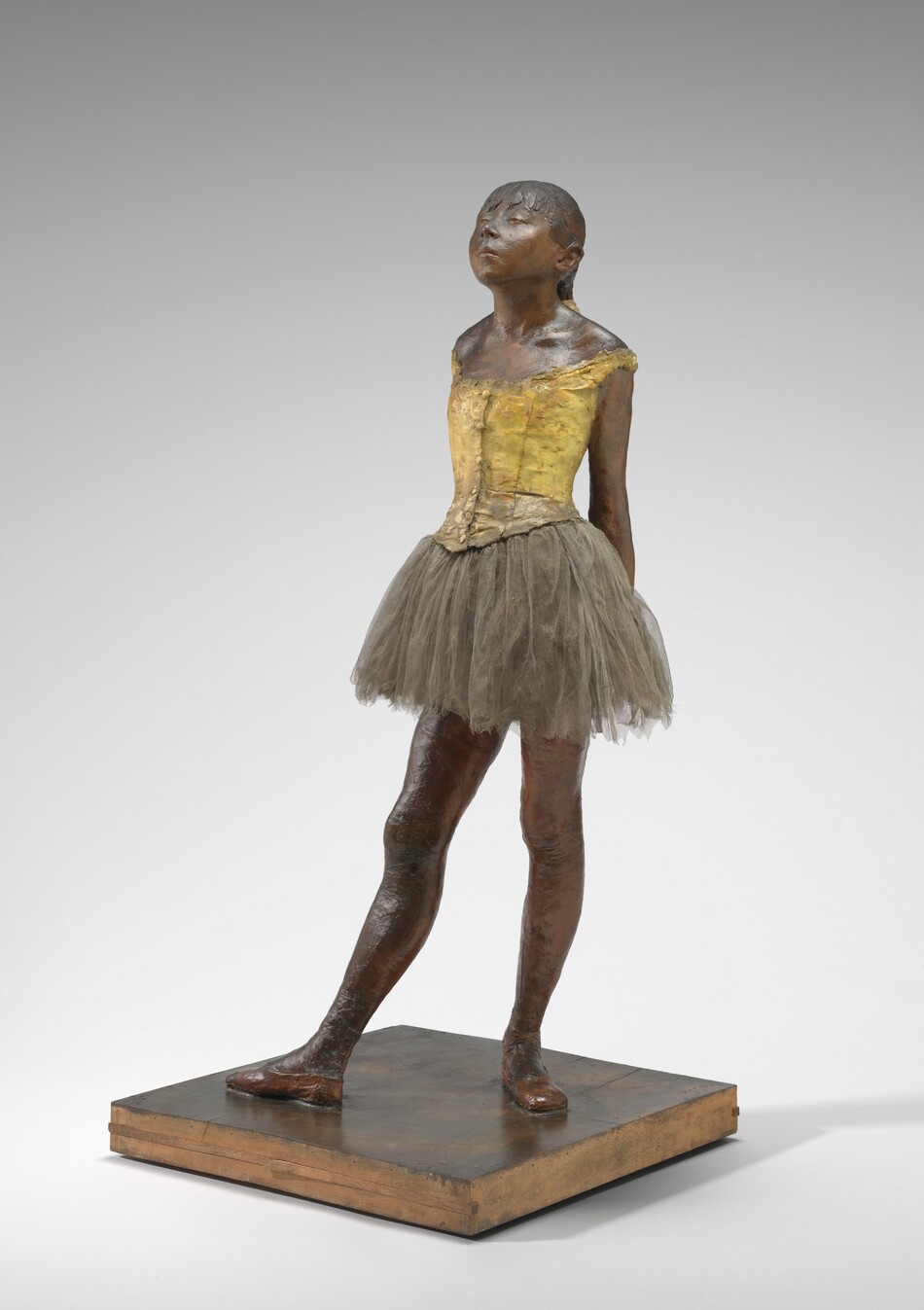
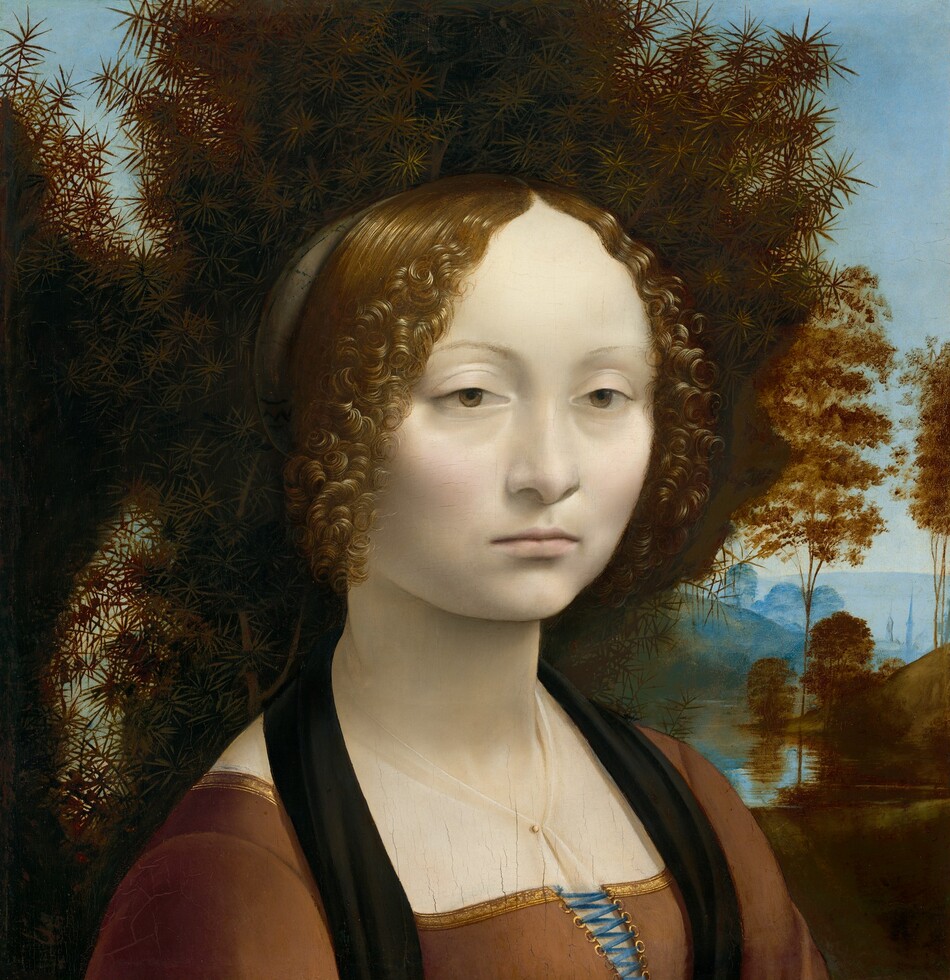
Artworks

Explore our collection of nearly 160,000 works spanning the history of Western art.