Interactive Article

Art Comes to Life in Joan Miró’s "The Farm"

Joan Miró’s complex and captivating painting is full of life and mystery.

By
  • Alex Dean
4 min read
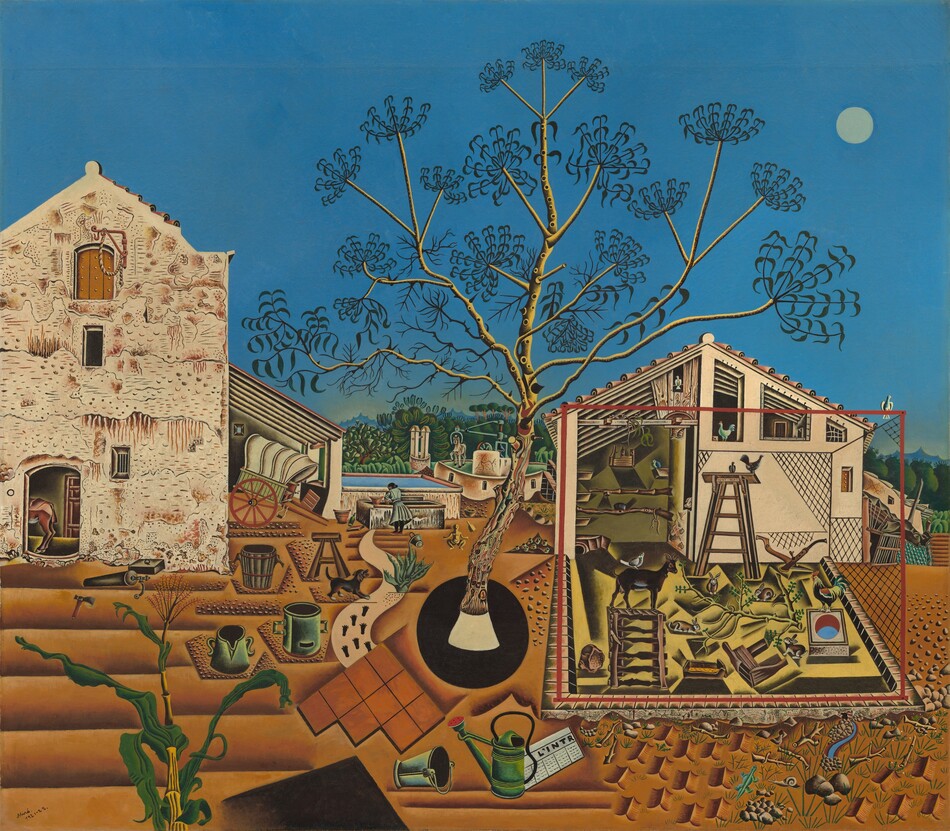
Two angular, cream-white buildings flanking a central, stylized tree are surrounded by brown soil, small animals, and farmhouse objects like watering cans and buckets beneath a clear, azure-blue sky in this square landscape painting. We look straight onto the buildings and slightly down onto the earth in front of us. About a third of the way up the composition, the horizon is lined with trees and mountains in the deep distance. The long, spindly branches of the central tree nearly reach the top edge of the painting and abstracted, sickle-shaped leaves are silhouetted against the sky so no leaves overlap. The far edge of the whitewashed structure to our left is cropped. The façade is pierced by two small rectangular windows and an arched hatch at the top under a winch. The back end of a horse is visible through an open door at the bottom center. Horizontal bands in front of the building suggest furrows in plowed earth, and a single stalk of corn grows up into the scene, seeming close to us. A pen protected by netting stretches out in front of the second structure, to our right of center. That wood-frame building has a triangular peaked roof, and the left half is open, like a lean-to. A goat, rooster, birds, and several rabbits occupy the pen. Watering cans, buckets and pails, a hoe, newspaper, lizard, and snail are spaced around the buildings. A tiny stylized person, perhaps a baby, appears in the distance between the buildings near a well where a woman works. A covered wagon, a round mill, trees, and plants fill the rest of the space between the buildings. A disk-like moon hangs in the sky to the right of the tree. The artist signed and dated the lower left corner, "Miro. 1921-22."
Joan Miró, The Farm, 1921-1922, oil on canvas, Gift of Mary Hemingway, 1987.18.1

Catalan artist Joan Miró created The Farm over the course of nine months. The painting was so deeply personal to him that he compared this period to a pregnancy. And with its rich world of details and lack of clear meaning, the work does echo the complexity of a human life. It is a dreamlike vehicle for nostalgia and memory, at once universal and highly specific.

Learn more about The Farm, its mysterious details, and how it came into the hands of one of the greatest American writers of the 20th century.
 

A Fantastical Painting of Mont-roig

In 1920, Miró left his hometown of Barcelona for Paris, where he hoped to advance his career as an artist. Though he spent much of his time in the French capital, Miró returned to Spain each summer to stay at his family’s farm in the small town of Mont-roig del Camp.

Drawing inspiration from the striking Catalan countryside, Miró created this sprawling depiction of the farm between summer 1921 and winter 1922.

One of the most intriguing mysteries behind this work is its arresting visual style. Like Miró himself, the painting resists categorization.

The Farm combines elements of cubism and realism. Objects appear from varying points of view, a technique common in cubism. But they are rendered with great detail, which is characteristic of realism.

The result is a highly detailed work full of precisely painted items that also feels like something out of a fantasy. Miró created a bustling scene of daily life in Mont-roig, but threw in quite a few mysterious elements.

Look Closely, Search for Meaning

What’s happening in this work?

But some elements of The Farm have clear—or at least clearer—meanings.

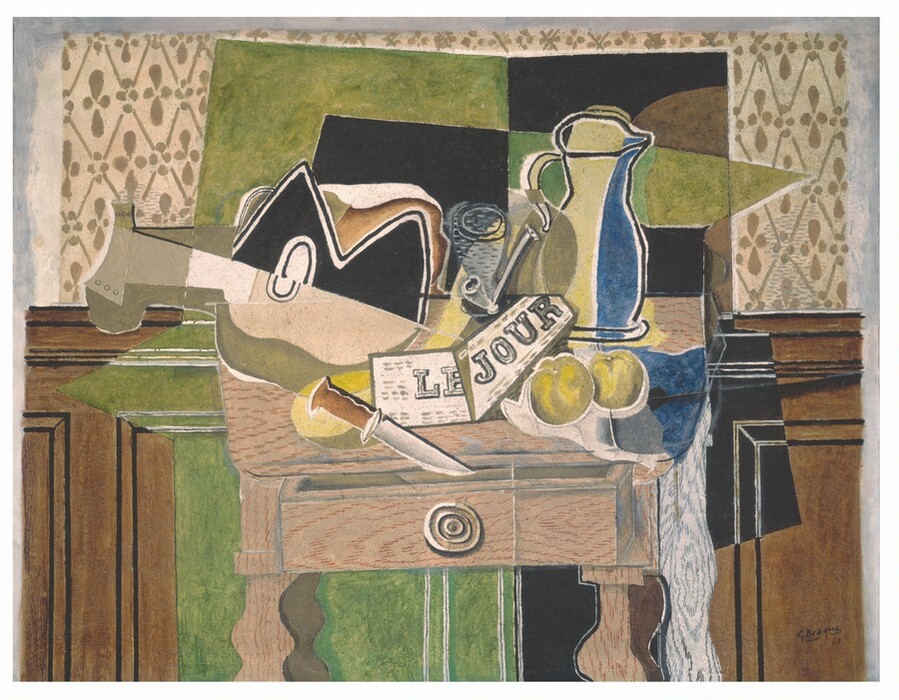
Note the newspaper near the bottom of the painting, sitting in a dusty field. While this might be a strange spot to leave a paper, its presence may reference Miró’s connections to the cubist movement. Artists like Pablo Picasso, Georges Braque, and Juan Gris often painted or collaged newspapers into their cubist works. 
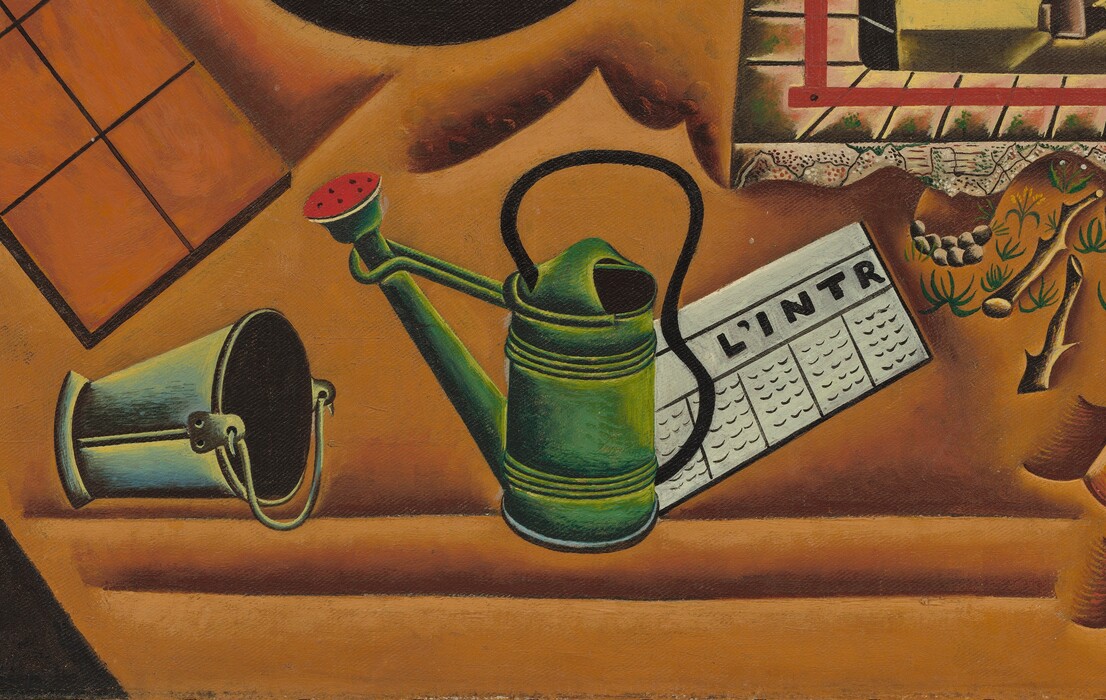
Two angular, cream-white buildings flanking a central, stylized tree are surrounded by brown soil, small animals, and farmhouse objects like watering cans and buckets beneath a clear, azure-blue sky in this square landscape painting. We look straight onto the buildings and slightly down onto the earth in front of us. About a third of the way up the composition, the horizon is lined with trees and mountains in the deep distance. The long, spindly branches of the central tree nearly reach the top edge of the painting and abstracted, sickle-shaped leaves are silhouetted against the sky so no leaves overlap. The far edge of the whitewashed structure to our left is cropped. The façade is pierced by two small rectangular windows and an arched hatch at the top under a winch. The back end of a horse is visible through an open door at the bottom center. Horizontal bands in front of the building suggest furrows in plowed earth, and a single stalk of corn grows up into the scene, seeming close to us. A pen protected by netting stretches out in front of the second structure, to our right of center. That wood-frame building has a triangular peaked roof, and the left half is open, like a lean-to. A goat, rooster, birds, and several rabbits occupy the pen. Watering cans, buckets and pails, a hoe, newspaper, lizard, and snail are spaced around the buildings. A tiny stylized person, perhaps a baby, appears in the distance between the buildings near a well where a woman works. A covered wagon, a round mill, trees, and plants fill the rest of the space between the buildings. A disk-like moon hangs in the sky to the right of the tree. The artist signed and dated the lower left corner, "Miro. 1921-22."
Joan Miró, The Farm, 1921-1922, oil on canvas, Gift of Mary Hemingway, 1987.18.1
A wood table is piled with stylized and abstracted objects, including a jug, lemons, a knife, guitar, newspaper, and a smoking pipe in this horizontal still life painting. The objects are made up of areas of mostly flat color and many are outlined in black, creating the impression that some shapes are two-dimensional and assembled almost like a collage. We look down onto the top of the table and at the front, where the grain of the wood is painted in tan against a lighter background. Concentric black and white circles make up the knob on the face of the table’s single drawer. There are two rows of objects on the table. Along the front, near the left corner of the table, the knife hangs with its blade slightly over the open drawer. A newspaper with the title “LE JOUR” rests next to the knife. Next to the newspaper are two yellow pieces of fruit, near the front right corner of the table. Behind the fruit, the right third of the pitcher is marine blue and the left two thirds is mostly straw yellow, with one round olive-green area near the handle. Next to the pitcher is a tobacco pipe, and, at the back left edge of the table, the guitar. The instrument rests on its side so the front of the soundboard faces the viewer, and the neck extends to our left. The instrument is bisected lengthwise into two halves that appear to be spliced together, and the edges and features of the halves are not symmetrical or aligned with each other. The bottom half of the guitar is painted a beige color, and is curved like a typical guitar body. The top half is painted black, and the contour of the instrument’s body rises into two pointed peaks instead of mirroring the rounded forms below. The sound hole is markedly smaller on the bottom half, and the two halves of the hole do not exactly line up. A rectangular form behind the table could be a screen. The left side is fern green, the right side black. Behind the screen is a wallpapered wall above wood paneling. The wallpaper is patterned with teardrop shapes, dots, and zigzagging lines in fawn brown against parchment white. The artist signed and dated the painting in the lower right corner, “G Braque 29.”
Georges Braque, Still Life: Le Jour, 1929, oil on canvas, Chester Dale Collection, 1963.10.91

Miró also used this painting to communicate a vision of humble rural life—even if it didn’t quite match reality. The painter chose not to include his family’s grand country house in the scene. 
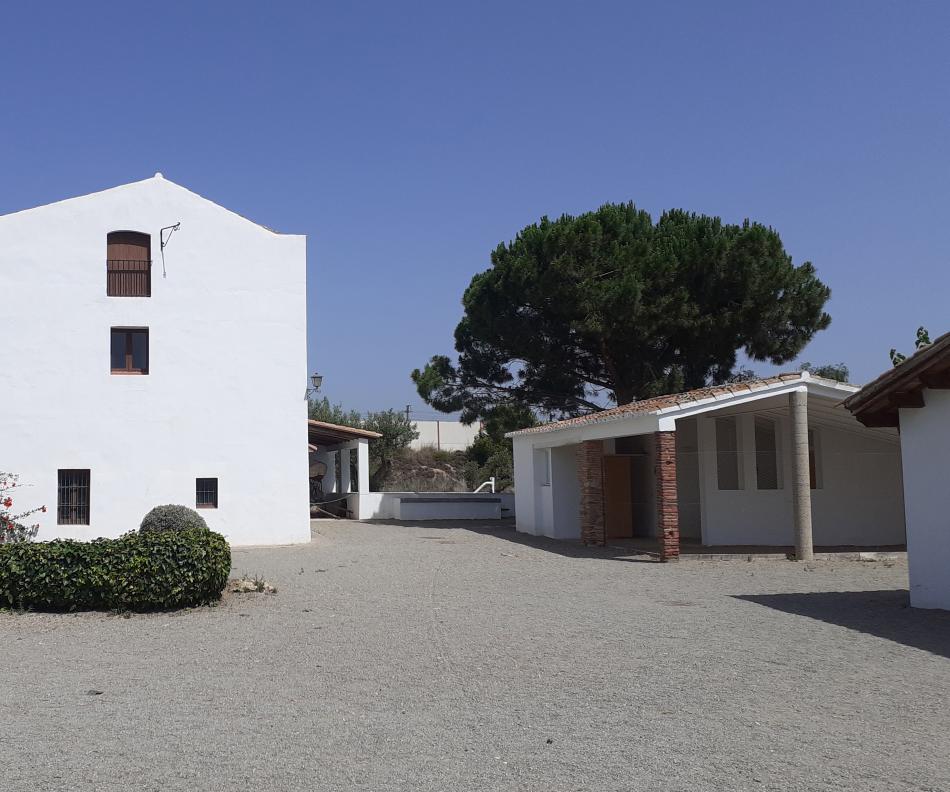
Two angular, cream-white buildings flanking a central, stylized tree are surrounded by brown soil, small animals, and farmhouse objects like watering cans and buckets beneath a clear, azure-blue sky in this square landscape painting. We look straight onto the buildings and slightly down onto the earth in front of us. About a third of the way up the composition, the horizon is lined with trees and mountains in the deep distance. The long, spindly branches of the central tree nearly reach the top edge of the painting and abstracted, sickle-shaped leaves are silhouetted against the sky so no leaves overlap. The far edge of the whitewashed structure to our left is cropped. The façade is pierced by two small rectangular windows and an arched hatch at the top under a winch. The back end of a horse is visible through an open door at the bottom center. Horizontal bands in front of the building suggest furrows in plowed earth, and a single stalk of corn grows up into the scene, seeming close to us. A pen protected by netting stretches out in front of the second structure, to our right of center. That wood-frame building has a triangular peaked roof, and the left half is open, like a lean-to. A goat, rooster, birds, and several rabbits occupy the pen. Watering cans, buckets and pails, a hoe, newspaper, lizard, and snail are spaced around the buildings. A tiny stylized person, perhaps a baby, appears in the distance between the buildings near a well where a woman works. A covered wagon, a round mill, trees, and plants fill the rest of the space between the buildings. A disk-like moon hangs in the sky to the right of the tree. The artist signed and dated the lower left corner, "Miro. 1921-22."

And notice the cracked, crumbling wall of the barn. Miró probably took artistic liberties here—the structure was likely not in such a dilapidated state. 

Compare the painting with this photograph of the home, now the Fundación Mas Miro.

Ernest Hemingway and The Farm

At first, Miró struggled to sell the painting. He later said that no art dealer in Paris “even wanted to look at it.” Eventually, Paul Rosenberg—a gallerist who represented Miró’s friend Pablo Picasso—agreed to display The Farm on consignment. When it failed to sell, Rosenberg suggested cutting the painting into eight pieces and selling them individually to better fit in small Parisian apartments.

Miró was distraught. He considered this one of his greatest works, writing that it “was the summary of [his] whole life (spiritual and poetic) in the countryside.”

Luckily, this masterpiece would soon become the singular obsession of another notable Paris resident.
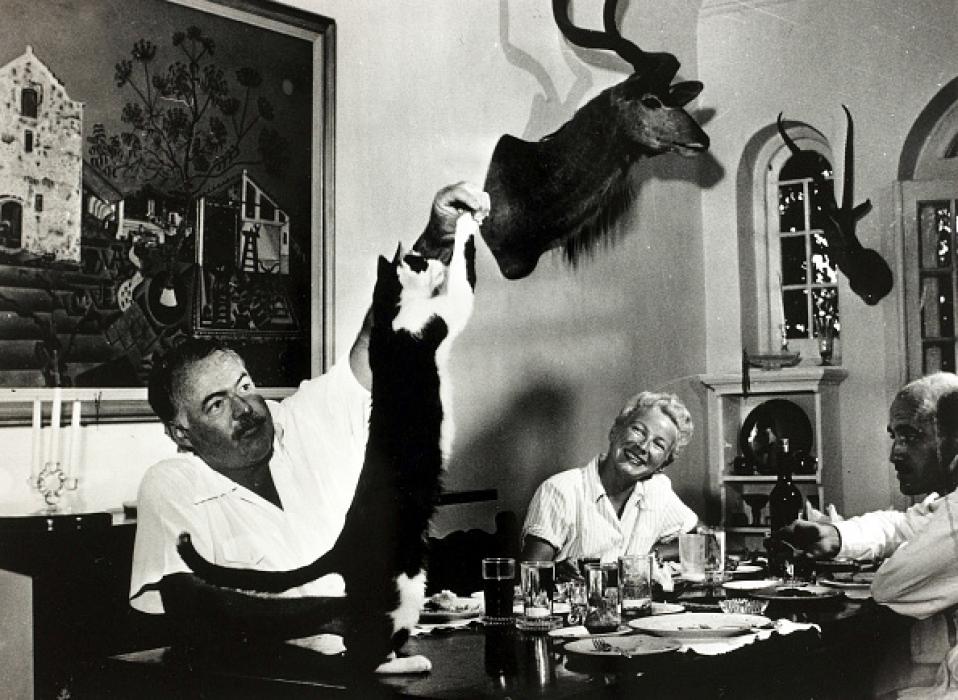
A black and white photo shows a bearded man feeding a cat standing on a table. A woman sits past him at the table. The head of a large antlered animal is on the wall.

Author Ernest Hemingway and his wife Mary Welsh Hemingway sit in their dining room with Joan Miró's The Farm behind them. (Photo by Popperfoto via Getty Images/Getty Images)

During his time in Paris, Miró befriended American writer Ernest Hemingway. By 1925, Hemingway had become enthralled with The Farm and planned to buy it. His friend poet Evan Shipman also wanted the painting. According to Hemingway, the two writers shot dice for it, and he won. To pay for it, Hemingway collected money from patrons in restaurants and cafés throughout Paris.

The painting became one of Hemingway’s prized possessions. He wrote that it “has in it all that you feel about Spain when you are there and all that you feel when you are away and cannot go there.”

But he may have said it best in an article for the French literary and artistic journal Cahiers d’Art in 1937. After explaining the story behind buying the painting and extolling its virtues, he concluded, “This is too long now and the thing to do is look at the picture: not write about it.” The fascinating work that captured this great writer’s imagination still resonates today.
You may also like
Close to us, a young man and three boys sit or recline in a small sailboat that tips to our left on a choppy dark green sea in this horizontal painting. The billowing sail extends off the top left corner of the canvas and is echoed in the background to our right by the tall sails of another ship in the distance. The horizon line comes about a third of the way up the composition, and puffy gray and white clouds sweep across the turquoise sky. The sun lights the scene from our right so the boys’ ruddy faces are in shadow under their hats. The young man and boys all face our left so they lean against and into the boat as it cants up to our right. The boy nearest the sail to our left reclines across the bow. Next to him to our right, a younger boy perches on the edge of the boat and holds on with both hands. The oldest, in a red shirt, sits on the floor of the boat as he maneuvers the sail with a rope. Closer to us and to our right, a younger boy sits with his bare feet pressed together in front of his bent knees on the back edge of the boat, gazing into the distance over his right shoulder as he handles the tiller. The artist signed and dated the painting in dark letters in the lower right corner: “HOMER 1876.”

Interactive Article:  A New View for America’s Centennial

As the United States emerged from the Civil War, Winslow Homer spent years perfecting a painting to embody his hopes for America’s future. 

We look beyond a cluster of flags hanging from the side of one tall building onto a wide street at a row of buildings across from us in this vertical painting. The scene is loosely painted with visible brushstrokes, so some details are difficult to make out. We seem to lean out a window to look along the street, so the building to our right only skims the edge of the composition and continues off the top. The three flags closest to us fly from nearly horizontal flagstaffs along the bottom edge of the painting. All the flags are in shades of scarlet red, white, and royal blue. The flag closest to us is red with the red, white, and blue Union Jack in the upper corner. Beyond it is an American flag with 49 stars, and then the French flag with the vertical bands of blue, white, and red. Those three flags are repeated about a dozen times along the building that stretches away from us, along the right edge of the painting. More of those flags are hung from the cream-white and tan buildings across the street, to our left. Some of those buildings reach off the top edge of the canvas and others come close. The shadows along moldings and the windows are painted with pale and lapis blue. Through narrow gaps left between the fluttering flags, vertical strokes of navy blue and violet purple suggest crowds of people in the street below. The sky between the buildings is ice blue. The artist signed and dated the painting in the center left, “Childe Hassam May 17 1917.”

Interactive Article:  Childe Hassam and the Flag in American Art

Explore the American impressionist's paintings of the US flag.