Interactive Article

Horns, Scales, and Armor

The Rhinoceros by Albrecht Dürer

4 min read
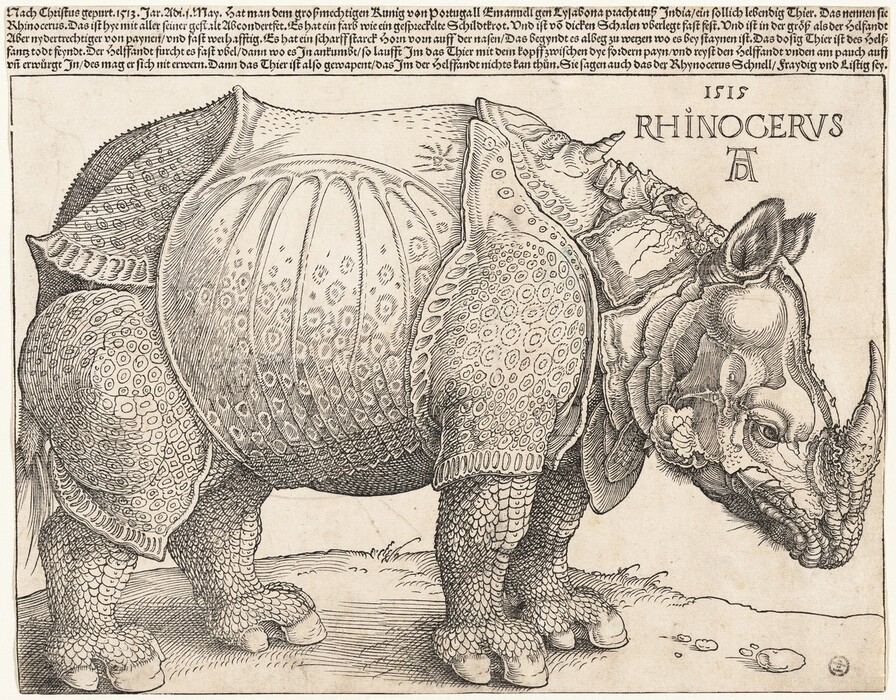
Printed with black lines on cream-white paper, a rhinoceros facing our right in profile fills this horizontal woodcut. The rhinoceros’s horn touches the border to the right and its hindquarters the left. Its left foot, farther from us, stands slightly ahead of its right hoof. Its front feet are close together and its head is lowered. Chunky, armor-like plates covering its body are patterned in some areas, especially on its legs and belly, with rings and dots, creating a mottled effect. The skin on its legs is scaly like a fish or reptile. A short, twisted, unicorn-like horn grows from between its shoulders, and the animal’s lower lip and the ear we see is fuzzy with short hairs. Near the upper right, in the corner near the animal's shoulders, the print is inscribed, “1515 RHINOCERVS.” Below, the artist’s initials appear as a monogram, with an upper case D tucked within the legs of an A. Five rows of tightly spaced German writing runs across the top edge of the paper, above the single-line border framing the animal. It reads, "Nach Christus gepurt. 1513. Jar. Adi. 1. May. Hat man dem groszmechtigen Kunig von Portugall Emanuell gen Lysabona pracht ausz India ein sollich lebendig Thier. Das nennen sie Rhinocerus. Das ist hye mit aller seiner gestalt Abconderfet. Es hat ein farb wie ein gespreckelte Schildtkrot. Und ist von dicken Schalen uberlegt fast fest. Und ist in der grösz als der Helfandt Aber nydertrechtiger von paynen und fast werhafftig. Es hat ein scharff starck Horn vorn auff der nasen Das Begyndt es albeg zu werzen wo es Bey staynen ist. Das dosig Thier ist des Helffantz todt feyndt. Der Helffandt furcht es fast ubel dann wo es In ankumbt so laufft Im das Thier mit dem kopff zwischen dye fordern payn und reyst den Helffandt unden am pauch auff un erwürgt In des mag er sich nit erwern. Dann das Thier ist also gewapent das Im der Helffandt nichts kan thun. Sie sagen auch das der Rhynocerus Schnell Fraydig und Listig sey."
Albrecht Dürer, The Rhinoceros, 1515, woodcut on laid paper, Rosenwald Collection, 1964.8.697

Does this animal look familiar? This woodcut print, made in 1515, depicts an Indian rhinoceros. Its artist, Albrecht Dürer, probably never saw a rhino himself. He based this image on other people’s sketches and written descriptions of the creature. But he seized the moment to capitalize on a sensational event: the arrival of an Indian rhinoceros on European shores. Learn about the strange and winding journey the creature took, and the ways Dürer’s woodcut popularized its image while burnishing his reputation.

Which Features Look Accurate?

Which Attributes Look Different from a Real Rhino?

A Gift from India

In the 16th century, Sultan Muzaffar Shah II of Cambay—now the state of Gujarat in western India—presented this rhino as a diplomatic gift to Alfonso de Albuquerque, the governor of Portuguese India. The governor then sent the creature to King Manuel I of Portugal in 1515. It was the first rhinoceros to set foot in Europe since ancient Roman times, 1,500 years earlier.

The rhino’s arrival in Lisbon was an astonishing event. People flocked to the city’s main plaza to see this extraordinary animal. A Portuguese sailor at the time described the rhinoceros in a letter as “fast, lively, and cunning.”

Dürer produced this print in Germany to capitalize on the rhino’s sensational reception in Portugal. He based his print on another artist’s sketch, and he included the sailor’s observation in the German text at the top. This woodcut print functioned as a broadsheet, almost like a poster or a newspaper ad, to announce the animal’s arrival.

King Manuel I later decided to present the rhino as a gift to Pope Leo X in Rome. Sadly, the ship transporting the rhino encountered a storm off the coast of northern Italy. The boat sank in the Mediterranean, and the animal drowned.

Printing Made Dürer a Celebrity

Dürer was one of the first “celebrity” artists in Western art history. His choice of medium helped him gain widespread recognition. He knew that creating and selling prints would enable him to reach a broad audience, further establish his reputation as an artist, and ultimately make him money. He made The Rhinoceros using a woodcut print.

Today, he is remembered as a prolific printmaker whose exceptional draftsmanship and tonal range helped elevate the medium into fine art.
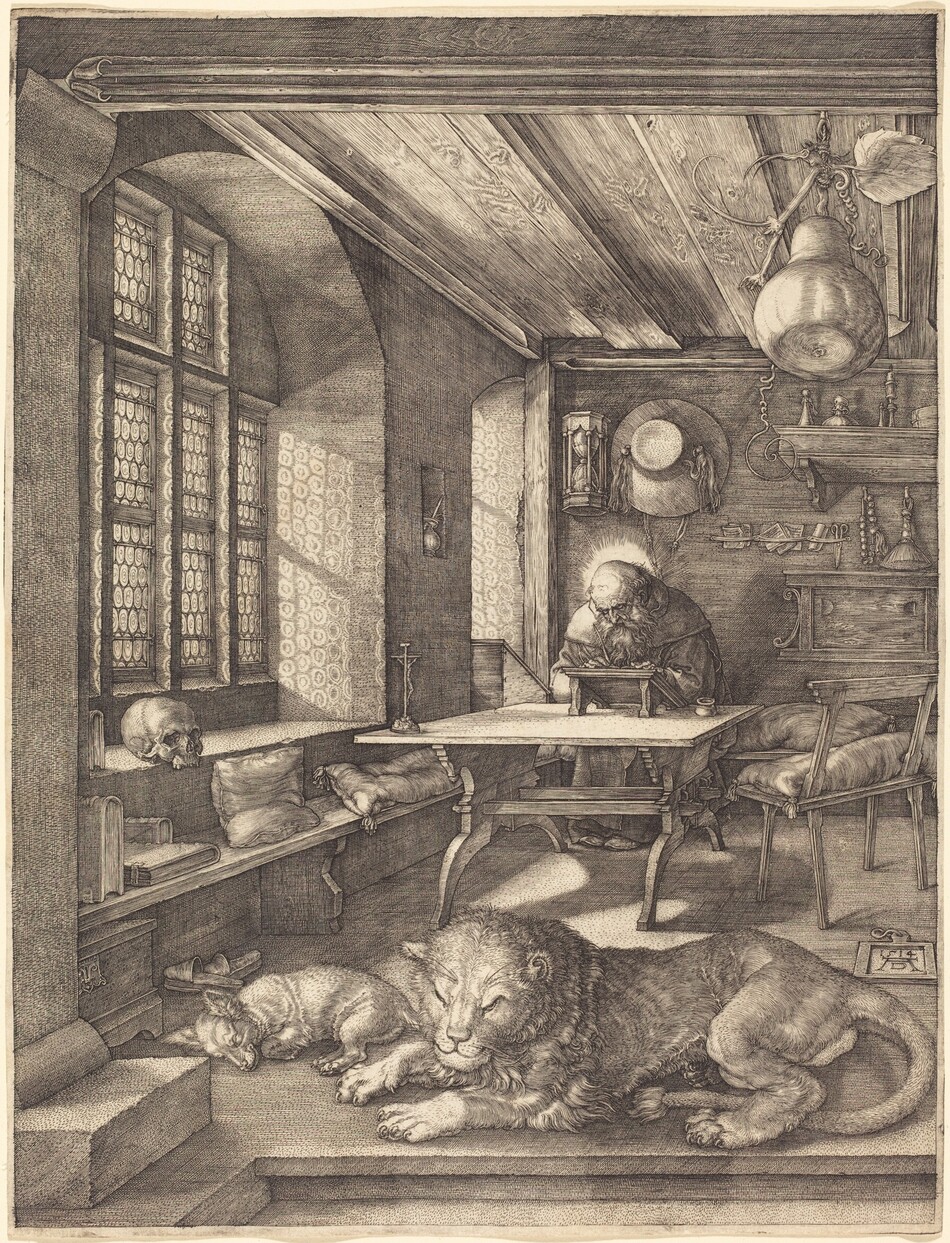
His stylized, prominent initials helped viewers recognize his works. In this print, the rhino’s smaller horn points toward Dürer’s initials AD.
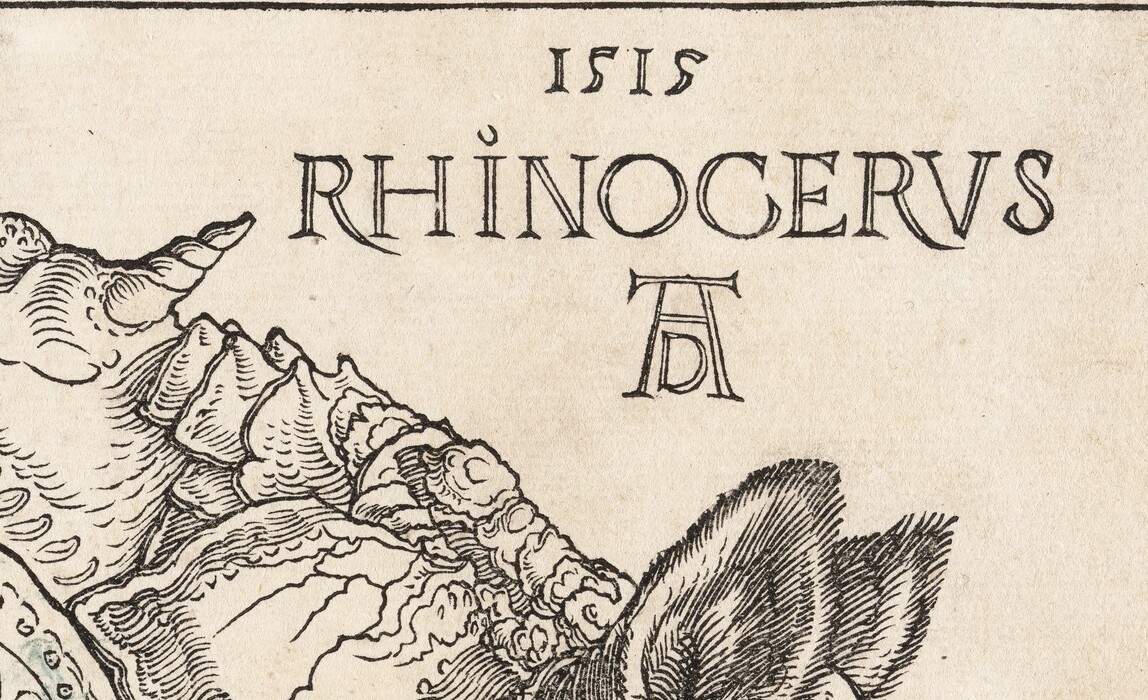
Printed with black lines on cream-white paper, a rhinoceros facing our right in profile fills this horizontal woodcut. The rhinoceros’s horn touches the border to the right and its hindquarters the left. Its left foot, farther from us, stands slightly ahead of its right hoof. Its front feet are close together and its head is lowered. Chunky, armor-like plates covering its body are patterned in some areas, especially on its legs and belly, with rings and dots, creating a mottled effect. The skin on its legs is scaly like a fish or reptile. A short, twisted, unicorn-like horn grows from between its shoulders, and the animal’s lower lip and the ear we see is fuzzy with short hairs. Near the upper right, in the corner near the animal's shoulders, the print is inscribed, “1515 RHINOCERVS.” Below, the artist’s initials appear as a monogram, with an upper case D tucked within the legs of an A. Five rows of tightly spaced German writing runs across the top edge of the paper, above the single-line border framing the animal. It reads, "Nach Christus gepurt. 1513. Jar. Adi. 1. May. Hat man dem groszmechtigen Kunig von Portugall Emanuell gen Lysabona pracht ausz India ein sollich lebendig Thier. Das nennen sie Rhinocerus. Das ist hye mit aller seiner gestalt Abconderfet. Es hat ein farb wie ein gespreckelte Schildtkrot. Und ist von dicken Schalen uberlegt fast fest. Und ist in der grösz als der Helfandt Aber nydertrechtiger von paynen und fast werhafftig. Es hat ein scharff starck Horn vorn auff der nasen Das Begyndt es albeg zu werzen wo es Bey staynen ist. Das dosig Thier ist des Helffantz todt feyndt. Der Helffandt furcht es fast ubel dann wo es In ankumbt so laufft Im das Thier mit dem kopff zwischen dye fordern payn und reyst den Helffandt unden am pauch auff un erwürgt In des mag er sich nit erwern. Dann das Thier ist also gewapent das Im der Helffandt nichts kan thun. Sie sagen auch das der Rhynocerus Schnell Fraydig und Listig sey."
Albrecht Dürer, The Rhinoceros, 1515, woodcut on laid paper, Rosenwald Collection, 1964.8.697

Dürer’s Print Spread the Rhinoceros Far and Wide

After Dürer died in 1528, printers continued to produce copies of his works. Some even used his original woodblocks for their prints. In 1548, Italian engraver Enea Vico made his own version of Dürer’s rhino. Vico shows the animal in reverse, and his print dropped Durer’s initials but includes his own. One of the resulting prints is in the National Gallery’s collection.
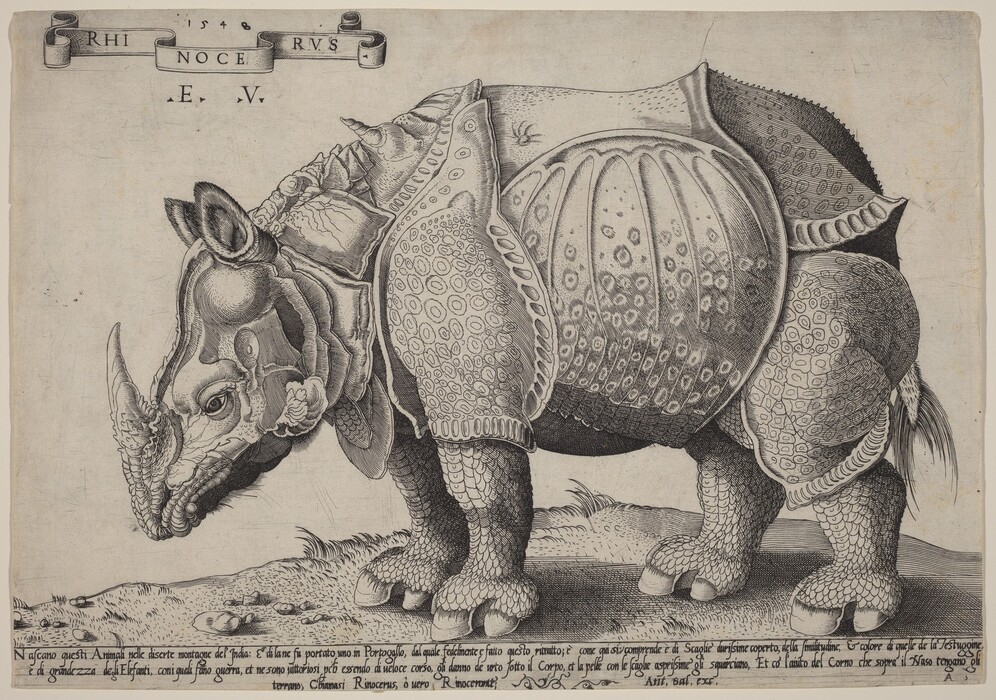
This is a drawing of a rhinoceros. It features intricate details on the rhinoceros's body, emphasizing its armored appearance. The rhinoceros is standing on grass, with its skin depicted in a stylized manner. The drawing is executed in fine lines, enhancing the texture of the skin. The artwork includes a banner with the word "RHINOCERVS" and Latin text below the main image.
Enea Vico, Rhinoceros, 1548, engraving on laid paper, Gift of Mrs. Robert A. Hauslohner, 1991.116.141
Printed with black lines on cream-white paper, a rhinoceros facing our right in profile fills this horizontal woodcut. The rhinoceros’s horn touches the border to the right and its hindquarters the left. Its left foot, farther from us, stands slightly ahead of its right hoof. Its front feet are close together and its head is lowered. Chunky, armor-like plates covering its body are patterned in some areas, especially on its legs and belly, with rings and dots, creating a mottled effect. The skin on its legs is scaly like a fish or reptile. A short, twisted, unicorn-like horn grows from between its shoulders, and the animal’s lower lip and the ear we see is fuzzy with short hairs. Near the upper right, in the corner near the animal's shoulders, the print is inscribed, “1515 RHINOCERVS.” Below, the artist’s initials appear as a monogram, with an upper case D tucked within the legs of an A. Five rows of tightly spaced German writing runs across the top edge of the paper, above the single-line border framing the animal. It reads, "Nach Christus gepurt. 1513. Jar. Adi. 1. May. Hat man dem groszmechtigen Kunig von Portugall Emanuell gen Lysabona pracht ausz India ein sollich lebendig Thier. Das nennen sie Rhinocerus. Das ist hye mit aller seiner gestalt Abconderfet. Es hat ein farb wie ein gespreckelte Schildtkrot. Und ist von dicken Schalen uberlegt fast fest. Und ist in der grösz als der Helfandt Aber nydertrechtiger von paynen und fast werhafftig. Es hat ein scharff starck Horn vorn auff der nasen Das Begyndt es albeg zu werzen wo es Bey staynen ist. Das dosig Thier ist des Helffantz todt feyndt. Der Helffandt furcht es fast ubel dann wo es In ankumbt so laufft Im das Thier mit dem kopff zwischen dye fordern payn und reyst den Helffandt unden am pauch auff un erwürgt In des mag er sich nit erwern. Dann das Thier ist also gewapent das Im der Helffandt nichts kan thun. Sie sagen auch das der Rhynocerus Schnell Fraydig und Listig sey."
Albrecht Dürer, The Rhinoceros, 1515, woodcut on laid paper, Rosenwald Collection, 1964.8.697

Dürer’s print circulated widely throughout Europe and came to be considered the archetypal image of a rhinoceros. For centuries, Europeans believed rhinos looked just like this! 

You may also like

The image depicts a seated woman wearing a large coat and skirt. She is seated with her body angled to the side, head turned slightly towards the viewer. The woman has delicate facial features, with her hair covered by a fluffy hat. Her hands are resting in her lap as she sits on a wide chair. She is not wearing any visible jewelry or holding any objects. The background features simple vertical lines resembling a plain interior wall, creating a minimalist setting.

Interactive Article:  Mary Cassatt, the Daring Printmaker

The pioneering American impressionist was one of the most innovative printmakers of her generation.

Elizabeth Catlett in her studio, 1942

Article:  Who Is Elizabeth Catlett? 12 Things to Know

Meet a groundbreaking artist who made sculptures and prints for her people.