


Iconic American Landscapes, Through Artists’ Eyes

Across our nation’s history, artists have shaped our country’s land. Artist’s sketches and photographs gave some Americans their first glimpse of Yellowstone and other distant terrains. Painter Thomas Moran encouraged the establishment of national parks, and photographer Ansel Adams advocated for the conservation of our country’s natural beauty. Still today, artists open our eyes to new views of familiar destinations, from Niagara Falls to the Grand Canyon and beyond.
Take a road trip to some of our nation’s most iconic landscapes through the eyes of nine artists.
1. Mount Desert Island
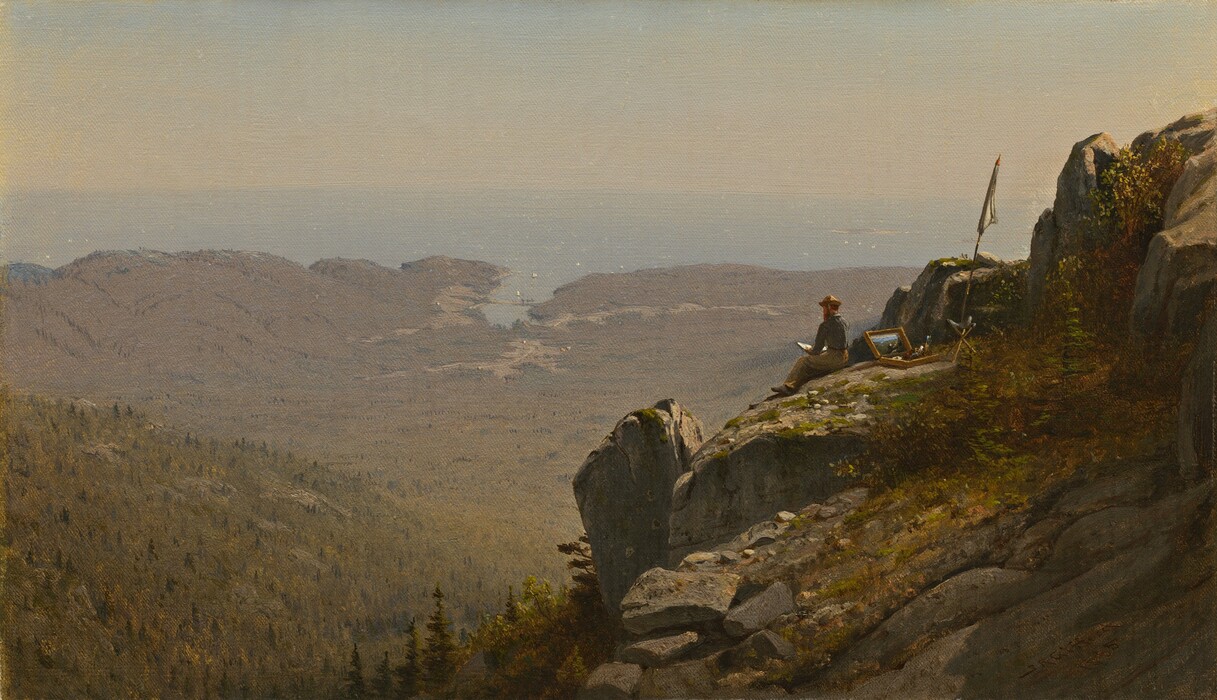
Nineteenth-century painters helped shape Maine’s reputation as the “vacationland” it is today. Hudson River School painters Thomas Cole and Frederic Edwin Church first visited Mount Desert Island, Maine’s largest island, in the 1840s and 1850s. Their vistas of the island’s rocky shores, steep summits, and moody sunsets inspired Sanford Robinson Gifford and other young painters to follow in their footsteps.
Gifford’s painting shows an artist—most likely himself—working en plein air. He sits on a mountain ledge, with his paint set, stool, and umbrella behind him. Gifford made several summer trips to Maine from his base in New York City.
Mount Desert Island became an increasingly popular destination for vacationers starting in the late 19th century . The advent of steamship and train routes, along with the publication of travel guides, enticed droves of “Rusticators,” wealthy New Yorkers and Bostonians, to this rustic picturesque destination.
2. Niagara Falls
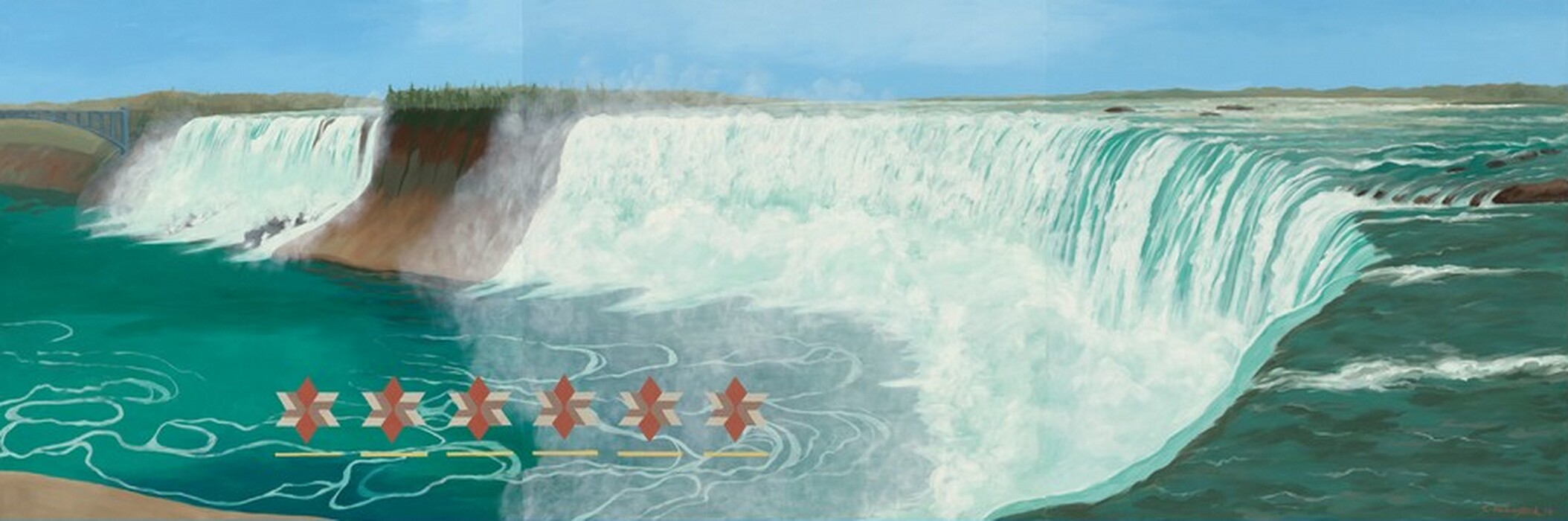
Niagara Falls is undoubtedly one of our nation’s most recognizable (and visited) landscapes. Artists have long attempted to capture the powerful falls that extend between the United States and Canada.
After seeing paintings by Hudson River School artist Louisa Davis Minot, Kay WalkingStick (Cherokee Nation of Oklahoma) decided to try her own hand at conveying the force of the falls. WalkingStick referred to sketches and photographs she had made while at Niagara Falls for this painting. In the lower left she overlayed a motif from a beaded coin purse made by an artist of the Tuscarora people, the Haudenosaunee tribe that lived closest to the falls. The purse was one of many “whimsies,” small souvenirs that they sold to Niagara Falls tourists.
See this painting in Niagara Falls: Mist and Majesty
3. The Hudson River
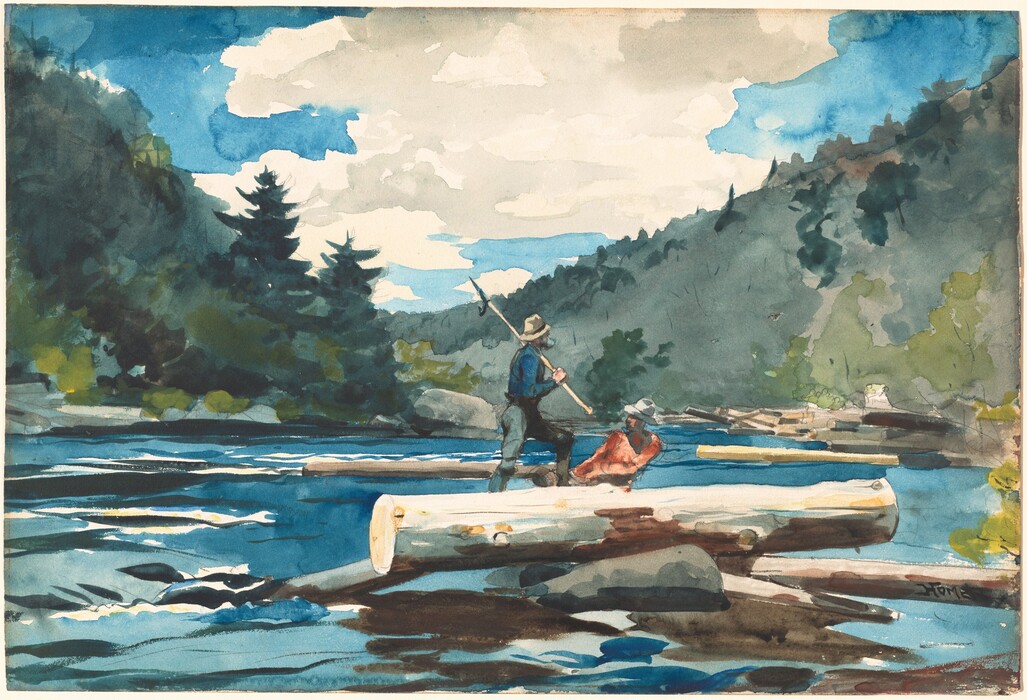
The Hudson River and its surrounding forests and mountains so inspired artists in the 19th century that an entire art movement is now named for the region. Winslow Homer, a later artist, also admired the Hudson River and made watercolors that documented the beauty and deforestation of its landscape.
The artist first began visiting the Adirondack Mountains in northeastern New York in the 1870s. Logging was a booming business at the time. Using the river eased transporting logs to sawmills. Loggers rolled felled trees into the rushing water and let the river’s currents float the logs downstream. Men tasked as log drivers directed the logs, while others broke up logjams. Around the time Homer made this watercolor in the early 1890s, Adirondack Park was established to preserve and conserve the area’s forests.
See this watercolor and more in American Landscapes in Watercolor from the Corcoran Collection
4. The Statue of Liberty
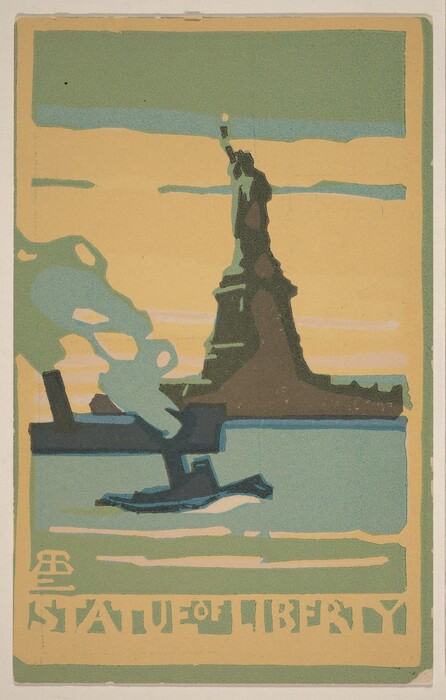
The Statue of Liberty is one of our country’s most recognized landmarks. It was originally a copper brown color when it was dedicated in 1886. By the time Rachael Robinson Elmer printed this linocut in 1916, it had the green patina we know today.
Elmer made a series of prints of familiar New York City sites. Her initial watercolors were translated into postcards. She made linoleum block prints for her second series of sites, including the Brooklyn Bridge and this view of the Statue of Liberty.
In 1916, the same year Elmer created this work, the Statue of Liberty sustained minor damage from a series of explosions in New York Harbor. During World War I, enemy agents attempted to sabotage munitions that were being prepared for shipment to the Allies in Europe that were stored on Black Tom Island, less than half a mile from the Statue of Liberty. The blasts embedded shrapnel into the statue and damaged its internal framework.
5. Mount Rushmore and Six Grandfathers Mountain

Mitch Epstein, Mount Rushmore National Memorial, Six Grandfathers, South Dakota 2018, 2018, printed 2025, inkjet print, © Black River Productions, Ltd.
Mitch Epstein set out to photograph South Dakota’s Mount Rushmore in 2018. The site was originally a sacred space that the Lakota people knew as the Six Grandfathers. As Epstein later reflected, “For me, the question was how to take something that’s so imaged and iconized and contrived and bring some kind of fresh reading to it.”
After waiting three days for the rain to pass, Epstein leaned into the atmospheric conditions to call attention to the mountain’s fraught history. Covering his 8 × 10-inch large-format camera with a tarp, he photographed clouds passing over the carved portraits of the presidents. Fog obscures the monumental faces. Epstein’s photograph suggests the effects time and erosion will have on this man-made homage.
See this photograph in Dear America: Artists Explore the American Experience
6. Yellowstone
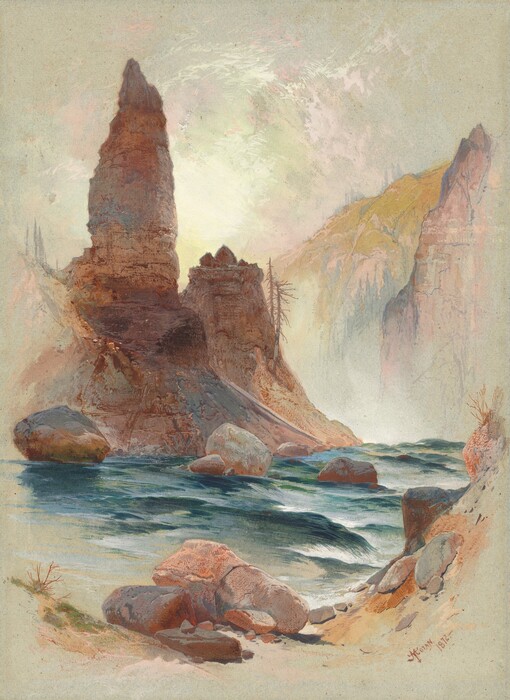
In 1871, Thomas Moran boarded a west-bound train for Yellowstone. Like many Americans at the time, Moran hadn’t set eyes on the area’s majestic landscapes. He joined a surveying expedition led by geologist F. V. Hayden for this adventure.
Raised in Philadelphia, Moran wasn’t a natural adventurer or an experienced camper—he’d never even ridden a horse—but he was determined to see Yellowstone for himself. He quickly learned how to navigate different sites, from Mammoth Hot Springs to Tower Falls, in this region of present-day Wyoming.
Moran used watercolors to record his first impressions of the astounding landscape. Upon returning to his studio in New Jersey, he painted the monumental Grand Canyon of the Yellowstone. Moran presented the 12-foot-wide painting to Congress while its members considered establishing Yellowstone as the country’s first national park. The federal government later purchased the painting and installed it in the US Capitol. Moran became so closely associated with the park that he even signed some of his paintings with the initials TYM for Thomas “Yellowstone” Moran.
7. Grand Tetons
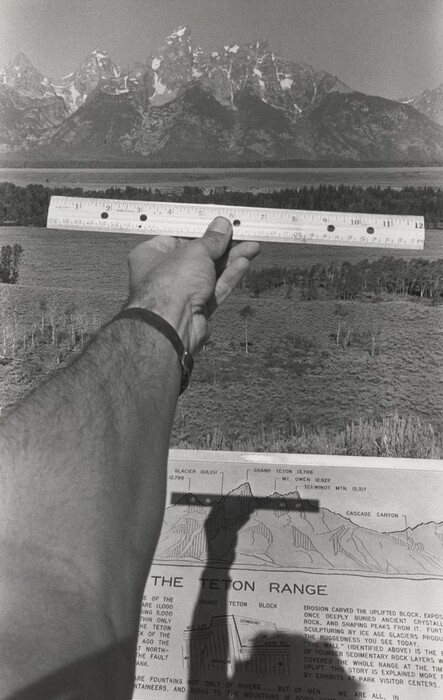
For his series History of Photography, Kenneth Josephson reflected on how photographs represent or skew reality. His photograph Wyoming is a play on Ansel Adams’s The Tetons and the Snake River, Grand Teton National Park, Wyoming. In Adams’s dramatic view, taken in 1942, a winding river leads our eye to the distant snow-capped mountain range. Clouds overhead obscure the sun. No signs of human life are seen in the vast landscape.
In contrast, Josephson inserts his arm into the center of his photograph. His fingers clutch a ruler, as if he’s measuring the landscape. His body casts a shadow on a plaque depicting and describing the Grand Teton mountain range in the distance. Josephson reminds us that a human hand has created every landscape photograph we’ve ever seen. No view is ever truly unfiltered.
8. The Grand Canyon
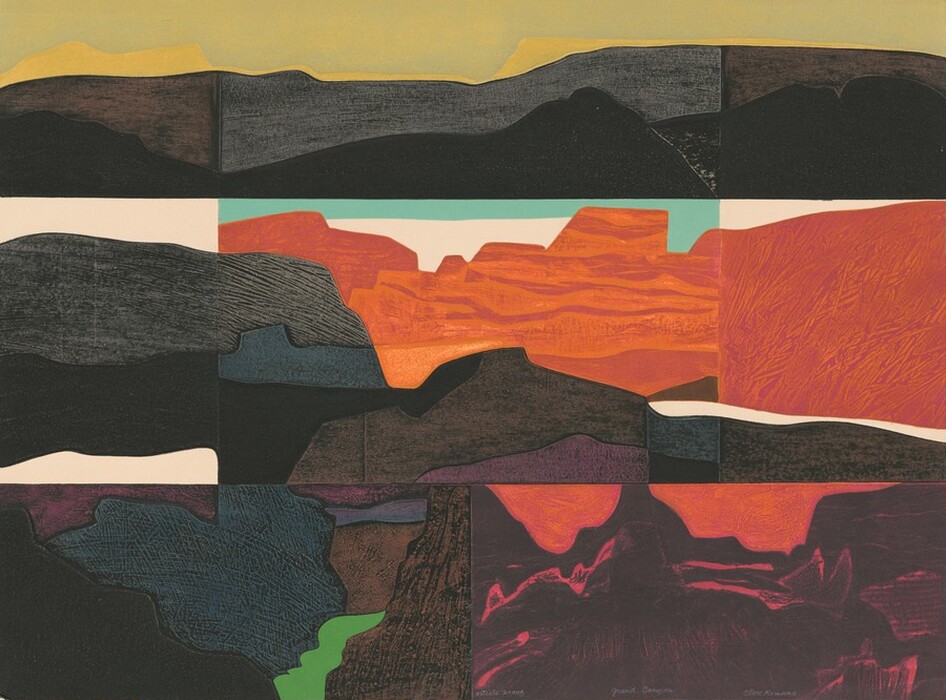
Artist Clare Romano made this collagraph print after her trip to Grand Canyon National Park in 1975. The collograph printmaking technique, which uses an assemblage of diverse materials, allowed Romano to create many color and textural effects.
For the layered bands of red rock, Romano divided her composition into individual printing plates made from matboard on which different materials were attached. She used rollers to coat them with colored inks, then assembled the “plates” like a jigsaw puzzle and printed the complete composition on paper. The lack of borders immerses us in the shadows and light of the Grand Canyon. President Theodore Roosevelt once called this natural wonder “the one great sight which every American should see.”
See this print in Dear America: Artists Explore the American Experience
9. Mount Denali

Ansel Adams’s striking photographs have defined public imagination of America’s natural beauty. His images also often helped preserve it.
Adams made his first journey to Alaska in 1947. “I felt Alaska might be close to the wilderness perfection I continuously sought,” he recounted. He set his sights on what was then called Mount McKinley, known for centuries as Denali, or the Great One, by the Athabascan people of the region. Alaska’s stormy weather proved a challenge. After a week waiting for the weather to clear, Adams woke before dawn to see if he could get a clear view at sunrise. “At about 1:30 a.m. the top of the mountain turned pink. Then gradually, the entire sky became golden and the mountain received more sunlight.” Shortly after this moment, clouds enveloped the mountain.
This trip, and many other ones Adams made, informed his advocacy to preserve Alaska’s land. He even took advantage of a portrait sitting with President Jimmy Carter in 1979. Adams presented Carter with a print of this photograph, along with a memo encouraging the president to support the Alaska National Interest Lands Conservation Act. The artist called his work to preserve Alaska’s wilderness as the “most important campaign in which I have participated.” Carter signed the act into law in 1980.
You may also like
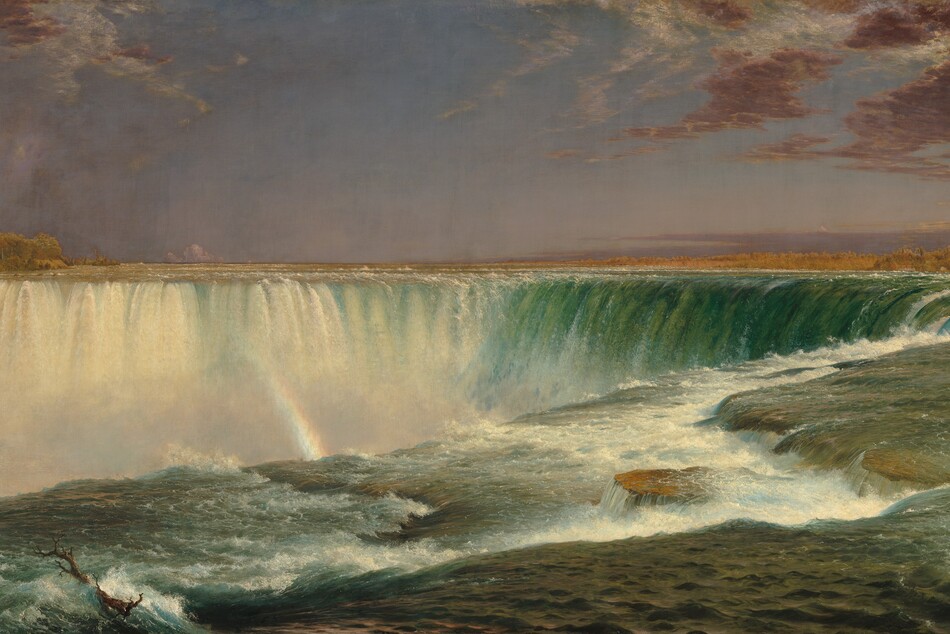
Article: The 19th-Century Blockbuster: Frederic Edwin Church’s “Niagara”
The American artist, skilled at both painting and publicity, created a sensation similar to the social media–famous exhibitions of today.

Article: Painter George A. Morton Transcends Tradition
Through sustained looking and detailed re-creations, this Atlanta-based artist studies Rembrandt and Sargent while finding new subjects that carry forward the painters’ traditions.