


A New View for America’s Centennial
Winslow Homer spent three years perfecting “Breezing Up (A Fair Wind)" to capture a unique moment in our nation's history.

Brisk wind, salty ocean mist, a burst of bright sunlight—Winslow Homer’s Breezing Up (A Fair Wind) is a breath of fresh air.
The American painter showed the work in 1876 at the Centennial Exposition in Philadelphia and at the National Academy of Design in New York. Critics at the time called it Homer’s “greatest hit” in several years, praising its ability to “delight and surprise” its audience.
The work was—and continues to be—enormously popular. It was so famous that it even earned a nickname: the original title was A Fair Wind, but it’s now known as Breezing Up.
It’s hard to imagine that this hopeful, energetic work was the result of a period of artistic struggle, but Homer claimed to have put in “three years’ work” on it, revising the painting’s composition over and over. He wanted to capture a unique moment in the history of the United States: emerging from the violence of the Civil War, optimism was growing in the young nation.
Artistic Growth
Just like his paintings, Winslow Homer was constantly evolving. He was largely self-taught and began his career as a commercial illustrator and printmaker. The artist began experimenting with oil painting in 1861 and completed his first major works using the medium around 1863, when he was 27.
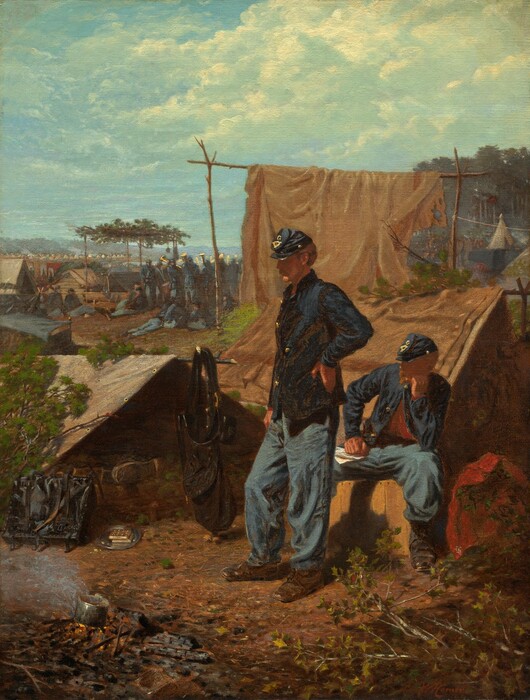
In the 1860s, the artist documented the Civil War (1861–1865) and its consequences. He worked as a correspondent for Harper’s Weekly magazine during the conflict. Paintings such as Home, Sweet Home (c. 1863) convey the emotional toll the war had on homesick soldiers.
After the war, in 1866 and 1867, Homer took a long trip to Europe. This visit changed his style, and he began to use looser brushwork. He also started painting more outdoor scenes. These changes reflected an awareness of French artists such as Claude Monet and Édouard Manet.
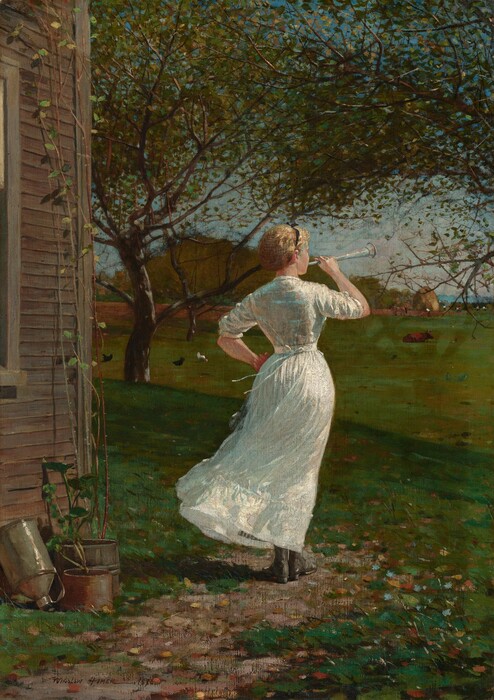
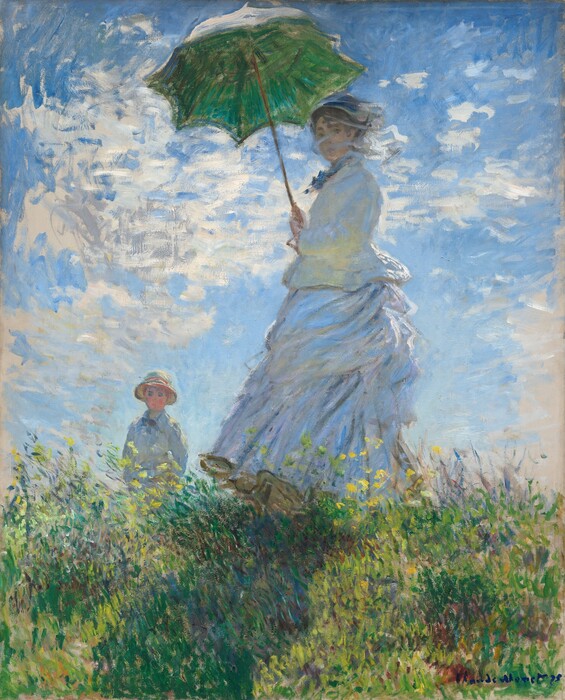
Homer’s post-1867 works have a liveliness reminiscent of these French painters, who worked to capture the feeling of a moment in time through their paintings. The Dinner Horn (Blowing the Horn at Seaside) (1870) exemplifies the freshness seen in works such as Monet’s Woman with a Parasol – Madame Monet and Her Son. Breezing Up and The Flirt echo this as well.
An Evolving Work
Homer created preparatory studies for Breezing Up, experimenting with the arrangement of figures, the lighting, and the background. These earlier versions include a 1873 watercolor, an oil sketch, and an 1874 oil painting titled The Flirt.
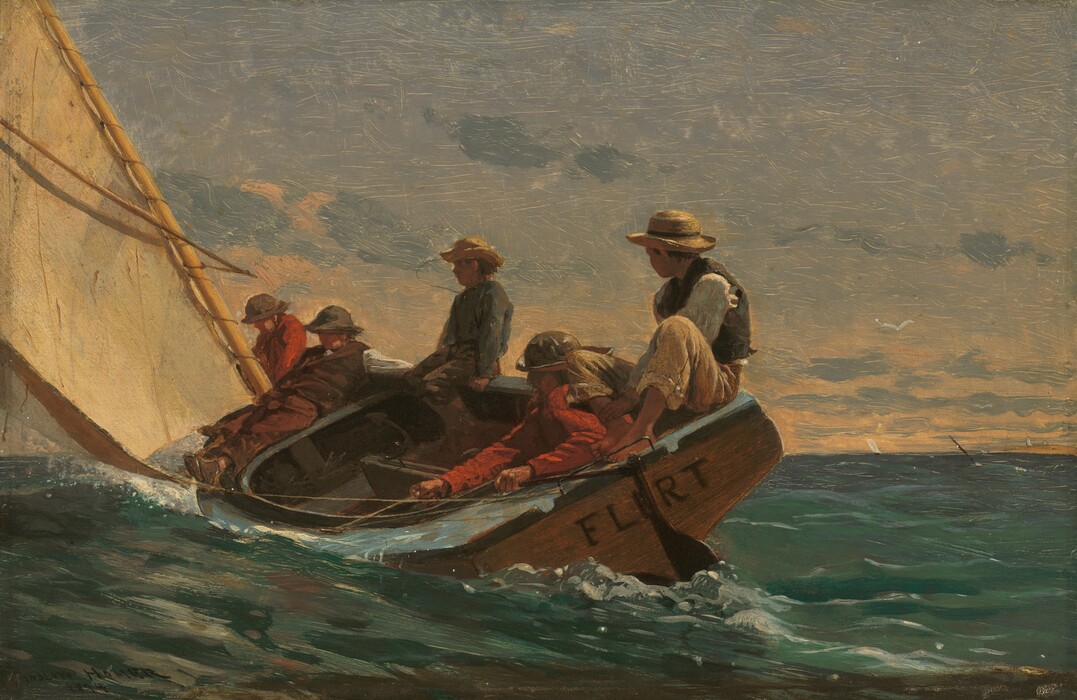
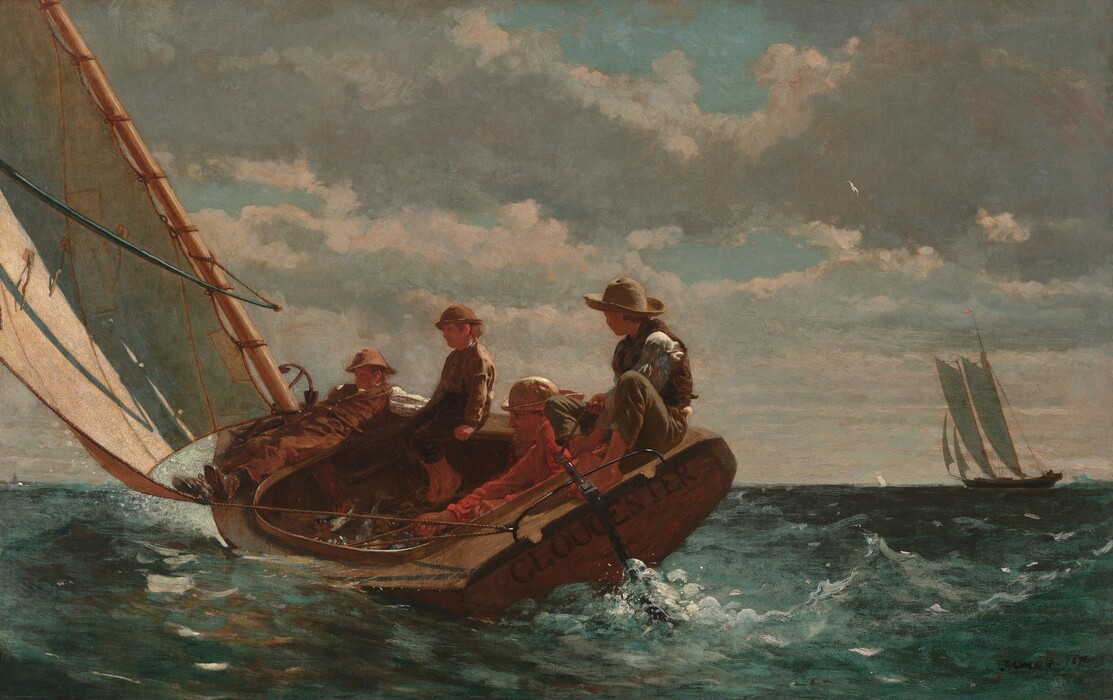
Both The Flirt and Breezing Up feature a man and several boys sailing in a catboat—a sailboat with a single sail and mast—on a peaceful, sunny day. Homer revised several details to arrive at the final composition of Breezing Up, which he completed in 1876.
Although similar, the two works have some important differences you may not notice at first glance.
Homer changed the name of the ship from the “Flirt” to the “Gloucester.” This likely indicates that the scene is set in Gloucester, Massachusetts, where Homer spent the summer of 1873.


The sunlight in The Flirt is warm; the boat’s sail glows yellow and orange. In comparison, the illumination in Breezing Up is more dramatic, with a strong contrast of light and dark. The sky in the earlier work is smooth, with almost creamy layers of gray-blue and pale orange. The later work is more varied, with puffy, textured clouds set against a light blue sky.


In The Flirt, a person sits in the bow of the ship. In the later painting, Homer has replaced this figure with an anchor. The anchor is a common symbol of hope, and Homer may have made this change to amplify the work’s sense of idealism.


An adult man in red is controlling the ship’s tiller (a lever used for steering) in The Flirt. In Breezing Up, a younger boy holds the tiller. Homer has also changed the direction of the tiller in the later work, moving it into a riskier position. These alterations embody the spirit of the work: a young man holds the sailboat’s direction in his hands.


These alterations added tense energy and dynamism to Breezing Up, but Homer was still unsatisfied. We know from infrared reflectography—an advanced imaging technique that reveals hidden layers of drawing and painting—that he made additional changes.
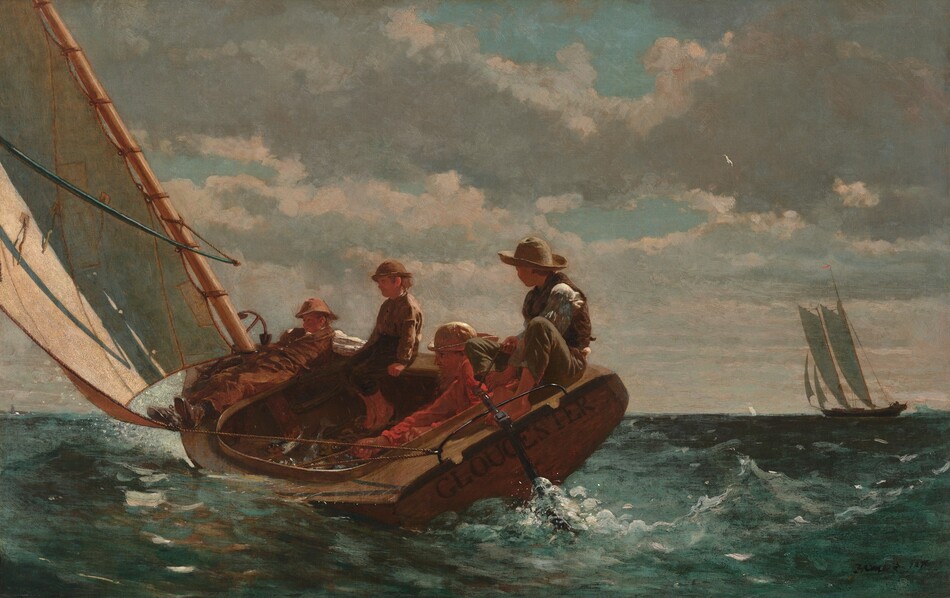

Like The Flirt, Breezing Up once featured a boy seated in the bow of the catboat. Homer removed him in the final version, adding the anchor instead. He also painted two schooners (large sailboats with multiple masts) in the background but eventually painted over them and included only one in the distance on the right side of the composition.
These changes give us insight into the iterative process of artmaking. Homer made multiple preparatory works of this composition and altered several elements of the final work before displaying it in public. Some of these changes may have been aesthetic choices, while others were symbolic: they helped to enhance the work’s message.
A Calm Forecast
Homer created Breezing Up during an idealistic time in our nation’s history. Completed in 1876, the centennial celebration of the United States’ founding, the painting may allude to the changing national mood emerging from the aftermath of the Civil War. Elements of the painting hint at this positive outlook.
Fan Favorite
Sometimes, artists disagree with viewers on what constitutes their best work. Despite its upbeat subject matter and positive critical reception, Homer wasn’t satisfied with Breezing Up. He even discouraged his patron, Lawson Valentine, from buying it, saying that he would create “much better pictures.”
In fact, Homer did make some of his best-known works later in life. He was renowned for his seascapes, many of which are less exuberant than Breezing Up.

Winslow Homer, The Fog Warning, 1885, oil on canvas, Museum of Fine Arts, Boston, Anonymous gift with credit to the Otis Norcross Fund 94.72

Winslow Homer, The Gulf Stream, 1899; reworked by 1906, oil on canvas, The Metropolitan Museum of Art, Catharine Lorillard Wolfe Collection, Wolfe Fund, 1906, 06.1234
The Fog Warning (1885) features a haggard fisherman navigating choppy waters as a storm gathers overhead. The Gulf Stream, originally painted in 1899 then reworked in 1906, depicts a Black man stranded in shark-infested Caribbean waters, the sole survivor aboard a damaged boat. As in Breezing Up, Homer used nautical scenes to convey larger messages: the first work showcases the struggles of North Atlantic fishermen, while the second alludes to the political unrest in the Caribbean at the turn of the century and its historical ties to the Middle Passage.
Along with works such as these, Breezing Up helped cement Homer’s legacy as a great American artist. A beloved work in the National Gallery’s collection, it has also come to be appreciated as a look at life in the 19th-century United States during a pivotal moment in the country’s history. We can learn a valuable lesson from Homer’s struggle with this work: sometimes, we are our own harshest critics.
You may also like
Interactive Article: Everyday Awe
Learn how the American painter Georgia O'Keeffe marveled at commonplace natural forms—and how to find the same sense of awe on your own.

Article: Painter George A. Morton Transcends Tradition
Through sustained looking and detailed re-creations, this Atlanta-based artist studies Rembrandt and Sargent while finding new subjects that carry forward the painters’ traditions.