


Who is Emily Kam Kngwarray?

Greg Weight, Emily Kngwarreye, 1994, gelatin silver photograph on paper, National Portrait Gallery of Australia, Gift of Patrick Corrigan AM 2004. Donated through the Australian Government's Cultural Gifts Program. © Gregory Weight/Copyright Agency, 2024
I keep painting the place that belongs to me—I never change from painting that place. The seeds and the seedpods of the pencil yam originated there. That’s all.
Emily Kam Kngwarray
In her late 70s, Australian Aboriginal artist Emily Kam Kngwarray began to paint the canvases that would make her famous around the globe. By the time she passed away in 1996, she had shared her deep connections to and knowledge of her Ancestral land with the world. Discover why she is one of Australia’s most celebrated Indigenous artists.
1. She was born and lived in a remote desert community.
Kngwarray was born around 1910 on Alhalker Country in the Northern Territory, Australia, home to her community, the Anmatyerre people. (The precise dates of her birth are unknown.) By 1938, the lands of the Anmatyerre were divided among white settlers into cattle ranches, called stations, and renamed as Utopia. As an adult, Kngwarray worked in Utopia, which relied on Aboriginal labor. Here, she tended sheep and goats, worked in kitchens, and provided childcare for women settlers.
2. She was named after the pencil yam.
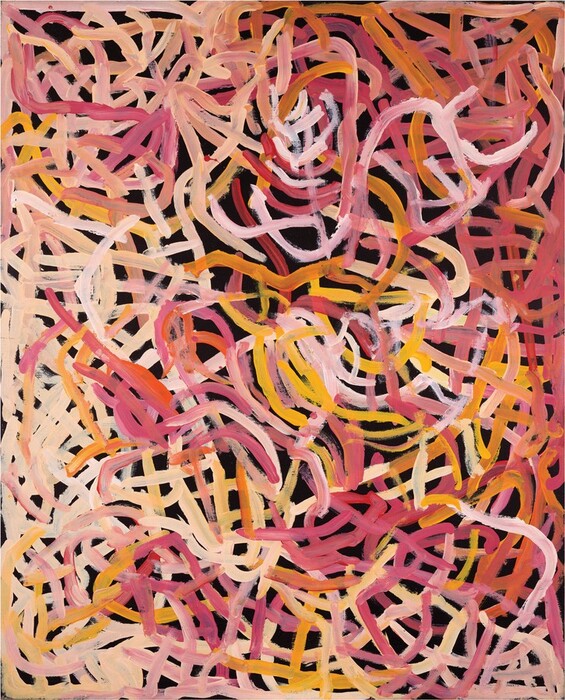
Kngwarray’s name reveals the different strands of her identity. Her bush name, or personal name, was Kam. In the Anmatyerre language, “kam” refers to the seeds and seedpods of the pencil yam. Able to withstand the drought of the Australian desert, the pencil yam is crucial in the diet of the Anmatyerre people. The artist strongly identified with the tubular plant, declaring, “I am Kam!”
The yam’s trailing vines and dense underground root network appear frequently as subjects in Kngwarray’s works. Her use of reds, pinks, yellows, and white reflect the natural colors of the plant, which turns from white to yellow to reddish brown across its life cycle.
Kngwarray was the artist’s skin name, indicating kinship with siblings and grandparents (parents have a different skin name), as well as more distant family members.
She was given the name Emily later in life, likely by Utopia station owners for administrative purposes, and would not have answered to it earlier in her life. Typically, she didn't sign her paintings—but when she did, she would only write, "Emily.”

Batiks by Emily Kam Kngwarray featured at the exhibition at the National Gallery of Australia. Photo by Lynn Matheny
3. Batik was her first formal art medium.
When she was in her late 60s, Kngwarray learned the batik process as part of a women’s arts and economic development program. To make a batik, you paint hot wax onto fabric to create resist designs: where the wax goes, the color doesn’t. Once you boil the fabric in a vat of dye, the wax melts and reveals the design.
Batik is a painstaking process that requires the artist to tend to fire, hot wax, and boiling water. Despite the physical rigors of the technique, Kngwarray managed to develop her spontaneous style. She made no preparatory sketches and applied her designs freehand.

Emily Kam Kngwarray, Emu woman, 1988–89, synthetic polymer paint on linen, Courtesy Janet Holmes à Court Collection, Boorloo/Perth. © Emily Kam Kngwarray/Copyright Agency. Licensed by Artists Rights Society (ARS), New York, 2026
4. She made nearly 3,000 paintings.
Kngwarray switched to painting on canvas in her 70s, after working in batik for 11 years. Another workshop in 1988 introduced her to acrylic paint. The organizers commissioned paintings from her and other Alhalker women, resulting in her breakout work Emu woman. The large, flightless bird is revered by the Anmatyerre people. Kngwarray often represented emus in her work, painting their distinct three-toed tracks, elongated necks, and ribcages.
The switch to acrylic, a more immediate medium than batik, uncorked an outpouring of work. In the eight years before her death in 1996, Kngwarray made nearly 3,000 paintings. That amounts to roughly one painting per day.
5. Her art is grounded in her Country.
Kngwarray’s detailed knowledge of Alhalker Country forms the basis of her art. The cosmology of Country encompasses the land and its ecosystems, the living beings that inhabit it, and traditional ceremonial practices and Ancestral knowledge. Her work visually represents the physical aspects of Country. She also translated ephemeral Anmatyerre designs like those drawn into the sand or painted on bodies in awely (women’s Ceremony) into works of modern art.
They are real—what Kngwarray paints is alive and true. . . . The Country transforms itself, and these paintings do as well. That’s why that old woman is famous.
Jedda Kngwarray Purvis and Josie Petyarr Kunoth, 2023

Emily Kam Kngwarray, Anwerlarr Anganenty (Big Yam Dreaming), 1995, synthetic polymer paint on canvas, National Gallery of Victoria, Melbourne, Presented through The Art Foundation of Victoria by Donald and Janet Holt and family, Governors, 1995. Photo: Christian Markel / NGV. © Emily Kam Kngwarray/Copyright Agency, 2024.
6. The monumental Anwerlarr Anganenty (Big Yam Dreaming) is considered her greatest work.
One of the best examples of how Kngwarray fused the physical and spiritual, the outer and inner worlds, is in her monumental painting Anwerlarr Anganenty (Big Yam Dreaming). Measuring 26 feet (802 cm) wide and nearly 10 feet (291 cm) tall, the painting consists of a single continuous white line winding across the massive canvas.
The fluid lines recall awely (women’s Ceremony) body paint, her earlier batik linework, the subterranean roots of the pencil yam, and the cracks in the earth where the tuber breaks through. The linear pattern that emerges pulses with mesmerizing rhythms. You can see Kngwarray’s masterpiece in our exhibition The Stars We Do Not See: Australian Indigenous Art.

7. She helped make the art of Aboriginal Australia world famous.
Despite only emerging as a recognized artist in the last decade of her life, Emily Kam Kngwarray’s paintings are now among the most sought-after works by an Australian artist. Her paintings have traveled to museums around the world. She represented Australia posthumously in the nation’s Pavilion at the 1997 Venice Biennale. But the artist never left her community—she stayed with her Country until the very end of her life.
Many thanks to Kelli Cole, Hetti Perkins, and Jennifer Green and the National Gallery of Australia for their monograph Emily Kam Kngwarray (National Gallery of Australia, 2023). We are indebted to this valuable resource for providing information and insight into the artist’s extraordinary life and art.
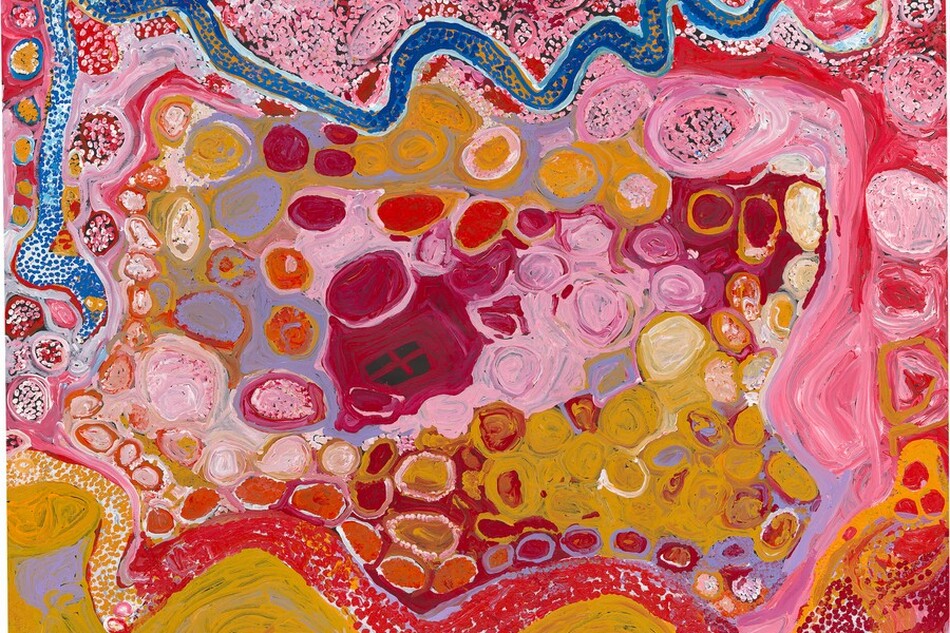
Exhibition : The Stars We Do Not See: Australian Indigenous Art
Don’t miss this once-in-a-lifetime exhibition of Aboriginal and Torres Strait Islander art—the largest ever shown outside Australia. Closes March 1.
You may also like
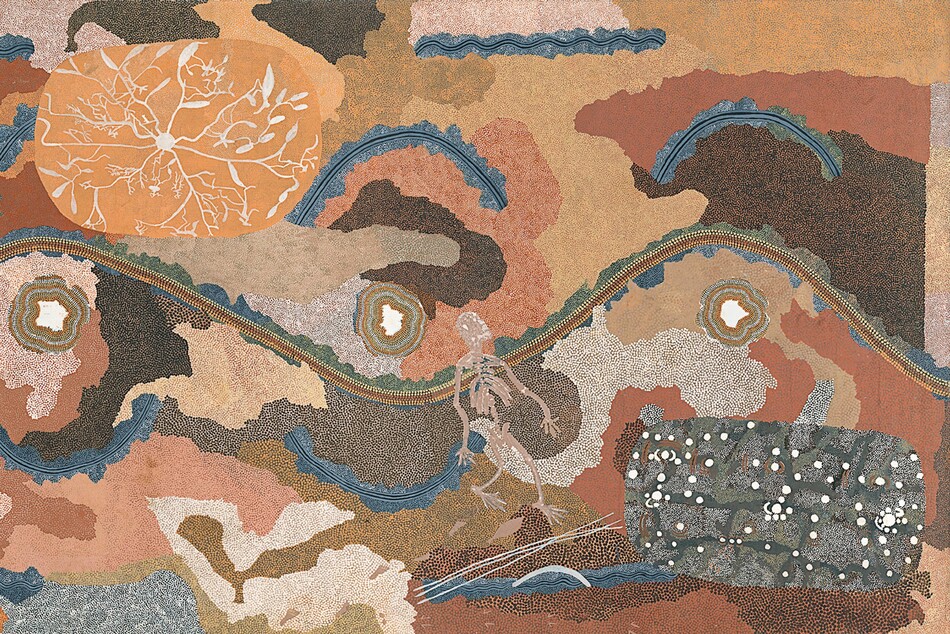
Article: Seven Things to Know About Australian Indigenous Art
Explore the extraordinary breadth and beauty of the world’s oldest continuing culture, featured in our exhibition The Stars We Do Not See: Australian Indigenous Art.

Article: Holding Place: The Work of Alaskan Artist Sonya Kelliher-Combs
The tools, textures, and symbols of daily life in rural Alaska inspire this Indigenous artist to create works that tell layered stories of loss and resilience.