


Who Is Joshua Johnson? 7 Things to Know

Who is Joshua Johnson? This question has fascinated historians for nearly a century. Johnson’s unsigned and undated portraits of Maryland’s merchant class were first attributed to white artists—or to no artist at all—until the 1930s, when a historian began to piece together the Black painter’s contributions to early American art.
While many details of Johnson’s life remain unknown, over the past three decades researchers have located records that confirm his remarkable arc from enslavement to a successful career as one of America’s earliest-documented professional Black artists.
1. He was born enslaved but gained freedom as a young adult.

Attributed to Joshua Johnson, Portrait of Ellin North Moale (Mrs. John Moale) (1740–1825) and Her Granddaughter, Ellin North Moale (1794–1803), 1798–1800, oil on canvas, The Colonial Williamsburg Foundation, Museum Purchase, Mr. and Mrs. Robert S. Wilson, 1987.100.1
Baltimore County records rediscovered in the late 1990s helped historians piece together some details of the artist’s early life.
They include a bill of sale showing Joshua was purchased by a man named George Johnson from a William Wheeler. The sale took place in 1764, when Joshua was only a child . The record suggests his mother was an enslaved woman made to work for Wheeler. Included in the document is a manumission, or release from slavery, by George Johnson. In it, he acknowledged Joshua as his son and agreed to recognize his child’s freedom once Joshua completed a blacksmith apprenticeship or turned 21, whichever came first.
The document was witnessed and signed by a justice of the peace, merchant-planter Colonel John Moale. But Joshua Johnson and Moale’s connection did not end there. After establishing himself as an artist, Johnson received a commission to paint Moale’s wife and granddaughter, both named Ellin North Moale.
From the sheen of the copper silk dress to the delicate weave of the black lace shawl, Johnson expertly rendered Mrs. Moale’s outfit. His painting was in fine company—Mrs. Moale had also sat for several well-known portraitists of the era, including Rembrandt Peale, John Wollaston, and John Hesselius.
2. He is one of the earliest-documented professional Black artists in the United States.

Joshua Johnson’s portrait painting advertisement in the Baltimore Intelligencer on December 19, 1798. Some archival documents spell his last name as “Johnston.” H. Furlong Baldwin Library, Maryland Center for History and Culture
We don’t know what Johnson’s next steps were after he completed his blacksmith apprenticeship in 1784 and gained freedom. But by 1790, he was listed in Baltimore directories as a painter. Only a few African American artists are on record as having worked earlier than him. Scipio Moorhead and Prince Demah Barnes, two enslaved Black artists, had worked in Boston, Massachusetts, in the decades before Johnson established his painting career.
Many scholars have speculated how Johnson might have transitioned from working with metal to paint, but no clear answers have emerged. At the time, painting was considered a craft or a trade—not yet a fine art—so the evolution from blacksmith to painter wouldn’t have been as much of a leap as we might imagine today.
In an advertisement he placed in a Baltimore newspaper in 1798, Johnson described himself as a “self-taught genius, deriving from nature and industry his knowledge of the Art.” He also alluded to “many insuperable obstacles in the pursuit of his studies.”
3. He painted portraits of Maryland’s elite.
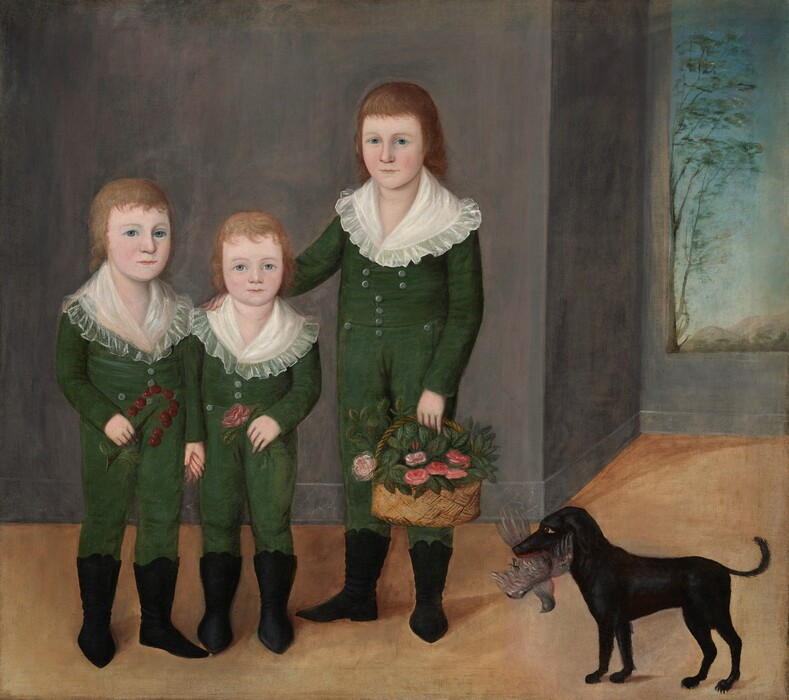
Johnson’s portraits show Maryland’s merchant class, a growing group at the time. He painted bankers, tavern keepers, politicians, and sea captains along with their families. Records show many of them were his neighbors, living within a few blocks of him in Baltimore.
Painted around 1807, The Westwood Children shows three boys: Henry, George, and John. They were the sons of Margaret and John Westwood, a Baltimore stagecoach manufacturer. While the boys’ green suits and black boots all match, Johnson painted the children as individuals, each with his own features and hair hue. The boys hold flowers and their dog carries a bird in its mouth, suggesting the group just stepped in from the outdoors (seen through the window at right).
4. He also painted figures of Baltimore’s Black community.

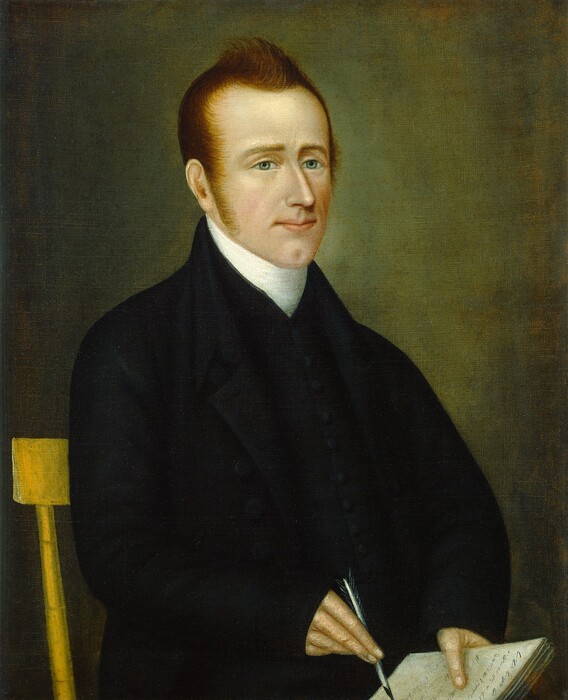
Joshua Johnson, Portrait of a Man (Abner Coker), c. 1805–1810, oil on canvas, Bowdoin College Museum of Art, Brunswick, Maine, museum purchase, George Otis Hamlin Fund, 1963.490
Two portraits by Johnson are believed to depict members of Baltimore’s free Black community, among the nation’s largest during the late 18th and early 19th centuries.
One portrays Abner Coker, a free Black minister of Baltimore’s African Methodist Episcopal (AME) Church. Another is believed to be a portrait of Daniel Coker, a minister and abolitionist. We’re not sure how well Johnson knew either subject or if he attended their churches. Nevertheless, the portraits are important documents of Baltimore’s free Black community.
5. He was skilled at painting details and group portraits.
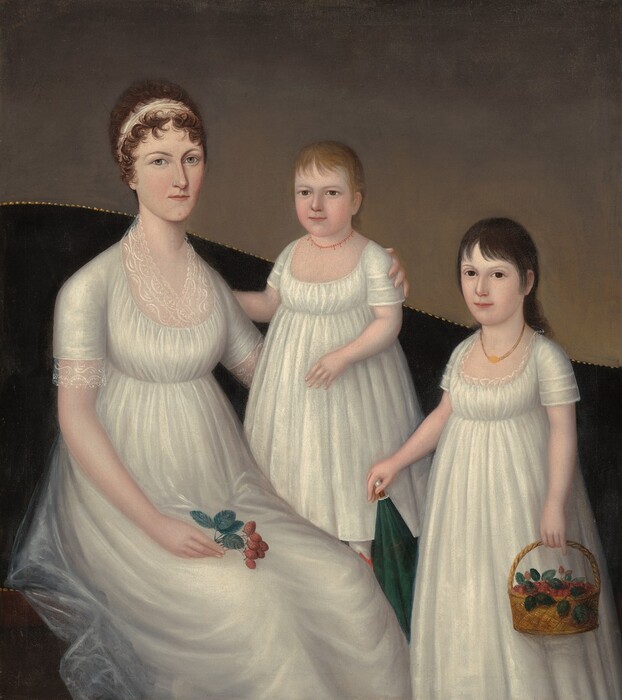
Johnson’s portraits stand out for their detail and precision. With careful brushwork he modeled his subjects’ features, down to each strand of hair. His skill extended to his rendering of textiles, like the gauzy dresses of Grace Allison McCurdy (Mrs. Hugh McCurdy) and Her Daughters, Mary Jane and Letitia Grace.
Johnson paid particular attention to the mother’s lace collar and sleeves and the daughters’ delicate coral-and-gold necklaces. Behind them, he painted the brass tacks lining the curved sofa. He often surrounded his subjects with furniture and decoration, adding elegance and complexity to the portraits.
Johnson’s composition choices were also innovative: family group portraits such as the ones he painted were rare during this period. Through the gestures and expressions of his subjects, Johnson conveyed each family member’s affection for one another.
6. He signed only one painting.
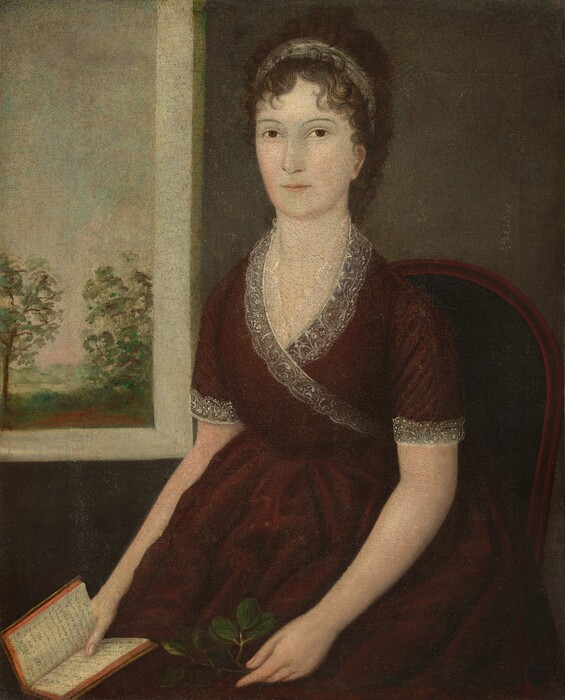
Only one known painting bears Joshua Johnson’s signature—Sarah Ogden Gustin. Gustin was the wife of an innkeeper and militia colonel in Berkeley Springs, West Virginia. Johnson painted Sarah seated with her thumb holding open a book. The book’s text is indecipherable with the exception of “JOSHUA JOHNSON” at the top of the page.

A detail of the painting rotated to show Johnson’s clever signature
7. Much of his life is still a mystery to us.
Because all but one of his paintings are unsigned, Johnson’s accomplishments were forgotten until the early 20th century. Since then, historians and curators have researched his life and identified his works, several of which were misattributed to white artists. Today, some 80 paintings are believed to be by Johnson.
We do know that later in life Johnson owned property in several counties around Baltimore, suggesting that he was financially successful. We also know he lived at least into his 60s, although his exact cause and date of death have yet to be confirmed.
Many questions remain. And with a lack of records relating to Baltimore’s free Black community, these questions may never be answered.
You may also like

Article: There Will Be Light
Not constrained by any one medium, style, or artistic tradition, Barbara Earl Thomas is eager to step into the unknown as she continues telling her story.

Article: Painter George A. Morton Transcends Tradition
Through sustained looking and detailed re-creations, this Atlanta-based artist studies Rembrandt and Sargent while finding new subjects that carry forward the painters’ traditions.