Article

From World War I to Afghanistan: Our Servicepeople in Photographs

By
  • Mark Levitch
3 min read

In honor of Veterans Day, browse a selection of photographs from our collection that depict US service members.
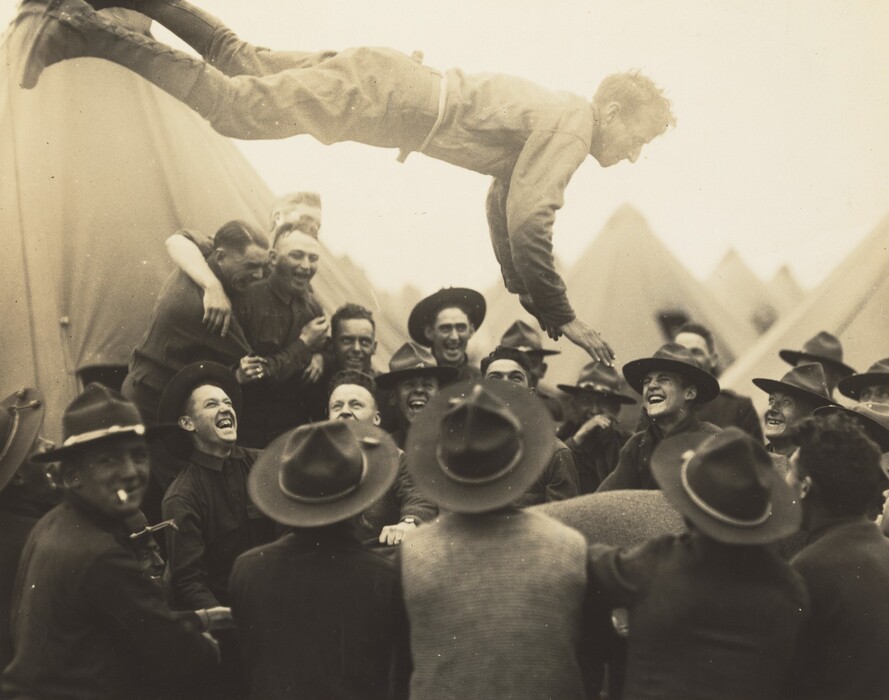
This black-and-white photograph shows a group of men in dark shirts with dark, wide-brimmed hats. Everyone is gathered outdoors near some pointed gray tents, and they appear to be in a loose circle, holding a tarp or cloth stretched out between them. One man appears to float in the air above the group, his body horizontal, facing the right. The men below him are all smiling widely, some appearing to laugh. In the bottom left corner, one man looks back over his shoulder at us, a white cigarette in his mouth. Most of the men appear to have light skin, although some are in shadow. The sky behind the tents and floating man is bright white.
Lewis Wickes Hine, Soldier Thrown in Air, 1917, gelatin silver print, Patrons' Permanent Fund, 1995.36.90

After the United States entered World War I, photographer Lewis Hine toured several army training camps on assignment for a popular magazine. Hine’s early stop-action picture freezes a man mid-air—capturing a seeming carefreeness among soldiers who are preparing to deploy abroad.
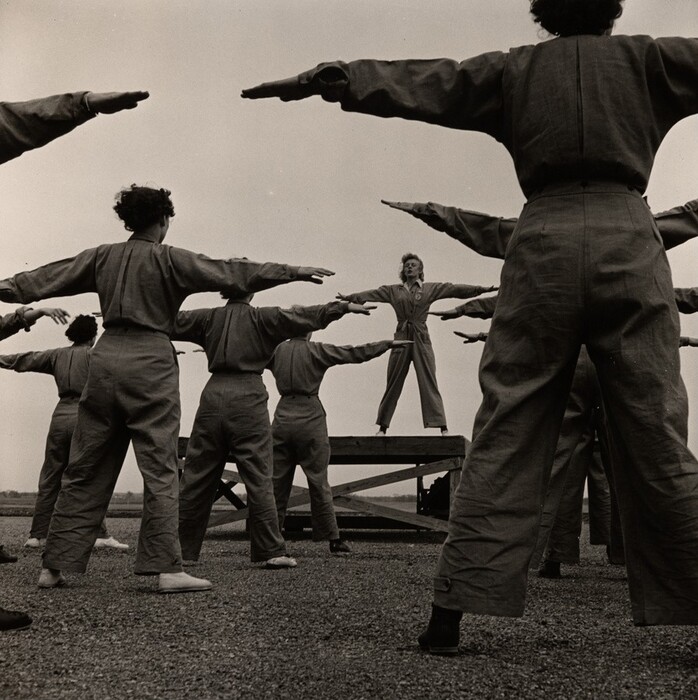
This is a photograph of a group engaged in an exercise routine. The image showcases several individuals wearing uniforms standing in a semi-circle with their arms raised and bent to the side in a synchronized exercise movement. In the center, elevated on a platform, another individual stands facing the others. The setting is outdoors, with a vast open space visible in the background, and the image is captured in black and white.
Wayne Miller, Naval Air Technical Training Center, Norman, Oklahoma, February 1943, printed later, gelatin silver print, Gift of Wayne F. Miller Family, 2021.89.26

During World War II, the Navy established a program called Women Accepted for Voluntary Emergency Service, or WAVES. It enabled around 100,000 women to play a critical role in the war effort. Here Navy photographer Lt. Wayne Miller has captured the new recruits doing calisthenics. Their outstretched arms evoke the airplanes on which many of them would soon be working as machinist mates and metalsmiths.
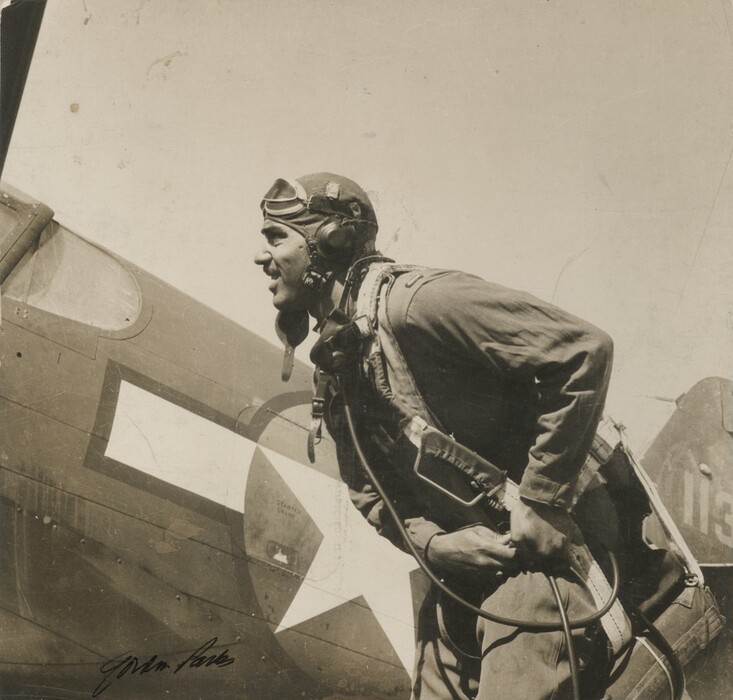
The image shows a man posed next to a military aircraft. He has a determined expression and is wearing a pilot's gear including a leather cap, goggles, headphones, flight suit, and harness with chutes, holding onto part of the gear. The aircraft bears an air force emblem on its side and tail. The sky is clear in the background.
Gordon Parks, Lt. George Knox. 332nd Fighter Group training at Selfridge Field, Michigan ("Fighters up! And good luck."), October 1943, gelatin silver print, Avalon Fund, 2019.17.2

Gordon Parks was the first African American correspondent for the Office of War Information, a World War II government propaganda agency. In autumn 1943, he made a series of photographs of the all-Black 332nd Fighter Group, part of the famed Tuskegee Airmen. In this dynamic portrait, the pilot’s pose parallels the line of the airplane, suggesting the effortless connection between man and machine.  

This well-known D-Day photograph is by US Coast Guard Chief Photographer’s Mate Robert F. Sargent. Troops from the First Infantry Division disembark from a Coast Guard landing craft. Carrying heavy equipment, they wade through the waters of the English Channel to reach Omaha Beach in France. The beach is littered with defensive obstacles that the soldiers, under heavy fire, would have to overcome before they could climb and secure the steep bluffs just visible in the background.
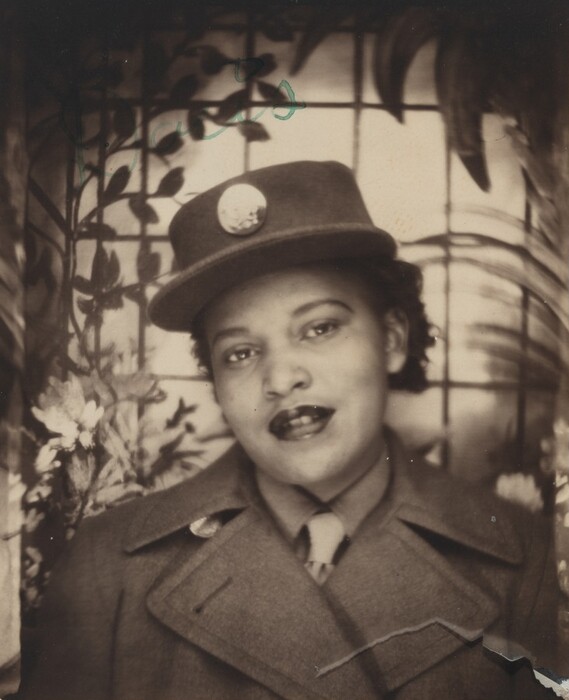
The image depicts a woman in a military-style uniform standing at a slight angle with her face directed towards the camera. She has distinct facial features, dark, well-styled hair, dark lipstick, and an engaging expression. She is wearing a thick coat with a wide collar, a tie, and a matching cap with a decorative emblem. In the background, there are floral elements including leaves and flowers, a textured background with a patterned gate or trellis, and some handwriting at the top left of the image.
American 20th Century, "Doris", c. 1944, gelatin silver print, Gift of Mary and Dan Solomon, 2019.170.36

This closely cropped, soft-focus studio portrait by an unknown photographer depicts a member of the Women’s Army Corps posing in her uniform. The picture is signed “Doris” in green ink on the top left, and the back of the photograph also reads, in part, “your friend, Doris.” Doris may have passed out copies of this elegant photograph to friends as keepsakes.
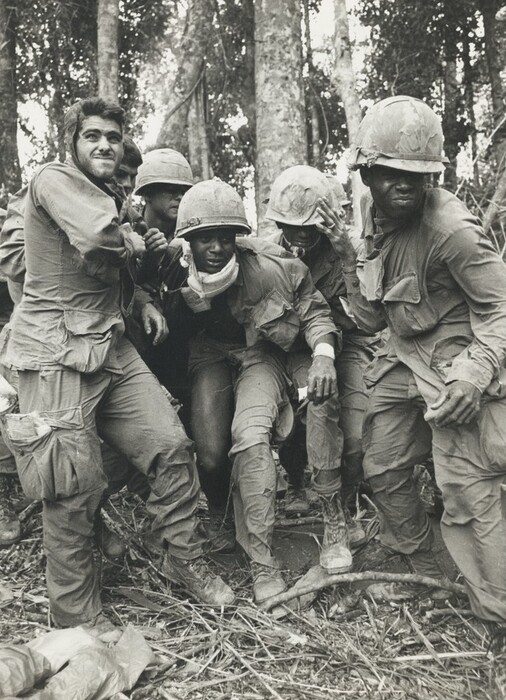
This is a photograph of a group of soldiers in a forested environment. The image depicts soldiers wearing military uniforms, helmets, and boots, navigating through a dense area filled with trees and underbrush. The soldiers appear to be engaged in a coordinated effort, possibly assisting one another. The ground is littered with fallen branches and leaves. The natural light filtering through the trees creates a high-contrast effect, highlighting the textures of the uniforms and the foliage. The expressions and body language suggest focus and determination. The composition and clarity suggest a moment captured during a military operation in a woodland setting.
Kyoichi Sawada, United Press International, Title from caption on object: “Twisted Faces”, November 22, 1967, gelatin silver print, Gift of Mary and Dan Solomon, 2018.177.572

Japanese photojournalist Kyoichi Sawada made this photograph in November 1967 while covering the intense days-long battle for Hill 875 in Vietnam. Shot from a low angle, it frames a symmetrically arrayed group of paratroopers aiding a wounded comrade against a thicket of trees in the background. Sawada is one of many photojournalists who would be killed during the war.
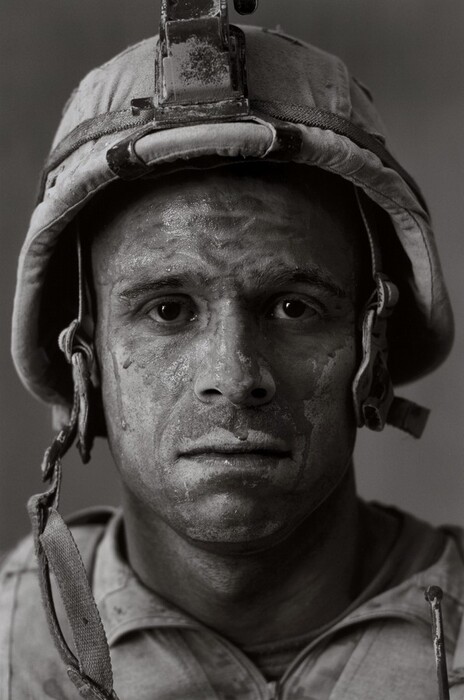
The image depicts a close-up of a man's face and shoulders. The man is facing the camera, with a prominent nose, full lips, and deep-set eyes gazing directly at the viewer. His skin appears textured and is covered in a layer of what seems to be dust or sweat. He is wearing a tactical helmet with straps hanging down on the sides of his face. The helmet hardware appears worn. He is dressed in a dusty military-style uniform. The background is out of focus and a uniform gray, emphasizing the man in the center of the frame.
Louie Palu, U.S. Marine Gysgt. Carlos "OJ" Orjuela, age 31, Garmsir District, Helmand Province, Afghanistan, 2008, printed 2013, inkjet print, Corcoran Collection (Gift of the artist in memory of Giuseppe Palu), 2015.19.5258

This is one of a series of haunting portraits that Canadian photographer Louie Palu made while embedded with the US Marines in Helmand Province, Afghanistan, in summer 2008. The tight framing and delicate lighting make it hard to look away from the blank stare of the worn, dirt-caked marine.
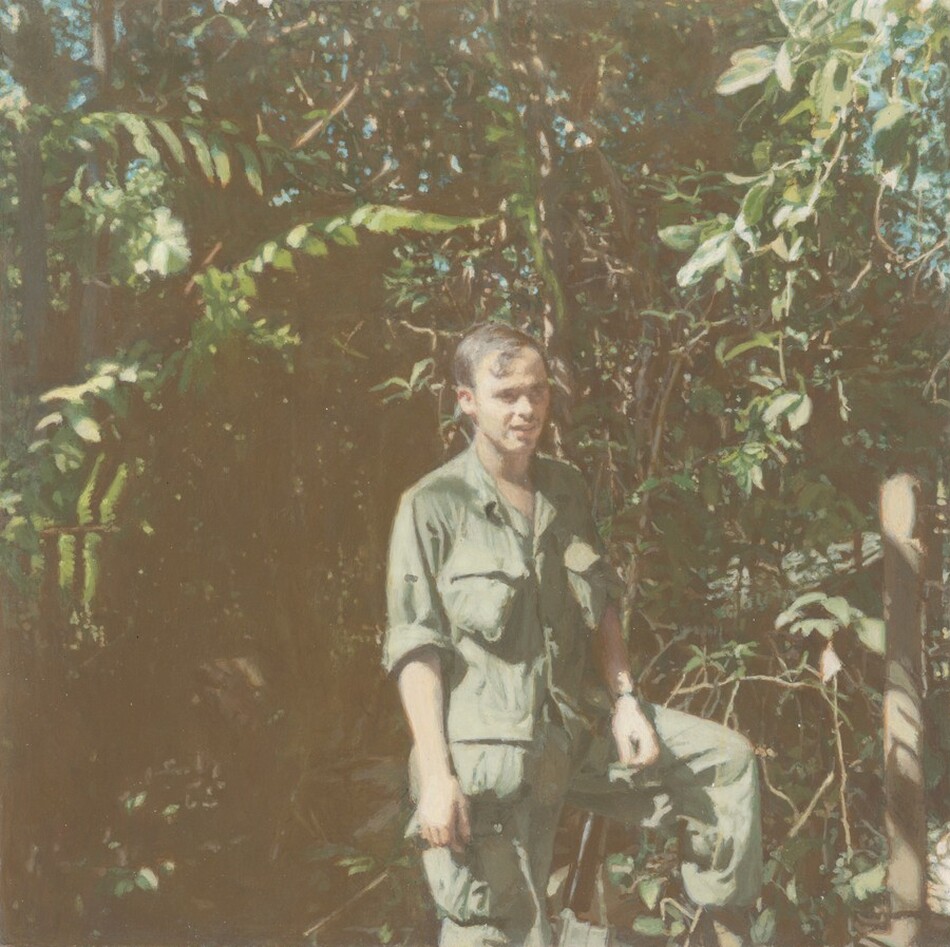
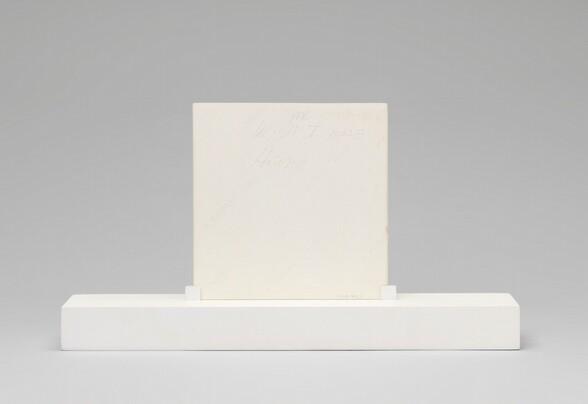
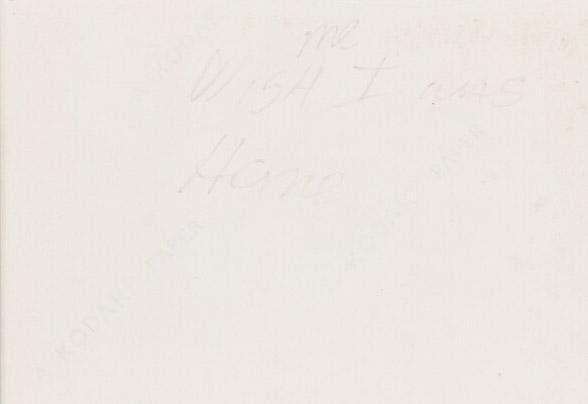
This work, amazingly, is a tiny painting. Elisheva Biernoff reproduces a found snapshot of an unidentified American soldier in precise size and detail, including copying the handwritten caption from the back of the faded photograph. It reads: “Me. Wish I was Home”—a sentiment that will no doubt be familiar to those who have served.  

You may also like

Shown from the chest up, an older man with pale, peachy skin, wearing a high-collared black coat and a cream-white, ruffled collar, is shown against a deep wine-red background in this vertical portrait painting. His body is angled to our right and he turns his face to look at us with gray eyes under pale gray eyebrows. He has a hooked nose and jowls along his chin line. His cheeks are flushed and his lips are set in a line. His white hair flares out along the sides of his head and is tied at the nape of his neck with a ribbon loosely painted and outlined with black. His ink-black coat has silvery gray highlights along the high collar and his right shoulder, to our left. The background is painted with light brushstrokes, deepening from scarlet red around his face to black at the upper corners.

Article:  George Washington, Pictured

For centuries, artists have depicted the military general—in paint, in print, and in plaster. These portraits continue to give us insight into Washington’s emotional life, military presence, and cultural footprint.

Article:  Photographing American Mining and Energy

Photographers have been documenting mining and energy extraction for nearly 200 years, revealing industrial activities often hidden from view.