Dutch and Flemish Paintings

Filter Results

110 artworks on view.

Results

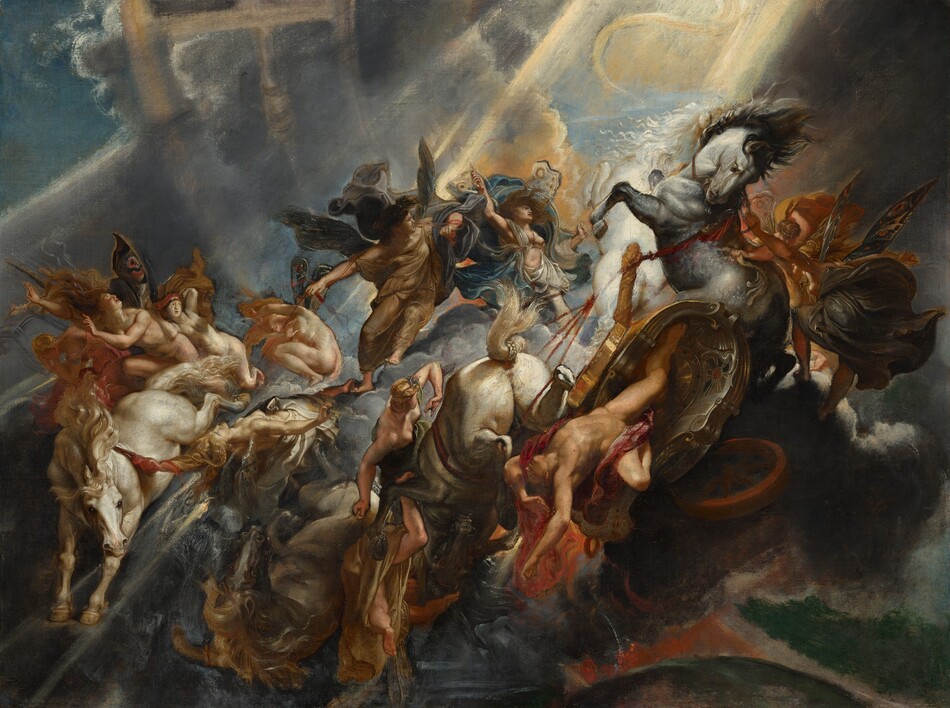
From high above the earth, we look onto a dramatically lit scene with a man falling from a horse-drawn chariot in midair, surrounded by eleven women against a bank of clouds in this horizontal painting. All of the people have pale skin and are illuminated by a bright burst of sunlight streaming across the scene from the upper right corner. The man is covered only by a burgundy-red sash that wraps across his groin and around one shoulder. He careens headfirst from the U-shaped, golden chariot with his chest facing us, arms flung overhead and legs splayed, to our right of center. The tumble of bodies around him includes four horses, three ivory white and one gray, and the eleven women, who are either nude or dressed in robes of parchment white, tan, slate blue, butterscotch yellow, steel gray, or rose pink. The women all have blond or brown hair, and some have wings like butterflies, patterned with circles and stripes. They fall alongside the man or float above the wreckage, their robes and hair billowing. Some of the women hold the red reins of the horses, though some of the reins stop abruptly or are painted over so they appear as dark lines beneath the surface. The nickel-gray clouds surround and support some of the women in front of a hazy circular arch curving up the left side of the composition. Peeks of sky around the action are deep aqua blue, and vibrant orange flames lick up from the earth in the lower right.

The Fall of Phaeton

Sir Peter Paul Rubens

c. 1604/1605, probably reworked c. 1606/1608

Oil on canvas  Accession ID  1990.1.1

On View: West Building Main Floor, Gallery M45
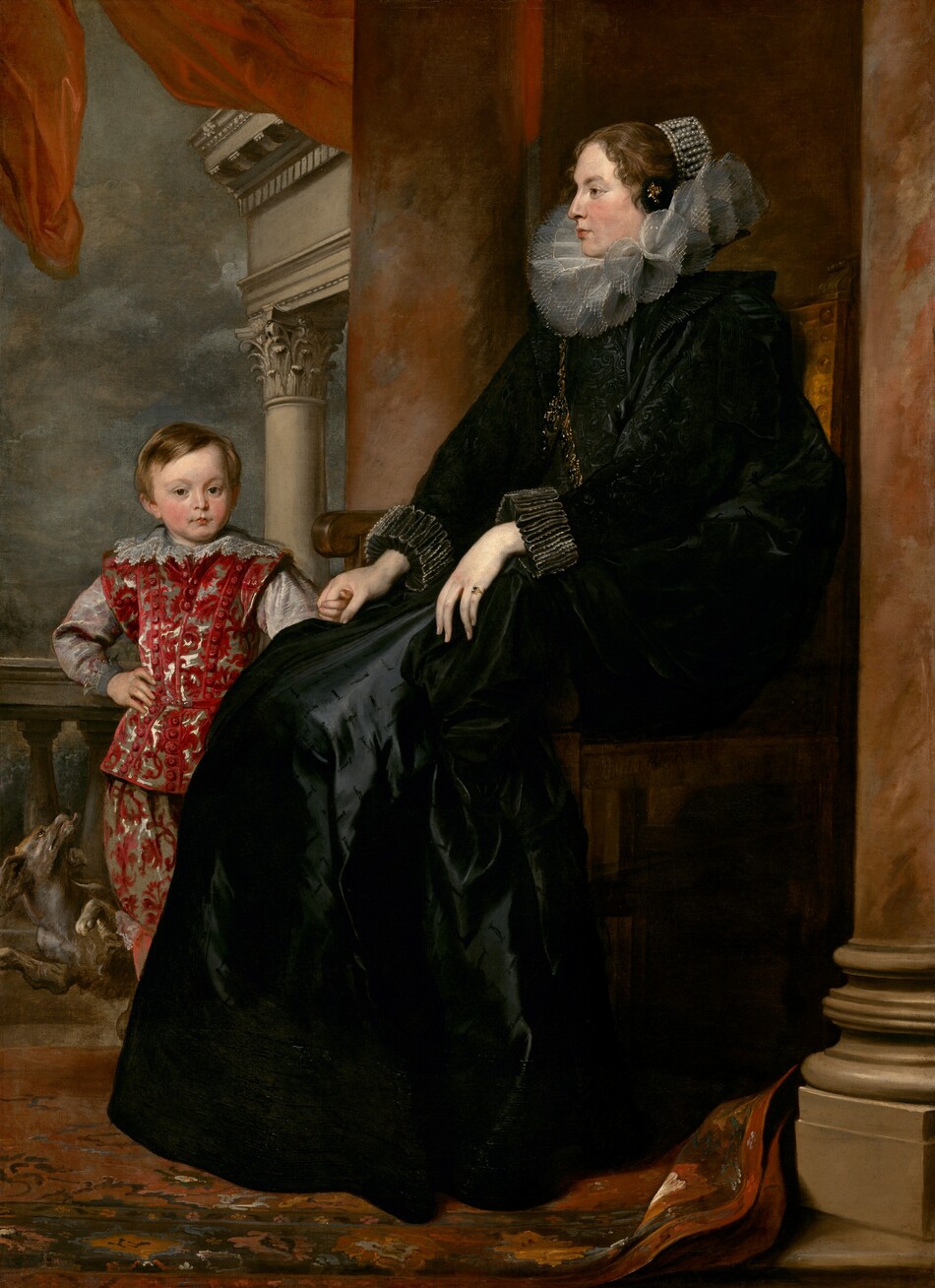
A woman wearing a voluminous black dress with a wide, ruffled collar sits holding the hand of a young boy, who stands next to her, in this vertical portrait painting. The woman sits with her body in profile facing our left, and she looks in that direction. The boy stands at her feet, behind her legs to our left, looking out at us. Both have pale, peachy skin with rosy cheeks, dark blond hair, and brown eyes. The woman’s hair is pulled back and covered with pearls, and a few short tendrils curl around her face. Her long black dress has puffed, black-on-black brocade sleeves, and the skirt is cut with short, decorative slits. The skirt has a sheen where the light falls, suggesting it is silk. Her wide, stiff, ruffled collar is pleated into a figure-eight pattern around her neck, and a thick gold chain loops over one shoulder to the opposite hip. The sleeves have wide, ruffled cuffs, and she wears a gold ring with a slate-blue gemstone on the pinky finger of her right hand, closer to us. The boy’s small fingers wrap around the woman’s right hand, farther from us. His body faces us, and his other hand rests on his hip. His straight hair falls across his forehead and to his ears. His suit has a crimson-red, leafy pattern against gray satin, and the sleeves are also nickel gray. A wide, lace-trimmed collar rests along his shoulders. A brown and white dog frolics behind the boy, looking up at him with mouth open and tongue hanging out. The woman’s chair is framed by two stone columns streaked with rust red and taupe, and they extend off the top edge of the composition. A balustrade runs behind the boy along an opening beyond. The top corner of an entablature or lintel supported by columns is visible against a steel-gray, cloudy sky. A red drape flutters above the pair, along the top edge of the canvas, and the red and brown woven carpet below kicks up at the base of the column closer to us.

A Genoese Noblewoman and Her Son

Sir Anthony van Dyck

c. 1626

Oil on canvas  Accession ID  1942.9.91

On View: West Building Main Floor, Gallery M42
A group of light-skinned people and animals gather in an oval ring around a shallow pool in a wooded landscape in this horizontal painting. Deep in shadow but closest to us, animals, objects, and people create a continuous band in the foreground. From left to right is a horse, a reclining woman and small child, a goat tended by a nude child, a dog sniffing at a pile of crockery, baskets, and metal pans and dishes, a cat lapping from a shallow pewter dish, and a young man drinking from a dish or large shell in the lower right corner. Beyond this and to our right, an older man with gray hair and beard and wearing turquoise, pink, and blue robes taps an outcropping of rocks with a thin rod. Water gushes in thin streams from the outcropping into the pool below. The bearded man is surrounded by several standing men and women. Men, women, and children bend over the edge of the pool around its perimeter, filling or drinking from jugs, dishes, and pans. Most of the men wear long robes and some wear turbans, and the women wear long dresses or robes in teal, aquamarine, shell pink, pale yellow, and ivory. Trees enclose this group to the left and at the center of the painting. Another band of dozens of people, animals, and wagons line the horizon in the distance. They are painted in pale gray, blue, pink, and white. The horizon line comes three-quarters of the way up the composition and glimpses of vibrant blue sky and white clouds are seen through breaks in the trees. Light glints off of clothing, smooth skin, the fur of the animals, and especially the metalware in the foreground to give the painting a glimmering, almost glossy look.

Moses Striking the Rock

Joachim Anthonisz Wtewael

1624

Oil on panel  Accession ID  1972.11.1

On View: West Building Main Floor, Gallery M44
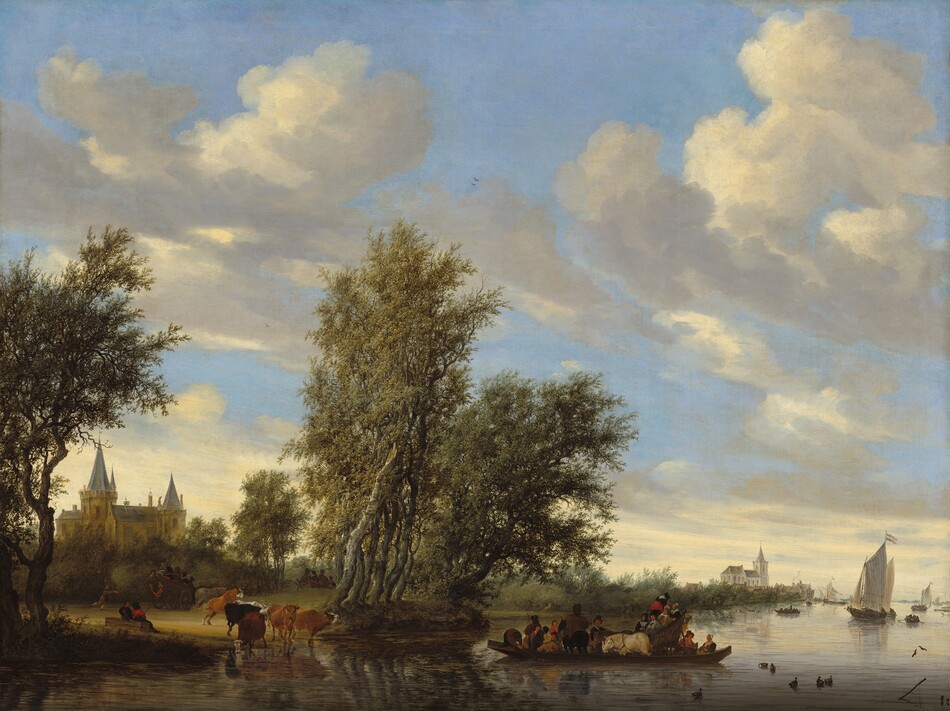
A river spans the lower edge of this horizontal landscape painting, and winds into the distance to our right, below towering white clouds in a blue sky above. The clouds sweep up and toward us from the low horizon line, which is about a quarter of the way up the canvas. Rowboats, sailboats, and ducks dot the river to our right.  The long, shallow ferry boat near the bottom center of the painting transports a pair of horses and a carriage, which is occupied by at least four seated people. More men, women, and a nursing woman fill the ferry around the carriage and animals. A herd of six cows stand at the water’s edge to the left, and two people sit nearby. Two more horse-drawn carriages filled with people head away from us. A church is visible in the middle distance through a break in the tall trees on the riverbank. Another church and buildings line the riverbank in the deep distance to our right.

River Landscape with Ferry

Salomon van Ruysdael

1649

Oil on canvas  Accession ID  2007.116.1

On View: West Building Main Floor, Gallery M49
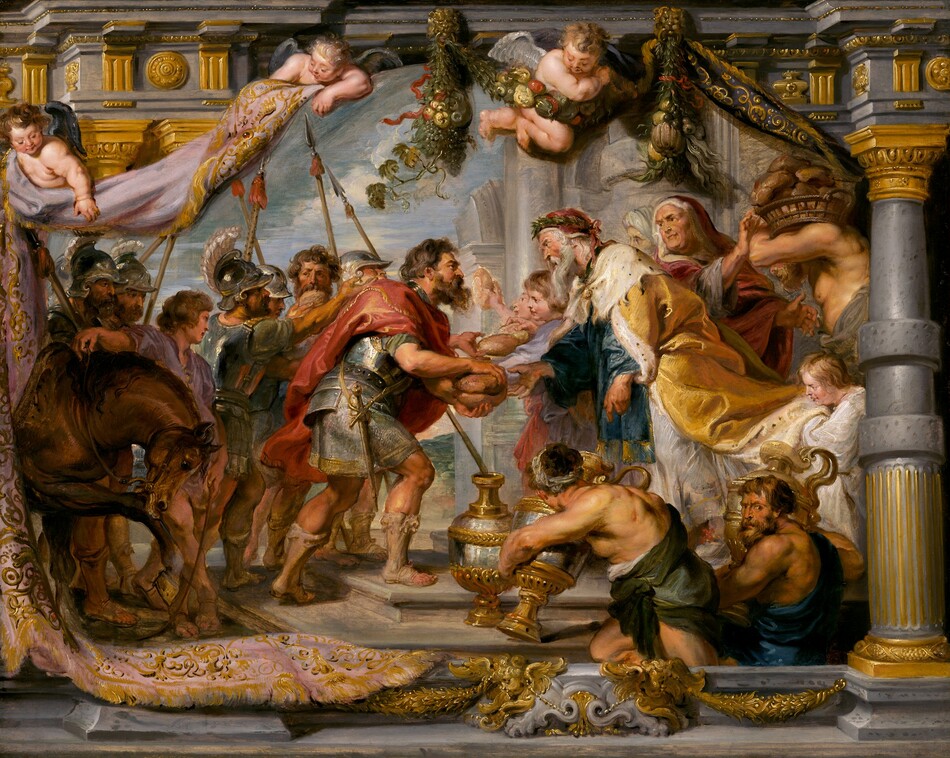
This horizontal painting shows a tapestry being unfurled and held up by winged, baby-like putti against a structure with gray and gold columns, seen at the edges of the composition. Taking up most of the composition, the tapestry shows two ranks of men, women, and children gathered behind two central men, who meet at the center. All the people have light or tanned skin, and the bodies we can see are muscular. In the central pair of men, the one to our left, Abraham, faces our right in profile as he holds two loaves of bread. He has a brown beard and short, wavy hair, and dark brows over a prominent nose. He looks at the other man with dark eyes and leans toward him, to our right. Abraham wears an armored breastplate over silver chainmail edged with gold, which falls to mid-thigh. A crimson-red cape wraps around his shoulders and swirls around his back. A sword hangs by his hip, and tan sandals cover his heels and shins. Behind him are seven men and one brown horse, who gnaws at its foreleg. Most of the men are bearded and five wear armored helmets. A cleanshaven man wearing a lavender-purple tunic stands with his arm slung over the horse’s neck, holding the rein between thumb and forefinger. The man to our right, Melchizedek has a long white beard and short white hair. His red cap is encircled with a wreath of dark green leaves. He wears a long-sleeved, waist-length, aquamarine-blue garment over a white skirt. A heavy, golden-yellow cape with a broad, white fur collar and lining drapes over his shoulders, and is supported by at least one attendant. Behind and around Melchizedek are eight men, women, and children, standing near stone, gray ruins. Behind Melchizedek, one portly person wearing a dark pink mantle reaches into a basket of bread held across the shoulders of a blond, bearded, bare-chested man. Closer to us, in the lower right corner of the tapestry, one man wearing a green toga and another wearing blue kneel and sit, holding oversized silver and gold urns, the size of their torsos. The man in blue, to our right, turns to look at us over his shoulder. A third large urn sits near the other man. A view into the landscape with a low, green hill and a pale blue sky is glimpsed between the groups. The tapestry showing this scene curls over at the edges where the pudgy angels lift the top edge. The top right corner of the tapestry wraps around the edge of an unseen feature of the building, next to a gray column that rises the height of the painting up along the right edge. The border of the tapestry is rose pink with stylized gold designs. One putto with brown hair holds up the left corner, and one with light gray hair holds up the middle one arm slung over the front of the tapestry. The third putto, with blond hair, hooks an arm over a leafy garland with fruit that hangs from the cornice near the top center of the composition.

The Meeting of Abraham and Melchizedek

Sir Peter Paul Rubens

c. 1626

Oil on panel  Accession ID  1958.4.1

On View: West Building Main Floor, Gallery M45
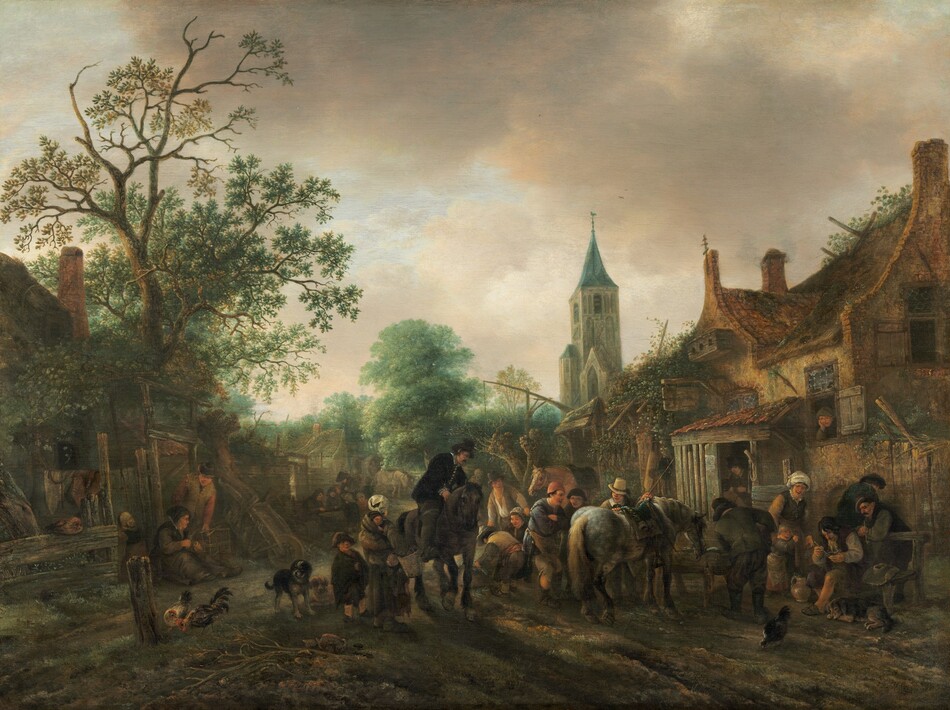
A group of pale-skinned men, women, and children along with a few horses and dogs form a loose line across a dirt road, which is flanked with rows of buildings on both sides that converge in the tree-filled distance in this horizontal painting. The scene is painted mostly with sage and moss green, peanut and caramel brown, cream white, and black. Most of the people wear hats or caps. The women wear long dresses and the men wear jackets and pants. One man wearing a black jacket with buttons down the front, and with white at the neck and cuffs, leans down from atop a black horse at the center of the group. Another man with a tall, cream-white, brimmed hat and white collar stands behind a dappled horse to our right of center. Men, women, and children, most wearing tattered and worn clothing, look on. One woman to our left holds a baby strapped to her back and others gather around the horses. A pair of men in front of a stone building to our right smoke long, white, tobacco pipes. Others peer out of the open door and windows. An illegible wooden sign hangs above the door. Leafy vines grow over parts of the building façade. To our left, a woman sits on the ground and holds a spindle as she winds wool with a spinning frame. A man leans down over her shoulder, and a child looks away from us, into a fenced enclosure in front of a building. People, horses, dogs, and chickens are scattered along the road into the distance, and a church steeple rises against the ivory-white clouds in the sky beyond. A partial inscription with the artist’s name and date appears in black paint in the lower right corner: “Isack van Os 164.”

The Halt at the Inn

Isack van Ostade

1645

Oil on panel transferred to canvas  Accession ID  1942.9.49

On View: West Building Main Floor, Gallery M47
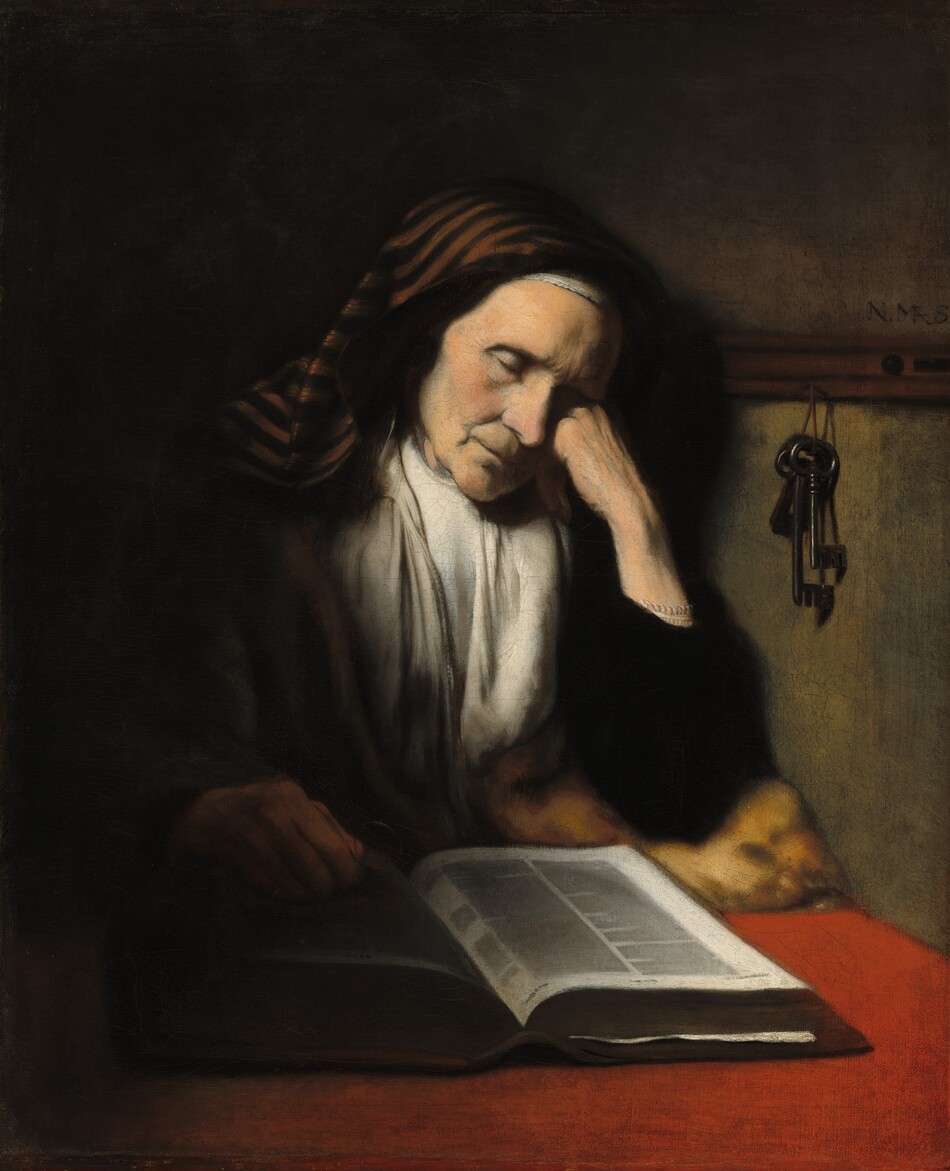
Shown from the waist up on the other side of a strawberry-red table, an elderly, pale-skinned woman sits facing us, sleeping with her head propped on her hand in this vertical painting. She is brightly lit from our upper left, which creates deep shadows across her face, and behind and around her. The woman rests her cheek against her closed left fist, to our right. That elbow is propped on a gold and amber-yellow cushion tucked into the corner where the table meets the wall to our right. Her brows are slightly furrowed over deep-set eyes. She has loose jowls, thin lips, and wrinkles line the corners of her eyes and her mouth. Almost lost in shadow, her other hand rests on the large book lying open before her. She wears a black coat draped over a parchment-white garment. Her hair is covered by a ginger-brown and black striped veil that hangs to her shoulders. Three iron-gray keys hang from a rail running across the wall next to her at head height. The wall is sage green and mustard yellow in the light, and the corners and left edge are swallowed in shadow. The artist signed the painting in capital letters on the right, just above the rail, “N. Maes.”

An Old Woman Dozing over a Book

Nicolaes Maes

c. 1655

Oil on canvas  Accession ID  1937.1.63

On View: West Building Main Floor, Gallery M51
Shown from about the hips up, a man with peachy skin, wearing an ink-black hat and coat with a bright white collar, looks out at us against a dark background in this vertical portrait painting. He stands with his body angled to our right and his face turned to look at us with dark gray eyes. His slim face is framed in long, brown curls under his tall, brimmed hat, which is cocked a little to our right, away from us. He has a straight, prominent nose, lightly flushed cheeks, and a wispy, light brown mustache above a small, pointed goatee under his lower lip. His neck is encased in a broad, starched, white linen collar, its wings lying along his collarbones. His velvety black coat has a row of tightly spaced buttons down the front. A cummerbund or sash wraps around his waist and hips. He rests his right hand, on our left, against his hip near his lower back, palm facing out. He wears a light, dove-gray glove on his opposite hand, and holds a second glove in that hand. The background is earth brown. The portrait is painted loosely, with broader brushstrokes in some areas, such as the hand at his hip and in the folds of the black garments.

Adriaen van Ostade

Frans Hals

1646/1648

Oil on canvas  Accession ID  1937.1.70

On View: West Building Main Floor, Gallery M46
We look across a dirt road or path at a tall, brick wall flanking an ornamented, stone gateway with a white, marble manor house in the distance in this horizontal landscape painting. Atop a low hill, the sunlit manor is outlined against a vivid, light blue sky with silvery-gray, fluffy clouds, which fills the top two-thirds of the composition. Statues line the gray, tiled roofline along the central section of the house, and more statues stand in the grassy lawn to either side. Closer to us, the gateway and people around it are cast into shadow. The arched gate is flanked by flat columns and is topped with a triangular pediment filled with relief sculpture of people and ornamental scrolls. A ramp leads up to the opening of the gate. Two men passing under the arch have long, brown hair and wear brimmed hats, long coats, breeches tied at the knee, and stockings. The man in front carries a walking stick. A woman wearing a white head covering and long, dark dress, carries a baby tied to her back and holds her hand out toward the men. Near the men, three brown dogs walk  as one raises a leg against the gate, and a fourth sniffs at the side of the ramp where it meets the ground. The red brick wall is topped with a balustrade. To our left of the gate and on the far side of the wall, two men lean on the balustrade, angled in toward each other as if in conversation, near a fountain with a sculpted woman on an ornamental urn. Below them, at the foot of the brick wall, a man sits on a cracked piece of marble sculpted with ornamental designs in low relief. The man wears a royal-blue suit with golden yellow stockings and a tan, brimmed hat. He leans forward to touch the collar of a long-legged, slender dog while four other dogs stand, sit, and lie down nearby. To our right, the roofline of a large, red brick building is seen over the tops of a grove of trees on the far side of the wall. The painting style throughout is detailed and precise, so one could conceivably count the individual bricks in the wall, for instance.

An Architectural Fantasy

Jan van der Heyden

c. 1670

Oil on oak panel  Accession ID  1968.13.1

On View: West Building Main Floor, Gallery M47
A young girl with light skin, round, rosy cheeks, and blond hair holds an apple and wears a full, ankle-length, silvery white dress with puffy sleeves in this vertical portrait painting. She stands with her body slightly angled to our left, and she turns her face to look at us with large, dark blue eyes under faint brows. Her wavy blond hair falls to her chin and glimmers where it catches the light. Her nose and cheeks are flushed, and her rose-red lips are closed. She holds a red and green apple with both hands at her waist. Her dress has a high neck and voluminous, puffy sleeves with lace at the cuffs. Her dress is covered by a smock down the front and an apron over the full skirt. The apron is edged with lace and seems to be smooth, which contrasts with the textured appearance of the skirt and sleeves. The rounded toes of her cream-white shoes poke out under the ankle-length hem of her dress. She stands on a platform or on a step, and a crimson-red cushion with gold trim and tassels rests on the floor behind her. To our left, a thick, square column rises from a tall base and reaches off the top edge of the composition. The background to our right is dark with shadow.

Maddalena Cattaneo

Sir Anthony van Dyck

1623

Oil on canvas  Accession ID  1942.9.94

On View: West Building Main Floor, Gallery M42
Light pours over a woman floating in front of a bank of clouds, surrounded by ten mostly nude, toddler-like winged putti in this vertical painting. The woman, Mary, and the putti all have pale, peachy skin. Mary's body faces us with her knees bent so her feet are lost in the clouds. She holds both hands out by her sides, palms facing out. Her head is tipped slightly back and to our right, and she looks up with light brown eyes, her pink lips parted. Her golden hair falls loosely in waves to her shoulders. Her pale blue, long-sleeved, voluminous garment is tied with a navy-blue ribbon that crosses her chest between her breasts and is presumably tied across her back. The ten child-like putti have rounded bellies, chubby limbs, and small, gold or silver wings at their shoulder blades. Five putti hover around Mary to each side. To our left, one putto plays with the end of Mary's blue ribbon while below, another holds a wooden cross near the lower left corner of the canvas. The putto holding the cross rests one foot on an iron-gray ball encircled with a gold band and topped with a gold cross. Another putto touches the top of the wooden cross and gestures toward Mary. Near her shoulder, one putto holds a ring of thorns above its head while another raises a ring of pink roses as if to place it on Mary's head. To our right, near Mary's head, a putto holds a piece of cloth like a handkerchief toward her face while one below holds a larger drapery around its head like a hooded cloak as it looks out at us and smiles. The two bottom-most putti hold Mary's fluttering dress and look up at her face. A streak of warm light pours down from the top center, casting yellow light on the tops of the powder-blue clouds.

The Virgin as Intercessor

Sir Anthony van Dyck

1628/1629

Oil on canvas  Accession ID  1942.9.88

On View: West Building Main Floor, Gallery M43
Shown from the shoulders up, a man and woman face our left in profile against a shadowy, dark green curtain in this vertical portrait painting. They both look steadily to our left, they and have pale skin and wear black. The man is closer to us so he overlaps the woman, whose profile is shifted to our left. A black cap sits on the man's curly, silver, shoulder-length hair. He has a slight double chin and soft jowls. A thin mustache curves over his upper lip, and a line of hair runs down his chin as a narrow beard. A broad, flat, white collar lies across his shoulders over a velvety black coat. He lifts his left hand, closer to us, in front of his chest with the fingers curled gently inward. The woman also has a double chin and soft jowls. Her thin lips are closed and downturned. Her hair is pulled back under a black covering, and her black garment has a sheen, suggesting satin.

Loading Results