Dutch and Flemish Paintings

Filter Results

110 artworks on view.

Results

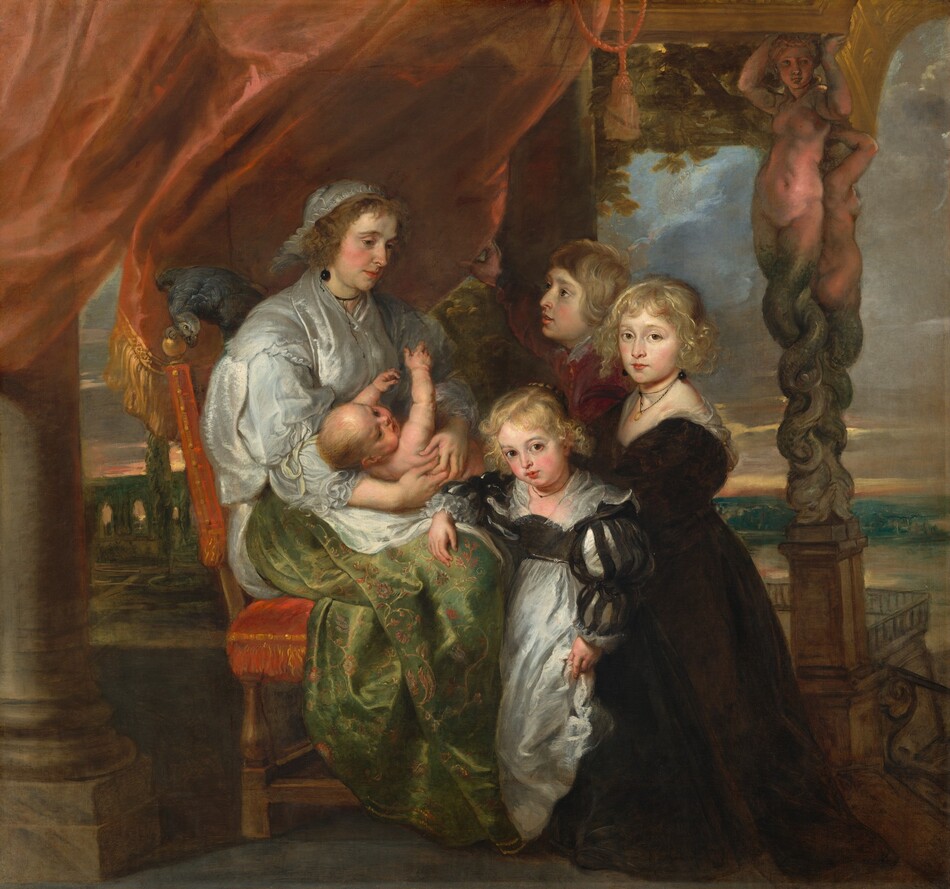
A seated woman with an infant on her lap and three children are clustered on a terrace overlooking green hills and a body of water in this square painting. They all have pale skin with flushed cheeks. The group is centered in the composition, and the woman sits to our left, facing our right, almost in profile. The wooden chair is upholstered in scarlet-red fabric and a large slate-blue bird perches on the backrest. Gold-edged, red drapery hangs behind the woman, suspended from stone columns on either side of her. The woman’s brown hair is covered by a frilly, silvery-gray cap with a matching shawl layered over a short, three-quarter sleeve jacket. Her fern-green skirt, covered with a pattern of coral-red flowers and gold vines, gleams in the soft light coming from behind us. A thin black band encircles her neck, and a round, black earring dangles from the ear we can see. She bows her head slightly and gazes down at the children. The infant lies across her lap with its head coming toward us, its chubby arms reaching up to the woman while turning to look at the three standing children. They appear to be a young boy and two girls, and they all have blond hair, large brown eyes, and delicate rose-red mouths. They crowd together at the woman’s knees. The boy is taller than the girls and stands behind them, visible from the shoulders up. He is dressed in red garments and stands almost in profile to gaze up at the woman. The girls turn their heads to look directly at us. At the center of the trio, the taller girl wears a long, voluminous brown gown. Her hair is pulled back and long ringlets frame her face. She also wears round black earrings and two delicate black cords around her neck, one of which holds a gold ring. At the front, the shortest girl wears a black and white gown with a sheer neckerchief along neckline, and she rests one arm across the woman’s lap. The girl’s long, puffy, black sleeves are slashed to create openings for white fabric to show through. Her hair is also upswept with ringlets framing her face. To the right of the group is a column made of two creatures with pink female heads, faces, and nude torsos with scaly, olive-green, twisting, snake-like legs. One creature faces us and the other faces our right. The sky beyond the terrace is filled with clouds that transition from slate gray at the top to tan and rust orange where it meets the distant hills.

Deborah Kip, Wife of Sir Balthasar Gerbier, and Her Children

Sir Peter Paul Rubens, Jacob Jordaens

1629/1630, reworked probably mid 1640s

Oil on canvas  Accession ID  1971.18.1

On View: West Building Main Floor, Gallery M43
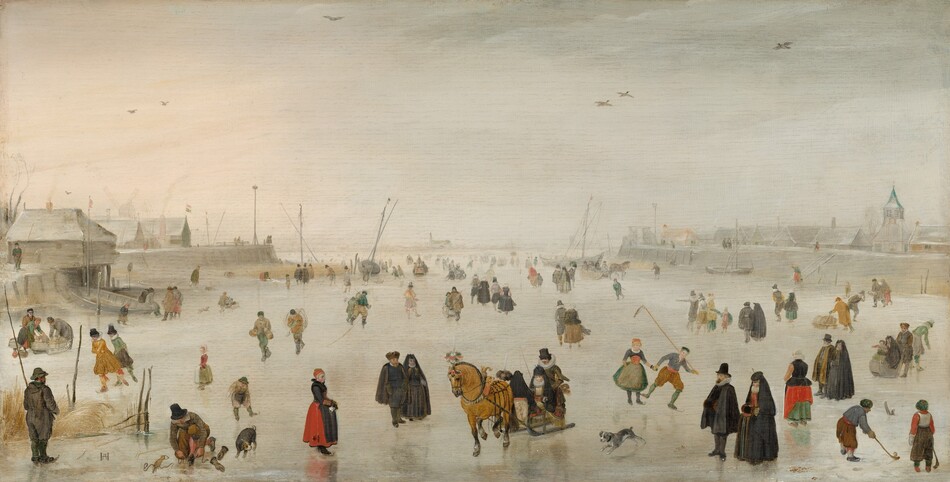
We look slightly down onto a panorama with dozens of pale-skinned men, women, and children skating and standing on a frozen river in this horizontal landscape painting. Most of the men wear black hats and suits, some with white collars and hip-length capes. The women all wear ankle- or floor-length skirts, and some are covered with black cloaks that drape over their heads to their feet. Many people wear black but some of the clothing is scarlet red, sage green, celestial blue, beige, or slate gray. A few people draw the eye, like the man standing with his back to us, wearing dark gray and holding a tall pole in the lower left corner. To the right, a man kneels to tie a skate with a brown and black dog nearby. A woman wearing a crimson-red skirt and a couple clad entirely in fur-lined black clothing look toward a man and woman riding a horse-drawn sled on the ice, at the lower center of the painting. Another black-draped form in the sleigh could be a second woman wearing a cloak. A pair of boys play a game like hockey in the lower right corner. People gather and skate in pairs and small groups, or ride in sledges into the deep distance. The buildings and boats lining the horizon, which comes about halfway up the composition, are painted in shimmering grays. The sky above is the same cool white as the ice below. A few birds fly across the scene.

A Scene on the Ice

Hendrick Avercamp

c. 1625

Oil on panel  Accession ID  1967.3.1

On View: West Building Main Floor, Gallery M44
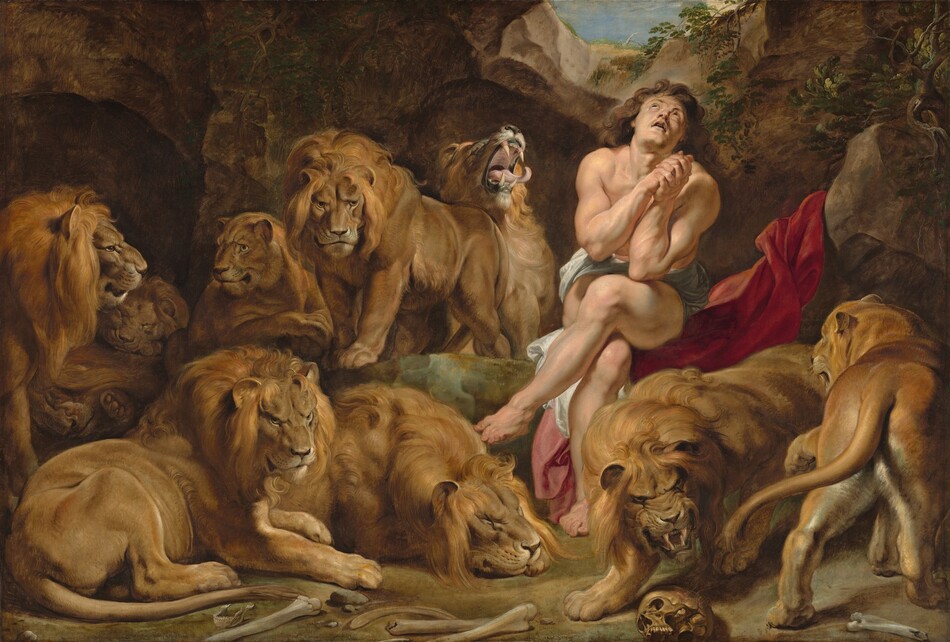
A nearly nude, muscular man with pale, peachy skin sits in an underground cave among seven male and two female lions in this horizontal painting. The man sits to our right of center with his legs crossed, elbows close to his body with hands clasped by his chest. His head tips back to look up through a small opening above. He has long, wavy, chestnut-brown hair and dark eyes. A white cloth wraps across his hips, and he sits on a scarlet-red swath of fabric draped up over a rock next to him. The nine lions stalk, sit, or lie down around the man. One male lion next to the man, to our left, opens his mouth with his head thrown back, curling tongue extended beyond long fangs. A human skull and other bones are strewn on the dirt ground close to us. The rocky cave curves up around the animals and man to a narrow, round opening showing blue sky above.

Daniel in the Lions' Den

Sir Peter Paul Rubens

c. 1614/1616

Oil on canvas  Accession ID  1965.13.1

On View: West Building Main Floor, Gallery M45
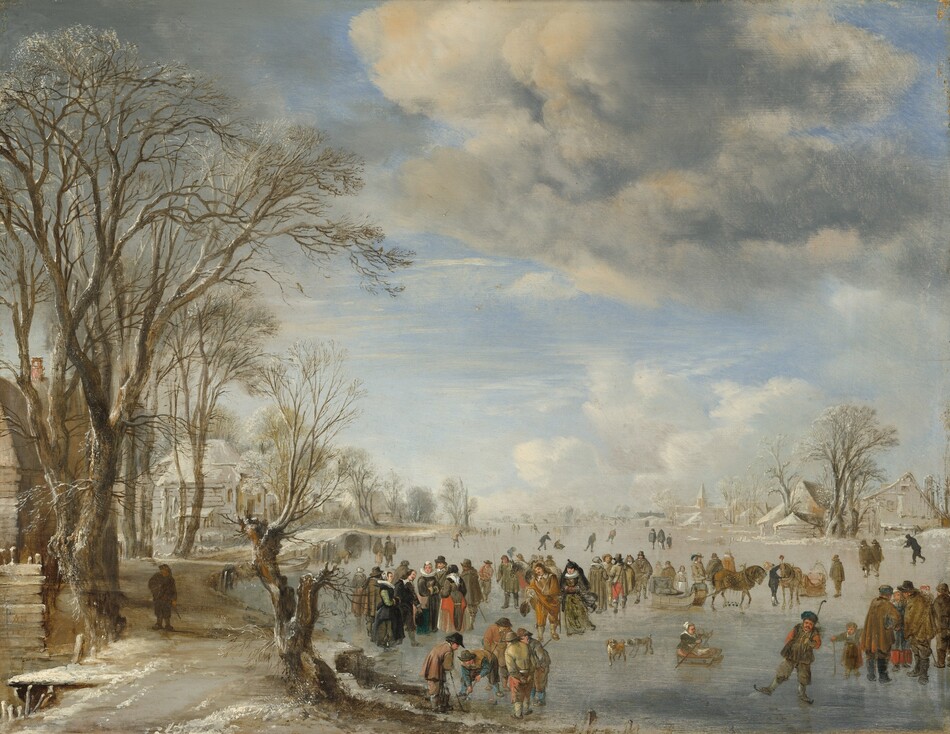
Dozens of people stand, skate, play a game like hockey, or ride horse-drawn sleds on a frozen river that winds along a town to our left and into the distance in this nearly square landscape painting. The horizon comes about a quarter of the way up the composition, and the sky above is filled with ivory-white clouds billowing up against a pale blue sky. Some of the men wear tall hats, hip-length capes over jackets, and breeches over stockings, while others are more simply dressed with rounded hats. Several of the women wear wide, pleated, plate-like neck ruffs, fur muffs, and long dresses, while others wear aprons over peanut-brown and muted blue dresses. The scene is alive with activity, including a man looking at us as he balances rakishly on one skate near the lower right corner, and a young girl sitting in a sled and pushing herself along with sticks nearby. The trees lining the snow-covered, riverside path are bare and the village to our left is painted in tones of pale tan and white. In the distance the snowy earth blends into the soft blue sky and fluffy clouds above. The artist signed the work as if he had painted his name and the date on the face of a wooden fence in the lower left corner: “AV DN 1645.”

Winter in Holland: Skating Scene

Aert van der Neer

1645

Oil on panel  Accession ID  2014.136.37

On View: West Building Main Floor, Gallery M49
A woman playing a lute sits next to a table, on which a man perches and leans toward her in this vertical painting. Two people look on from the background. All the people have pale skin. The table is covered by cloth patterned in brick red, fawn brown, and black, and it extends off the right edge of the painting. The woman sits along the narrow end of the table to our left of center. Her body faces us as she holds the lute in her lap, one foot resting on a small wooden box. Her left elbow, to our right, is propped on the table to hold the neck of the lute. Her curly, blond hair is pulled back under a string of pearls and a fuzzy salmon-pink cap, or a feather, covers the back of her head. The bodice and puffy, elbow-length sleeves of her gown have cream-white and peach-colored stripes, and the ivory-white satin skirt falls to her feet. She wears a thin gold necklace and pearl earrings. With lips parted, she turns her face up to look at the cleanshaven man sitting on the table next to her. The man’s brown curls fall loosely over his shoulders. A long, wide white collar hangs down the front of his mustard-brown jacket. The voluminous white shirt he wears underneath shows where the jacket is unbuttoned near his waist and at his cuffs. He wears thigh-length, red pantaloons and close-fitting tan leggings. Baggy white socks hang around his ankles, and his brown shoes are tied with laces. A wooden flute sticks out of the pocket farther from the woman, and he holds a tall black hat in his lap, cradled in his left hand, to our right. With his other hand, he reaches to pluck a string near the peg board of the lute. One foot dangles off the edge of the table, and the other is propped on a bench, next to an open book. A glass with a tall stem and rounded bowl sits on the table next to him. Farther back in the shadows of the room, an older woman looks toward the couple, perhaps at the man’s hand on the lute, with her mouth slightly open. A white bonnet frames the woman’s face, and she wears a black hood and cloak over her dark dress. A bed under a box-like canopy sits along the back wall, and is cut off by the left edge of the painting. Dark curtains hanging from the canopy are pulled back to show two white pillows laid one atop the other. Also at the back of the room, to our right, a man peers in through a half-opened, arched door. He wears a conical, black, brimless hat and has a white collar over a dark coat. He looks toward the older woman with one index finger held to the corner of his grinning mouth. The wall is covered with gold-embossed, brown leather squares. The artist signed and dated the painting as if he had written in the open book on the bench: “J Steen 1667,” with the letters J and S entwined.

Ascagnes and Lucelle (The Music Lesson)

Jan Steen

1667

Oil on canvas  Accession ID  2014.136.45

On View: West Building Main Floor, Gallery M50
A woman, Mary, floats in the sky surrounded by eleven winged angels above fifteen men and women gathered around an open, stone coffin in this vertical painting. All the people have pale, peachy skin. Near the top center of the composition, the woman’s torso twists to our left as her knees turn to our right. She lifts her left hand, to our right, to her chest and her other arm reaches down along her body. She looks up with dark eyes, her head tipped slightly back. She has a round face, a small nose, flushed cheeks, and a heart-shaped, rose-pink mouth. Her long, golden-brown hair falls over the shoulders of her scoop-necked, powder-blue dress. A honey-brown wrap loops over one shoulder and billows up to surround her head and shoulders. A voluminous silver cloth edged with gold flows around her hips, legs, and feet. Seven of the angels gathered near Mary’s feet and legs are baby-like, pudgy children with gossamer-white or smoke-gray wings. Most of these angels are nude but the genitals of two are covered in ivory or golden yellow cloths. Four taller, so presumably older, angels float around Mary’s head and shoulders with two to each side. Two angels to our left, wearing petal pink or butterscotch yellow, hold a ring of leaves up toward her head. The angels to our right wear ruby red or bronze gold, and they look toward Mary with their arms crossed over their chests. The hair and drapery of all of the angels flutter as if in a breeze. Below this group, on the dirt earth, twelve men and three women gather around an open stone coffin set in front of an arched opening leading into a hillside. Some in the group look into the coffin, some look up, and some look toward a man standing to our left. That man has long, chestnut-brown hair and wears a red robe over a white tunic. He looks up at Mary with his head tipped back and raises both hands high, palms facing the scene in the sky. The three women are closest to the coffin, which sits on a two-stepped platform. The woman closest to us kneels on the steps wearing a golden yellow dress. Her white-blond hair has been pulled up and braided. She pulls a pale gray or white cloth from the coffin and holds what could be a small bunch of flowers or leaves in one hand. The other two women have brown hair and stand on the far side of the coffin. Some of the men have beards, and they wear robes in cardinal red, olive green, honey yellow, and tan. A sliver of landscape with water, trees, and a hill is visible in the deep distance to our left, and the sky above is filled with slate-blue clouds. A darker bank of charcoal-gray clouds sweeps around the group in the sky to our right, and bright, yellow rays emanate down from the top center. The scene is loosely painted, especially in the clothing, to create the impression of a sheen on the fabrics.

The Assumption of the Virgin

Anonymous Artist

probably mid 1620s

Oil on panel  Accession ID  1961.9.32

On View: West Building Main Floor, Gallery M43
A bearded man with copper-blond hair and flushed, peachy skin stands on a stone-gray pedestal and gestures toward a group of five more men gathered before him in this square painting. Some of the men are light-skinned, others are tan. The man on the platform, Decius Mus, stands with his ruddy face turned to our right in profile, his muscular right arm raised and right foot extended. He wears a knee-length toga, and form-fitting armor covers his torso. A sword hangs from his waist, and a scarlet-red cape flaps behind him. Piled against the pedestal in the lower left are spears, battle axes, a silvery-gray shield covered with gold lightning bolts, and an ornate crested helmet. In the upper left corner, an eagle with one wing extended hovers behind Decius Mus’s head, clutching long peach and straw-colored strands in its talons. The other five men stand clustered together on the ground to our right, facing Decius Mus. They are also bearded and muscular, and each holds a golden staff topped with a different symbol. They wear knee-length tunics and cloaks in brick red, olive green, black, or tan, and three wear armor protecting their upper bodies. Calf-high, brown boots cover their feet but leave their toes exposed. The man closest to us has gray hair and stands with his back to us. A parchment-brown animal skin speckled with brown spots covers the back of his head and wraps around his armor and tunic. The man just beyond him, to our left, faces us and holds a gold staff topped with an eagle set within a round laurel wreath. The rest of the men stand in profile, filling the right side of the composition, and they lean in toward Decius Mus. Two of them wear crested helmets, one olive green, the other charcoal gray, both with gold ornamentation on the front. The man in the gray helmet holds aloft a flag painted with vertical swipes of scarlet red and ginger brown. A sketchily painted landscape beyond the group has trees with dark brown trunks and sage-green leaves along the left edge, leading back to a line of trees in the distance. Rolling, teal-blue land along the horizon could be hazy mountains. The powder-blue sky above is scattered with butter-yellow and light gray clouds. The scene is loosely painted, especially in the costumes and background.

Decius Mus Addressing the Legions

Sir Peter Paul Rubens

probably 1616

Oil on hardboard, transferred from wood and canvas  Accession ID  1957.14.2

On View: West Building Main Floor, Gallery M45
More than two dozen rowboats and sailboats bustle around a waterway in this horizontal landscape painting. Beige-colored water gently ripples across the bottom of the composition and extends into the deep distance, where buildings, windmills, and a church line the low horizon. Clouds with warm white tops and cool gray bottoms tower across a pale blue sky, which takes up the top three-quarters of the composition. A few reeds poke out of the water close to us, near the lower right corner of the painting. The row- and sailboats just beyond are packed with people. Two flags fly from the masts of the largest ship, which is to our left of center. One flag has red stripes flanking a white stripe, and the other is striped with red, white, and blue. Two rowboats have pulled up to the grassy shore of a spit of land to our left. A ladder leans against the steep hill rising from the water’s edge, and a cluster of spindly trees lean toward the water from the hillock. The people all wear clothing and hats in tones of brick red, ochre yellow, sable brown, and black. More boats move through the water back to the town and waterways to either side.

View of Dordrecht from the North

Jan van Goyen

early 1650s

Oil on canvas  Accession ID  2014.136.34

On View: West Building Main Floor, Gallery M49
A young boy with pale skin and short brown hair, wearing a black and gold jerkin and breeches, white lace collar, and buttercup-yellow stockings, stands facing us with a dog at his heels in this vertical portrait painting. The boy is brightly lit so the area around and behind him are deep in shadow. His body is angled slightly to our right but he turns to look at us with green eyes under faint brows. He has a round face, a short nose, and the corners of his closed, coral-pink lips turn slightly up. His hair is parted in the middle and bangs sweep to each side of his forehead. He stands with his left fist resting on his hip so his elbow juts out. His other arm rests by his side and he holds the dog’s chain-link leash in that hand. The boy's right foot, on our left, points toward us. His close-fitting, belted jacket, breeches, and hip-length cape are embroidered with gold on black. He has a delicate lace collar at his neck, bright yellow stockings on his calves, and brown, round-toed shoes. The chain he holds connects to the collar on the brown and white dog, which could be a puppy. The dog’s collar is lined with large brass bosses like a row of buttons. The dog stands or sits with its front legs straight, and his back end is hidden by the boy’s legs. The background behind the boy is chestnut brown and the room seems to have a wooden floor. The painting is inscribed in black paint near the upper left corner: “Ao 1623 AET. 4. 7.”

Filippo Cattaneo

Sir Anthony van Dyck

1623

Oil on canvas  Accession ID  1942.9.93

On View: West Building Main Floor, Gallery M42
Shown from the knees up, a pale-skinned woman wearing a voluminous, gold-trimmed, white satin gown and a black overdress stands holding a closed fan in this vertical portrait painting. Her body and face are angled to our right, and she looks at us from the corners of her gray eyes. She has pale skin, a straight nose, thin lips, and a slight double chin. Chin-length brown waves frame her face, and the rest of her hair is pulled back. A pearl necklace lies at the base of her neck, though traces of another necklace, originally painted higher up on the neck like a choker, are visible. A lace-edged collar lies along her shoulders, and more lace lines a kerchief tucked into the low, straight neckline of her bodice. The gown’s puffy sleeves are tied around the elbows and end in wide lace-lined cuffs at the wrists. The sleeves and the front and bottom edges of the bodice are lined in glittery gold. A bejeweled gold brooch nestled in black lace is pinned to the front of her gown. A gold chain links the brooch to one side of the bodice before draping across her chest and lying over the other shoulder. A white satin ribbon is tied with a bow around her waist over the black overdress, which has subtle suggestions of a black-on-black pattern down the front. The fan is in her left hand, to our right, perhaps attached to a length of gold chain visible under her wrist. Her other hand rests in the folds of the black overdress. Some brushstrokes are visible in the woman’s clothing and in the walnut-brown background.

Lady with a Fan

Sir Anthony van Dyck

c. 1628

Oil on canvas  Accession ID  1957.14.1

On View: West Building Main Floor, Gallery M43
Shown from the hips up, a man with pale skin and shoulder-length brown hair, wearing a long-sleeved, rose-pink satin jacket and pants, props a flagpole with a voluminous blue flag against one shoulder in this vertical portrait painting. He stands with his body facing our left in profile with his left hand on his hip, elbow jutting out at us. He turns his face to look directly at us with dark eyes. He has a straight nose, rosy cheeks, and a mustache and narrow goatee below his lips, which are slightly parted. He wears a wide-brimmed black hat generously adorned with pale blue, turquoise, pale yellow, and orange plumes. The fabric of his pink clothing reflects the light in wide patches of white, creating the impression of a satin sheen. Wide, pale gray lace lines the front opening of the jacket, the shoulders, the arms, and the sides of the trousers. His white lace collar is tied with a pale celery-green bow and a bow of the same color ties the lace cuff of the wrist we can see. A baby-blue sash wraps around his waist and is tied in a large rosette at the back. Both hands are covered with ivory-white gloves. His left wrist rests against his hip so the underside of those fingers dangle down, while the other hand supports the flag pole, which is wrapped in blue fabric. A sword hangs from his front hip. The topaz-blue fabric of the flag, or standard, drapes down from the flag pole, which extends off the top right corner of the canvas. A coat of arms, about the size of a person’s palm, hangs from a nail with a string in the upper left corner on the taupe-colored wall behind the man. The coat of arms is made up of three fleur-de-lis lined up in a diagonal band and the remaining two corners are filled with stylized lions, long tongues curling out. The artist dated the work “1640” in the lower left corner.

Andries Stilte as a Standard Bearer

Johannes Cornelisz Verspronck

1640

Oil on canvas  Accession ID  1998.13.1

On View: West Building Main Floor, Gallery M46
Shown from the hips up, a pale-skinned man with a Van Dyck beard stands with one hand on his hip in this vertical portrait painting. The man’s body faces our right almost in profile, but he turns his head to look at us from the corners of his brown eyes under lifted, black brows. The bridge of his nose is slightly flattened, and he has full pink lips, a pointed chin, and chin-length, wavy black hair. His mustache flares upward at the ends, and a line of hair grows down his chin. The wide brim of his hat would nearly have reached his shoulders, but it sits angled on the back of his head. Layers of white lace create a round collar resting on his chest over a black jacket. The coat is slashed over the chest and upper arms of the sleeves so the white shirt underneath is visible. The jacket is also partially unbuttoned over his torso. The cuff we can see reaches from his wrist along his forearm and is edged in lace. The back of that hand rests against that hip, and the cloth of a black cloak is bunched up around that hand. Black drapery fills most of the background but is pulled back to our right to reveal a landscape with a sunset-streaked sky.

Portrait of a Man in a Wide-Brimmed Hat

Flemish 17th century, Jan Cossiers

early 1630s

Oil on panel  Accession ID  1969.2.1

On View: West Building Main Floor, Gallery M46

Loading Results