Dutch and Flemish Paintings

Filter Results

110 artworks on view.

Results

On a tabletop spread with an ivory-white cloth, plates, and white porcelain bowls containing sweets, fruit, olives, and a cooked fowl are arranged around the largest platter, which holds the head, wings, and tail of a peacock stuck into a tall, baked pie, in this horizontal still life painting. The front, left corner of the table is near the lower left corner of the painting, so the tabletop extends off the right side of the composition. The white tablecloth lies over a second cloth underneath, which is only visible along the right edge. The cloth underneath has a leafy, geometric pattern in burgundy red against a lighter, rose-red background. The peacock pie is set near the back of the table, to our right, so it fills the upper right quadrant of the composition. The bird holds a pink rose in its beak. In front of it, near the lower right corner of the painting, a white porcelain bowl painted with teal-green floral and geometric designs holds about ten pieces of pale yellow and blush-red fruit. A pewter plate next to it, to our left, holds dried fruit and baked, stick-like sweets, some covered with white sugar. A pile of salt sits atop a gold, square vessel between the sweets and the peacock pie. Another blue-patterned, white porcelain bowl filled with green olives sits near the back of the table next to a lidded, pewter pitcher with a long spout. Other pewter plates hold a baked fowl, like a small chicken, and, closest to us, a partially cut lemon with its peel curling off the plate. Nuts, more fruit, an ivory-handled knife, bread rolls, and flat biscuits sit on the white cloth among the plates. One glass with a wide stem covered in nubs and a flaring bowl sits near the back, left corner of the table, filled with a pale yellow liquid. An empty glass lies with the upper rim on another pewter plate, to our left. Also on the plate is a bunched up white napkin and a leather case for the knife. The background behind the still life is brown.

Still Life with Peacock Pie

Pieter Claesz

1627

Oil on panel  Accession ID  2013.141.1

On View: West Building Main Floor, Gallery M50
Shown from the shoulders up, a bearded man with wrinkles lining his pale-skinned face looks up and to our left, toward a bright light source, in this vertical portrait painting. His shoulders are angled to our left, and he tips his head slightly back so his face turns toward us. He looks up from the corners of his gray eyes under bushy brows. A soft gray cap, pushed back high over the crown of his head, frames his face over a few tuffs of charcoal-gray hair on his high forehead. His brows are furrowed and his hollow cheeks ruddy. He has a silvery gray mustache, and his long, full beard falls to his chest. Lines have been incised in the gray and white paint of his beard to reveal an underlayer of rust orange. His slate-gray tunic is streaked with fawn brown to create highlights. The background is painted with blended strokes of leather brown and touches of golden orange, and it lightens around the man’s head.

Bearded Man with a Beret

Jan Lievens

c. 1630

Oil on panel  Accession ID  2006.172.1

On View: West Building Main Floor, Gallery M51
This horizontal painting shows a group of eight light-skinned musicians and onlookers gathered closely around a rectangular, carpet-covered table. The front edge of the table runs parallel to the bottom edge of the painting, and seems close to us. Shown from about the waist up, the men and women’s vivid lapis-blue, coral-red, buttercup-yellow, lilac-purple, and moss-green garments fall in crisp folds. Bright reflections on the fabric suggest a satin-like material. Two women wear feathers in their hair and one man’s hat is plumed. One man, wearing crimson red and black, sits with his back to us to our left on the near side of the table. He holds the neck of a bass viol, about the size of a cello, with his left hand, and points to pages of an open music book with the bow in his right hand. The other people cluster on the far side of the table. A man to the left plays a violin; a woman at the center plays a guitar-sized bandora, and a woman to our right plays a lute. The musicians, along with a man who leans over the table from between the two women, look down at the music books. A young man behind the woman at the center holds up a glass of pale liquid with his right hand as he touches his left forefinger to his smiling lips. A man and woman stand close together in the background to our right, in the top right corner of the canvas.

The Concert

Gerrit van Honthorst

1623

Oil on canvas  Accession ID  2013.38.1

On View: West Building Main Floor, Gallery M45
Two women, four men, and a satyr, which is a creature with a man’s body and hairy goat’s legs, gather in a wooded landscape in this horizontal painting. All the people have pale, peachy skin. At the center of the group, to our left of center, a young, cleanshaven man balances on the ball of one foot as he strides toward us. He turns his head to his left so he faces our right in profile, and he looks off in that direction. He wears a ring of laurel leaves in his blond curls and his lips are parted. He holds a jeweled, golden stringed instrument, a lyre, in the crook of his right arm, on our left. He lifts his other hand to gesture toward the men to our right. He is nude except for a coral-red cloak fastened with a gold clasp at his neck. The cloak billows around his muscular body, and one bottom corner curls across his hip to cover his groin. To our left, two women sit on a rocky outcropping. The woman to our left holds a sapphire-blue robe to her chest. Her golden brown hair is pulled back, and she looks at the young man. The second woman sits with her body facing away from us, her arms resting on the rock in front of her. Her nude back faces us and she has a soft, rounded belly. She sits against a white cloth, and a light sage-green cloak pools around her hips and lies across one thigh. To our right, behind the young man holding a lyre, two bearded men sit on a rock with their bodies angled toward each other. The man to our left wears a leafy crown and holds a wooden staff. The second man wears a topaz-blue hood and robe, and turns to speak to his neighbor as he points in the opposite direction. Closer to us, near the right edge of the painting, the satyr plays a set of pan pipes. The man sitting next to him has tall, pointed, ass’s ears and a pointed, red beard. He wears a shimmering butter-yellow cloak over a brick-red tunic, and he rests one hand on the satyr’s shoulder. The entire group is enclosed by tall, tawny-brown rocks and leafy, sage-green trees. In the upper left corner, lilac-purple clouds float across a pale blue sky. The scene is painted with swirling brushstrokes that are especially visible in the clothing and background.

The Judgment of Midas

Jan van den Hoecke

c. 1640

Oil on panel  Accession ID  2015.143.18

On View: West Building Main Floor, Gallery M45
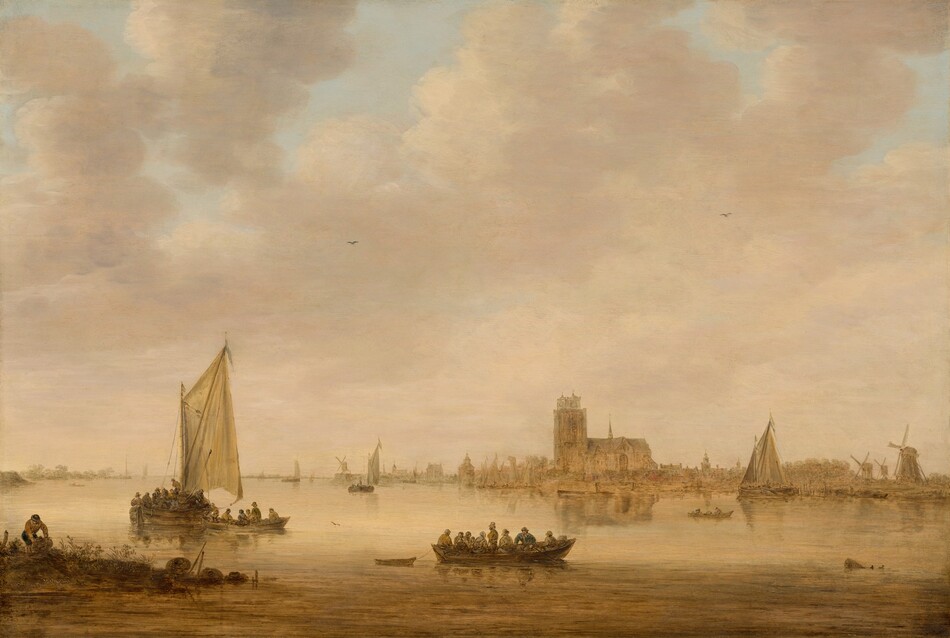
We look across a body of calm water onto a wooden pier, rowboats, sailboats, and a town on the distant shore, all beneath a cloudy sky that takes up the top three-quarters of this horizontal landscape. The pier extends into the scene from the left edge, and stretches about a quarter of the way across the painting’s width. Three men and a woman, all with light skin, stand in a group near a fourth man, who sits on a piling at the front corner. They all wear charcoal-gray, muted blue, or fawn-brown clothing and hats. A rifle leans against the hip of one man, and another man looks out at the water, his back turned to the rest of the group. Three small boats are tied to the end of the dock. The one closest to us holds large containers, perhaps wrapped with rope. A fifth man bends over the far edge of the boat farthest from us. In another rowboat to our right, a man stands, another sits, and a third pulls on the oars. Four sailboats float into the distance down the center of the composition. To our right, the town along the far shore has closely spaced buildings with peaked roofs, a windmill, and a tall steeple, all painted with tones of peanut brown and tan. Light falls across the water from our left, casting the area closest to us in deep shadow. The surface of water is painted with tones of ivory and gray, matching the sky above. Light filters and streaks through ash-gray clouds across most of the sky. The clouds part to reveal a patch of pale blue at the upper left corner.

A Pier Overlooking Dordrecht

Aelbert Cuyp

early 1640s

Oil on panel  Accession ID  2012.73.1

On View: West Building Main Floor, Gallery M49
A cage, net, hunting horn, powder bag, pouch, two whistles, a bow and arrow, and a small, round hood for a bird are arranged in and around an arched niche set into a cream-white wall in this vertical still life painting. The objects are lit from our upper left so soft, slate-gray and powder-blue shadows are cast across the walls. The niche is framed with a wood border. Centered in the niche, the wooden cage has an arched top and closely spaced bars. The hood sitting atop the cage is a scarlet-red cap that would fit onto the head of a falcon. It is topped with a red pompom on a short stick, like an antenna. A sheathed knife with a bone-white handle and a long, curving, hunting horn lean against the front of the cage. The horn lightens from black where one would blow into the horn to a shimmering sage green at the wide end, which rests against the cage. A bow and arrow lie across the floor of the niche, under the cage, and a tangle of netting is tied to the horn, near the foot of the cage to our left. A pine-green whistle is affixed to or looped through the top of the cage, under the falcon’s hood, and hangs down past the ledge. A powder horn and bag hang on a canary-yellow cord looped over a nail driven into the wall over the alcove, to our left, and a pouch with a tassel hangs from a nail to our right.

Niche with Falconry Gear

Christoffel Pierson

probably 1660s

Oil on canvas  Accession ID  2003.39.1

On View: West Building Main Floor, Gallery M50
A sage-green harbor teems with more than a dozen sailing ships and rowboats under a pale gray sky in this horizontal painting. The horizon comes about one-fifth of the way up the composition, and dark gray and white clouds tower above. Light filters onto the scene through the clouds from our left to fall across the ships while casting shadows on the water nearest us. Painted in tones of slate gray and warm brown, most of the ships closest to us have their sails furled so the masts and horizontal yard arms bristle against the sky. The larger ships have cannons poking out of square portholes. On our right, a war ship floats with its ornately carved and gilded stern facing us. A flag flying from the tallest of the three masts has red, white, and green stripes. The artist painted his name on that flag, “R. Zeeman.” The ship is tied to a buoy with a length of rope, and an empty rowboat is tethered to the right side of the ship. A similar ship but with the sails hanging loosely is tied to a buoy just beyond this one. A row of pickets, like a fence, extends into the water behind these two ships. To our left, a rowboat full of men has pulled up alongside a partially sunken ship, its masts tilting toward us. A few people stand on two more ships nearby. A black temporary dock floats next to the leftmost ship here. A person mixes something that smokes on the platform, and another person stands on a board lifted halfway up the ship’s side, presumably working on a repair. Two women in another rowboat next to the floating dock lean over the side, washing clothes. Another fence encloses the harbor to our left, and a hut in the middle of the harbor is surrounded by a similar structure. Two rowboats closer to us are filled with men wearing tall hats and black or brown coats, and women wearing black bonnets and white shawls. More sailing ships and rowboats move back or around beyond the harbor, out to sea. Visible cracks cover the surface of the painting.

Amsterdam Harbor Scene

Reinier Nooms, called Zeeman

c. 1654/1655

Oil on canvas  Accession ID  2011.3.1

On View: West Building Main Floor, Gallery M49
A basket overflowing with grapes and surrounded by dead birds and more fruit sits on a long table covered in a scarlet-red cloth in this horizontal still life painting. In the basket at the center of the painting, luminous green, blue-black, red, and purple grapes are piled up in a rough pyramid that overflows the sides. Long stems with broad sage and celery-green leaves edged with brown jut up above and to the side of the bunches of grapes, nearly touching the top edge of the painting. Just in front of the basket to our left, a bowl overflowing with a bunch of purple grapes is tipped toward us. The inside of the bowl is painted with cobalt-blue, geometric, vegetal designs against a white background. Behind it, at the far left, a tall, bronze, footed serving dish stacked high with pale green and black-skinned figs is cut off by the left edge of the composition. In front of and to the right of the central basket, the bodies of about two dozen small and medium-sized birds fill the right half of the tabletop. About ten small birds are arranged along a stick between a pair of dead birds to our left and a pile of several larger birds to our right. The birds’ feathers and bodies are painted in shades of cream and parchment white, ink black, ruby red, tawny brown, and butter and golden yellow. The fruit and birds are lit from the upper left, and the backround is earth brown.

Still Life with Grapes and Game

Frans Snyders

c. 1630

Oil on panel  Accession ID  2006.22.1

On View: West Building Main Floor, Gallery M44
A child and woman stand at the open door of an entryway with black and white marble floors, as the child drops a coin into the hat of a disheveled boy accompanied by a nursing mother across the threshold in this vertical painting. Beyond the entryway, a man and woman look on from a room with a landscape painting hanging over a tall mantle. All the people have pale skin. The child standing with the woman inside, near the door, looks at us with gray eyes. Blond ringlets frame a round face with full cheeks, a snub nose, and parted coral-red lips. The ringlets are tied with butter-yellow ribbons and the rest of the head is covered with a white cap. The child’s garment has a wide, flaring, flat collar, a tight-fitting bodice, and a flaring, floor-length skirt. Pale plum-purple, puffy sleeves are tied with pale yellow and azure-blue ribbons, and a cape of the same fabric lined with pale grass-green falls from the shoulders. A medallion hangs from a thick gold chain looped over the child’s right shoulder, to our left, across to the opposite hip. The child touches the hand of the woman standing behind with one hand, to our right, and drops a silver coin into the proffered hat with the other. The woman’s body faces us but she turns her oval-shaped face to look down at the boy holding out his hat. She wears a scarlet-red, long-sleeved bodice with a wide, white collar over her chest. A taupe-brown apron covers her dark skirt and her bonnet is long on the sides, draping to brush her shoulders. She rests her right hand, to our left, on her stomach and touches the fingertips of the child in front of her with the other. Near the lower right corner of the painting, a small white dog with ginger-brown spots stands on the black and white marble floor, looking up toward the exchange. Light pours into the entryway through the open door and a transom window above it. The walls are light gray and the doorways are surrounded with darker gray molding. A painting of a landscape hangs above the doorway leading to the room beyond. The man and woman there look at us from in front of a mantle that is taller than the woman who stands next to the man, who is seated. The woman’s hair is pulled back under a cap, and she wears a silver-gray dress lined with a wide band of white fur. She holds one hand to her waist and gestures toward the foyer with the other. The man wears a black suit with a wide, flat collar. The floor in this room is a checkerboard pattern of white and brick-red  squares, and sky-blue panels with gilded leafy designs cover part of the walls. A carved stone cherub like a small, chubby child, stands on the mantle to our left, next to the landscape painting there. Back in the entryway, across the threshold, the boy steps with one foot onto the floor of the foyer as he holds out his frayed, brimmed hat. He has short-cropped blond hair and wears a mustard-yellow shirt with tattered brown pants. The nursing woman stands next to the door, out of sight of the people inside, holding a baby to one round breast. The boy and woman’s faces, necks, and hands are noticeably tanned, almost orange. Two small children huddle, almost out of sight, in the narrow space between the boy and the left edge of the painting. They look down onto a few light tan disks, perhaps coins, on the step in front of them. In the distance beyond the family are a few trees and buildings beneath a vibrant blue sky with puffy white clouds. The artist signed and dated the painting in the lower right corner, “J. Ochtervelt f. 1663.”

A Nurse and a Child in an Elegant Foyer

Jacob Ochtervelt

1663

Oil on canvas  Accession ID  2015.68.1

On View: West Building Main Floor, Gallery M50
""

Walnut Serving Table with Herms and Sphinxes

French 16th Century

second half 16th century

Walnut  Accession ID  1942.9.372

On View: West Building Main Floor, Gallery M49
This painting shows a landscape with rugged gray rocks, rolling green hills, and tall trees with leaves in shades of dark green and rusty orange. On the left, red and gray wooden structures sit on the rocky ground, surrounded by scattered rocks and tree limbs. Small white goats walk on the rocks around the buildings. A gray river flows from near the buildings down to a waterfall at the center of the painting. The sky above is light blue and covered with white and gray clouds.

Waterfall with Log Cabins

Allart van Everdingen

c. 1665/1670

Oil on canvas  Accession ID  2018.210.1

On View: West Building Main Floor, Gallery M49
This is an ornate goblet crafted from a nautilus shell mounted on a decorative stand. The shell has an off-white color with delicate orange patterns and is carved with swirling designs. The shell is set into an intricate golden-colored metal holder, and the stem of the goblet seems to depict a human figure with a fish tail and what looks like wings. The gold base features elaborate floral patterns.

Nautilus Cup

Dutch 17th Century, Swedish 17th Century

c. 1650 (etching), c. 1670 (mount)

Nautilus shell (nacreous layer with etched low relief), silver, and gilded silver  Accession ID  2022.124.1

On View: West Building Main Floor, Gallery M50

Loading Results