Dutch and Flemish Paintings

Filter Results

166 artworks on view.

Results

A cage, net, hunting horn, powder bag, pouch, two whistles, a bow and arrow, and a small, round hood for a bird are arranged in and around an arched niche set into a cream-white wall in this vertical still life painting. The objects are lit from our upper left so soft, slate-gray and powder-blue shadows are cast across the walls. The niche is framed with a wood border. Centered in the niche, the wooden cage has an arched top and closely spaced bars. The hood sitting atop the cage is a scarlet-red cap that would fit onto the head of a falcon. It is topped with a red pompom on a short stick, like an antenna. A sheathed knife with a bone-white handle and a long, curving, hunting horn lean against the front of the cage. The horn lightens from black where one would blow into the horn to a shimmering sage green at the wide end, which rests against the cage. A bow and arrow lie across the floor of the niche, under the cage, and a tangle of netting is tied to the horn, near the foot of the cage to our left. A pine-green whistle is affixed to or looped through the top of the cage, under the falcon’s hood, and hangs down past the ledge. A powder horn and bag hang on a canary-yellow cord looped over a nail driven into the wall over the alcove, to our left, and a pouch with a tassel hangs from a nail to our right.

Niche with Falconry Gear

Christoffel Pierson

probably 1660s

Oil on canvas  Accession ID  2003.39.1

On View: West Building Main Floor, Gallery M50
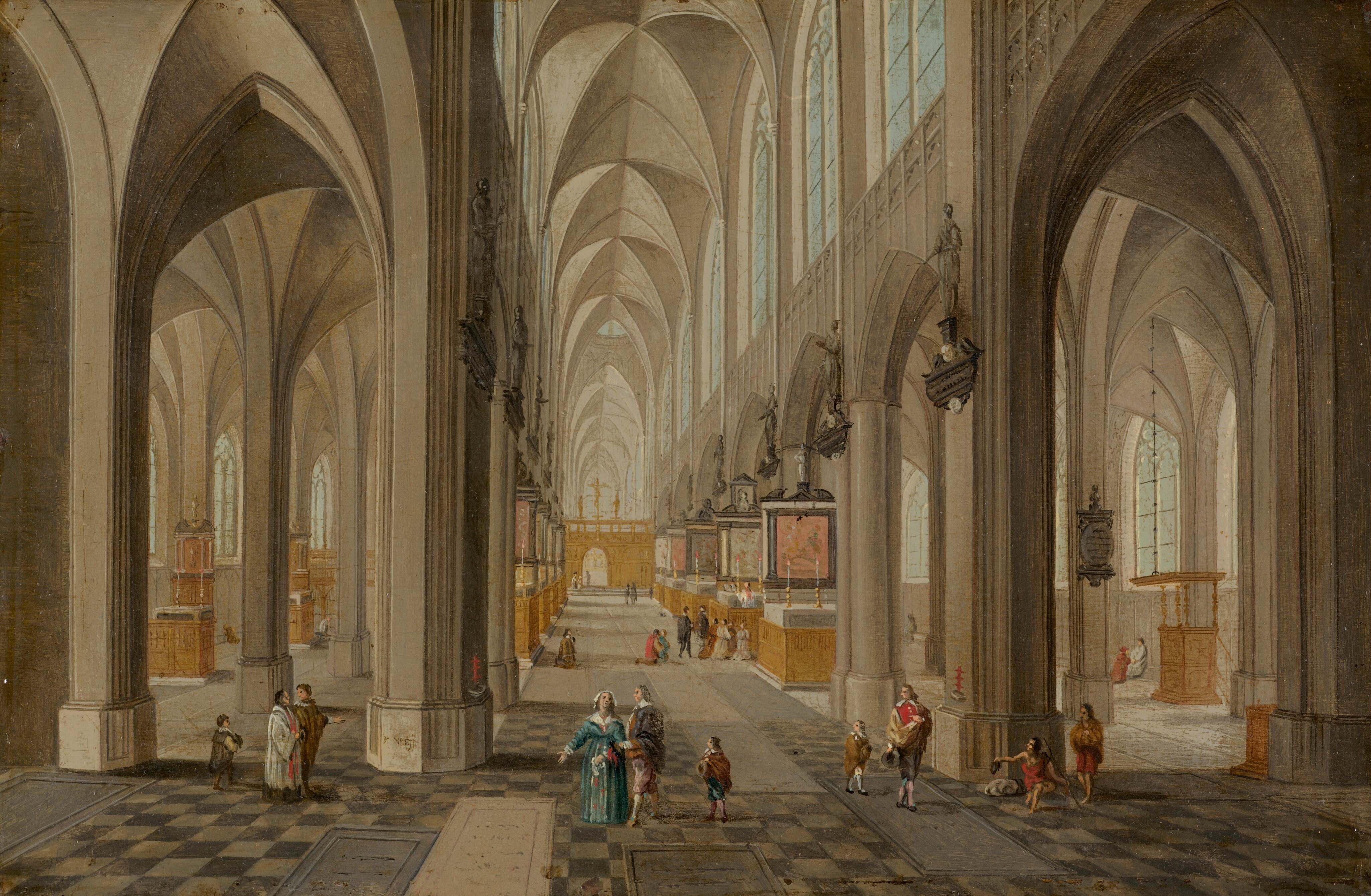
This is a painting of a Gothic-style cathedral interior. The building features tall, cream-colored arches and vaulted, ribbed ceilings. There are framed artworks above wooden pulpits with lit candles on them, and dark gray statues high on the walls. A light blue sky is visible through tall windows, and the floor is a checkered white-and-black pattern, occasionally disrupted by rectangles of gray and white. Men, women, and children dressed in vibrant clothing walk across the floor or kneel by altars.

Antwerp Cathedral

Peeter Neeffs the Elder

c. 1650/1655

Oil on copper  Accession ID  1960.6.29

Not on view
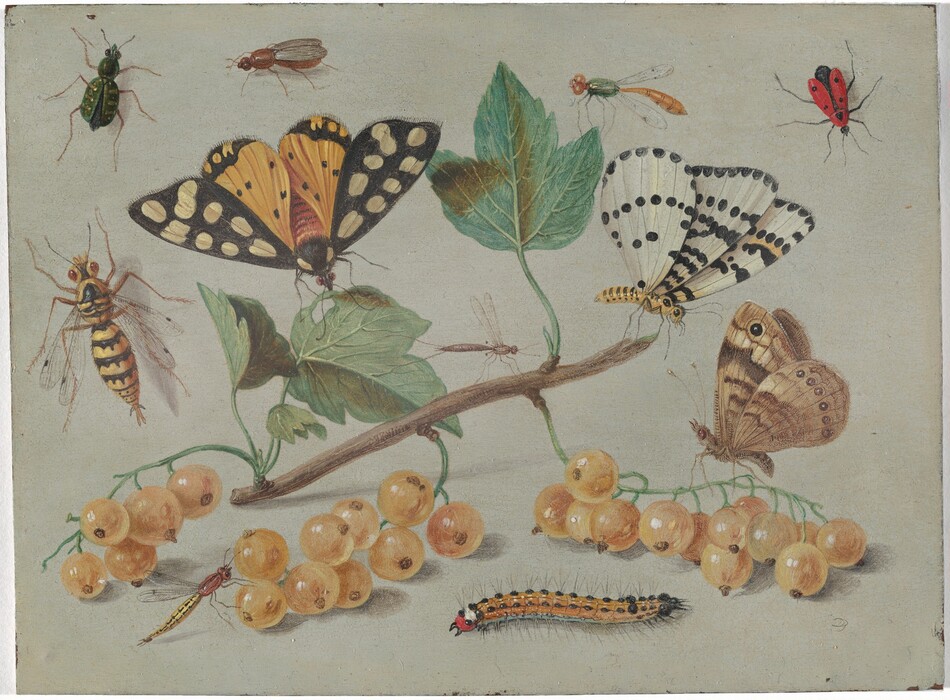
A butterfly, moths, and insects alight on or around a twig with green leaves and straw-yellow berries in this horizontal painting. The background is putty gray, and the objects and insects cast pale shadows to our right. The twig angles slightly upward from left to right in the center of the composition. Wide green leaves sprout from its top edge and three clusters of gleaming berries rest along the table closer to us. A butterfly perches on a leaf to the left on the twig, its wings spread and the antennae touching the leaf. The edges of the wings are charcoal grey with tan spots, and closer to its body, the wings are gold, dotted with black. A bug with a narrow brown body and nearly translucent wings sits near the center of the branch, and a moth perches on the broken end of the twig to our right. The moth’s wings are closed above its body. Its body is striped with yellow and black, and the white wings have black dots. Another moth, with its tan wings also closed, sits on a sprig of berries near the lower right corner of the painting. There are two more insects with spindly bodies and thin, narrow wings, one on a stem of branches near the lower left corner, and one on a green leaf near the upper right. More insects rest on the gray surface around the twig and berries. Along the bottom edge of the painting is a caterpillar with a golden yellow body with black spots, and a red face. Clustered near the top left corner, around the butterfly, are a brick-red bug with closed, sheer wings and six legs, a dark green insect also with six legs and yellow bands on its body, and an insect like a yellow jacket. At the top right is an elongated ladybug.

Study of Butterfly and Insects

Jan van Kessel the Elder

c. 1655

Oil on copper  Accession ID  1983.19.3

Not on view
We look slightly down onto a scene showing light-skinned men, women, and children ice skating on a frozen river in this horizontal landscape painting. We get the impression of hundreds of people gathered on the ice creating a crowd that extends into the hazy distance. The couple dozen closest to us are the most defined. A few clusters of people and individuals in particular draw our attention. For example, a group of three men wearing dark cloaks and hats stand in conversation on our right. Two boys nearby hold sticks and play a game similar to hockey. A small child holds two smaller sticks, perhaps to help balance. A man in the front center wears puffy scarlet-red pants with white stockings, a red jacket, and a tall brown hat with a cloud of scarlet feathers. He stands next to a woman wearing a black hooded cloak over a black skirt and raspberry-pink bodice. She tucks her hands into a cylindrical muffler held at her waist. Another elegantly dressed man in golden yellows and black and a woman in mauve pink and butter yellow stand nearby. Some of people throughout the scene wear white frilly collars and others are more simply dressed in shades of brown, gray, and black. To our right, a faded rose-red windmill stands at the river’s edge, and to our left a large house with steeply pitched and stepped roofs is enclosed within a solid fence painted with pink diamonds against black and white. Smoke rises from one chimney, and other houses and a church line the riverbank into the distance. A wooden bridge near a grove of bare trees connects spit of land near us in the lower left corner with the village beyond. Brilliant azure-blue sky is visible through breaks in the steel-gray clouds above.

Skating on the Frozen Amstel River

Adam van Breen

1611

Oil on panel  Accession ID  2010.20.1

On View: West Building Main Floor, Gallery M50
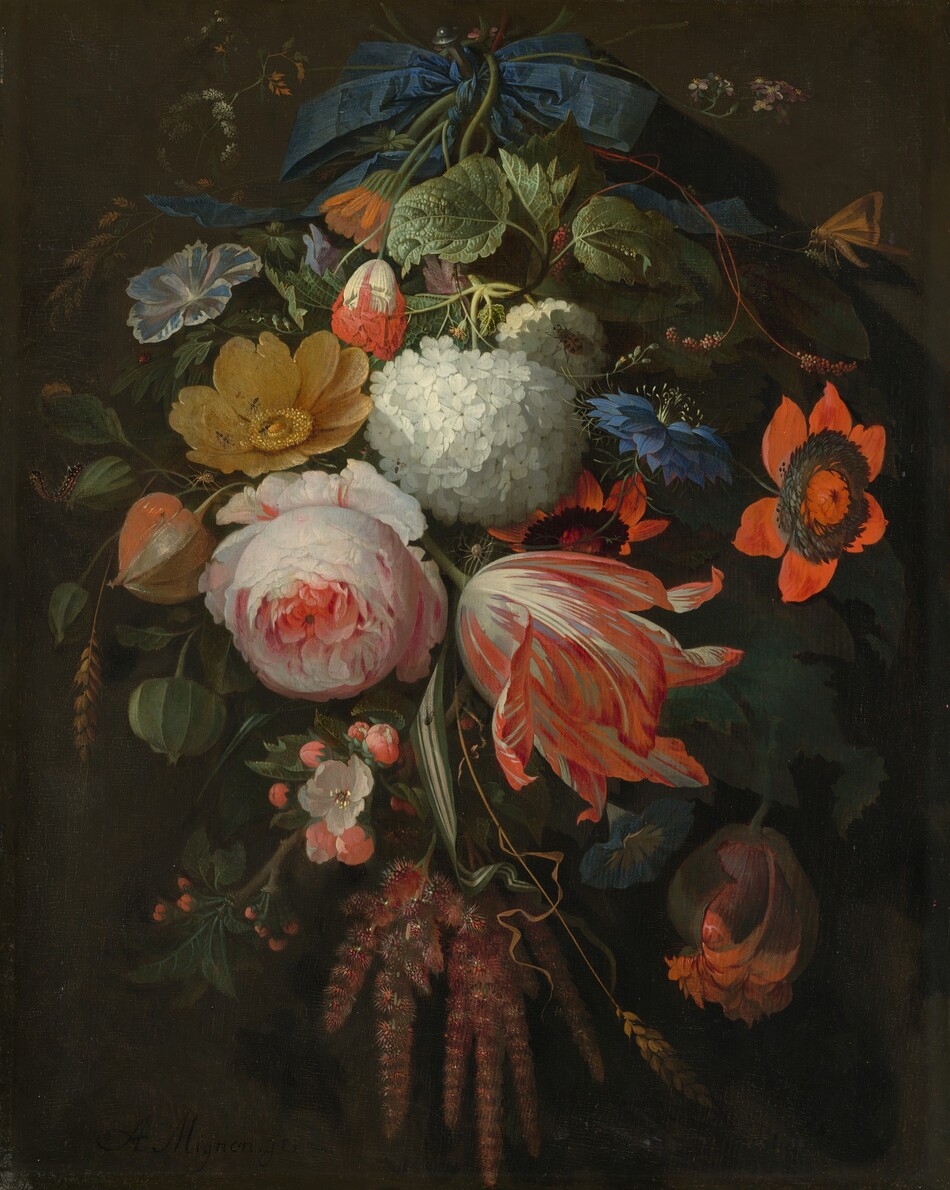
A bouquet of flowers against a dark brown background hangs from a sapphire-blue bow to fill this vertical still life painting. The three largest blooms make a pyramid at the center. A pale pink, flat-leaved carnation is to the lower right of this trio. A red and white striped tulip with flame-shaped petals is next to it, to our right, and a white viburnum bloom, which is made of dozens of smaller clusters, is above. A tan-colored spider builds a web at the center of these three blossoms. Using the face of a clock to work around this trio, we find a spotted bug on a smaller viburnum and some frosty green leaves at noon. A muted orange moth rests on a stalk nearby. Down the right side, the layered vivid blue petals of a love-in-the-mist explode like a starburst. Two coral-red peonies, a mostly closed peony, a topaz-blue morning glory, and the fuzzy fingers of amaranth bring us to six o’clock. Up the left side are delicate pink crab apple blossoms, a spray of Chinese lanterns, a yellow rose with ants crawling across its splayed petals, a striped morning glory, and a few blue, orange, and red buds. A caterpillar rears up on a Chinese lantern bud and a ladybug sits on a leaf nearby. A few stalks of wheat are scattered throughout. Stems weave through the blue ribbon at the top, which is tied around a protruding nail. The artist signed the lower left corner, “AB Mignon f,” with the AB conjoined in a monogram.

A Hanging Bouquet of Flowers

Abraham Mignon

probably 1665/1670

Oil on panel  Accession ID  1992.51.5

Not on view
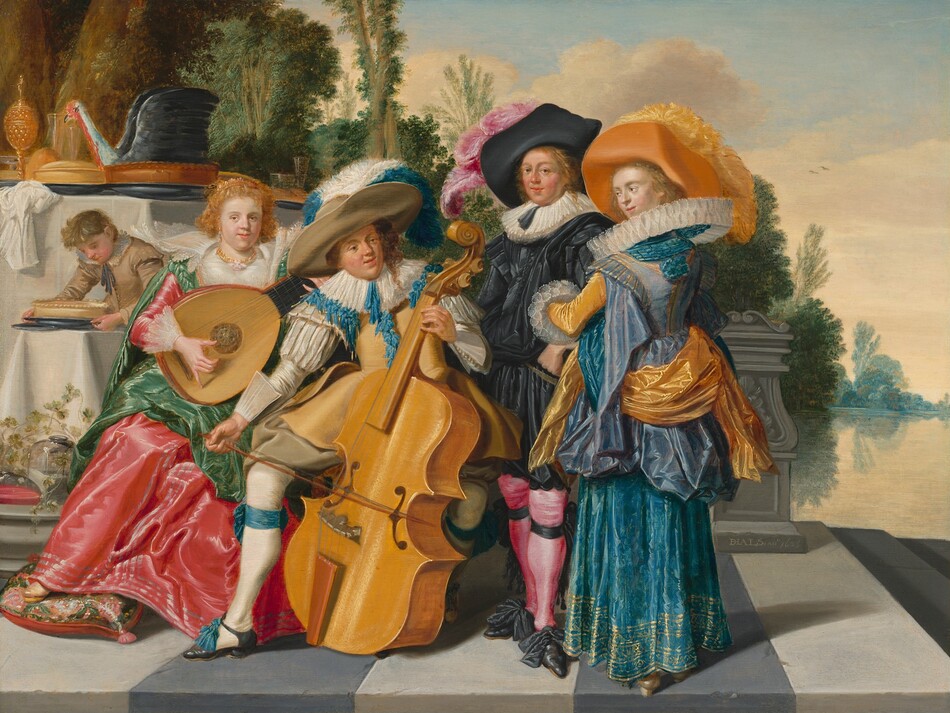
This painting shows four individuals gathered together. They all have light skin and are elaborately dressed. On the far left is a woman with golden curls, a gold necklace, and a crown-like headpiece playing a lute. She wears a vibrant red dress with a white bodice and lace on the sleeves and neckline. On top of it is a green shawl with braided straps. On the right is a man with curly hair wearing a large, tan hat adorned with a white-and-blue plume, a tan doublet with blue feathers or fabric down the middle, tan shorts, and white stockings tied with blue ribbons above blue shoes. He plays a large cello. To the right are two people standing with their arms interlaced. The one on the left is a man with a large black hat with a pink feather, wearing a black shirt with a wide white collar, black shorts, and pink stockings. The woman next to him has an orange hat with a yellow feather and wears a blue gown with a stiff white collar, yellow sleeves, and a yellow sash. The bottom of her dress is embellished with gold. The four people are standing outside on a gray-and-white striped floor. Behind them, on the left, are tables set with white cloths and a lavish feast, including a large golden goblet and the top half of a large bird set atop what looks like a pie crust. A boy dressed in tan garments bends down to pick up a plate from one of the tables. Behind the tables are tall trees with green leaves, and on right is a calm body of water. The sky is light blue and full of white clouds.

Merry Company on a Terrace

Dirck Hals

1625

Oil on panel  Accession ID  2020.11.1

Not on view
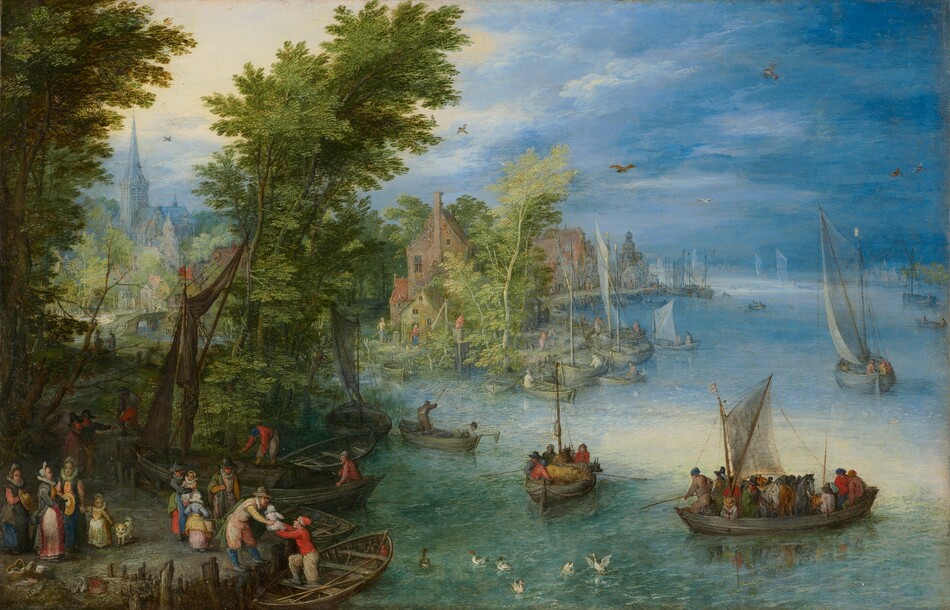
People gather under trees next to an expansive river dotted with boats in this horizontal landscape painting. The people are tiny in scale in the landscape, and they all have light skin. The softly rippling river takes up the right half of the composition. The water is bottle green closest to us, shifting to celestial blue in the distance. The water blends with the same color blue in the sky along the horizon, which comes halfway up the painting. Rowboats and sailboats line the shore along our left and float into the distance, some with sails tied up and others unfurled. In the lower right corner, a ferryboat filled with travelers, horses, and cattle approaches a landing on the lower left. At the landing, a boatman passes a baby to a man standing on the riverbank, while several ladies, a young girl, and a dog wait nearby. On the ground in front of this group is a basket, several packages, and dead fish. A second small group awaits passage just beyond the man receiving the baby. The women wear long dresses and hats or bonnets, and the men wear jackets, knee-length britches, stockings, and caps in shades of royal blue, petal pink, laurel green, ruby red, or white. A copse of trees with tall, slender canopies fills the left third of the composition. People walk along a path through the trees and work in and around boats along the riverbank. Farther back, a stone bridge crosses a stream, and beyond it, tan buildings cluster around a church spire seen through a break in the trees. Above the church, the sky is a pale cream color, and the light streams down to highlight the bridge, buildings, and the water. Birds sit in the trees and fly overhead, while waterfowl gather by the landing, near the lower left. The painting is signed and dated in the lower left: “BRVEGHEL 1607.”

River Landscape

Jan Brueghel the Elder

1607

Oil on copper  Accession ID  2000.4.1

Not on view
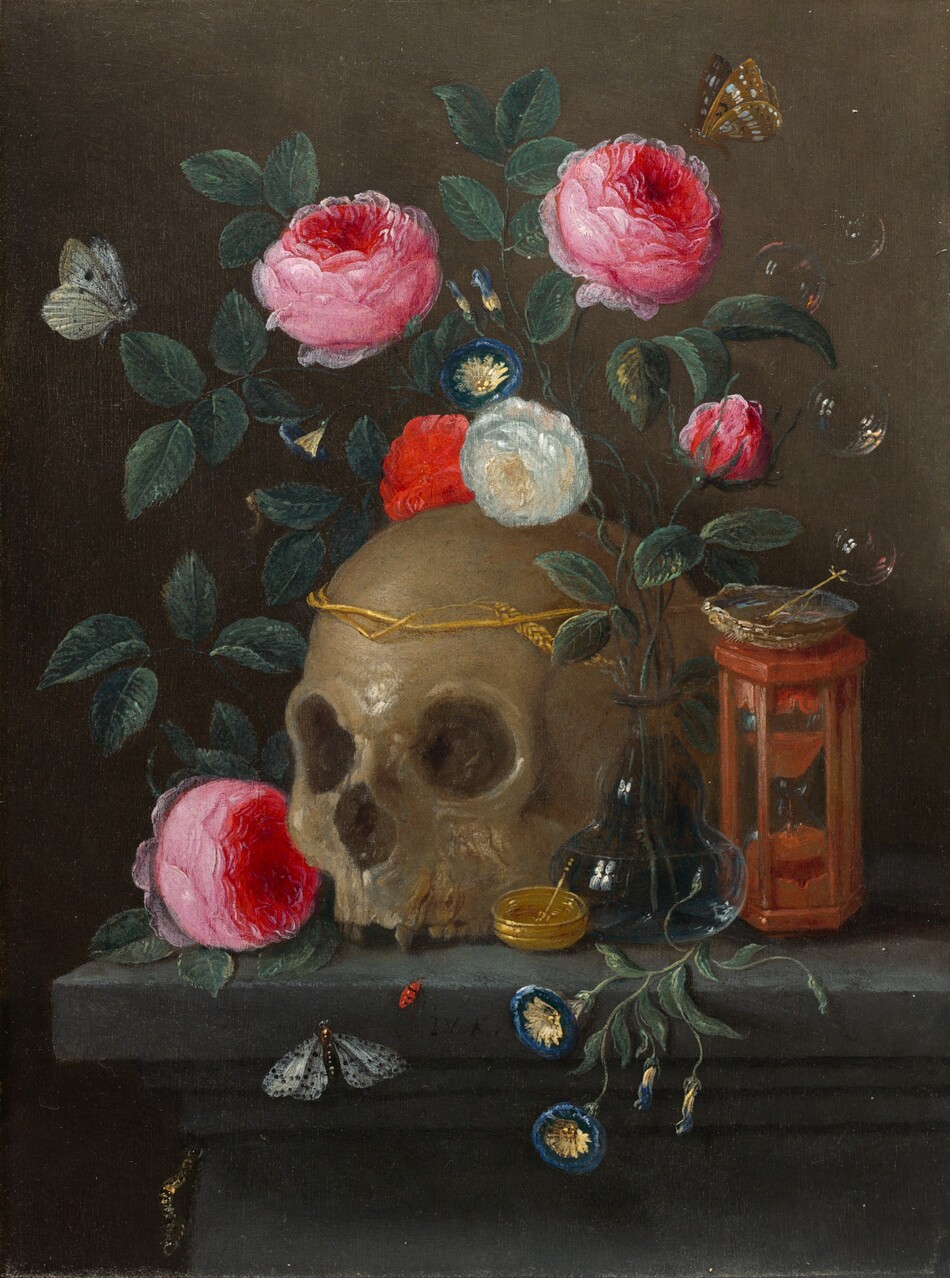
A skull, a glass vase of flowers, an hourglass, and two small dishes are arranged on a charcoal-gray ledge against a fawn-brown background in this vertical still life painting. Soap bubbles float around the objects to our right, and several insects alight on the flowers or ledge. At the center of the composition, the dark, parchment-colored skull is missing the lower jaw and front teeth, and the crown is wrapped with a single stalk of wheat. To our right of the skull and tucked in near the hollow of the cheek, a short, glass vase with a bulbous bottom, narrow neck, and slightly flaring lip holds four blush-pink flowers, perhaps roses, along with a white flower and a red one, perhaps carnations. A vine of royal-blue, trumpet-like flowers with pale yellow centers could be morning glories. Three of the pink roses are in full bloom and one, near the hourglass, is in bud form. The red and white carnations rest next to each other on or near the top of the skull. Deep green leaves fill the spaces between the loosely gathered flowers. Next to the vase, to our right, an hourglass has a cedar-red wooden frame, and about half the sand has dropped into the bottom bulb. A shallow dish, perhaps a shell, sits atop the hourglass with a short straw or stick resting against the lip to our right. One glistening soap bubble perches on the far end of the straw. Another small bowl and stick, this set of burnished gold, sits between the vase and skull. One of the blooming roses rests next to the skull, on the front left corner of the ledge. Several delicate soap bubbles rise above the hourglass along the right side of the painting. A golden brown moth with white markings floats above the bubbles, about to land on one of the roses. On the opposite side, a white moth with one black spot on its wing rests on a leaf near another rose. A white moth with black speckled wings clings to the front of the ledge, and a black and dark caterpillar flecked with gold climbs up under it. The artist painted his initials, “JVK,” on the front of the ledge, near a small red beetle. Light falls across the still life from our left, and panes from a window outside our view are reflected in the bubbles and on the glass vase.

Vanitas Still Life

Jan van Kessel the Elder

c. 1665/1670

Oil on copper  Accession ID  1995.74.2

Not on view
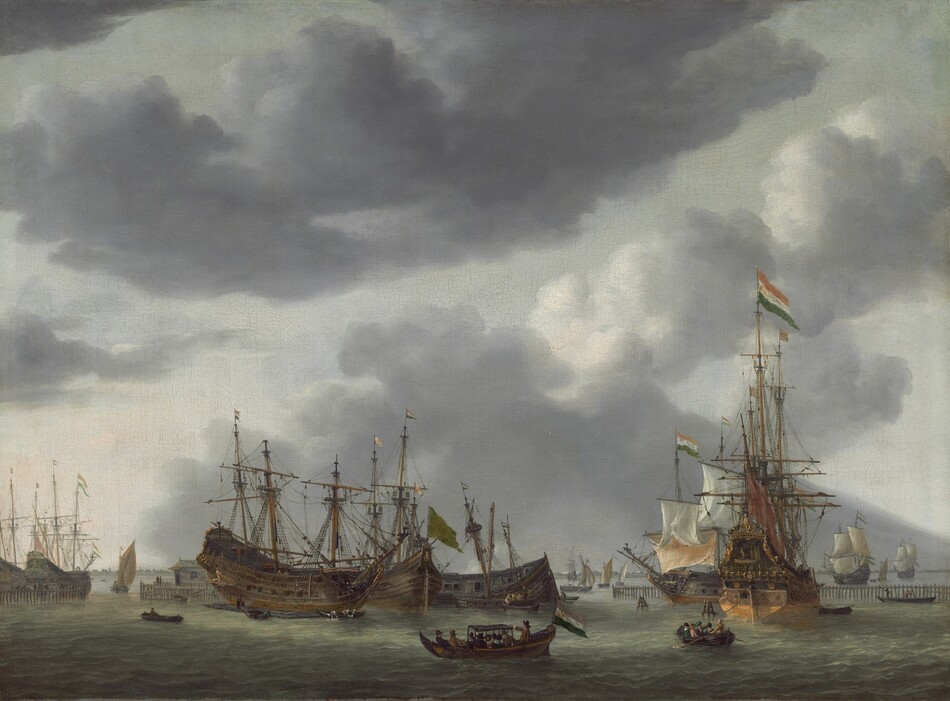
A sage-green harbor teems with more than a dozen sailing ships and rowboats under a pale gray sky in this horizontal painting. The horizon comes about one-fifth of the way up the composition, and dark gray and white clouds tower above. Light filters onto the scene through the clouds from our left to fall across the ships while casting shadows on the water nearest us. Painted in tones of slate gray and warm brown, most of the ships closest to us have their sails furled so the masts and horizontal yard arms bristle against the sky. The larger ships have cannons poking out of square portholes. On our right, a war ship floats with its ornately carved and gilded stern facing us. A flag flying from the tallest of the three masts has red, white, and green stripes. The artist painted his name on that flag, “R. Zeeman.” The ship is tied to a buoy with a length of rope, and an empty rowboat is tethered to the right side of the ship. A similar ship but with the sails hanging loosely is tied to a buoy just beyond this one. A row of pickets, like a fence, extends into the water behind these two ships. To our left, a rowboat full of men has pulled up alongside a partially sunken ship, its masts tilting toward us. A few people stand on two more ships nearby. A black temporary dock floats next to the leftmost ship here. A person mixes something that smokes on the platform, and another person stands on a board lifted halfway up the ship’s side, presumably working on a repair. Two women in another rowboat next to the floating dock lean over the side, washing clothes. Another fence encloses the harbor to our left, and a hut in the middle of the harbor is surrounded by a similar structure. Two rowboats closer to us are filled with men wearing tall hats and black or brown coats, and women wearing black bonnets and white shawls. More sailing ships and rowboats move back or around beyond the harbor, out to sea. Visible cracks cover the surface of the painting.

Amsterdam Harbor Scene

Reinier Nooms, called Zeeman

c. 1654/1655

Oil on canvas  Accession ID  2011.3.1

On View: West Building Main Floor, Gallery M49
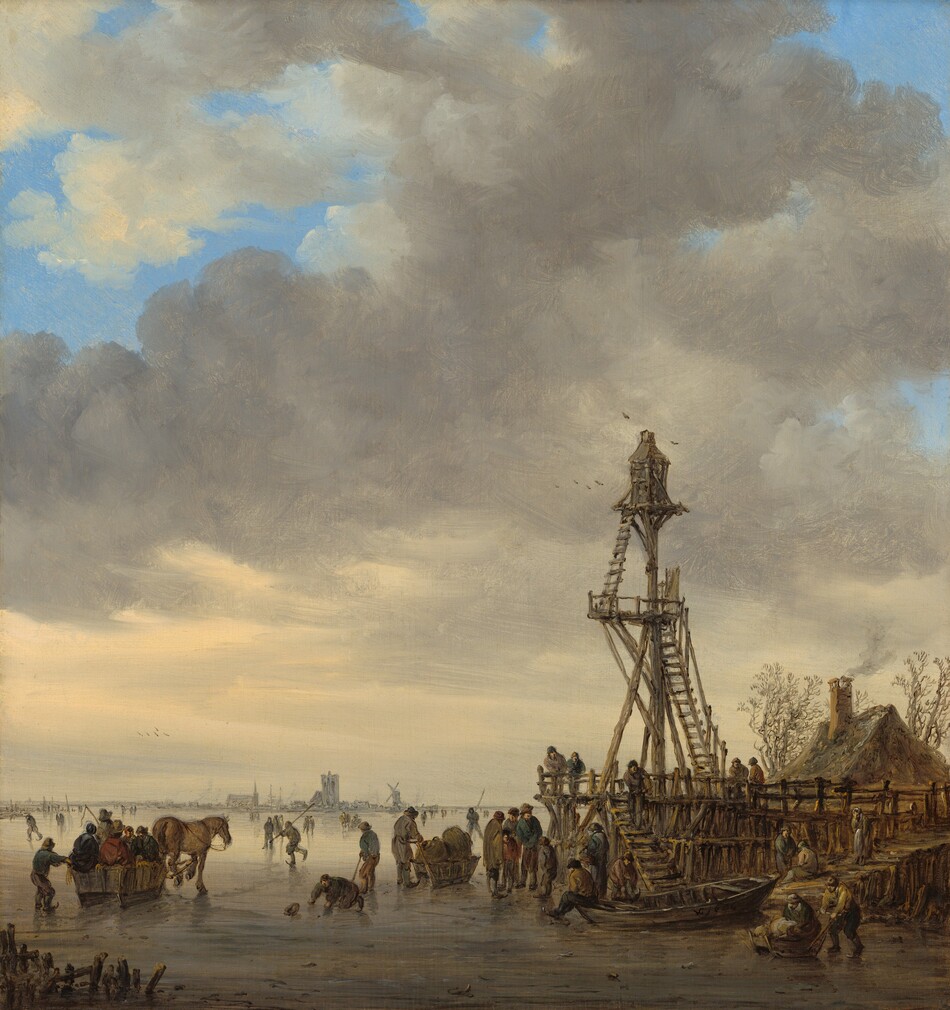
A band of gray ice spans the bottom quarter of this vertical landscape painting, where dozens of people stand, skate, ride in sledges, or cluster near a slender wooden tower, all beneath a vivid blue sky screened with towering gray clouds. We look slightly down onto the scene from a distance. The cloud bank is horizontally streaked with pale yellow light along the bottom, but swells into gray puffs that break apart in several places toward the top to reveal patches of blue sky. The people below wear heavy coats, hats, and trousers, mostly in muted slate blue, gray, and brown. Many have their backs to us. Closest to us and near the lower left corner of the painting, a rectangular wooden sledge on rail-like runners holds five or six passengers, and is pulled by a brown horse toward the center distance. Nearby, a man on his hands and knees scrambles for his fallen hat. A man holds a pole like a hockey stick behind him, looking into the distance where others stand or run with more sticks. Near the bottom center of the painting, a man pushes a sledge laden with two brown bundles. The largest group of people and children gather on and around a rickety wooden pier from which the tower rises, to our right of center. A lantern-like structure sits atop a narrow platform on a tall pole, at the top of the tower. One ladder leads up to a landing about two-thirds of the way up the pole, and another leads to the top. A house with a pitched roof and smoking chimney sits on the far side of the pier, between two bare trees with curling, twisting branches. Birds fly above the tower. The ice is dark gray closest to us, and it becomes paler as it recedes into the distance. People dot the ice singly and in small groups as far as the eye can see. Far away, the silhouettes of a church with a spire, the masts of two ships, a wide tower, and a windmill line the horizon. The artist signed the work with a monogram and a date as if painted on the boat in the lower right corner: “VG 1646.”

Ice Scene near a Wooden Observation Tower

Jan van Goyen

1646

Oil on panel  Accession ID  2014.35.1

On View: West Building Main Floor, Gallery M50
A stone bridge with turrets at each end spans a placid river in this horizontal landscape painting. The bridge takes up the right half of the composition, moving from the right edge of the canvas back and to our left. The horizon line comes about a quarter of the way up the painting so much of the tan-colored bridge is nearly silhouetted against the sky. The sun, low in the sky to our right, angles sharply through the four large stone arches of the bridge. The sky glows with golden light along the right side of the composition, and deepens to pale and then aquamarine blue to our left. Vegetation hangs down from the tops of tower-like structures rising at each end of the bridge. Along the shadowed riverbank, close to us, two men on horseback talk and gesture toward the bridge. Another standing to our right seems to point to a man in a boat near the shore, who stands with his arms spread. A dog looks at the man in the boat, and another man herds three cows through the water, near the lower left corner of the painting. All of the men except the cowherd wear or hold wide-brimmed hats and wear jackets and stockings in black, yellow, navy blue, or crimson red. The riverbank opposite us us sheer and rocky, but details are difficult to make out in the shadows there. Beyond the riverbank, sunlight brushes the tops of rolling green hills. Two buildings with low towers sit among the hills in the distance. Mountains beyond become more blue in the hazy light along the horizon.

The Tiber River with the Ponte Molle at Sunset

Jan Asselijn

c. 1650

Oil on canvas  Accession ID  2012.129.1

On View: West Building Main Floor, Gallery M50
Shown from the chest up, a bearded man with pale skin and flushed cheeks wears a chestnut-brown jacket with a thick, lace-trimmed, pleated, cream-white collar in this octagonal portrait painting. The man’s body is angled to our right, and he cuts his light brown eyes back to look at us. Wrinkles line the corners of his eyes under dark brows, and he has a straight, narrow nose and high cheekbones. His red lips are closed and almost lost in the shadow of his full, trimmed beard. His dark brown hair is combed back from a receding hairline and falls around his ears. The dense, ruffled collar comes up to the earlobe we can see. His brown vest has a row of gold buttons down the front, and there are more gold buttons down the sleeve. He is lit from our left so the far side of his face is in shadow. The dark brown background lightens slightly around his face.

Loading Results