Dutch and Flemish Paintings

Filter Results

166 artworks on view.

Results

Shown from the knees up, a pale-skinned woman with gray hair and wearing a scarlet-red, velvet dress looks at us in this vertical portrait painting. The woman’s shoulders and face are angled slightly to our left so she gazes out of the corners of her dark blue eyes under sloping brows. Her pink lips are closed, and jowls soften her chin line. She wears a black cap over her gray hair, and gold, jeweled earrings hang from her ears. A double strand of pearls is around her neck. The bodice of her dress is cut straight across the shoulders, and white cloth covering her decolletage is tucked into the neckline. A muted gold cloth wraps around the woman’s left shoulder, to our right, across her back, and down over her other elbow. The red dress’s sleeves split over the puffy white sleeves of her undergarment. The woman rests her right elbow, to our left, on a ledge, and her other hand hangs by her side with those fingers nestled into the fabric of her skirt. An iridescent, gold-colored cloth drapes over the ledge to our left and behind the woman. A stone column is along the left edge of the painting and a sunset sky over a grassy, tree-filled landscape is visible to the right. The artist signed and dated the lower right corner, “NMaes 1676.”

Portrait of a Lady

Nicolaes Maes

1676

Oil on canvas  Accession ID  2001.138.1

On View: West Building Main Floor, Gallery M43
We stand in the central nave of a deeply shadowed church looking down toward the altar in this horizontal painting. Sunlight streams in from our right to bathe white pillars lining the nave with light, and it illuminates a wooden stall, like a private seating box, situated in front of the columns to our left. The forehead, eyes, and one hand of a young child peeks over the top edge of one of the panels, perhaps peering at us. Touches of pale red and yellow suggest stained glass over the dimly lit altar at the far end of the church, across from us. Gold chandeliers with curling, scrolling arms hang along the length of the nave, well below the dark, vaulted ceiling. About a dozen of men wearing black enter the church in a line from the left, near the altar. Closer to us, to our right, two men lean together in conversation with a dog nearby. One man gestures to a rectangular stone slab that has been lifted from the church floor to reveal dirt underneath, to our left. Two shovels, a broom, and a skull lay nearby. In front of the men, in the lower right corner of the canvas, a woman sits and nurses a swaddled infant. A young boy and another dog near the pair looks toward or at us. Two dogs stand in the shadows around the column closest to us on the left, and one raises its leg to relieve itself on the base.

The Interior of the Oude Kerk, Amsterdam

Emanuel de Witte

c. 1660

Oil on canvas  Accession ID  2004.127.1

On View: West Building Main Floor, Gallery M47
A jumble of pewter plates and a pitcher, glass goblets, a gold chalice, a brass candlestick, and other vessels along with lemons, olives, and the remains of a mince pie are arranged on a cream-white tablecloth bunched on a dark green tabletop in this square still life painting. The scene is painted almost entirely in shades of cool grays, gold, brown, and white against a deep beige background. The objects span width of the canvas across its center. At the left edge of the painting, a vibrant yellow lemon has been cut so its rind curls in a spiral that hangs over the front edge of the table. Behind the lemon, a scissor-like candle snuffer is propped against the wide ledge of the tall brass candlestick, its white candle nearly burned down. A few glistening olives sit in a small pewter plate, and one olive sits on the tabletop near the lemon and candlestick. A glass goblet with a wide stem with textured knubs rests upended on an elaborately chased, gold, footed vessel that has been tipped over so its wide shallow bowl faces away from us. The tall pewter pitcher behind this is dented on its rounded body. The lidded gold chalice next to the jug is the tallest object in the painting. Next to the chalice, along the right half of the painting, is a glass oil cruet with a long, curving spout, a tall, cylindrical vessel holding a small pile of salt, and a straight-sided, low glass holding beer. In front of these objects, an untouched bread roll and knife sit on a pewter plate at the center of the composition. The remains of the mince pie with its pastry crust sit on a large pewter plate to our right. In front of it is a smaller plate holding a broken goblet and a piece of black and white paper rolled into a cone. A few empty oyster shells sit on the table to the left and right, near the lemons and mince pie. The artist signed and dated the painting along the edge of the white cloth near the lower right corner: “HEDA 1635.”

Banquet Piece with Mince Pie

Willem Claesz Heda

1635

Oil on canvas  Accession ID  1991.87.1

On View: West Building Main Floor, Gallery M50
The limp, dead bodies of a swan, rabbit, and three birds along with a live bird and a small dog are arranged on and near a low stone step in the bottom left corner of this horizontal painting. To our left and close to us, the white swan lies on its back on the step with its wings partly extended. Its long neck drapes toward us over the rabbit’s body, the bird’s head turned to our left. The rabbit has tawny-brown fur and lies stretched out on its side, its belly facing away from us. Tucked in the lower left corner of the painting, a fowl has a round body with cream-white and chestnut-brown feathers. The beaks of two more dead birds peek out from the shadows beyond the rabbit’s body. Behind the dead animals and taking up the left third of the painting, the square base of a fawn-brown stone column nearly reaches the top edge of the canvas. The front face is carved with a relief showing a woman and man huddled together as they look down in front of them, seemingly toward the swan. A yellow flower with narrow, tapered petals hangs over the upper left corner of the base and lavender-purple flowers, perhaps roses, peek around the base from our right. To our right of the dead animals, a bird with black, smoke-gray, and white feathers stands facing away from us with its wings flared back. Its emerald-green and gold head gleams in the stark light illuminating the scene from the lower left. It turns its head toward a small dog in the lower right corner. The dog has white and pale, honey-brown fur, a round face, blunt nose, and sable-brown floppy ears. The dog’s back half is cut off by the edge of the painting, and it seems to lean back as it looks toward the bird. A grapevine with broad, curling leaves winds into the painting behind and above the dog, ending with scrolling tendrils at the center of the composition. The leaves are fern green, some fading to a pale sage green or tan, and edged in brown. One leaf over the dog’s head is crimson red and tan, and a glistening cluster of green grapes lies on the ground near the dog’s front paws, to our left. Beyond the live bird and dog, a deep landscape opens up with statues lining a stepped walkway that leads to a rectangular reflecting pool. Several black and white birds the size of ducks stand in the shadowed background near the pool and more birds fly overhead. Backlit by the amber-gold sunset, tall trees with thin black trunks and caramel-brown leaves line the path leading to a tall narrow structure at the water’s edge. The golden sunset fades to a pale blue sky with drifting clouds over low mountains in the deep distance.

Still Life with Goose and Game before a Country Estate

Jan Weenix

c. 1685

Oil on canvas  Accession ID  2004.39.1

On View: West Building Main Floor, Gallery M50
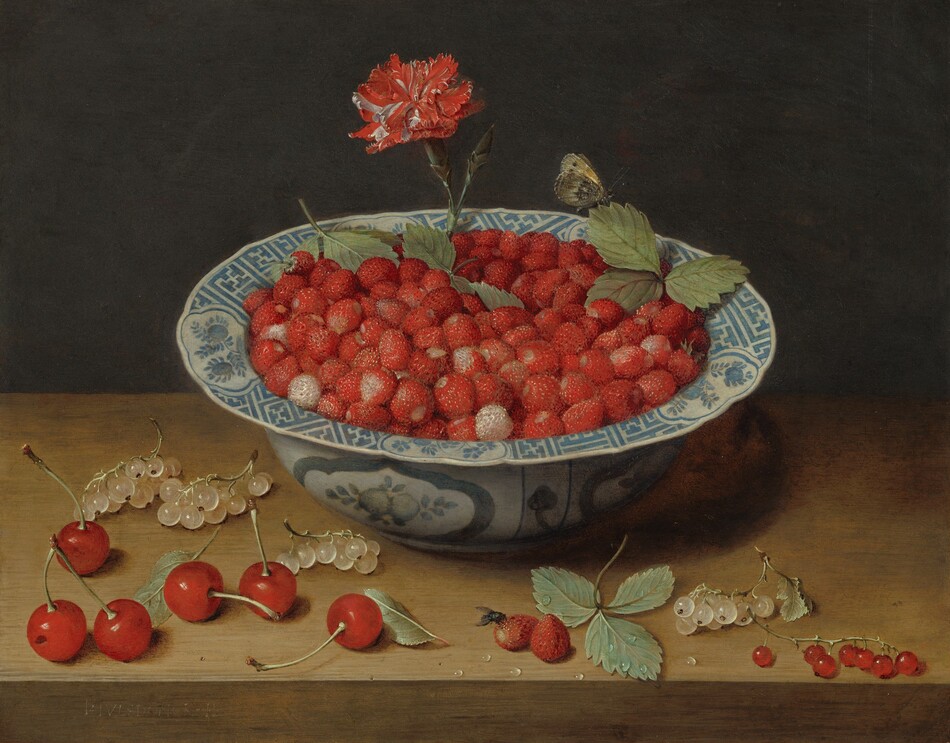
A blue and white bowl with a flaring rim is filled with small red strawberries, and the currants and cherries scattered around it are arranged along a wooden ledge or table in this horizontal still life painting. A single, ruby-red and white carnation with a short stem has been stuck down into the bowl at the back center. A few green strawberry leaves lie among the berries near the flower. A butterfly with honey-yellow and black wings perches on one leaf to our right. The top edge of the bowl’s rim is painted with geometric designs in muted azure blue between roughly oval-shaped medallions painted with stylized flowers. The base of the bowl is painted with fruit within a rounded medallion. To our left of the bowl, six vibrant red cherries and three stems of pearl-white currants sit on the table. To our right is another sprig of white currants and one of gleaming, scarlet-red currants. Between them is a trio of strawberry leaves and a pair of strawberries. A fly has landed on one of those berries, near the bottom center of the composition. Several water droplets glisten on the leaves and tabletop. The background is dark, earthen brown.

Wild Strawberries and a Carnation in a Wan-Li Bowl

Jacob van Hulsdonck

c. 1620

Oil on copper  Accession ID  2013.1.1

On View: West Building Main Floor, Gallery M50
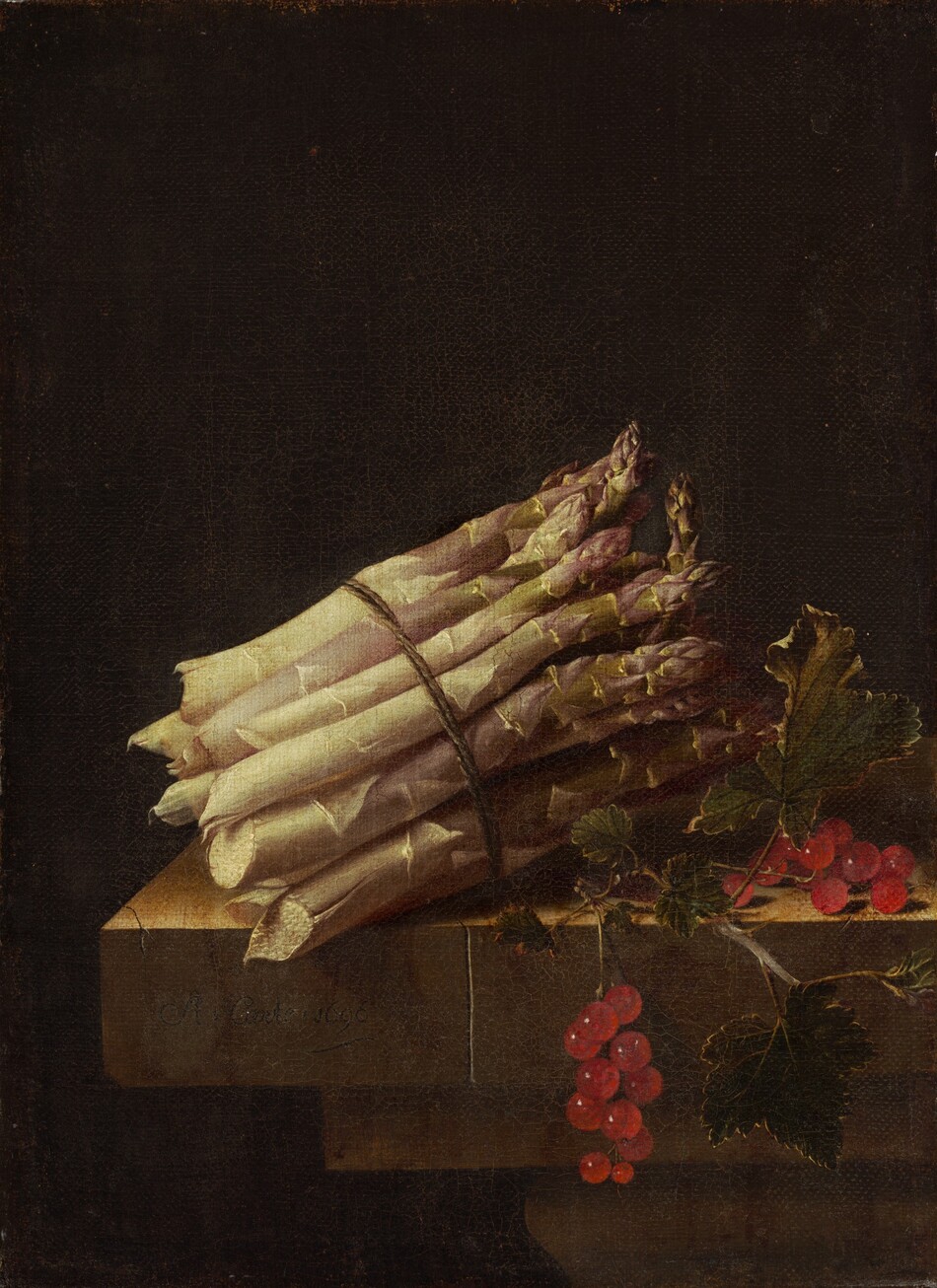
A bundle of pale green, thick asparagus stalks bound by twine and a bunch of glistening ruby-red currants sit on the edge of a stone table or ledge against a deeply shadowed background in this vertical still life painting. The asparagus is situated with the jagged, broken edges facing our left and the pointed tips angled away from us to our right. The base of the stalks are nearly cream-white, and the tips are faint green and muted purple. To our right, one the two stems of the red currant berries and leaves dangles off the front edge of the table. Light spills onto the scene from our upper left giving the currants a glassy sheen. The stone ledge or table is cracked in a couple of places. The artist signed this work as if he had inscribed his name and the date on the front surface of the table: “A. Coorte. 1696.”

Still Life with Asparagus and Red Currants

Adriaen Coorte

1696

Oil on canvas  Accession ID  2002.122.1

Not on view
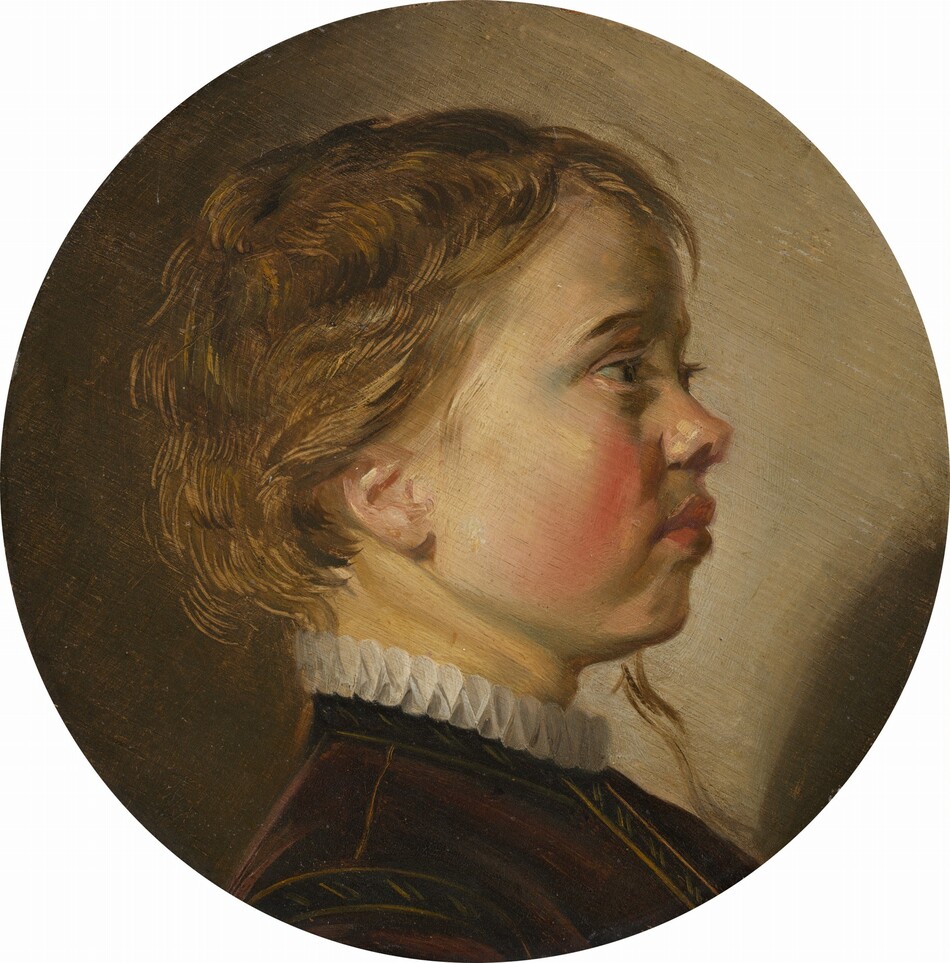
This round portrait painting shows the head, face, and the top of the shoulders of a young, blond boy with pale, peachy skin and flushed cheeks, facing our right in profile against a tan background. Light comes from behind us and to our left, so the boy’s cheek, jawline, and ear are brightly lit as he looks straight ahead, to our left. He has long, dark eyelashes, a turned-up nose, and his full, coral-pink lips are closed. The cheek we see is deeply flushed along the curve, near the nose and mouth. His short, light brown hair is highlighted with gold strands where it catches the light. A long tendril falls down past his chin on the far side of his face. He wears a fitted jacket, perhaps of brown velvet, stitched along the seams in a lighter golden color. The narrow, white ruff encircling his neck above the jacket is pleated to create a pattern of figure-eights. The background is lighter to our right and deepens to a brownish olive green to our left. The portrait is somewhat loosely painted with visible brushstrokes.

Young Boy in Profile

Judith Leyster

c. 1630

Oil on panel  Accession ID  2009.113.1

Not on view
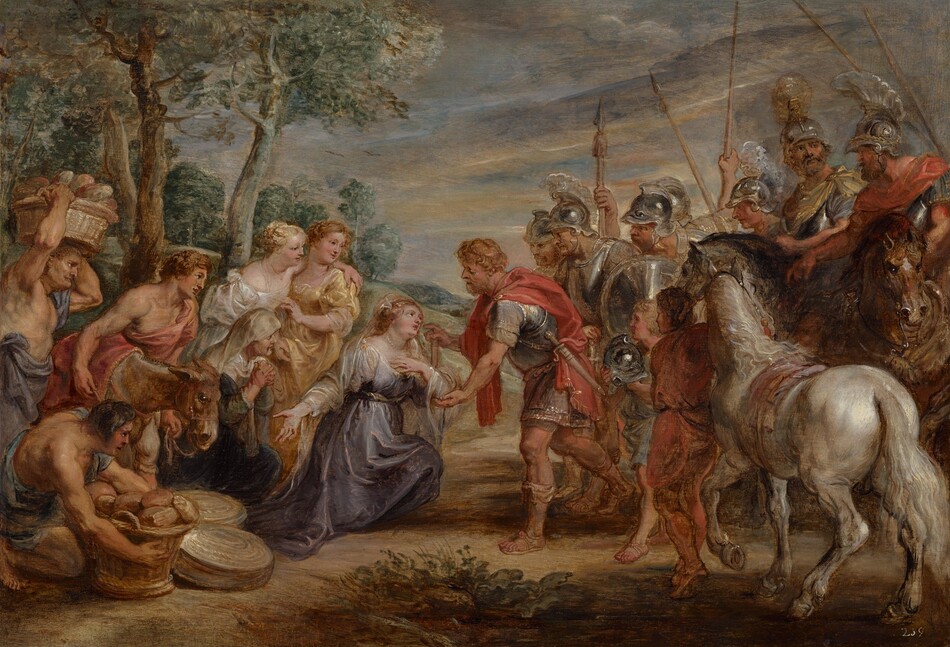
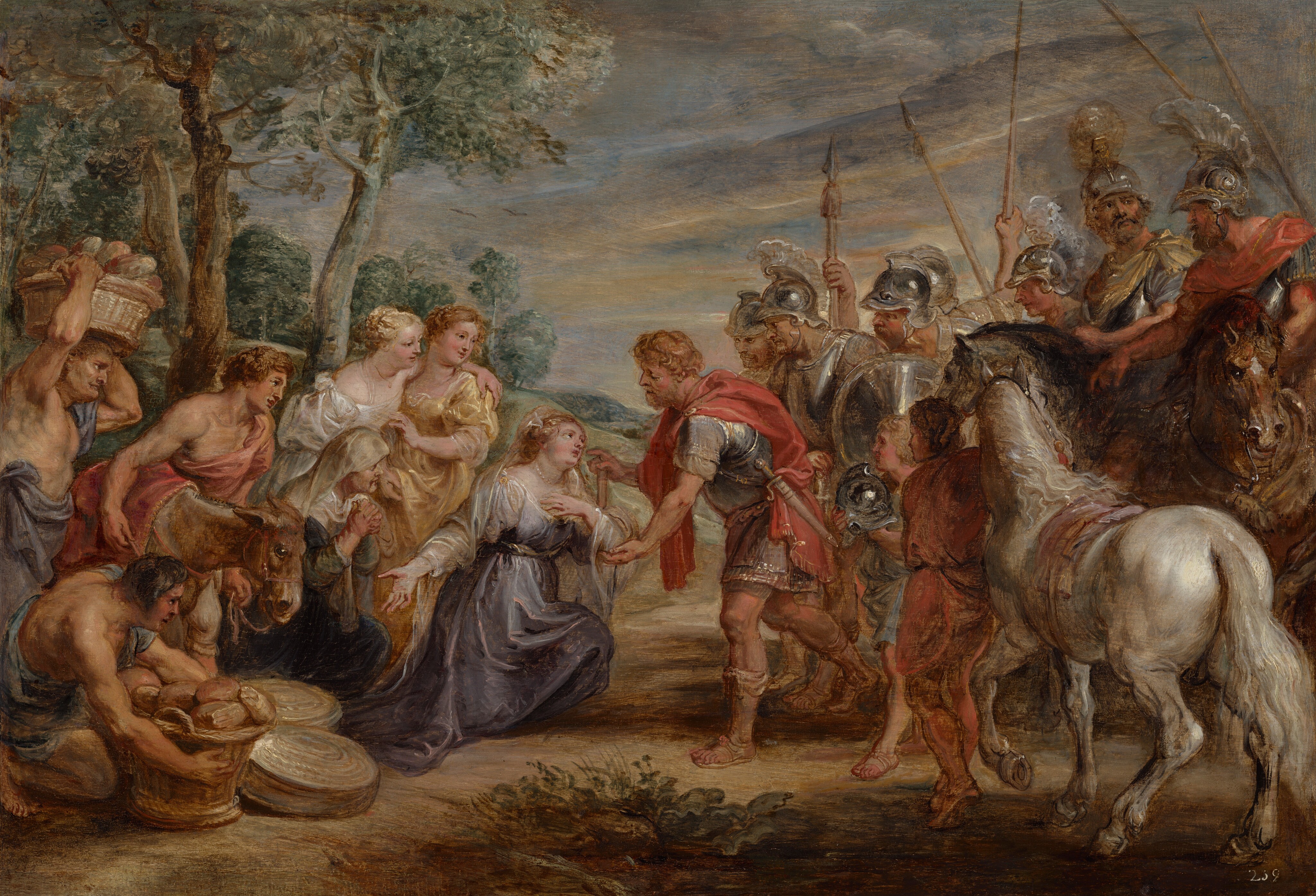
A man and woman greet each other at the center of a group of about a dozen people set within a landscape in this horizontal painting. All the people have pale, peachy skin. In the middle of the crowd, a woman, Abigail, kneels to our left while a man to our right, David, reaches out to her. Abigail’s blond hair is tied back under a white veil that drapes over her shoulders, and she wears a slate-blue dress and a string of pearls around her neck. She holds her left hand, on our right, to her chest and her other hand gestures down to a basket of bread held by a man in the lower left corner of the painting. David stands and bends toward Abigail as he cups her bent elbow with his left hand. His other hand rests on a walking stick near her head, and his index finger is extended as if to brush her cheek. He has short, curly blond hair and beard, and he wears a thigh-length tunic under a breastplate. Crimson-red fabric drapes around his shoulders and over his armor, and a dagger or short sword hangs at his hip. Three women, three men, and a donkey gather to our left, behind Abigail. Two of the men hold large baskets of bread, and they all look toward Abigail and David. Six armored men, two younger people, and two horses make up the group to the right. Trees line a hill behind the people to our left and dark gray and amber-colored clouds fill the sky.

The Meeting of David and Abigail

Sir Peter Paul Rubens

c. 1630

Oil on panel  Accession ID  1997.57.8

On View: West Building Main Floor, Gallery M44
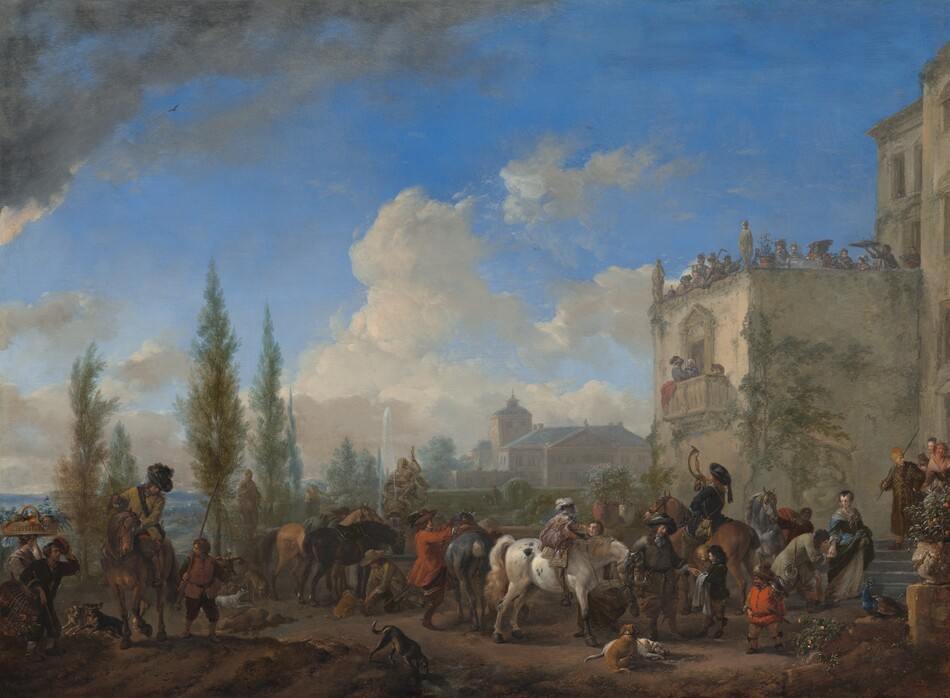
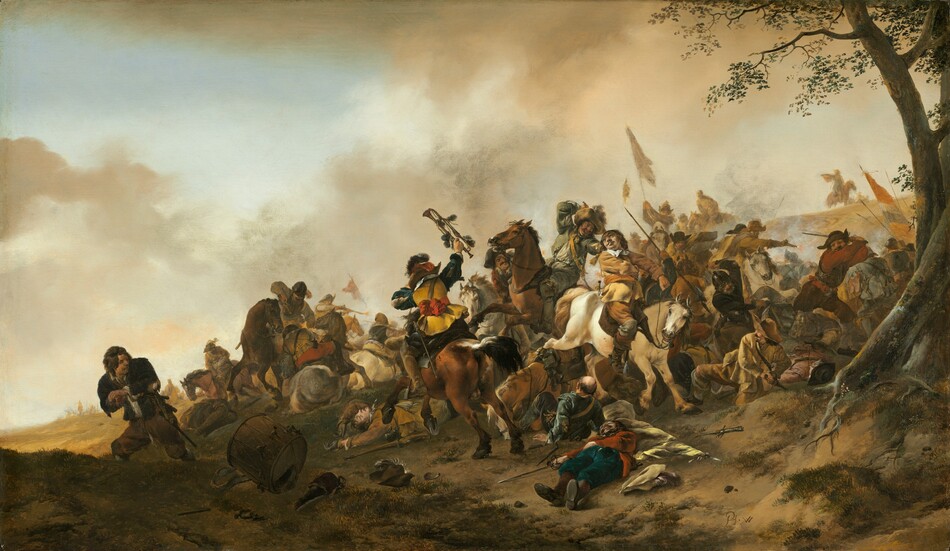
Sixteen men, women, and children sit on or walk among seven horses against a landscape with tall, narrow trees, buildings, and distant mountains under a vivid blue sky in this horizontal painting. In the lower left corner, a man and woman approach the group, which are arrayed across a dirt ground. The man carries a large basket with chickens over one arm and doffs his hat with his other hand. Just behind him, the woman carries a flat-bottomed, wide basket of fruit and vegetables balanced on her head. Some of the men in the main group wear wide-brimmed, feathered hats, long coats in shades of peanut brown, black, and scarlet red, and knee-length pants over stockings. The two other women wear gold-trimmed dresses in shimmering orchid pink or sapphire blue. Several of the men and women ride or prepare to ride horses, which range in shades of brown, gray, white, and black. Nine dogs with brown, white, or black fur frolic, stand, or lie among the horses. One boy pours from a jug into a stemmed glass with a flaring bowl, held by a man holding a curling hunting horn. Just beyond this pair, another man, wearing black and sitting on a horse, blows into a curving horn held up in one hand, while his other hand is planted on his hip. All the people have pale pink skin except for two men. One, to our right, is possibly of short stature and he has an olive complexion. He wears a crimson-red jacket and holds a falcon on one gloved hand. The second man has brown skin and holds the reins of a gray horse near the right edge of the composition. Near the lower right corner of the painting, a potted miniature orange tree sits on a ledge next to a peacock who perches nearby. A second peacock’s head peers out from behind the ledge. A fountain just behind the group at the center has water pouring from a stylized fish’s mouth. A sculpted woman riding the fish holds up a long object while water spouts in thin streams from her breasts. Another statue stands between two tall, spear-like trees to our left. To our right, about two dozen people look onto the scene below from a rooftop terrace on a section of the building rising up along the right edge of the painting. There, a band of musicians plays while guests dine at a small table with a peacock-shaped pie, as two more people bring out trays of food. On the front face of that structure, a man and woman talk on a balcony, as a monkey eating an orange perches on the banister. A grassy lawn or garden stretches back to a large manor house, which is hazy in the distance to our right. The horizon comes about a quarter of the way up this composition, and the sky above has bright white and flint-gray clouds against a brilliant blue sky. The overlapping letters “DG” are inscribed on the rump of a horse to our left, near the fountain. Painted in red in the lower right corner, the letters “PHILS” are entwined in a monogram next to a “W.”

The Departure for the Hunt

Philips Wouwerman

c. 1665/1668

Oil on panel  Accession ID  2019.2.1

On View: West Building Main Floor, Gallery M47
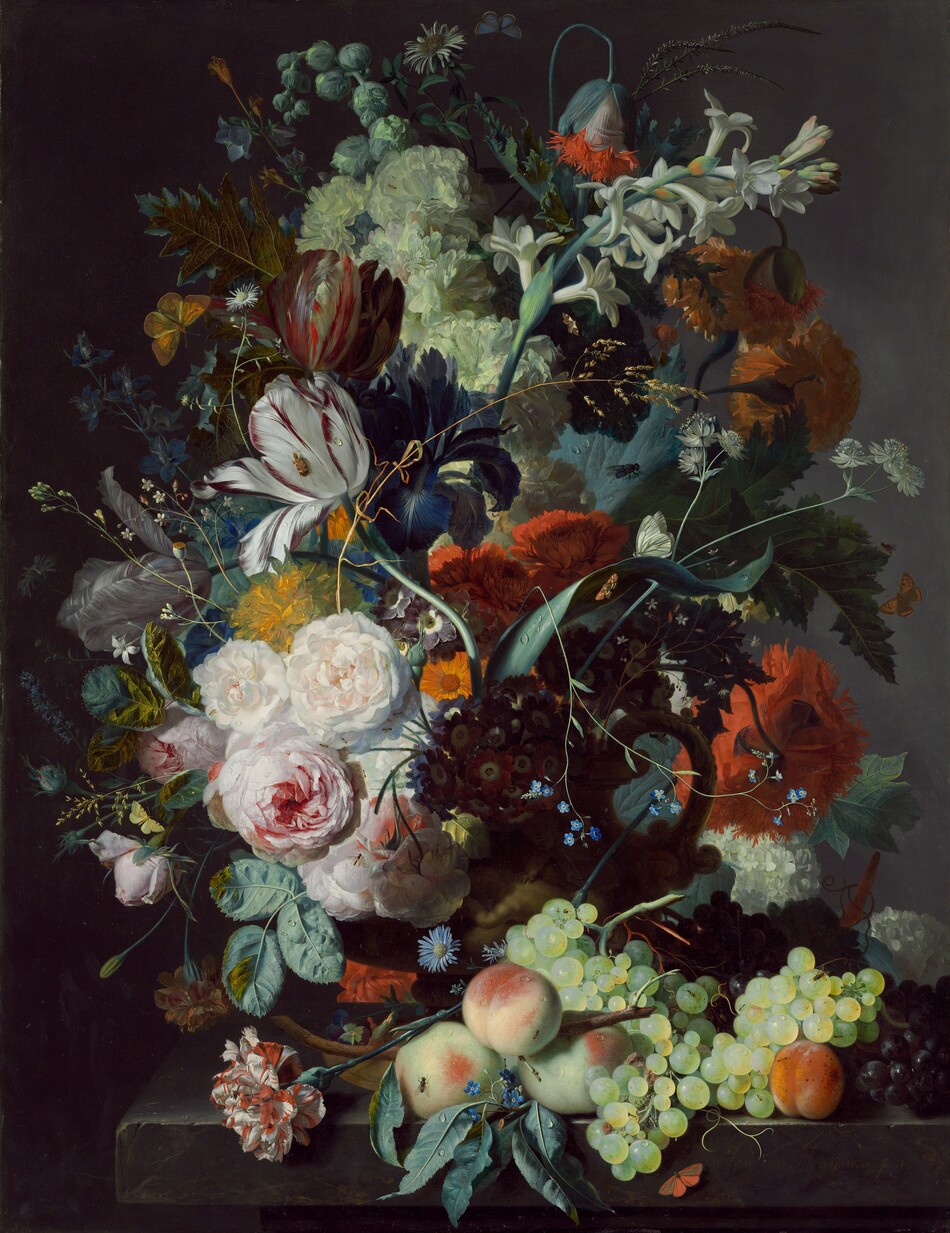
Against a dark background, an abundant, colorful arrangement of flowers and fruit fills this vertical still life painting. Set on a stone ledge, a barely visible terracotta vase contains the overflowing bouquet of flowers and greenery. Carnations, tulips, peonies, roses, tuberoses, hops, and other flowers create swirling, circular patterns that sweep across the panel. A delicate stalk of wheat and a few long, thin stems create bright, sinuous lines that span the composition. Peaches and green and purple grapes are piled on the ledge to our right, and an orange butterfly perches below. Barely noticeable, small, pale blue, yellow, white, and orange butterflies hover around the arrangement, while small insects and flies crawl on a few of the flowers and pieces of fruit. Drops of water reflect the light on some of the greenery, fruit, and tulip petals. The flowers are strongly lit across the face of the arrangement, which creates deep shadows to the sides and back.

Still Life with Flowers and Fruit

Jan van Huysum

c. 1715

Oil on panel  Accession ID  1996.80.1

On View: West Building Main Floor, Gallery M50
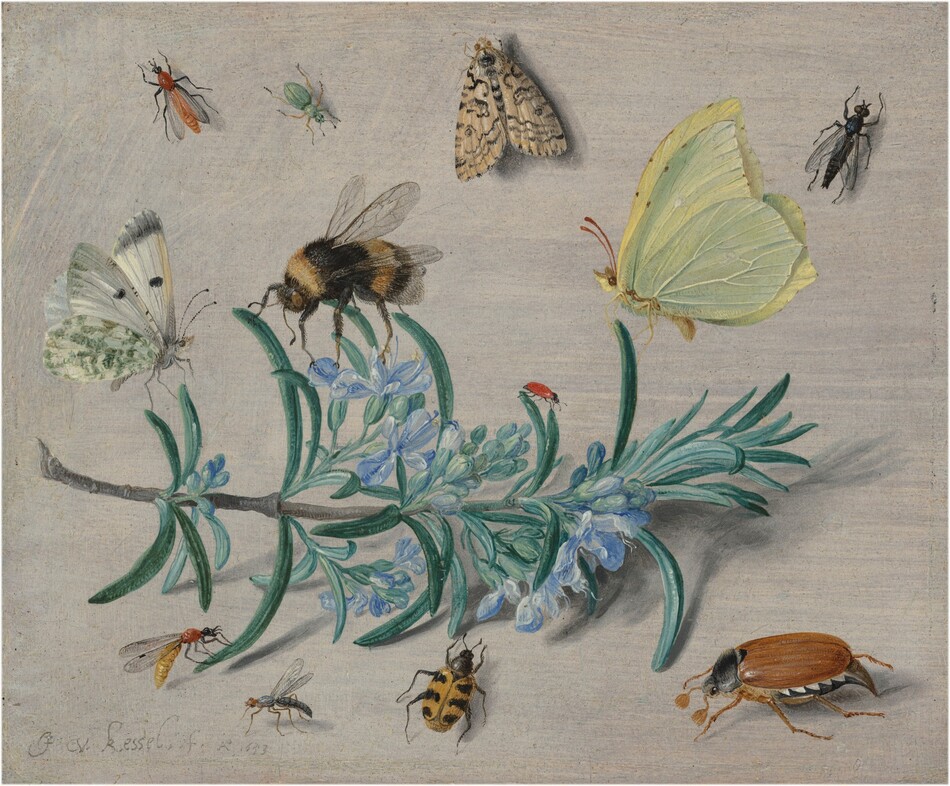
A sprig of flowering rosemary lying against an ivory-white background and the twelve insects that surround it fills this horizontal painting. Stretching nearly the length of the composition with the cut end to our left, the rosemary has blunted, needle-like, gently curling teal-green leaves and small periwinkle-blue flowers along the ash-brown stem. Several insects perch on the sprig while others are seen as if looking from overhead, resting on the white background. The three largest insects perch along the top of the sprig, with an ivory-white butterfly with moss-green and black markings to the left, a black and golden, fuzzy bumblebee near the center, and a lemon-yellow butterfly with red antennae to our right. A tiny red insect, perhaps a ladybug without spots, sits on a leaf between the bee and yellow butterfly, and a small wasp-like insect rests on a leaf in at the lower left. Another mosquito-like insect alights on the surface nearby, next to a beetle with a honey-orange body with black, almost tiger-like stripes. A large cockroach sitting near the lower right corner has six spindly legs, a mahogany-colored abdomen, a black thorax, and tiny, black head. Spaced somewhat evenly across the top of the panel are a brick-red, winged insect to the left, a mint-green, beetle-like bug near a moth patterned with bone white and black, and a black, fly-like insect to our right. Lit from the upper left, the rosemary and insects cast shadows on the surface. The artist signed and dated the work with gray in the lower left corner: “J v. kessel . . f. Ao 1653.”

Insects and a Sprig of Rosemary

Jan van Kessel the Elder

1653

Oil on copper  Accession ID  2018.41.1

Not on view
A man with pale, peachy skin sits holding and tuning a lute next to a heavily laden table in this vertical portrait painting. The man’s body faces us, and he looks at us with light brown eyes under slightly furrowed brows. His round face is tipped slightly to our right, toward the neck of his instrument, so he looks out from the corners of his eyes. He has a round face, a snub nose, and his pale pink lips are closed. His dark blond mustache curls up at the ends, and he has a faint goatee. Nestled on chin-length, curly, light brown hair, his gray hat has a wide, soft brim pushed up around the crown. Much of his torso is covered by the lute but he wears a wide, white collar under a billowing, fawn-brown cloak. A cloth on his shirt or pinned under the instrument has small black dots on a white background. His knickerboxers match his cloak, and are tied with a brick-red ribbons just below his knees, over white stockings. More red ribbons are tied to the front of his black leather shoes, which have low heels. One foot rests splayed on the bare, hardwood floor. His other foot is propped up on the rail of the chair to support the instrument. One hand is braced over the strings, and he tunes the pegs with the other. He sits next to a table covered with an aquamarine-blue cloth and overflowing with kitchen utensils, smoking instruments, and food. Closest to the man, a pipe rests in an earthenware bowl filled with burning embers, which sits on a terracotta-orange plate. Near that are a silver-colored, covered ewer, a short drinking glass, a covered box with its lid open, and, to our right, a pewter plate with a roll and a knife. A wooden instrument like a small violin sits at the back of the table. The scene is lit from our left. The back wall of the room deepens from clay brown near the light to coffee brown in the upper right corner.

Self-Portrait as a Lute Player

Jan Miense Molenaer

c. 1637/1638

Oil on panel  Accession ID  2015.20.1

Not on view

Loading Results