French, Italian, and Spanish Paintings

Filter Results

86 artworks on view.

Results

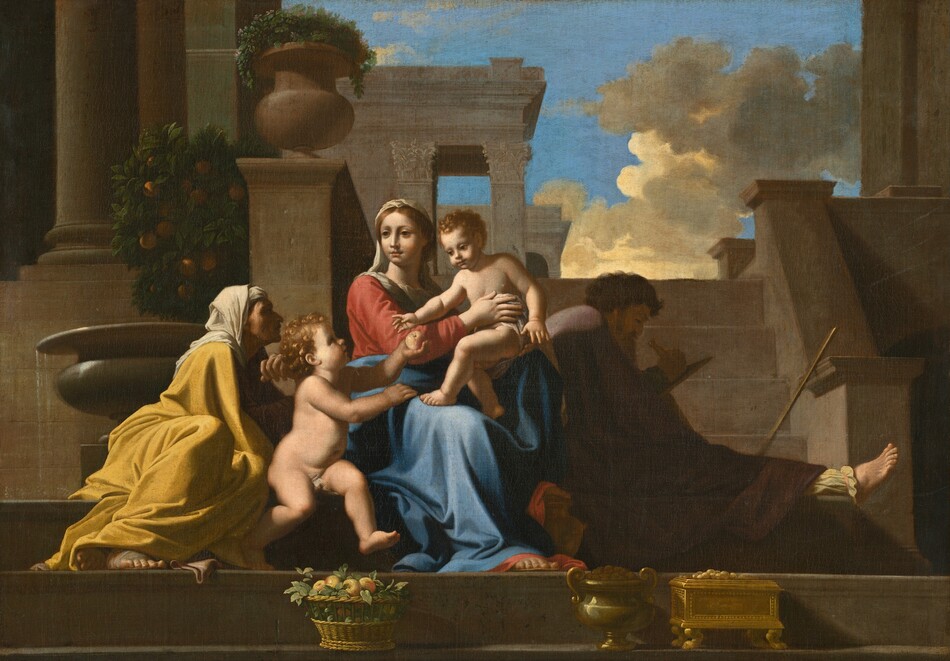
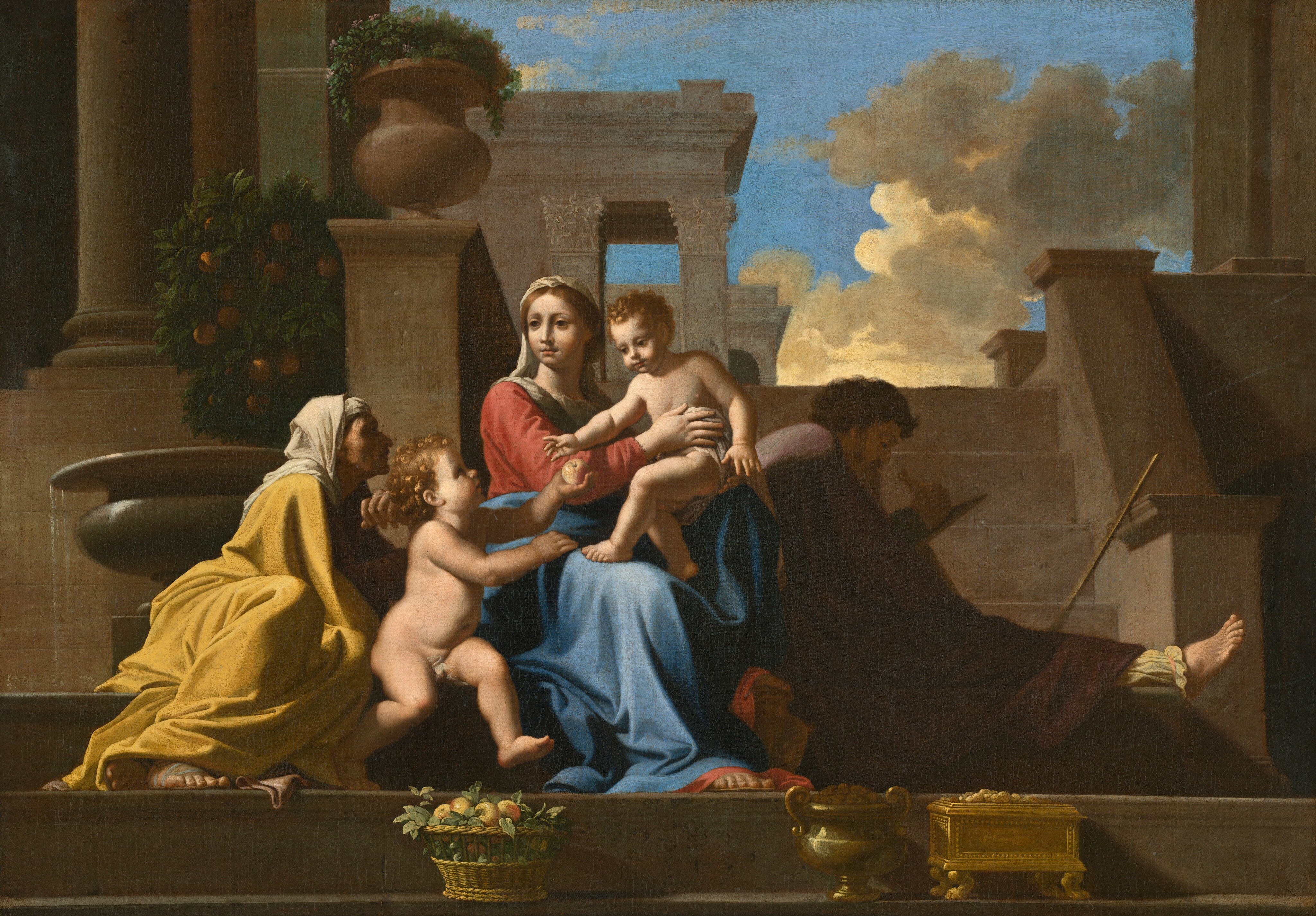
We look up at two women, two young boys, and a man, all with pale skin, sitting together on a wide landing, with stairs leading up to stone buildings behind the group and a patch of vivid blue sky in the upper right corner of this horizontal painting. At the center, a woman, Mary, sits holding a nearly nude child propped on one knee. Her body is angled to our right but she turns her head to look off into the distance to our left with large, dark eyes under faint brows. Her strawberry-blond hair is pulled back under a white veil that falls down the back of her neck and across her chest. Her smooth cheeks are lightly flushed in her round face. She has a straight nose and her pink, bow lips are closed. She wears a coral-red dress under a long, azure-blue robe that wraps around her waist and covers her legs. The sandaled toes of one foot peek from under the hems, and her other foot rests up on a gold-colored, rounded urn. Mary holds one child on her lap, and the second child sits by her right side, to our left. Both toddlers have blond, curly hair, dark eyes, rounded faces, and slightly pudgy bodies. Swaths of pale gray drapery mostly cover the genitals of both. The child on her lap half-sits, half-stands on the knee propped up on the urn. She supports his belly with one hand, the other wraps around his bottom. He leans forward, toward the second child, who faces him and holds up a yellow and blush-red fruit. Behind him, to our left, an older woman sits leaning forward and facing Mary in profile. Her wrinkled face is mostly lost in shadow, and she has a hooked nose and her forehead is lined, as if her eyebrows are raised. A white veil is wrapped around her head and drapes over the shoulders of her long, canary-yellow dress. One foot is crossed behind the other ankle, and the toes of both peep out from under her dress. To our right of Mary, a bearded man, Joseph, wears an eggplant-purple robe and sits almost entirely in shadow, facing our right in profile. The leg closer to us is extended and his foot stretches out of the shadow. He has short, curly brown hair and a long gray beard. He holds a carpenter’s compass to a panel in front of him. Closest to us, a step down runs along the bottom edge of the painting. On that step, a basket with leaves and yellow and peach-colored fruit sits in front of the standing child. Near Mary’s feet is a bronze-colored urn and a shiny gold box on raised feet. Behind the older woman to our left, water trickles from a round-bellied fountain on a pedestal in front of an orange tree. One building with round columns rises behind the tree. Behind Joseph, a long stick rests against the post of a short flight of four steps, which leads to another landing. The portico of a second temple-like building with squared columns and leafy capitals rises over Mary, presumably from the upper landing. A bright, topaz-blue sky with cream-white and steel-gray clouds fills the upper right corner of the composition.

The Holy Family on the Steps

Anonymous Artist

1648

Oil on canvas  Accession ID  1952.5.49

On View: West Building Main Floor, Gallery M36
A young woman with pale skin sits at a table in a darkened room in this vertical painting. Long chestnut-brown hair drapes over her shoulder and her deep, cream-colored, long-sleeved garment is open at her neck. She rests her chin in her right hand, farther from us, as her left reaches for a skull placed on a thick book on the table in front of her. The scene is lit by a single candle mostly out of sight behind the skull. Shown in profile, she looks into a small mirror next to the skull, which reflects that object and the book.

The Repentant Magdalen

Georges de La Tour

c. 1635/1640

Oil on canvas  Accession ID  1974.52.1

On View: West Building Main Floor, Gallery M37
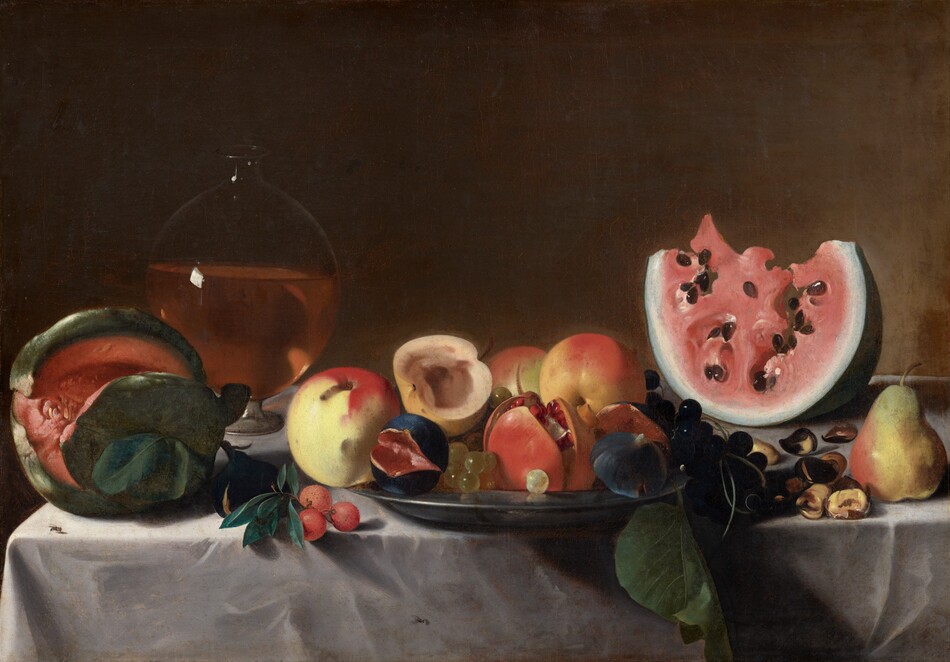
Melons, apples, pears, and other fruits, along with a glass vessel and chestnuts, are arranged along a tabletop covered by a white cloth in this horizontal still life painting. The left edge of the table is close to that edge of the canvas, and the table extends off the right edge. Starting at the left, the melon near the edge of the table has a forest-green rind with coral-colored flesh. Just behind it, to our right, the spherical glass vessel is about half filled with amber liquid. Next to the melon and in front of the vessel is a dark-skinned fig and a cluster of three red berries. At the center of the composition, a pewter plate holds three yellow and red apples and a fourth piece of fruit, perhaps a pear or apple, cut in half. There are also several green grapes, a pomegranate split open to expose the ruby-red seeds, and two more black-skinned figs cut so the rose-pink flesh shows. A bunch of dark purple grapes and a green leaf spill out of the right side onto the table. A wedge of pink watermelon with black seeds sits on the far right toward the back of the table. A yellow and pink pear stands near the front of the table to our right, and a handful of chestnuts is scattered between the pear and watermelon. Two tiny insects, like small flies, sit on the tablecloth, one near the melon to our left and the other on the front of the tablecloth near the lower center. Bright light from the upper left glints off the carafe, the edge of the plate, and the seeds of the pomegranate and watermelon, and it creates deep shadows around the fruit. The background lightens from earth brown along the top to sable brown near the table to our right.

Still Life with Fruit and Carafe

Pensionante del Saraceni

c. 1610/1620

Oil on canvas  Accession ID  1939.1.159

On View: West Building Main Floor, Gallery M34
Shown from the shoulders up, a man with a flushed complexion, wearing a crimson-red cap and garment, looks at us from the corners of his eyes in this vertical portrait painting. He is brightly lit from behind us and the mahogany-brown background is deep in shadow. The man’s shoulders angle to our right, and he turns his head slightly to look at us with brown, deep-set eyes under arched brows. His wispy, auburn-brown goatee is tinged in silvery gray. His nose is slightly bulbous, and his thin lips are tightly closed in a straight line. Wrinkles and jowls give his face a paunchy look. His tall, flat-topped, fez-shaped hat covers his hair. A white, nearly translucent collar curls up along his neck and flares out to points at his collar. Rose-pink highlights on his red cape suggest it is a shiny material, like silk, and it is fastened with several small, dark buttons down the front.

Pope Innocent X

Anonymous Artist

c. 1650

Oil on canvas  Accession ID  1937.1.80

On View: West Building Main Floor, Gallery M34
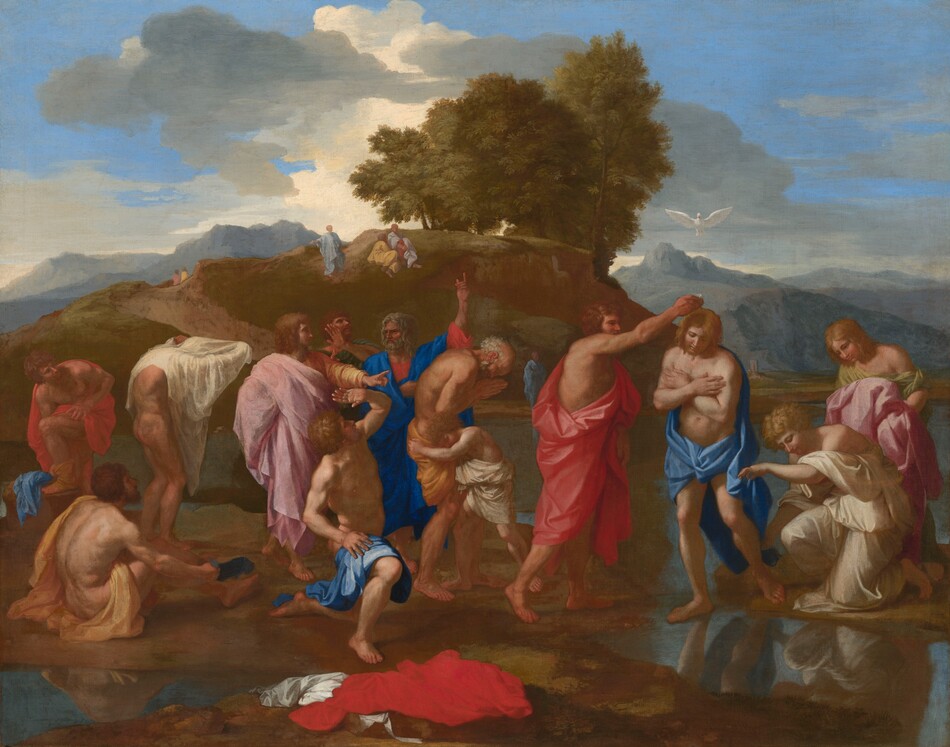
Twelve people and one child stand, sit, or kneel along a riverbank in this horizontal painting. All the people have pale or tanned skin, and are muscular. They are in various stages of undress, wearing robes of golden yellow, ruby red, petal pink, azure blue, or cream white. To our right of center, a man, Jesus, stands facing us with his arms crossed over his chest. He wears a blue robe wrapped loosely across his shoulders and across his hips. He looks down, his blond hair falling alongside his face, as another man, wearing red, pours water from a shallow dish onto his head. A white dove flies with wings spread overhead. To our right of Jesus, one kneeling person wearing white holds up Jesus’s blue robes and another looks on, wearing a sage green robe and holding a voluminous rose-pink cloth. To our left, a group of five men react by throwing up hands, pointing upward, or looking up. One man with a gray beard and hair stands and bows his head over praying hands. A young boy wraps the arm we can see across the praying man's hips. Three more men to the left of this group pause as they undress to look toward Jesus. All the men stand or sit among puddles as a river spans the width of the painting behind the group and winds into the distance to our right. At the center of the composition, three men stand or recline on a grassy mound on the far side of the river. Tucked under trees at the peak of the mound, a smudge of white could be another kneeling person. Two more people walk along a path that crests the mound to our left. Mountains in the distance are slate blue beneath a vivid blue sky streaked with white clouds.

The Baptism of Christ

Nicolas Poussin

1641/1642

Oil on canvas  Accession ID  1946.7.14

On View: West Building Main Floor, Gallery M36
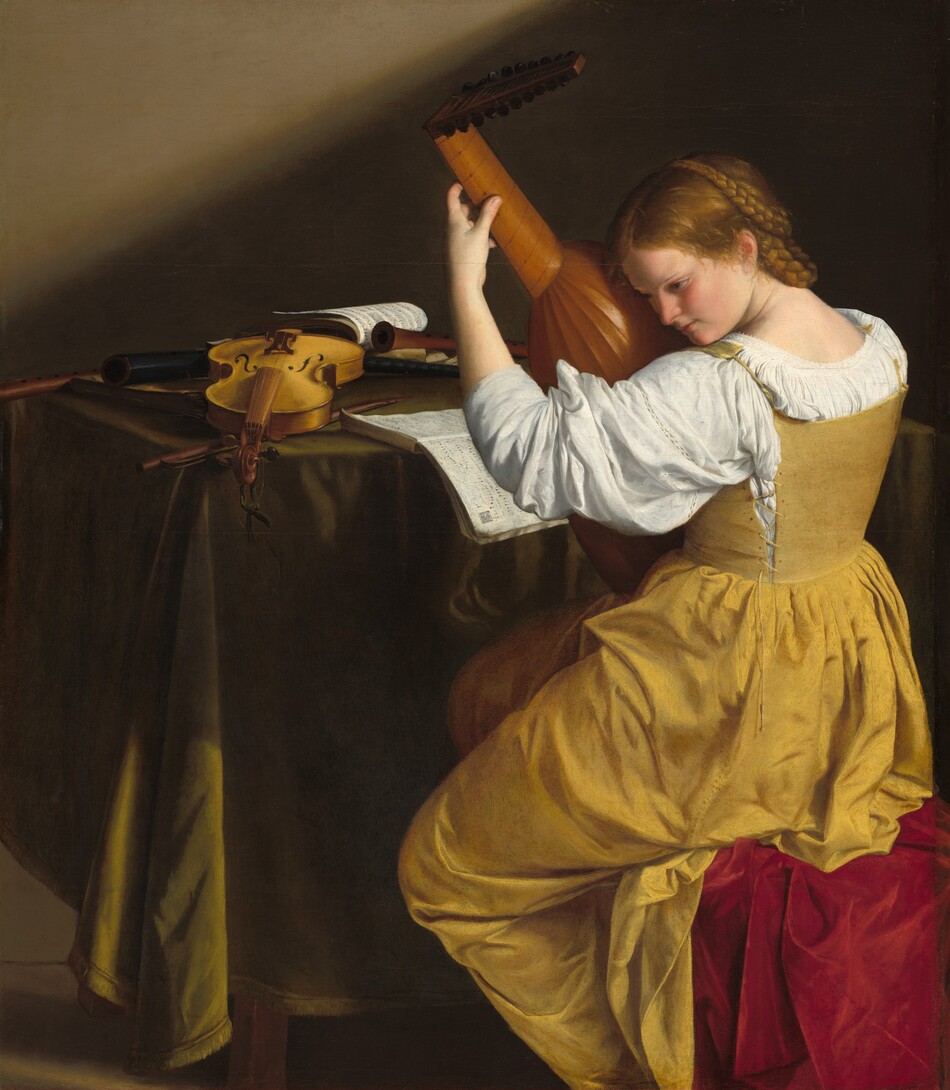
Facing away from us, a young woman with pale skin, wearing a golden yellow gown, leans her head down toward the lute she holds nearly upright in her lap in this horizontal painting. She sits near the right edge of the painting so her body faces the table beyond her, to our left. Her body is angled away from us but she turns her head so we see her in profile, facing our left. She tips her head to put her ear next to the lute, and she looks down and off to our left with brown eyes under thin, slightly arched brows. She has a straight nose, smooth, flushed cheeks, and her coral-pink lips are closed. Her dark blond hair is parted down the middle and pulled back under long braids looped around the back and over the top of her head. Light reflects off her hair and off the short, loose strands near the ear we can see. Her long yellow dress has a full skirt. The stiff bodice is laced up the sides and hooks over the shoulders, over a voluminous, bright white blouse. The sleeve we can see is pushed up over her forearm. Her seat is draped in crimson-red, velvety fabric. She holds the neck of the lute up high with her left hand, her fingers pressing the strings, so she brings the rounded body of the instrument up to her ear. In front of her, the table is draped with fringed, olive-green fabric. A violin made with blond wood lies on the table with the neck stretching toward us. There is also the violin bow and at least three wooden recorders on the table. One book of music is open so the pages fall over the edge of the table, near the woman. One other book of music at the back of the table is held open with a recorder. The feet of the table and the ankles of the woman are cut off by the bottom edge of the painting. The background is dark, earth brown except for a diagonal shaft of light across the top left corner of the composition, presumably from a high window in the wall out of our view.

The Lute Player

Orazio Gentileschi

c. 1612/1620

Oil on canvas  Accession ID  1962.8.1

On View: West Building Main Floor, Gallery M29
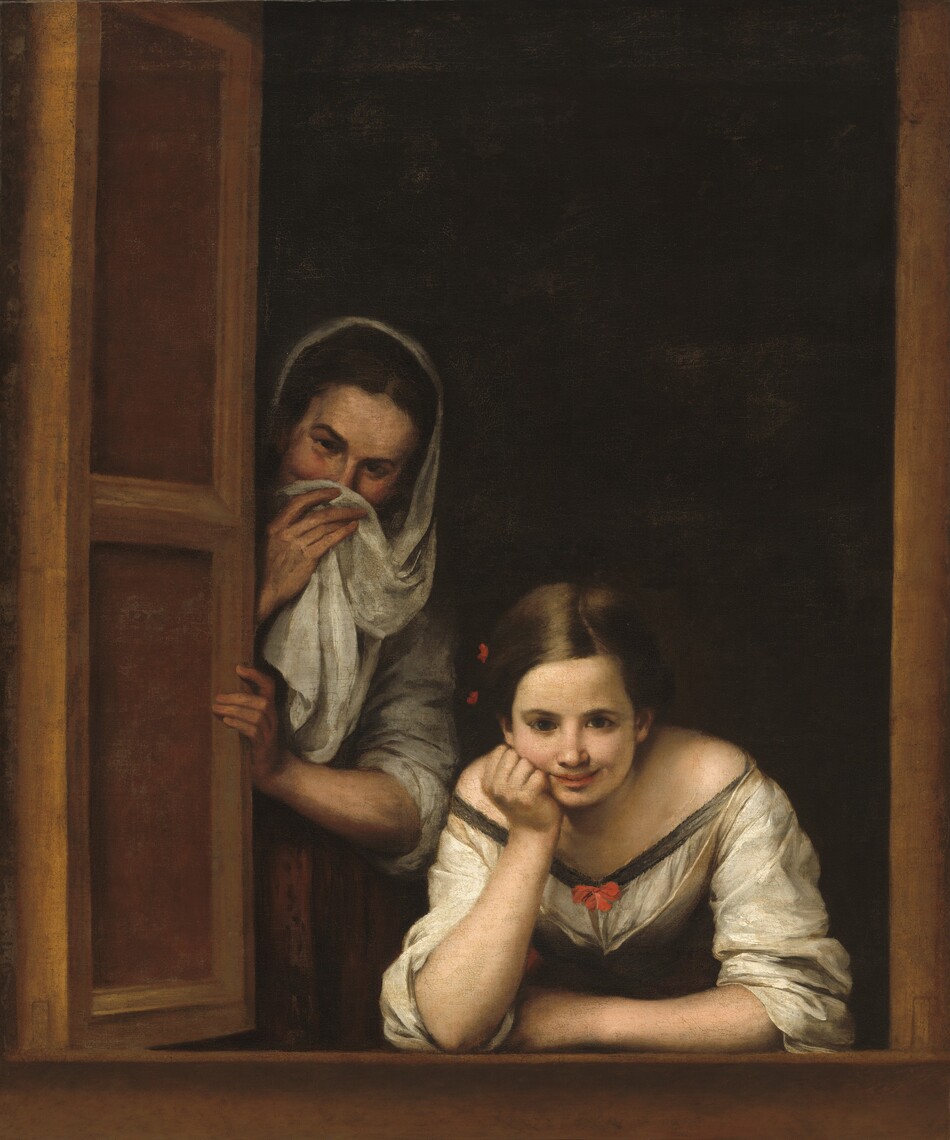
Two women with pale skin look out at us from the other side of a rectangular window opening with a shadowy interior behind them in this vertical painting. On our right, in the lower third of the composition, one young woman leans toward us over her left arm, which rests along the window ledge. She bends her right arm and props her chin on her fist. She looks at us with dark brown eyes under dark brows. She has shiny chestnut-brown hair with a strawberry-red bow on the right side of her head, to our left. She has a straight nose, and her full pink lips curve up in a smile. She wears a gossamer-white dress with a wide neckline trimmed in dark gray, with another red bow on the front of her chest. Her voluminous sleeves are pushed back to her elbows. To our left, a second woman peeks around a partially opened shutter. She is slightly older, and she stands next to the first woman with her body facing us. She tilts her head and also gazes at us with dark eyes under dark brown brows. She has dark brown hair covered by an oyster-white shawl. She holds the shawl up with her right hand to cover the bottom half of her face. Her mouth is hidden but her eyes crinkle as if in a smile. Her left arm bends at the elbow as she grasps the open shutter. She also wears a white shirt pushed back to her elbows, and a rose-pink skirt. The frame of the window runs parallel to the sides and bottom of the canvas. The room behind them is black in shadow.

Two Women at a Window

Bartolomé Esteban Murillo

c. 1655/1660

Oil on canvas  Accession ID  1942.9.46

On View: West Building Main Floor, Gallery M34
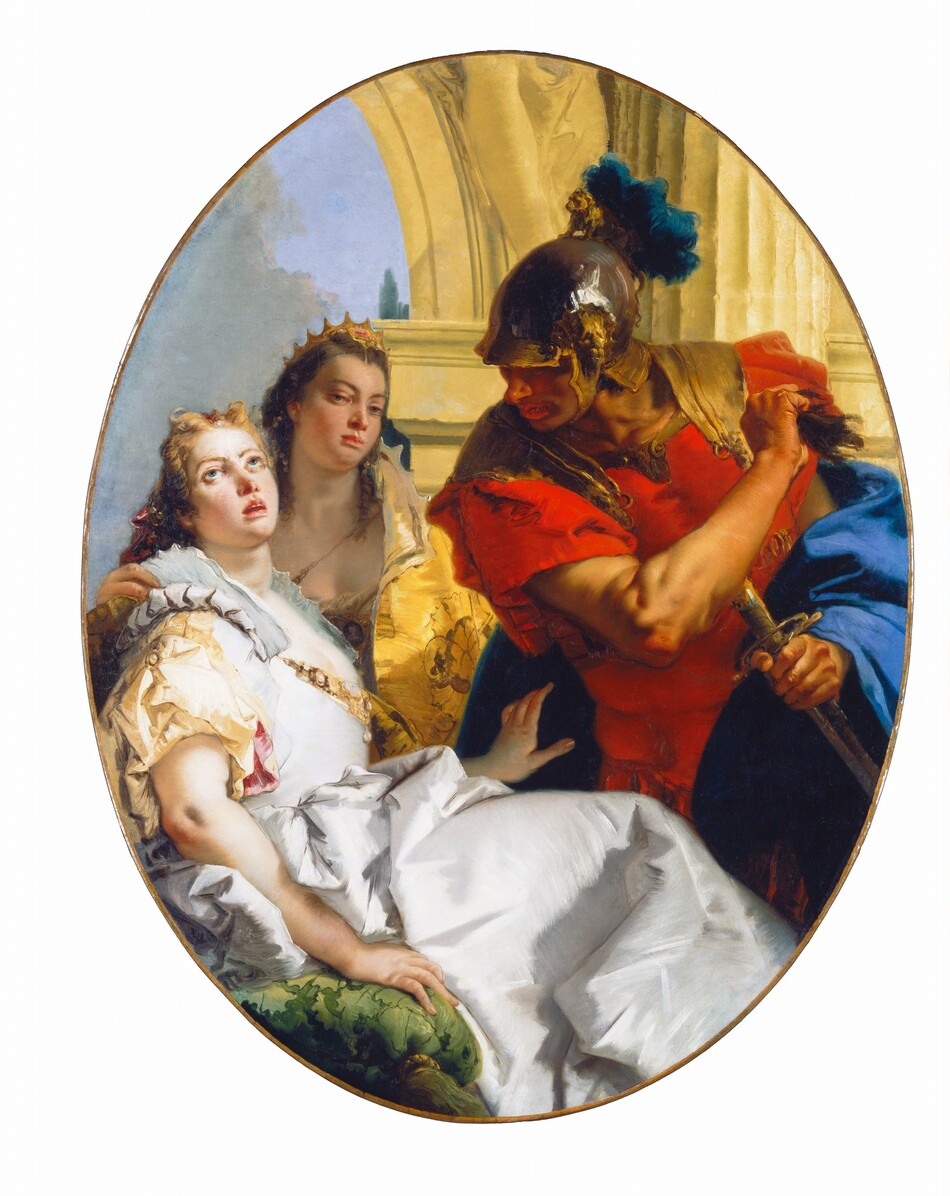
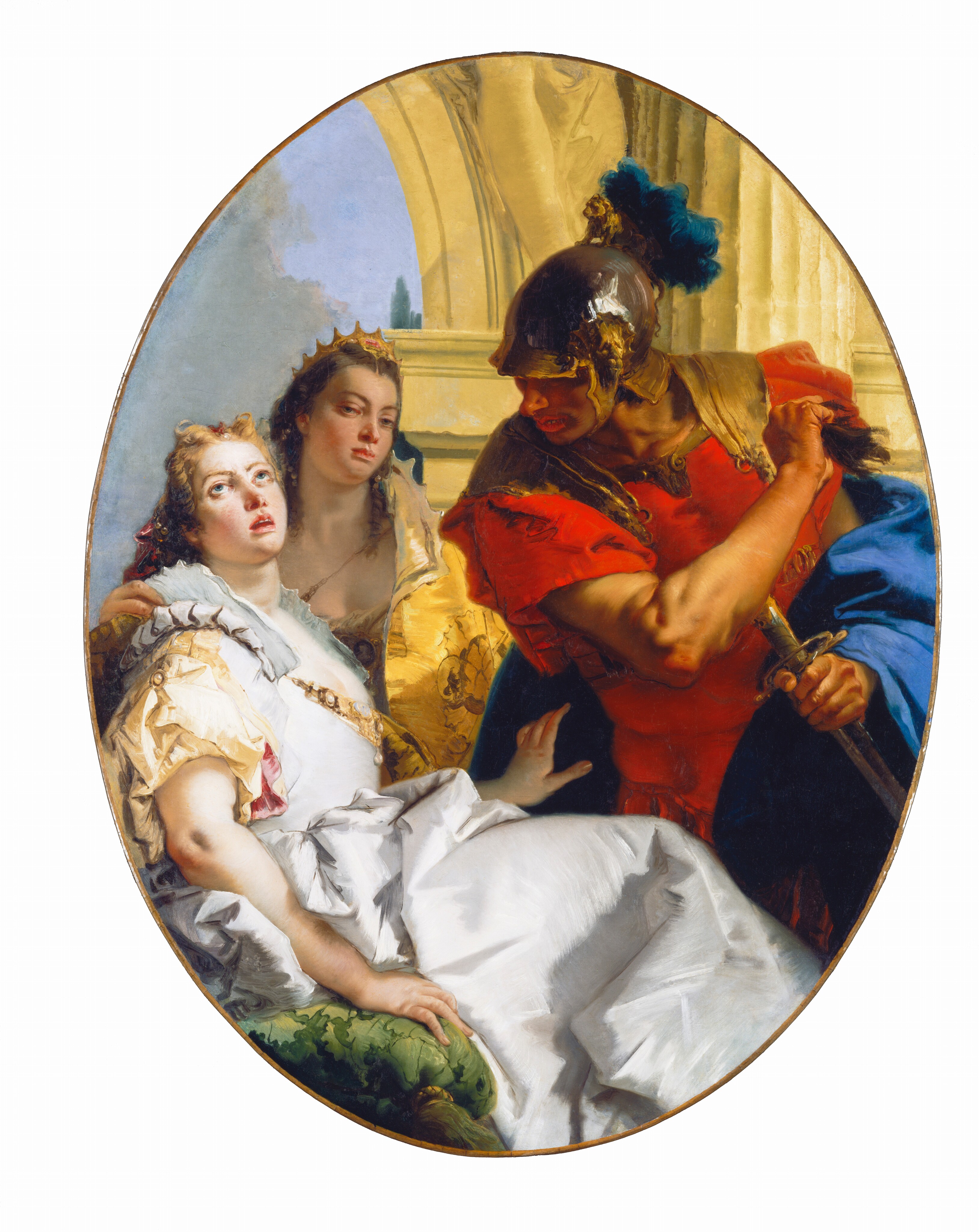
Two women and a man in front of a column and arch nearly fill this vertical, oval painting. The two women have pale skin with round faces, wide-set eyes, and full pink lips. The woman in the lower left quadrant of the painting sits on a moss-green cushion with her body facing our right almost in profile. Her face turns to us and is tipped up, the eyes cast heavenward and her lips parted. She has blond hair and wears a white gown with a voluminous skirt.  A gold and possibly jeweled belt is looped over one shoulder and crosses her torso. Her right hand, closer to us, rests on the pillow and the other is slightly lifted to reach toward or touch the hip of the man to the right. The second woman is behind the first and wears a gold crown tucked into her long brown hair. Her mouth is closed, and her head is tipped slightly back and away so she looks at us from the corners of her heavy-lidded eyes. She wears a low-cut bodice and a buttercup-yellow robe, and one hand rests on the other woman’s shoulder. Dominating the right half of the composition, the clean-shaven man has dark, tan-brown skin. He wears a silver and gold helmet topped with a gold lion and a royal blue plume. His armor is scarlet red, and a lapis-blue cloak wraps across his middle back and over one forearm. He holds a sword in one hand a what looks like a lock of brown hair or fur in the other. He looks down at the first woman with his head tipped toward us so his eyes are hidden by the helmet’s brim. The column and arch behind the trio is pale yellow, and gray clouds, a sliver of blue sky, and the tip of a green tree are visible in the distance to the left.

Scene from Ancient History

Giovanni Battista Tiepolo

c. 1750

Oil on canvas  Accession ID  1939.1.365

On View: West Building Main Floor, Gallery M32
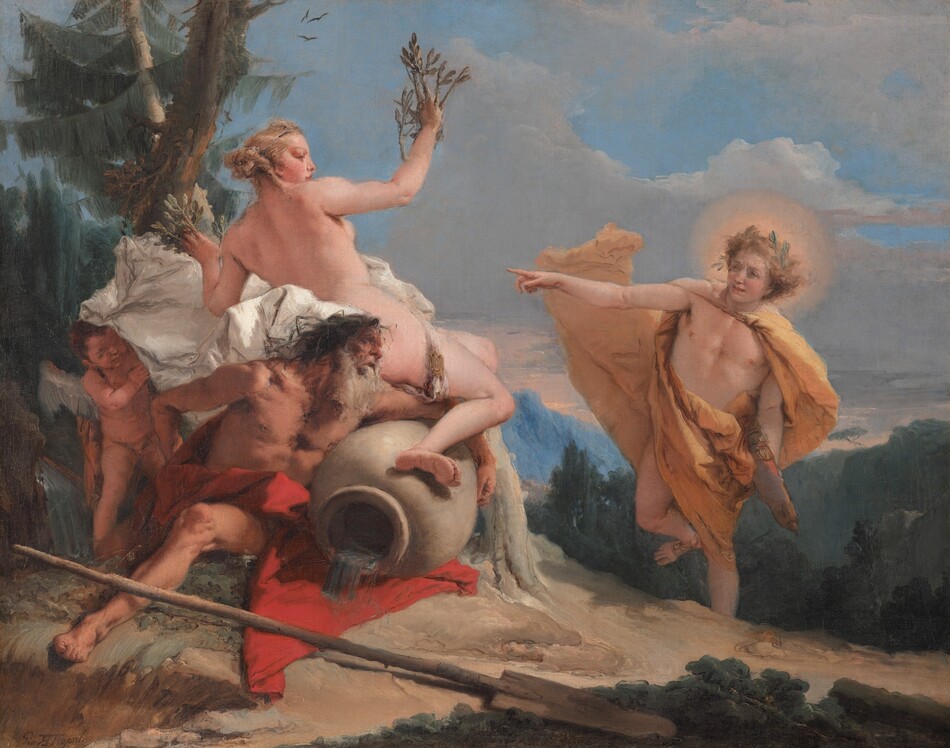
A cleanshaven man in a saffron-yellow cloak runs and points to a nude woman whose fingers are turning into leafy tree branches in this horizontal painting. The woman is supported by an elderly man with a long beard and a winged young child all gathered around an oversized urn. The people all have pale rosy or tanned skin. To our right, the young man runs toward the woman to our left. His cloak wraps around his hips and flies out behind him. He wears a laurel wreath nestled in his blond hair, which is surrounded by a gold glow. A quiver of arrows hangs from one hip, and he wears sandals but is otherwise nude. He points to the woman with his right hand, on our left, with that foot raised. The blond, nude woman sits on the urn and lies back on a white cloth supported by a nude boy with short white wings. Her back is to us, and she looks to our right in profile. The fingers of her raised hands morph into muted green leaves. One of her legs bends over the arm of an old man who sits next to the urn and hooks one arm over its round body. The man’s head is topped with dark green material, like reeds, and he has a long white beard. His skin is ruddy, and his body is muscular. The urn’s opening faces us, and water pours onto the scarlet-red cloth that drapes across the old man’s hips and pools on the dirt ground around him. A spade with a long, wooden handle and a long, narrow blade lies on the ground before him. Evergreen trees grow up the left side of the scene, which appears to take place at the top of a mountain, for we look down into a dense forest beyond. A hazy blue mountain in the deep distance points up to the topaz-blue sky spanned with thin layers of gray-white clouds. The artist signed the lower left, “Gio. B. Tiepolo.”

Apollo Pursuing Daphne

Giovanni Battista Tiepolo

c. 1755/1760

Oil on canvas  Accession ID  1952.5.78

On View: West Building Main Floor, Gallery M32
A barefoot man wearing tattered clothing, with his hands clasped at his chest, kneels at the feet of an old, bearded man in this almost square painting. The pair is flanked by five people on our right and a man, boy, and calf on our left. All the people have pale skin. The kneeling man faces our right in profile and tilts his head up to look at the old man who embraces him. The younger man has shaggy, dark brown hair and a heavy five o'clock shadow. A small white dog jumps at his dirty, bare feet. The old man has a long gray beard and wears a black skullcap over gray hair. His voluminous dusty rose-pink cloak drapes over a teal-blue robe. To our right of the pair are a child, a woman, and three men. Some look at the embracing men while the others look at each other. At the front of that grouping, two men have brown hair and wispy mustaches. One wears a golden-yellow tunic and holds a silver tray piled with a shimmering sky-blue and pale pink garment, a bright white shirt, and a pair of sandals. Just beyond him and looking into his face, the second man wears gray with a dark green cloak draped over one shoulder. He holds up a gold ring with a ruby-red stone. To our left of the embracing men, a smiling blond boy leads the calf into the scene. Just beyond him is a thin, muscular man carrying an ax over one shoulder as he gazes down at the boy. The scene is set in a courtyard with walls that extend back on either side. Billowing putty-gray and white clouds fill the background.

The Return of the Prodigal Son

Bartolomé Esteban Murillo

1667/1670

Oil on canvas  Accession ID  1948.12.1

On View: West Building Main Floor, Gallery M34
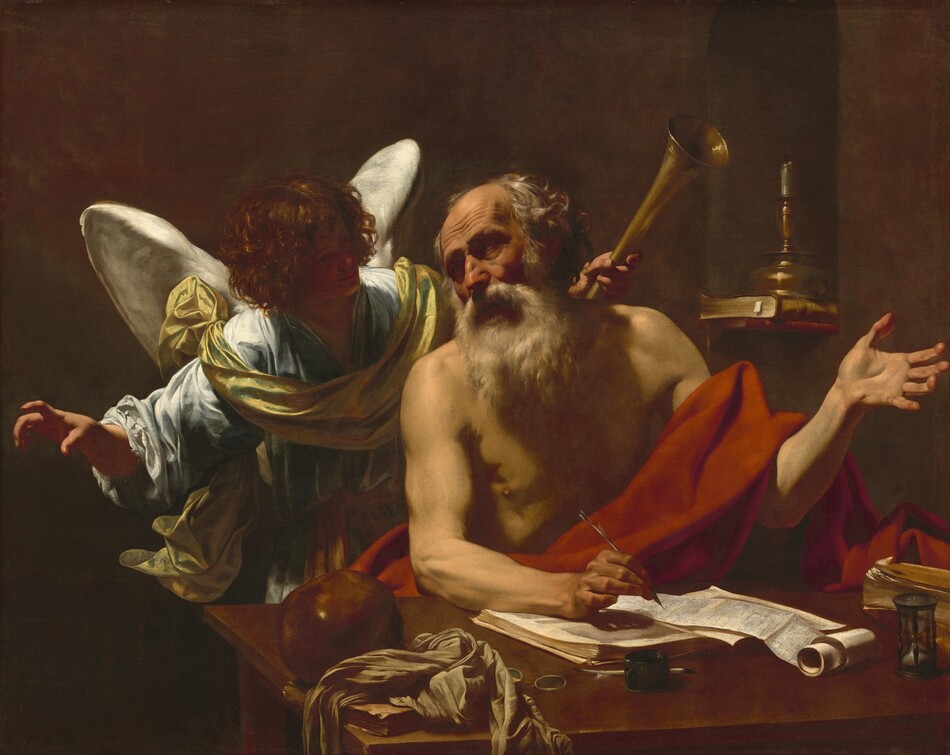
Shown from the waist up, an elderly, balding, light-skinned man with a bushy white beard sits behind a table, facing us, in front of a winged angel who looks on in this shadowy, horizontal painting. The man sits with his body angled slightly to our right, and he turns his head to look in the opposite direction. His eyes are sunk in shadow under deeply furrowed brows, set in his lined face. His sparse, gray and white hair is tousled. He wears only a scarlet-red cloth draped across his lap and over his sinewy left arm, on our right. His open left hand is raised, palm up, at shoulder height. In his other hand, he holds a pen, hovering over a partially unwound scroll. His forearm rests on an open book beneath the scroll. He looks over his right shoulder at the curly-haired angel with snow-white wings. The angel wears a flowing, light blue robe with a golden yellow cloth draped around the chest and over the shoulders. Softly smiling, the backlit angel leans toward the man, face deep in shadow. With arms lifted, one hand gestures with a slightly crooked finger, pointing beyond the picture’s border to our left. In the other hand, the angel holds a golden horn in the dusky background behind the man’s left shoulder. Behind the man and angel and to our right, a single candle sits on two books lying in an arched wall niche. On the desk closest to us are a crumpled cloth on a book, a shiny rust-brown ball, a pair of eyeglasses, an inkpot, an hourglass, and a second book, to our right. Light coming from our upper left starkly illuminates the two people against the shadowed, earth-brown background.

Saint Jerome and the Angel

Simon Vouet

c. 1622/1625

Oil on canvas  Accession ID  1961.9.52

On View: West Building Main Floor, Gallery M29
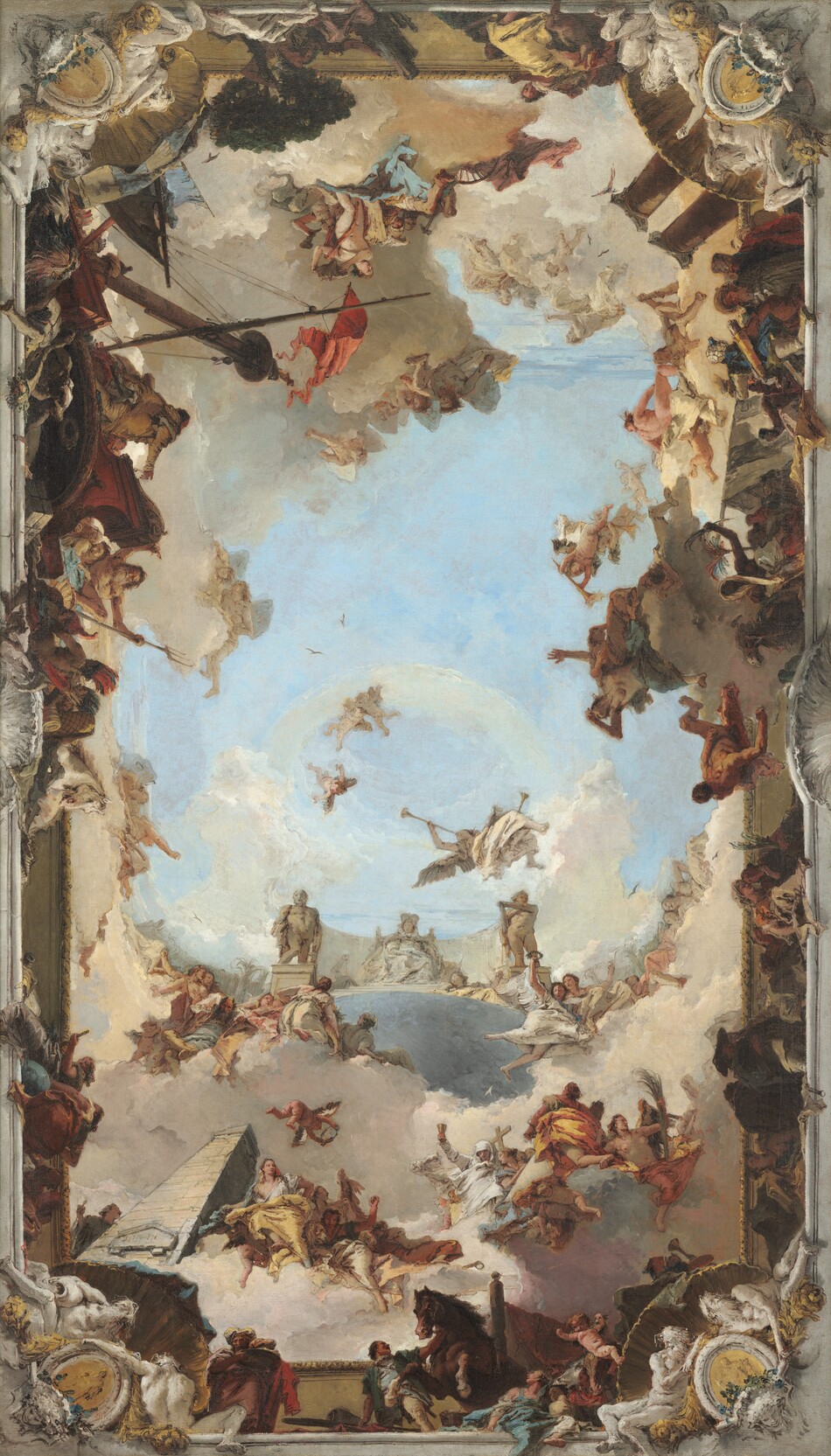
We look up through an opening surrounded by a stone ledge, with clusters of people and clouds swirling into a blue sky up and away from us in this vertical, rectangular painting. From a distance, the scene looks like a complete illusion but up close, the people, clouds, and architecture are sketchily painted. The ledge running around the opening has a gold, oval medallion at each corner. Appearing to be carved from white stone, two bearded men with long hair recline against each medallion, flanking them to each side in front of large shells that curve up over the people and frames them. A few architectural structures extend up into the sky, including a pointed obelisk in the lower left corner, a pair of columns at the upper right, and what seems to be the mast of a ship at the top left. Most of the people have pale skin but some have more tan complexions, and a few, including those wearing feather headdresses near the upper left corner, have brown skin. The people wear windswept robes of pale, butter yellow, robin’s egg blue, rose pink, and ivory. The eye may drawn to a few vignettes, such as the man holding a rearing, chestnut-brown horse on the illusionistic ledge near the lower right, a nun wearing a white robe and holding a cross above him in the clouds, and, farthest away, a crowned person sitting on a throne.

Wealth and Benefits of the Spanish Monarchy under Charles III

Giovanni Battista Tiepolo

1762

Oil on canvas  Accession ID  1943.4.39

On View: West Building Main Floor, Gallery M32

Loading Results