French, Italian, and Spanish Paintings

Filter Results

86 artworks on view.

Results

Shown from about the lap up, a woman with light skin sits facing us as she wears a voluminous garment that covers her head and forehead beneath a black veil that falls over and past her shoulders in this vertical portrait painting. The light comes from our left, illuminating her smooth skin and flushed cheeks. She looks at us with gray eyes under gently arched brows. Her coral-pink lips are closed and possibly pulled back slightly at the corners. Her garment is pleated across the chest and sleeves to fall in full folds over her arms. A wide panel covers her shoulders, the sides of her neck, and head, and a white band crosses her forehead. The semi-transparent black veil creates a stiff peak over her head where it attaches to the top of this garment, called a wimple. Her right hand, on our left, rests in her lap and her index finger marks her spot in the small book she holds. The other hand is presumably tucked under the folds of her garment. The background behind her is peanut brown, and a diagonal line suggests a curtain pulled to our right. An inscription in capital gold letters spans the right half of the painting along the top edge: “ELIZABETH DAUGHTER OF SR ROBT THROCKMORTON BART.”
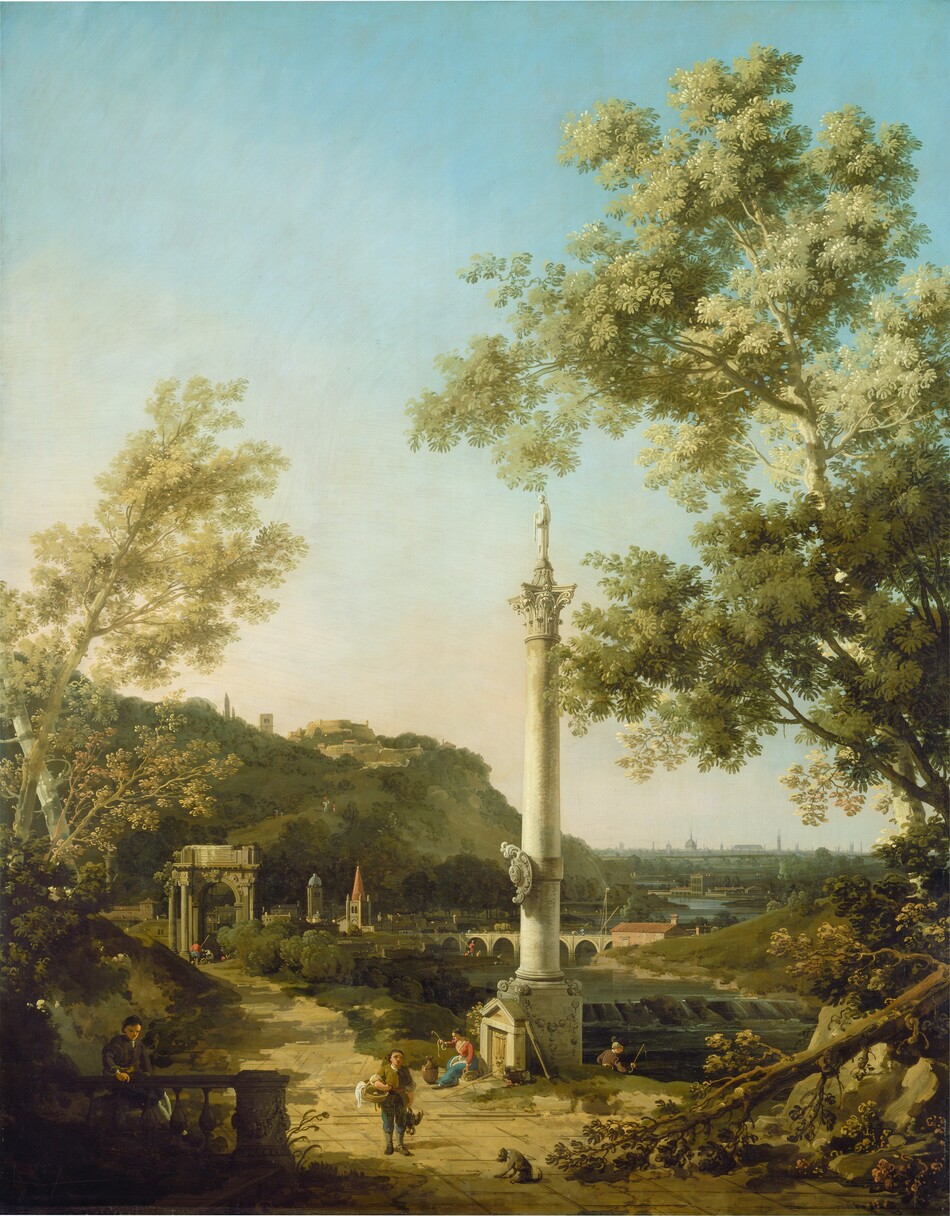
We look slightly down across a sun-drenched plaza with people scattered among ruins, buildings, and around a free-standing column in this vertical landscape painting. The people we can see have light skin. Towering trees with celery, sage, and forest-green leaves frame a small plaza paved with flax-colored stones. A tree to our right almost reaches the top of the painting, and a shorter tree in front of it has toppled onto the plaza. To our left, in the lower corner, a man sits behind a shadowy balustrade, looking down. In the lower center of the painting, a man walks toward us, holding a basket over one arm and dead poultry in the other hand, and a dog sits nearby. Slightly farther back is a tall stone column with a door in its base and a statue on top. A woman wearing a red shirt and blue skirt sits on a step in front of the door. Along the left side, the plaza gives way to a tree-lined, dirt road that meanders toward a stone arch in the middle distance, and to a cluster of low buildings beyond. Two towers catch the light, one with a slate-blue dome and the other with a peach-colored steeple. Farther back from the buildings is a dark line of trees at the base of a steep green hill dotted with groves of trees, which rises high over the plaza below. Another building complex, glowing in warm tones of straw yellow, sits at its top. Small dots of red, white, and blue suggest a handful of people making their way up the hill’s wide path. A river with moss-green water pouring over a dam extends from the lower right corner into the distance along the right edge of the painting. Near the column, a man fishes at the water’s edge. The water winds back to a row of silvery-gray buildings in the far distance. Several people in red, yellow, or white, tiny in scale, dot the riverbanks and cross the bridge. A screen of thin, pale pink clouds float across the light blue sky.

English Landscape Capriccio with a Column

Canaletto

c. 1754

Oil on canvas  Accession ID  1964.2.1

On View: West Building Main Floor, Gallery M31
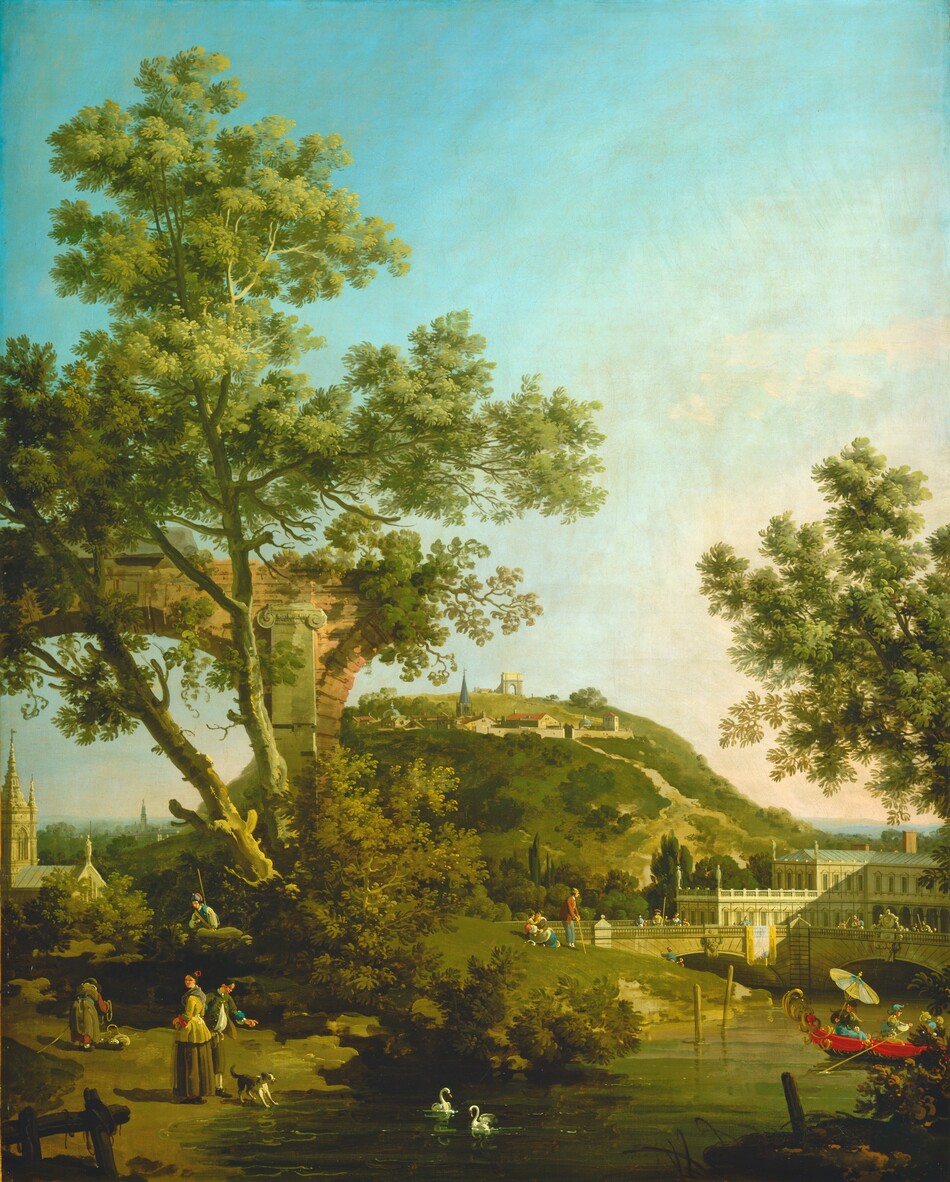
Sun pours across a landscape with trees and plants growing around and on an arched stone ruin, a bridge and river, and, in the distance, buildings along a flat-topped hill carpeted with grass in this vertical painting. Tiny in scale in the landscape, about two dozen men, women, and children wear dresses and clothing in shades of tan, brown, turquoise, cream white, black, red, and mustard yellow. Close to us, the arched ruins, possibly of an aqueduct, are nearly hidden by tall trees, bushes, and growth hanging from its deck. The trees growing up in front of the ruins nearly span the height of the painting and take up most of the left half of the composition. A river winds from the lower right corner into the distance to our right, passing under a bridge in the middle distance on the right edge of the painting. The shallowly arched bridge crosses the river in front of a long block of a building with rows of windows and arched arcades. The flat-topped hill rises in the center distance. There, a freestanding arch could be another ruin. Buildings with brown walls and terracotta-red roofs, along with the pointed spire of a church, are contained within a town wall a little farther down the hill from the arch. More churches with spires are nestled into the valley to our left of the hill, extending into the distance. The people are scattered through the landscape, and they all have pale skin. Closest to us, a man and woman stand near a black and white dog that barks at a pair of swans in the river, at the bottom center of the composition. A woman nearby bends over a basket on the ground, and a man with a long staff, tucked into the vegetation near the aqueduct, looks on. More people sit, stand, or play by the riverbank closer to the bridge or look at the water from the bridge itself. On the river is an elaborately decorated, long, narrow boat like a gondola. One person in the boat props open a yellow and white parasol; another, who rows the boat, wears a blue and yellow outfit with a cap like an overturned flower blossom. The horizon comes about a third of the way up the composition and the sky above is brilliant topaz blue.

English Landscape Capriccio with a Palace

Canaletto

c. 1754

Oil on canvas  Accession ID  1964.2.2

On View: West Building Main Floor, Gallery M31
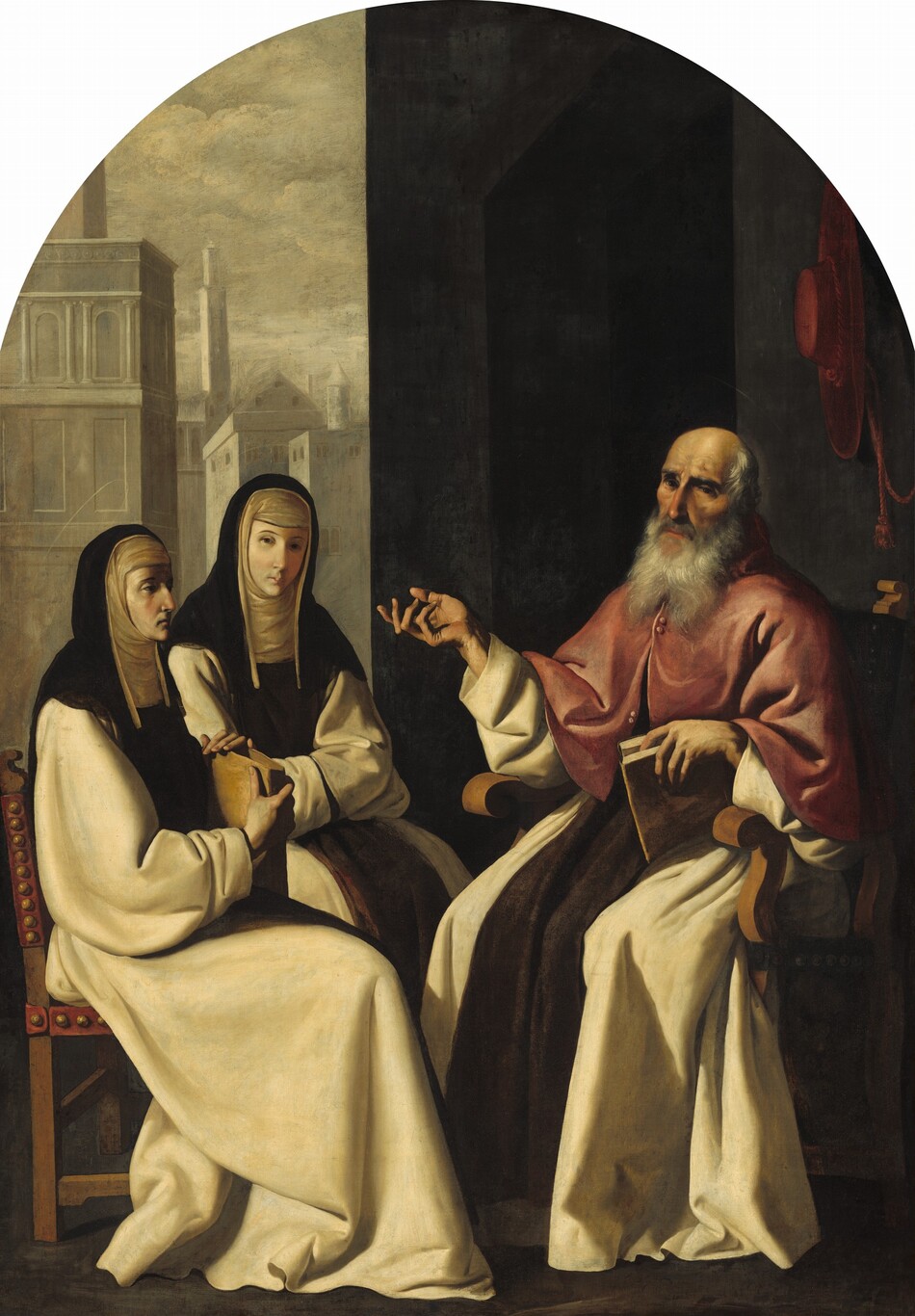
This painting shows three people sitting together. Two individuals on the left are women, likely nuns, with light skin, wearing black habits over tan head coverings and long-sleeved white robes. One of the women holds a book. The person on the right is an older man with light skin and a white beard, wearing a light red cloak over a long white robe. He holds a book and gestures towards the women. In the background on the left, there is a tan cityscape with buildings and a cloudy sky. On the right is a dark wall with a red hat hanging behind the man. The top of the painting is curved.

Saint Jerome with Saint Paula and Saint Eustochium

Francisco de Zurbarán, Spanish 17th Century

c. 1640/1650

Oil on fabric  Accession ID  1952.5.88

On View: West Building Main Floor, Gallery M34
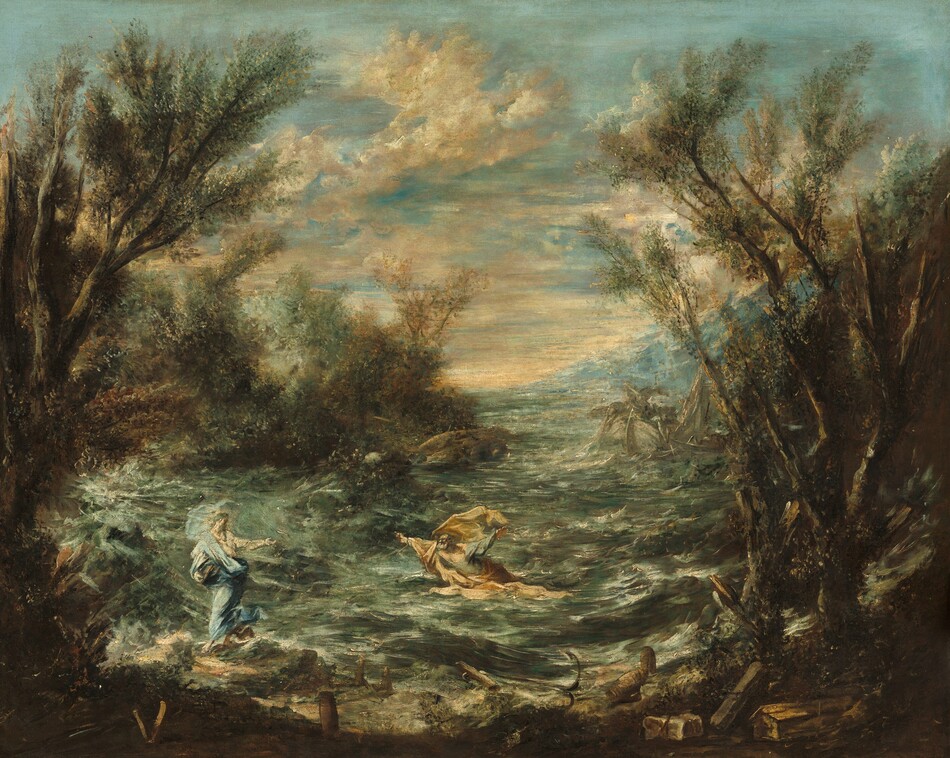
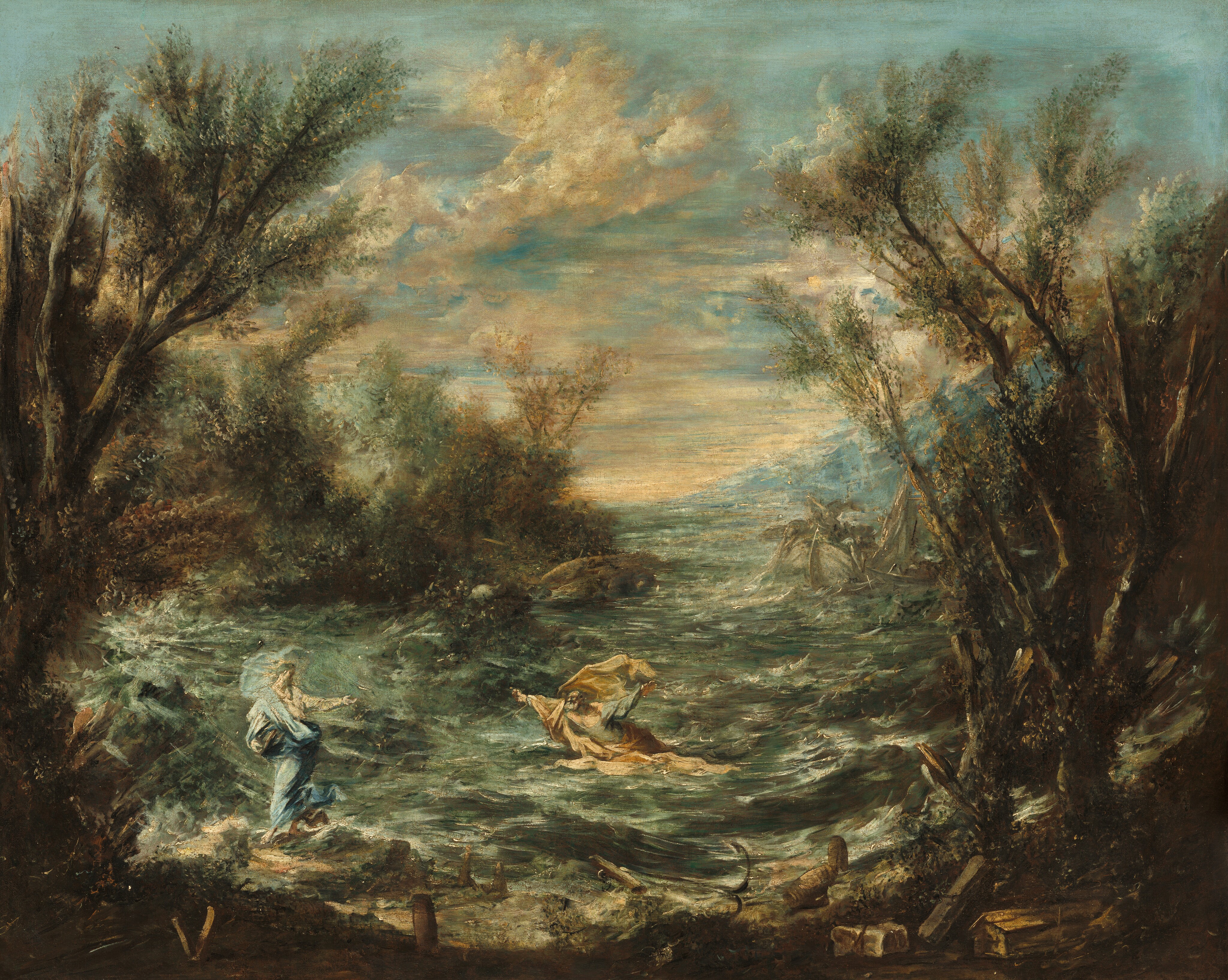
Two pale-skinned men face each other across surging waves in a cove surrounded by trees in this horizontal painting. Tall trees to each side have dark, gnarled trunks and small, olive-green leaves. They curve toward each other like parentheses. Swirling sage-green and muted turquoise water kicks up waves highlighted with ivory white. The water heaves in great waves back into the distance where it meets a blue form, which could be a mountain or more water. The men are small in scale within the domineering landscape. One man stands on the shore near the lower left corner. His topaz-blue cloak lifts high in the wind behind him. He is barefoot, has long brown hair, and he holds out one hand toward the second man, who is waist-deep in the water. That second man’s honey-yellow and blue robes whirl around him as he lunges forward, arms spread wide. The narrow band of land spanning the bottom edge of the canvas is strewn with jugs and bits of stone and lumber. A pale ship with a man leaning over our side is barely visible on the right at the mouth of the cove. Above the scene, a robin’s egg-blue sky peeks out from wide streaks of flax-yellow and peanut-brown clouds.

Christ at the Sea of Galilee

Alessandro Magnasco

c. 1740

Oil on canvas  Accession ID  1943.4.31

On View: West Building Main Floor, Gallery M30
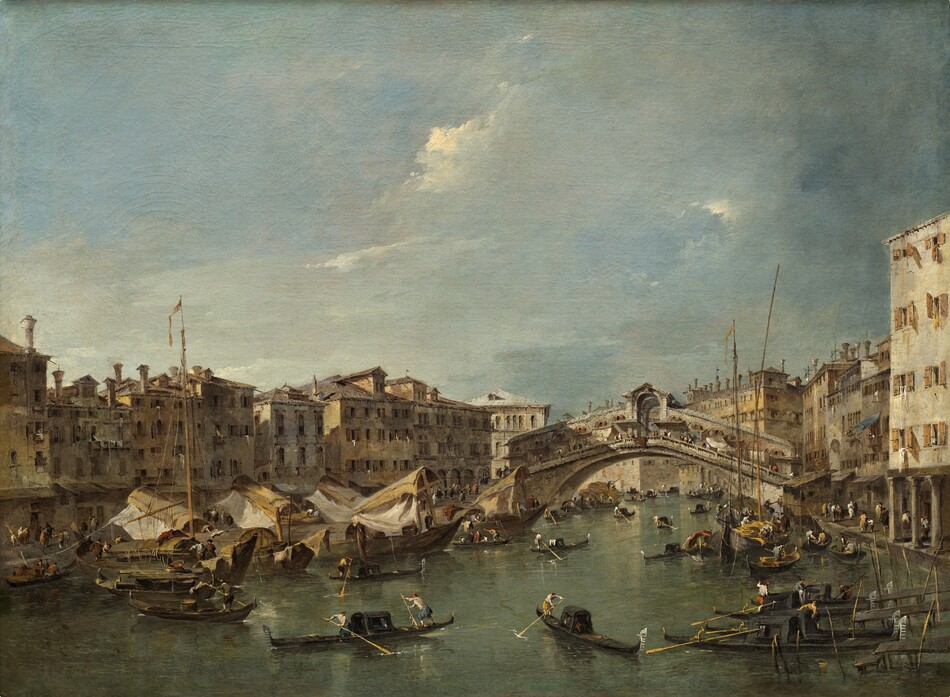
We look down and across a canal filled with more than two dozen gondolas and sailing boats, and flanked by rows golden-yellow and parchment-white buildings connected by a wide, arched bridge in this horizontal landscape painting. Some of the boats are pulled up to the buildings lining the water, and others weave through the canal, guided by one or two people each. Closest to us, two long, low, slender gondolas are angled toward each other. Other boats have curving, cabin-like structures, and there are three sailing ships with tall masts among the gondolas. The densely spaced buildings along either side of the canal have three or four stories with rows of dark, rectangular windows, but some have five stories, like the building closest to us to our right. Laundry hangs from some windows or from balconies, and rooflines are lined with low chimneys. The two banks of the canal are connected by a fawn-brown, stone bridge with a wide, arched span. The deck is covered with an arched walkway filled with pedestrians. The canal extends into the distance and turns a corner, so the rows of buildings create a screen beyond the bridge. Tiny in scale, people walk along both sides of the canal. Touches of white, black, brown, and harvest gold suggest clothing and hats. The water and buildings take up the lower third of the composition. Against a pale blue sky, a screen of white clouds darkens to flint gray in the upper right corner.

Grand Canal with the Rialto Bridge, Venice

Francesco Guardi

probably c. 1780

Oil on canvas  Accession ID  1942.9.27

On View: West Building Main Floor, Gallery M31
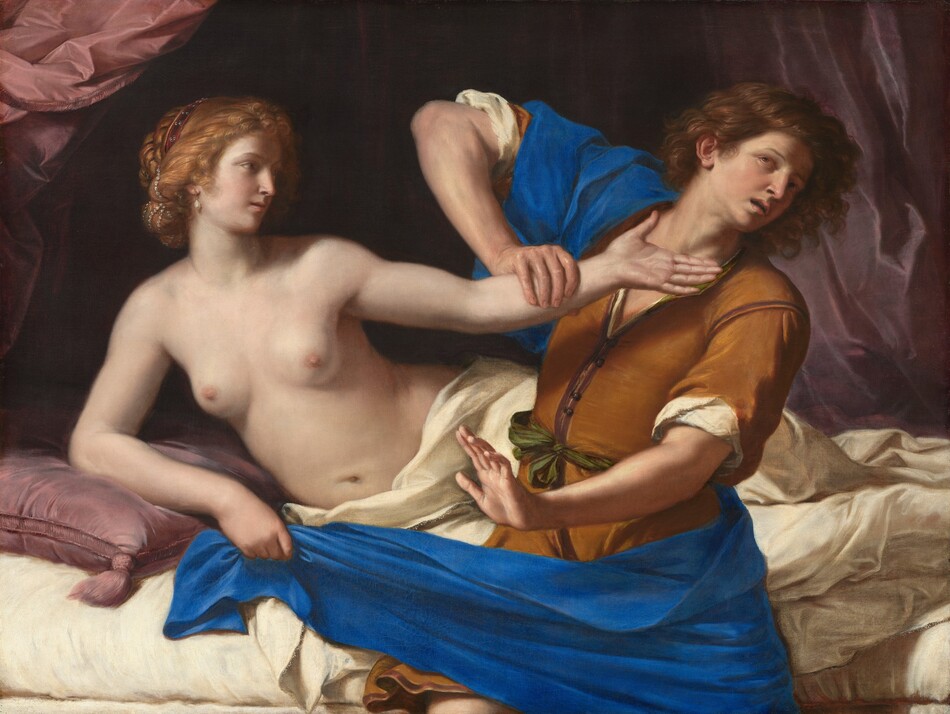
A nude woman with pale pink skin reclines under cream-white sheets in a bed as she reaches for the cloak of a man with light skin standing in front of the bed, who leans away with arms raised in this horizontal painting. The mattress runs along the bottom edge of the canvas, and the man is shown from the knees up. The woman’s bare torso faces us, hips stacked, as she turns her face to our right in profile, looking at the man. She props her body up with her right elbow, to our left, on a mauve-pink pillow. With that hand, she clutches the end of the man’s royal-blue cloak. With her other hand, she reaches with palm up across the body of the man toward his face. Her strawberry-blond hair is pulled back under a muted red ribbon, woven with pearls, and gathered at the nape of her neck. Soft curls frame her forehead and temple. A teardrop pearl earring dangles from her right earlobe. Her nose is long and slender, and her small, pale peach lips are slightly parted. The man’s body is angled toward the woman, to our left, but he twists and leans away, to our right. With elbow raised, he grips her extended forearm with his right hand, to our left. He raises his other arm with his palm out. He looks up with brown eyes under raised brows. His mouth is open and his head tipped sharply away from the woman so his chin-length, wavy, brown hair hangs by his face. He wears an ochre-yellow, thigh-length tunic over a white shirt. A thin olive-colored belt is tied in a bow at his waist. His vivid blue cloak wraps over his right upper arm, farther from us, around his torso and hips, and is pulled by the woman. Rose-pink, shiny curtains frame the scene in the upper corners, and beyond, the background is swallowed in shadow.

Joseph and Potiphar's Wife

Guercino

1649

Oil on canvas  Accession ID  1986.17.2

On View: West Building Main Floor, Gallery M33
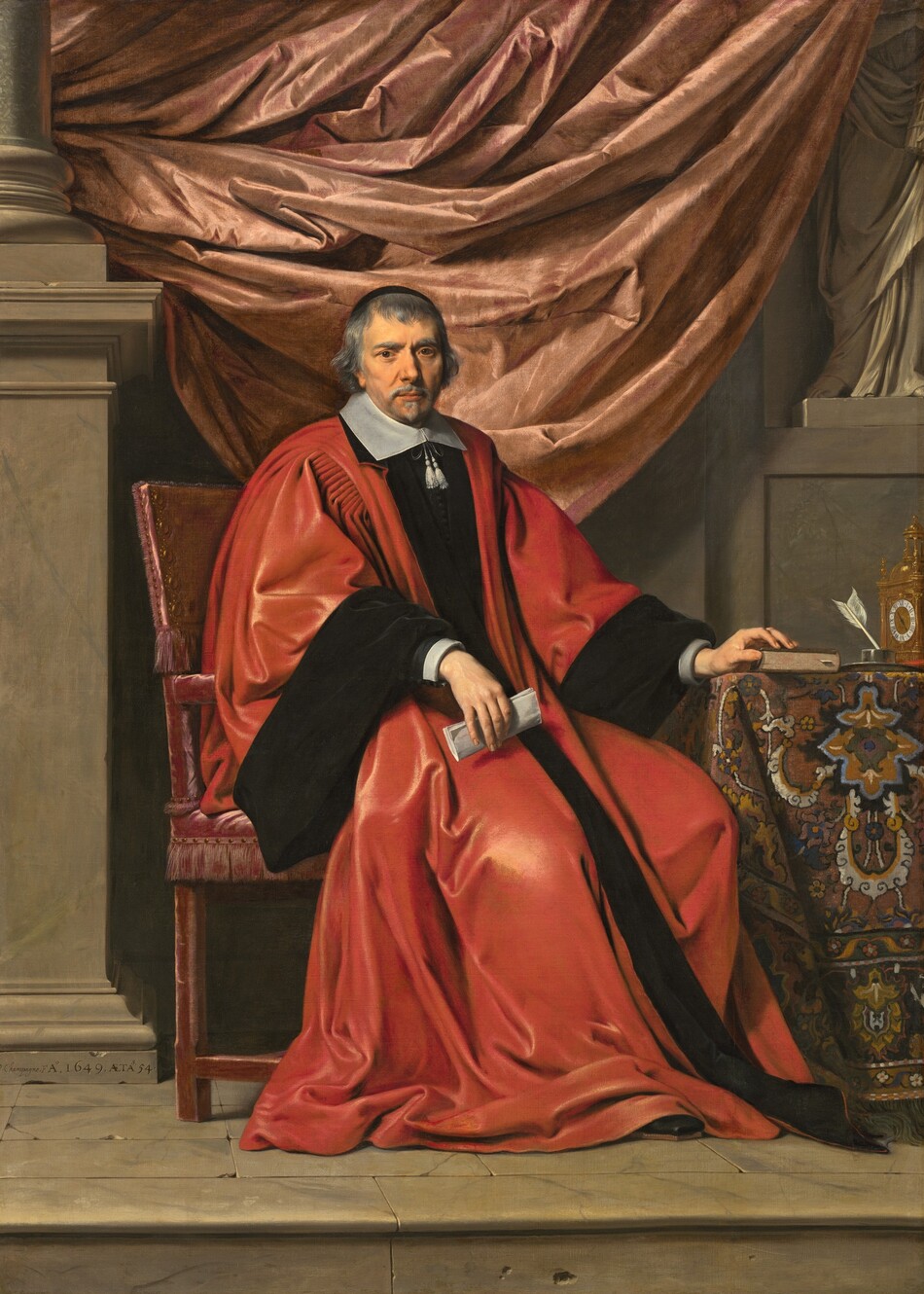
This painting shows a man seated on a red cushioned chair, his head turned toward us and his body facing slightly to the right, his hand resting on the corner of a table on the right. He has light skin, with a neatly trimmed gray mustache and pointed gray beard. His brown eyes look out at us, with his face is a neutral expression. His gray hair has a slight wave around his ears, and he wears a small black cap on the top of his head. He is wearing a red and black gown with wide sleeves, a white collar, and white cuffs. In his right hand, he holds a folded paper. His other hand rests on a closed book sitting on the table. The table is covered in a decorative cloth in shades of brown, black, white, blue, and gold, and next to the book is a white quill in a silver pot and an ornate golden clock. The background includes a large, draped curtain in a light pink color and a tall gray pillar on the left. A gray statue in a niche is partially visible in the top right corner.

Omer Talon

Philippe de Champaigne

1649

Oil on canvas  Accession ID  1952.5.35

On View: West Building Main Floor, Gallery M36
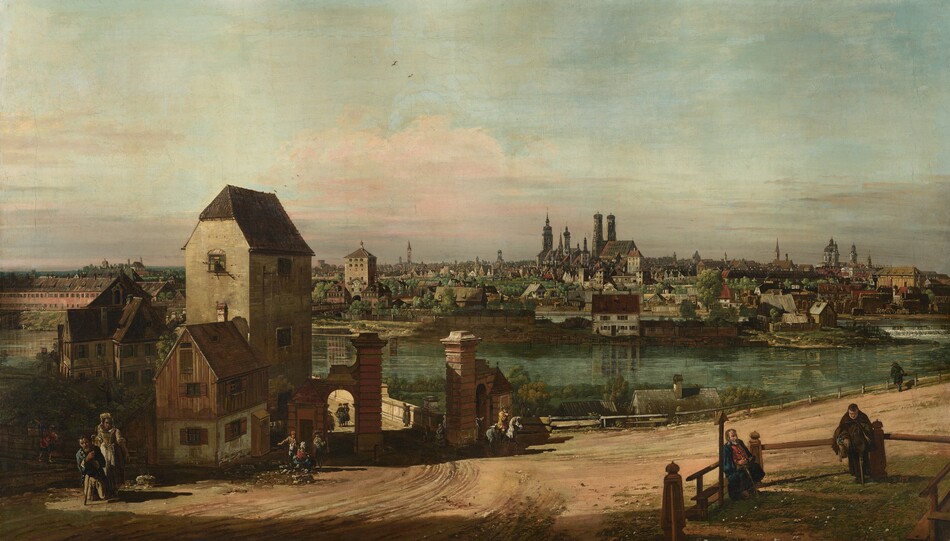
Afternoon sunlight pours over a town crowded along the banks of a serene, glass-green river that runs through the middle of this horizontal painting. Several buildings cluster to our left on the riverbank close to us. A gateway there opens onto a bridge or walkway that extends back and behind the buildings. Tiny in scale, people stand, sit, or ride singly or in small groups on the dirt road that spans the lower edge of the composition. One man sits on a bench in a fenced-in, grassy enclosure at the lower right, and another man there wears monk’s robes and holds a basket. The land must dip down steeply between the dirt road and riverbank, for a few rooftops nestled in there have chimneys at road level. Houses, churches, and grand structures line the far riverbank and fill in the town beyond. Many of the buildings are white or tan with dark red roofs, though others are brown or gray. Trees and an open green space are tucked among the structures. A pale blue sky with wispy, petal-pink and light tan clouds fills the top half of the composition.

View of Munich

Bernardo Bellotto, Italian 18th Century

c. 1761

Oil on canvas  Accession ID  1961.9.64

On View: West Building Main Floor, Gallery M30
We look slightly down onto a group of people gathered along the bank of a river that winds around a copse of tall trees to our left, past a hill to our right, and into the deep distance in this horizontal landscape painting. The horizon line comes about a third of the way up the painting. More than a dozen people gather to converse in pairs or trios, or work loading a ship in the lower right corner of the composition. Most of the people seem to be men, except for two women who stand near a man who gestures to our left at the lower center of the painting. The people we can see have light or tanned skin. The men loading the boat to our right wear pants and shirts in navy blue, gray, tan, or crimson red. Men wearing hats and capes over suits near the lower center, and the women wear clothing in olive green, butter yellow, petal pink, coral red, or gray. Goods are strewn along the riverbank closest to us, including potted flowering plants to our left, a jumble of chairs, tables, and musical instruments nearby, and collections of wooden barrels to our right and in the lower left corner. Two more boats are moored at the shore in front of the grove of tall, dark green, leafy trees that take up the left third of the composition. The sage-green surface of the river curves to our right, to a tree-covered hill with a watermill at its base. A stone structure with a large, central, round tower sits along the top of that hill. The river continues to wind into the deep distance, where towns nestle along the bases of rolling, slate-blue mountains along the horizon. The sky above is pale yellow along the horizon and deepens to pale blue above. Smoke-gray clouds sweeping in from the right are lit bright cream-white where the sun catches the edges. The artist signed and dated the painting as if he had written his name on the side of the boat in the lower left corner, though the inscription appears to be incomplete: “CLAVDIO o I Vo 16 9 OM.”

Landscape with Merchants

Claude Lorrain

c. 1629

Oil on canvas  Accession ID  1952.5.44

On View: West Building Main Floor, Gallery M36
Shown from the thighs up, a light-skinned man and woman gesture dramatically, partially covered only by colorful lengths of loosely draped fabric in this horizontal painting. To our left, the man stands with his lean, muscled body facing us but he turns his face to our right in profile to look at the woman with his chin dropped. His thick, dark hair is brushed back. He has a long, straight nose and his lips are parted. His left arm, on our right, is raised to shoulder height, elbow pointed out at the woman, and that hand is clenched in a fist in front of his chest. His other arm is slightly bent at his side, that hand also balled into a fist. A narrow, vivid cobalt-blue cloth winds and flutters around his body from behind him to our left, over the raised arm, and across his hips. To our right, the woman stands with her back to the man, and she looks back over her right shoulder. Her copper-red hair blows back from her face, lifting off her shoulders. She has light brown eyes under lowered brows, and the corners of her pink lips are pulled slightly down. She wears a teardrop-shaped pearl earring from the ear we can see and a headdress wrapped with more pearls at the back of her head. Her body is pale, soft, and rounded. Her arms bend at the elbows to cross in an X-shape in front of her bare breasts. With her left hand, closer to the man, she points an index finger at him. Around her body swirl two layers of satiny draperies, the outer one a honey orange, and an inner layer in dusty pink. Both people are lit from our right brightly enough to create deep shadows. Behind them, a bed at hip height has ivory-colored linens and a dark green drapery hanging to each side. The space recedes into darkness beyond the bed, contrasting with the brightness of the people.

Amnon and Tamar

Guercino

1649-1650

Oil on canvas  Accession ID  1986.17.1

On View: West Building Main Floor, Gallery M33
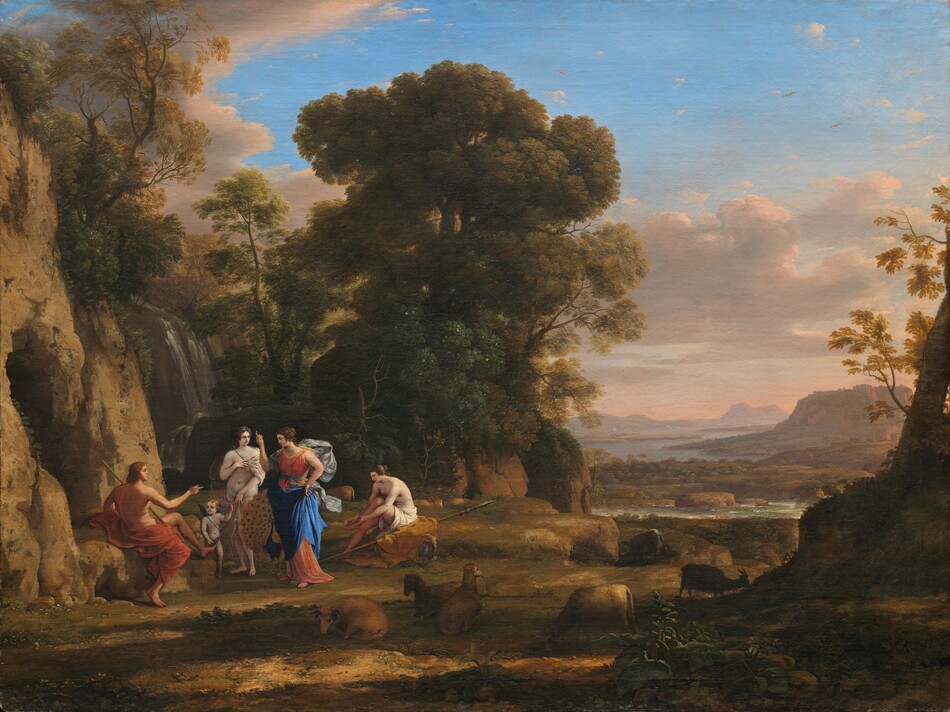
Three women, one man, and a winged child gather near a cave opening within a vast, distant landscape in this horizontal painting. The people are small in scale, taking up the lower left quadrant of the composition, and all have pale skin. Near the lower left corner, the man sits on a rock with his back mostly to us, so we see him in profile. Red cloth drapes around his hips and legs, and his chest and arms are bare. He braces a long staff in his far hand, and raises his right hand, closer to us, and points at the women. He is cleanshaven with a straight nose, closed lips, and brown, shoulder-length hair. To our right, two women stand and one sits on a cloth-covered rock. All three have brown hair that has been pulled back. They also have straight noses, and their lips are parted. The woman at the center of this trio wears a coral-red dress under lapis-blue cloth that drapes across her legs and is held in one hand. Smoke-blue fabric billows behind her. She stands with her body angled to our left, and she looks down at the man in profile. The back of one hand, to our right, rests near that hip, holding the fabric, and she points up with the index finger of her other hand. A peacock with its tail fanned open stands next to her, to our left. The other two women are nude except for a white cloth that partially covers the soft, rounded contours of their bodies. To our left of the peacock and close to it, the second woman holds her drapery so it covers her breasts and her groin. Her body faces us, and she turns her face to look at the central woman. A nude, winged child holding an arrow stands between her and the man. A blue ribbon across the child’s chest holds a quiver of arrows on his back. The third woman is to our right, sitting on a rock draped with a goldenrod-yellow cloth. A white cloth covers her hips, and she leans forward, touching her sandal. A long lance rests under the yellow cloth, and a metal helmet with a red feather sits next to the rock. Six sheep lie or graze along the grassy ground, closer to us. The rocky outcropping with the cave opening rises steeply along the left edge of the composition. A waterfall is tucked into shadows just beyond the cave, and tall trees enclose the left half of the scene. Nearly reaching the top of the canvas, the cluster of trees near the center have dark green canopies. A rocky bank is shown nearly in silhouette in the lower right corner, in front of a deep landscape with a body of water winding through low, marshy areas and a flat-topped formation. Mountains are hazy purple in the deep distance. The horizon comes about halfway up the composition, and the sky above has mauve-pink and lavender-gray clouds sweeping across a vivid blue sky.

The Judgment of Paris

Claude Lorrain

1645/1646

Oil on canvas  Accession ID  1969.1.1

On View: West Building Main Floor, Gallery M36

Loading Results