French, Italian, and Spanish Paintings

Filter Results

86 artworks on view.

Results

A young woman plays a small pipe organ while a winged angel holds up a piece of sheet music in this horizontal painting. A strong light source illuminates the scene from our right, creating deep shadows in the dark background. Both the woman and angel have pale skin, flushed cheeks, and light brown hair. Shown from the knees up and taking up the left half of the painting, the woman’s body is angled to our right as she sits at the organ, which is near the right edge of the composition. Her hair is pulled back into a braid, and wisps fall on her forehead. Her skin is smooth, and her head tilts down toward the organ. Her cherry-red dress has a squared neckline and olive-green sleeves over a white shirt. The voluminous sleeves are pushed back over her forearms as she rests her fingertips on the keys of the organ. Gazing toward the woman, the angel has short, curly hair, silvery gray wings, and wears a topaz-blue garment. Two lines of music on the paper the angel holds have notes written in and one staff is empty. The small organ is angled away from us so we see one narrow end and the row of low pipes along its back. The dark brown background lightens behind the young woman’s head.

Saint Cecilia and an Angel

Orazio Gentileschi, Giovanni Lanfranco

c. 1617/1618 and c. 1621/1627

Oil on canvas  Accession ID  1961.9.73

On View: West Building Main Floor, Gallery M29
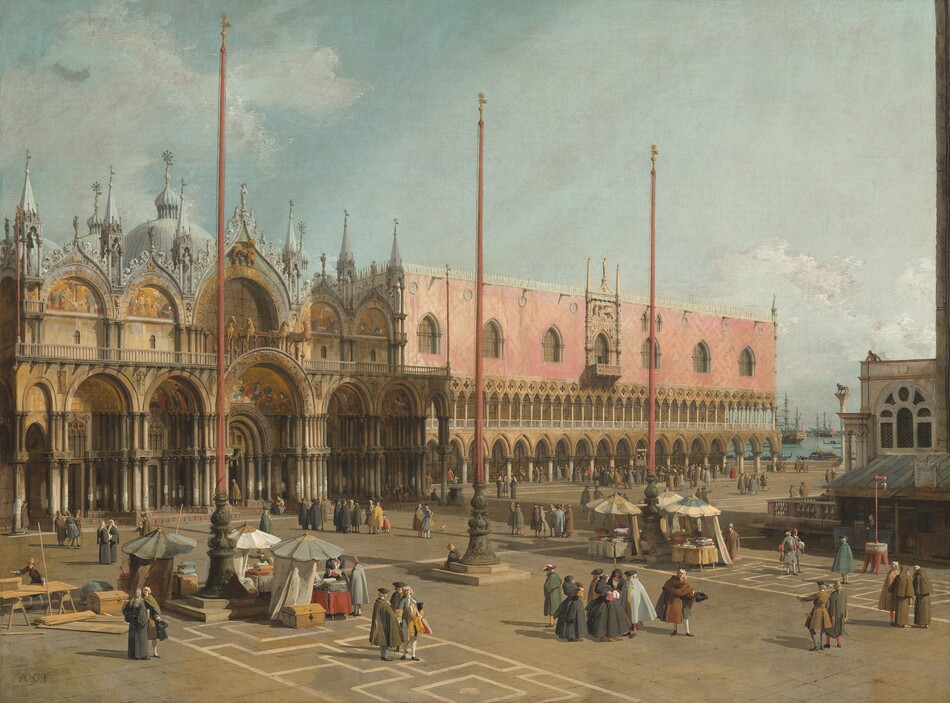
Dozens of men with several women and a few children gather in pairs or small groups across a sun-drenched plaza in front of a domed church next to a long, pale pink building in this horizontal painting. The people’s faces and hands we can see have pale, peachy skin. The men wear hats and shin-length capes or jackets over stockings in tones of charcoal gray, olive green, butterscotch yellow, black, and brown. The women wear black capes covering their heads and long, full skirts. The ash-brown plaza has two zones where geometric patterns are picked out in a lighter, oatmeal brown. Three coral-red flagpoles are spaced along the center of the plaza parallel to the two buildings. Each flagpole rests on an olive-green base about a third of the height of the pole. Tables under open umbrellas clustered around the outer two flagpoles display piles of cloth, and a few people gather around the wares. The domed building extends into the scene from the left edge of the painting, and reaches about a third of the way across as it angles away from us. It has a central portal with nested arches, flanked to each side by a pair of slightly smaller, arched portals. Scenes against gold backgrounds appear in the archway of each of the five doors. There is a second level of arches above. The smaller arches to either side are decorated with more scenes of people against gold backgrounds. Four gold horses stand atop the central, lower arch, each with one front and one back hoof raised. The arch behind them is dim, the back side of a stained-glass window. The stone of the arches and front of the building are light brown. The upper arches are lined with pale, slate-gray spires and curling tracery. The three-story pink building sits close by to our right, extending into the distance on the same angle as the church, and as tall as its neighbor. The lowest level is a series of open, pointed arches. The second level is also a row of arches, but more closely spaced. People walk and stand under both covered walkways. The top half of the building has a carnation-pink façade with seven windows evenly spaced across its width. The central window is surrounded by carved stone ornament. Along the right edge of the painting and closer to us than the large buildings is the corner of a two-story building. The lower level is in shadow under a sloping awning, creating a merchant’s stall, and the second level has a rounded, arched window. One person stands at the front corner of the roof and looks down into the square. In the narrow gap between the row of buildings to our left and the smaller structure to our right is a winged lion atop a tall column. Beyond that is sparkling blue water with several masted ships and long, narrow gondolas. The sky above has thin white clouds against a pale blue sky. The artist signed the lower left, “A.C.F.”

The Square of Saint Mark's, Venice

Canaletto

1742/1744

Oil on canvas  Accession ID  1945.15.3

On View: West Building Main Floor, Gallery M31
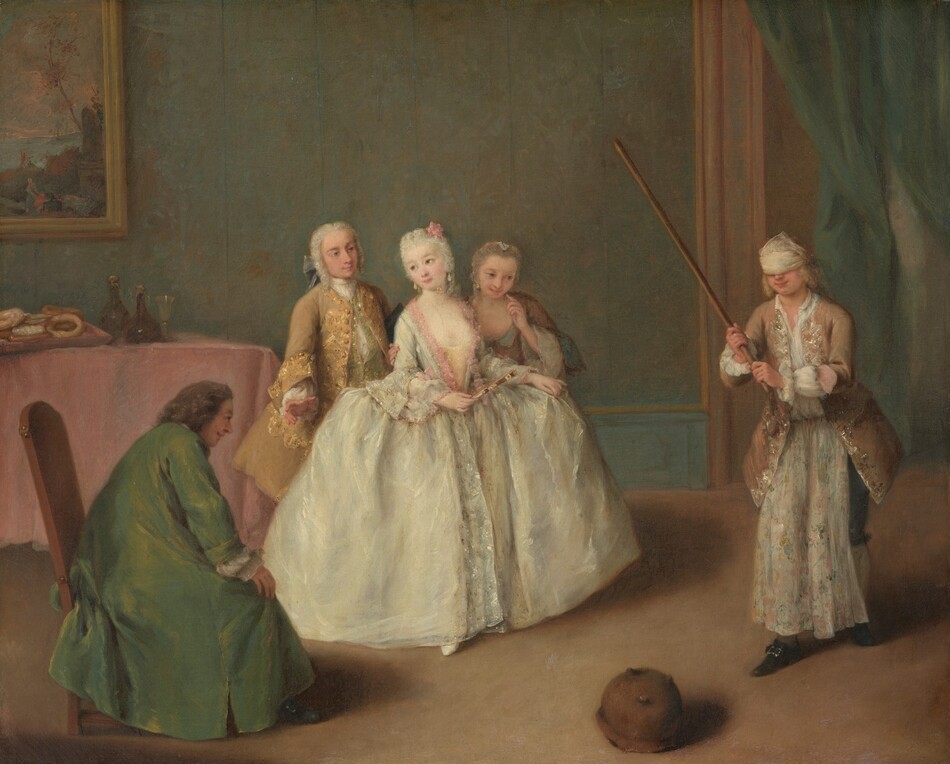
This painting shows five individuals in an indoor setting. Four are standing, while one person with long dark hair is seated on a chair in the bottom left corner, wearing a long dark green robe. In the center of the painting is a group of three people, including a man in a light gold embroidered coat and white breeches with a white wig. In the middle of this trio is a woman in an elaborate ivory gown with pink lace details, holding a fan and wearing a floral pink accessory in her white powdered hair. Another woman stands slightly behind her, dressed in a brown gown with gray styled hair. On the right, a blindfolded man stands and holds a wooden stick, wearing a long brown coat with silver embroidery, a white blindfold, and a white wig. A floral, light-blue cloth has been tucked into the front of his pants, covering blue breeches. All of the people in the painting have pale skin. The floor is light brown, and a small, round, brown object is on the floor in front of the group. The background includes a table with a pink tablecloth, wine bottles, and pastries, below a framed painting on the wall. The wall is a pale, blue-green color, and green drapes hang on the right side of the room next to a brown opening.

The Game of the Cooking Pot

Pietro Longhi

c. 1744

Oil on canvas  Accession ID  1939.1.64

On View: West Building Main Floor, Gallery M32
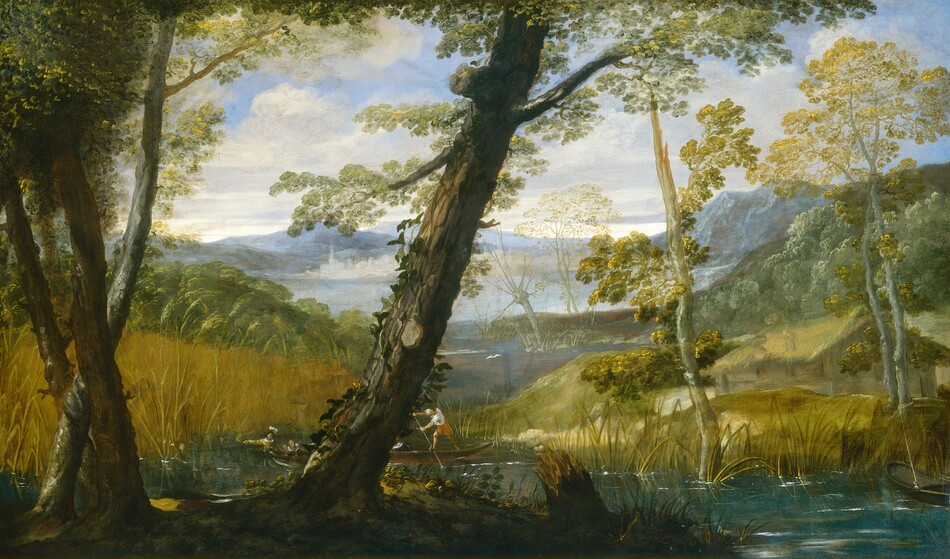
We look through shadowed trees at a river winding into the distance in this horizontal landscape painting. Close to us, a cluster of three thin trees and a larger central tree are deep in shadow, which contrasts with the light-filled scene beyond. The topaz-blue river curves from the lower right corner, across the canvas, and into the distance at the center. A few spindly trees grow along the riverbank in front of a hut with a thatched roof to our right. The bank to our left is lined with reeds and tall grasses. Behind the central shadowed tree, a long, low, narrow boat is occupied by four people with pale skin. To our left, a person with a dark garment and white collar reclines near a seated man wearing yellow and a feathered cap. To our right, another person reclines near the boatman who pushes the boat through the water using a long pole. The harvest yellow and sage green of the riverbanks and vegetation beyond the boats fades to hazy, pale blue mountains along the horizon line, which comes just over halfway up the composition. White clouds float across a blue sky above.

River Landscape

Annibale Carracci

c. 1590

Oil on canvas  Accession ID  1952.5.58

On View: West Building Main Floor, Gallery M33
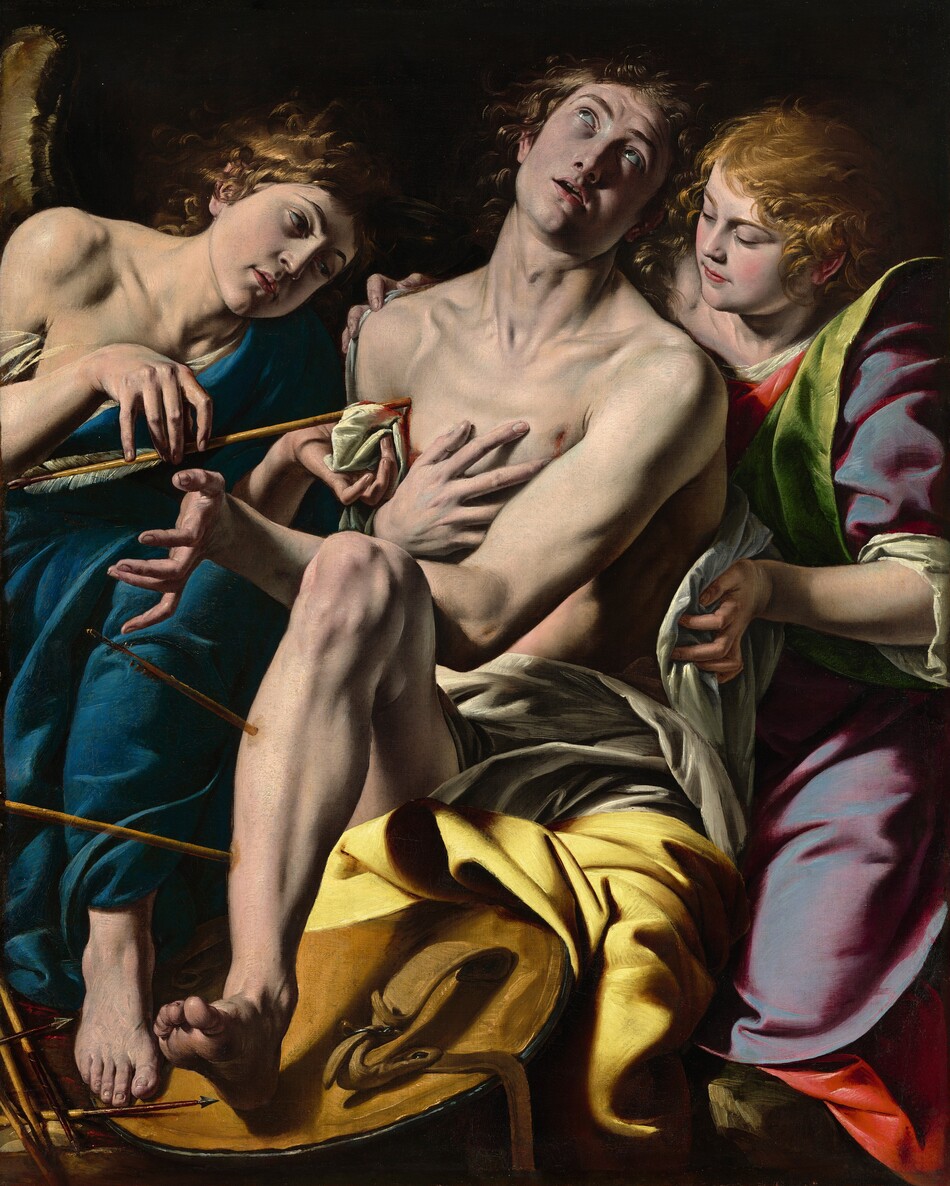
Bright light from the upper left washes over a young man pierced with arrows, an angel, and a young woman, who together fill this vertical painting. The three cluster closely against a black background, and all of them have pale, peachy skin. The muscular young man at the center, Saint Sebastian, faces us and appears to be seated with his right leg bent, to our left. The heel of that foot is braced on a round, golden brown object that might be the back of a shield. Saint Sebastian’s shin is pierced by two arrows. His head is thrown back as his glistening brown eyes roll back to gaze up and his mouth hangs open. He touches his chest near one wound, near his left shoulder, to our right. His other wrist rests against his bent knee, and the palm of that hand faces our left, fingers splayed back. He is nude except for silver-gray and goldenrod-yellow cloths draped across his lap and left leg. To our left, the angel, wearing a long, sapphire-blue toga, leans toward Saint Sebastian with shoulders squared to us. The angel’s head tips toward Saint Sebastian’s shoulder as he delicately draws an arrow from the saint’s chest and holds up a bloody cloth to staunch the wound. A sliver of a golden-brown wing shimmers against the ink-black background, near the left edge of the painting. Several blood-covered arrows sit near the angel’s feet, in the lower left corner of the painting. To our right, the woman stands close behind Saint Sebastian, wearing a plum-purple robe with emerald-green lining over a long, scarlet-red garment. She cradles Saint Sebastian’s body against hers, bracing him with her hands as she wraps the gray cloth around his back.

Saint Sebastian

Tanzio da Varallo

c. 1620/1630

Oil on canvas  Accession ID  1939.1.191

On View: West Building Main Floor, Gallery M29
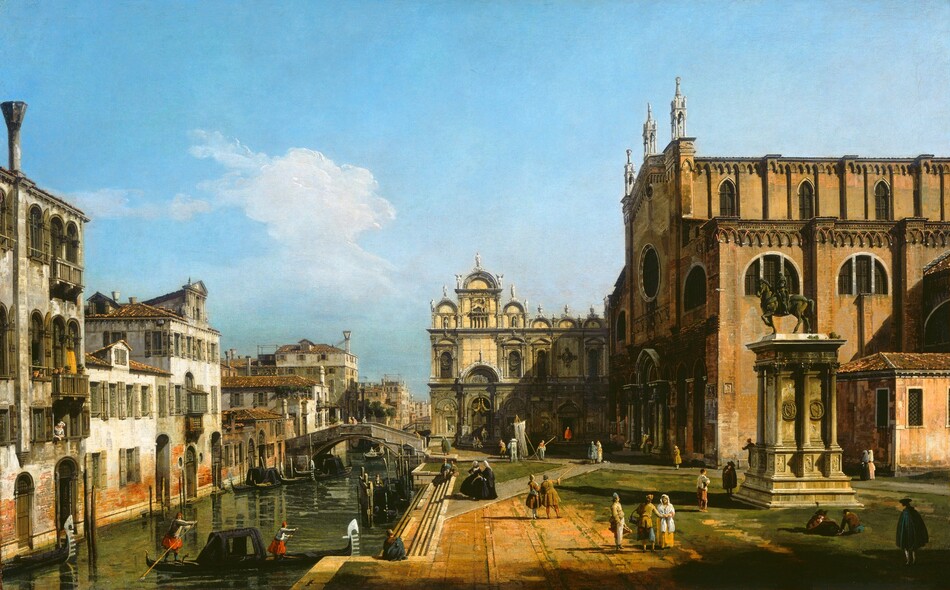
People walk, sit, or stand on a plaza along a canal lined on the far side with buildings in this horizontal landscape painting. The canal begins in the lower left corner and angles slightly right as it travels to the horizon, which comes about a third of the way up this composition. One, two, three, or four-story buildings line the canal to the left into the far distance. Arched doorways give direct access to the water, and one person leans out an upper-story window. The buildings are reflected in the gently rippling water, which is painted in shades of olive green. A stepped bridge crosses the canal in the near distance, and two gondoliers guide a long, narrow boat to a platform alongside the plaza in the bottom left corner of the composition. People walk or stand singly or in pairs on the plaza in the bottom right quadrant of the painting. The women wear dresses with long skirts and head coverings in shades of black, white, yellow, or pale pink. The men wear hats, jackets, capes, stockings, and slacks in shades of peanut brown, muted yellow, red, blue, or white. The people all appear to have pale, peachy skin. A statue of a man riding a horse rests on a towering platform in a grassy patch to our right. Beyond it is the blocky form of a red brick church. One man in a pair standing on the plaza gestures toward the entrance with a walking stick and others approach the central entrance. Sunlight streams across the scene from the upper right, throwing the church façade into shadow and casting a deep shadow across the face of another building that encloses the far side of the plaza. That second building has arched windows and doors, statues lining the roofline, and a winged lion over the entrance. A fat cloud trundles across a mostly empty vibrant blue sky above.

The Campo di SS. Giovanni e Paolo, Venice

Bernardo Bellotto

1743/1747

Oil on canvas  Accession ID  1942.9.7

On View: West Building Main Floor, Gallery M31
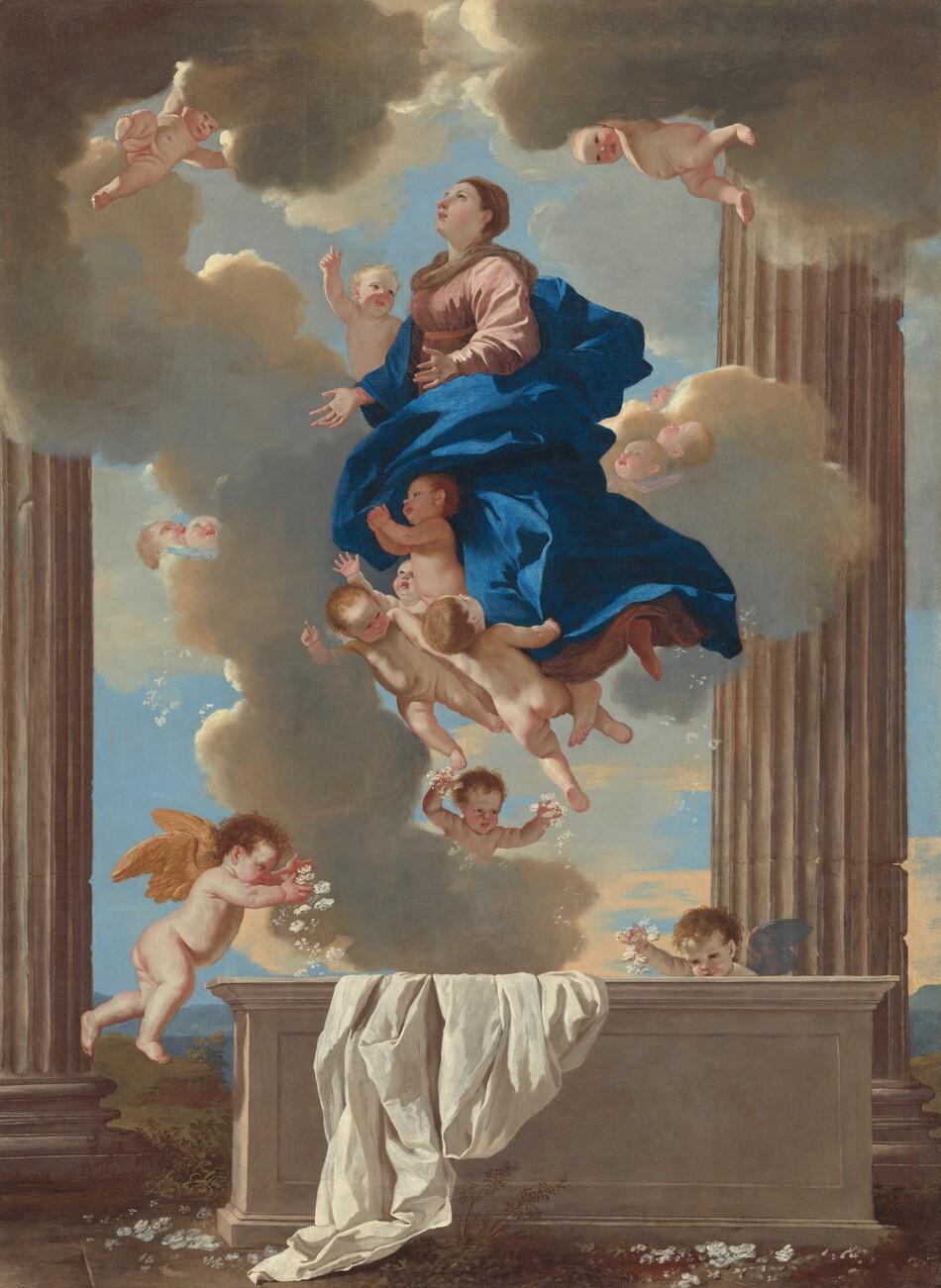
A woman floats among billowing clouds over a rectangular stone coffin in this vertical painting. Ten nude, baby-like putti support her body, float alongside her, or scatter flowers, while more winged baby heads are tucked among the parchment-brown clouds. The woman and all the babies have pale, peachy skin. The woman rises with her body facing our left, almost in profile. She looks up with dark eyes so we see the underside of her straight nose, and her coral-pink lips are parted. Her chestnut-brown hair is pulled back, and a scarf of the same color wraps across her shoulders. Her rose-pink dress is belted under her bust. It has puffy long sleeves, and the bottom hem flutters around her bare feet. Her lower torso and legs are wrapped with a voluminous, azure-blue cloak. She reaches her hands slightly forward, palms facing up. All the babyish putti have short blond or light brown hair, chubby bodies, and rosy cheeks. Four hold up or support the woman's legs, and many of them reach, point, or look upward. Another floats near her right arm, farther from us. Below, a white cloth is bunched and draped over the side of the stone coffin closer to us. Three child-like putti scatter white flowers into the coffin, and more are on the ground around it. Two of those putti have wings, one in golden yellow and the other slate blue. The clouds around the woman seem to emanate from behind the coffin to swirl up and around her. Two more putti hold up the clouds along the top edge of the composition. The scene is flanked to either side by peanut-brown, fluted stone columns, which extend off the top edge of the composition. The sky beyond is streaked with apricot peach near the horizon and shifts to topaz blue above.

The Assumption of the Virgin

Nicolas Poussin

c. 1630/1632

Oil on canvas  Accession ID  1963.5.1

On View: West Building Main Floor, Gallery M36
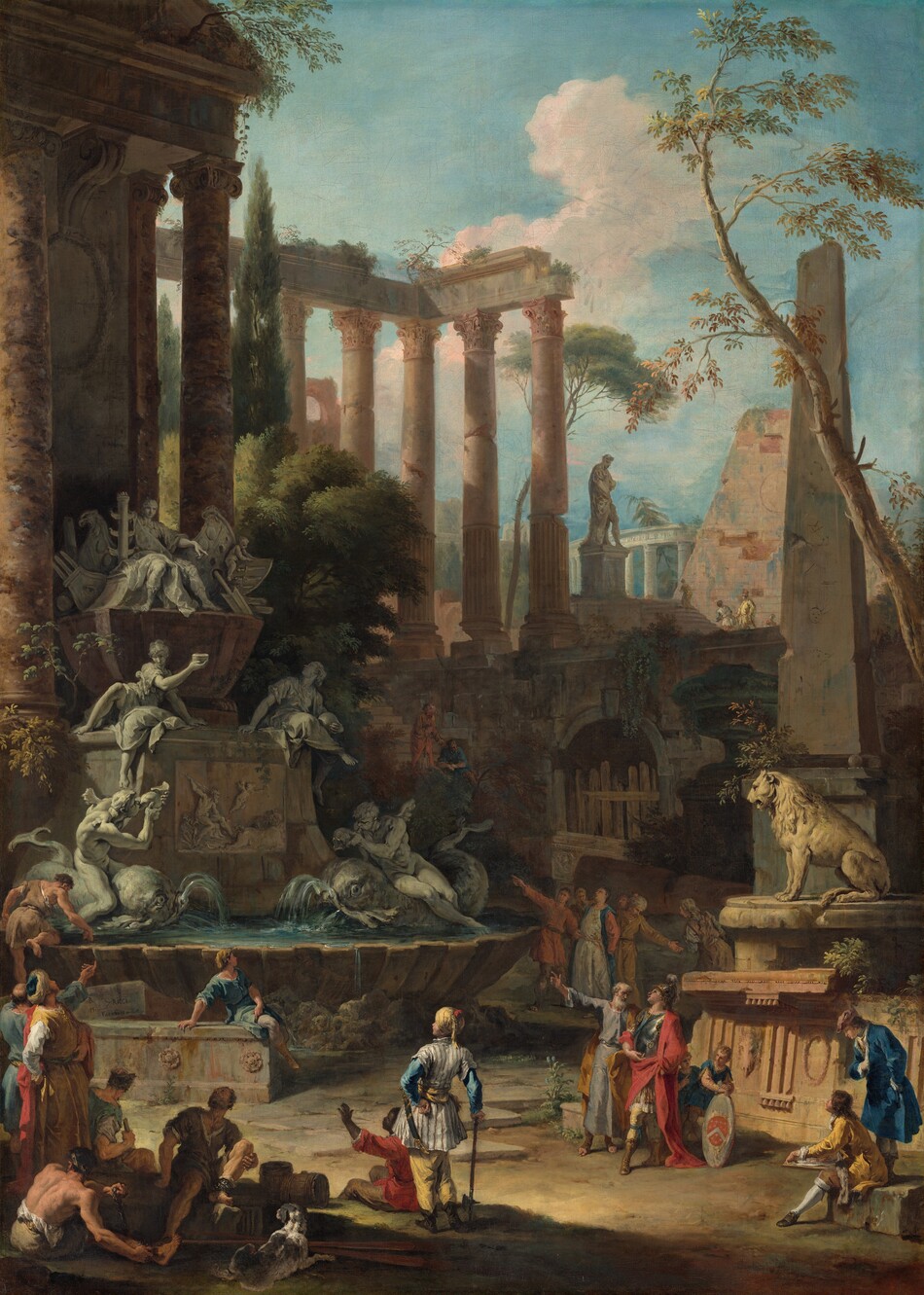
We look slightly down at an ornate fountain in a dirt and stone courtyard surrounded by about two dozen people, many of whom look at or gesture toward the fountain in this vertical painting. Most of the people have pale, peachy skin but one man, near the lower center, has dark brown skin and short black hair. The fountain has a broad, shell-shaped base filled with glimmering, aquamarine-blue water. In the basin, and as if carved from gray stone, two muscular, nude men blow horns as they ride stylized dolphins, which spout water into the pool. Two more people wearing robes sit atop a tall, pedestal-shaped form that rises from the back of the shell base. The person to our left holds aloft a bowl and the other holds a vessel on her lap as she turns to look up and behind her at the pinnacle of the fountain. There, a person, also carved from stone, sits on a throne and points down with one hand while the other, closer to us, rests on a short column with three flame-like protrusions up each side. He leans back against a short, curving ship with an oar coming through a porthole to our right. A nude, chubby, baby-like cherub straddles the rudder like a horse to our right. The sun falls down the front of the fountain, especially highlighting the middle tier and bottom shell-shaped basin, and it illuminates the people gathered around and near its base. One man to our left kneels on the edge of the basin and dips one hand in, as several others stand around it and look up at or point toward it. Most of the people wear robes, cloaks, and tunics in mustard yellow, tomato red, peach, white, and royal or light blue. A few vignettes draw the eye, including two men wearing chains on their ankles, are sprawled in shadow in the lower left corner of the composition. In that same cluster, two men stand and gesture toward the fountain while another sits at their feet. Nearby, the man with brown skin sits in front of a light-skinned man wearing a turban, a striped tunic, and a short sword hanging from his belt. The turbaned man stands with his back to us and rests his right hand on the handle of a pointed axe, using it like a cane. To our right, a person wearing an armor breastplate under a ruby-red cloak stands next to a balding man who also points up at the fountain. A young man wearing a lemon-yellow suit sits on a fallen block in the lower right corner of the composition, holding a board on his lap and presumably sketching the fountain, as a man wearing sapphire blue looks on. More people walk toward the fountain down in front of a gate to our right of the fountain. Beyond, plants and vegetation grow among ruins with columns, a stone obelisk, and a tall narrow pyramid. Pale pink clouds float in the pastel blue sky above. The artists signed their names as if written on the face of a stone block near the lower left: “B.” and “M.” next to “RICCI Faciebant.”

Memorial to Admiral Sir Clowdisley Shovell

Sebastiano Ricci, Marco Ricci

1725

Oil on canvas  Accession ID  1961.9.58

On View: West Building Main Floor, Gallery M31
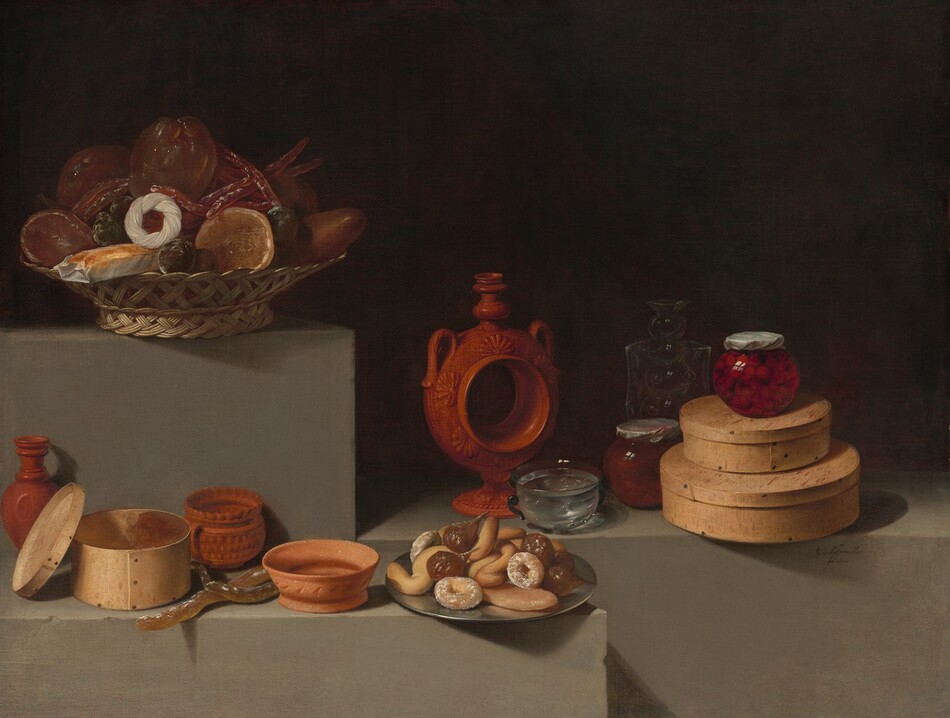
A basket of fruit, a plate of baked goods, glass jars, round wooden boxes, and terracotta-red and orange vessels are arranged among gray stone ledges set at different heights that together span the width of this horizontal still life painting. Light falls across the objects from the left, and the background is deeply shadowed, nearly black. Near the top left corner, a woven basket sits on the tallest ledge, almost reaching the top of the composition. It contains dark, plum-purple fruits, a golden loaf of bread in a white wrapper, and several translucent, glistening pieces of fruit in shades of brown and gold. Several long, garnet-red, finger-like objects are tucked among the fruit, and a braided white ring is propped in front. A ledge below this one starts in the lower left corner and spans just over half the width of the composition. Three terracotta vessels, a round, wooden box with its lid propped on its side, and a pewter-silver dish loaded with figs and baked sweets are arranged along the plinth, seeming close to us. Two long, fawn-brown, finger-like objects, perhaps more pastries, are tucked between the wooden box and a terracotta bowl. On the pewter dish, some of the pastries are round like doughnuts and sprinkled with white sugar, some curve in S-shapes, and at least one is long and straight. The third ledge extends from the center of the composition off the right edge, and it is situated behind the pewter dish and alongside the ledge with the basket. To the left on that ledge and at the center of the composition, a tall, rust-red vessel has a hollow center, creating a ring with a flaring foot. It has handles on the shoulders near the tall neck and spout. Shell shapes adorn the perimeter of the hollow center. A glass bowl filled with clear liquid and a round, glass jar filled with a red food, perhaps preserves, sit nearby. The jar sits in front of a translucent glass carafe, which is also tucked behind a stack of two round, lidded boxes, the one on top smaller than the one beneath. Another jar filled with cherry-red fruit sits atop the smaller box. The jars are sealed with twists of paper. The artist signed and dated the work as if he had inscribed the front face of the ledge near the lower right, “Juan vanderHamen i Leon fat 1627.”

Still Life with Sweets and Pottery

Juan van der Hamen y León

1627

Oil on canvas  Accession ID  1961.9.75

On View: West Building Main Floor, Gallery M34
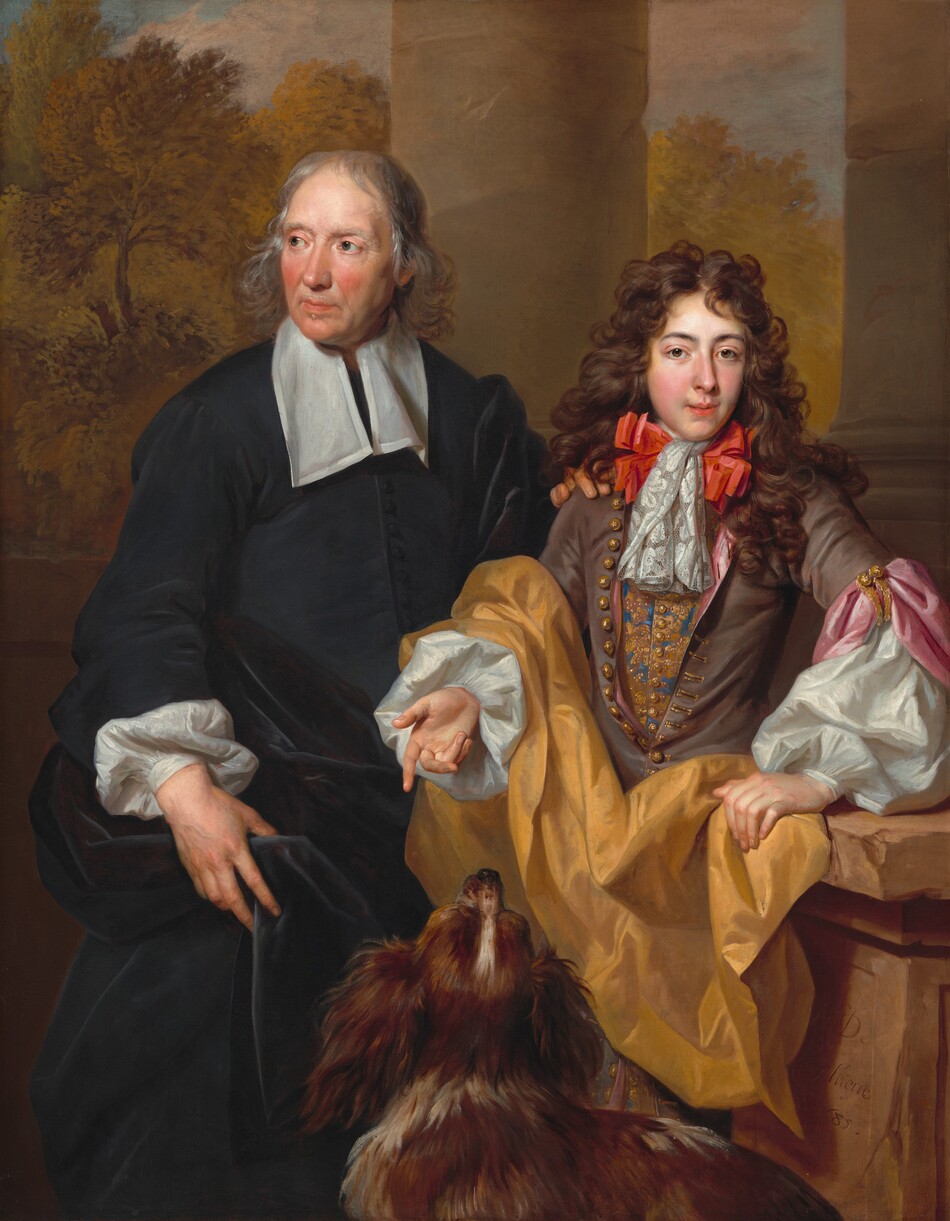
An older man, a young man, and a dog stand on a verandah that opens onto a landscape in this vertical portrait painting. The men are pale skinned and shown from the knees up. The older man stands on the left with his head turned to look off in that direction. Long, silver-gray hair frames his flushed face. Bushy brows curve over his dark gray eyes, and deep creases line his long nose. His plump pink lips are closed between a thin white mustache above and a dot of a beard below. A long white collar hangs down the chest of his lead-gray jacket. His right sleeve, on our left, is turned back to show the cuff of a puffy-sleeved white shirt underneath. That hand holds gleaming velvet-black fabric, which is gathered at his waist and falls to his knees. His other hand rests on the shoulder of the young man to our right. That man’s oval face is framed by thick, shoulder-length, curly, chestnut-brown hair. He gazes at us with amber eyes under slender brows. He has flushed cheeks, a narrow nose, and coral-red lips are slightly parted. A bright orange ribbon tied under a white brocaded ascot around his neck is wider than his face. His russet-brown jacket is unbuttoned to show an embroidered gold and azure-blue vest underneath. A wide pink sash is fastened around his left elbow, on our right, and billowing white sleeves extend from the shorter sleeves of the jacket. He holds his right hand, to our left, palm up with his index finger extended toward the dog in front of him, who has turned to look up. Shown from the back, the dog has long, glossy, coffee-brown fur with some white streaks. The young man’s other hand rests on a chipped stone balustrade next to him. The artist signed and dated the work as if he had carved the front face of the balustrade to read, “N. De Largillierre F. 1685.” Two stone columns rise to either side of the young man and give way to a tree-filled landscape under a muted blue sky above.

Portrait of a Young Man and His Tutor

Nicolas de Largillierre

1685

Oil on canvas  Accession ID  1961.9.26

On View: West Building Main Floor, Gallery M37
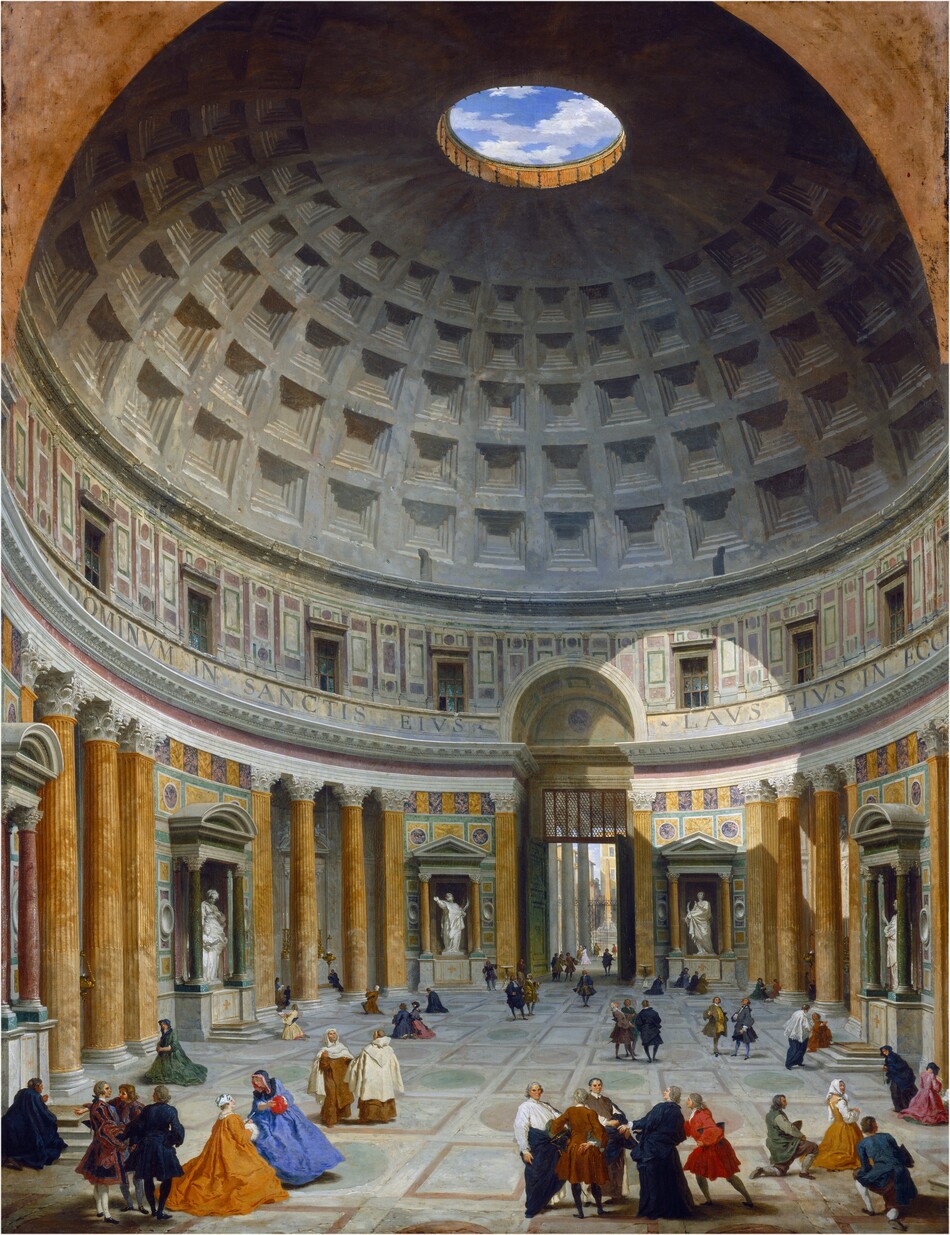
Dozens of men and women wander through a tall interior space lined with statues and columns and topped by a soaring domed roof in this vertical painting. The people are small in scale within the cavernous space. The women wear long, full dresses and the men wear knee-length waistcoats and stockings in shades of dark blue, crimson red, pine green, marigold orange, or brown. Three people wear clothing of the clergy: two of them, on our left, wear long, ginger-brown robes under white mantles, and a third person on our right wears a hip-length, diaphanous white cape over a long dark blue robe. The crowd strolls, kneels, converses, or leans back to look up at the high ceiling overhead, which has a round opening at its apex. A glimpse white of azure-blue sky with white clouds is visible through the opening. The interior is divided into three levels. The ground level has five niches lining the walls, each with a white stone statue of a man or woman standing inside. Each statue is at least three times the height of the people in the space below. The three niches closest to us on our left and right have semicircular pediments with garnet-red or moss-green columns flanking the statues. Two niches at the far end have triangular pediments and honey-gold columns. Each niche sits on a wide base, presumably an altar, and is surrounded by marbled gold and purple panels set against a sage-green background. Sets of three honey-gold columns line the wall between each niche. Oversized, copper-green double doors are swung inward at the far side of the space. More people, a sunlit obelisk, blue sky, and slivers of other buildings are visible through the doorway. The second level of the interior has windows spaced across walls otherwise covered with white, blue, and mauve-pink panels. An inscription running around the building between the first and second level reads, “DOMINVM IN SANCTIS EIVS LAVS EIVS IN ECCLE.” The third level is the domed pewter-gray ceiling with coffers, like inwardly stepped panels. The floor is patterned with alternating circles and rectangles in sage green or light brown.

Interior of the Pantheon, Rome

Giovanni Paolo Panini

c. 1734

Oil on canvas  Accession ID  1939.1.24

On View: West Building Main Floor, Gallery M30
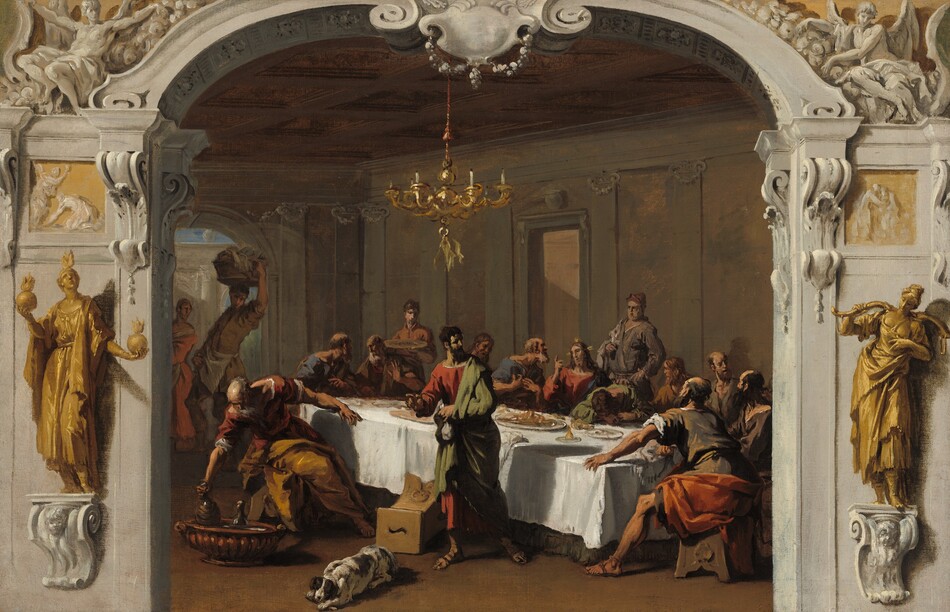
Seen through a wide, shallow, ornamental, stone arch, seventeen light-skinned people and a dog gather around or near a long banquet table set with plates of food in this horizontal painting. The table angles away from us so the short, right side is closest to us in the darkened room, which is lined along the far wall with shallow columns and capitals. To our left, an arched doorway in the room opens to a view of a stone structure and a sliver of blue sky. A gleaming, gold candelabra with curving arms hangs over the table from a coffered, possibly wooden ceiling. The table is covered with a white cloth. Men crowd around the short ends and the long side of the table opposite us. In pairs and trios, the men converse or look toward a man with light radiating from the top and sides of his head, at the center of the far side of the table. That bearded man, Jesus, has long brown hair and points his index finger upward with his right hand, on our left. The other men at the table wear robes and tunics in sage green, tan, brown, or slate blue. A portly man behind Jesus stands with a cloth draped over one forearm and his other hand on his hip, looking down at the table. Another cleanshaven man stands holding a large platter at the far corner of the table, and two people, perhaps a man and woman, appear to be walking away from the table but look back over their shoulders to our left. On the long side of the table, closer to us, a man to our left, balding with a long gray beard, sits on a narrow, bench-like seat and twists to pick up a jug from a large basin on the floor. The final man stands near an overturned seat as he turns his back on the table. He gestures forward, to our left, with one hand as he looks back over his other shoulder. A white dog with brown spots chews on a bone near the overturned seat. The highly decorated wide archway through which we see the scene seems to be carved from pale, fog-gray stone with scrolling moldings and capitals. The arch has a shield-like decoration at the top center, and is flanked by sculpted people in the upper corners. Two larger golden statues of robed women stand on floating plinths to either side of the arch. The woman to our left holds flaming orbs and the other holds a yoke across her shoulders. Though the painting seems rather illusionistic from afar, closer examination shows that it is sketchily painted throughout.

The Last Supper

Sebastiano Ricci

1713/1714

Oil on canvas  Accession ID  1943.4.32

On View: West Building Main Floor, Gallery M30

Loading Results