Italian Medieval and Renaissance Paintings and Sculptures

Filter Results

366 artworks on view.

Results

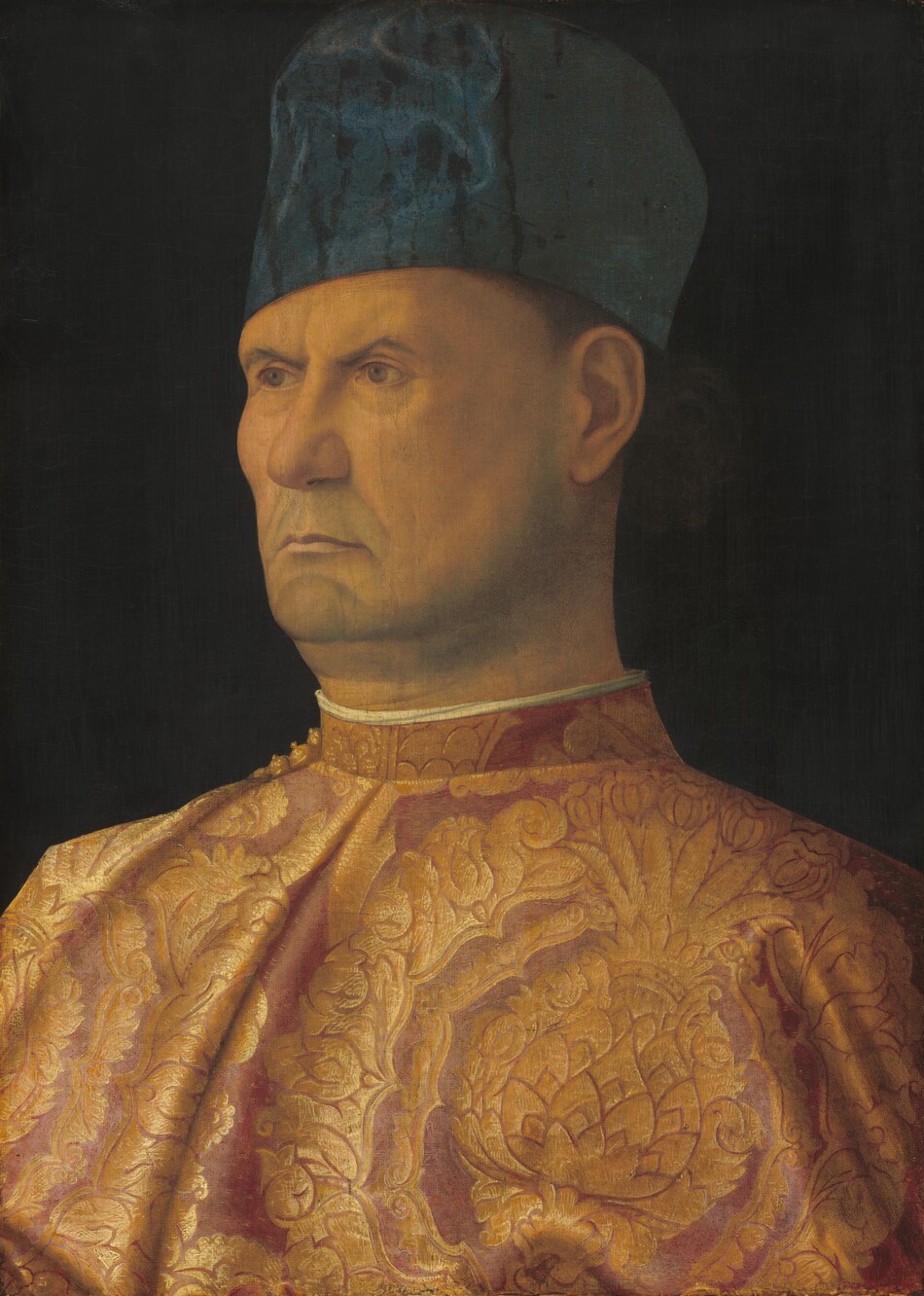
Shown from the chest up against a black background, a man with peachy skin wears a gold and rose-pink cloak in this vertical portrait painting. With his shoulders pulled back, the man’s body is angled to our left, and he looks in that direction with gray eyes under pointed, furrowed eyebrows. There are wrinkles around his eyes and mouth, and he has a five o-clock shadow along the jowls lining his jaw. He has a rounded nose, and the corners of his thin, pale pink lips turn downward. The hint of closely cropped, dark hair is seen around his ear under his tall, brimless, cobalt-blue cap. His cloak has a stylized floral pattern around pineapples in gold, against a dusky-rose pink background. The high neck of his cloak is lined with white.

Giovanni Emo

Giovanni Bellini

c. 1475/1480

Oil on panel transferred to canvas mounted on panel  Accession ID  1939.1.224

On View: West Building Main Floor, Gallery M12
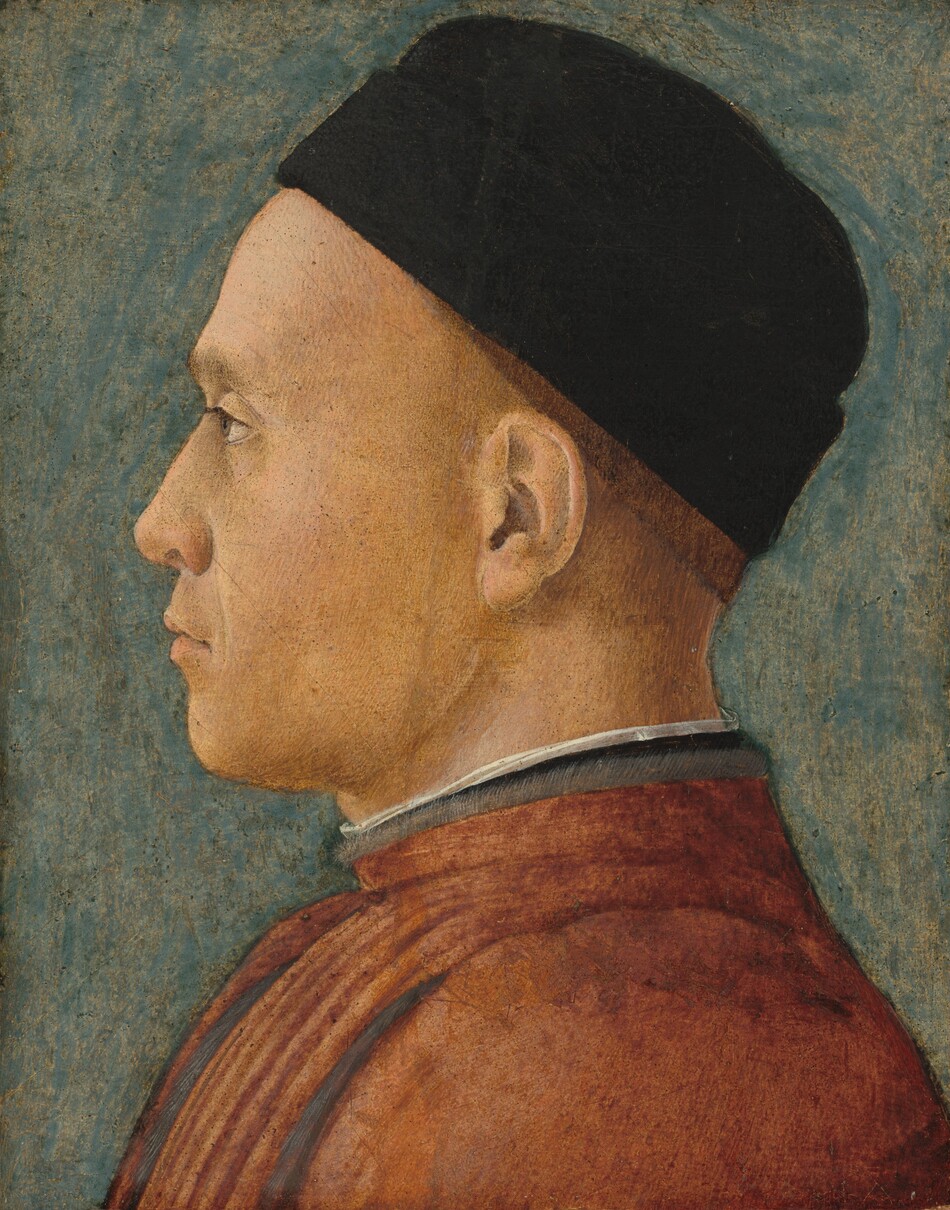
This painting shows a portrait of a man. His head is turned to the left. He has light skin, a straight nose, a soft jawline, and pale lips in a neutral expression. He has closely cropped brown hair mostly covered by a black cap. He wears a red garment with a high gray-and-white collar. The background is a textured, muted blue.

Portrait of a Man

Andrea Mantegna

c. 1470

Tempera on hardboard transferred from canvas transferred from panel  Accession ID  1952.2.5

On View: West Building Main Floor, Gallery M13
On a ledge-like rocky outcropping, a man kneels and looks up at an angel while, below and closer to us, three people sit or lie near the same man, who is shown twice in this vertical painting. The people have light skin with a greenish cast, though their cheeks are flushed, and they have flat, gold halos around their heads. In both appearances, Jesus has long, wavy, amber-blond hair, a beard, and a long straight nose. He wears a lapis-blue robe under a rose-pink cloak, which are edged in gold. Closest to us, he stands near the lower left corner of the composition, facing our right almost in profile. He holds one hand to his chest and with the other, clasps the hand of a man kneeling in front of him. That man, Saint Peter, wears a sky-blue robe and a canary-yellow cloak, and he has a gray beard and hair. His brows are lowered and furrowed as he reaches for and looks up at Jesus. Between Jesus and Saint Peter, a cleanshaven young man, also with blond hair, sleeps sitting up with his head propped on one hand. He wears a sage-green robe under a sky-blue cloak. Another man lies on his stomach beyond the others, so his head, resting on his folded arms, nearly reaches the right edge of the panel. He wears the same blue and pink of Jesus, and also has blond hair. Beyond this trio, a garden separates the four men close to us from the kneeling Jesus above. The garden has a hedge of pale pink roses, two small trees with red flowers, and rows of vegetation painted with pine green. That second, kneeling Jesus folds his arms across his chest, and his face and neck are dotted with touches of scarlet red. He looks up at a miniature winged angel, whose robe and wings are marigold orange. The angel holds out a golden chalice, which blends into the shiny gold background behind the people. Beyond the mount with the kneeling Jesus, a steep, narrow, charcoal-gray hill rises in the distance, to our left. About a dozen soldiers carrying lances and shields, on horseback and on foot, ride or walk from a fortified castle. A man with a dark halo, wearing a red robe and gray cloak, walks near the front of the line. The panel comes to a pointed arch at the top, and the corners are filled with raised vines and flowers, also painted gold.

Scenes from the Passion of Christ: The Agony in the Garden [left panel]

Andrea di Vanni

1380s

Tempera on panel  Accession ID  2014.79.711.a

On View: West Building Main Floor, Gallery M3
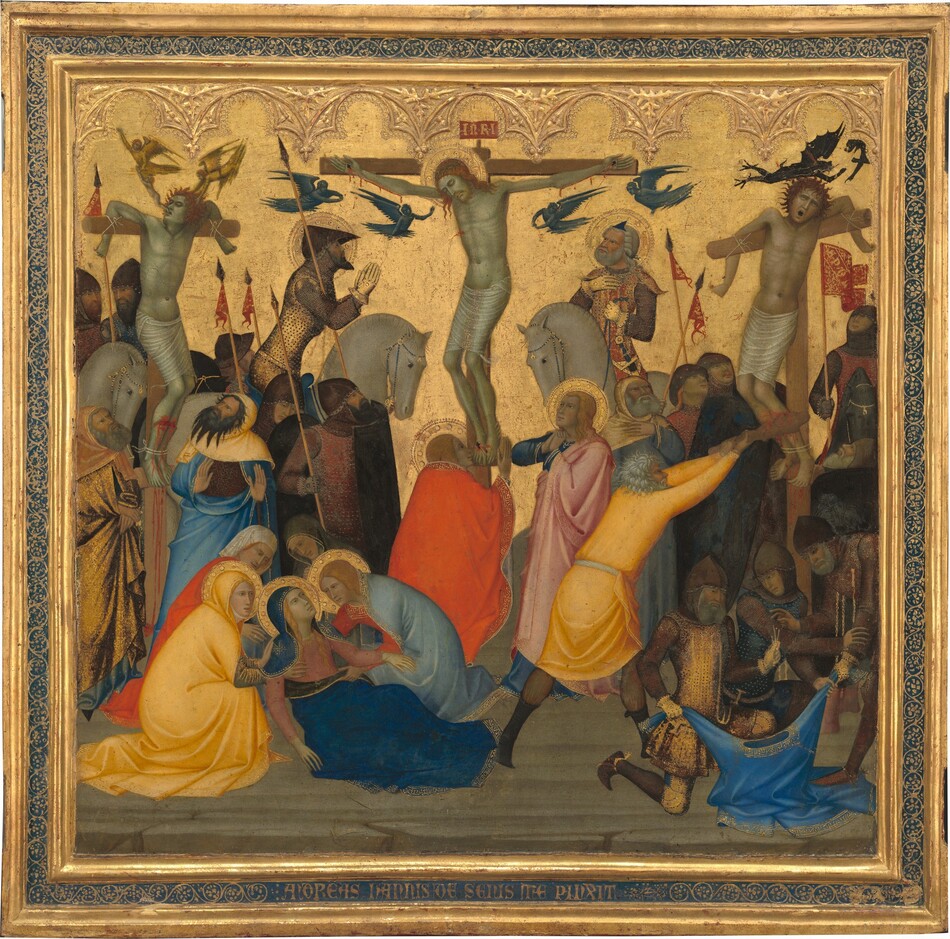
Three men hang on wooden crosses above people crowded below in this square panel painting. The crucified men wear only white cloths across their hips, and their pale skin has a noticably green cast. A halo encircles the bent head of the man on the middle cross, Jesus, who wears a ring of thorns in his long, red hair. Blood trickles down his forehead and drips from nails driven through his hands and overlapped feet, and from a gash over his right ribs, to our left. Four miniature, winged angels are painted entirely in tones of dark cobalt blue fly in pairs on either side of his body. An inscription over the top of the cross reads “INRI” in gold letters against a red field. The other two crosses are spaced evenly to either side. The men are tied with their elbows hooked unnaturally back over the crossbeams and wounds on their broken shins pour blood. The man to our left tilts his head up as one small, golden angel touches the back of his head and the other lifts a miniature version of the man from his parted lips. To our right, the man’s eyes roll back and his mouth gapes open as two black, winged creatures like dragons fly overhead. In the bottom left corner, a group of four women comfort a recumbent woman with long blond hair wearing a blue cloak. In the right corner, a group of three men tug at a blue tunic, as they draw straws from one man’s fist. Other men and women, a few with gold halos, cluster at the feet of the crosses, wearing robes and armor in shades of buttercup yellow, coral and brick red, light and lapis blue, and brown. The panel is in a gold frame inset with a band of lapis blue with a scrolling, leafy design in gold.

Scenes from the Passion of Christ: The Crucifixion [middle panel]

Andrea di Vanni

1380s

Tempera on panel  Accession ID  2014.79.711.b

On View: West Building Main Floor, Gallery M3
A bearded man, Jesus, strides from under an archway across a wooden door that lies flat along the ground as it pins and crushes a black beast in this vertical, framed panel. A crowd of people huddle inside the rocky cave, and everyone has pale skin faintly tinged with green. Jesus wears a bright, gold-patterned cloth draped over one shoulder and around his body. He holds a tall pole with a flag with a red cross on a white field with his left hand. His other clasps hands with an elderly man with gray hair and long white beard. Behind the elder man, a crowd of men and women kneel in front of the opening of a craggy cave. One man holds a scroll with black letters that reads, “ECCE ANGIUS.” Another bearded man floats above holding a scroll that reads, “DESTRUXIT QUIDAM MORTES INFERNI ET SUBVERTIT POTENTIAS DIABOLI.” Above the scene, an architectural arch and tracery is created in low relief in gold against the gold-leaf background. The gold frame has inset bands of lapis blue with scrolling, leafy designs in gold above and below the central scene.

Scenes from the Passion of Christ: The Descent into Limbo [right panel]

Andrea di Vanni

1380s

Tempera on panel  Accession ID  2014.79.711.c

On View: West Building Main Floor, Gallery M3
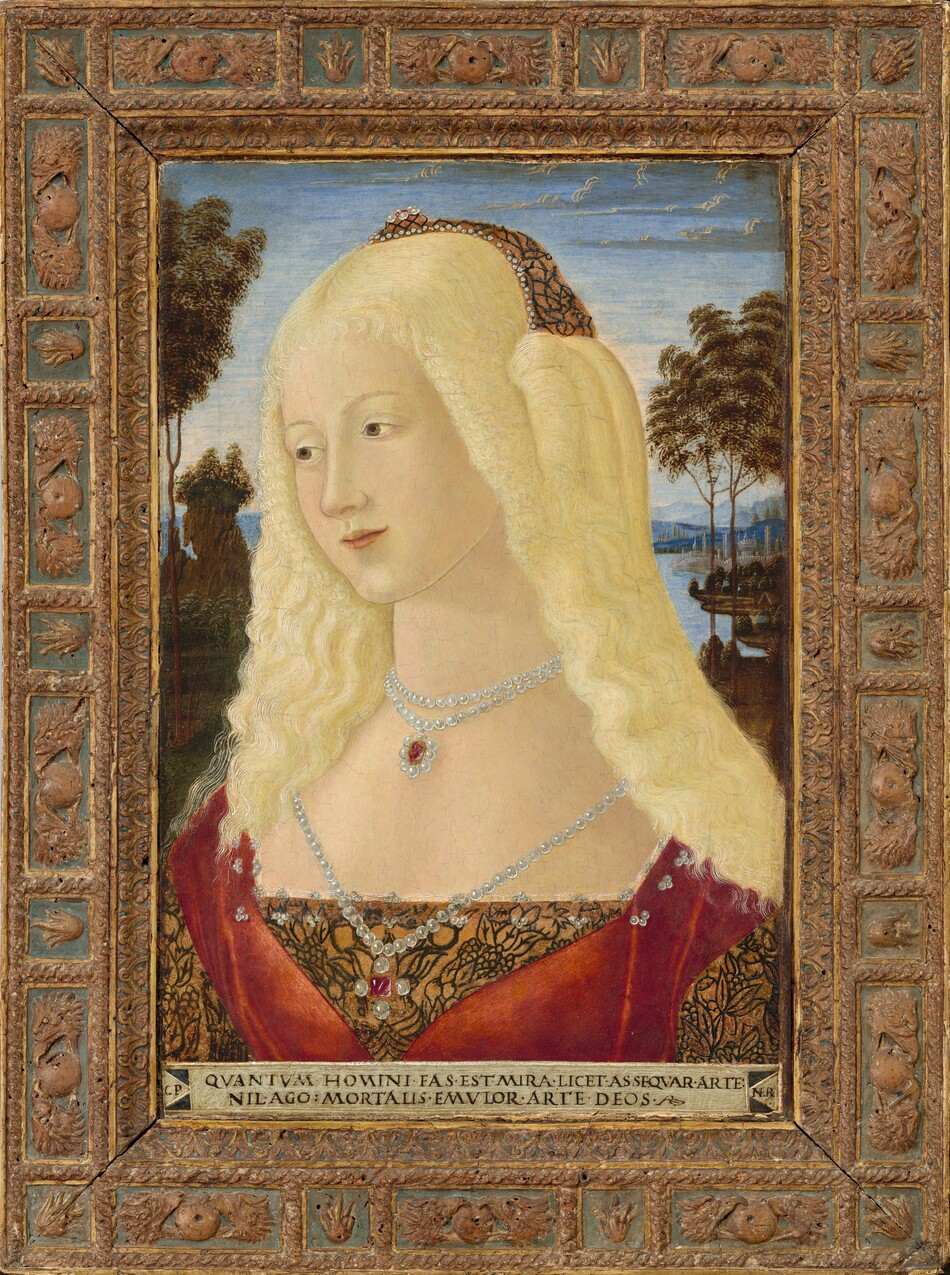
Shown from the chest up, a light-skinned, blond young woman wearing a gold and red gown and pearls looks off to our left in this vertical portrait painting. Her face and body both angle to our left, and she gazes in that direction with brown eyes under faint brows. She has smooth skin, a long, straight nose, and her closed, light pink lips curl up slightly at the corners. Long, cottony, light blond hair falls over her ears and flows down beyond her shoulders. At the back of her head, she wears a caramel-brown cap decorated with black, web-like lines and a row of pearls along the front edge. Her bodice is the same golden brown color, with the black linework in a leaf and floral pattern. The low neckline runs straight across her chest, and swaths of scarlet-red fabric wrap over her shoulders to meet in a wide V. Clusters of three tiny pearls line the squared edge of her neckline. A double-stranded pearl necklace has a red gemstone pendant that hangs at the base of her neck. A third, single strand of pearls hangs low over her chest, holding a pendant with a magenta-pink stone flanked by more pearls. A landscape stretches into the distance behind her. Dark green, grassy fields dotted with trees leads back to a winding body of water, over her shoulder to our right. Stone walls enclose at least two clusters of buildings, including several towers, far back along the banks. The light blue sky is tinged with petal pink near the horizon, over mountains painted blue in the hazy distance. An ivory-white band spans the bottom edge of the portrait, and is inscribed, “QVANTVM HOMINI FAS EST MIRA LICET ASSEQVAR ARTE. NIL AGO: MORTALIS EMVLOR ARTE DEOS.” The band is flanked by a triangle to each side; the one to our left has the letters “CP” or “OP,” and the one to our right reads “NER” with the N and E conjoined. The painting has an ornately carved, brown wooden frame. A rope design divides the border into alternating squares and rectangles. Each rectangular box has a pair of carved eagle heads flanking an orb, while a flame-like shape is in each of the smaller square boxes. The boxes and trim have slate-blue backgrounds, and gold edging.

Portrait of a Lady

Neroccio de' Landi

c. 1485

Tempera on pine panel  Accession ID  1942.9.47

On View: West Building Main Floor, Gallery M8
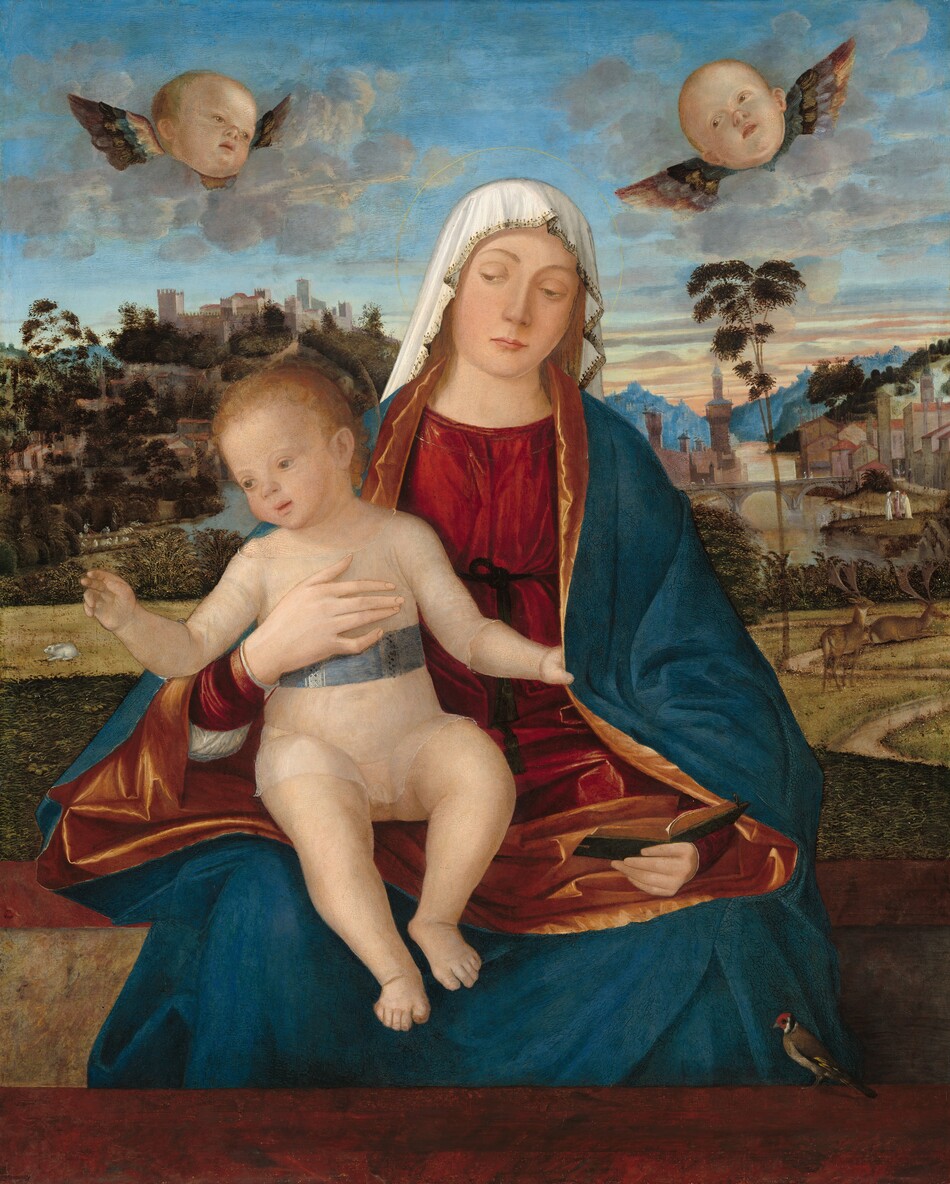
Shown from the shins up, a woman holds a seated child in her lap below two winged baby heads and in front of a deep landscape in this vertical painting. The woman, child, and faces above all have pale skin and blond hair. The woman sits at the center of the painting with her body facing us. Her head tips slightly to our right, and she looks down and to the left with heavy-lidded eyes. She has a heart-shaped face, and her pink lips are closed. A white cloth drapes over her head and back beyond her shoulders. Her ruby-red dress is tied with a dark green, nearly black cord around the waist, and a voluminous lapis-blue robe with a coppery gold lining drapes heavily over her shoulders and covers her lap. She holds a book with a dark green cover open in her left hand, to our right, and braces the baby’s chest with her other hand. Both she and the child have delicate, gold lines creating halos. The baby’s pudgy body also faces us, and he wears only a translucent white garment that comes down to his elbows and hips. A slate-blue band is around his middle. The child looks down and to the left with light hazel eyes. He and the baby heads above have round faces, snub noses, rosy cheeks, and parted pink lips. He lightly grips the edge of the woman’s robe with his left hand, to our right, and holds the other hand up with first two fingers and thumb raised. The pair sit on a wide, maroon-red ledge or bench behind a second ledge, which runs across the bottom edge of the painting. A small bird with a tawny brown body, yellow-tipped wings, and a red, black, and white head perches on the right side of the closer ledge, near the lower right corner. A dirt path winds across a grassy area beyond the ledges. A white rabbit crouches in the distance to our left and two four-legged animals, perhaps stags, are to the right. Towns on hills along a body of water reach into the deep distance, where ice-blue mountains line the horizon about two-thirds of the way up the composition. Streaks of pale pink and yellow over the mountains deepen to blue across the top of the painting. The two baby heads are each flanked by a pair of brown and gray wings, and they float in banks of pale gray clouds.

Madonna and Child

Vittore Carpaccio

c. 1505/1510

Oil on poplar panel  Accession ID  1961.9.8

On View: West Building Main Floor, Gallery M10
Shown from the waist up, a young woman embraces a baby in this vertical painting. They both have peachy skin, reddish-blond hair, and round faces. The woman is angled to our left and almost takes up the height of the painting. She looks down with gray eyes through lowered lids, under slender, arched brows. She has a straight nose and her pale pink lips are closed. Barely visible, a thin dotted white line spans her brow. A few loose, copper-colored tendrils frame her face under an azure-blue mantle that drapes over her head, shoulders, and arms. Under the mantle she wears a brick-red robe with a stylized, plant-like pattern in gold on the upper bodice and the cuff we can see. Her left elbow, on our right, rests on a sage-green ledge that runs along the bottom edge of the composition, and that hand dangles over the child’s leg. Her other hand curves around the baby’s back. The child is turned to our right to face the woman. He is wrapped in a cloak the same red as the woman's robe, and it has a thin gold border. He sits on a kelly-green cushion resting along the left side of the ledge. His head is turned to gaze off to our right with large hazel eyes under thin brows. He has a button nose and a rosy flush around his small pink mouth, which is slightly open. His right hand dips into the woman’s neckline while the other arm embraces her neck. His right leg stretches out toward her so one pudgy foot peeks out from under the red cloth. The horizon of the landscape behind them comes halfway up the painting. Sloping fields are dotted with trees. Low hills are ice blue in the hazy distance along the horizon, and the sky above is nearly white near the mountains, deepening to pale blue along the top edge.

Madonna and Child

Antonello da Messina

c. 1475

Oil and tempera on panel transferred from panel  Accession ID  1937.1.30

On View: West Building Main Floor, Gallery M12
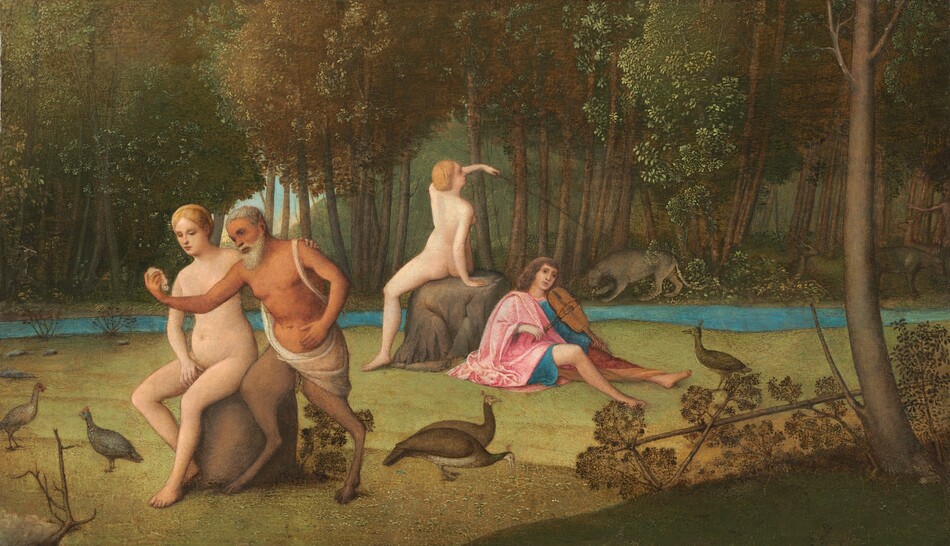
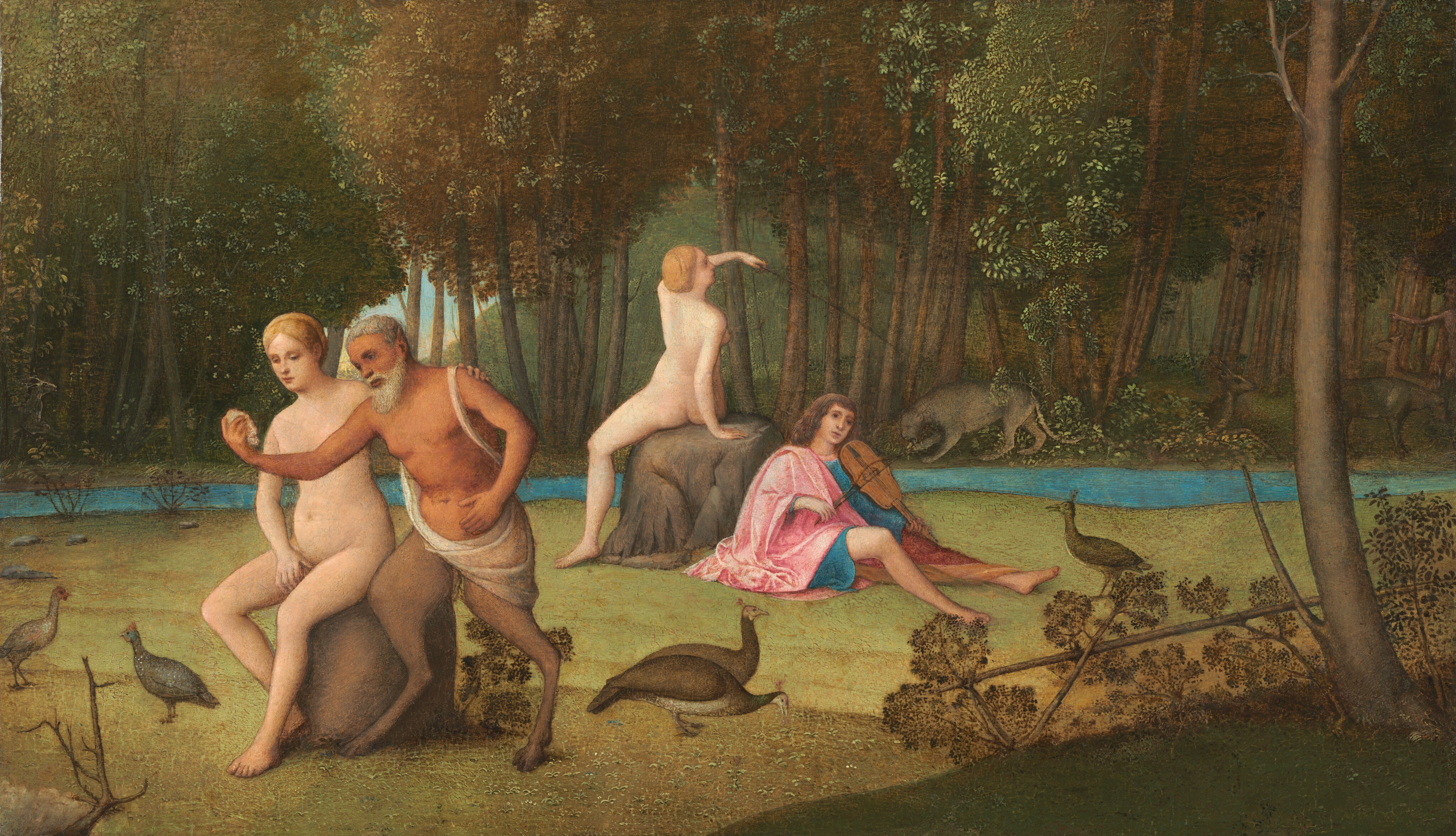
Two women, a man, and a satyr, a man with goat’s legs, are in two pairs in a forested landscape in this horizontal painting. The pale-skinned women are nude, and their blond hair is tied up and back. One woman sits on a brown boulder to the left of center. One hand covers her groin, and the other hand rests on the satyr’s shoulder. The satyr has deeply tanned skin, short white hair, and a long white beard. A white cloth wraps over one shoulder and across his hips. He holds up an object, perhaps a shell, with one hand. That arm crosses over the woman’s breasts. His other hand is by his lower belly, and he looks at the shell. A bit farther back and to our right, a second nude woman also sits on a boulder. She faces away from us and holds up a long stick with her left arm, which arcs over her body. A clean-shaven, pale-skinned man sits with his back against the boulder. He has long brown hair and looks off to the distance to our right. He wears a carnation-pink robe over a sapphire-blue tunic. His legs splay in front of him, his feet bare, as he holds a bow to a violin-like instrument tucked under his chin. The two pairs sit in a grassy glade occupied also by five pheasant- or peacock-like birds. A thin river running behind the glade is lined with spindly trees that together make an impenetrable bronze-brown and laurel-green canopy. The second woman’s stick points or is directed to a gray, mountain lion-like cat on the far bank. Closer inspection reveals deer and another person, who points, tucked among the trunks. A glimpse of blue sky is visible through a break in the tree trunks.

Orpheus

Venetian 16th Century

c. 1515

Oil on panel transferred to canvas  Accession ID  1942.9.2

On View: West Building Main Floor, Gallery M17
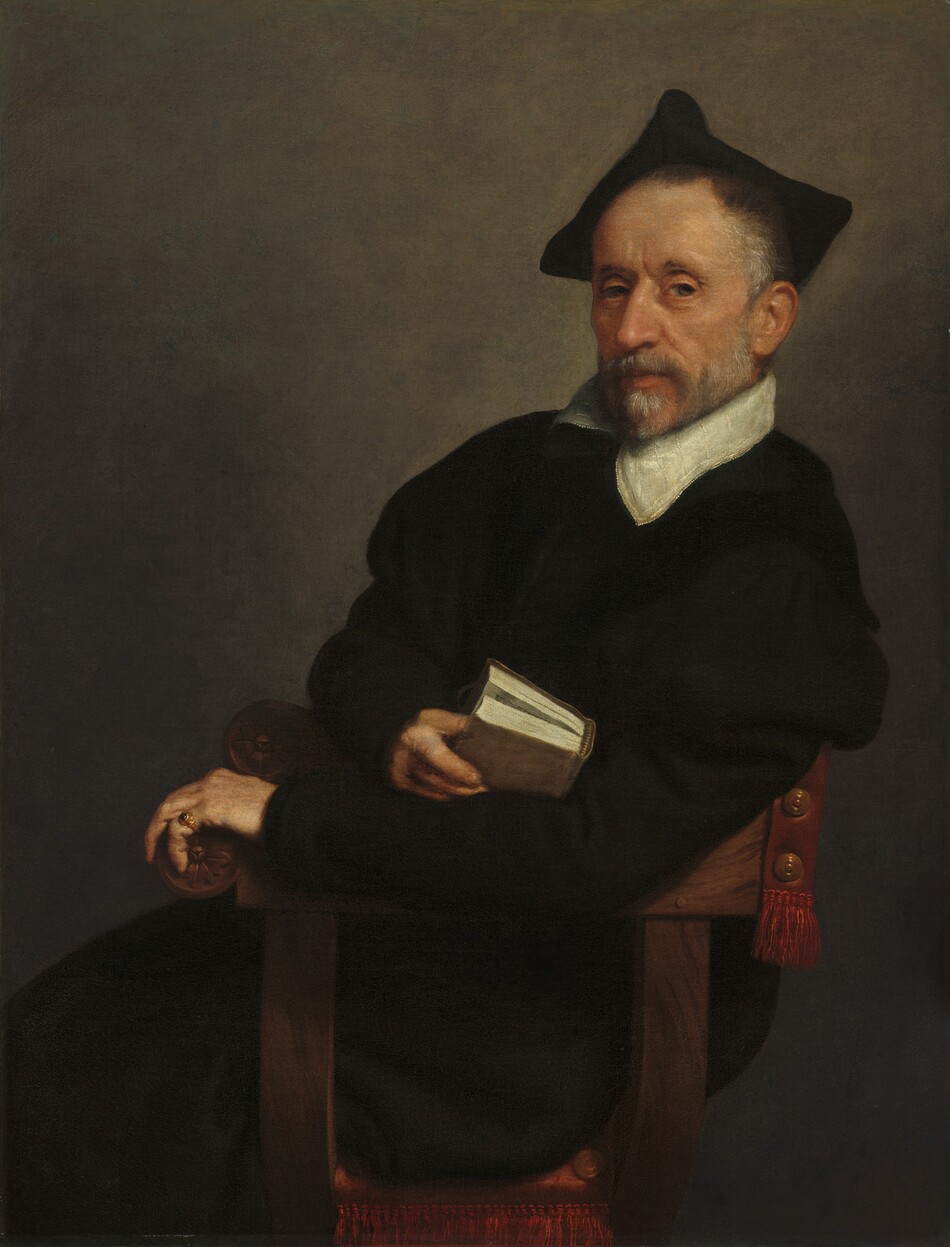
Shown from the knees up, a light-skinned man wearing a loose, ink-black garment with a white collar leans back in a wooden chair in this vertical portrait painting. His body faces our left almost in profile, but he turns his head to look at us from the corners of his light hazel-brown eyes, the eyebrow closer to us slightly cocked. Crow’s feet line the corners of his hooded eyes. He is lit from our right so the side of his face to our left is in shadow. His slightly hollow cheeks are lined between his nose and mouth with wrinkles. His silvery-gray beard is trimmed close to his angled jawline and pointed chin. His gray hair is closely cropped hair under a velvety-black, three-pointed cap. The white collar is trimmed with stripes and a row of delicate dots along the edge. The man leans heavily against his left arm, closer to us, which is stretched along the arm of the chair to nearly span the width of the painting. That hand curls around the terminal of the chair, which is carved with a stylized flower in a disk. He wears a gold ring with a dark blue stone on the pinky of that hand. He marks the spot in a closed book with his other hand, and rests the book in the crook of the elbow draped along the arm of the chair. The book he holds has a sand-brown cover, and is about the size of a thick paperback novel. The crimson-red lining along the back of the chair, to our right, and the cushion on which the man sits is trimmed with rows of fringe of the same color. The background behind the man is deep, sable brown in the corners and lightens to tan around the man’s head.

"Titian's Schoolmaster"

Giovanni Battista Moroni

c. 1575

Oil on canvas  Accession ID  1942.9.45

On View: West Building Main Floor, Gallery M22
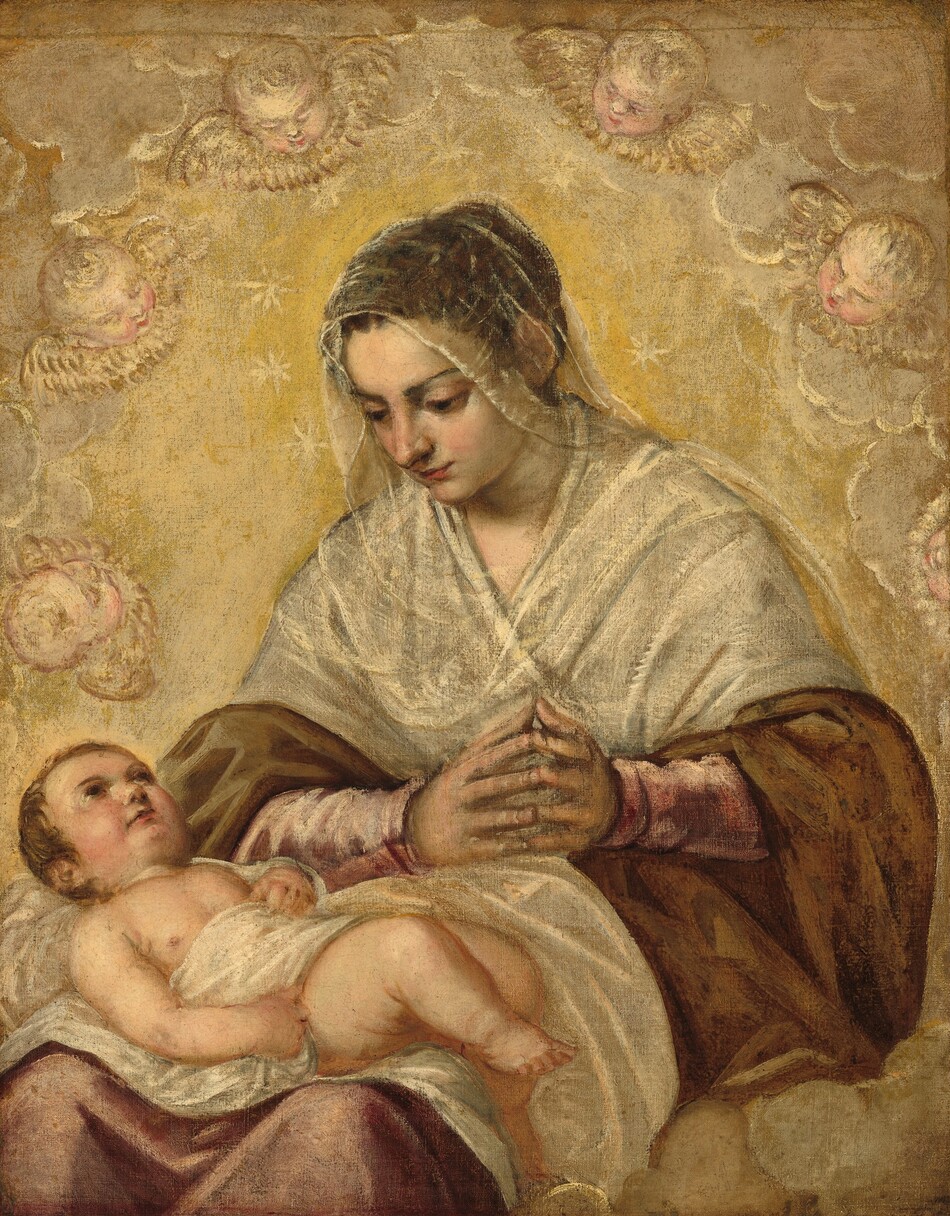
Shown from the knees up, a seated woman is surrounded by an arch of disembodied, winged baby heads as she gazes down at an infant lying across her lap in this vertical painting. They all have pale, peachy skin, and are placed against a honey-gold background. The floating heads are all angled inward to face the woman. The woman sits on straw-yellow clouds that billow up from the lower right corner, and more clouds fill the upper corners around the floating heads. The woman and baby take up most of the canvas. The woman’s knees are angled to our left but her upper body turns to us. Her hands are together, fingertips touching and coming toward us. Her chestnut-brown hair is pulled back and gathered at the back of her head, and is covered by a translucent white veil that falls to her shoulders. Her shoulders and upper arms are wrapped in an ivory-white shawl over a fawn-brown dress with rose-pink sleeves. Pale yellow stars create a ring around her head, which tilts down as she gazes toward the child with large brown eyes. The plump baby lies on his back, with his head resting on the woman’s right leg, farther from us. He has short, brown hair with dark eyes looking straight up. The white cloth on which he lies wraps around his midsection and upper thighs. One hand rests on his belly and the other by his side, and his chubby knees are bent over the woman’s leg.

The Madonna of the Stars

Jacopo Tintoretto, Italian 16th Century

c. 1575/1585

Oil on canvas  Accession ID  1947.6.6

On View: West Building Main Floor, Gallery M24

Loading Results