Italian Medieval and Renaissance Paintings and Sculptures

Filter Results

367 artworks on view.

Results

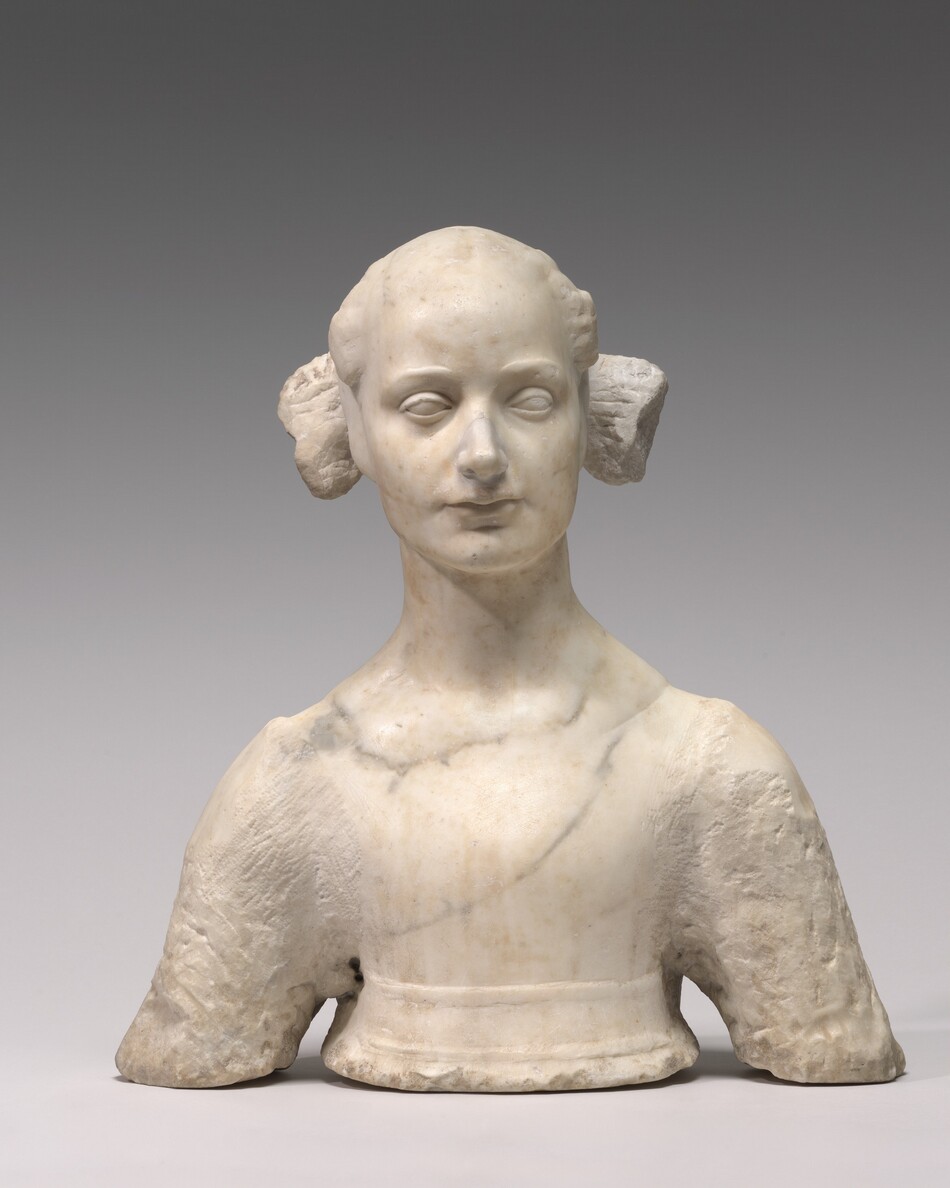
The sculpture is a bust of a female figure with a serene expression. Her hair is styled in an elaborate fashion, with two distinct rounded sections on either side of her head. The sculpture is made from marble. The figure is depicted from the shoulders upwards, with the surface below the neckline appearing rougher and less polished than the smooth finish of the face and hair. The sculpture is slightly smaller than life-sized when compared to a human.

A Young Lady

Florentine 15th Century

1450/1475, with later alterations

Marble  Accession ID  1942.9.112

On View: West Building Main Floor, Gallery M9
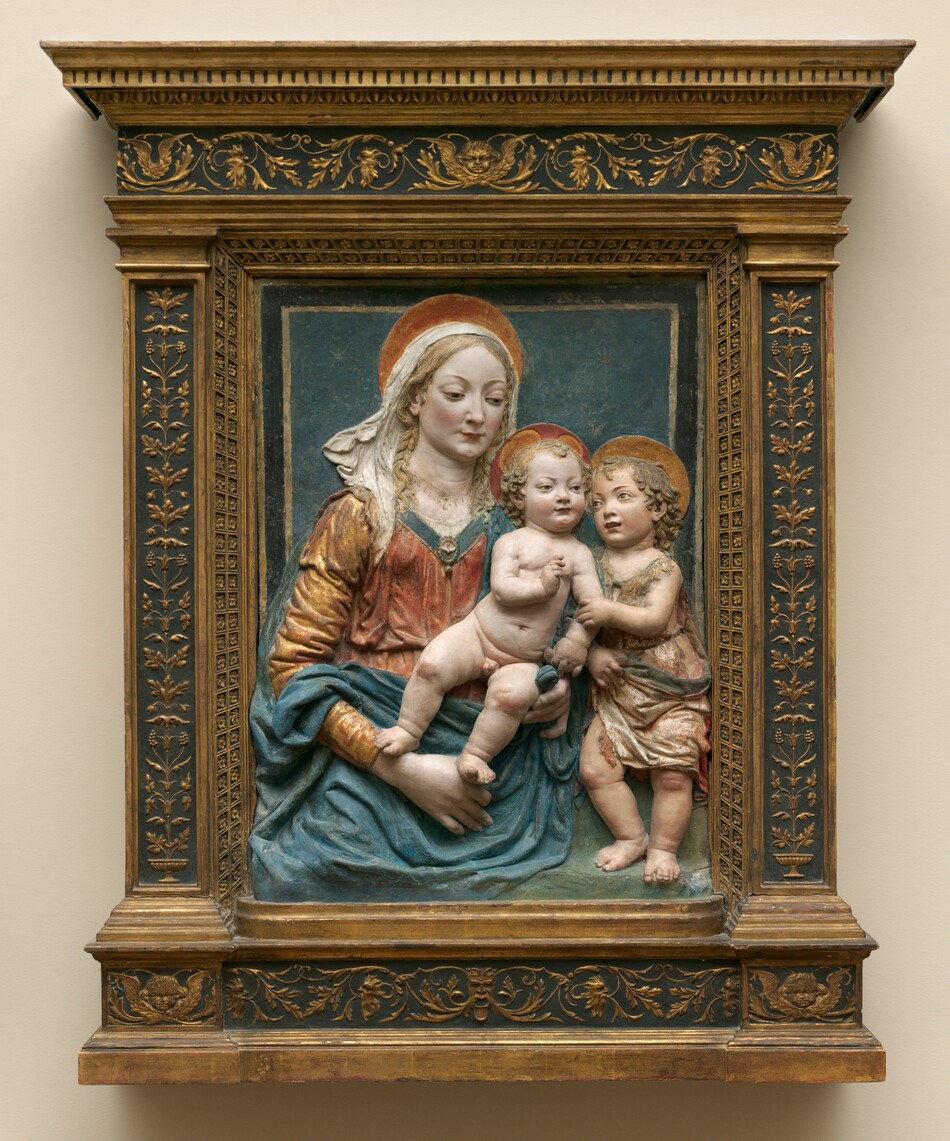
The sculpture depicts a woman and two young children, all three adorned with orange halos. In the center, the woman holds one of the infants. The woman has curly blonde hair and pale skin with rosy cheeks, and she wears a red-orange garment with a blue robe and a white cloth over her head. Both infants also have pale skin, and the one held by the woman is nude with blond hair, while the other child on the right has curly brown hair and a ragged brown tunic. The three people are in high relief on a blue background within a frame with gold leaf designs on a blue backdrop.

Virgin and Child with Saint John

Italian 15th Century

Painted terracotta  Accession ID  1942.9.147

On View: West Building Main Floor, Gallery M9
A woman stands over a sleeping infant in front of a deep landscape in this vertical painting. She has pale skin and light brown wavy hair. Her head tilts down to our left as her dark eyes gaze down at the infant lying on a ledge in front of her at about hip height, and her fingertips come together in front of her chest in prayer. A thin golden halo encircles the air above her head, and she wears thick robes of moss-green fabric with a dark blue lining over a crimson-red tunic. The collar of the tunic is edged with gold, and light reflects off the creases in the green robe where it bunches around her bent arms. The nude, bald infant lies on a blue cloth draped over a brown ledge in the bottom left corner of the panel. His body angles toward us as he lies back on two cushions. His eyes are closed, his lips slightly parted, and his left hand rests across his belly. A landscape behind the pair stretches out from rolling green hills to pale blue mountains in the distance. A thin white cloud spreads across the top of the blue sky. A building is nestled into the hills to the left, and tall spindly trees grow up the right edge of the panel. A man dressed in a brown tunic and hat leans on a staff near the tree, watching a cluster of white sheep. A narrow dirt path winds from the left side of the painting to the right and through the trees. Cracks on the surface of the painting are visible throughout and are especially noticeable in the sky. The artist signed the lower right corner of the painting on the edge of the ledge facing us: “M. BASAITI/P.”

Madonna Adoring the Child

Marco Basaiti

c. 1520

Oil on panel  Accession ID  1939.1.144

On View: West Building Main Floor, Gallery M12
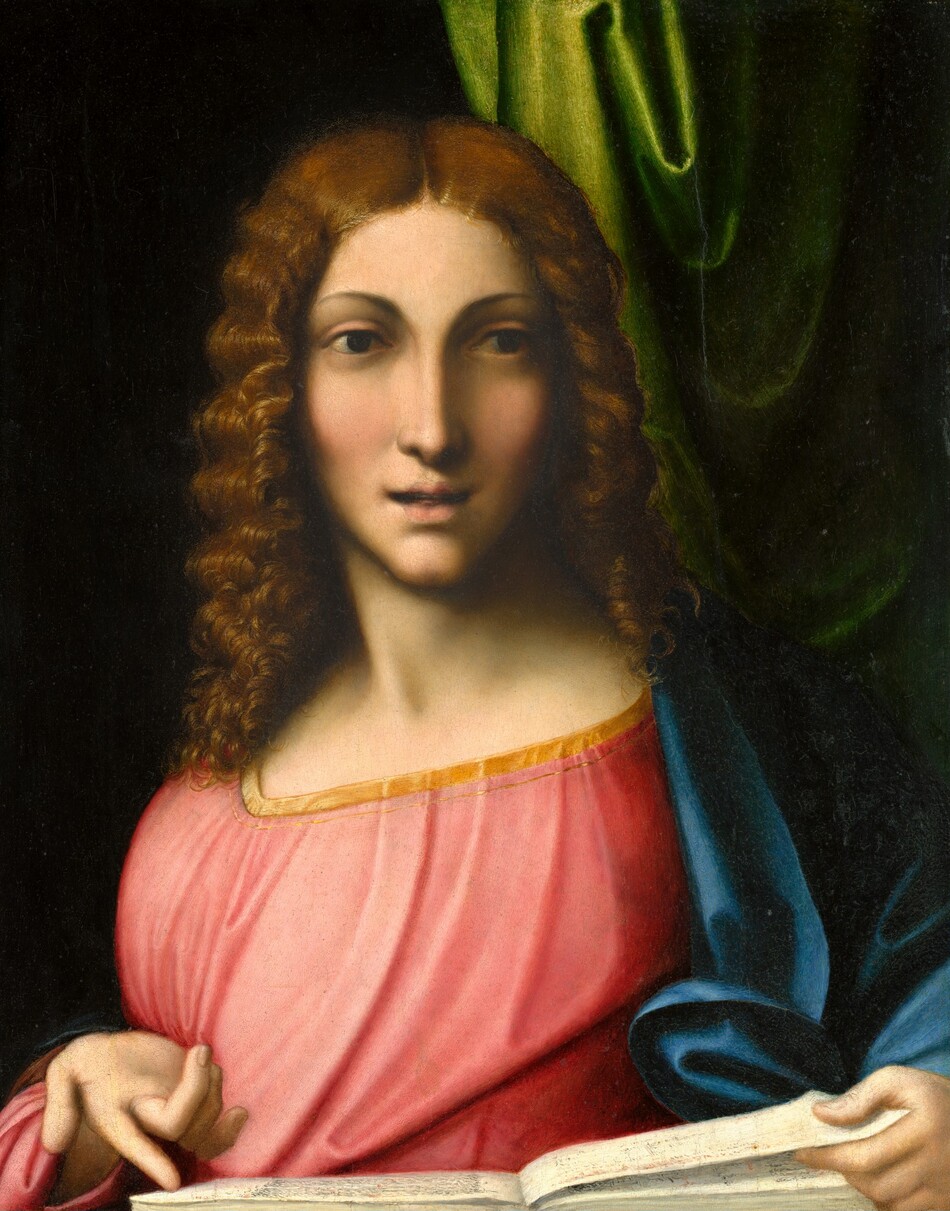
This painting shows a person from the waist up. Their gender is ambiguous. They have long, curly, light brown hair, fair skin, rosy cheeks, thin, arched eyebrows, a long, straight nose, and a small, slightly open mouth. They wear a peach-pink garment with gold trim under a blue cloth draped over their left shoulder. The person holds an open book and is pointing at a page with their right hand. The background is black, with a bright green curtain on the right.

Salvator Mundi

Correggio

c. 1515

Oil on panel  Accession ID  1961.9.68

On View: West Building Main Floor, Gallery M18

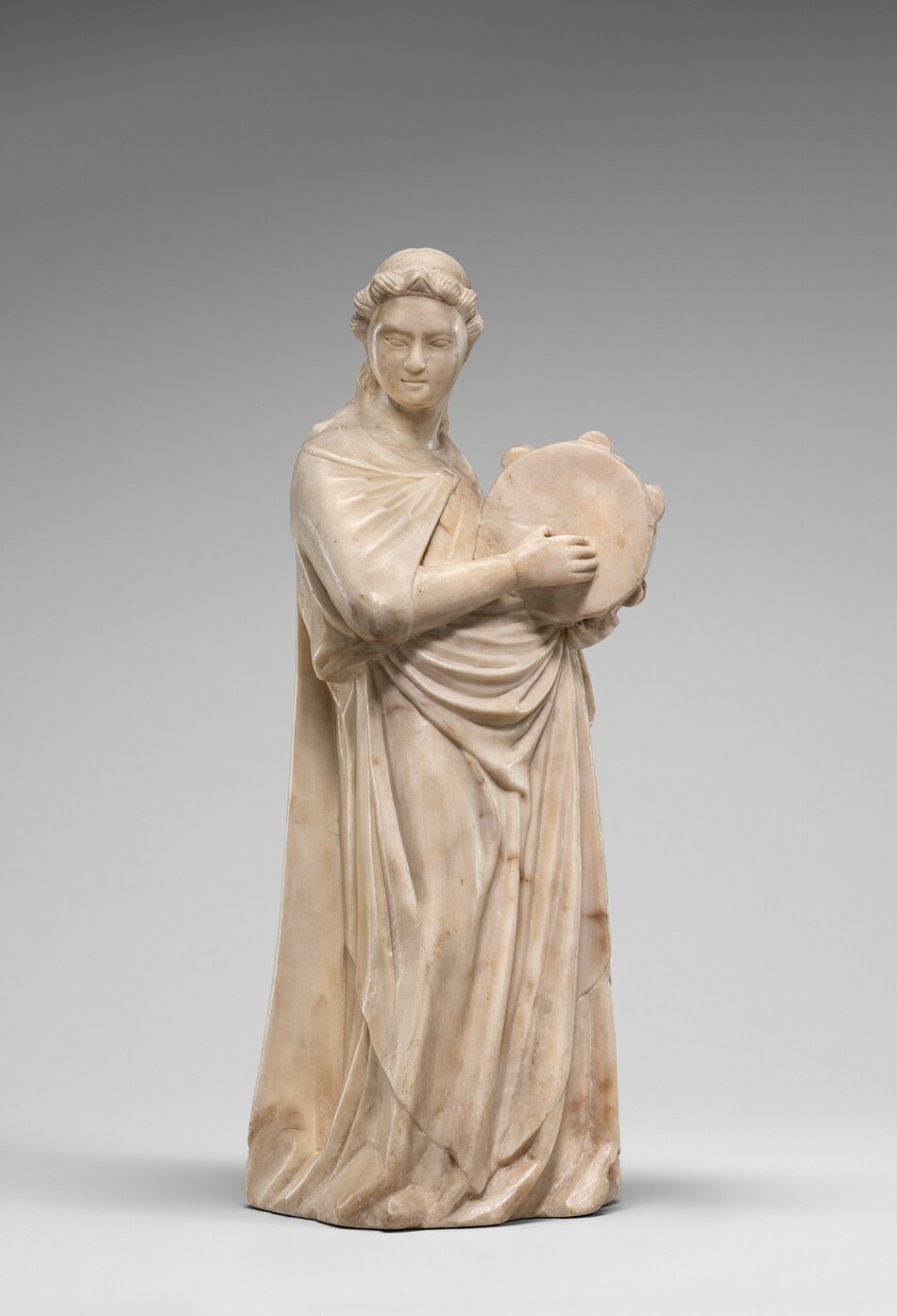
Angel with Tambourine

Pisan 14th Century

c. 1360

Marble  Accession ID  1960.5.15

On View: West Building Main Floor, Gallery M2
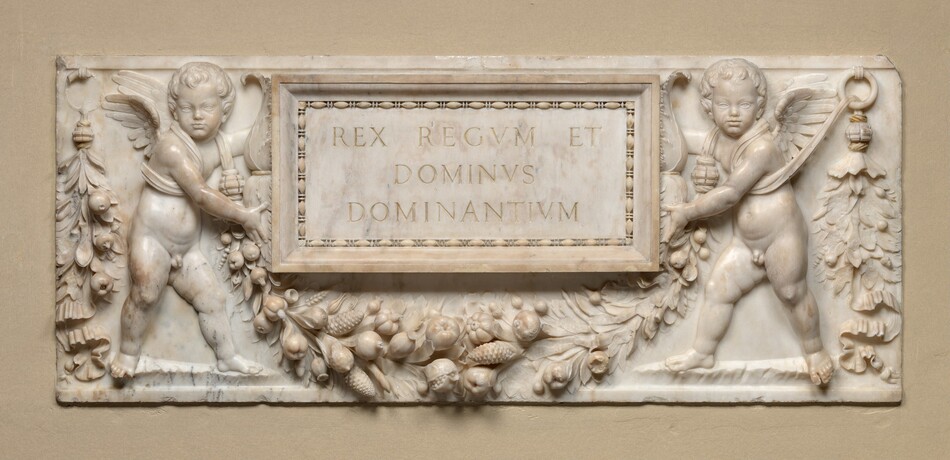
The sculpture features two cherubs with wings adorning either side of a central rectangular plaque. The cherubs each stand on opposite ends of the marble rectangle, with their bodies facing inward and their arms holding up the plaque. The central plaque contains engraved text surrounded by decorative borders. Around the cherubs are carvings of fruits and pinecones among garlands of leaves.

Relief from an Altar or Tabernacle

Benedetto da Rovezzano

c. 1507/1512

Marble  Accession ID  1942.9.131

On View: West Building Main Floor, Gallery M9
This painting shows a group of people. In the center is a seated woman holding a baby. The woman has pale skin and blonde hair wrapped with a sheer blue cloth, and she wears a red garment with a draped green-and-blue fabric over her lap. The child sits on her lap, looking off to the left. Surrounding them are four standing people, two of whom are standing on a low white wall behind the woman. These two people have large wings, and their hands clasped in front of their chests. The other two are on either side of the woman, one holding a long pink flower and a clear glass, and the other holding a blue book and a long green feather or quill. These four people also have pale skin and blond hair. In the distance there are green fields and blue mountains under a blue sky. The painting is an octagon, with longer sides on the left and right.

Madonna and Child with Two Angels, Saint Rose, and Saint Catherine of Alexandria

Anonymous Artist, Pietro Perugino

late 1480s/early 1490s

Oil on panel  Accession ID  2015.19.41

On View: West Building Main Floor, Gallery M20
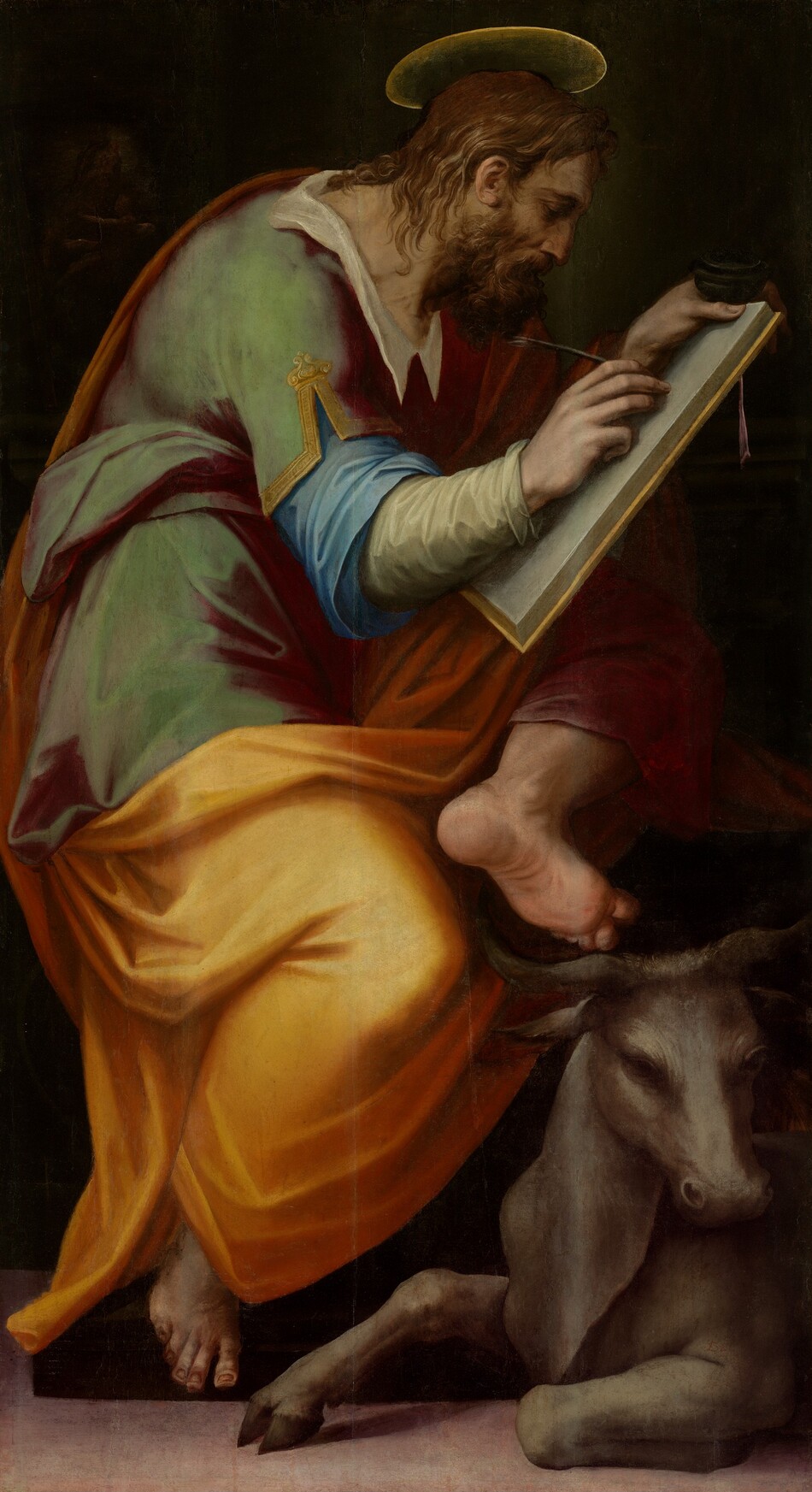
A pale-skinned man sitting hunched over as he draws on a tablet and a bull lying at his feet fill this vertical painting. The man faces our right in profile, and he looks down at the book. He has a lined forehead, a bumped nose, and wrinkles around his nose. He has lanky, chin-length hair and a curly, unruly beard. He sits with one leg pulled up so he can partially brace the tablet on that knee. He holds the inkwell and clutches the top of the tablet with one hand and draws using a feather quill with the other. His other leg stretches down, and the ball of the bare foot is perched against the edge of the low platform on which the man sits. His garment has a white collar over a tunic that shimmers from plum purple to moss green. Extending from under the tunic’s short sleeves are long sky blue and pale laurel green sleeves. A golden yellow robe drapes over one shoulder and wraps around his lap. The gray bull, which is shown in about half the scale of the man, sits with one front leg tucked under his body as he looks over to our right. The floor is pale mauve purple, and the background is dark green, almost black. A glimpse of a work of art showing a woman holding a baby is visible near the top left corner of the painting.

Saint Luke

Giorgio Vasari

1570-1571

Oil on panel  Accession ID  2012.79.2

On View: West Building Main Floor, Gallery M21
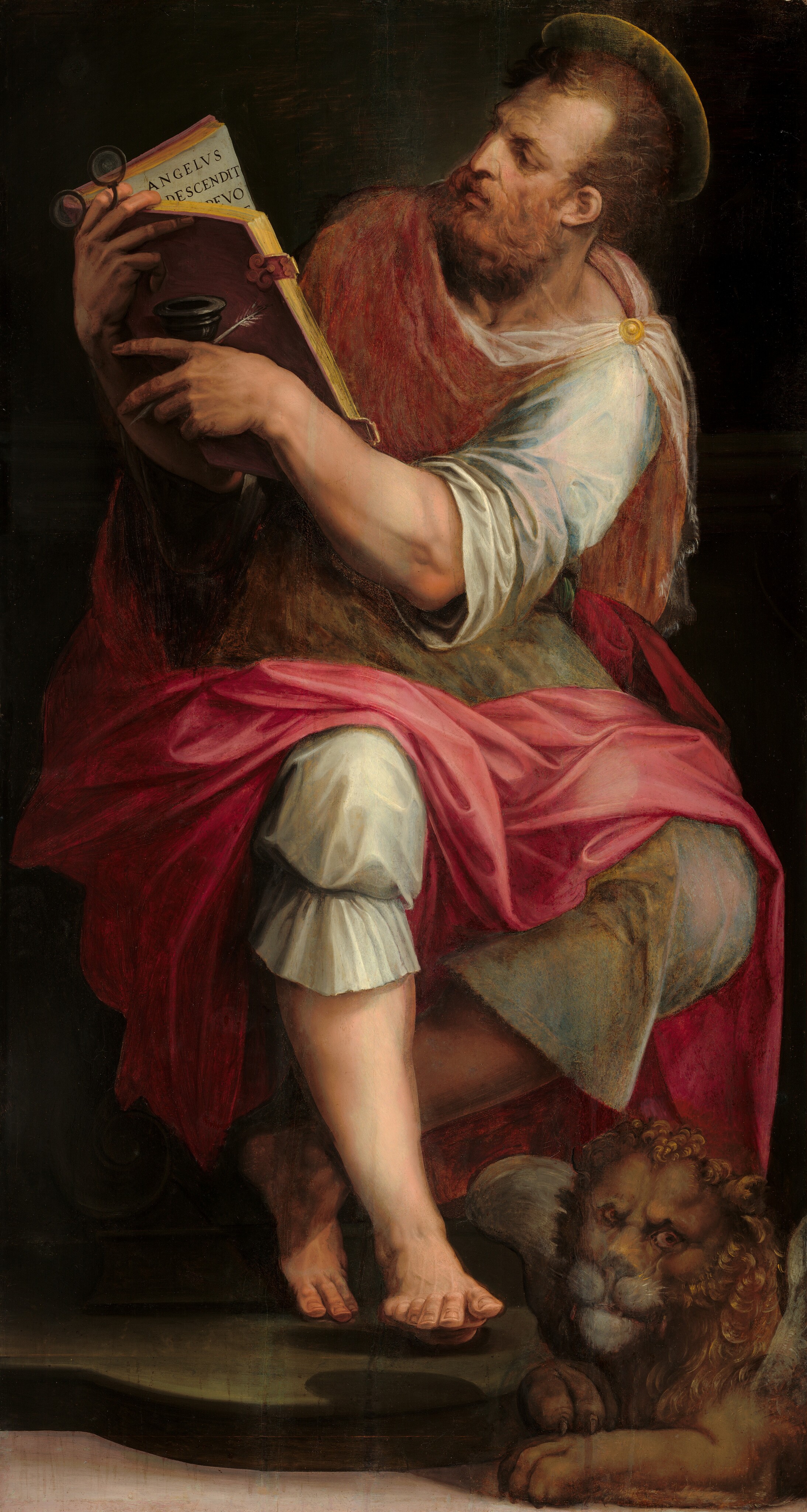
A pale-skinned, muscular man sitting and reading a book as a lion rests at his feet fills this vertical painting. The man’s knees are angled slightly to our right but his torso twists back to the left. His head follows that direction so he’s almost in profile as he looks at the book, which he holds up to our left. His brows are deeply furrowed, and he has a bumped, blade-like nose. He has short, copper-red hair and a squared beard. He wears a tunic and knee-lengths pants that shimmer in shades of topaz blue and pearly white under a carnation-pink cloak that drapes from his shoulders and across his thighs. A round, gold pin holds the cloth in place on his left shoulder, to our right. His lower legs and feet are bare. He rests the heel of one foot on a rounded plinth and lifts the toes so they come at us. The other knee bends deeply and the toes of that foot perch lightly behind the first leg. The man leans to our right to look at the open book, which he holds in both arms to the left. Visible text on the far page reads, “ANGELVS DESCENDIT EVO.” He braces a black inkpot and spindly white feather quill in one hand and holds a pair of pince-nez glasses with the other. The lion is small in comparison to the man and has a curly mane and translucent gray wings. The background is dark except a strip off-white floor along the bottom edge.

Saint Mark

Giorgio Vasari

1570-1571

Oil on panel  Accession ID  2012.79.1

On View: West Building Main Floor, Gallery M21
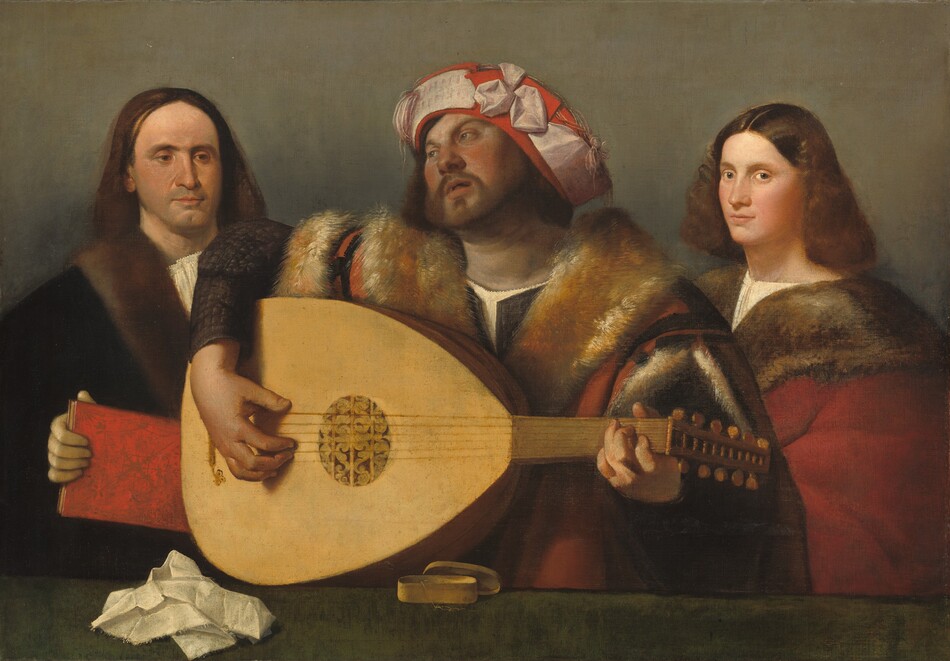
Shown from the waist up behind a forest-green ledge or tabletop, a bearded man with a ruddy complexion strums a six-stringed lute between two, light-skinned people in this horizontal painting. The green ledge runs close to the bottom edge of the canvas, and the people nearly fill the composition. The musician’s body faces us but he looks up and off to our left with gray eyes under arched brows, with lips parted. His long brown hair is covered with a red hat wrapped with a pale, pink band. The ribbon meets in a bow-like form near the front center, and tassels hang to each side. His voluminous coat has wide, burnt-orange fur lapels and is lined with fur where it splits open over his shoulders. The garment below has dark sleeves. He lifts his right shoulder high over the lute as the instrument rests on the tabletop, with the neck to our right. The soundhole at the center is covered with rosette-like tracery. The man to our left has long, straight, dark brown hair and a cleft in his chin, which is darkened with a five o’clock shadow. He looks down and toward the musician with brown eyes over a long nose, and his lips are closed. He wears a black cloak with a fur collar over a white shirt, and holds a red book. To our right, a young person, possibly a man with delicate features, stands with his body angled toward the musician but he turns his face to look at us with gray eyes. He has flushed cheeks, a long, straight nose, and a rounded chin. He has shoulder-length, wavy brown hair parted down the middle, and he wears a red cloak also with a fur lapel, over a cream-white undershirt. A crumpled white cloth and a small, oval-shaped box with its lid askew sits on the green surface near the lute. The background behind the trio is elephant gray.

A Concert

Cariani

c. 1518-1520

Oil on canvas  Accession ID  1997.57.2

On View: West Building Main Floor, Gallery M22
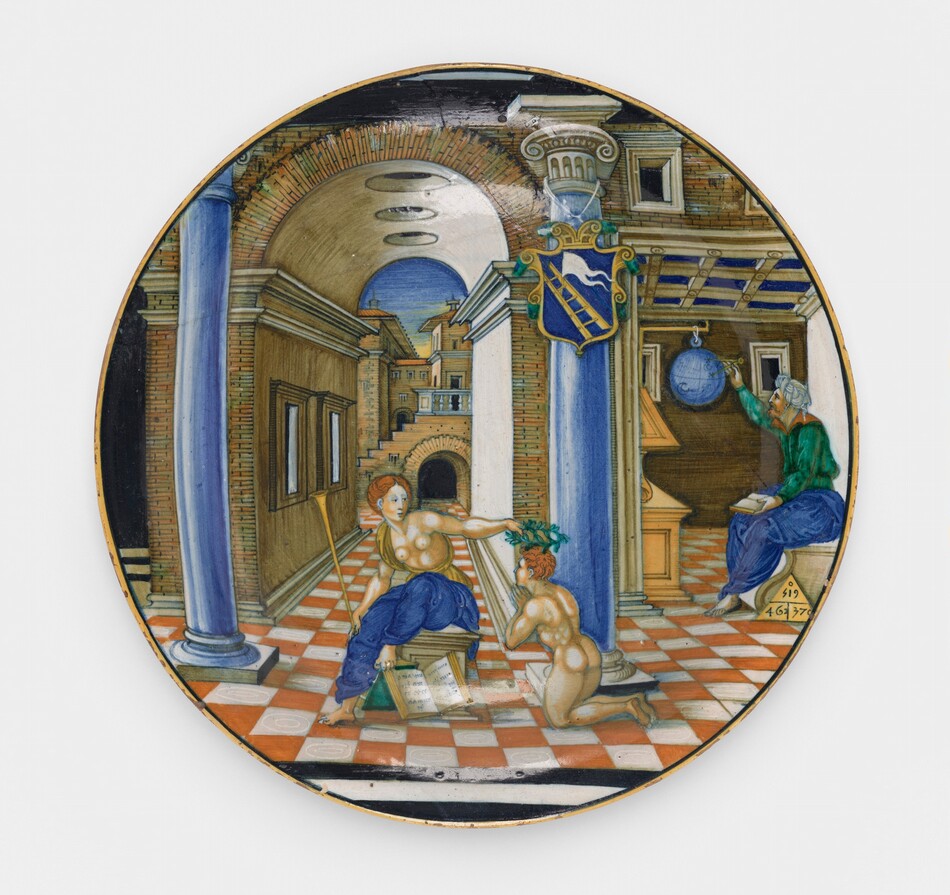
This is a painting of a classical architectural scene with figures. The image depicts a woman seated in an architectural setting decorated with columns and arches, alongside a kneeling child and another figure holding a sphere. The painting is highly detailed, with the architectural setting resembling a palatial interior, complete with checkered flooring and intricate brickwork. The columns are painted in a vibrant blue hue, and the background features a view of a blue sky and distant buildings. The seated woman appears to be interacting with the kneeling child, possibly teaching or bestowing wisdom, as indicated by the open book and laurel wreath. The third figure, dressed in robes and holding the sphere, contributes to the scholarly or philosophical theme of the scene.

Plate with an allegorical scene of Calliope and a youth (from the Ladder Service)

Nicola da Urbino

c. 1525/1528

Tin-glazed earthenware (maiolica)  Accession ID  2014.136.321

On View: West Building Main Floor, Gallery M25
Three nude women, three men, and a child stand or sit under the canopies of trees close to us as others move through a deep mountainous landscape in this horizontal painting. The people all have pale skin and muscular proportions. The women also have blond or light brown hair and delicate facial features. The women stand facing us and a nude man, who sits with his back to us at the bottom center of the composition. The man, Paris, sits on a ruby-red cloth and holds out a round, golden apple in one hand. The woman at the center of the trio takes the apple from him. A winged, nude, baby-like putto standing at her feet reaches one hand toward Paris and holds a bow down by his side in his other hand. Translucent white cloth covers that woman’s head and wraps in front of her groin, and a sapphire-blue robe falls from her shoulders. The woman to our left wears a gold helmet. She has a spear on one side and holds the index finger and thumb of the other hand up. The woman to our right hunches forward as she leans, also with one hand up, toward the apple while looking at Paris. She wears a gold tiara and white cloth falls from her shoulder and flutters over her buttocks. Just beyond Paris and to our left, another man leans one elbow against a tree stump and raises the other hand toward the trio of women. He holds a staff with two intertwining serpents in one hand and wears a brimmed cap with gold wings and a harvest-yellow robe over a red tunic. A bearded man sits beside an overturned urn near the lower right corner. Water pours from the vessel to a river along the bottom edge of the canvas. Trees with dark green canopies frame the scene, which opens onto a vast landscape beyond the women. A man pursues a woman in the shadows of the trees to our left. A woman and child ride a donkey as another woman walks alongside it in the near distance beyond the trees to our right. Deer drink from the river, which winds into the distance, and a man walks over a natural bridge there. Faint white dots suggest sheep grazing on a grassy field in the distance, which leads back to a building complex. A round structure there is surrounded by panel-like buttresses. Three obelisks stand around what might be a tomb. More buildings and statues are hazy where the land meets the horizon, about two-thirds of the way up the composition. Ivory-white clouds are streaked across a turquoise-blue sky above.

The Judgment of Paris

Giovanni Sons

late 16th century

Oil on canvas  Accession ID  1961.9.80

On View: West Building Main Floor, Gallery M27

Loading Results