American Paintings 1750–1900

Filter Results

166 artworks on view.

Results

From atop a high hill, we look across a broad valley leading to a winding river in this loosely painted horizontal landscape. The scene is created entirely with visible brushstrokes in fresh and vibrant green and shimmering and smoky blues. The hill slopes from the right edge of the painting down to the valley, which extends into the distance, angling slightly to our right alongside the river. Darker green trees are along both sides of the river, and a few buildings line the far bank. The land beyond rises to sapphire-blue hills along the horizon, which comes about two-thirds of the way up the composition. A few white clouds dot the robin’s egg-blue sky above.

The Valley of the Seine, from the Hills of Giverny

Theodore Robinson

1892

Oil on canvas  Accession ID  2014.79.30

On View: West Building Main Floor, Gallery M70
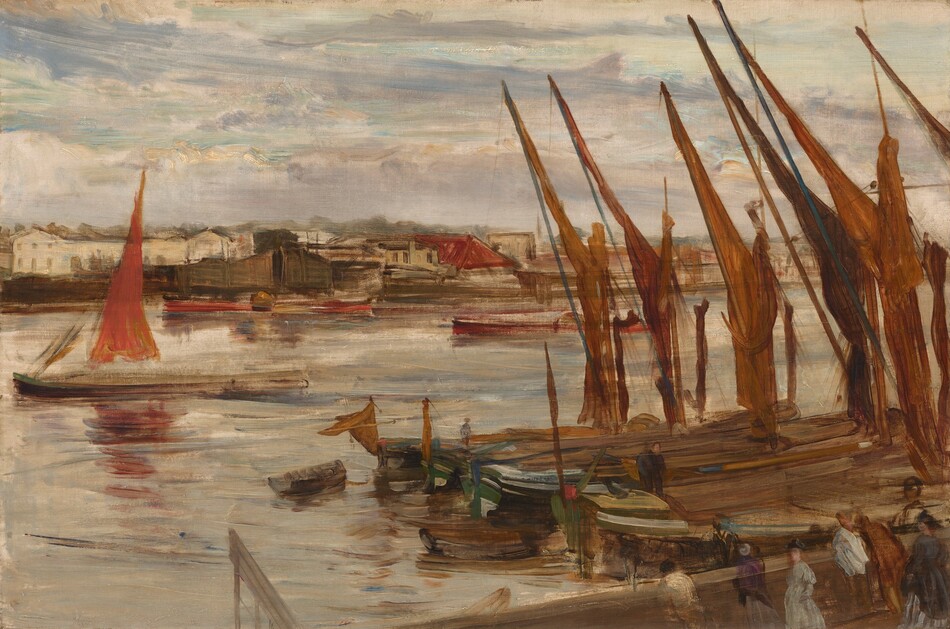
We look slightly down onto and across a wide, boat-filled river under a cloudy sky at the far bank, which is lined with buildings, in this loosely painted, horizontal landscape. Four long, wooden boats are pulled up side-by-side to our right, so most of their prows are cropped by the right edge of the composition. Their amber-brown sails are tied up to the vertical masts and angled spars, which create a row of diagonal lines jutting into the painting from the right edge. The boats’ sterns are painted moss green, and the boat farthest from us has what could be a small dingy tethered off the back end. Several ghostly men and women stand below us, in the lower right corner, on a pecan-brown walkway low to the water. We can see through the people so the details are indistinct, but they all seem to look away from us except one person who looks our way, indicated with a touch of peach for a face. They wear long gowns and jackets or baggy shirts and trousers in tones of plum purple, caramel brown, light blue, or charcoal gray. In the middle of the river, a long, thin boat with a narrow, scarlet-red sail has drifted past them toward the left side of the composition. Two long strokes of cranberry red suggest more vessels on the water closer to the opposite shore. Low buildings painted in fawn and coffee brown, cherry red, cream, and tan line the far bank. The buildings become indistinct and fainter as they angle away from us into the distance. Bands of off-white clouds, some frothy and some wispy, fill the upper half of the painting. The sky is otherwise washed with violet purple, slate gray, and aquamarine blue. The river’s surface is smeared with the reflections of the sky, buildings, and boats.

Battersea Reach

James McNeill Whistler

c. 1863

Oil on canvas  Accession ID  2014.79.35

Not on view

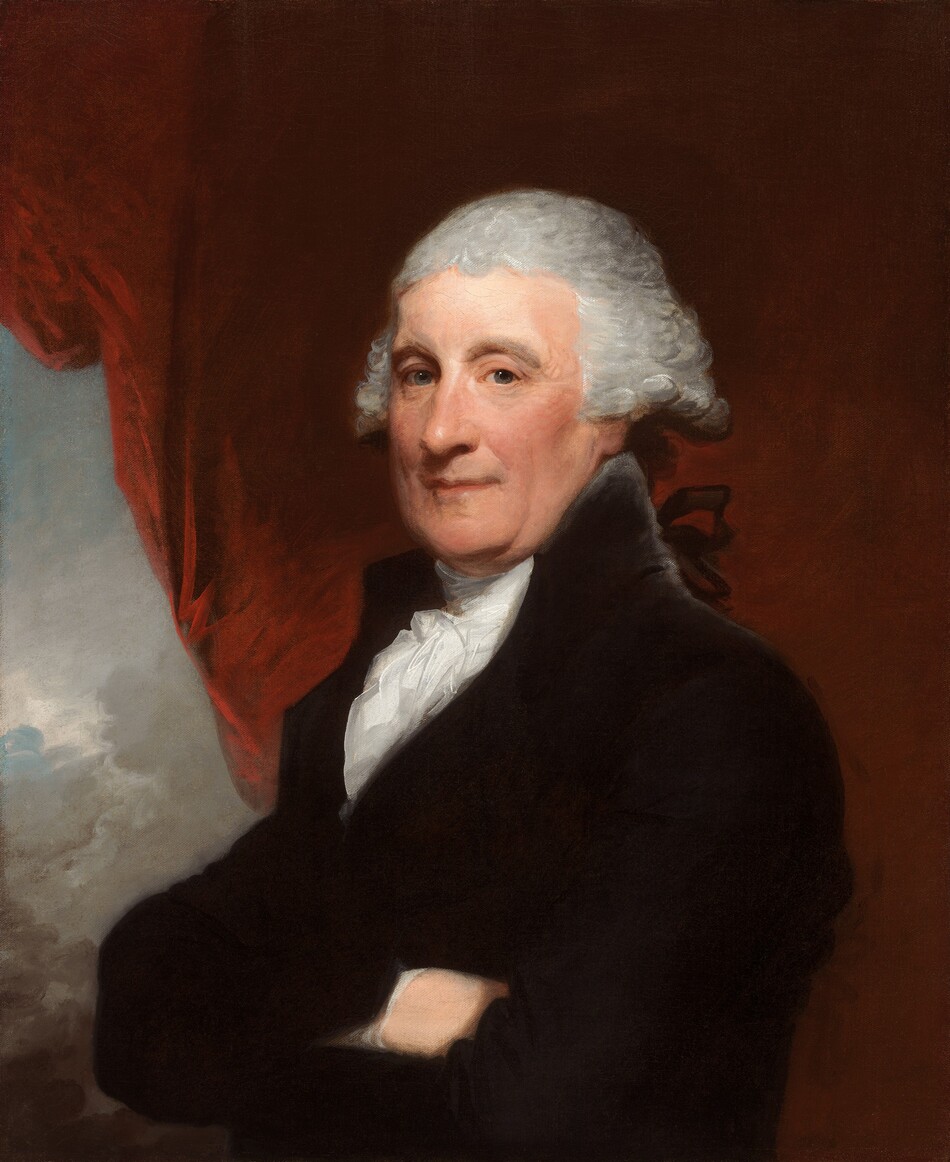
Robert Liston

Gilbert Stuart

1800

Oil on canvas  Accession ID  1957.10.1

On View: West Building Main Floor, Gallery M60
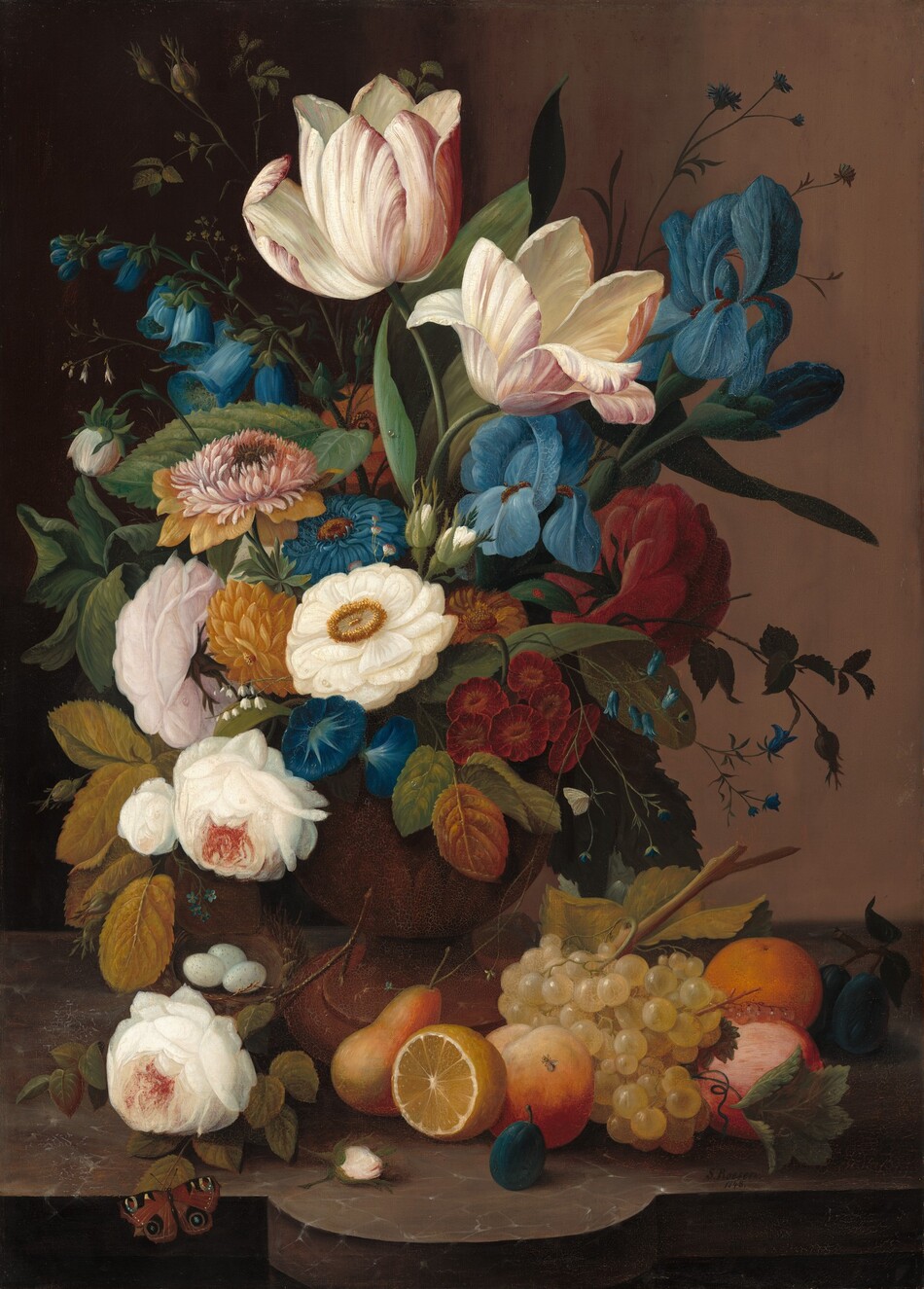
A tall bouquet of mostly celestial-blue, cream-white, and maroon-red flowers fills a rust-red urn, which sits next to a pile of fruit on a brown, stone table in this vertical still life painting. The bouquet is arranged so the flowers fill most of the painting from the upper right corner down to the lower left. The bouquet includes two open, white tulips delicately veined with wine-red streaks at the top center. Two ocean-blue irises are to the right of the tulips, and bluebells are tucked in toward the back of the arrangement, to our left. The bottom half of the bouquet has an anemone flower with white petals around a golden yellow center, and a white rose with its petals tightly clustered around a salmon-pink center. Sprigs of more flowers and fern-green or mustard-yellow leaves fill in and spill out at the sides of the bouquet and the vase. A second white rose and a rosebud rests on the table to our left of the bouquet, and a nest with three small, speckled eggs sits behind it. A butterfly landed on one of the fallen peony's leaves near the front edge of the table. The butterfly has brick-red wings spotted with black and white rings. The fruit spans the right two-thirds of the composition, and includes a bunch of luminous, pale green grapes, two peaches, an orange, a pear, and three plums. A cut citrus fruit sits at the center of the table with the cut side facing our left. The tabletop is marbled with white veins against brown, and it curves out in a half-moon at the front center. The scene is lit from our left. The background behind the flowers lightens from dark shadow at the upper left corner to pecan brown along the right edge. The artist signed and dated the painting as if he had inscribed the top of the table near the grapes: “S. Roesen 1848.”

Still Life, Flowers, and Fruit

Severin Roesen

1848

Oil on canvas  Accession ID  2014.136.84

On View: West Building Main Floor, Gallery M69
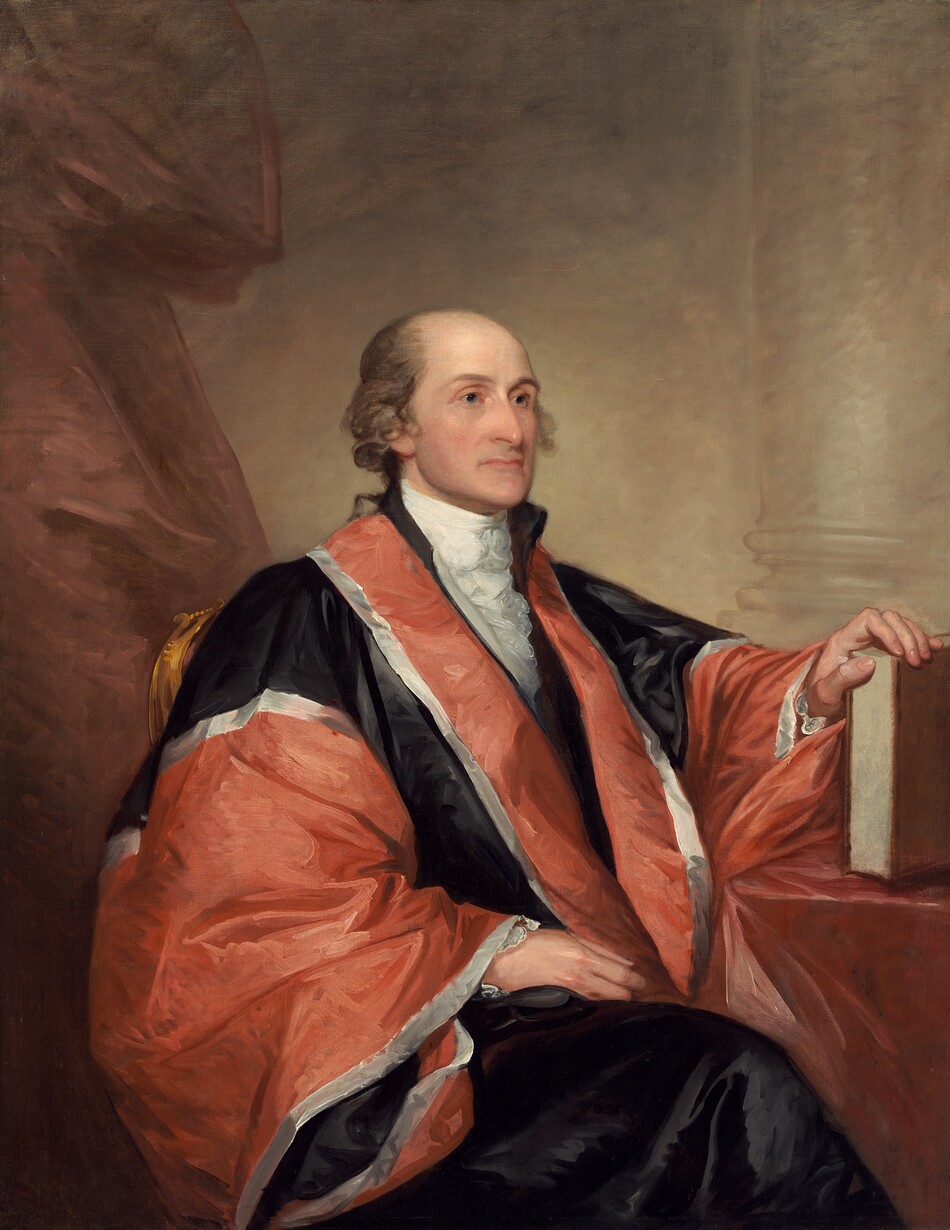
Shown from the knees up, a balding, pale-skinned man wearing a voluminous rust-red and black robe sits angled to our right in this vertical portrait painting. The man is clean-shaven, and tufts of ash-brown hair curls around his ears. He looks to our right with gray eyes under slender brows. The tip of his long nose comes to a prominent point, and his wide, thin, pale pink lips are closed. A white, ruffled ascot is tucked into the lapels of a red and black robe edged with silvery white. The fabric has a sheen, suggesting satin or silk. The man’s legs are crossed and covered with inky-black fabric. The man’s right hand, to our left, rests in his lap, and the other rests on the edge of a book propped upright on a table covered in a dusky, dark pink cloth. A muted copper-red curtain hangs to the left, and a column and its base is outlined against the parchment-brown wall behind him. The portrait is loosely painted with some visible strokes, especially in the costume and background.

John Jay

Gilbert Stuart

1794

Oil on canvas  Accession ID  2009.132.1

On View: West Building Main Floor, Gallery M62
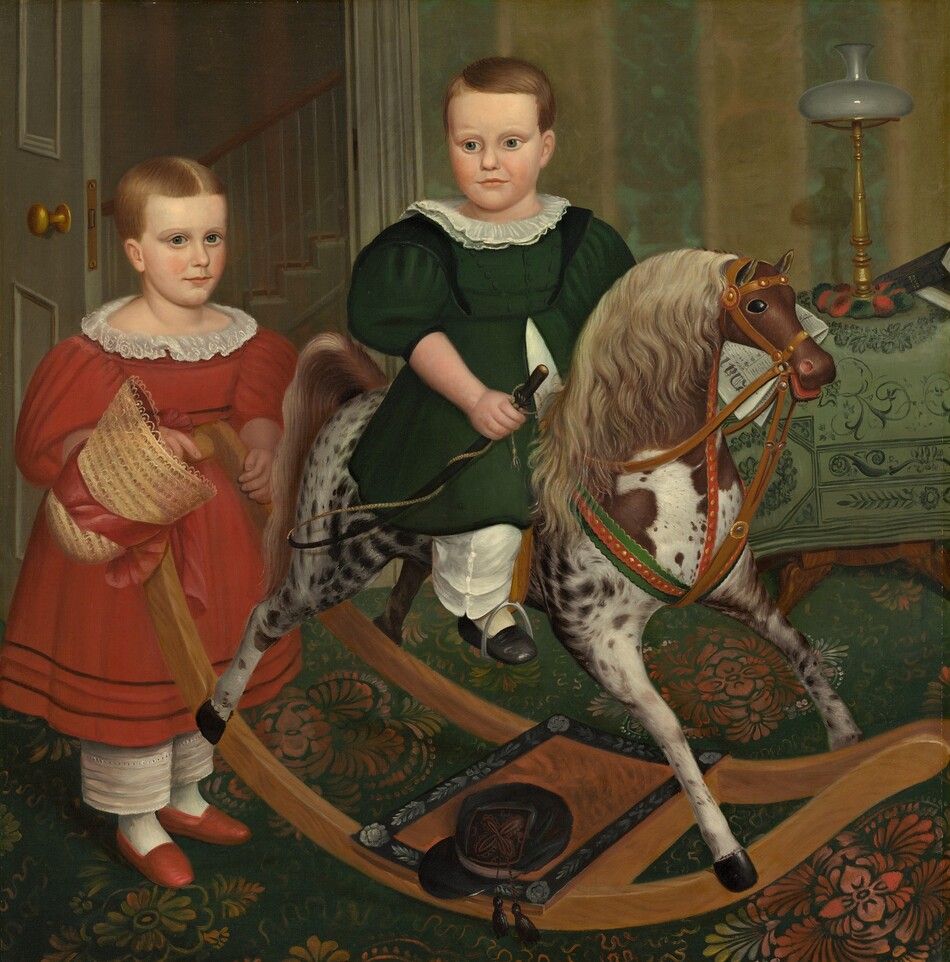
Two children with pale, peachy skin stand and sit on a rocking horse in a wallpapered interior in this square painting. Both children have short, honey-brown hair, high foreheads, dark blue eyes, and small, rounded noses. Their cheeks are smooth and the corners of their thin, pale pink lips curl slightly up. Both wear dresses with puffy, elbow-length sleeves, white collars, calf-length skirts, and wide, white pantaloons over white stockings. At the center of the composition, one child sits astride the rocking horse, which faces our right in profile. The skirt of the forest-green dress splits at the waist to fall open on either side of a white garment underneath. That child’s head turns back over one shoulder to look down and to our left. One black shoe rests in a stirrup, and the child holds a riding crop in one hand. The horse is dappled with fawn brown and white, and has a parchment-brown mane and tail. The horse’s eye we can see is black and its red mouth is open around the bridle and reins. The second child stands at the back of the rocking horse, hands resting on the crossbar that connects the toy's long, curving rockers. That child wears a crimson-red dress and holds the red ribbon of a straw bonnet in one hand. The hair is parted down the middle and that child looks at us. A black cap with a curved, shiny visor and tassels hanging from the crown rests on the base of the rocking horse. The rug has a stylized, terracotta-orange floral pattern against a pine-green background. The wall behind the children is striped with wide bands of golden yellow and moss green. A door with a gold-colored doorknob is swung inward to our left, behind the child in red, to reveal the profile of a staircase beyond. To our right, just behind the horse’s head, a wooden table is draped with a cloth patterned with vines and leaves in dark green against a pea-green background. A lamp with a tall, spindly brass base is topped with a squat, round white globe. A folded newspaper behind the child in green could rest on the table, or could be held by that child. An inscription on the masthead of the paper begins, “Dai.”

The Hobby Horse

Robert Peckham

c. 1840

Oil on canvas  Accession ID  1955.11.23

On View: West Building Main Floor, Gallery M63
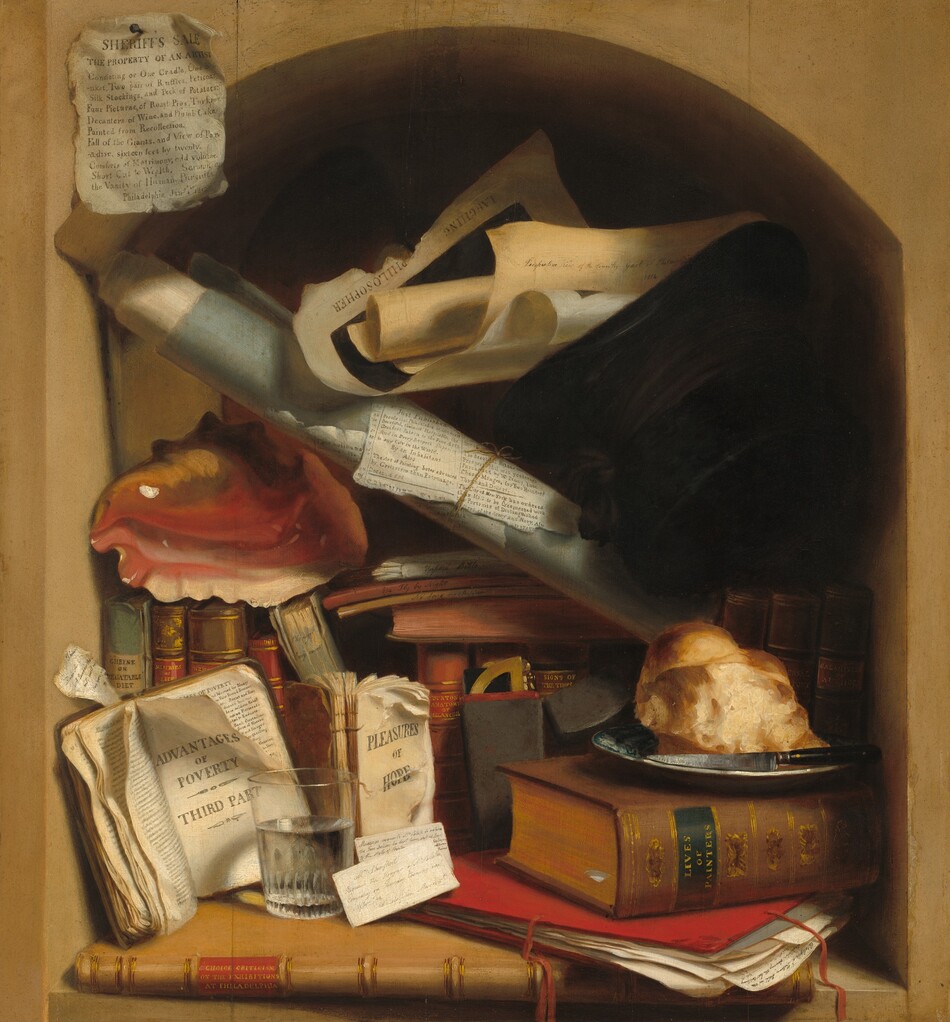
A crusty piece of bread, a short glass of water, a black top hat, a pink conch shell, more than a dozen books, and papers are crammed into an arched alcove in this nearly square still life painting. Lining the bottom edge of the alcove, the long, thin spine of a brown book is printed with the title, “CHOICE CRITICISM ON THE EXHIBITIONS AT PHILADELPHIA” in gold against a red background. To our right, a red portfolio holds a sheaf of loose papers under a thick book titled “LIVES OF THE PAINTERS.” A crusty hunk of bread and a black-handled knife sit on a ceramic plate on the thick book. To our left, two calling cards with handwritten notes lean on the short glass of water. Both are addressed to “Palette” and one is an invitation to visit after tea and other asks about a debt of five dollars. The glass holds open the pages of a book propped against the niche, and the title page reads, “ADVANTAGES OF POVERTY THIRD PART.” The title of a second book behind the glass, missing its cover, reads, “PLEASURES OF HOPE,” though the page is ripped through the word “hope.” The light green, brown, or red spines of a row of books behind this, along the back of the niche, are titled, from left to right: “CHEYENE ON VEGETABLE DIET,” then “MISERIES OF LIFE” to our left, and “BURTONS ANATOMY OF MELANCOL” and “SIGNS OF THE TIMES” near the center. One of the two spines in shadow to our right reads “CALAMITIES OF AUTHOR.” A protractor tucked into a small notebook with a gray cover and red edges leans on the books near the center. More books are piled on top. Three of those spines are written in cursive handwriting with “Unpaid Bills,” “We Fly by Night,” and “No Son No Supper.” The conch shell sits along the edges of the standing books below to our left, with its gleaming rosy pink and golden tan interior facing us. A tightly rolled sheaf of papers wrapped with a sky-blue sheet rests diagonally from the upper left corner of the niche down behind the bread. What looks like a newspaper clipping is tied at the center with the headline “Just Published.” A tattered black top hat is wedged between the tightly rolled paper and loose, curling papers stacked above. One of the loose sheets is titled “LAUGHING PHILOSOPHER” and handwriting on another reads, “Perspective view of the County Gaot of Philadelphia.” Another newspaper clipping is affixed to the upper left face of the beige-colored stone niche. It has the headline, “SHERIFF’S SALE THE PROPERTY OF THE ARTIST,” and continues, “Consisting of One Cradle, One Blanket, Two pair of Ruffles, Petticoat, Silk Stockings, and Peck of Potatoes. Four Pictures, of Roast Pigs, Turkies Decanters of Wine and Plumb Cake Painted from Recollection. Fall of the Giants, and View of Paradise, sixteen feet by twenty. Comforts of Matrimony, odd volume. Short Cut to Wealth. Sermon on The Vanity of Human Pursuits. Philadelphia Jan 1st 1812.”

Poor Artist's Cupboard

Charles Bird King

c. 1815

Oil on wood  Accession ID  2014.79.24

On View: West Building Main Floor, Gallery M65
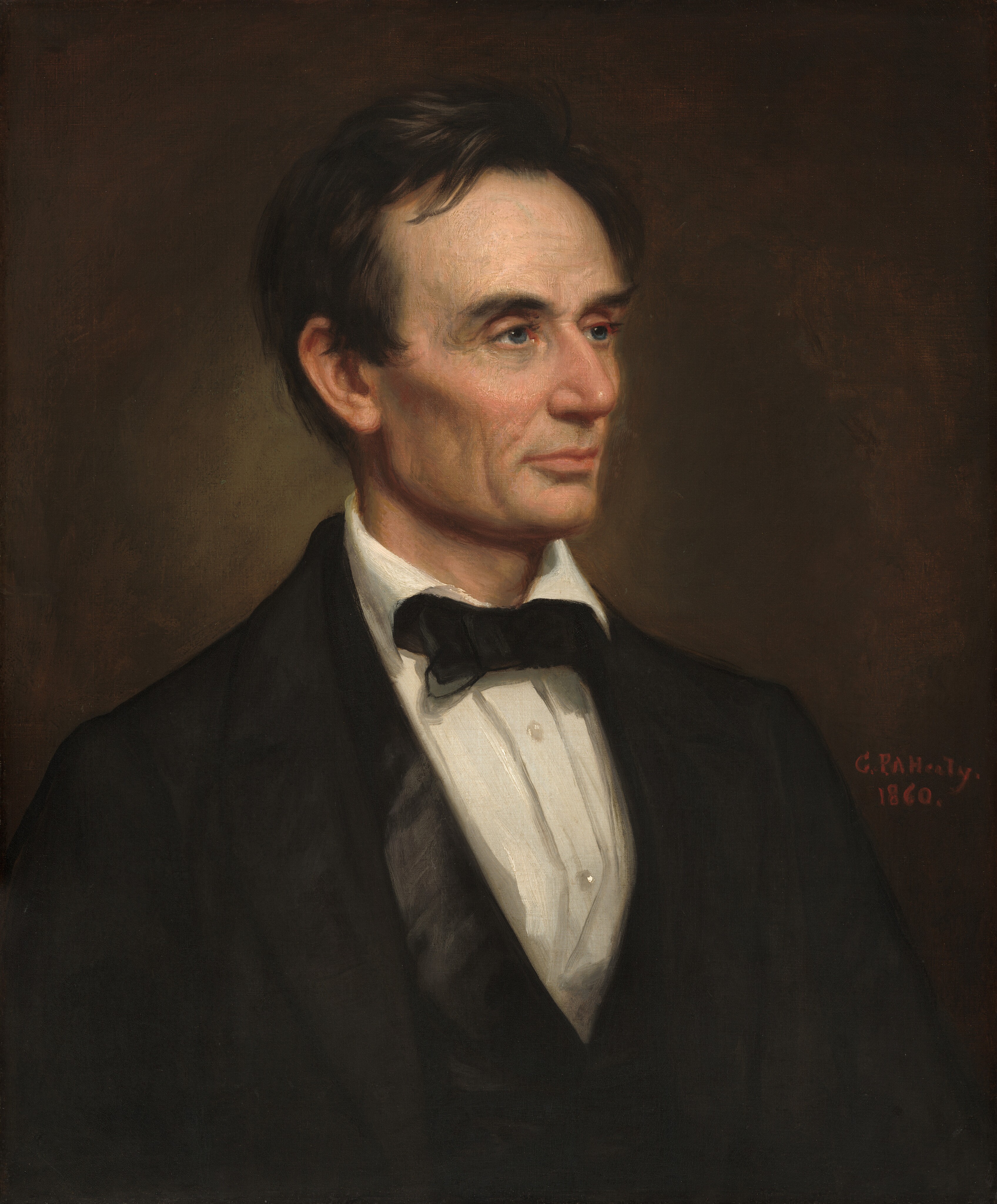
The head and shoulders of a cleanshaven, light-skinned man with black hair and a lined face is shown against a dark background in this vertical portrait. His body is angled to our right and he looks in that direction with blue-gray eyes under black brows. His hair is combed loosely back from his face but one lock falls onto his forehead, and it curls around the ear we can see. His prominent cheekbones are lightly flushed over hollow cheeks, which create noticeable shadows. He has a long nose, and his thin pink lips are closed. His forehead, the corners of his eyes, and the areas around his mouth and chin are lined with wrinkles. His black suit jacket has wide rounded lapels over a white buttoned shirt. The collar folds over a black bow tie and the two buttons visible on this shirt shine. Next to his left shoulder, on our right, the artist signed and dated the work with red paint: “G.P.A. Healy 1860.”

Abraham Lincoln

George Peter Alexander Healy

1860

Oil on canvas  Accession ID  2014.79.22

On View: West Building Main Floor, Gallery M66
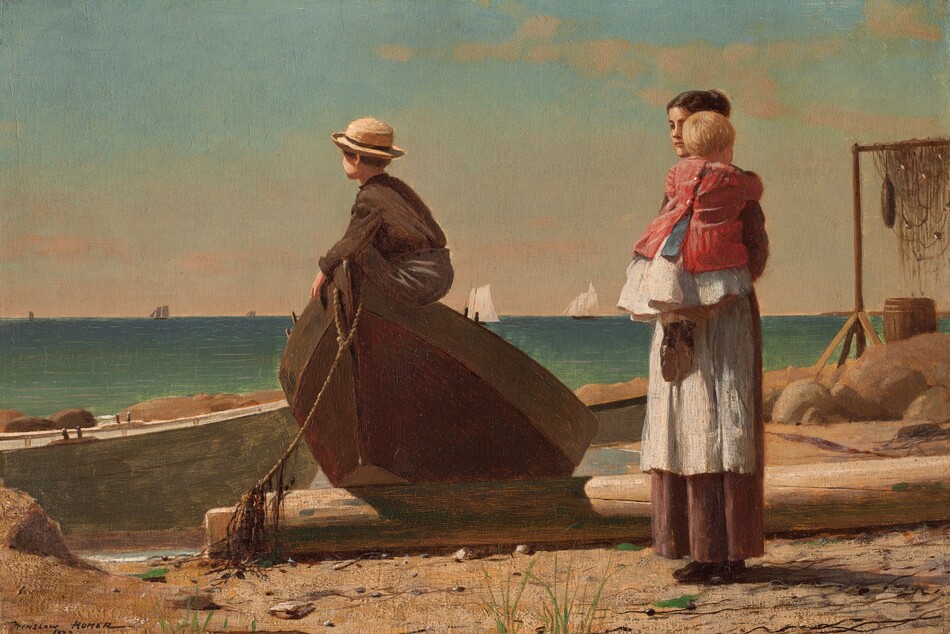
A woman holding a baby stands near a young boy who perches in the tipped-up end of a rowboat that has been pulled onto a sandy beach in this horizontal painting. All the people have light skin. The turquoise and aquamarine-blue ocean beyond meets the pale blue sky at the horizon line, about halfway up the composition. To our left of center, one end of the wooden rowboat has been propped on what might be a fallen piling on the sandy, rocky beach. The boy sitting in the bow faces our left almost in profile, and wears a round, brimmed straw hat over brown hair, a brown, long-sleeved shirt, and charcoal-gray pants. His face turns away from us so we only see his cheek and the curve of his ear. To our right, the woman’s dark hair is pulled up and she wears a white apron over a long brown skirt. She stands angled to our right and looks over the shoulder of the blond baby she holds up against her chest. The child is dressed in a white skirt, blue sash, a red jacket, and black shoes. The beach around the people is strewn with another rowboat, large boulders, a wooden barrel, and fishing nets hung over a tall frame to dry. A few tufts of scrubby grass grow in the sand around the woman’s feet. The white sails of several ships line the horizon in the deep distance. Thin, pale peach clouds float across an ice-blue sky. The artist signed and dated the work in dark paint in the lower left corner: “WINSLOW HOMER 1873.”

Dad's Coming!

Winslow Homer

1873

Oil on wood  Accession ID  2001.97.1

On View: West Building Main Floor, Gallery M68
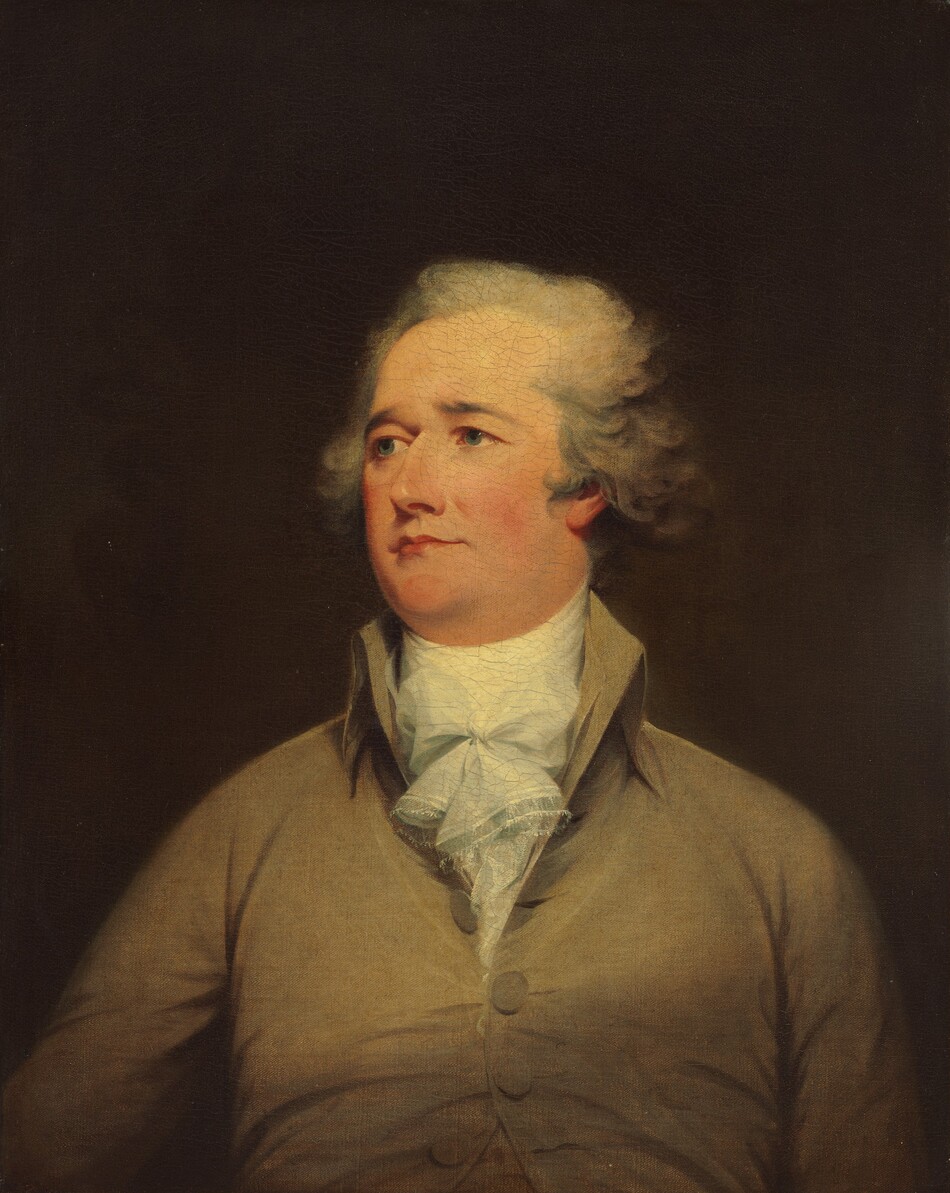
Shown from the chest up, a pale-skinned man wearing a coat and cravat looks off to our left with his chin tipped slightly up in this vertical portrait painting. The man’s shoulders and chest face us, but he turns to the left to look off in that direction with blue eyes under straight brows that angle up toward the center. He has a straight nose, rosy cheeks, full, bow-shaped lips, and a double chin. His wavy gray hair is brushed back from his high forehead and falls to his ears. His ivory-white ascot has a lacy border and is tied snugly around his neck with a bow in front. It is tucked into the high collar of his camel-brown jacket. His right arm, on our left, angles away from his body while the other is close to his side. He is warmly lit from the front set against a dark brown background.

Alexander Hamilton

John Trumbull

c. 1792

Oil on canvas  Accession ID  1952.1.1

On View: West Building Main Floor, Gallery M62
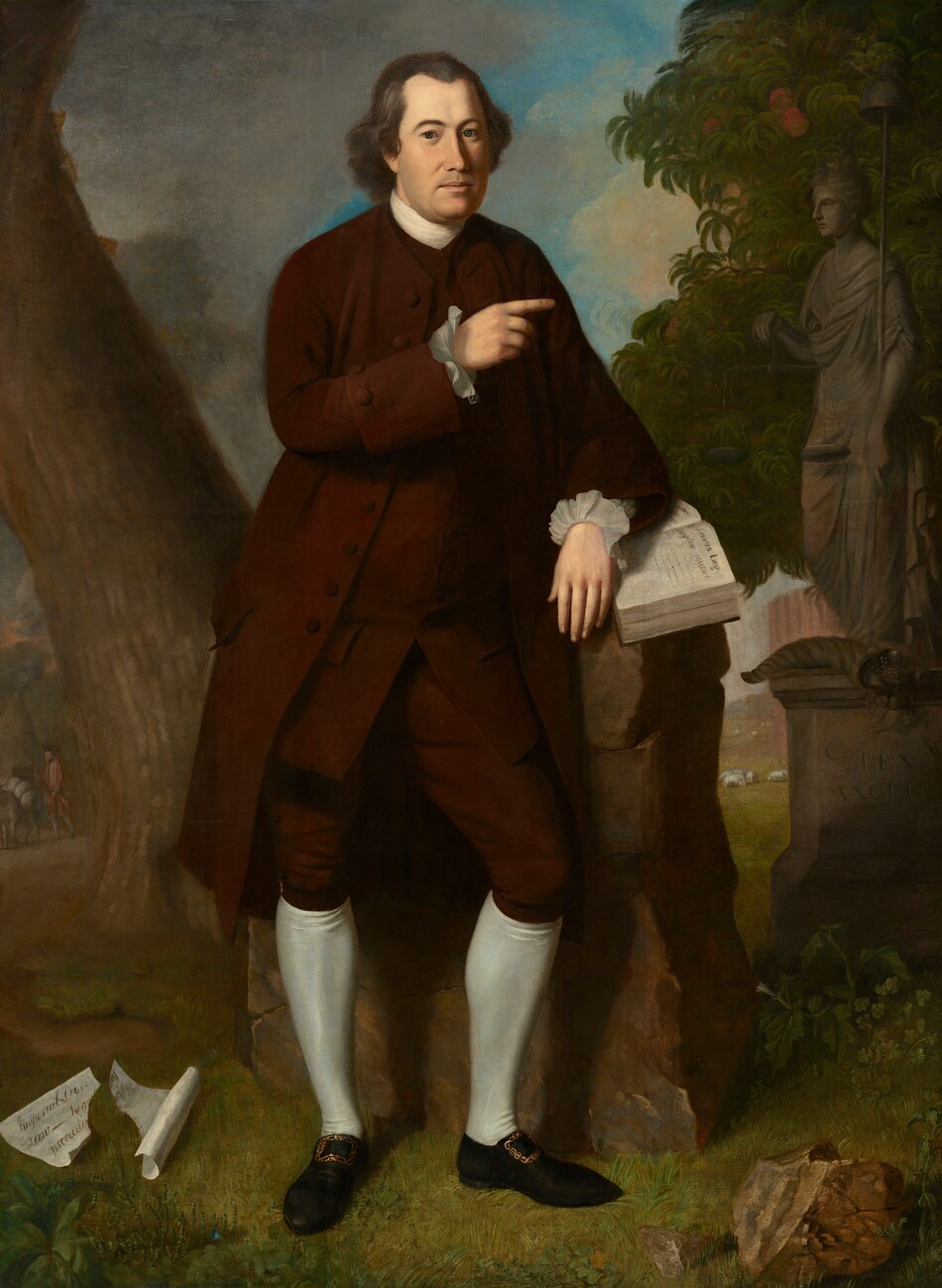
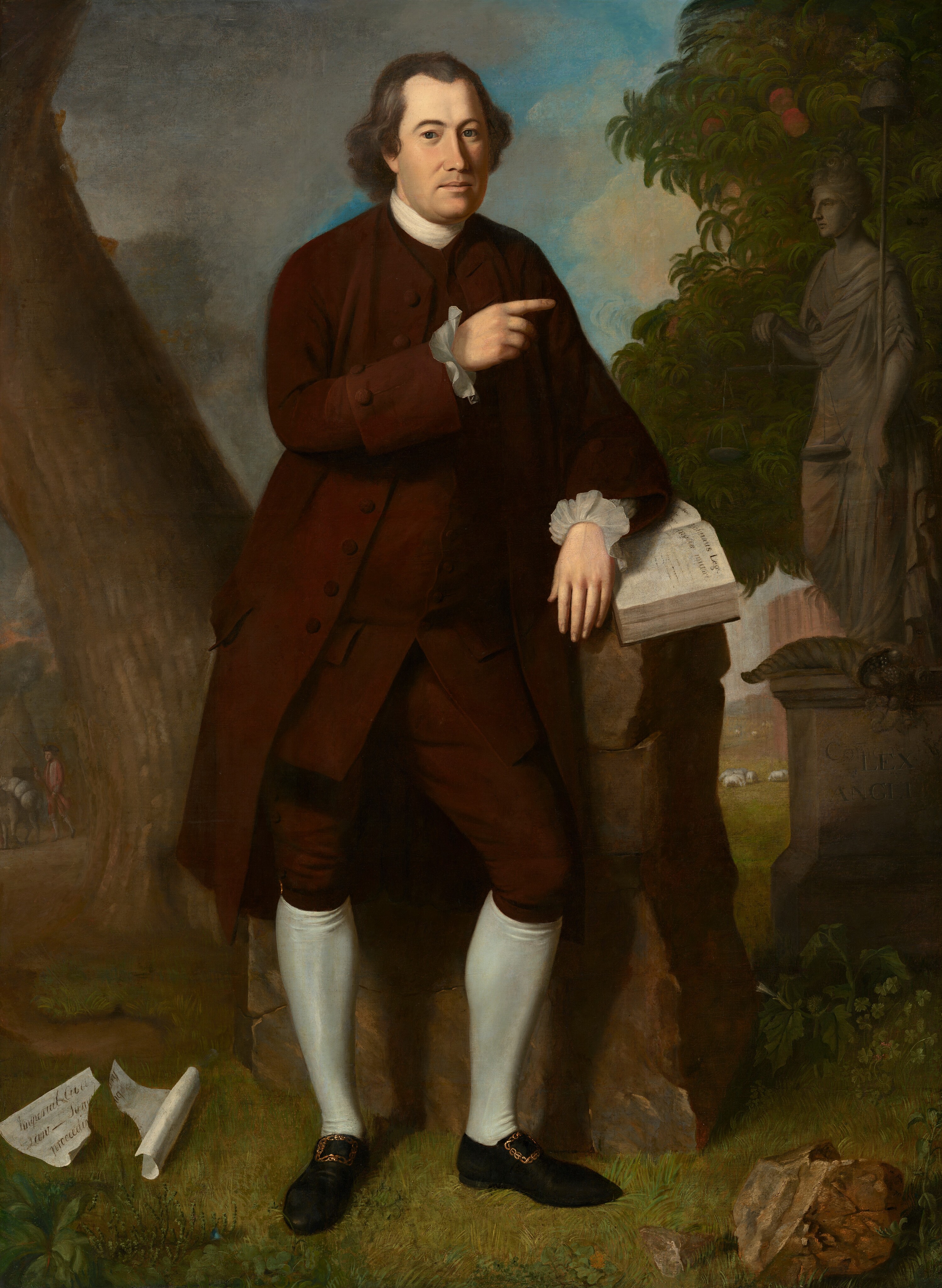
A middle-aged, light-skinned man stands facing and looking at us, leaning on one arm propped on a tall rock in a landscape in this vertical portrait painting. The man looks out with dark blue eyes under curved black brows. He has a prominent nose, his full apricot-colored lips are closed, and there is a shadow of a beard on his smooth cheeks. He has a receding hairline, and his wavy, ash-gray hair curls around his high, white collar. The man wears a tawny-brown topcoat with white, ruffled cuffs at his wrists, and a long brown vest with fabric-covered buttons. He wears matching brown, knee-length pantaloons with white stockings, and black shoes with gold buckles. His feet are widely planted as he leans on the tall rock on his left elbow, to our right. His elbow rests on an open book on the tall, narrow rock, shaped like a podium. Writing visible in the thick book reads, “Nolumus Leges Angliae mutari.” He points with his other index finger to our right. Behind the man and to our right is a gray, stone statue of a woman wearing flowing robes. She holds a pair of scales in one hand a tall staff with a bell-like form at the top in the other elbow. The statue is angled toward the man, and the tall base on which she stands is carved with the words, “Co LEX ANGLI.” A tree with sickle-shaped leaves and peach-colored fruit spans the height of the composition behind the statue. Near the lower left corner of the composition, two halves of a piece of paper, torn from corner to corner, lies on the ground with the edges curling up. The writing on the paper reads, “Imperial Civil Law — Sumary proceeding.” A thick tree trunk curves in a shallow S shape up along the left edge of the canvas, behind the man. Fern-green jimson weed, clover, small flowers, and rocks carpet the ground beneath and around the man. In the distance, to our left, a man wearing a red coat, a tricorn hat, and holding a musket leads a mule carrying a pack, while sheep graze to our right. Pockets of azure-blue sky are visible beyond gray clouds to our left and fluffy, flaxen-yellow clouds to our right.

John Beale Bordley

Charles Willson Peale

1770

Oil on canvas  Accession ID  1984.2.1

On View: West Building Main Floor, Gallery M62
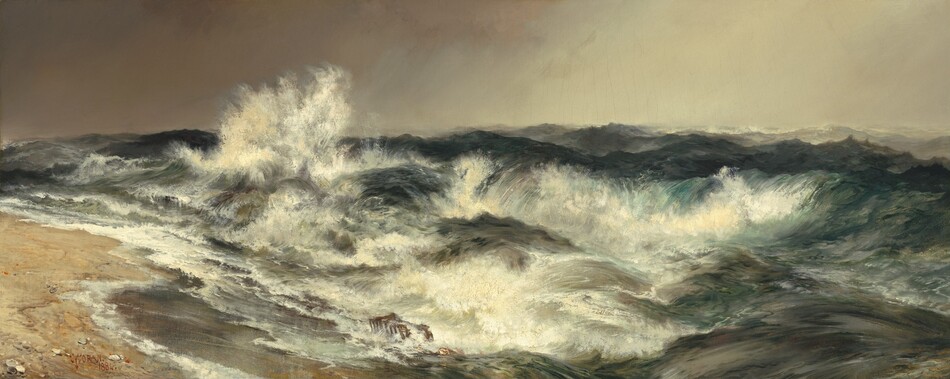
Roiling, churning waves breaking against a patch of a sandy beach fill most of this wide, horizontal landscape painting. The water deepens from aquamarine blue to teal, slate, and midnight blue amid clouds of ivory-white crests and spray. A glassy, mirror-like sheen of water coats the sandy beach where it drops sharply from the lower left corner to the breaking waves. A few shells or other objects are suggested with touches of pumpkin orange and charcoal gray along the beach. Near the lower center, a battered wooden cage is pommeled by waves where the water meets the foot of the sloping beach. A strip of sky lightens from sable brown to our left to light tan to our right across the upper third of the composition. The artist signed and dated the work with red paint in the lower left corner, “T MORAN 1884,” with the T overlapping the M to make a monogram.

The Much Resounding Sea

Thomas Moran

1884

Oil on canvas  Accession ID  1967.9.1

On View: West Building Main Floor, Gallery M67

Loading Results