American Paintings 1750–1900

Filter Results

166 artworks on view.

Results

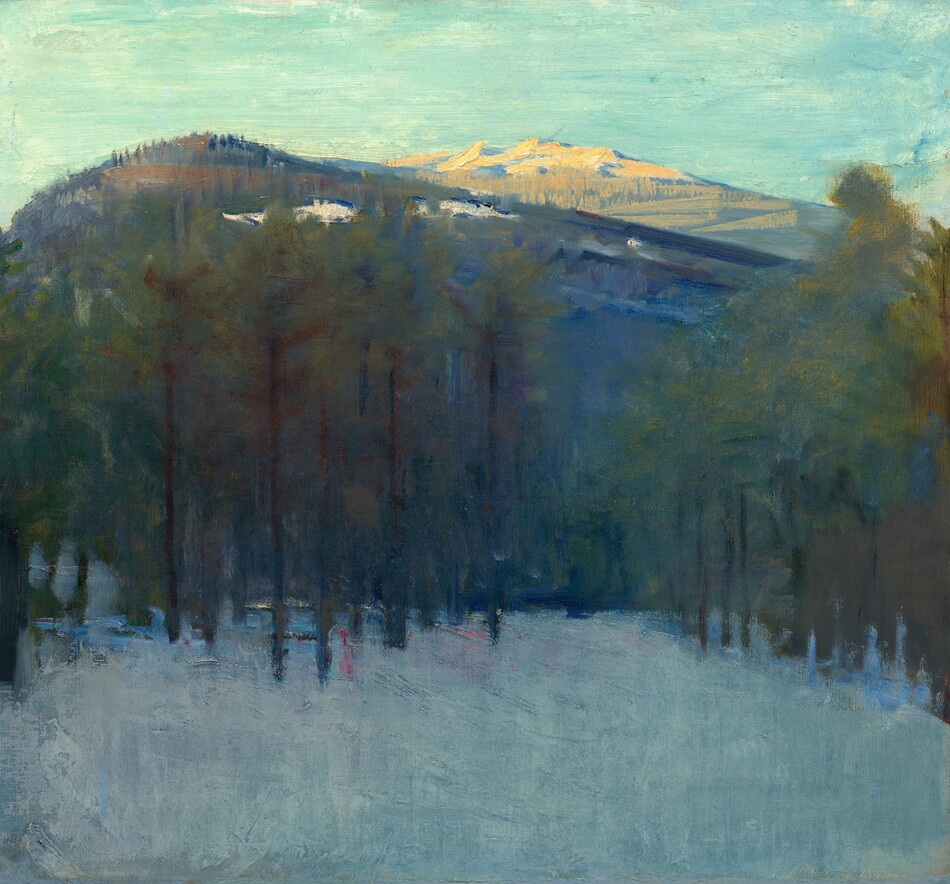
We look across a shaded field of snow, through a screen of loosely spaced trees at a cobalt-blue mountain that dominates this square landscape painting. The scene is painted with visible brushstrokes throughout. The base of the mountain comes about a third of the way up the composition, and a narrow band of vibrant turquoise sky runs above it, along the top edge of the canvas. The mountain curves up to its gentle peak to our left of center and slopes down gradually to our right. Patches of white snow stand out against the deep blue mountain just above the treetops. Trees along the mountaintop create a choppy contour against the sky. The broad summit of a second mountain beyond, to our right, is lit by the sun so the face is golden tan, shaded with denim blue. The slopes are painted with thick strokes that create texture on the surface of the canvas. The snowy field close to us is painted with loose brushstrokes in arctic blue. The trees are painted with deep, olive-green foliage or needles and tall, dark, straight trunks. Patches of topaz blue and fuchsia pink appear on the ground among trees to our left.

Mount Monadnock

Abbott Handerson Thayer

probably 1911/1914

Oil on canvas  Accession ID  2014.79.34

On View: West Building Main Floor, Gallery M70
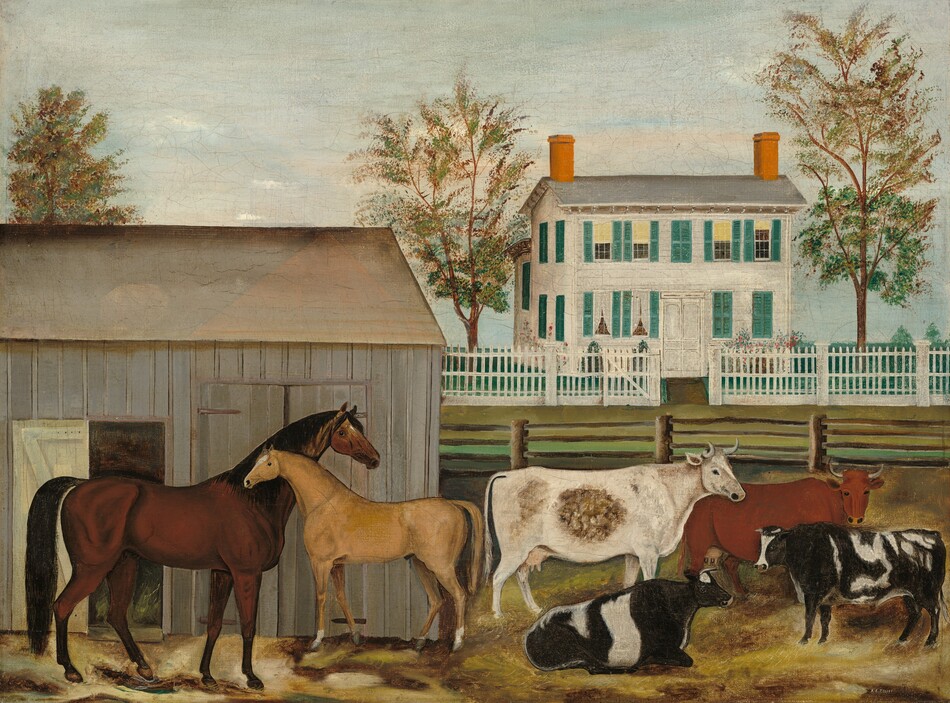
The painting depicts a rural farmstead. On the left, two horses stand near a gray wooden barn, with cows standing and sitting on the right in front of a fenced-in green field. The ground below the animals is brown, with patches of yellow, green, and cream. There is a white two-story house with blue shutters and a white picket fence in the distance. The sky is grayish-blue with light clouds. Trees around the house and barn show hints of green and brown.

The Barnyard

Amzi Emmons Zeliff

late 19th century

Oil on canvas  Accession ID  1955.11.1

On View: West Building Main Floor, Gallery M63
This painting shows a plucked chicken hanging upside down by one yellow leg from a piece of string. The chicken's bare skin is pale yellow with some areas of pale pink. Its tail and head are still intact, showing white plumage and a red crest. There are some small white feathers still connected to its skin, and a few scattered feathers float downward against the brown wooden panel background.

Plucked Clean

William Michael Harnett

1882

Oil on canvas  Accession ID  2014.136.133

On View: West Building Main Floor, Gallery M65
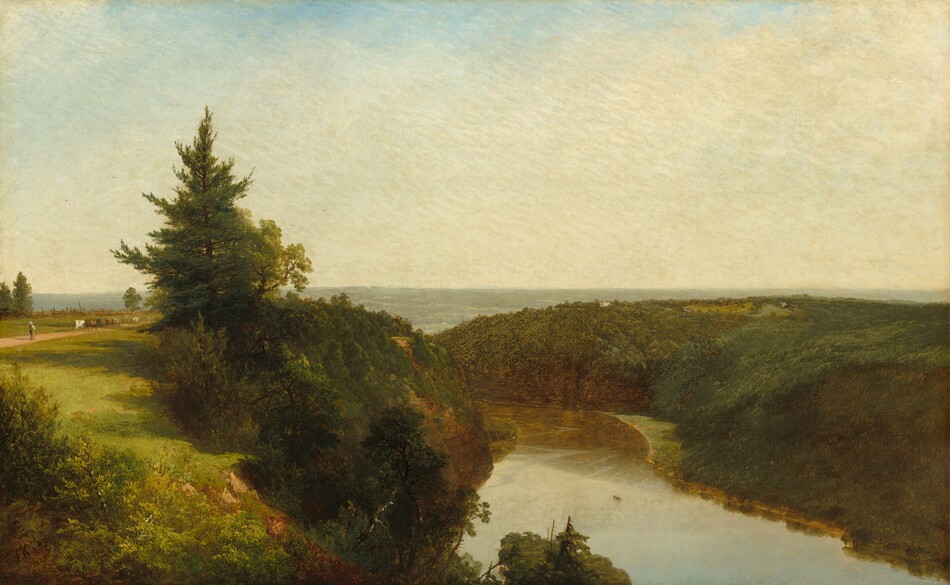
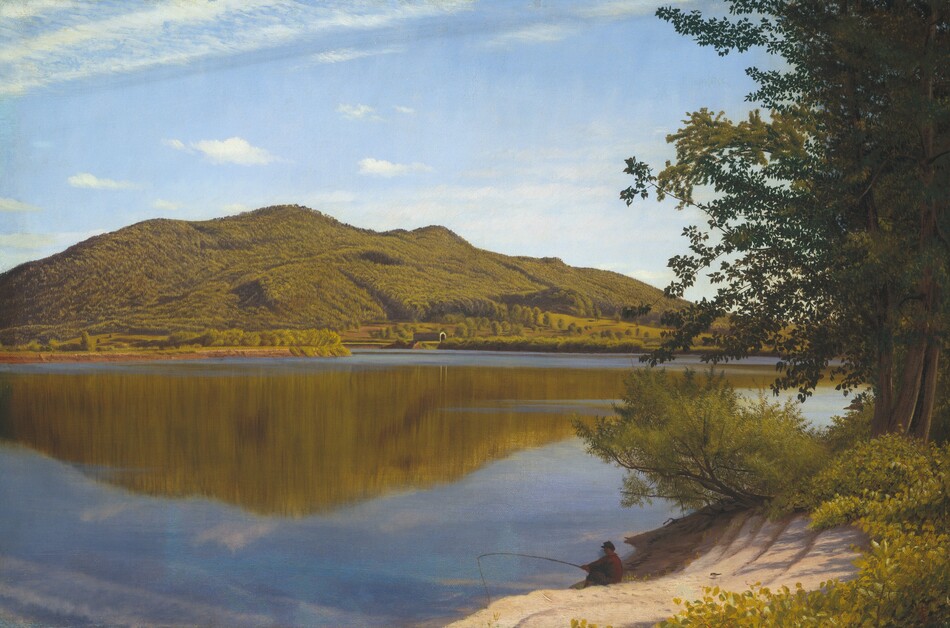
This painting shows a landscape with a wide river on the right flowing through green hills. There is a path on top of a green hill on the left, showing a small person in the distance facing away from us, walking behind a group of brown and white cattle. Tall, dark green trees separate the path from the slope down to the river. The sky is vast and pale blue, covered in white clouds. The painting has smooth brushstrokes and a color palette of primarily greens, browns, blues, and yellows.

View on the Genesee near Mount Morris

John Frederick Kensett

1857

Oil on canvas  Accession ID  2014.136.118

On View: West Building Main Floor, Gallery M67
The painting is a landscape featuring a riverbank with tall, dark-green trees on the left side and distant blue hills in the background. The shore on the left is covered is tall yellow and green grass and dotted with pink and white flowers below the dark green trees. The water on the right is light blue, reflecting the blue sky and the thick white clouds.

Palmer River

Edward Mitchell Bannister

1885

Oil on canvas  Accession ID  2021.11.1

On View: West Building Main Floor, Gallery M68
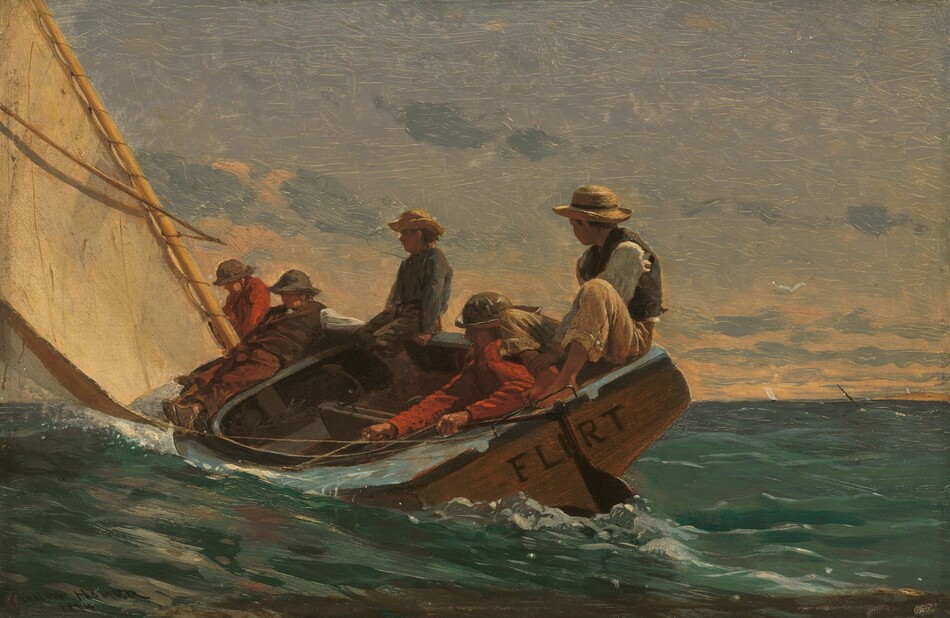
Close to us, a young man and four boys sit or recline in a small sailboat that tips to our left on a choppy dark green sea fringed with white foam in this horizontal painting. The billowing sail extends off the top left corner of the painting. The horizon line comes about a third of the way up the composition, and wispy gray and white clouds skip across the pale blue sky. The sun skims along the scene from our right so the boys’ ruddy faces are in shadow under their hats. They wear long-sleeved shirts and long pants in shades of brown, slate blue, white, and red. The young man and boys all face our left and they lean against and into the boat as it cants up to our right. The boy nearest the sail to our left reclines across the bow. Next to him, to our left, is a boy sitting on the edge of the boat partially hidden by the sail’s mast. To the right another boy perches on the edge of the boat and holds on with both hands. The oldest sits on the floor of the boat as he maneuvers the sail with a rope. Closer to us and to our right, a younger boy sits with his bare feet pressed together in front of his bent knees on the back edge of the boat, gazing into the distance over his right shoulder as he handles the tiller. Directly beneath his bent knee the boat’s name is painted on the flat stern: “FLIRT.” The artist signed and dated the painting in dark letters in the lower left corner: “WINSLOW HOMER 1874.”

The Flirt

Winslow Homer

1874

Oil on wood  Accession ID  2014.18.18

On View: West Building Main Floor, Gallery M68
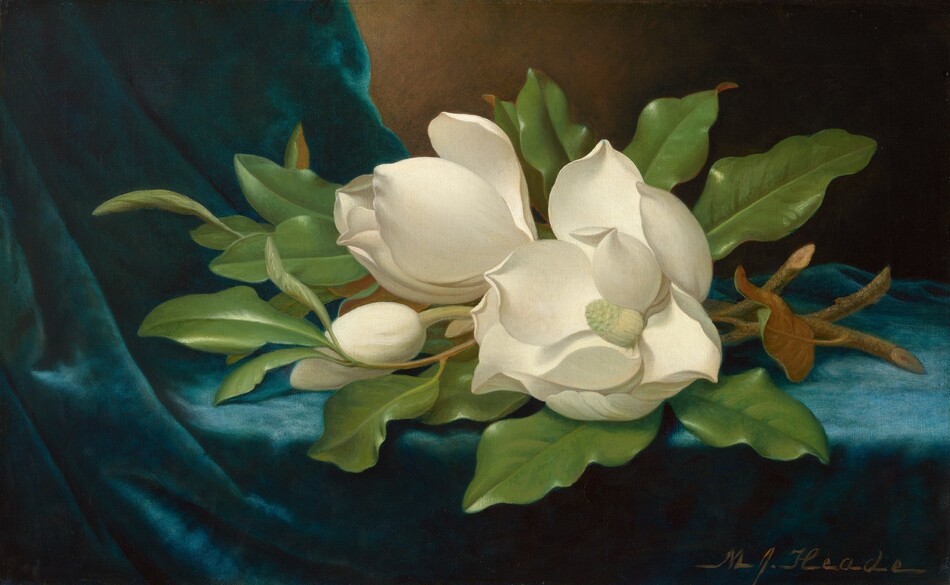
Twigs of a magnolia tree with light green, glossy leaves and three cream-white blossoms lie on a sapphire-blue cloth in this horizontal still life painting. Brightly lit from our left, the blossoms and leaves nearly fill the composition, and the cut ends lie on the fabric to our right. The blue fabric cascades from the upper left and across the table or ledge. The three flowers are in various stages of bloom. The tightest bud is to our left, overlapped by a stem and the tender, unfurling leaves of a branch. The blossom next to it, at the center, is starting to open. The petals of the third blossom, to our right, splay open around the flower’s oval-shaped stamen. Light glints off the waxy leaves surrounding the flowers. The tawny-brown underside of one leaf is visible where it turns over, near the cut ends of the branches. Light shimmering on the fabric darkens from bright blue to our right, to deep royal blue in the shadows to the upper left, suggesting the fabric is velvet. The background is streaked with tan and pine green behind the fabric, and becomes nearly black in the shadows of the upper right corner and along the bottom edge. The artist signed the lower right corner, "MJ. Heade."

Giant Magnolias on a Blue Velvet Cloth

Martin Johnson Heade

c. 1890

Oil on canvas  Accession ID  1996.14.1

On View: West Building Main Floor, Gallery M69
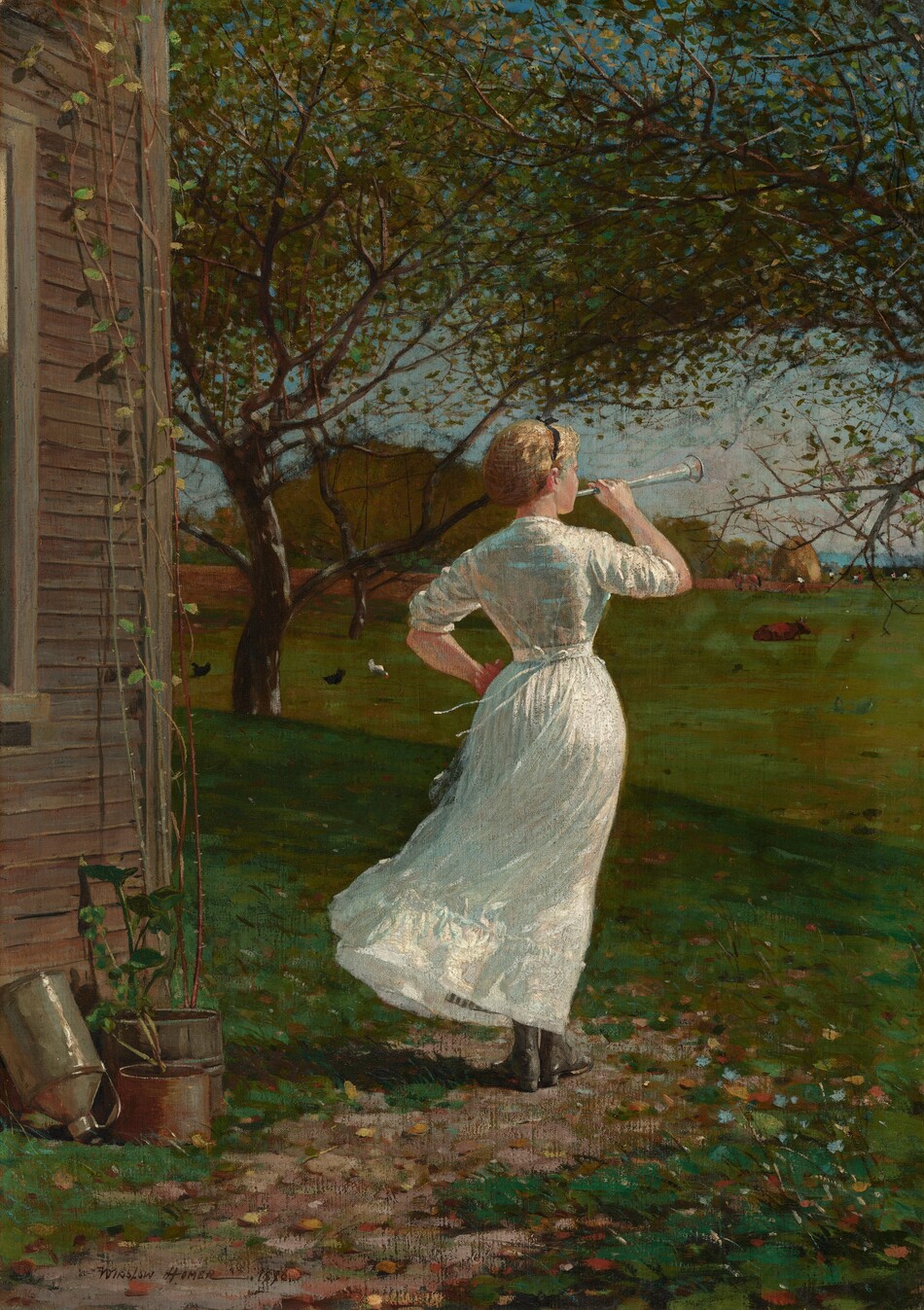
Facing away from us, a light-skinned woman blowing a silver horn stands in a grassy landscape in this vertical painting. The woman is lit brightly from the upper right, making her ankle-length, white dress glow. The sleeves are rolled back to her elbows, and a black ribbon fastens her blond hair in a net. We see the right edge of her cheekbone, and her skin is smooth and pale. She holds the horn up with her right hand and plants the back of her other hand on her hip. She stands with her heels together, wearing black boots. A strong wind from our right lifts and twists the hem of her dress and the thin ties at her waist. She stands on a patch of dirt within a leaf-strewn, grassy lawn. The edge of a building with wooden siding, presumably a house, runs parallel to the left edge of the painting. A vine grows up the corner of the house, and the very edge of a window frame is seen along the left side. At the corner of the house, two plants grow in pots, and an overturned, metal jug leans against the wall. An expanse of bright green grass stretches in front of the young woman. The land dips and rises a short distance away. A reddish-brown cow lies in the field beyond as black and white chickens peck the grass. The dark green canopies of trees growing to our left fill the top third of the painting. In the deep distance, a few dots of paint indicate people wearing white and red, working on a strip of brown land. One man works a plow pulled by a brown horse. A mounded, golden haystack sits farther back in that field. A strip of blue along the horizon could be water or distant hills. The turquoise sky above peeks through the canopies of the trees. The artist signed and dated the painting in the lower left corner, “WINSLOW HOMER. 1870.”

The Dinner Horn (Blowing the Horn at Seaside)

Winslow Homer

1870

Oil on canvas  Accession ID  1994.59.2

On View: West Building Main Floor, Gallery M68
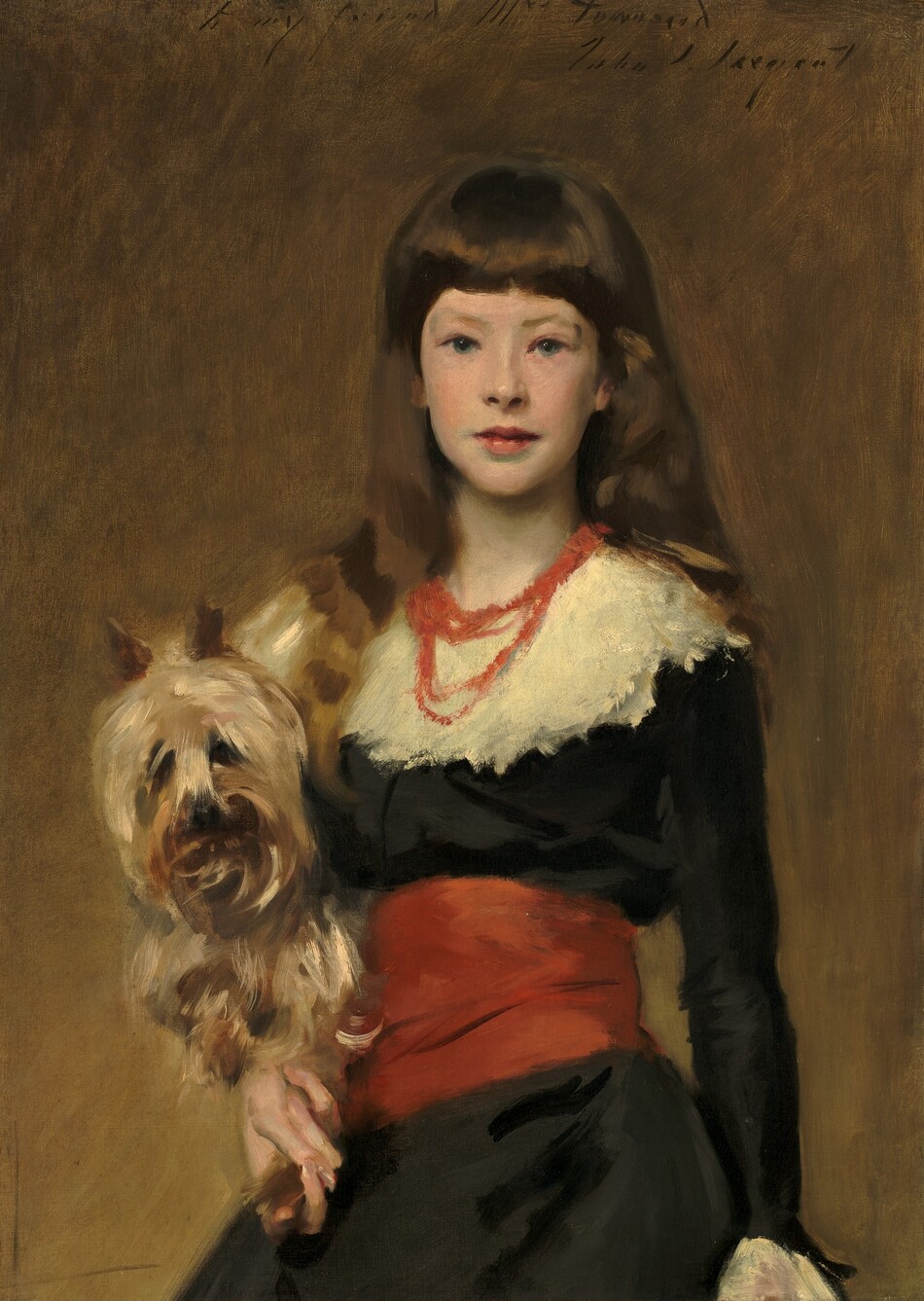
Shown from the hips up, a pale-skinned young girl wearing an ink-black garment with a cream-white collar and a coral-red sash and necklaces holds a terrier dog as she looks at us in this vertical portrait painting. The artist used brushstrokes throughout, especially in the hair, clothing, dog, and background. The girl’s body is slightly angled to our left but she turns her oval face to us. She slightly cocks one faint brow as she gazes out with large, pale blue eyes. She has smooth cheeks, and her full, red lips are closed. Her chestnut-brown hair curtains her forehead in thick bangs and falls down past her shoulders. Her black dress has long, tightly-fitting sleeves and is cinched with a wide, oversized red sash, presumably tied at the back. A multi-stranded, coral-red necklace lies over her layered, cream-white lace collar, which extends just past her shoulders. A long, white cuff falls over her left wrist, down by her side. With her other hand, to our left, she supports the terrier against her right hip. The long fur around the dog’s dark eyes is shimmering, flax brown. Caramel-brown ears poke up on its shaggy head. The girl holds the dog's tail in that hand. The background behind the pair lightens from fawn brown across the top to golden brown along the bottom edge. The artist inscribed and signed the painting in slanting, cursive letters at the top right corner: “to my friend Mrs Townsend John S. Sargent.”

Miss Beatrice Townsend

John Singer Sargent

1882

Oil on canvas  Accession ID  2006.128.31

On View: West Building Main Floor, Gallery M69
We look across a profusion of vivid red, blush-pink, and white flowers lining a stony shoreline in this almost square landscape painting. The scene is loosely painted so some details are indistinct, especially the blossoms of the flowers, which are dabs of pink and red. The flowers have long, sage-green stems shaded with flicks of navy blue. The field of flowers covers the bottom third of the composition, and a vibrant green and blue bush peeks in from the right edge of the painting. Beyond the field of flowers is a powder-blue body of water with low, rocky formations, like giant, shallow boulders rolling across the surface of the water. The rocks are painted in shades of white tinged with pink, blue, and green with daubs of rust orange along their edges. An outcropping farther in the distance to our left is carpeted with patches of pea green and canary yellow. One rock formation in the middle of the composition almost spans the width of the painting. Beyond it is a small boat with white sails drifting on the water. In the deep distance is another long finger of oyster-white land stretching across the left half of the horizon, which comes two-thirds of the way up the composition. A lone bird flies through the milk-white sky that fills the top third of the scene. Some patches along the bottom edge of the painting are beige, where the canvas on which this is painted is visible. The artist signed and dated the lower left, “Childe Hassam 1891.”

Poppies, Isles of Shoals

Childe Hassam

1891

Oil on canvas  Accession ID  1997.135.1

On View: West Building Main Floor, Gallery M70
An unmade bed with white sheets and scattered pillows is on the right side of this painting. The headboard and sides of the bed are a reddish-brown color, while the sheets and pillows are in shades of white, with a pale-pink fabric that might be a blanket or a piece of clothing. On the left is a wooden chair angled towards the bed, draped with a white cloth and topped with a tea set that includes several gleaming pots and bowls and half of a large yellow lemon or grapefruit. On the gray floor is a pair of black shoes, one upright and the other on its side. On the left, behind the chair, is a closed white door with a round knob. A light illuminates the scene from the top left, casting shadows on the floor.

The Breakfast Tray

Elizabeth Okie Paxton

c. 1910

Oil on canvas  Accession ID  2023.138.1

On View: West Building Main Floor, Gallery M70
This painting shows a man from the knees up.  His body faces us, while his head is partially turned to the right. He has a round face with light skin and light gray hair combed back from his face and coming down to his ears. He has a straight nose, thin lips, and a double chin. He wears a dark brown coat with a white collar and cuffs and holds a light brown cane. One of his hands is wearing a dark gray glove, while the other is bare; the gloved hand also holds the other glove, along with the cane. The man is leaning against a large brown column that takes up the left side of the painting, and the wall behind him is dark brown.

Thomas Amory II

John Singleton Copley

c. 1770-1772

Oil on canvas  Accession ID  2014.79.14

On View: West Building Main Floor, Gallery M62

Loading Results