American Paintings 1750–1900

Filter Results

166 artworks on view.

Results

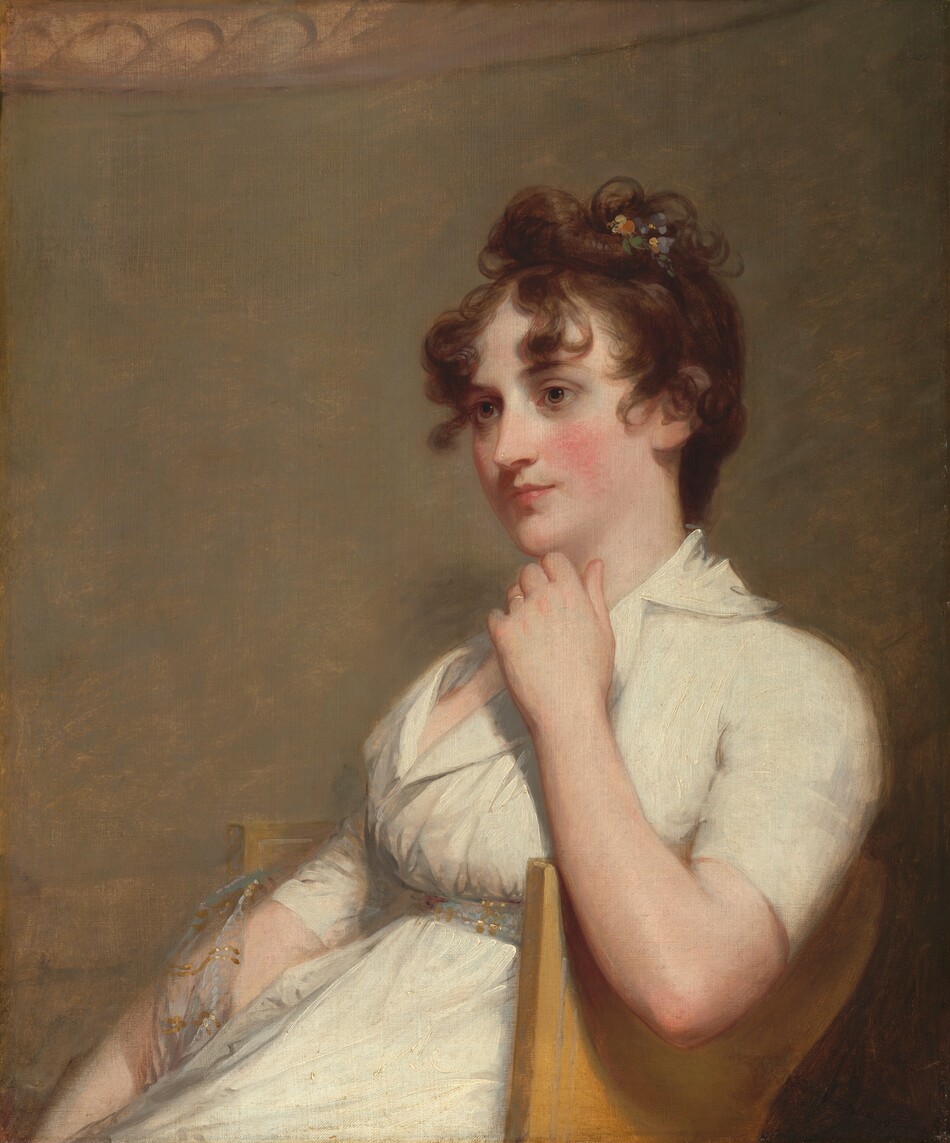
This painting is a portrait of a seated woman looking off to the left with a composed expression. She has light skin with rosy cheeks, brown eyes, and slightly upturned pink lips. Her curly brown hair is styled on top of her head with a small floral clip or decoration. She is wearing a white dress with short sleeves and a low neckline with a wide collar. Around her waist is a thin belt with gold and light-blue designs, and a translucent cloth with a similar pattern is draped over her right forearm. Her other arm rests over the edge of the tan chair she sits in, and she brings her hand up slightly below her chin. A thin gold band is visible on one of her fingers. The background is a plain, muted brown color, with a curved tan section at the very top.

Eleanor Parke Custis Lewis (Mrs. Lawrence Lewis)

Gilbert Stuart

1804

Oil on canvas  Accession ID  1974.108.1

On View: West Building Main Floor, Gallery M60
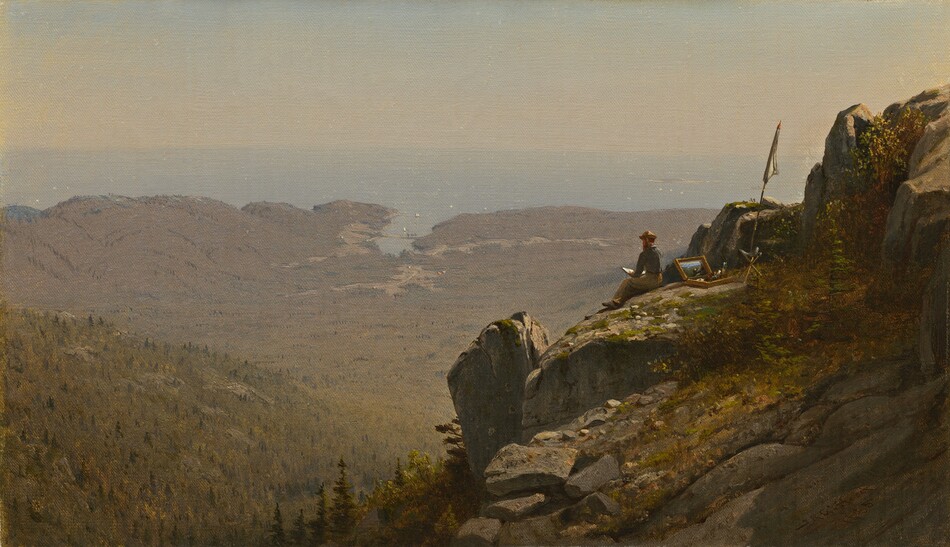
A man sits on a sheer, rocky outcropping high above a sunlit expanse of land that stretches to meet a sun-dappled sea in this horizontal painting. The outcropping slopes in to fill the right half of the composition, and is partially carpeted by mustard-yellow, brown, and moss-green growth. Bright sunlight from the upper right glints off some of the craggy, steel-gray rock faces. The man is tiny in scale within the composition, and sits near the top right with his legs stretched out in front of him. He wears a denim-blue shirt, tan pants, and soft hat with a narrow brim. He appears to have red hair and a beard. He holds a white object in front of him, presumably paper or a notebook. Behind him an open box of paints and brushes sits near a camp stool with a closed white parasol planted next to it. A lower hill in the middle distance slopes in from the left side and disappears behind the outcroppingin the center of the composition. The hill is covered with muted and dark greens and yellows, suggesting a forest of pine trees. The hill descends to meet the flat, mauve-tinted land, which is crisscrossed with shallow fissures. In the distance, the area where the narrow band of powder-blue sea meets the sky, about three-quarters of the way up the canvas, is painted with a tan-colored haze. The artist signed the work in the lower right as if he had carved his name and the date into the rock. It reads, “S R Gifford 1865.”

The Artist Sketching at Mount Desert, Maine

Sanford Robinson Gifford

1864-1865

Oil on canvas  Accession ID  2004.99.1

On View: West Building Main Floor, Gallery M65
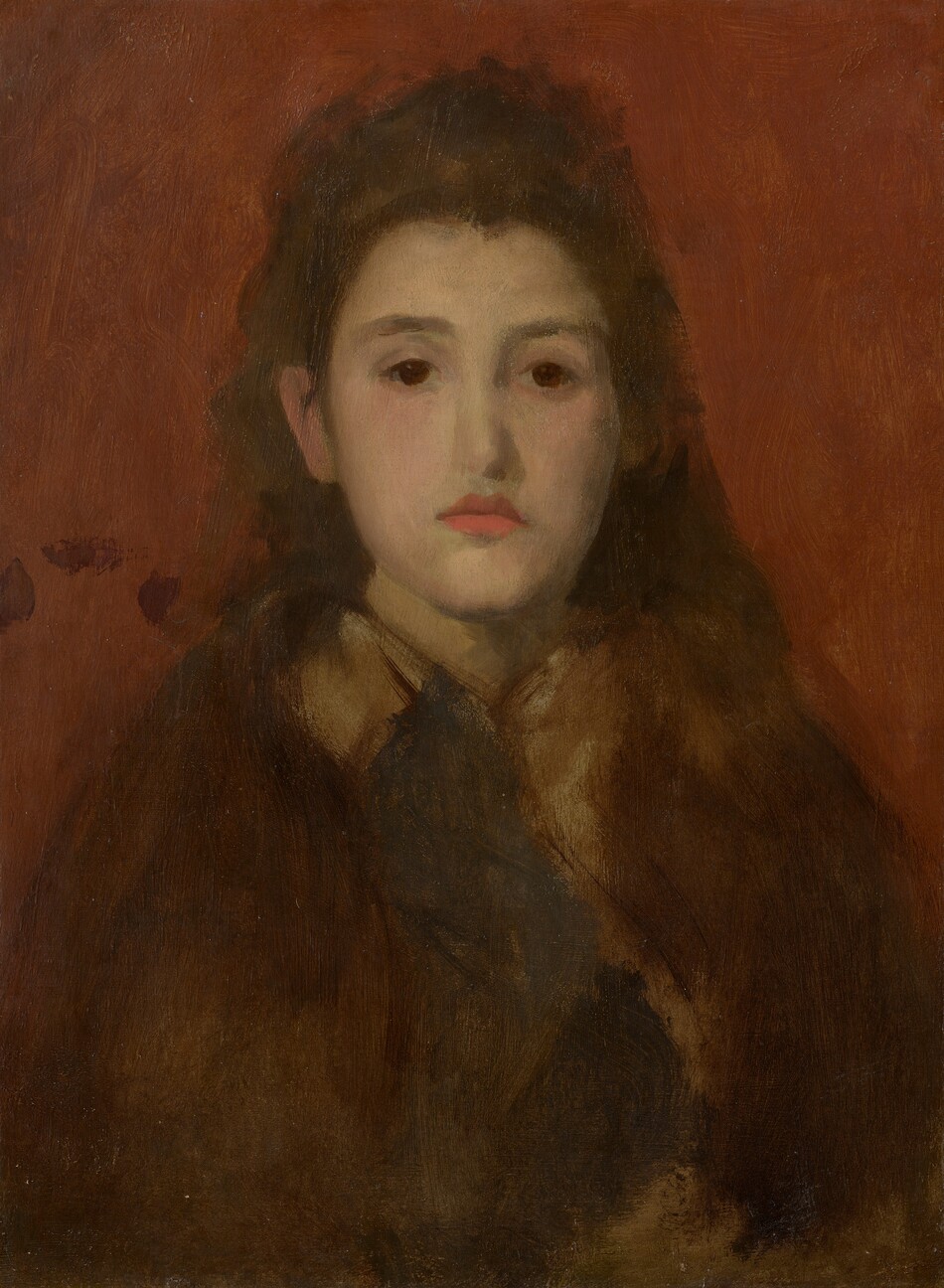
The head and shoulders of a young woman with gold-tinted, pale skin looks out over our right shoulder from against a tomato-red background in this vertical painting. The portrait is created with mostly visible, sinuous brushstrokes that make some details indistinct. With her body facing us, the woman nearly fills this composition. She looks in our direction with large, dark eyes under almost flat brows. She has an oval face, a long nose, and her full, slightly downturned coral-red lips are closed. Her chestnut-brown hair falls loosely down her back. Some locks pour over her left shoulder, to our right, and her hair is tucked behind her other ear. Her hair and clothing are especially loosely painted, so it is difficult to make out what she wears. An area of beige could be a scarf draped around her neck and down her front, or a dark, coffee-brown cloak could be open over a lighter garment beneath. The red background is painted with long, visible brushstrokes, and three dark brown spots are clustered against the background over her right shoulder, to our left.

Alice Butt

James McNeill Whistler

c. 1895

Oil on canvas  Accession ID  1948.16.2

On View: West Building Main Floor, Gallery M69
A bearded man with wrinkled, peachy skin and reddened cheeks sits and smokes a pipe on a wooden box in a landscape in this vertical painting. The man’s body faces us, and he peers at us with dark eyes under heavy, bushy white brows. Wrinkles line his forehead, the corners of his eyes, and his cheeks. He has a bulbous nose and a gray beard, and the long-stem pipe is pinched in his downturned mouth. His shaggy gray hair is covered by a cardinal-red cap. He wears a blousy daffodil-yellow shirt, which is loose around the neck, faded and patched blue pants, and scuffed brown boots. His legs are crossed with one knee over the other, and one fist rests in his lap. The other elbow is propped on a pyramid of three wooden barrels stacked on their sides to our left. A few bits of bricks or red stones are near the man’s feet, and a wooden houseboat with a low-pitched roof is in the near distance, to our right. The platform under the structure floats on a river, which is lined with trees to our right and mountains to our left. The sunset warms the face of the mountains and the trees to red and gold. Sage-green and peach clouds billow above the man, dividing the sky diagonally in front of bright blue sky beyond. The artist signed and dated the painting in the lower left corner, “G.C. Bingham 1850.”

Mississippi Boatman

George Caleb Bingham

1850

Oil on canvas  Accession ID  2004.66.1

On View: West Building Main Floor, Gallery M65
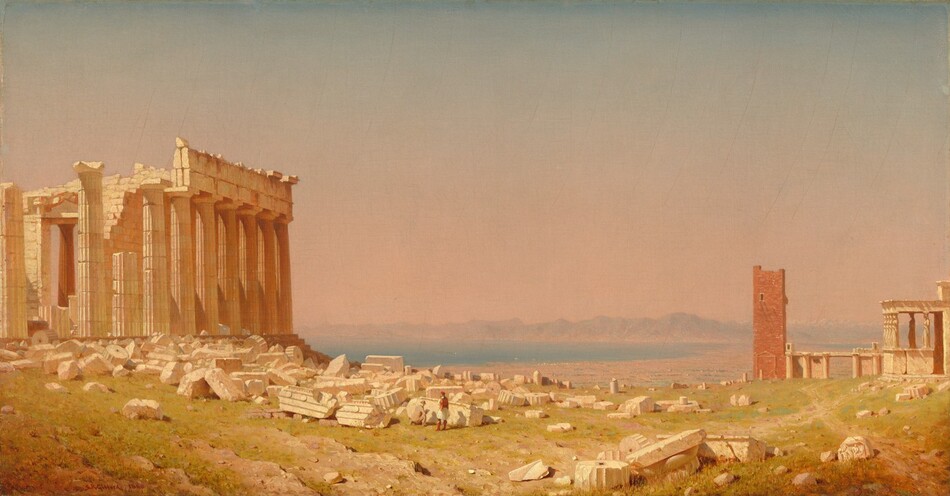
A view across a wide, brightly lit field scattered with broken pieces of stone is framed to the left and right by crumbling stone temples in this horizontal painting. The sunlight is infused with a soft pink glow, which warms the cream-white stone with a pale blush. The temple on our left sits on a low rise, and a row of at least nine columns topped with an entablature faces our right. Several of the columns are broken off, and part of the entablature and the entire roof is missing, from what we can see. Fragments of pediments and wheel-like sections of columns tumble down from its front steps and back along its side, cascading into and across most of the field before us. The rocky terrain is carpeted in celery-green growth speckled with sage green and areas of rust red in the lower left and right corners. Barely visible in the center of the field, are two men, barely taller than the fragments they inspect. One man wears an apricot-orange suit and bowler hat over blond hair. He kneels with his back to us as he writes or sketches on a piece of paper. A second man stands to his right, also with his back to us, dressed in a long pleated, white tunic with a red cap, jacket, and knee-high boots. To our right and farther back than the other temple, a brick-red tower stands next to another columned arcade. A third temple there, or perhaps another part of that building complex, has columns carved into the shape of six identical, robed women, facing our left. Beyond the ruins, the field slopes down to a peach-colored plain that ends at a wide, topaz-blue body of water with mountains in the far distance along the low horizon line. A petal-pink haze rises from the water and mountains and almost fills the blue-gray sky above. The artist has signed and dated the painting in the lower left, “S.R. Gifford 1880.”

Ruins of the Parthenon

Sanford Robinson Gifford

1880

Oil on canvas  Accession ID  2014.79.20

On View: West Building Main Floor, Gallery M67
This painting shows a seated woman depicted from the knees up. She is sitting in a dark reddish-brown chair with a dark green cushion, her body turned slightly to the left, facing the viewer. She has both arms resting on her lap, her left hand holding a small twig with round green leaves and her right hand holding a small book open. She has light skin, dark brown eyes, thin eyebrows, thin pink lips set in a neutral expression, and dark curly hair styled away from her face and adorned with a white headband. She wears a dark red dress with lace detailing around the neckline and the cuffs of the short sleeves. The background features a dark gray wall on the right, with a white window on the left providing a view of an outdoor scene with leafy green trees and a sky that is a gradient of light gray and light blue, with light pink at the horizon.

Sarah Ogden Gustin

Joshua Johnson

c. 1805

Oil on canvas  Accession ID  1971.83.7

On View: West Building Main Floor, Gallery M63
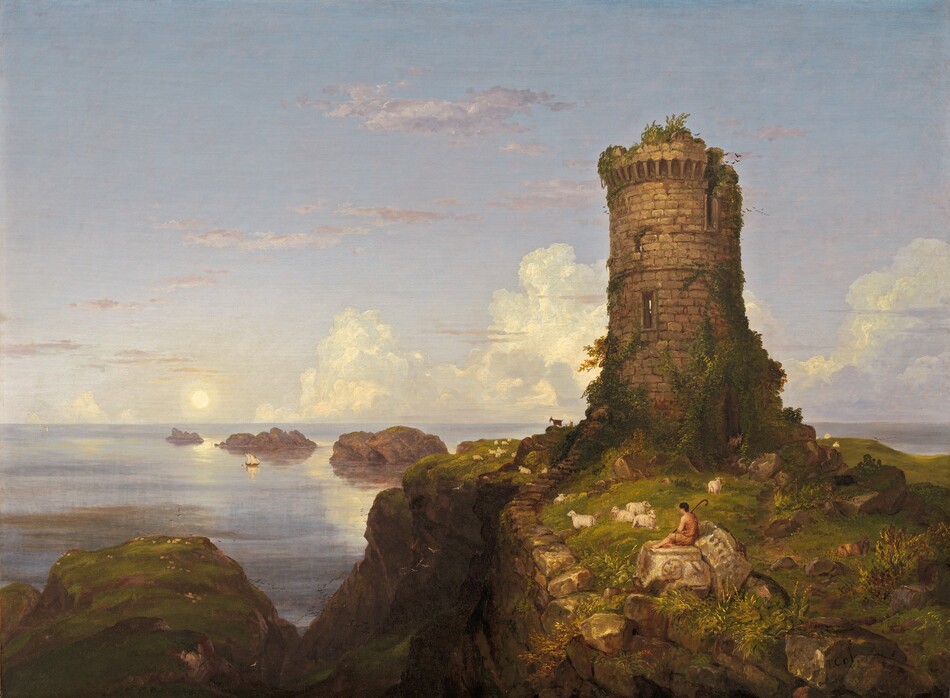
We look across a rocky, grass-covered promontory at a crumbling, round brick tower overlooking topaz-blue water in this horizontal landscape painting. Golden sunlight warms the face of the tower and throws the steep outcropping below into deep shadow. To the right of center, the brown stone tower is partially overgrown with climbing ivy and other vegetation. About two dozen white sheep and several sienna-brown goats lie or stand scattered around the narrow ring of grass that surrounds the tower. A young man with pale skin and dark hair, wearing a ginger-brown toga, watches over the six sheep and two goats on the side of the tower closest to us. The shepherd’s staff has a hooked end, and he sits facing away from us on parchment-white stones that may be carved fragments of a large building. The promontory holding the tower has steep, vertical sides that dip into shadow, and lower hills fill the bottom left corner of the painting. Three more rocky outcroppings jut up in the smooth waters of the ocean in the distance, and a solitary ship, tiny in scale, sails near the middle formation. The still surface of the water reflects the towering, puffy white and lavender-purple clouds that line the horizon, which comes almost halfway up the canvas. A white disk, presumably the moon, hangs low near the horizon to our left. A few thin, lilac-purple clouds stretch across the sky closer to the top edge of the painting. The artist signed the work as if he had written his name on the face of a rock near the lower right corner, so the last letter is partially obscured by another rock: “T.Cole.”

Italian Coast Scene with Ruined Tower

Thomas Cole

1838

Oil on canvas  Accession ID  1993.55.1

On View: West Building Main Floor, Gallery M64
Two men play cards at a wooden table in a tavern while a third stands on the far side of the table between them, wearing green-lensed glasses and reading a newspaper in this horizontal painting. The men have pale skin and ruddy cheeks. The man on our side of the table sits with his back to us in a wood chair painted mustard yellow. He wears a black top hat and a long-tailed coat. He looks down at the splayed playing cards he holds in one hand and he touches the top edges of the cards with the other. A striped traveling bag leans against the table leg next to his chair. Across from him and facing us, a bearded man leans onto the table, arms folded and cards in one hand. He looks at the other player with squinting eyes and lips parted. He wears a blue coat over a striped shirt, and a silver ring on the third finger of one hand. He holds his stacked cards face down that hand and rests the other hand in that elbow. A black top hat sits brim-down on the bench next to him, and, under the table, the toes of the foot we see tilt upward. At least six silver coins and more cards are on the table. A coin purse is near the man wearing black, and a long tray holds an open decanter and a glass, both filled with amber-brown liquid. A silver object, perhaps the handle of a spoon, is propped in the glass and the stopper for the decanter is next to the tray. The man reading the newspaper wears a fur-lined cap and a brown coat over a high-collared white shirt. His neck is wrapped in a blue scarf dotted with white, which is tied at his throat. The newspaper droops toward us to show the masthead, which reads “THE SPY.” In the room behind the trio, a pewter teapot and white teacup sit on a wood-burning stove and shelves hold bottles and small barrels. A snuffed candle is on a shelf next to the stovepipe, near a chalk board about the size of a piece of copier paper. Someone has drawn a man’s bearded face with white chalk on the board. Two postcard-sized papers are tucked into a gold-framed, arch-topped mirror behind the standing man. A few bits of broken white smoking pipes are on and near a round, rust-red container on the wood-plank floor, to our left of the table. The artist signed and dated the work in the lower right corner, “R.C.W. 1851. Paris.”

Waiting for the Stage

Richard Caton Woodville

1851

Oil on canvas  Accession ID  2014.79.36

On View: West Building Main Floor, Gallery M65
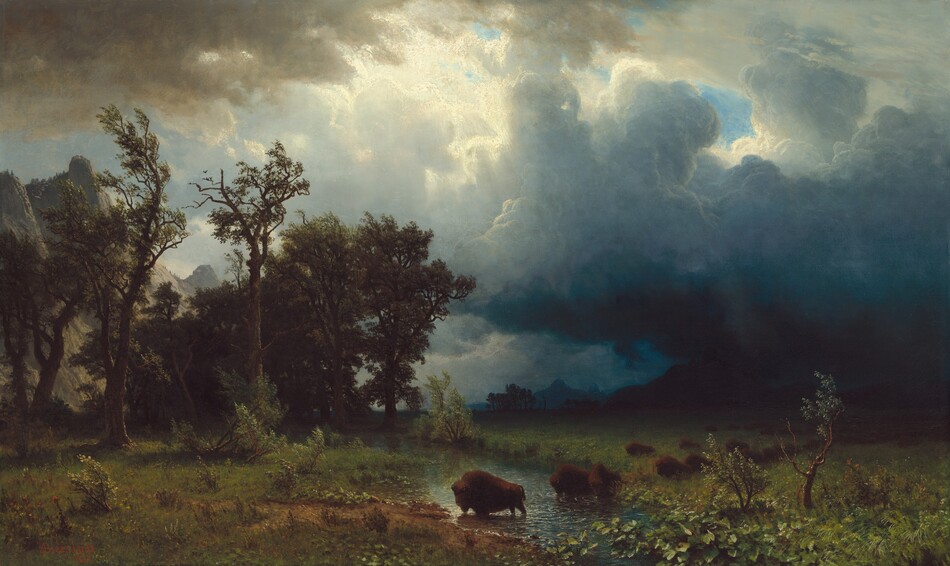
The top three-quarters of this horizontal landscape painting is filled with roiling, deeply shadowed clouds that tower over a line of buffalo crossing a grassy meadow below. Small in scale, the buffalo form a line that extends away from us at a diagonal into the distance to our right. Sunlight creates a bright reflection on the stream where the frontmost buffalo crosses, but the other animals are nearly backlit in the raking light. Trees, with branches whipping in the wind, rise along the left side of the painting, and the mountainous landscape to our right is lost in darkness under heavy clouds. The clouds above lighten from navy blue in the lower right corner of the sky to slate blue and white at the center of the painting. Small patches of blue sky are visible between a few breaks in the clouds, and sunlight falls on a cliff-like mountain face in the distance beyond the trees to our left. Another bank of parchment-colored clouds in the upper left corner, closer to us, contrasts with the glimmering light highlighting some of the clouds nearby.

Buffalo Trail: The Impending Storm

Albert Bierstadt

1869

Oil on canvas  Accession ID  2014.79.3

On View: West Building Main Floor, Gallery M67
This painting is a portrait of a seated woman shown from the knees upwards. She is seated in a woven yellow armchair, with her right arm resting on one arm of the chair, while her left hand rests on her lap. The chair is slightly turned to the left, but she looks directly at us. She has pale skin with slightly pink cheeks, round blue-green eyes, thin brown eyebrows, and pink lips set in a neutral expression. Her hair is dark brown and styled in soft waves, visible beneath a wide-brimmed cream hat adorned with a striped green-and-white band. The woman wears a white dress with a green belt or sash around the waist and a pearl necklace. A green cloth appears to be draped on the chair beneath her, and the background is a deep blend of green, dark blue, and black shades, similar to a heavy draped curtain. The brushstrokes in the painting are thick and visible.

Florence Sittenham Davey (Mrs. Randall Davey)

George Bellows

1914

Oil on wood  Accession ID  1979.80.1

On View: West Building Main Floor, Gallery M69
The sculpture shows a woman and a young girl on a couch. The woman sits, leaning towards the child who is lying on the couch with her head in the woman's lap. Both figures are dressed in long garments. The couch is intricately carved with folds and patterns. The sculpture is made of a dark material, highlighting the detail and connection between the figures. The couch has decorative scrolls and floral motifs at its ends.

Day Dreams

Bessie Potter Vonnoh

model 1898, cast late 1906/early 1907

Bronze  Accession ID  2015.19.3623

On View: West Building Main Floor, Gallery M70

Loading Results