Printed with fine black lines on cream-white paper, a man wearing a knee-length tunic and reading from a piece of unfolded paper faces our right against a mostly blank background in this vertical engraving. The man's right shoulder, closer to us, is angled in a way that suggests his torso is turned slightly away from us even though his feet and face are shown in profile. A narrow wreath is almost lost in his dense curls, and he has a straight nose and prominent chin. His fur-lined tunic is belted low across his hips, and a dagger hangs from his belt. His pointed clog-like shoes seem to slip onto his feet like sandals, and he stands on a grassy field in an otherwise empty space. Creases in the paper he holds suggests it had been folded into nine sections.
Master of the Playing Cards, A Poet Reading, 1430s, engraving on laid paper, Gift of Ladislaus and Beatrix von Hoffmann, 1999.26.1

Prints

Printmaking has played a key role in spreading artistic styles, scientific diagrams, and ideas around the world. A printmaker first creates a design on a matrix—a surface often made of metal, wood, or stone. They then apply ink and press paper or fabric to the matrix, transferring the design. This process can be repeated, creating multiple works.
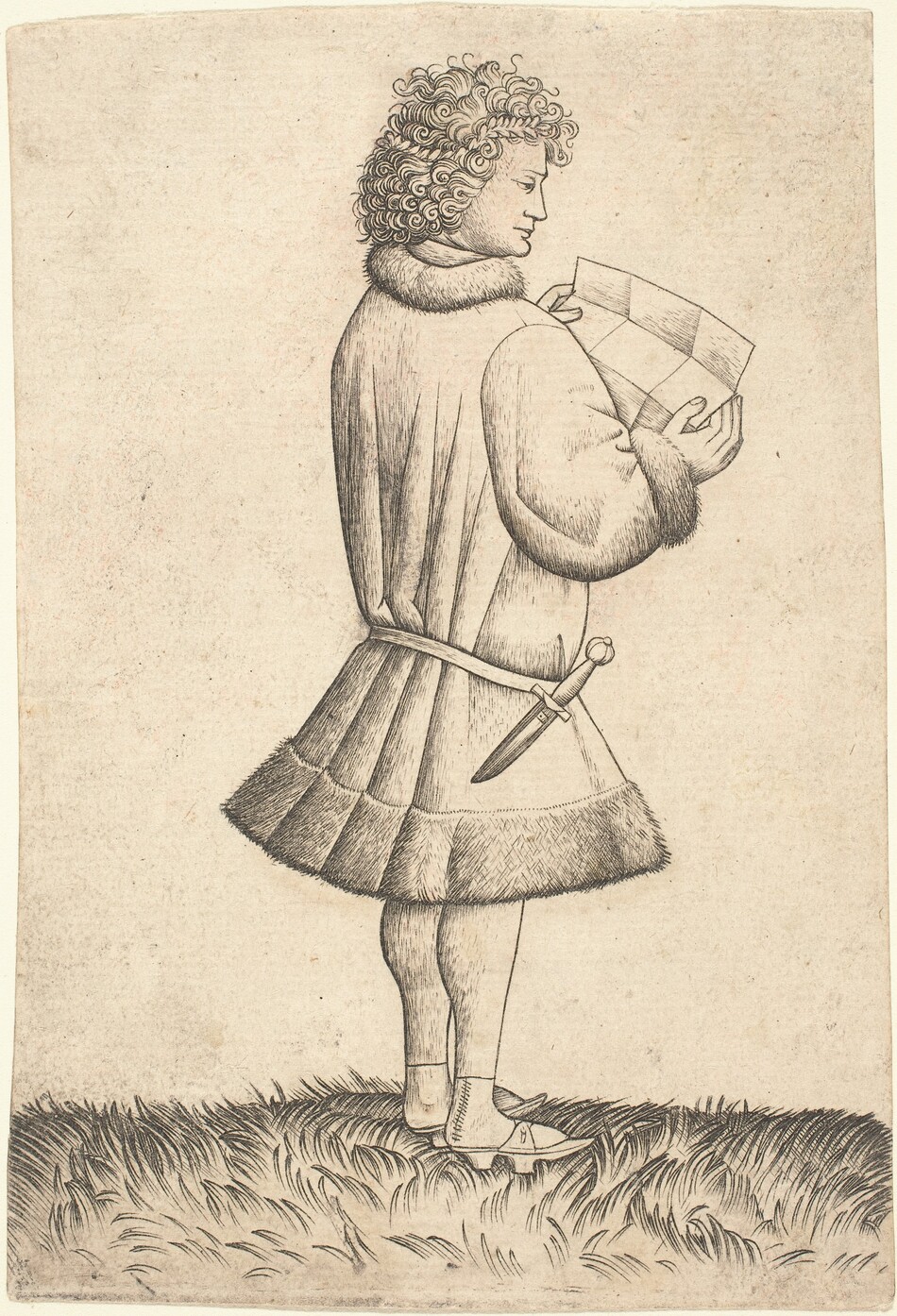
  • Printed with fine black lines on cream-white paper, a man wearing a knee-length tunic and reading from a piece of unfolded paper faces our right against a mostly blank background in this vertical engraving. The man's right shoulder, closer to us, is angled in a way that suggests his torso is turned slightly away from us even though his feet and face are shown in profile. A narrow wreath is almost lost in his dense curls, and he has a straight nose and prominent chin. His fur-lined tunic is belted low across his hips, and a dagger hangs from his belt. His pointed clog-like shoes seem to slip onto his feet like sandals, and he stands on a grassy field in an otherwise empty space. Creases in the paper he holds suggests it had been folded into nine sections.
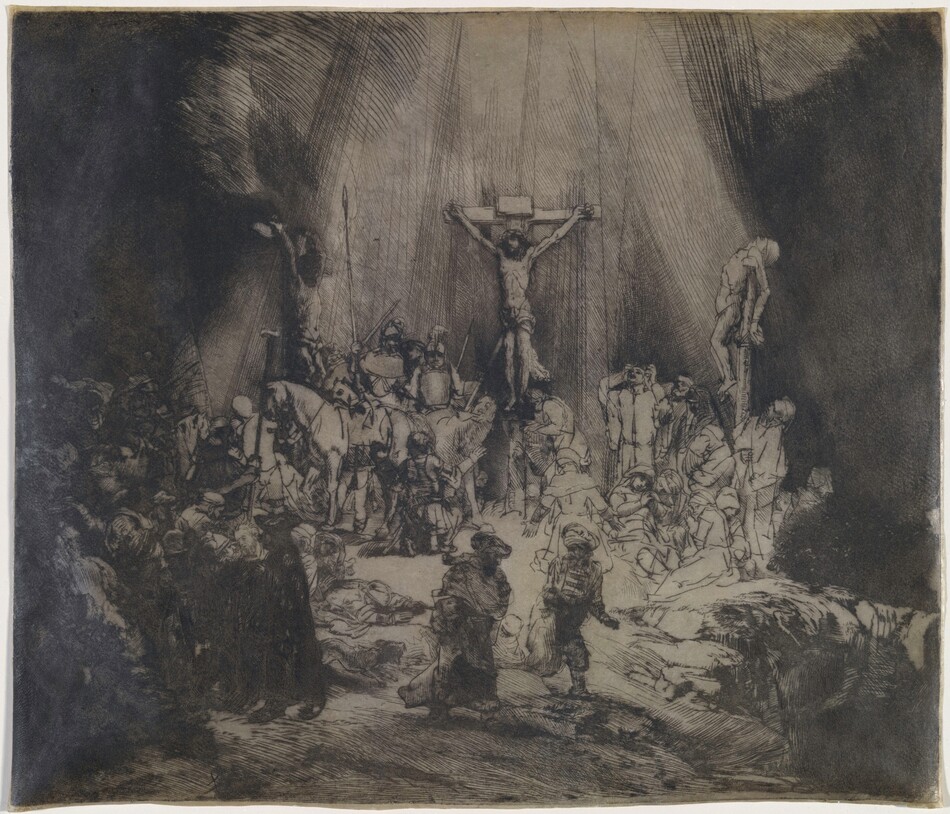
  • This is an image of a crucifixion scene. The composition is centered around a figure on a cross, surrounded by other figures. Some are on horseback, others standing. The atmosphere is dramatic, with shadows and light creating depth and emphasizing the solemnity of the scene. The detailed etching captures various expressions and actions. The cross is slightly elevated, making the figure on it more prominent. The intricate line work and detailed composition make this a depiction of a historical or religious moment.
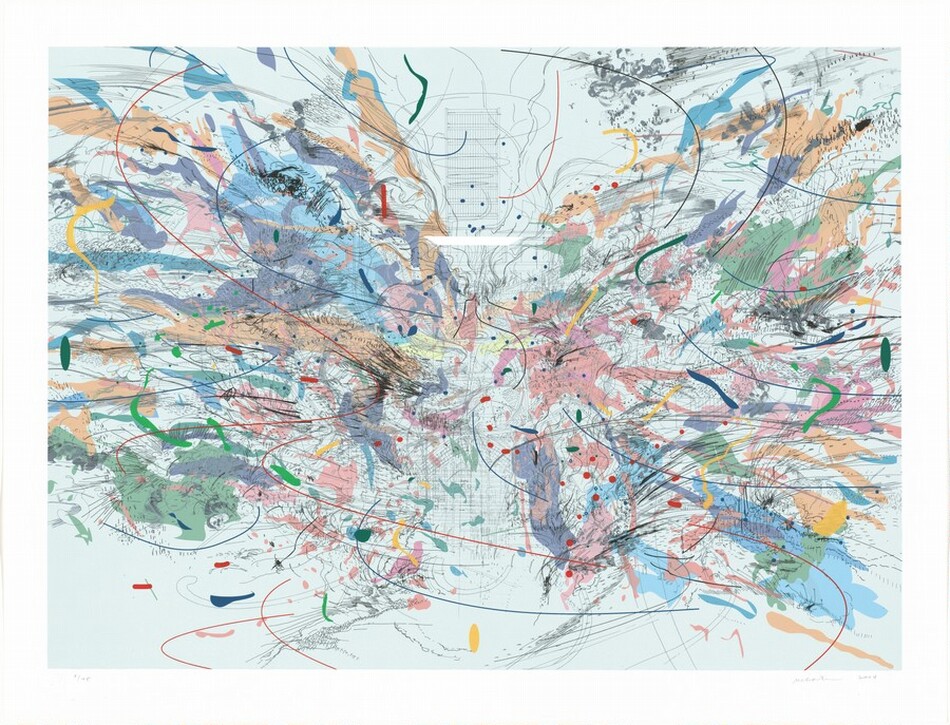
  • This print features a complex network of swirling lines, arcs, and splatters across the pale blue canvas. The swirling lines and splashes are in shades of orange, yellow, pink, green, blue, and purple. There are also thin grids of black lines in the center from which many of the colorful swirls seem to emerge.
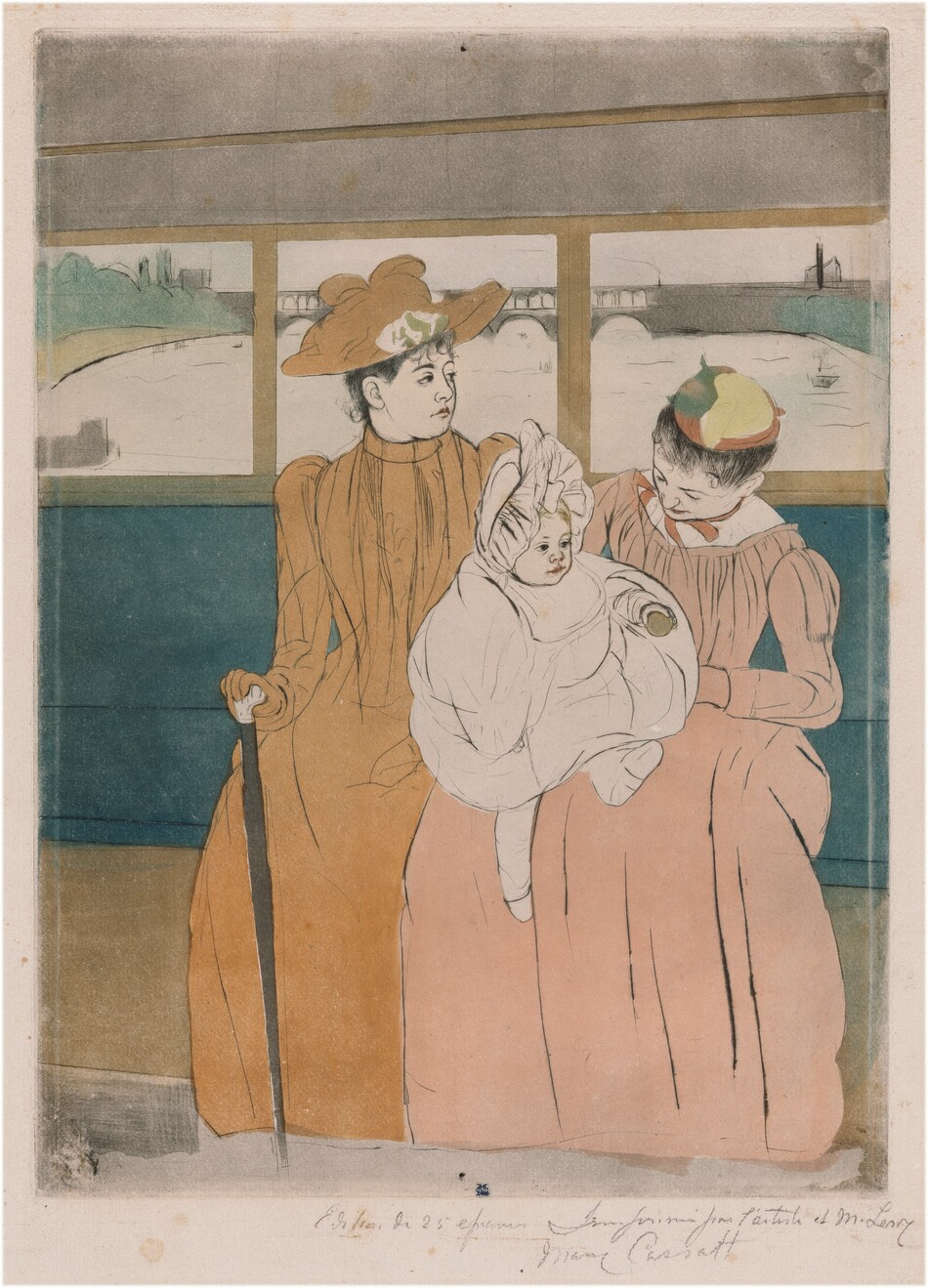
  • Two women, one holding a baby on her lap, sit on the long bench seat of an omnibus in this vertical, colored print. The women and their full skirts take up almost the width of the composition against the peacock-blue bench, which extends off both sides. The women and baby’s skin are the color of the cream-white paper. The woman to our left wears a tan-colored, high-collared dress, gloves, and hat. She looks off to our right, almost in profile. She has a round face and the hint of a double chin. One gloved hand rests on a cane. The other woman holds the baby and tips her head down toward the child. That second woman wears a tea rose-pink dress and a hat with areas of darker pink, fern green, and straw yellow. Both women’s black hair is pulled up under their hats. The baby’s ruffled white bonnet, blousy garment, stockings, and shoes are also the white of the paper, though the hair is picked out with yellow, the lips with pink, and the ball held in one hand with brown. The structure of the women’s bodices, puffy long sleeves, and long skirts as well as the baby’s clothing are outlined in black. A row of windows behind them, parallel to the top of the bench, open onto an arched bridge spanning a river with boats. To our left, the sandy water’s edge is lined with spruce green trees. Back inside, the panel behind the women’s legs is peanut brown, and the top of the omnibus is muted mauve purple. A mark with an oval, or a mirrored C, over an uppercase M, is stamped in royal blue at the bottom center of the print. The sheet is inscribed with graphite across the right half of the bottom margin. Text reads, “Edition de 25 épreuves Imprimée par l’artiste et M. Leroy Mary Cassatt."
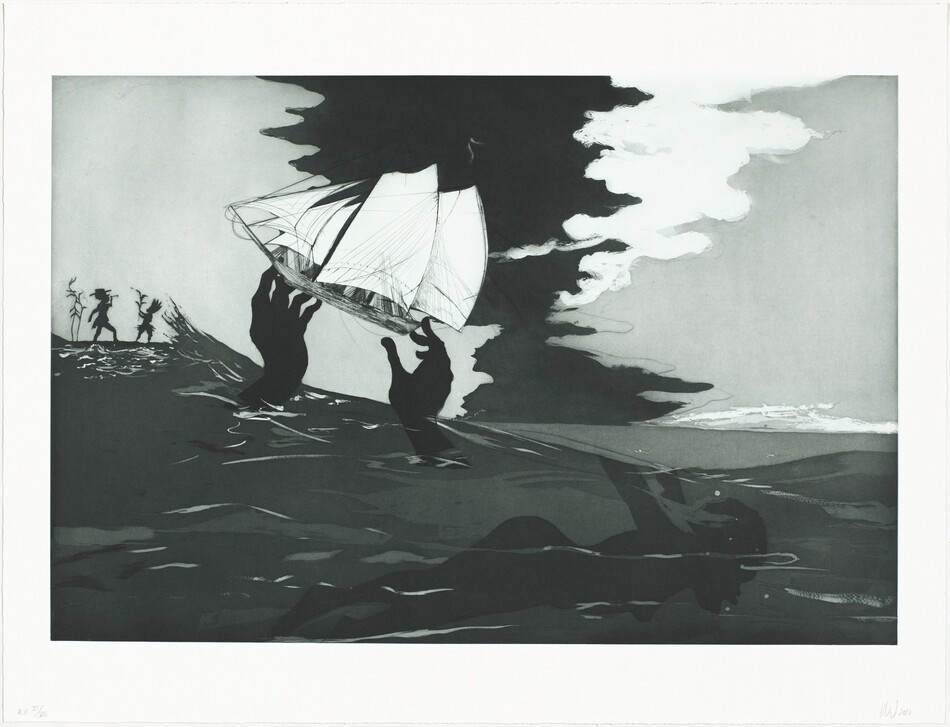
  • Printed with tones of black, gray, and smoky gray, two oversized hands reach out of an ocean and hold up a masted ship in this horizontal etching, aquatint, and drypoint. Closer to us, the black silhouette of a woman sinks under the surface of the water, face down with her arms thrust back and her mouth gaping open. Her features are exaggeratedly rounded to reference stereotypes historically connected with Black and African people. The wave surges to our left, and the giant hands lift the boat just left of center of the composition. Small in scale, two silhouetted people stand on a flat area to the left. One wears a brimmed, flat-topped hat, a coat with tails, and holds up a tool, perhaps a hoe. The other wears a spiky headdress and skirt and holds up a stalk of sugar cane. The sky is pale gray to either side of a plume of white and a black void with jagged edges, which spreads like a seeping stain down the middle of the sky. Under the image and across the bottom of the page, the artist wrote “A.P. VI/VIII” to the left and “KW 2010” to the right lightly in graphite.
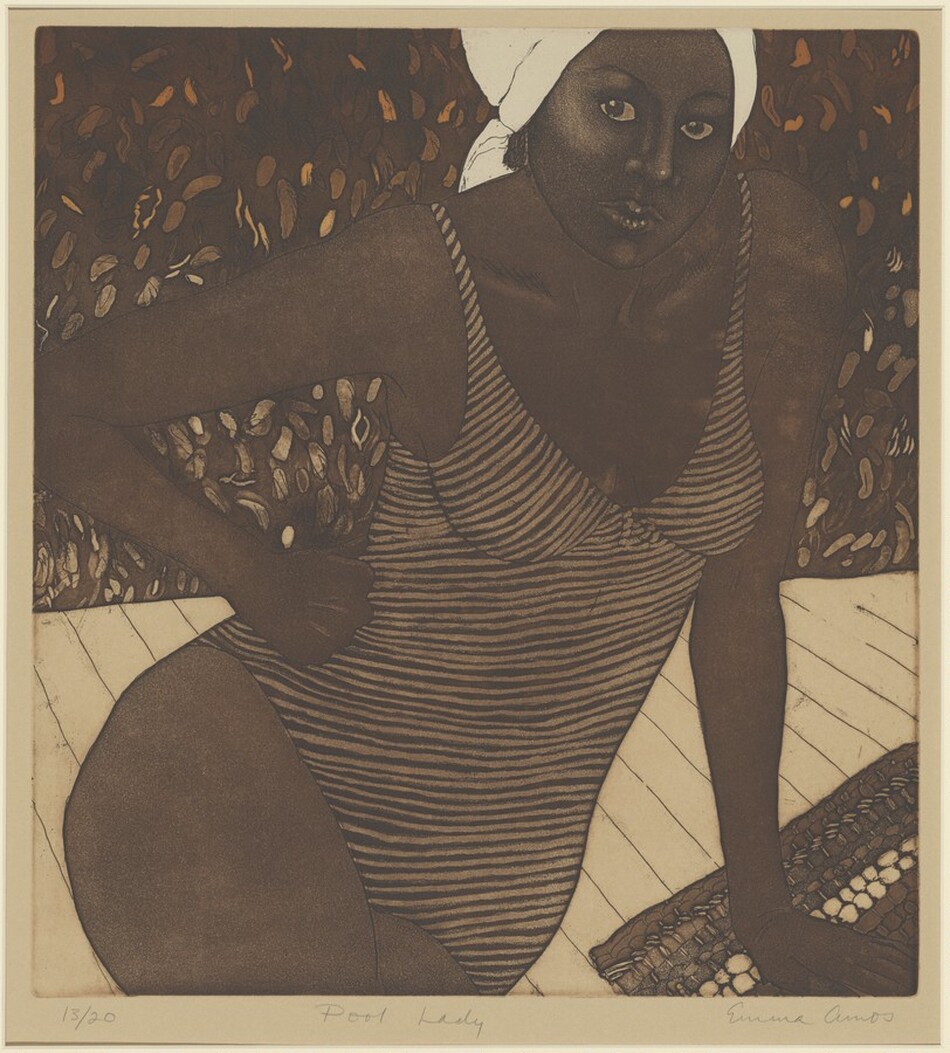
  • The image depicts a woman in a seated position, from the hips upwards. She has a hand on her hip and another on the ground for support. She has a direct gaze, with accentuated eyes and full lips. Her hair is covered with a white head wrap, and she is wearing a striped swimsuit that fits closely. There are no visible accessories. The background has a textured pattern resembling foliage or a natural design with earthy tones. The surface she sits on appears to be smooth with linear patterns, possibly representing wood or decking near a pool.
  • The image is an etching depicting two figures in a natural setting. Both individuals are shown from head to toe. The person on the left is seated with a beard, head resting on their hand. They have short, slightly curly hair. The person on the right is also seated, with long, flowing hair cascading down their back and partially across their face, holding a small object. Both wear long robes. Surrounding them are tall, leafy palm trees and sparse vegetation. In the sky above, there are ambiguous figures. The background suggests a natural landscape, possibly coastal or desert.
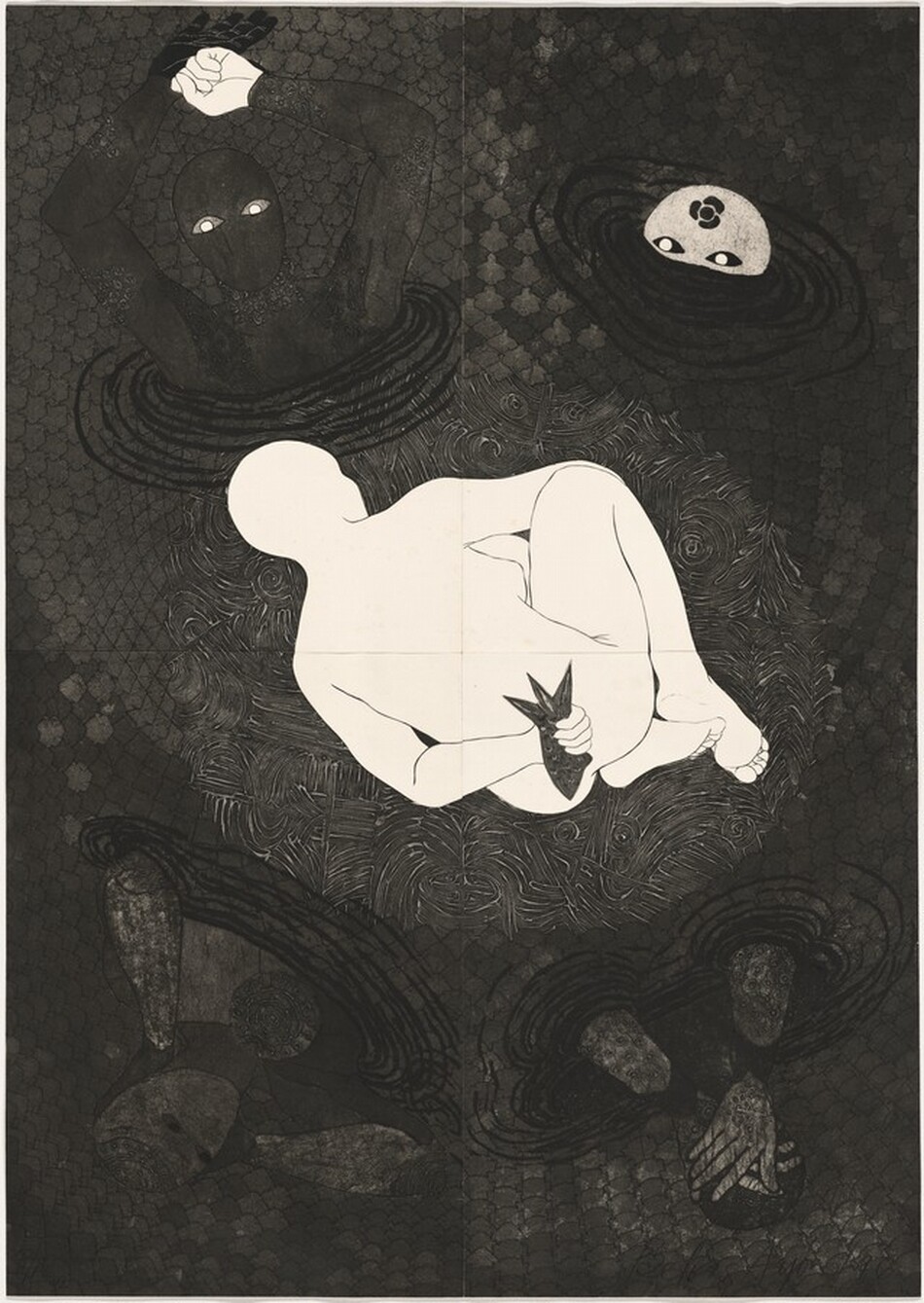
  • In this print, swirling lines and circular shapes create a dynamic composition. A large white silhouette of a person is in the center, turned on their side with their legs up to their chest and their back to us. The person appears to be clutching a fish-like object behind their back. They have no visible hair or clothing. Surrounding the silhouette is a background made up of swirling black and gray lines against a dark gray background. Upon closer inspection, several mask-like shapes that resemble faces or heads become visible, each surrounded by swirling ripples that suggest they are floating under water. Most of these shapes are a dark gray color similar to the background, but the one near the top left corner has white eyes and one white hand, and the one near the top right corner has white eyes and white skin with a dark flower-like shape on their forehead. The background also contains a faint pattern of overlapping scales.
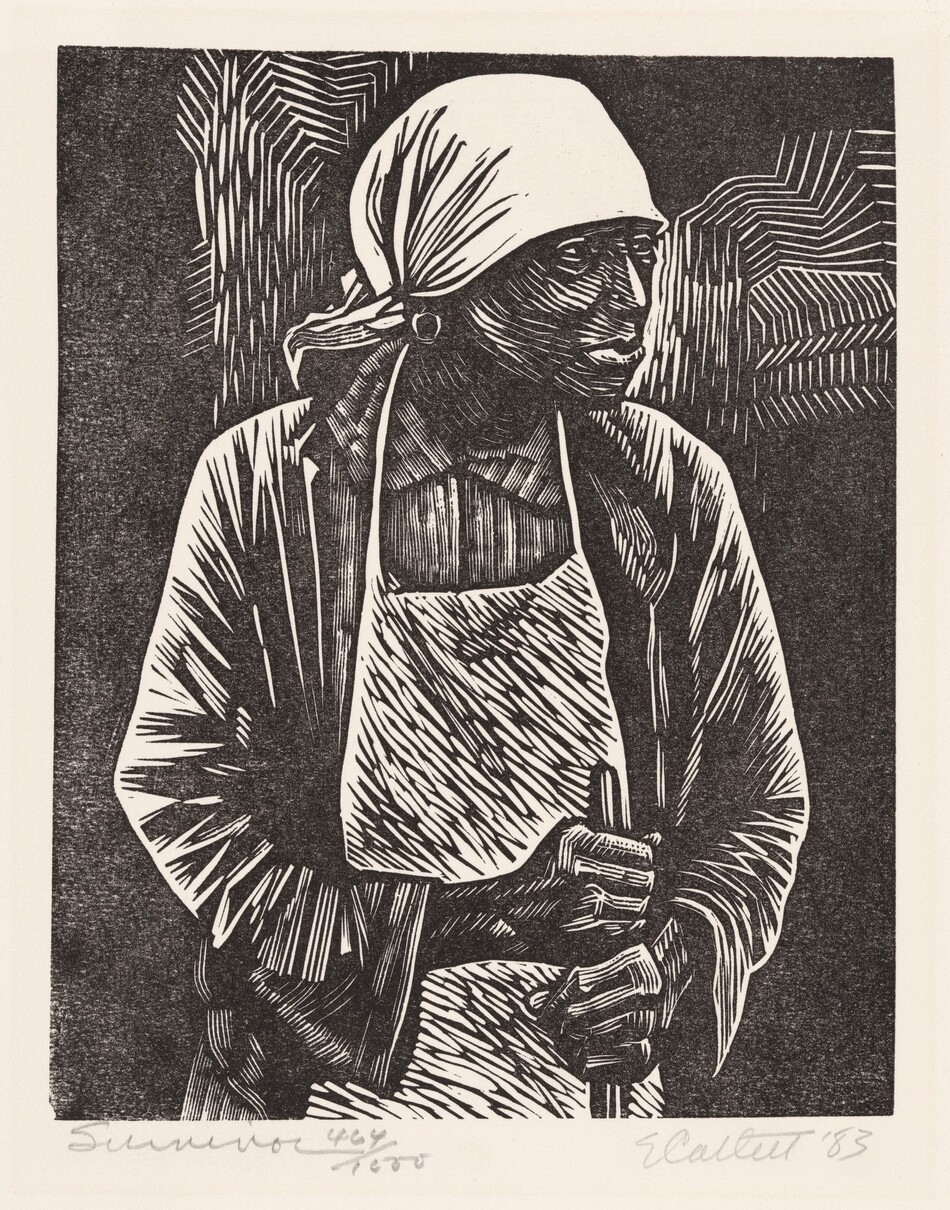
  • This is a black and white print of a woman shown from the waist up, her body facing us and her head turned to the right. She is holding a stick or the end of a tool in front of her with both hands. The woman has prominent cheekbones, a long nose, deep-set eyes, and lips set in a neutral expression. Her skin is mostly dark, with some small while lines providing highlights and texture. She wears a white headscarf tied at the back and an apron over a long-sleeved striped shirt or dress. She has small circular earrings. The background is mostly black, with two areas of thin, zigzagging lines behind the woman's head.
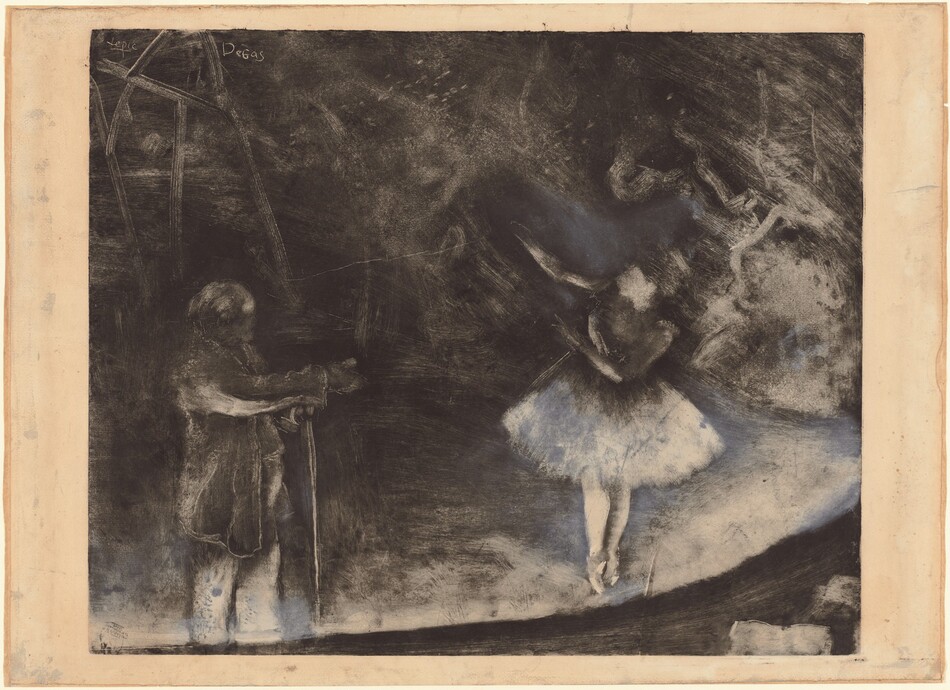
  • We look down onto a shadowy stage with a ballerina and a man in this black and white work on paper. The man stands in the lower left corner of the composition wearing a knee-length jacket and resting his wrists on a tall stick in front of his body. Though his face and head are lost in deep shadow, it seems that he looks toward the ballerina to our right. Up on her toes en pointe, her body faces us but her arms are raised and angled toward the upper left corner of the composition. She turns her upper torso and head to gaze in the direction of her hands. Lighting comes from the front edge of the curving stage and illuminates the man’s pants and undersides of his arms, the dancer’s legs, tutu, and face, and the front part of the stage. The space behind the people is lost in shadow but is marked by strokes and smudges. In the upper left corner the names of the artists are scratched onto the ink that had coated the surface of the printing plate: “Lepic” and “Degas.”
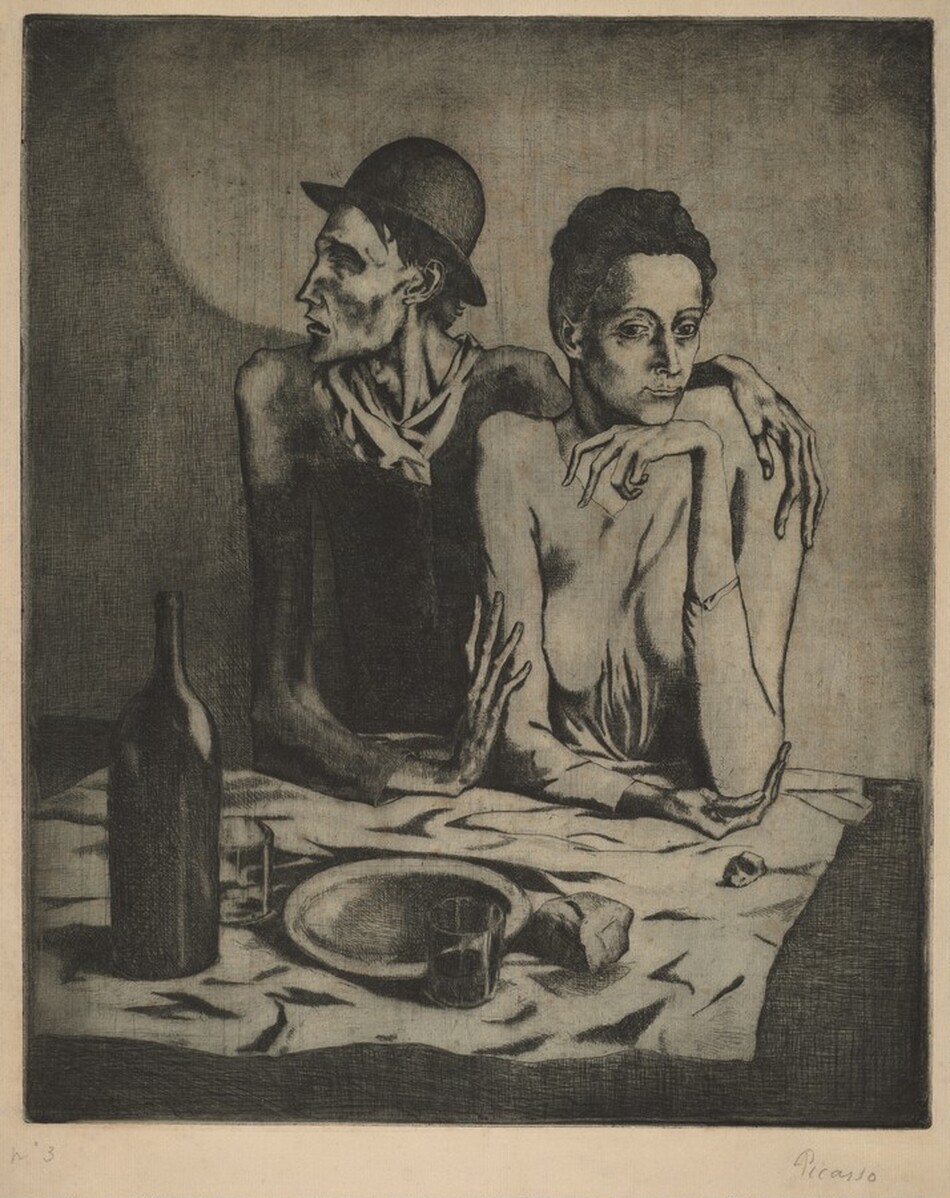
  • The image depicts two individuals seated at a table from the waist up. The person on the left is in a side profile, facing right, wearing a bowler hat, a scarf around their neck, and a high-collared shirt. Their sharp nose, pronounced cheekbones, and shadowed eye sockets are prominent. The person on the right is facing forward with their head slightly tilted to one side, resting their face on their hand. They have a narrow face, short and somewhat wavy hair, and a somber expression. Their attire is simple, with a shirt that exposes the collarbone. The table in front of them is covered with a cloth and has a large bottle, glasses, a plate, and a piece of bread. The background is plain with shading for depth.
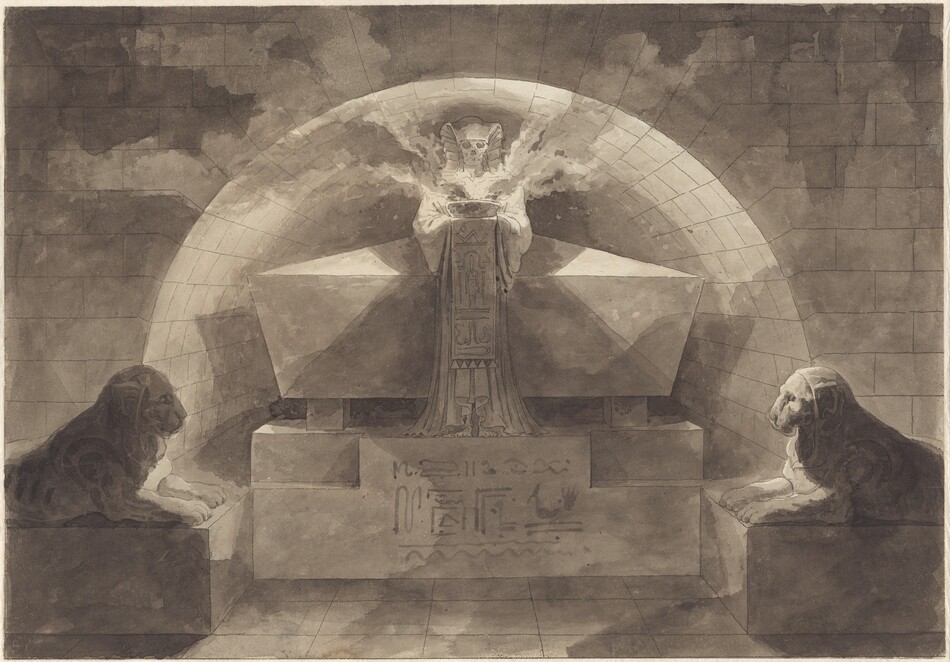
  • This is a drawing of an underground chamber. The scene depicts a central figure standing behind or emerging from a large, geometric sarcophagus. The figure is surrounded by smoke or mist. Flanking the central figure, there are two large sculptures of seated lions facing each other on stone pedestals. The chamber is constructed of large stone blocks, and the floor is made of tiled stones. The walls curve to form an arch above the sarcophagus, and there are hieroglyphics etched into the pedestal in front of the sarcophagus. The drawing has a sepia tone.

Explore more

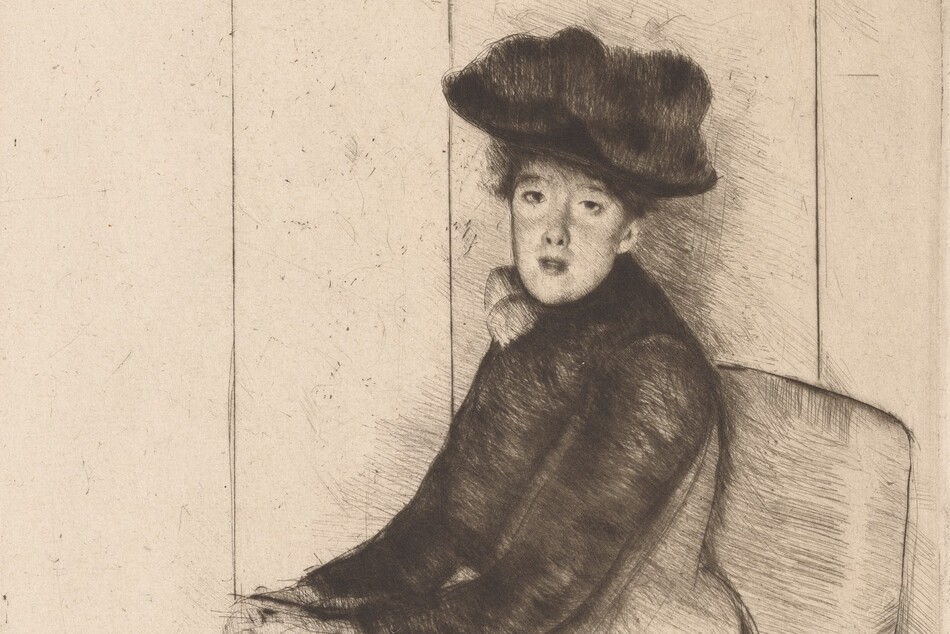
The image depicts a seated woman wearing a large coat and skirt. She is seated with her body angled to the side, head turned slightly towards the viewer. The woman has delicate facial features, with her hair covered by a fluffy hat. Her hands are resting in her lap as she sits on a wide chair. She is not wearing any visible jewelry or holding any objects. The background features simple vertical lines resembling a plain interior wall, creating a minimalist setting.

Interactive Article:  Mary Cassatt, the Daring Printmaker

The pioneering American impressionist was one of the most innovative printmakers of her generation.
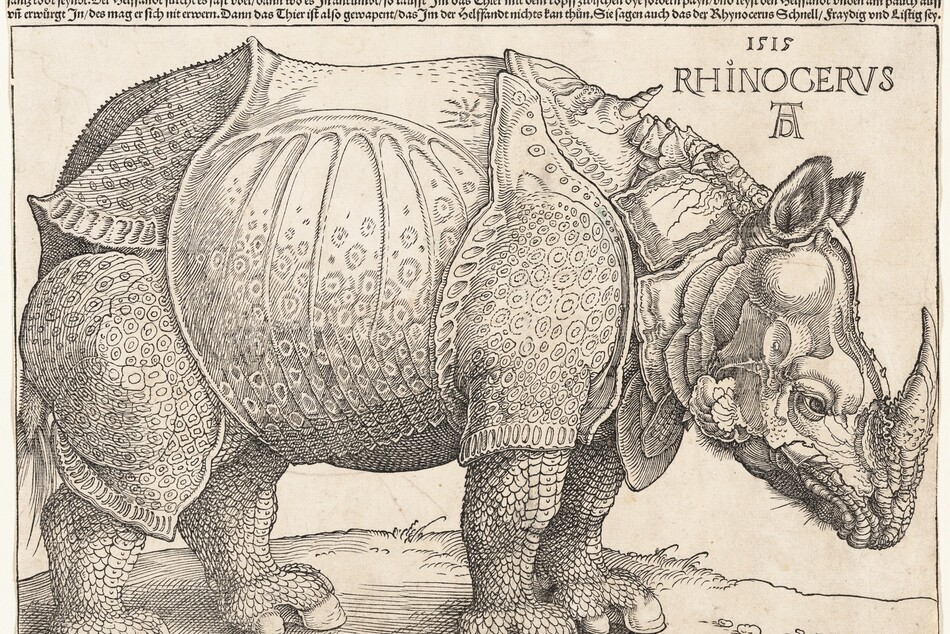
Printed with black lines on cream-white paper, a rhinoceros facing our right in profile fills this horizontal woodcut. The rhinoceros’s horn touches the border to the right and its hindquarters the left. Its left foot, farther from us, stands slightly ahead of its right hoof. Its front feet are close together and its head is lowered. Chunky, armor-like plates covering its body are patterned in some areas, especially on its legs and belly, with rings and dots, creating a mottled effect. The skin on its legs is scaly like a fish or reptile. A short, twisted, unicorn-like horn grows from between its shoulders, and the animal’s lower lip and the ear we see is fuzzy with short hairs. Near the upper right, in the corner near the animal's shoulders, the print is inscribed, “1515 RHINOCERVS.” Below, the artist’s initials appear as a monogram, with an upper case D tucked within the legs of an A. Five rows of tightly spaced German writing runs across the top edge of the paper, above the single-line border framing the animal. It reads, "Nach Christus gepurt. 1513. Jar. Adi. 1. May. Hat man dem groszmechtigen Kunig von Portugall Emanuell gen Lysabona pracht ausz India ein sollich lebendig Thier. Das nennen sie Rhinocerus. Das ist hye mit aller seiner gestalt Abconderfet. Es hat ein farb wie ein gespreckelte Schildtkrot. Und ist von dicken Schalen uberlegt fast fest. Und ist in der grösz als der Helfandt Aber nydertrechtiger von paynen und fast werhafftig. Es hat ein scharff starck Horn vorn auff der nasen Das Begyndt es albeg zu werzen wo es Bey staynen ist. Das dosig Thier ist des Helffantz todt feyndt. Der Helffandt furcht es fast ubel dann wo es In ankumbt so laufft Im das Thier mit dem kopff zwischen dye fordern payn und reyst den Helffandt unden am pauch auff un erwürgt In des mag er sich nit erwern. Dann das Thier ist also gewapent das Im der Helffandt nichts kan thun. Sie sagen auch das der Rhynocerus Schnell Fraydig und Listig sey."

Interactive Article:  Horns, Scales, and Armor

At a time when few Europeans had ever seen a rhinoceros, Albrecht Dürer seized the moment after the king of Portugal received a rhino as a gift.
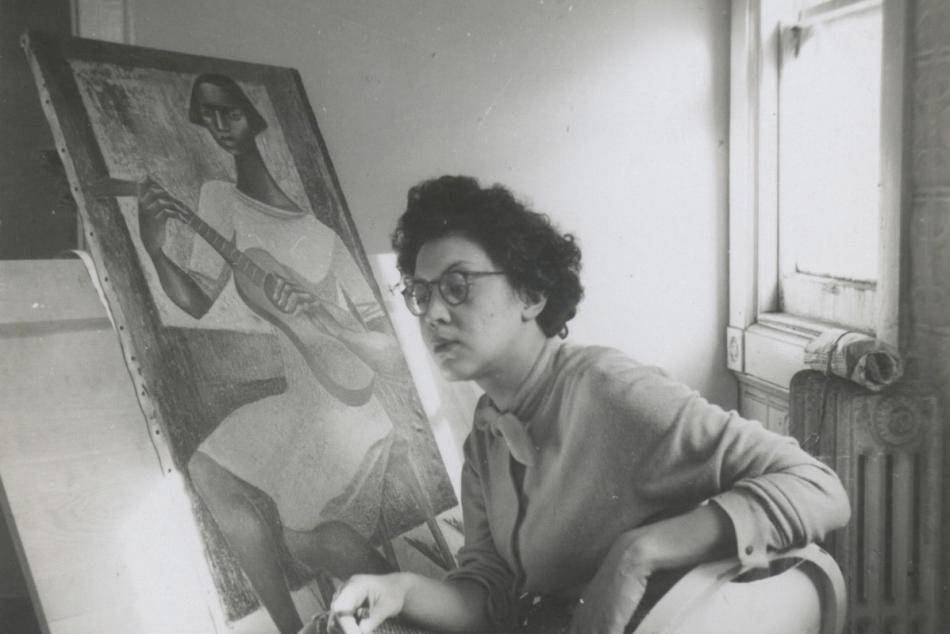
Elizabeth Catlett in her studio, 1942

Article:  Who Is Elizabeth Catlett? 12 Things to Know

Meet a groundbreaking artist who made sculptures and prints for her people.
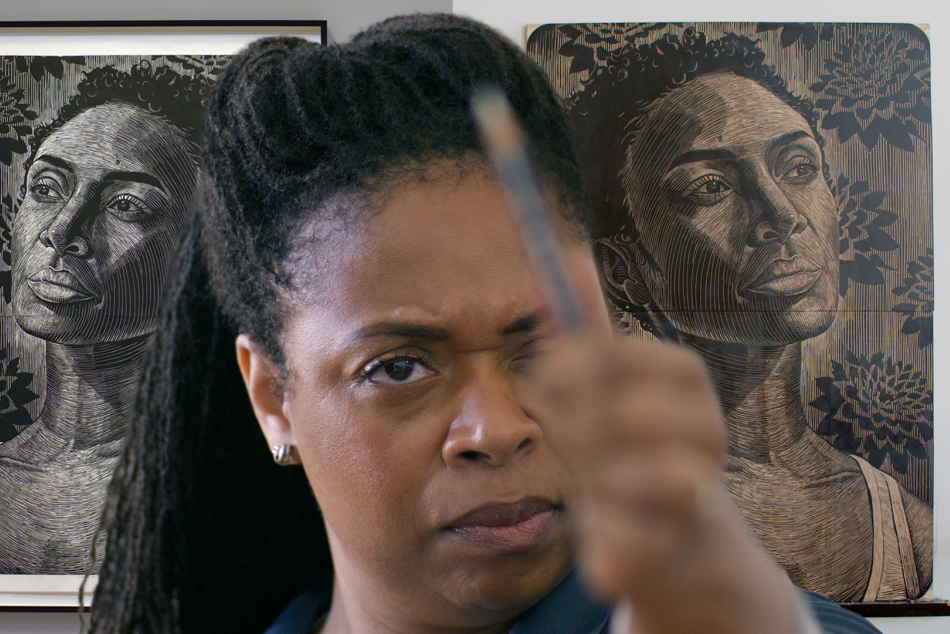
Video:  Print Like a Great: Elizabeth Catlett

What happens when legacy, artistry, and womanhood collide? LaToya Hobbs creates a stunning woodcut portrait of Naima Mora, inspired by the life and work of legendary printmaker Elizabeth Catlett—Naima’s own grandmother.
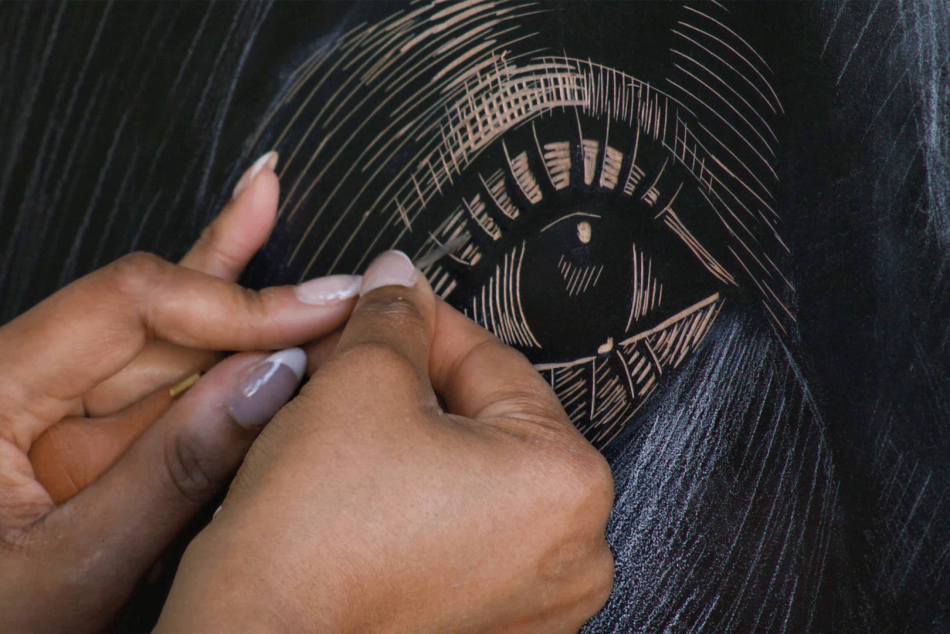
Video:  Master Printmaker LaToya Hobbs Creates a Woodblock Print Inspired by Elizabeth Catlett

Master printmaker LaToya Hobbs creates a woodblock print portrait of Naima Mora, referencing the sculpture Naima created by Elizabeth Catlett.
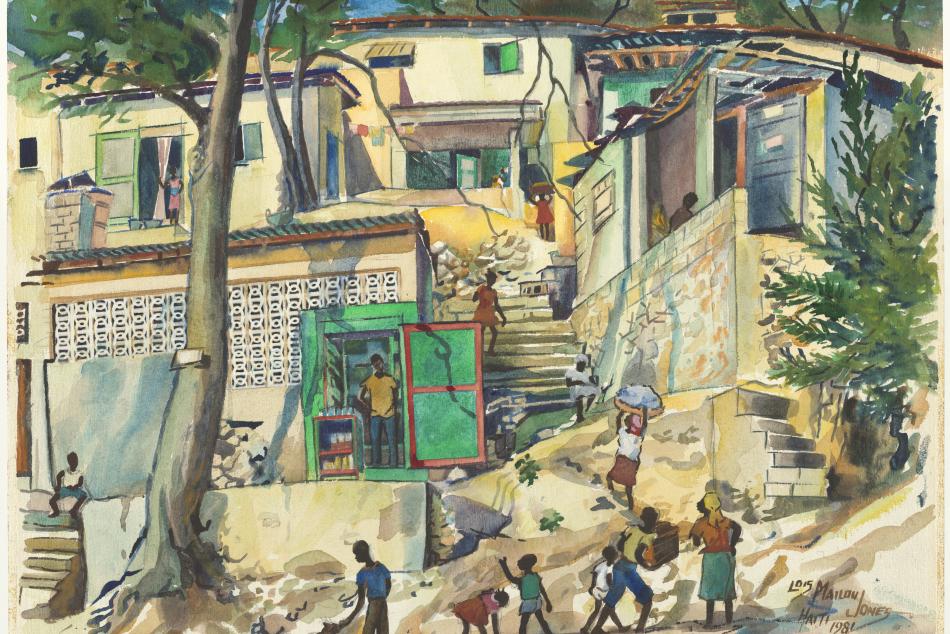
Video:  Is Art for Pleasure or for Politics?

Art historian Rashieda Witter discusses Washington, D.C.-based Black artists throughout history whose work challenged our ideas of what art can be. 
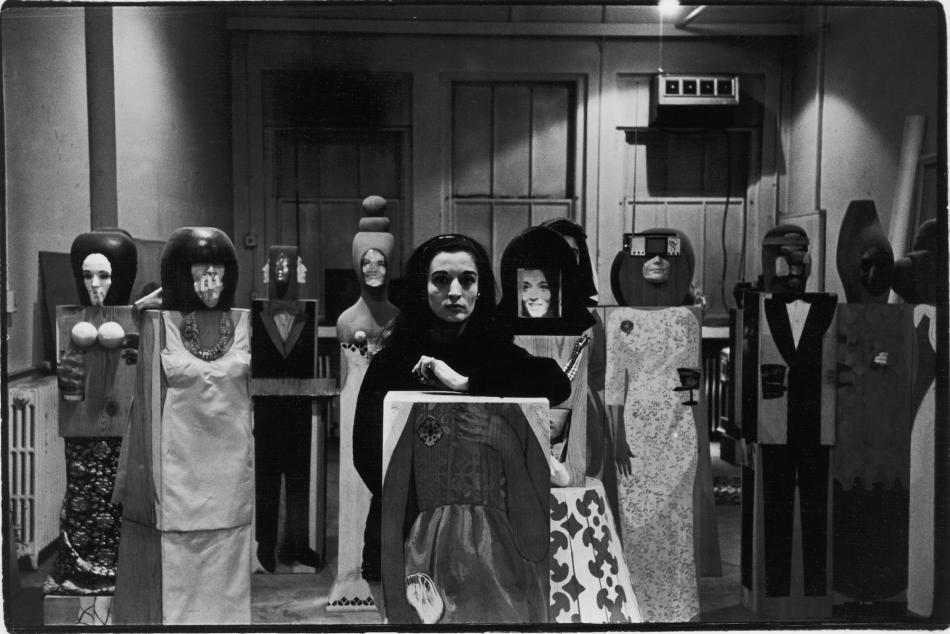
Article:  Who Is Marisol? 7 Things to Know

The Venezuelan American artist was wildly famous in the 1960s and ’70s for sculptures that have many sources, but defy categories.
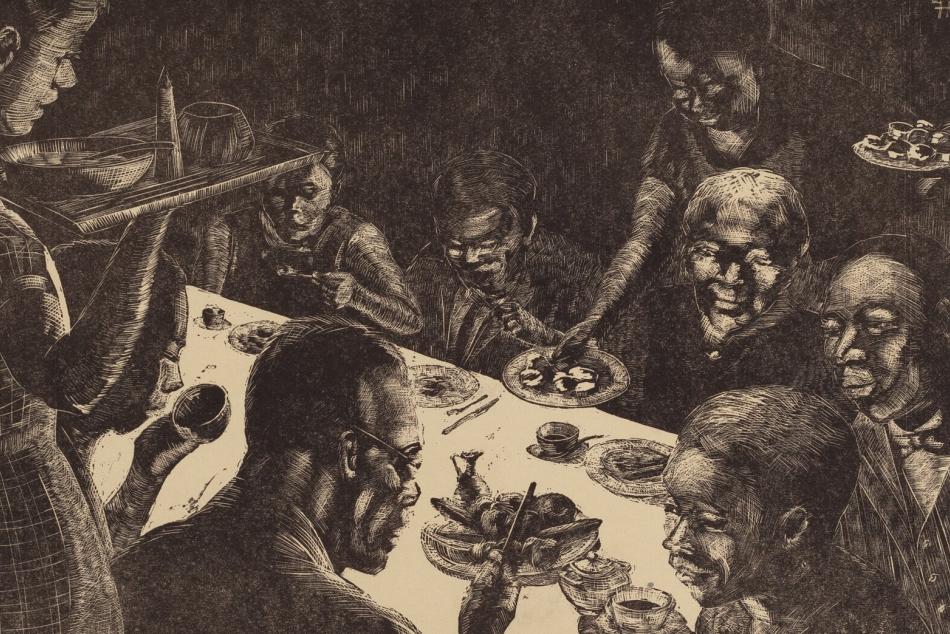
Article:  Church Supper: Eating, Drinking, and Building Community

A print by Frank Hartley Anderson reminds chef Adrienne Cheatham of the church meals she grew up with—and of a recipe for buttered rolls.
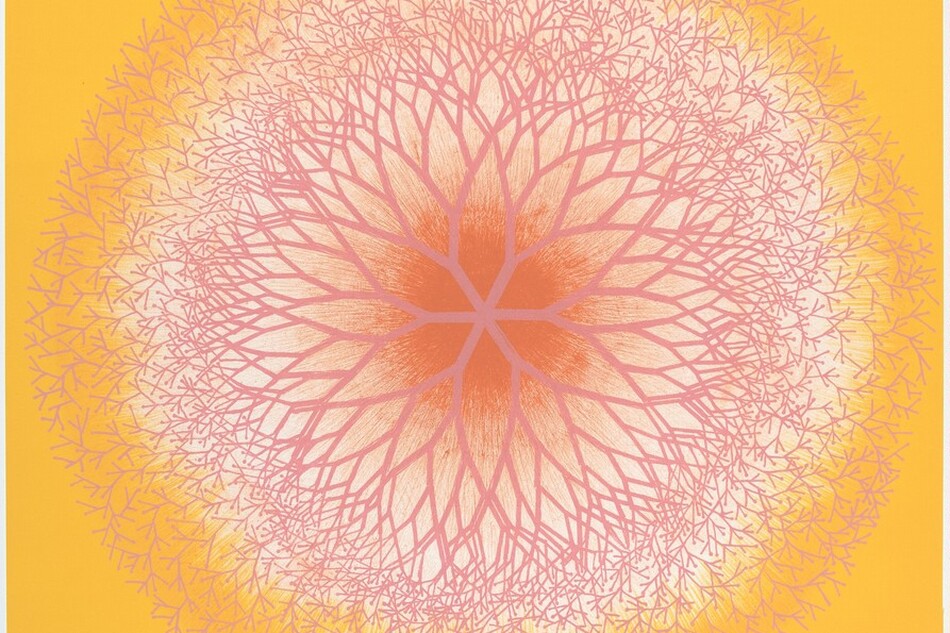
This print shows a network of interlocking pink lines radiating from a central red point to form a circular pattern. The shapes resemble a vibrant, stylized flower or mandala against a white background. The branching lines get smaller and smaller as they reach the edge of the circle, and from slightly before then to the edge of the print the background is a bright, vibrant yellow.

Article:  Ruth Asawa’s Little-Known Experiment with Printmaking

Memorialized in stamps for her wire sculptures, the artist’s experiments with printmaking have been largely forgotten.
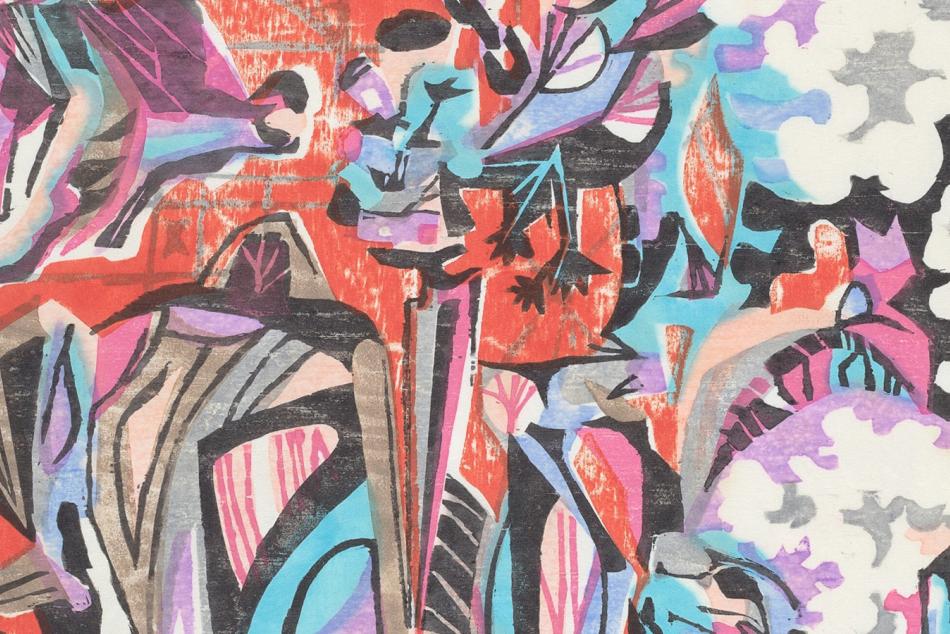
Article:  Eldzier Cortor Takes Us Inside the Slaughterhouse

Through his surrealist woodcut, Cortor considers the relationship between humans and animals and tells the stories of Black bodies.
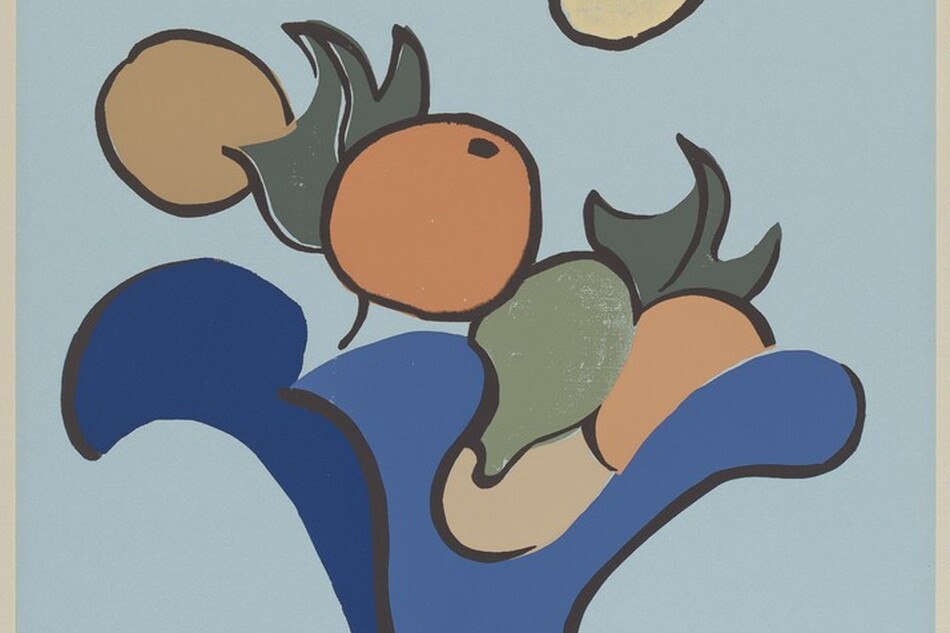
This print shows a stylized blue vase or bowl holding various rounded fruits, including what appear to be an apple, a peach, and a lime. There are also two dark green leaf-like shapes. Above the vase, two fruits are floating, one that looks like a lemon and one that is round and tan. The blue vase has a wavy rim and a narrow base. The background is pale blue.

Article:  Enjoy a Poem Inspired by Emien Etting’s “Flying Fruit”

Poet Aimee Nezhukumatathil sees a love story in this print by American artist Emien Etting.

Video:  Science and Paper: Conserving a Drypoint by Michael Heizer

This video covers the conservation process for Michael Heizer's Scrap Metal Drypoint #6, developed by conservators, curators, and the artist himself.

Because drawings are damaged with exposure to light, we are unable to keep them on permanent display. Anyone can make an appointment to see prints in our collection, however, by contacting our study rooms.

You may also like
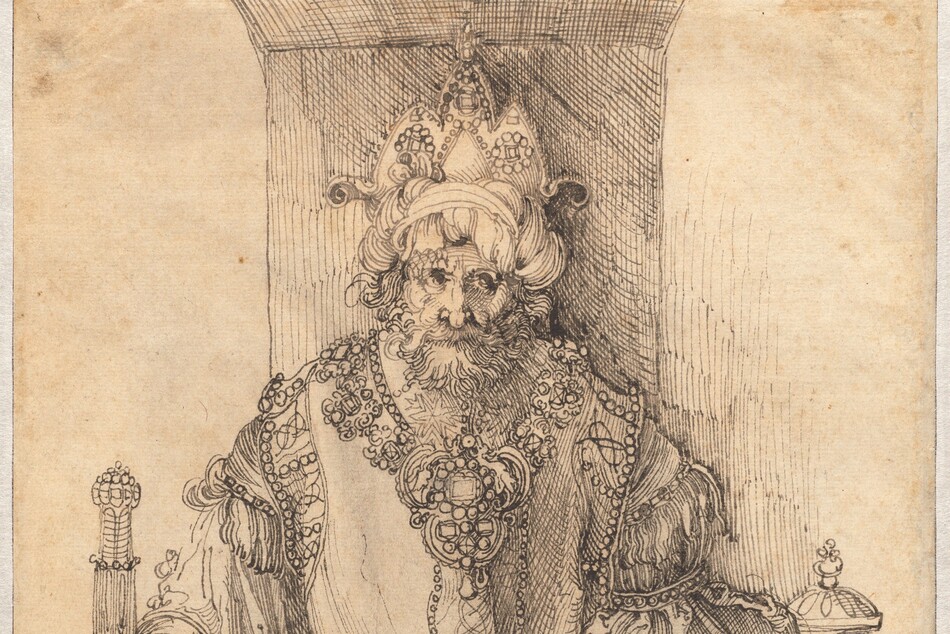
A crowned, bearded man sits facing us on a throne, and he holds a sword and orb in this vertical drawing, which was made using black ink on parchment-colored paper. A three-peaked, jeweled crown nestles in a twisted turban on the man’s head. He faces us but his eyes look to our right, and he has a long, hooked nose and flowing hair and beard. A band of ornate jewels could be a collar resting over his shoulders and on his chest, or it could be that the edge of his robe is elaborately decorated. His robe has voluminous, flowing long sleeves and his garment is decorated with bands of jewels and fringe at the shoulders, hem, and down the front. His left hand, on our right, rests on a round orb about the size of an orange, and he holds the hilt of a jewel-encrusted sword upright with his other hand so the tip of the sword rests on the ground. The artist signed the work with his initials at the bottom center: “AD.”

Drawing

Nearly every artist makes drawings at some point. Some use them as a way of thinking, jotting ideas down as quickly as they occur. Such rough sketches can offer fascinating glimpses into the artist’s imagination or their process. Meanwhile, many artists make elaborate drawings as finished works.
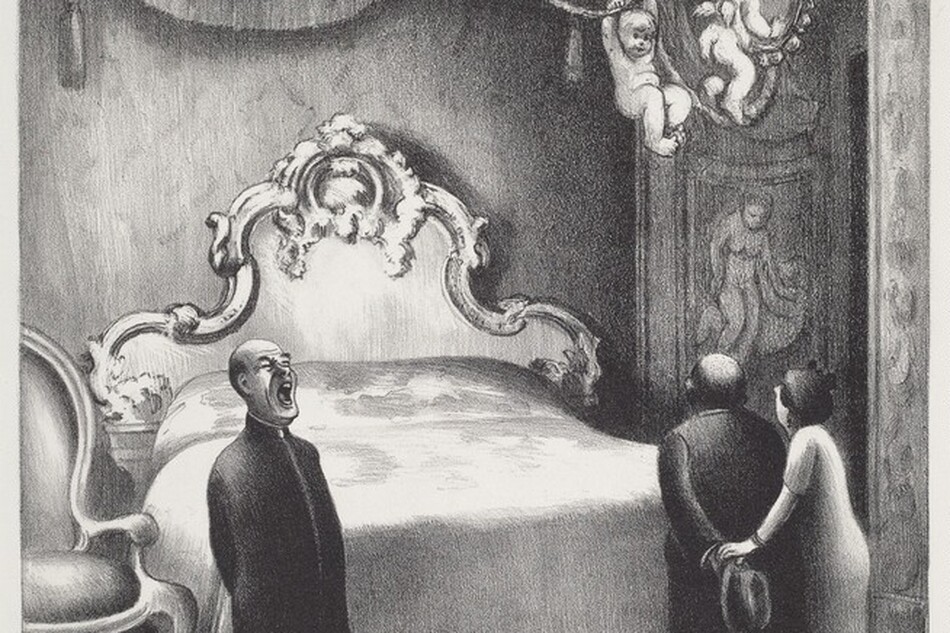
This is a drawing of a bedroom with baby-like figures hanging from the ceiling. The room features a grand bed with an intricately carved headboard. Above the bed, multiple cherubic figures swing and frolic from the drapery and ceiling ornaments, creating a whimsical atmosphere. The room's decor is lavish, with classical elements such as a decorative panel featuring a figure in relief. The image conveys a sense of humor and fantasy with its contrasts between the formal setting of the room and the lively antics of the cherubs above.

Comics

Did you know that we have comics in our collection? Discover artists who have both been inspired by, and created, these graphic stories.