Article

The Stories Behind 10 New Additions to Our Collection

5 min read

Dig into the stories behind 10 recent additions to our permanent collection. All were made between 1964 and 2021 by artists from the United States, Austria, Kenya, Brazil, Colombia, and Japan. Learn more about the artists, their inspirations, and their processes.

1. Freddy Rodríguez, Paradise for a Tourist Brochure (1990)
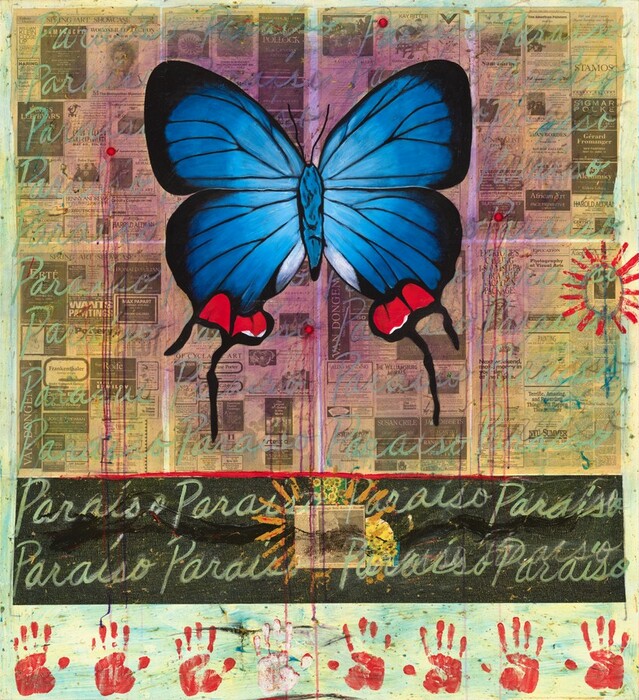
The painted collage shows a large blue butterfly set against a background of layered text and newspaper clippings. The butterfly's vibrant blue wings are crossed with thin black lines, and the bottom of the wings are red, as if they have been dipped in red paint. Below the newspaper is a strip of black paint with a cut-out image in the center that may display a landscape, surrounded by painted yellow lines like the rays of the sun. Across the newsprint and the black strip, the word 'Paraiso' has been written repeatedly in light blue. Below the black strip at the bottom of the page is a strip of light blue with eight handprints across it in a horizontal line. Seven of the handprints are bright red, while the one to the left of center is white. Additionally, there are small, round areas of dripping red paint on the newsprint around the butterfly, evoking bleeding bullet holes.
Freddy Rodríguez, Paradise for a Tourist Brochure, 1990, acrylic, sawdust, and newspaper collage on canvas, Gift of Funds from The Ahmanson Foundation, and Patrons' Permanent Fund, 2022.45.1

Dominican American artist Freddy Rodríguez’s Paradise for a Tourist Brochure is part of a series critiquing Dominican dictator Rafael Trujillo. Red bullet holes and handprints refer to the dictatorship’s violence and abuse. In contrast, the word paraíso (paradise) repeats across the canvas. At the center is a blue butterfly. For Rodríguez, butterflies symbolized silent witnesses to the atrocities of life in the Americas since colonization.

Rodríguez often worked with collage. This painting includes pages from the arts section of the New York Times, perhaps comparing the power of the dictator to the power of the art world as it determines which artists are remembered and valued.

2. Kiki Kogelnik, Night (1964)
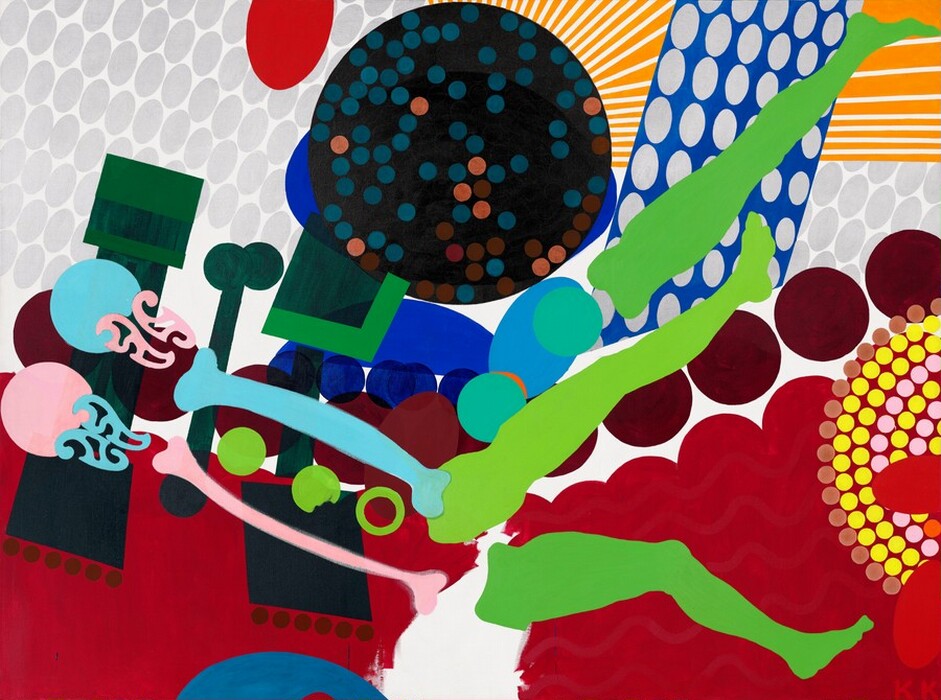
This painting showcases an array of dynamic shapes and lines overlapping with one another like a collage. There are elongated green leg-shaped forms and long bones in light pink and blue attached to circles, alongside other colorful, abstract elements. In the upper center of the painting there is a black circle filled with blue and rust-colored dots, with red and yellow spots forming a circular pattern on the right side. Much of the background of the bottom half of the painting is colored in a bold, bright red, while the top features a gray oval pattern on a white background. Other shapes are in bright shades of orange, blue, green, black, and yellow, forming overlapping squares, circles, and lines.
Kiki Kogelnik, Night, 1964, oil and acrylic on canvas, Gift of Funds from Howard and Roberta Ahmanson, Kyle and Sharon Krause, Meredith and Brother Rutter, Katherine and Peter Kend, the Frederick & Diana Prince Foundation, and the Collectors Committee, 2022.76.1

Living in the era of the Space Race, Austrian artist Kiki Kogelnik was fascinated by the possibilities and uncertainties of technology. Her painting Night shows two cyborg-like figures floating in a dizzying mix of colors and patterns. The red tones on the bottom are believed to represent earth, while the yellow rays and white cloud-like shapes in the upper half may represent the sky.

Kogelnik was part of a group of artists in New York City that drew their content from popular culture, along with Roy Lichtenstein, Marisol, Claes Oldenburg, and Andy Warhol.

3. Dindga McCannon, Woman #1 (1975–1977)
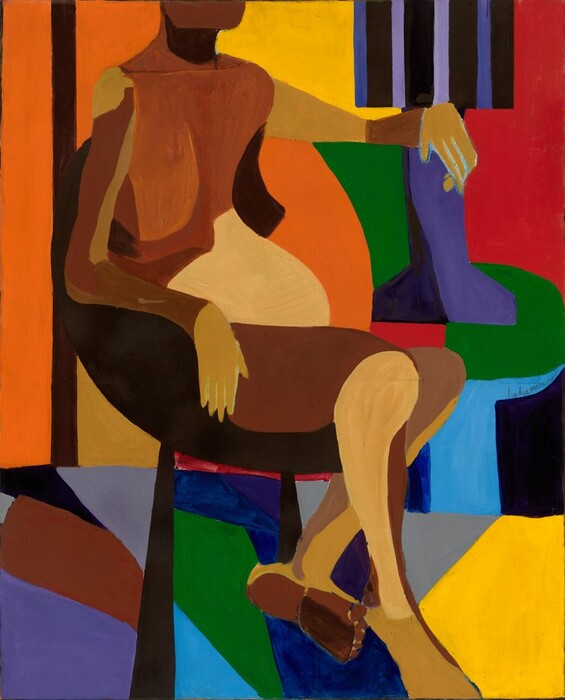
This painting shows a composition of colorful geometric shapes and bold lines creating the abstract form of a seated person. The painting is made up of broad, flat areas of color, with different tones of brown and tan for the person’s skin and a variety of vivid colors like orange, green, red, and blue in the background. The skin-toned shapes give the impression of a person lounging on a chair, turned to the right, with their legs crossed and one arm resting on the back of the chair. Their chin and neck are visible, but the rest of their face is not. They don't appear to wear any clothing or shoes.
Dindga McCannon, Woman #1, 1975-1977, acrylic on canvas, Gift of Funds from Agnes Gund, 2022.125.1

American multimedia artist Dindga McCannon centers Black women in what she calls “imaginative portraiture.” She uses photographs of real people and historical figures like actor Hattie McDaniel and singer Bessie Smith as inspiration for her vibrant works.

In Woman #1, McCannon painted a pregnant Black woman nude against a patchwork of blocks of a rainbow of colors. A barred window in the background may hint at the challenges Black women artists face as they worked while raising children. McCannon, along with artists Kay Brown and Faith Ringgold, cofounded Where We At (Black Women Artists, Inc.). The collective organized what is considered the first exhibition of professional Black women artists in 1971.

4. Mwangi Hutter, Ours To Hold And Caress And Cherish (2017)
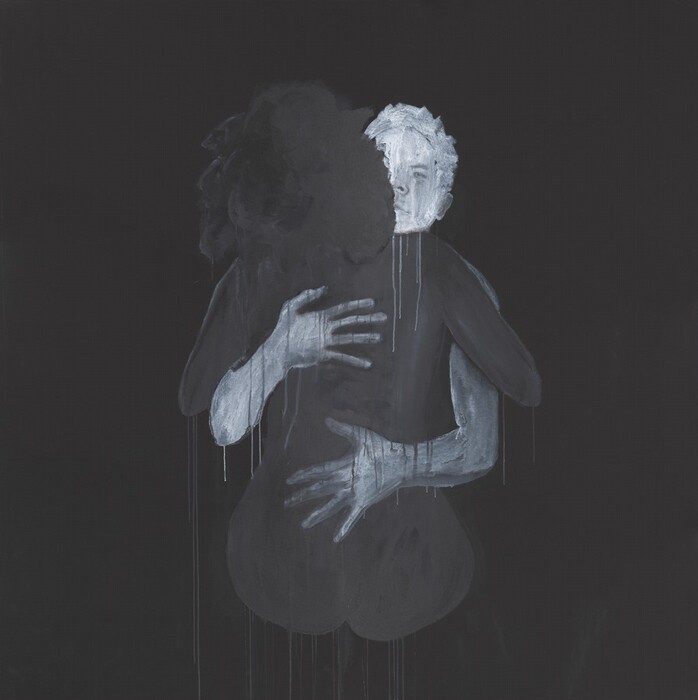
This painting depicts two individuals hugging each other against a solid black background. One of the people has their back to us, while the other's face and arms are partially visible. The person facing away from us appears to be nude, and they have long hair that appears to be styled in a loose afro. Their skin and hair have been painted in shades of dark gray only slightly lighter than the black background, and their legs have not been included. The other person has short hair, and we can see half of their face, which seems to be in a neutral expression. We can also see their forearms and hands, which are wrapped around the other figure in a tight embrace. This person has been painted in bright white and shades of light gray. The paint on both figures is streaky, creating areas of uneven color. It also runs down the painting, creating drips that overlap with one another.
Mwangi Hutter, Ours To Hold And Caress And Cherish, 2017, acrylic and diluted chalk on canvas, Gift of Tony Podesta Collection, Washington, DC, 2020.116.2

Mwangi Hutter is one artist . . . but two people. They are the fused artistic identity of a couple: Ingrid Mwangi, who was born in Kenya, and Robert Hutter, who was born in Germany. Mwangi Hutter’s works explore identity, race, and relationships.

Ours To Hold And Caress And Cherish is part of an intimate series that depicts an interracial couple. Mwangi Hutter made the painting with diluted chalk and acrylic paint, which drip down the canvas. Are the figures melting together?

5. Rozeal, SONG OF SOLOMON 5:16 – BE BEEWORLD: BE B BOY B GIRL (after “Emperor Xuanzong and Yang Gueifei playing the same flute,” by Utamaro Kitagawa) (2014-2016)
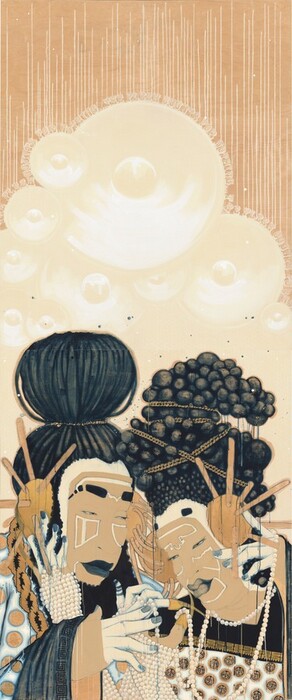
This is a painting of two abstract people surrounded by bubble-like shapes. The people are at the bottom of the tall painting, and both have large, elaborate hairstyles adorned with gold chains. Their faces are painted with geometric patterns in cream and tan, and they have stylized features including dark, segmented eyebrows, barely visible noses, and dark lips. They are draped with strands of pearls that they hold in their hands, and they have round discs by their ears that emit brown rays. Above them, numerous cream-colored bubbles float, and above those are cream drips of paint on a tan background. Words are written in cream above the bubbles. The colors in the painting are earthy tones like beige, black, and gold.
Rozeal. (formerly known as iona rozeal brown), SONG OF SOLOMON 5:16 – BE BEEWORLD: BE B BOY B GIRL (after “Emperor Xuanzong and Yang Gueifei playing the same flute,” by Kitagawa Utamaro), 2014-2016, mixed media on wood, Gift of Giorgio Furioso and William A. Clark Fund, 2021.19.1

DC-based artist Rozeal blends inspiration from Japanese art with elements of African American culture.

This work references a Japanese Edo-era print by Kitagawa Utamaro. Rozeal also references hip-hop through dreadlocks, coiled hair, Cuban-link chains, and conjoined headphones. And the title alludes to breaking, a popular hip-hop dance style. The discs in the background echo music speakers—Rozeal is also a DJ.

6. Winfred Rembert, G.S.P. Reidsville (2013)
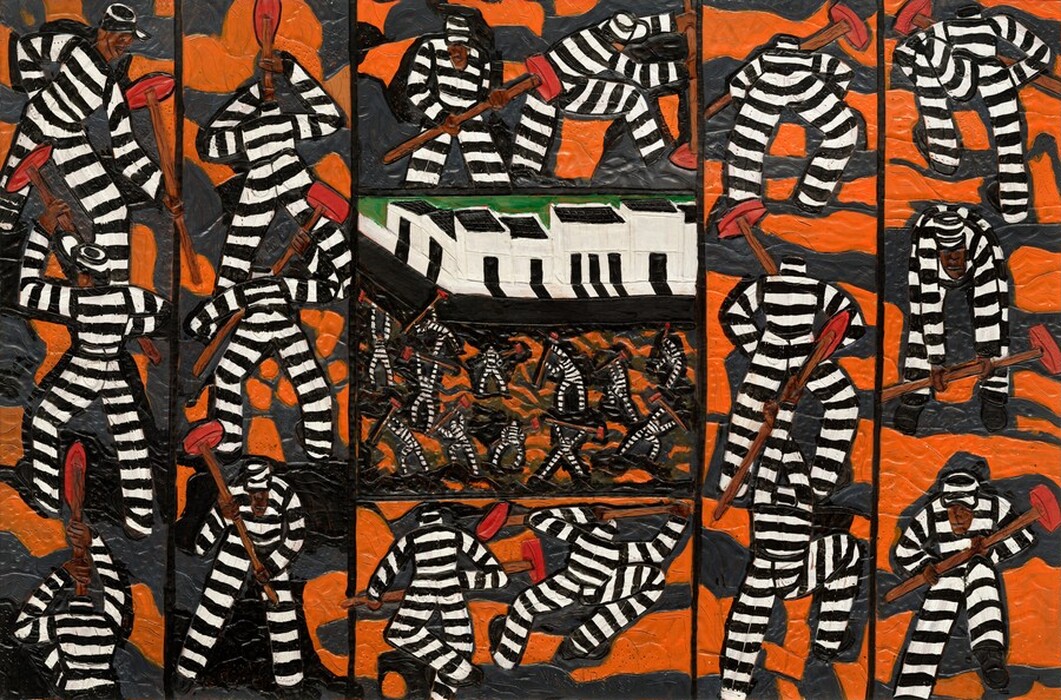
The image displays an array of diagonal and vertical lines forming striped figures in various active poses against an orange and dark background with swirling patterns. The figures resemble prisoners in black and white stripes holding large red axes, engaged in laborious tasks reminiscent of a chain gang. A white building with a green roof is located at the center of the scene, adding to the structured chaos of the composition.
Winfred Rembert, G.S.P. Reidsville, 2013, dye on carved and tooled leather, Gift of Funds from Glenstone Foundation, 2022.37.1

Winfred Rembert grew up in the American South during the Jim Crow era. He survived a near-lynching and seven years of incarceration. After his release, Rembert began making art on leather using techniques he learned from a fellow prisoner.

G. S. P. Reidsville shows the artist’s experience with a work gang at the Georgia State Prison (G.S.P.). Using cut, tooled, and dyed leather, Rembert depicts Black figures in striped prison uniforms using sledgehammers to work black and orange soil.

7. Sonia Gomes, Correnteza, from Raizes series (2018)
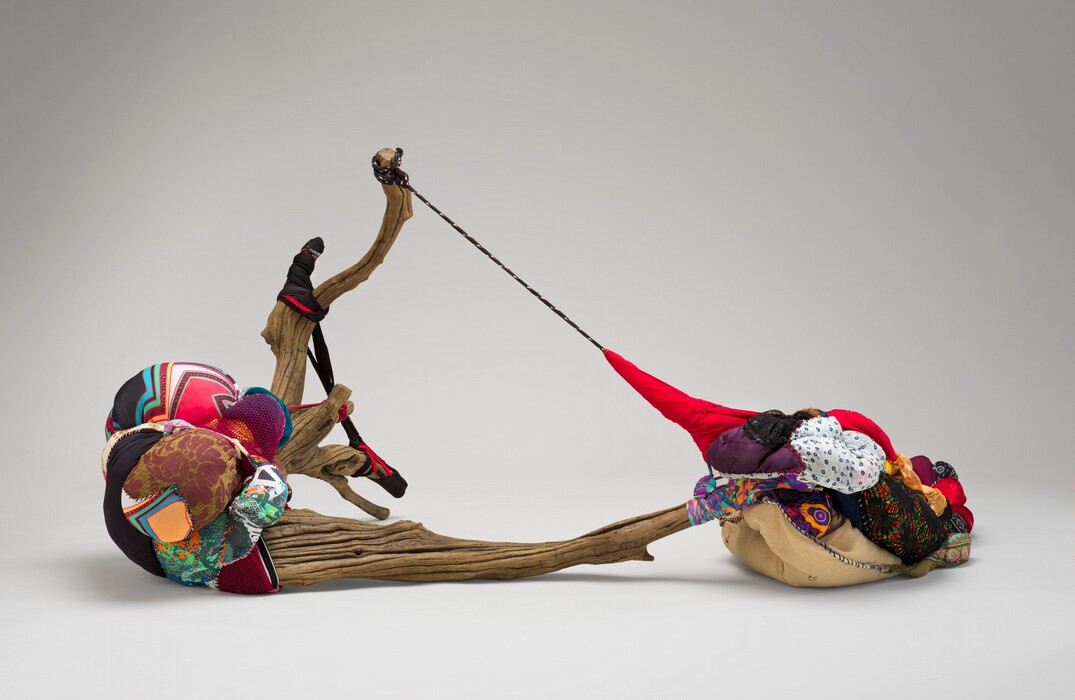
Sonia Gomes, Correnteza, from Raizes series, 2018, stitching, bindings, fabric, and lace on wood, Gift of the Collectors Committee, 2022.43.1

Brazilian artist Sonia Gomes makes organic sculptures out of found textiles and everyday materials.

Her sculptures reflect Afro-Brazilian cultural and spiritual traditions. The bundles of fabric and wood recall sacred objects that Gomes saw her grandmother, who was a shaman, use in rituals. The sculptures also blend Gomes’s memories with the experiences of people she knows—she gets most of the fabric she uses as gifts from friends.

8. Lee Ufan, Dialogue (2011)
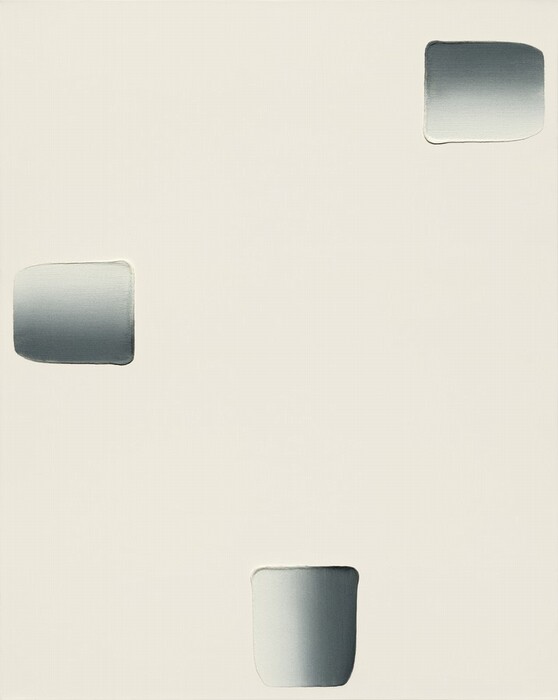
This painting features three small, rounded squares of paint against a blank canvas background. The paint in the squares is a gradient from dark gray to white; in two of the squares, the gradient is horizontal, while in the third it is vertical. The paint squares are all arranged around the edge of the canvas, with one in the top right corner, one in the center of the bottom edge, and one halfway up the left side.
Lee Ufan, Dialogue, 2011, oil on canvas, Patrons' Permanent Fund and Gift of Milly and Arnie Glimcher, 2022.83.1

South Korean–born Lee Ufan is a painter, sculptor, theorist, and founder of the Japanese art movement Mono-ha (School of Things). Formed in the 1960s, the group rejected Western ideas of representation and instead emphasized materials, process, and perception. Their minimal works feature raw materials that have barely been changed.

Lee is known for unconventional processes. He made Dialogue by holding his breath as he swiped a wide hake (goat’s hair) brush across the canvas. The result is three ombré grey brushstrokes.

9. María Berrío, A Sunburst Restrained (2019)
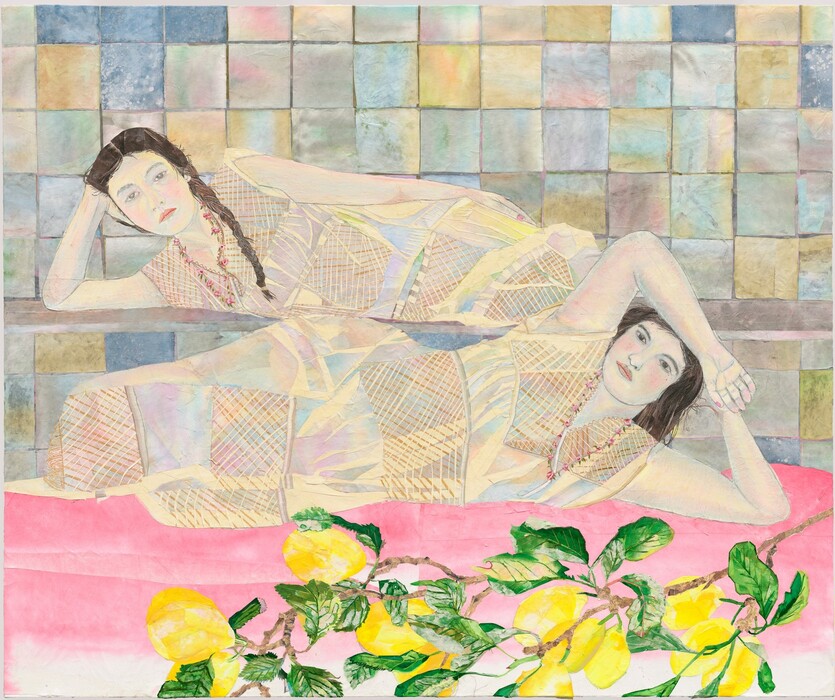
In this painting, two women are lying down on a tiered surface in front of a collaged wall. The woman on the top has pale skin and long dark hair in a braid, and she rests her head on her hand. Her head is to the left, while the rest of her body is to the right. Her legs and feet aren't visible. The other woman is a step below her, laying on a bright pink surface, and she has light skin and loose dark hair. She also rests her head on her hand, but her other hand is also bent and raised upward, her forearm resting on her forehead. Her head is to the right, and the rest of the body is to the left; her legs and feet are also not visible. Both women wear patterned dresses in shades of cream, light blue, light purple, and pale pink, with necklaces of small pink flowers. The background is a grid of different squares of paper that have all been painted with different pastel-colored gradients. The colors include golden yellow, light blue, dark blue, white, light pink, and light gray. At the bottom of the painting, in front of the pink floor, is a thin branch with green leaves and yellow lemons.
María Berrío, A Sunburst Restrained, 2019, collage with Japanese paper and watercolor on canvas, Gift of Erika and John Toussaint, 2020.2.1

Colombian-born and New York–based artist María Berrío made this large and glowing collage using Japanese papers painted with watercolor.

Chilean poet Pablo Neruda’s “Ode to a Lemon” inspired Berrío. The poem links the greatness of light to the modest but life-affirming form of a lemon: “a ray of light that was made fruit/ the minute fire of a planet.”

10. Steve Locke, Homage to the Auction Block #65, overlook (2020)
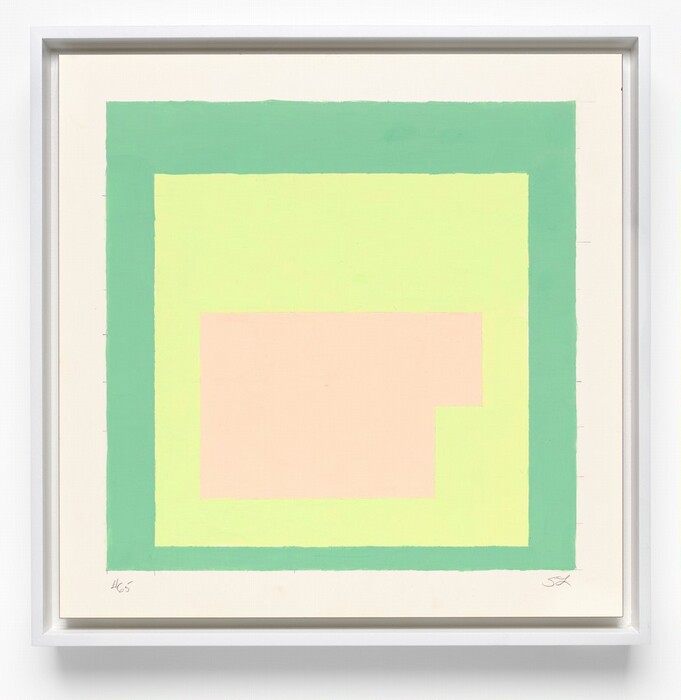
Steve Locke, Homage to the Auction Block #65, overlook, 2020, acrylic gouache on panel, Gift of Funds from Kate Haw and Elizabeth Tinsman, 2022.117.2

American artist Steve Locke references artist and educator Josef Albers’s Homage to the Square. In that series, Albers investigated the perception of color. His concept of color theory is fundamental to modern art.

Locke replaces the shape of the square with the form of an auction block, commenting on the role of slavery in shaping the cultural and economic prosperity of the United States. His Homage to the Auction Block reframes modernism around the history that made it possible.

You may also like

Artist Hannah Chalew in her New Orleans studio

Article:  What Is an Artist’s Role in Preserving Louisiana’s Coastline?

New Orleans artist Hannah Chalew explores how her own work and practice can contribute to a sustainable future.

Article:  Photographing American Mining and Energy

Photographers have been documenting mining and energy extraction for nearly 200 years, revealing industrial activities often hidden from view.